What ID for Voter ID? 

Jason Lowther

Photo credit: Liz West, https://www.flickr.com/photos/calliope/

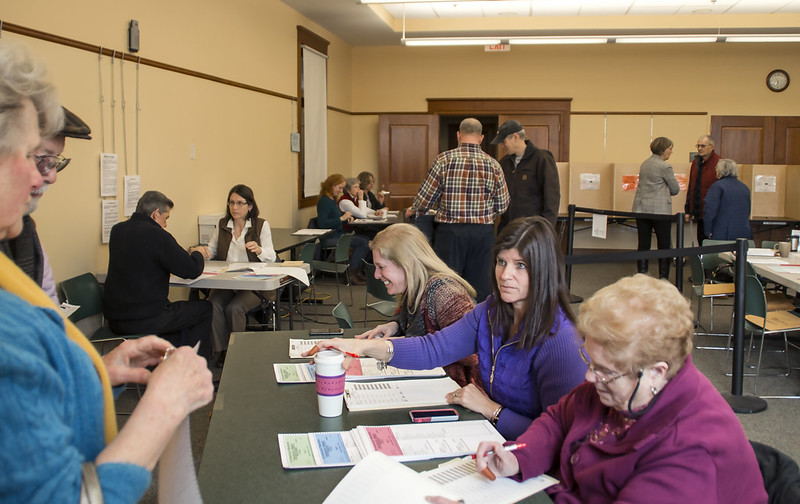
Last October, I wrote in this blog about the many positive aspects of the Elections Bill currently working its way through parliament.  It clarifies what “undue influence” on voters means, improves poll accessibility, reduces the risk of intimidation of candidates and requires all paid for digital political material to have an imprint.  The big problem, though, is the plan to require voters to present certain restricted types of identification in order to vote.  This month the House of Lords voted to mitigate this problem.

As part of the “Report Stage” of the bill, on 6th April the Lords agreed an amendment which radically expands the range of identification documentation which voters could use.  The new list is fairly extensive including an adoption certificate, bank or building society statement, P45 form, asylum seeker letter from the Home Office, and even a library card or National Railcard. 

In the debate, Cross-bencher Lord Woolley of Woodford claimed that the government had failed to make a convincing case on voter fraud – quoting one conviction from 47 million voters, which he likened to the chance of winning the national lottery jackpot.   He said that the cost of insisting on photographic ID could be to disenfranchise 2 million voters.

For the Greens, Baroness Jones of Moulsecoomb labelled the policy ‘a cynical ploy’. She went on to claim: “It is a clear attempt by the Government to make it harder for people to vote in elections. That is the only motive I can see when we have this sort of Bill in front of us. More cynically still, it will disproportionately stop BAME, working-class, Gypsy, Roma and Traveller people voting. These people find it hard enough to vote already. Anything you put in their way will stop them voting completely; that is preventing democracy’.

One of the amendment’s sponsors, Conservative former cabinet minister Lord Willetts, said that there was little concern with voter personation in the mainland and raised the concern that a future government elected with a small majority could face questions if significant numbers of voters had been unable to vote due to the new requirements.  He concluded that the amendment was ‘protecting our system from a major political and constitutional risk while remaining consistent with the manifesto on which the Conservative Party fought the last election’.

The vote on ‘Amendment 8’ in the Lords was 199 to 170, with three Conservative peers in favour and 155 against.  The House of Lords has its final sitting on the Report Stage on Monday (25th April), after which it will complete the Third Reading before the bill returns to the Commons for its consideration of the amendments.  The Government is known to be concerned at the inclusion of ID which does not have a photo, so the amendment is likely to be further challenged.

UPDATE (30/4/22): As anticipated, the Government rejected Amendment 8 in the Commons as the Government’s view was the types of ID listed were not sufficiently secure and might be prone to fraud. More detail is available in the excellent summary by Elise Uberoi and Neil Johnston for the House of Commons Library here.

Jason Lowther is Director of the Institute for Local Government Studies (writing in a personal capacity).

We’re recruiting

As the first step in further strengthening our brilliant team, this week we started advertising for a new education-focussed Assistant Professor (£42-50k). Soon we’ll be advertising for research and teaching academics at various grades – Assistant Professors, Associate Professors and full Professors – watch this space!

The Institute of Local Government Studies (INLOGOV) is the leading UK centre for the study of public service management, policy and governance. With over 50 years of experience working within local government and the public sector, INLOGOV creates the new thinking with public servants.  INLOGOV sits in the School of Government, which is one of the largest in the United Kingdom – home to more than 80 full-time academic staff, more than 1,200 undergraduate and taught postgraduate students, and more than 70 doctoral researchers. The School is intellectually vibrant with an excellent record in both research and teaching.


INLOGOV offers a range of postgraduate degree programmes, at Masters, diploma and certificate levels, with a thriving doctoral research community.  Our taught postgraduate programmes include a full-time on-campus Public Management MSc, an on-line Masters of Public Administration, a blended Degree Apprenticeship in Public Leadership and Management, and study opportunities for research degrees (MPhil or PhD).    


INLOGOV’s teaching is informed by a robust and innovative research agenda.  Building on our rich history of research addressing the institutional and political life of local government and public management, our research now reaches beyond these traditional structures and actors to address governance, democracy, leadership, participation, policy-making and service delivery at and across multiple scales and issues.
The successful post holder will be enthusiastic about teaching and able to teach students from new graduates to experienced professionals in areas such as public management and service delivery, policy making and implementation, participation and democracy, governance and devolution, or public sector economics and finance.  The post holder will teach on campus and online.  A range of CPD opportunities will be available.  

Role Summary

You will contribute to a range of education-related activities.  In addition, you will be expected to demonstrate academic citizenship, developing and maintaining mutually respectful and supportive working relationships with all staff and students, and ensuring the way you carry out your role impacts positively on how others carry out theirs. 

Teaching is likely to include a substantial contribution to: (a) the management, development and delivery of teaching and assessment at all levels; and (b) enhancement of the student experience and employability.  The role will also involve developing and advising others, including: (a) providing expert advice to staff and students, and (b) developing and advising others on learning and teaching tasks and methods. 

You will be expected to advance teaching and learning practice in your modules within the school, take a role in leading curriculum development, and play an important role in student academic and pastoral support.  You will deliver excellent teaching that inspires students and is informed by discipline-based research. 

Management and administration is likely to include developing and making substantial contributions to knowledge transfer, enterprise, business engagement, public engagement widening participation, or similar activities at Department/School level or further within the University.
 

Person Specification

⦁    Normally, a higher Degree relevant to the discipline area (usually PhD), or equivalent qualifications.
⦁    Extensive teaching experience and scholarship within subject specialism.
⦁    Proven ability to devise, advise on and manage learning.
⦁    Skills in managing, motivating & mentoring others.

Teaching
⦁    Ability to design, deliver, assess and revise teaching programmes. 
⦁    Extensive experience and demonstrated success in developing appropriate approaches to learning and teaching and advising colleagues. 

Management Administration
⦁    Ability to contribute to School/Departmental management processes.
⦁    Ability to assess and organise resources effectively.
⦁    Understanding of and ability to contribute to broader management/administration processes.
⦁    Experience of championing Equality, Diversity and Inclusion in own work area.
⦁    Ability to monitor and evaluate the extent to which equality and diversity legislation, policies, procedures are applied. 
⦁    Ability to identify issues with the potential to impact on protected groups and take appropriate action.


Desirable areas of teaching experience 
Experience of teaching in one or more of the following areas:
⦁    Public management and service delivery
⦁    Policy making and implementation
⦁    Participation and democracy
⦁    Governance and devolution
⦁    Public sector economics and finance
 

For full details and to apply please see: https://bham.taleo.net/careersection/external/jobdetail.ftl?job=220000E2&tz=GMT%2B01%3A00&tzname=Europe%2FLondon

For an informal discussion of the role, please contact Dr Karin Bottom, Head of Education ([email protected]) or Jason Lowther, Head of Department ([email protected]).

Women in (West Midlands) Governance: A patchy metamorphosis

Chris Game

Yes, I did blog really rather recently on the topic of ‘Women in local and national governance’; and yes, I did conclude it by pledging to “retire gracefully from this particular field of research”.

But that was before I found myself fruitlessly upending my flat for anything conceivably useful to the Ukrainian refugees for whom one of my ward councillors was commendably collecting. Finding virtually nothing I could honourably offer, it was cash to the Disasters Emergency Committee, who assured me the UK Government would double my donation.

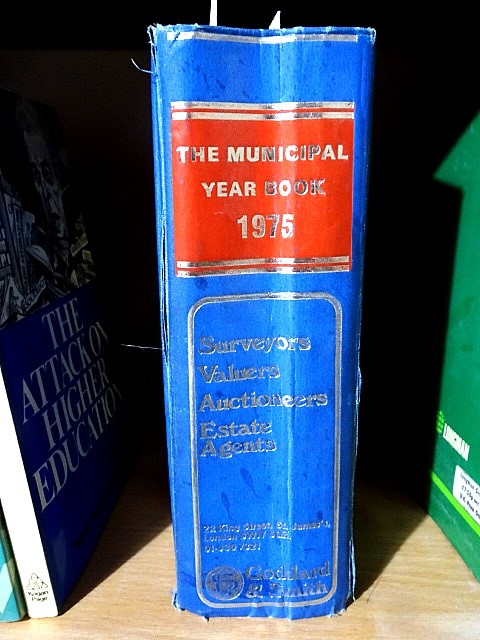
However, among the dust-covered treasures I’d totally forgotten, and spared the Ukrainians, was my 1975 Municipal Year Book (MYB) – a hefty, royal blue tome of 1,400-plus extremely closely printed pages, taking up over three inches of shelving.
myb

In pre-computer decades, when I joined INLOGOV, it was the proverbial local government bible – the 1975 MYB listing all 564 of the UK’s so-called principal local authorities plus, individually, their 26,467 councillors and further thousands of principal officers.

Several years later a thoughtful colleague, Ray Puffitt, bequeathed me his signed personal copy, possibly in exchange for my not pressing him to lecture to my undergraduate students.

Thoughtful because 1974/75 was, of course, the year of large-scale local government restructuring – or, in MYB-ese, ‘re-organization’. There were now far fewer councils and councillors, but these were the ‘new’ and therefore more relevant ones – which explains how I acquired my edition, though obviously not why it wasn’t binned decades ago.

Anyway, having discovered this 1975 stash of raw research data, I thought I’d share with you (and Birmingham Post readers) how much statistically women’s presence and visibility in our West Midlands local governments have changed in the past nearly half-century.

My earlier blog concluded by noting how Paulette Hamilton’s recent by-election victory for Labour in the Birmingham Erdington by-election had taken the proportion of women MPs over 35% for the first time. Moreover, that she and the six other women by-election winners since 2019 had – another first – made the Commons more gender-representative than our elected local governments, whose UK-wide proportion of women councillors has seemingly become stuck in the low 34%s.

Internationally, both percentages would get us, just, into the top quarter of the respective rankings. In educational lingo, though, it would be a “disappointing, could surely do better”.

If the Parliaments of Cuba, Mexico, New Zealand, Iceland and all Scandinavia can have more than 45% of elected women, why can’t we – or, more precisely, why doesn’t our huge Conservative Party majority comprise even a quarter? Similarly, if local government in countries as diverse as Bolivia, Tunisia, Iceland, Uganda, Namibia and Mexico can attract at least 45% of women elected members, why can we barely manage one in three?

At least, though, the picture has changed, or improved, hugely in the past half-century, which is what the rest of this blog is about – focusing on the metropolitan West Midlands.

I hadn’t moved to Birmingham in 1974/75, but I reckon that even without research I could probably have named the incumbent West Midlands’ women MPs – because, though few, they were all exceptional and established national reputations.

One, indeed, would have me as an Edgbaston constituent for the latter part of her elective parliamentary career: Jill (later Dame Jill) Knight, MP from 1966 to 1997.

The other three were all Labour: in West Bromwich another Dame-in-Waiting, Betty Boothroyd (1973-2000), latterly Speaker of the Commons. In Coventry West was Audrey Wise, and in Wolverhampton NE Renée Short. A formidable quartet.

Their successors are, necessarily, impressive too, and the reason I couldn’t immediately name them all is not just my ageing memory, but that there’s a full dozen of them. Eight Labour – including all three of Coventry’s – and four Conservatives out of West Midlands’ 28, or 43%.

Yardley’s Jess Phillips is, I’m guessing, probably best known, and she is one of just two of Labour’s eight who aren’t from minority ethnic backgrounds. Overall, another massive change from the mid-70s.

What about councillors?  Would the MYB’s council listings actually identify women members, and, if so, how?  Fortunately, they all risked the accusations of chauvinism and did – though in differing ways.

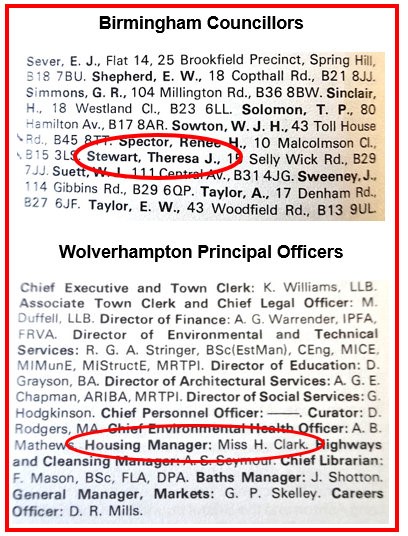
Birmingham, for example, gave first names – of all women members, while initialising the men. Then, as now, it was a Labour-dominated Council, 21 (17%) of whose 126 Members were women, including two Fredas, two Marys, and an exotic-sounding Carmen from Coleshill Road, B16. Oh yes, and a future Leader of the Council, Birmingham Lord Mayor, and wife of a Professor John Stewart.
bcccllrs

The other councils preferred marital status: almost always Mrs, with the very occasional Miss. Across the seven West Midlands councils Labour members outnumbered Conservatives by two to one, which was broadly reflected in women’s representation, with comfortably Tory Solihull managing just one woman out of 51 members.

However, the gender blend on Labour-run Coventry and Walsall Councils wasn’t that much better – four women on councils of well over 50, and one can only imagine how, on occasion, they must have been treated.

And no point whatever seeking empathy from senior women officers – because quite simply there weren’t any. Sorry, not strictly true. Of the 101 listed Principal Officers in the seven WM Councils, Miss H Clark, Wolverhampton’s Housing Manager, was the sole woman.

It’s here that the culture has changed most dramatically. Today, try counting the number of women in the senior managements of the seven West Midlands metropolitan councils, and the very first name you’d encounter would be Birmingham City Council Chief Executive: Deborah Cadman OBE – heading a 13-strong team of service Directors, including four more women.

Remarkably, though, that 38% female senior management puts Birmingham at the foot of this particular league table, which is headed by Dudley and Solihull with 75% and 67% women senior managers respectively, followed by Walsall with 57%, headed by CE Dr Helen Paterson. In this sphere of local government at least, there has indeed been a metamorphosis.
Photo

Chris Game is an INLOGOV Associate, and Visiting Professor at Kwansei Gakuin University, Osaka, Japan.  He is joint-author (with Professor David Wilson) of the successive editions of Local Government in the United Kingdom, and a regular columnist for The Birmingham Post.

_________

A version of this blog – ‘Equality progress – but room for improvement’ – was published by the Birmingham Post, March 24th, 2022 https://www.pressreader.com/uk/birmingham-post/20220324/textview