Local Government’s Big Night

Jason Lowther

On Thursday, over 17,000 candidates will be asking their fellow citizens to elect them to around 5,000 roles as their representatives.  Although there have been serious concerns about the wisdom of running elections in the middle of a pandemic, as we explored in this blog in January, it looks like local government has again risen to the challenge and will deliver elections as required.  It looks like a big night for local government, with some important trends that might affect politics nationally in coming years.  Will Northern voters return to Labour?  Will England’s Combined Authorities see a shift in power?  How will voters react to alternative voting systems?  What will be the impact of greater postal voting?  And will we see more influence from smaller parties?

Will the Red Wall start to repair or crumble further?  Labour is defending seven councils where the 2019 general election suggests a swing of over 6% to the Conservatives, according to analysis by the GuardianResearch by Lord Robert Hayward (Con) suggests that the Conservatives are fielding many more candidates in Northern areas than in the last local elections in 2017: at least doubling their candidates in Doncaster and Rotherham and fielding more than 40% extra candidates in Durham. 

Combined Authorities could see some significant shifts in power.  Whilst Labour has a strong majority in Greater Manchester and Liverpool City Region, other CA contests look much closer.  Tees Valley CA has a straight two-way fight between red and blue, with Conservatives defending a 2.3% majority. But the closest fight is probably in the West Midlands, where Conservative Andy Street had less than a 1% majority last time. 

A range of voting systems are operating.  In England, Combined Authority (Metro) Mayors and Police and Crime Commissioners are being elected on the ‘supplementary vote’ system rather than the traditional First Past The Post (FPTP) system used for MPs.  With the ‘single transferable vote’ system in Scottish Councils and NI, and the ‘additional member system’ in London and (all adults aged over 16) in the Scottish and Welsh Parliaments, there must be a question mark on how long MPs can hold out against a more democratic electoral system for Westminster.

As required by the Combined Authority (Mayoral Elections) Order 2017, in CA areas each registered voter has received a package of information on the election process and each of the candidates.  I was interested to read the West Midlands CA booklet, which provided a clear explanation of the ‘supplementary vote’ system used in these elections.  It also included two-page statements from each of the candidates which I felt was a huge improvement on the usual random arrival of leaflets through the letterbox.  In a very Covid-Era vignette, the order in which the candidates appeared in the booklet was decided after the close of nominations by the Council’s Monitoring Officer drawing lots, witnessed by the Electoral Commission on a Teams Call, with the video of the call then provided to the candidates. 

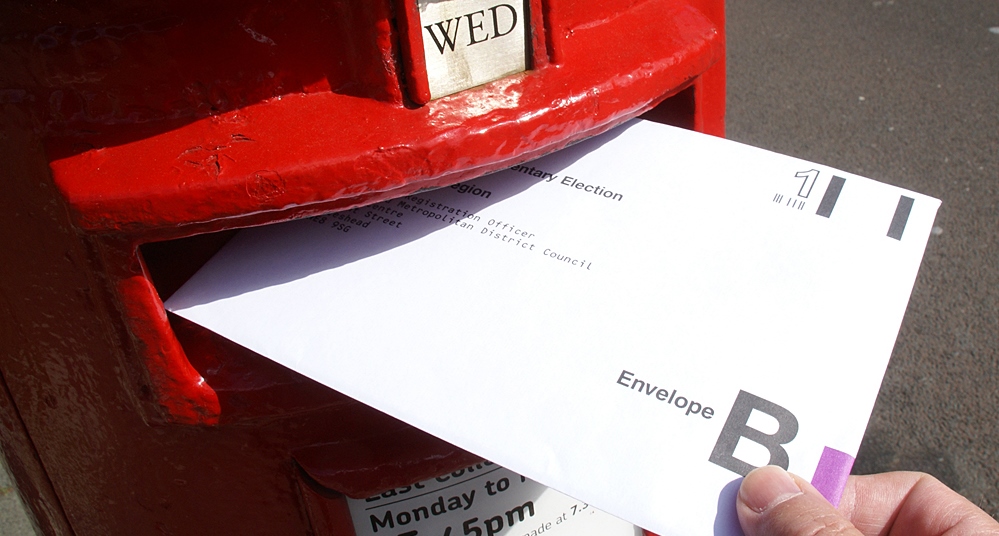
Postal votes may be particularly important in these elections, with around 90,000 people requesting their postal vote on the deadline day itself.  In some areas most votes might be cast in this way before election day, fortunately for the Conservatives ahead of the current ‘cash for curtains‘ controversy.  It will be interesting to see whether this new method becomes the ‘new normal’ for many voters, replacing their usual stroll to the ballot box in the Great British weather.

We are seeing a rise in smaller parties.  Beyond the big four parties, six smaller parties are fielding 60 or more candidates at these elections: Reform UK, the Trade Unionist and Socialist Coalition, the UK Independence Party, the Freedom Alliance, the Social Democratic Party and The For Britain Movement.  Research by Democracy Club, based on Statements of Persons Nominated published by English councils on 8-9 April 2021, shows these six parties contesting at least 1% of available seats.  As Colin Copus demonstrated, smaller parties not only provide voters with electoral choice, they can also influence the agenda of larger parties and can shift boundaries in political thinking.  Although Westminster MPs continue to hoard power in the big two parties through the FPTP system, across the UK we are seeing a much wider range of political options for voters.

We might not know the results of the May elections for a couple of days given the difficulties in managing counts in the context of the pandemic, but when they come they could be significant not just for local people but also for our future politics nationwide.
Jason Lowther is the Director of INLOGOV. His research focuses on public service reform and the use of “evidence” by public agencies.  Previously he worked for the West Midlands Combined Authority, led Birmingham City Council’s corporate strategy function, worked for the Audit Commission as national value for money lead, for HSBC in credit and risk management, and for the Metropolitan Police as an internal management consultant. He tweets as @jasonlowther

[edited 9.5.21 to delete quoted voting odds post election results]

Big changes to the NHS

Cllr Ketan Sheth

Big changes come into effect this month in the way our local health services are managed. Eight clinical commissioning groups (CCGs), including Brent, have merged into a single North West London CCG. This CCG  will also be working with every hospital, mental health trust, community trust and local authority in North West London as part of an ‘integrated care system’ (ICS).

People often ask if such changes really matter. My sense is that they really do and that they can be both a risk and an opportunity.

NHS doctors and managers tell me that the benefit to patients is that a single organisation and system can drive a consistent approach to high quality services, using data on population health to target improvements and tackle health inequalities. There are huge inequalities across our patch, with outcomes and life expectancy varying widely between the poorest and more affluent areas. We saw this play out tragically during the Covid pandemic, where the least well off, including many people in Brent, were disproportionately affected.

The role of local authorities in the ICS – which is expected to become a statutory body in April 2022 – is also important, as it means we can better join up health and social care services, building them around the needs of our communities by working as a single system.

We also have to recognise the risks. A bigger system across eight London boroughs – North West London will be the biggest CCG and ICS in the country – could easily become far removed from local needs and concerns in each area. We know public input to both health and local council services improve those services. So ensuring a strong resident voice, at both borough and North West London level, is going to be critically important.

So too is local decision-making. I am pleased that the single CCG will have strong borough-based teams – and particularly, that the intention is to create a local ‘integrated care partnership’ (ICP) between all part of the NHS and the council in each borough. While this may sound like lots of new jargon and bureaucracy, it is important. The balance of power between the ICS and the local ICPs will be important: ICPs should be setting the local agenda with their residents while the ICS steers the overall direction of travel for the system.

On balance, the changes feel like the right thing to do – residents often complain that services don’t work together closely enough. But the success of this latest NHS reform will really depend on all of us. If we can ensure that the local systems work and play their part in driving down health inequalities across the whole area, there should  be huge benefits for North West London. If we lose local voice and influence in a sprawling, centralised bureaucracy, we will have failed.

Cllr Ketan Sheth is Chair of the Community and Wellbeing Scrutiny Committee of Brent Council

Stop playing party politics with Mayors and Police Commissioners

Chris Game

A couple of years ago I wrote a blog about choropleth maps and the accuracy, or otherwise, of the UK’s locally compiled electoral registers, in which I indulgently referred to the University of Essex, and particularly its Department of Government’s late Professor Anthony King, thanks chiefly to whom, as a 1960s postgrad student, I first became interested in such abstruse matters.

For me those UoE years were transformative, as no doubt they were for countless successors, including two prominent MPs – former Commons Speaker, John Bercow, and current Home Secretary, Priti Patel – whom The Times somehow mixed up in Professor King’s obituary. Recounting King’s tale of the now well-known ex-student whose thesis had been “so bad I virtually had to rewrite it” … the student was incorrectly identified as Bercow … rather than Patel. Grovelling apologies ensued, and not inconsiderable mirth.

It’s a pleasing story, but I’d have struggled to justify raising it, were we not currently witnessing a further example of Patel’s either inability or refusal to grasp the workings of surely King’s specialist Mastermind subject: electoral systems. The Home Secretary, in reviewing the role of our 41 Police and Crime Commissioners (PCCs), wants to replace from 2024 what she calls the “transferable system”, by which they – plus the Mayor of London and nine Combined Authority Mayors – are elected, with the ‘First-Past-The-Post’ (FPTP) system we use for MPs.

Patel offers several reasons. It is “in line with the government’s (2019) manifesto position in favour of FPTP”, creates “stronger and clearer local accountability”, and “reflects that transferable voting systems (her plural, my emphasis) were rejected by the British people in the 2011 nationwide referendum”.  Plus presumably, though unmentioned, she reckons on balance it would benefit the Conservative Party.

None of her assertions are straightforwardly true; only, strictly speaking, the bit about voters rejecting the 2011 referendum question – by a certainly decisive 68%. But that referendum was about one particular system, the Alternative Vote (AV) – supported ironically by neither party in the Conservative-Lib Dem Coalition and rejected understandably by voters as a contribution to producing the more fairly elected and representative House of Commons that at least many hoped the long awaited referendum would be about. Nothing to do with electing powerful, high profile and individually accountable public officials.

Moreover, if referendums are important, in the 1998 one creating the Greater London Authority, London electors voted by 72% for a Mayor elected by the then novel, but much debated, Supplementary Vote system she wants to abolish for us all with no voter consultation at all.

Her ‘transferable voting systems’ is anyway a potentially misleading term that I doubt Professor King would have used. ‘Preferential’ better describes the several systems allowing voters to express their ordered preferences for a list of candidates.

Best known is probably the highly ‘voter-friendly’ Single Transferable Vote (STV), used in multi-member constituencies, as in Scottish and Northern Irish local elections, where there are two objectives. First, to elect perhaps more representative ‘slates’ of local councillors than our FPTP system produces, and ultimately to elect more community-representative councils (or parliaments) by greatly reducing the numbers of ‘wasted’ votes cast for losing candidates.

Voters rank-order as many candidates as they like. A ’quota’ is set, based on the numbers of seats to be filled and votes cast. Then, once a candidate reaches that quota, proportions of their ‘surplus’ votes are transferred to voters’ second and subsequent choices until all vacancies are filled.

By contrast, PCCs and Mayors, as even the Home Secretary will have noticed, are elected individually. So the relevant ‘preferential system’ here is the Supplementary Vote (SV), using ballot papers with two columns of voting boxes, enabling voters to X both their favouritest candidate and their second favourite.

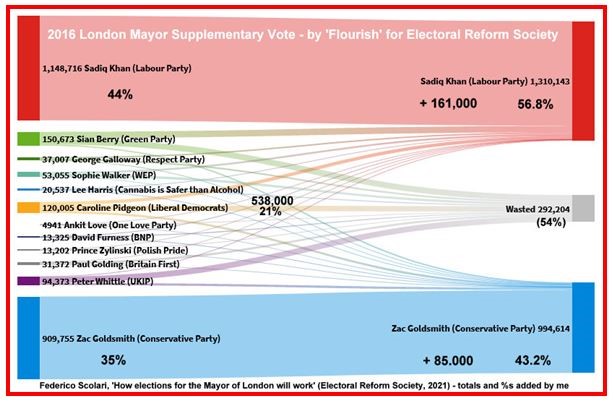
If no candidate gets over half the first-column vote – as in 36 of the 40 contests in the 2016 PCC elections, all five London and roughly two-thirds of all mayoral elections to date – just the top two candidates continue to a run-off, and will probably have campaigned with that eventuality in mind.

If either your first- or second-choice candidate gets through, they get your run-off vote. The important consequence is that the winner – here, every elected and accountable PCC – can claim the legitimacy and authority of having secured a majority electoral mandate.

Under Patel’s preferred FPTP system, 229 of our serving MPs could be accused of having slunk into office on minority vote mandates of regularly under 40%.  Personally, I’d feel slightly diffident, even as a Conservative MP, knowing both I and my party’s Government were elected on way short of majority votes. But for a PCC, daily exercising wide-ranging policing powers, it would be potentially undermining.

In our ‘local’ 2016 West Midlands election, the incumbent Labour PCC David Jamieson, seeking re-election, managed ‘only’ 49.88% of first-preference votes – fifth highest out of 40 English and Welsh contests, incidentally. But in the necessary second-round run-off against the Conservative, Les Jones, that was raised to a significantly weightier 63.4%.

The difference, and demonstrable majority electoral mandate, would be handy for an MP – but of genuine weight and almost daily importance for Police and Crime Commissioners, more than half of whom received under 40% of first-round votes.

Or, indeed, for elected mayors. I can’t but think West Midlands Conservative Mayor Andy Street feels considerably more comfortable being able to claim a 50.4% run-off victory over Labour’s Siôn Simon in 2017, as opposed to the 41.9% that would have given him a FPTP victory.

Time now, with a final paragraph already typed, for a very belated declaration of interest – personal and academic interest, that is – in an electoral system effectively invented, developed and, I’d argue, deployed effectively during my university teaching lifetime. I knew, at least distantly, both possible claimants to the SV’s invention, and, while I’m well aware of its limitations, I do believe it was and, after 20 years’ usage, is the best system realistically available for the election of mayors and PCCs.

If you’re interested in more, try the excellent evaluative paper written at about the halfway point in that history – and so before the invention of PCCs – by Colin Rallings and colleagues.  Pluses include a neat summary list of SV plus points (p.4), and some colourful and interesting bar charts.

But nothing to rival the Electoral Reform Society’s recent effort: a creation of interactive beauty (the real thing, not my reproduction, obviously!), produced especially for this year’s elections, and showing for instance, as you’d possibly hypothesise, that first-choice Britain First and One Love Party voters split their second-choice votes proportionately really rather differently.

Election of London Mayor

To conclude: my hope is that at least Patel’s intervention will prompt a few interesting campaign questions – I was going to type ‘hustings’, but I’m not sure we’re allowed those this time – for Conservative PCC and mayoral candidates. The 20 successful Conservative PCC candidates in 2016 averaged 36% of turnouts averaging under 25%, or under 10% of the registered electorates.  Do they, I wonder, think election on their minority first-round votes alone – 11% of registered electors in Andy Street’s case – would give them the “stronger and clearer local accountability” Patel suggests it would?

Photo

Chris Game is an INLOGOV Associate, and Visiting Professor at Kwansei Gakuin University, Osaka, Japan.  He is joint-author (with Professor David Wilson) of the successive editions of Local Government in the United Kingdom, and a regular columnist for The Birmingham Post.