What is local government for?

Howard Elcock

Do we know what local government is for? Is it just a device for providing services to people at the behest of the central government, or does it provide local citizens with a means of making policy choices about what they want their councils to do? In the 19th century John Stuart Mill and Charles Toulmin Smith debated this issue, with Mill taking a centralist view that local government is an agent acting for the centre and a training ground for would-be Parliamentarians, while Toulmin Smith argued that local authorities are and must be elected bodies chosen by local people to make local choices on their behalf(Chandler, 2007), a view echoed by Professor John Stewart (1986).

Today local authorities are much too dependent on central government to be able to make major local choices. In 1976 the Layfield Committee said that if central government provided more than 40 per cent of local authority funding, this would make local councils excessively dependent on the centre. Today that proportion is between 70 and 80 per cent as a result of rate capping, the bitter legacy of the Poll Tax and incremental funding decisions to support local services with central grants. Beyond all this, local authorities are dependent on Westminster and Whitehall for their very existence, as has been demonstrated by repeated and largely enforced reorganisations imposed on local government by Parliament since 1972.

The role of local government can be discussed in terms of its five purposes. The first is to represent the different political balances in different parts of the country. In England this has become an acute issue as a result of the recent Scottish independence referendum because devolution for England is being discussed partly in terms of proposals such as “English votes for English laws” and the creation of an English Parliament that treat the country as a unit and ignore the major differences in the economic interests and political balance between the North and the South-East, which ought to be reflected in any proposals for constitutionals change. Enhancing the autonomy of local authorities would be one way of achieving this.

Secondly, councillors are the only elected representatives apart from Members of Parliament who can hold public servants to account on behalf of their electors. Thirdly, local authorities can adopt varied methods of providing local services which may provide models for other public authorities to copy. Fourthly, local authorities provide responsive and accessible services that can be sensitive to local needs and wishes – something the central government with its responsibility for 60 million citizens cannot hope to achieve. Lastly, local control of certain activities has long been regarded as a defence against tyranny. For example, the local control of police forces ensures that the central government cannot enforce its policies on the control of public order without persuading local police forces to comply with its demands. Again, the dispersed ownership of computer systems may provide a protection against an all-knowing and all controlling central state.

However, all these purposes are in danger of being diluted or even lost as a result of excessive central control. The diminished powers of local authorities mean that they are not able fully to represent the views and interests of their local citizens. Secondly, their ability to hold public servants to account has been weakened by the creation of increasing numbers of non-departmental public bodies (“Quangos”) with no local and tenuous national accountability to elected representatives, as well as by the enforced privatisation of local services including care homes. Thirdly, local initiatives are stifled both by financial restrictions and excessive regulation, especially through target setting by Whitehall departments. Fourthly local government has been made less local by the creation of smaller numbers of increasingly large units of local government, especially unitary authorities that cannot easily identify and respond to the concerns of local communities within their wide areas. Lastly, central control over public services has been increased by financial constraint, reorganisation and over-regulation, thus increasing central control even over services such as policing where local control is an important bulwark of democracy and accountability, which has not been significantly reversed by the 2011 Localism Act (Jones and Stewart, 2012).

It will take bold Ministers and a collective commitment by the central government to reverse these trends, particularly because the Treasury will be staunchly resistant to an effective programme of renewed devolution of powers and functions to local authorities. Such a programme would have to include an end to council tax capping, the introduction of new sources of local revenue such as a local income tax together with the reduction of central government grants towards the 40 per cent limit recommended by the Layfield Committee. This must be accompanied by renewed creation of truly local democracy by strengthening the powers of parish and town councils and securing their creation where they do not now exist. The dead hand of central regulation and target setting must also be relaxed. Lastly, the rights, duties and powers of local government must be guaranteed under a written Constitutional settlement. I fear that this is too big an agenda for any of our political parties to cope with.

References

Chandler, JA, (2007) Understanding local government, Manchester, Manchester University Press

Jones, G and JD Stewart (2012): “Local government: the past, the present and the future”. Public Policy m& Administration, volume 27, no. 4, pp. 346-367

Layfield Committee (1976): Local Government Finance, Cmnd 6453, London, HMSO

Stewart, JD,(1986): The New Management of Local Government, London, G Allen & Unwin

DSCF5376_Elcock_small

Howard Elcock is Professor (emeritus) at Northumbria University. He is author of Administrative Justice (1969), Portrait of a Decision: the Council of Four and the Treaty of Versailles (1972), Local Government (three editions 1984–1994) and Political Leadership (2001). His current research includes political leadership and elected mayors; local democracy; and the ethics of government.


Pickles’ Shock-horror News: Biggest Councils Have Biggest Tax Arrears

Chris Game

Communities and Local Government Secretary Eric Pickles is famed for his sensitive news antennae. I wonder therefore just what – in a week dominated by revelations of his party’s and government’s moral flakiness on the whole tax collection business – persuaded those antennae that it would be a good time to attack local authorities’ tax collecting record.

Actually, I don’t wonder.  I assume that, as with the many other Pickles’ Passions – from council newspapers and biscuits at meetings (bad) to street parties and weekly bin collections (good) – he just can’t stop himself.

Councils’ uncollected taxes and hoarded revenue reserves have become Pickles’ winter perennials – a reassuring sign of approaching spring – and three league tables of the supposedly guiltiest councils were duly posted by the DCLG last Tuesday.

As a Birmingham City Council taxpayer, I was naturally interested to note that Birmingham featured prominently on two of these naughty lists – first of the 10 councils with highest council tax arrears, and fourth of those with highest non-ringfenced reserves – and, to be honest, slightly surprised that it didn’t register at all on the third. Doubtless to the minister’s disappointment, DCLG hadn’t found a single “surplus fixed asset, not directly occupied, used or consumed in the delivery of services”.

There’s no attempt to percentagise these lists, or acknowledge that there might just possibly be some relationship with, say, the size or relative deprivation of councils’ populations.  So Pickles’ shock-horror story amounts to large councils having bigger tax arrears, reserves, etc. than small councils.

It’s hardly headline stuff, but Local Government minister, Kris Hopkins, was determined we should share his boss’s outrage. During that same day’s Commons debate on the recent local government finance settlement, my and the University’s Birmingham, Edgbaston MP, Gisela Stuart, had questioned the fairness and sustainability of Birmingham’s share of that settlement. In customary Commons style, the minister, rather than answer that tricky question, preferred to tell the House about the council’s tax arrears:

“I am afraid that poor leadership in Birmingham and the fact it has not collected some £100 million in council tax arrears may explain some of the issues it is facing. Stronger leadership and the ability to carry out the simple function of placing a charge on an individual and collecting it will assist it” (col.671).

In the heat of the moment, Hopkins omitted to explain that this arrears figure was a cumulative one covering the whole 21-year life of the council tax, or that it includes costs incurred in collecting unpaid taxes. Nor, even more unfortunately, was there time for Gisela Stuart or anyone else to observe that the biggest councils have not only the largest cumulative tax arrears, but also, equally unsurprisingly, the largest tax receipts.

For, by Hopkins’ reasoning, Birmingham’s having collected £63 million more last year in council tax and non-domestic rates than any other English authority outside London presumably reflects rather positively on the quality of its political leadership (Table 5).

Returning from Planet Hopkins to the real world, the key statistics – and they are key – are those for tax collection rates: not pounds collected but percentages collected of the total sum due.

The 2013-14 council tax collection rate for all English authorities was 97%, ranging from shire districts’ 97.9% to 95.4% for Inner London boroughs and Birmingham’s most obvious comparators, the 36 metropolitan districts. Birmingham’s 95.3%, therefore, was fractionally below the met district average, but, as it happens, second highest among the 10 large authorities in the DCLG’s naughty list – behind only Croydon (96.2%) and way ahead of the coalition’s current favourite Labour council, Manchester (91.7%).

Certainly not the disgrace, then, that its heading of the naughty list suggested, but yes: both improvable and costly. If ever decimal places matter, it’s here. Though respectable nationally, Birmingham’s 95.4% collection rate was lowest of the seven West Midlands metropolitan districts – behind Solihull (98.6%) and, in a perhaps less expected second place, Sandwell (98%), ranked 9th most multiply deprived of England’s 326 local authorities against Birmingham’s 13th.  With each percentage point worth nearly £3 million, if Birmingham had achieved even Sandwell’s rate, it would have collected an additional £8 million – and a similar sum each year.

The DCLG’s non-ringfenced reserves naughty list is even more contestable. There is no set or professionally agreed formula for an ‘appropriate’ level of reserves, or for the balance between earmarked/ringfenced and unallocated reserves. But when CIPFA (Chartered Institute of Public Finance and Accountancy) asserts that councils increasing their cash reserves “is essential for protecting frontline services” and finance officers advise that, with council funding over the next few years being exceptionally uncertain, it’s only prudent to set aside reserves in anticipation, it’s hard for councillors – and should be for Pickles – to argue otherwise.

Birmingham’s prominence on this particular list – again, a consequence of its sheer size – is just perverse, given repeated warnings by the council’s external auditors about the councils’ reserves being, if anything, too low. In fact, last month’s Annual Audit letter noted specifically a concern regarding the “relatively low levels of general fund reserves (£85.8 million compared to a revenue budget of £3.5 billion)” (p.7).

Returning to tax collection, if there are numbers of individual councils that find it difficult to, as the minister put it, “carry out the simple function of placing a charge on an individual and collecting it”, what should we make of Her Majesty’s less than exhaustively tenacious Revenue and Customs (HMRC)?

One of HMRC’s helpful ancillary services – or hostages to fortune – is its annual report detailing all the taxes it doesn’t collect: in 2012-13 just the £34 billion – or 6.8% of the total it should have managed.  In other words, all but the very worst council tax collection rates exceed the average managed by the people whose sole job is tax collection.

If we take that most “simple function” of individual taxation, English local authorities failed to collect £734 million (3%) in council tax, while HMRC failed to collect £14.2 billion (5.3%) in income tax, NI contributions and capital gains tax. From businesses, councils failed to collect £478 million (2.1%) in non-domestic rates, while HMRC failed to collect £12.4 billion (10.9%) in VAT, and £3.9 billion (8.7%) in corporation tax.

As Matthew, the Galilean tax collector-turned-gospeller, might have put it: You hypocrite, Pickles; first take the plank out of your own eye, and then you will see clearly to remove the speck from your brother’s eye.

game

Chris Game is a Visiting Lecturer at INLOGOV interested in the politics of local government; local elections, electoral reform and other electoral behaviour; party politics; political leadership and management; member-officer relations; central-local relations; use of consumer and opinion research in local government; the modernisation agenda and the implementation of executive local government.

Do Local Authorities Really Want Sustainable Construction Powers?

Max Lempriere

When it comes to setting sustainable construction standards new research reveals English local authorities favour national regulation over local powers. 

National planning policy and building regulations have undergone considerable reform in recent years. The latest incarnation is embodied in the Housing Standards Review, (HSR) published in 2014. The HSR sought to consolidate the plethora of standards into national building regulations whilst making it harder for local authorities to introduce standards that supplement these national regulations in response to local needs or priorities. One area where local powers have been significantly curtailed by the HSR is in the sustainability and energy efficiency of homes.

Since the publication of Building A Greener Future and the Supplement to the Planning Policy Statement: Planning and Climate Change in 2007, local authorities have been able to set local standards on building sustainability to reflect local needs and priorities. Although options are provided in the HSR for local standard setting in a number of areas to supplement the revamped building regulations, this isn’t one of those. The extent to which sustainable construction targets can be set locally has thus been significantly curtailed. The response was predictably fierce. The Association for the Conservation for Energy remarked on the ‘political naivety’ and ‘shortsightedness’ associated with the decision. A report by the Environmental Audit Committee from November 2013 suggests that ‘this decision bulldozes local choice in favour of a one-size-fits-all approach designed to benefit developers who want to build homes on the cheap’.

Yet what do local authorities themselves think? The evidence points towards local authorities being against the idea of local standard setting in the area of energy-efficiency in buildings.

When asked in the HSR consultation whether sustainable construction standards should be incorporated into National Building Regulations (thus restricting local choice) an overwhelming number of local authorities responded in favor (46 of 69 responses). When asked their views on whether local authorities should have the powers to set ‘Merton Rule’ type policies (which mandate the minimum renewable energy use in a building) ‘a number of local planning authorities are also in favour of a review [of the Merton Rule type policies], who do not see a role for planning in decisions about the energy performance of houses’.

What’s more, as part of my on-going research into this area I have surveyed all local English local authorities. Only 50% have embraced the standard setting powers that they have had up until the HSR, and even then there are serious concerns over whether those local standards are being enforced.

An obvious question that arises from this is why? Why do local authorities propose a national Building Regulations led approach to sustainable construction standards? In the course of my research two factors have been raised.

First, many local authorities feel that the national debate on sustainable construction is in such flux that to expend resources on incorporating local standards is risky. Take Harrogate Borough Council for example, who took a proactive lead on introducing sustainable construction targets in their 2009 Local Plan. Subsequent changes to the planning framework published by central government in 2012 reformed the technicalities of local standard setting and in effect forced Harrogate to tear up their plan and start the process again. This obviously comes at considerable costs. When resources are already being stretched to breaking point the threat of having the rug pulled from under their feet is enough to put a lot of local authorities off the idea.

Second, local authorities are subject to strong external pressures from developers that prioritise growth over sustainability. Many lack the necessary internal capacity (whether in terms of expertise, institutional norms, pro-environment policy networks or dominant discourse favouring ecologism) to overcome these pressures. On that basis many consider any local powers a waste, because they can’t be fully exploited.

We must not therefore be alarmist when we look at the HSR and its curtailment of local powers. It is by no means perfect; the extent to which the sustainability and environmental standards of homes can be raised in the future is largely down to how the Building Regulations are going to be reformed and there are doubts that it will go far enough in this regard. Nevertheless, the evidence points towards local authorities favouring a national approach. We should listen to and respect this view, and try to understand why they think like this at all. Only then can we hope to do anything about it.


lempriere

Max Lempriere is a third year PhD student in the Department of Political Science and International Studies at the University of Birmingham. His research interests include the politics of planning and construction, local government innovation and ecological modernisation.

New ways of working for district councils

Anthony Mason

My primary school history teacher always taught that the shires of England were mapped out by Alfred the Great. For me, that story was confirmed by an illustration in my treasured Ladybird book on the great man (Alfred – not the teacher) that shows four burly Saxons knocking in a waymark post as they lay out the boundary pattern. I still have that book. I later learned that while the reality was much more complicated, it is essentially true that much of our shire county structure would be familiar to a returning Anglo Saxon – even if not much else would be.

And while our present pattern of local government boundaries isn’t quite so longstanding, the institutional structure of local government outside the cities and metropolitan areas in England has been much more stable than the landscape in health administration – which seems to change with every incoming Secretary of State. Of course, we’ve seen some reorganisation in the shire counties in the years since 1974, when the foundations of our present system were put into place, but much of rural England is still governed by two tiers of council – three if you count the parishes.

The relative stability of the system doesn’t prevent people talking about changing it. On the contrary, no gathering of local government officers or members would be complete without talk of the supposed delights or evils of unitary local government – especially in the bar later at night. Our counterparts in Wales and Scotland have gone down the unitary path some time ago; and for some, the crazy English mosaic of cities, unitaries, counties, boroughs and districts is an affront to rational workable local governance.

Eric Pickles isn’t among these. And while the great man is famous (or infamous) for many things, his mythical “pearl-handled revolver” ready for the first person to come into his office and propose the structural reorganisation of local government, must be one of his most repeated aphorisms. For once, he may be on to something. Recent work by the New Local Government Network points out that while there are savings to be had from “unitarising” two tier councils, there are costs involved as well. The report also makes a strong case that some of the claimed savings from reorganisation may already have been realised as district councils increasingly work in collaboration and share services and even management teams in some cases.

INLOGOV is now working with the District Councils’ Network (DCN) to explore further the case for retaining the essence of the two tier structure after the 2015 general election. This doesn’t mean no-change: rather, it recognises that structural reorganisation of itself may offer little stimulus to change. Transformation comes from adopting new and sometimes radically different ways of working and collaborating across the public and voluntary sectors rather than worrying about tiers of councils. We’re relatively early in the project and the DCN team has just issued a “call for evidence” to districts (and indeed others) to showcase new and innovative models of working – especially where there is good evidence of positive outcomes.

So now is the opportunity for those in two tier local government to map out the case for innovation and creativity in the way they work – but still set in the 1974 institutional structures. You have until January 16th 2015 to make a submission.

Perhaps my Ladybird book (price, 2/6d) can have some currency for a little while longer?

Anthony Mason

Anthony Mason is an Associate at INLOGOV and works mostly on local government systems and organisation and on improving public sector partnerships.  His early career was in local government followed by more than 20 years in PwC’s public sector consultancy team

Sustainable construction and local authorities: a failed experiment

Max Lempriere

Sustainable housing policy is a hot-topic at the minute. The autonomy that local authorities have had from central government since 2007 to require local energy efficiency and sustainable construction that supersede those in national building regulations is set to be revoked. The government has raised concerns that because so few local authorities are embracing this autonomy there is a hotchpotch of standards in different parts of the country, creating an un-even playing field and raising costs for developers. The decision to strip local authorities of this legislative independence represents a serious blow to the question of whether the sustainability of housing can be raised but, importantly, it also forces us to ask why the uneven playing field was created in the first place.

This experiment to involve the local level in the design and adoption of sustainable planning policy has failed not because of a lack of environmental concern amongst local authorities but because central policy makers and academics alike are unaware of the social, economic and political factors that affect the ability of local government to embrace any autonomy they are granted. They failed to see that conditions on the ground simply weren’t right for a significant number of local authorities to face up to developers and require more from them. Political, institutional, economic and sociotechnical barriers prevent a large number of local authorities from raising local standards, even when the will was there.

In my PhD research I attempt to increase our understanding in this regard by focusing on the barriers faced by local authorities. Up until now there hasn’t been much work that looks at what factors encourage or inhibit local government to legislate in pursuit of environmental goals, so my research doesn’t just help us understand this policy area but helps us refine our analytical models of the politics local government in processes of sustainable development.

It is becoming clear that for change to occur policy champions must push sustainable construction proposals through the local legislative process, there must be a culture of innovation and sustainability and a sense of ecological optimism in the council and proponents of change must be organised and resourced well enough to counter any challenges. It looks like these conditions simple weren’t there in the majority of local authorities to the extent required for reform of spatial planning policies.

Of course this provides only a snapshot of a bigger, far more complex picture. Spatial planning in particular and sustainable development in general cuts across many areas of policy, economics, society, technology, history and geography and the answer to why a local authority is more or less willing to legislate for either goal lies in a particular combination of factors drawn from all of these areas.

My work is therefore part of a bigger picture, one that policy makers and academics alike need to start painting. We need to recognize the important role that local government plays in the transition towards a more sustainable society and ask how we can understand the barriers they face in order to encourage more, and better, policy.

That brings me on to the main point I want to make here: If we are to prevent a repeat of this failed experiment then we need to increase our understanding of whether and why local authorities embrace the legislative autonomy granted to them in the context of environmental policy. Doing so will allow us to increase our certainty that future devolutions from the national to local level will be successfully endorsed. If, alternatively, we continue along our current trajectory of ignorance of the politics of local government’s role in legislating for sustainable development then we can expect any future experiments to fail.

Local authorities have an enormously important role to play in the provision of sustainable development and we cannot afford to ignore the mechanisms that permit or prevent them exercising that role.

lempriere

Max Lempriere is a second year PhD student in the Department of Political Science and International Studies at the University of Birmingham. His research interests include the politics of planning and construction, local government innovation and ecological modernisation.

What does the Autumn Statement mean for local government?

Catherine Staite

This December, in contrast to the previous two years of worse than expected news, the Chancellor has revised his growth forecasts upwards and revised his debt forecasts downwards.

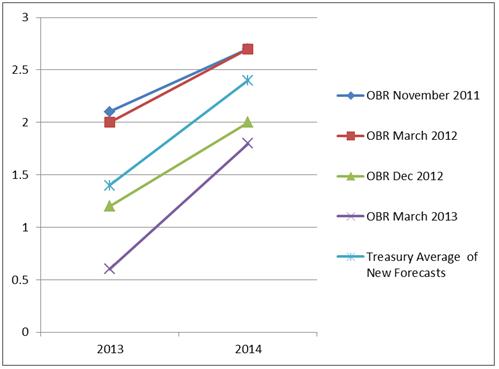
Figure 1 shows successive forecasts for year-on-year GDP percentage growth (at constant prices) since November 2011 It can be seen that the forecasts have been successively revised downwards by the Office for Budget Responsibility since then, as shown by arrows a, 2 and 3.  However, the latest survey of forecasts by the Treasury for this November suggests that the Chancellor will be presented in December with a higher-than-expected forecast for GDP growth – as shown by arrow 4 – for his Autumn Statement.

staite 1

Figure 1: Growth forecasts since November 2011

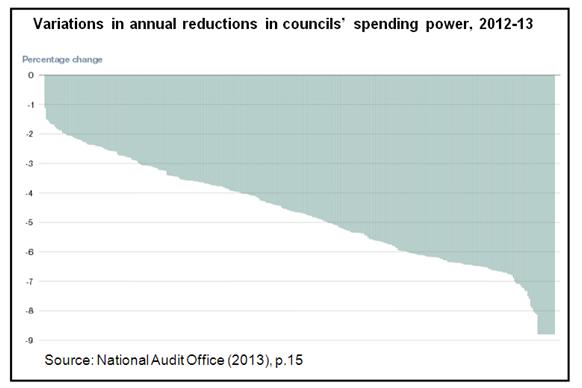
Up until now, local government has taken more than its fair share of the downward adjustments to spending plans. Funding for councils has fallen by an average 21% and ‘councils serving deprived areas have seen the largest reductions in funding relative to spending since 2010/11’.

staite 2

Figure 2: The variable impact of the cuts

Dealing with the problems generated by changing demographics, the economy and central government policy have increased pressure on council finances. Spending on homelessness has risen by 16% since 2011/2 and the number of looked after children increased by 10% between 2009 and 2012.  The pressure to meet rising urgent need means there is less to invest in early intervention which will save money and improve lives in the long term.

Local government has reduced its costs by cutting jobs and being more efficient.  Council’s can only cut so far before they become unable to meet their 1700 statutory duties, including protecting the most vulnerable and remain viable.

staite 3

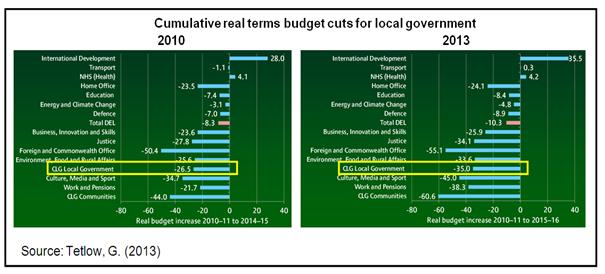
Figure 3: Cumulative cuts for CLG and local government

Because Communities and Local Government have taken a disproportionate share of previous budget cuts, local government has also taken more than its fair share of the cuts.

The news that there will be no further cuts to local government funding in 2014/5 is to be welcomed, not least because it is a tacit acknowledgement that local authorities have risen to the challenge of becoming more efficient, in an exemplary way. Perhaps it also reflects some understanding that continued cuts would further endanger services for the most vulnerable.

Local government has wearied of the confrontational style and unrelenting unpleasantness of Eric Pickles. Perhaps, today’s news is a sign that George Osborne is interested in having a more mature and productive relationship with local government.

Catherine Staite

Catherine Staite is the Director of INLOGOV. She provides consultancy and facilitation to local authorities and their partners, on a wide range of issues including on improving outcomes, efficiency, partnership working, strategic planning and organisational development, including integration of services and functions.