Budget cuts, outsourcing, council mergers: 12,000 miles travelled, but Cornwall’s ex-CE will find plenty that’s familiar

Chris Game

Even allowing for local government’s legendary Stakhanovite working practices, the sector can’t usually manage that many hot news stories on Christmas Eve, so you do tend to notice them, especially if they contain a strand of possible personal interest. I remember well, then, the BBC’s announcement this past Christmas Eve that Cornwall Council CE, Kevin Lavery, had accepted a five-year appointment as CE of Wellington City Council and would be moving to New Zealand to take up the post in March – oh yes, at an annual salary of NZ$400,000, which converted then into £203,000, but today into £219,000 (I note irritably).

The reason (for my remembering, not for his moving) was that I happened to know that England’s cricketers would be playing the second Test Match in their series against the New Zealanders at Wellington’s charming and historic Basin Reserve ground in March – and I was planning to watch it. How brilliant, I thought, if I could do a quick interview with Lavery, just a couple of weeks into his new job, about his first impressions, contrasts with Cornwall, etc. Unfortunately, it quickly turned out that – for, I have to concede, eminently good reasons – ‘March’ in fact meant 31st March, by which time I would be well back in the UK.

More recently – like this morning – it also turned out that the final day of the said Wellington Test Match would almost certainly be rained off. So, lacking anything better to do, I thought I’d report anyway on some of the stuff that the interview might have covered.
First, the contrasts and similarities. Wellington City has a population of 200,000 and the biggest of 9 and a bit elected councils (1 regional, 8 and a bit city and district – don’t ask!) in the Wellington region. The council has an elected mayor (currently Green), 14 councillors, employs 1,500 staff, and has a budget of NZ$400 million (£220 million).

Cornwall has a population of 535,000 and a 123-member council – roughly the number of councillors plus mayors in the whole Wellington region. The council employs 19,000 staff – not far short of NZ local government’s total employment – and has a budget of about £1 billion.

In short, Lavery’s new job represents an apparently significant drop in scale, but barely a drop at all in remuneration. I quoted his salary at the outset, partly because the NZ media (and possibly public) are at least as fascinated/obsessed with executive pay, pay-offs, etc. as ours are, but mainly because so far his financial cost is one of the very few things that most Wellingtonians, including most councillors, know about their new CE. He was head-hunted in a recruitment process that cost NZ$157,000, including NZ$12,000+ to fly him out for interview; he can claim up to NZ$40,000 removal costs, and is promised a ‘golden parachute’ payment of up to NZ$200,000, if the job disappears in the regional governmental reorganisation expected over the coming couple of years. As one councillor put it: “We don’t know what we’re getting, but he’s cost us a bomb to get and he’ll cost us a bomb if he goes”.

So it’s fair to say that his relations, initially at least, with some councillors could be as touchy as they were with some of those in Cornwall, where, it may be recalled, the Conservative leader, Alec Robertson, was deposed and plans for a massive Lavery-driven shared services joint venture project had to be halted after they’d failed to win majority councillor backing.

Reportedly, Lavery was first sounded out by the Wellington headhunters immediately following the leadership change and the resulting withdrawal of one of the two bidders for the shared service joint venture, leaving only BT, one of Lavery’s former employers. But whatever the detailed sequence of events, the reputation preceding him to Wellington has been that of a ‘Marmite (or perhaps Vegemite) bureaucrat’ – you either love him or loathe him – and one with an undisguised enthusiasm for privatising and outsourcing services.

From which you might suppose that the costly new appointment was perhaps a symbolic act on the part of a council whose leadership had recently taken a shift to the right, and was looking at one and the same time to signal its political authority and a major change in policy direction. You might, but you’d be quite wrong.

If party politics in Cornish local government is, by UK standards, relatively low-key, in Wellington – and indeed in NZ local government generally – it is barely visible and almost uninterpretable to the untrained eye. In the city’s 2010 local elections, only 3 of the 14 successful candidates had stood openly under party labels (2 Labour and 1 Green), and the Mayor, elected for the first time (like councillors, for a three-year term), though a Green party member, had campaigned as an Independent.

Celia Wade-Brown’s election as Mayor seemed to surprise her almost as much as it did pretty well everyone else. Born and brought up in England, she came to NZ only in her late twenties, and, with little prior public warning, decided in 2010 not to recontest her council seat, but instead to challenge the high-profile mayoral incumbent, Kerry Prendergast, seeking her fourth term of office. In the STV election, Prendergast was a comfortable 6% ahead after the count of first preference votes, was still ahead on the second, third and fourth counts, but was overtaken by Wade-Brown on the fifth and final count by just 176 out of more than 60,000 votes cast.

The mayoral and councillor results combined were interpreted as representing at least a modest move towards the centre-left, but if voters were looking for a significant leftward policy swing, most must have been disappointed. Indeed, the CE appointment, involving as it did the personally humiliating dismissal of the former CE after 15 years and for apparently nothing very particular, was one of the few visible signs of an intended change of direction. As far as the 2013/14 Draft Annual Plan and budget is concerned, the headlines must look as familiar to Wellington electors as they do to us: large-scale savings (NZ$240 million over 10 years), necessitating service cuts, job losses, increases in fees and charges, and ongoing outsourcing.

A major reason for Lavery not taking up his post until the end of the month is that there are three important events taking place between now and then, the consequences of which will take up a sizeable chunk of his in-tray. One is the Council vote on 27th March to approve the Draft Annual Plan, detailing the Council’s work programme and proposed rate and fee increases, following which it will, as required, go out for a month’s public consultation, before coming back to the Council for final approval in June.
This year’s Draft Plan cuts council spending by NZ$9 million and proposes a rate (property tax) increase of 2.8%, and several of the detailed cuts especially are controversial: restricted library opening hours, increased parking charges, “changing the operating model” of the aquatic centre crèche (unsubtle euphemism there!), reduced grants to the Zoo Trust and ‘Positively Wellington Tourism’. All can, of course, and doubtless will be compared to the new CE’s salary.

Before that, on 21st March, another public consultation begins – on three options for local government reform across the whole Wellington region. Two of the three are alternative ‘super city’ models, as favoured by the regional reform working party. The third is a minimally modified status quo, added by the Mayor and councillors who oppose a super-city solution and argue that the public should be presented with a wider-ranging choice. Lavery will be on familiar territory here.

Also on 21st March Wellington councillors vote again on the national Transport Agency’s proposal for a 300-metre long, 9-metre high concrete flyover to ease the perpetual congestion round the huge roundabout within which is situated the Basin Reserve cricket ground (where in fact I should be sitting at this moment). We cricket fans fear the flyover would seriously blight our spectating, to say nothing of its impact on hundreds of local residents. The Mayor – for whom almost any kind of road development is anathema – and a majority of councillors argue that the congestion can be resolved by a combination of other means. However, some of the Mayor’s phraseology is worrying. She talks rather vaguely of ‘fine-tuning’ the present roundabout, and of how Basin Reserve “must not be blighted by a naked block of concrete”, as if various forms of pleasingly attired concrete were available alternatives. And now there’s talk of a couple of the eight councillors who opposed the flyover in December maybe switching sides following a two-month council staff investigation. What a pity I couldn’t have given the new CE a short personal briefing on the issue.

game

Chris is a Visiting Lecturer at INLOGOV interested in the politics of local government; local elections, electoral reform and other electoral behaviour; party politics; political leadership and management; member-officer relations; central-local relations; use of consumer and opinion research in local government; the modernisation agenda and the implementation of executive local government.


Doing local politics differently: learning from an inspiring community campaign against the cuts

Catherine Durose

For the second time in as many years, the south Manchester neighbourhood of Levenshulme where I live, has faced the closure of vital public facilities. This time, the library and swimming pool have been targeted. Both these facilities are community hubs which bring people in a diverse, and in many ways disadvantaged, community together. To continue to build cohesion and understanding in our community, we need these spaces. In an economic context, where literate, educated, skilled people are the key to our future growth as a city, closing the library seems a perverse decision. In an area with some of the worst health outcomes in the city, where health services are stretched and we desperately need to encourage people to take responsibility for their own health, closing down the swimming pool seems obscene. The context of these closures is that Manchester is facing one of the toughest and most unfair financial settlements for local government which has been compounded by the loss of substantial deprivation linked funding. Many in Levenshulme feel that the proposal to close our local facilities is not only short-termist, but is self-defeating.

The anger in the community has been directed in a sustained, vibrant, thoughtful and provocative campaign to save our facilities, which has engaged hundreds of people. Yesterday, a flash mob of dancers from Levenshulme wearing masks of council leader Sir Richard Leese’s face performed a routine outside Manchester Town Hall proclaiming a ‘Lev-olution’. Last week, local people held a ‘beach party’ protest outside the pool before occupying it into the night. These actions followed months of well-attended demonstrations, occupations, vigils, petitions, fundraising events and public meetings which have attracted extensive local and national media coverage. These actions reflect the importance not only of persistence – a similarly vital community effort saved the swimming baths and sports hall in 2011 – but also of a sense of humour in mobilising people. We documented similar approaches in our recent INLOGOV pamphlet, ‘Beyond the State – Mobilising and Co-Producing with Communities’.

Today sees both – in a timetable which has generated a somewhat cynical interpretation in the community – the ending of the consultation by Manchester City Council on proposals for a new community hub in Levenshulme to open in Autumn 2014 and the debate of these proposals in full council. These proposals now have an amendment, tabled by local councillors following local pressure, to work with community groups to explore whether a viable business plan can be developed to allow our existing facilities to remain open until replacement facilities are available. Teams of local people are actively working to find a way to make this happen.

The council has been unable or unwilling – until demanded to by the community campaign – to communicate with the communities in Levenshulme and unable to – until led by the community –find a way to work in collaboration to find community-based solutions to dealing with unprecedented cuts to public services. Hopefully, the inspiring community campaign in Levenshulme adds another example of how local authorities can begin to learn to do local politics differently.

durose

Catherine Durose is Director of Research at INLOGOV. Catherine is interested in the restructuring of relationships between citizens, communities and the state. Catherine is currently advising the Office of Civil Society’s evaluation of the Community Organisers initiatives and leading a policy review for the AHRC’s Connected Communities programme on re-thinking local public services.

Council officers as local democracy makers

Philip Lloyd-Williams

To what extent does the lack of training and development of senior officers at local councils impact on the practice of local democracy? Can ‘democracy’ even be taught? It’s a question that has been with me for a while. I have no answers but can offer some personal reflections following research I undertook into the role of senior officers in managing local democracy. From personal knowledge I knew that Chief Executives and Directors of local authorities advised, negotiated and shaped not only the delivery of services but also how citizens engaged with their Councils. As a result, I saw them as what I termed Local Democracy Makers as they held a position of influence and authority which could impact democratic practice – so I decided to have a more detailed look.

Much has changed in local government in the last 20 years. We now have Executive decision making structures with fewer Councillors being involved as decision makers. Commonly services are delivered in partnership or from commissioned providers, often on long term contracts with opaque accountability arrangements. However, what is often mentioned when local government is discussed is the challenge of engaging and connecting with communities, inspiring interest in elections, bucking the trend of low turnout for voting and the senior age profile of Councillors. Securing the democratic mandate and involvement (however it is defined or described) is still considered an integral part of local government. Thus, local democracy is of importance and how it is then shaped, moulded and operated matters. The senior officers as Local Democracy Makers have a powerful and authoritative position in the organisation of local government to have a material bearing on the way local democracy is discharged locally.

Senior officers are well versed and often highly trained in management but there is little training or teaching in the management of political relationships or local Democracy. It’s mostly ‘on the job training’ which in turn influences how the senior officers behave as Local Democracy Makers. I interviewed and observed senior officers interacting with the politicians and I discovered that, unsurprisingly, their own world view of politics, localities and democracy would inform how they enabled and restricted local democracy. Often, the heavy hand of regulation, managerialism, audit and the management of risk would result in a narrow view of how local decisions should be informed by local people. Other elites had several deep political scars that made them suspicious of allowing a more deliberative democratic practice. For certain, the push to achieve a good ranking in performance, financial management and consumer reputation has the effect of marginalising the place of local democracy. Perhaps such findings are to be expected, but when they have an impact on how democracy is practiced it becomes more acute.

So, are we doing enough to raise awareness of the impacts of management arrangements on democratic practice? My research tells me that not enough discussion, debate and possibly training is given to the principles of local democracy in the management and administration of local services. It suggests to me that too much emphasis is placed on the ‘management’ abilities and not enough of the importance of democracy. Like it or not, senior officers in local government act as Local Democracy Makers and we need to actively support them in this role.

lloyd-williams

Philip’s doctorate from the University of Aston was on the role of local authority officials as ‘makers of democracy’. His career has given him extensive experience of working with elected representatives in local government as a Solicitor. He is an INLOGOV Associate Member and contributes to its Management Development programmes.

Reflections on the paradoxes of public sector leadership development

Ian Briggs

The question of how we play a part in encouraging future generations of leaders has never really been more acute than at the present. The question has been around for quite a while now but perhaps never really satisfactorily answered. Some years ago a PhD study looked at the career paths of Local Authority Chief Executives and the startling conclusion appeared to be that actually wanting to be a chief executive was the only real common feature.

Clearly having the drive and the will as well as a fair modicum of talent was also pretty crucial, but how do talented people accrue the required characteristics needed to get into those positions? How do people learn to be good leaders and from where do they form their ideas about what constitutes an effective leader? Higher education clearly plays a key role in supporting this, and those that sponsor career-minded individuals to study expect us to support the way they form their ideas about effective leadership – but we have a problem.

Some pretty uncomfortable issues are in the ether arising from the Mid Staffordshire Hospital debacle, where managers may have been more focused upon targets and less attenuated to the needs of patients; and from some councils who feel that top managers are an expense and offer little value added to the way that complex organisations function. So the whole question is: what attributes do we need to acquire in order to be able to sit at (or close to) the top of public sector organisations in the future?

We are on the eve of commencing a new round of the Local Government Graduate Programme and we should remember the LGA in their wisdom resource this programme to reinforce the supply side of the equation to add to the talent pool – and very laudable it is. Yet it is easy to detect that these younger individuals as well as some of our postgraduate students are often a bit reluctant to play by the rules that the current power elite want to impose on them.

This can be contrasted with an event at a recent gathering of senior leaders where the issue of ‘networking’ became the hot topic of conversation. Being in contact with a group of likeminded, like placed people with similar challenges and problems was near universally reported to be a key feature of their role. They were asked to explore this in a little more depth and offer the criteria they would apply to the question of “what does having a good network actually look like”? The top three were:

1. Something that looked a little like benchmarking – are my ideas and interpretations of the problems the same as others who occupy similar roles, a kind of support for innovative thinking
2. Gaining early warning of emergent good and innovative practice (mildly surprising that was second)
3. Most interesting was the potential advance warning of possible career openings if I ‘fell foul’ of my current employer!

I am not suggesting that this was a totally representative group and that everyone identified with this last point. It did cause the most debate and even alarm in some, but where those with the most positional power are acting so defensively and needing others who would help them get out of a career fix suggests that younger talented people have some sizable hurdles to overcome if they are to be seen and valued as potential successors. The group were challenged as to who had potential future leaders in their networks and few immediately reported that they had – they did see it as a vital part of their roles to talent spot, but what kind of talent were they spotting? Most saw this issue as something that was separate to having a good and effective network and more a part of the job of being at the top!

All this suggests that we are facing a clash between an increasingly defensive power elite with a new generation who are more reluctant to accept the old traditions and thinking. This presents teachers and facilitators of advanced leadership development with a big problem. Should we focus our study on today’s senior people to try and distil out a model that shows clearly what is needed to perform at the top, or should we look to develop more sophisticated approaches to support development where the talented form their own models of effective leadership to prepare them for when they are ready to enter the realms of the new power elite? We favour the latter approach and whilst it is important to offer key messages from the history of leadership research, space must also be found for these proto leaders to shape their own thinking and become aware of what drives them to seek greater responsibility and accountability.

For the last two years we have asked groups of postgraduate students to explore their personal implicit models of being an effective leader. We have offered them a template from wider research into implicit leadership theory (ILT) and some interesting findings are emerging. At the top of the list is a powerful rejection of forming ‘power distance’ between them and others, they are possibly more comfortable with uncertainty and they seek to be part of something that is more collective and socially shared than just wishing to be part of a like minded group. If this is true then we can perhaps be comforted by the fact that future leaders may start from a position of wishing to be embedded within an organisation rather than sitting on top of it and that they could create new organisational forms that are more fluid and representative of wider society. If so, this can only be good for our public services and our traditions of local democracy.

Let’s hope this is true and it comes to pass that future leaders will be significantly different from the leaders we currently have – however please note we still have some fantastic leaders today – not all are putting energy into defending their roles, but the reported level of pressure we are placing on top leaders is unsustainable and something is bound to break. Can we as developers, teachers and facilitators help to overcome the very real pressures of being socialised into a role that causes people to perform outside of their own values system? If we can, then we must help those who are on career trajectories to the top to resist the processes of socialisation to become the new old guard.

In the 1960’s, Alvin Toffler took a leaf from the works of Isaac Asimov and suggested that there is a ‘ghost in every machine’ – organisations are so complex and powerful that they can twist people to behave in a way that they have vowed never to do. The story centres around a young employee in a fictitious future organisation who is treated miserably by his boss, he is psychologically abused and bullied and vows that if he ever achieves promotion he will not behave in the same way as a boss himself. Yes, you have guessed right – he does become his boss in time.

A more detailed account of trends in leadership learning can be found in Briggs, I and Raine, J.W. (forthcoming) Rethinking leadership learning in postgraduate public management programmes. Teaching and Public Administration.

briggs

Ian Briggs is a Senior Fellow at the Institute of Local Government Studies. He has research interests in the development and assessment of leadership, performance coaching, organisational development and change, and the establishment of shared service provision.

Horse-meat in beefburgers? Who says we are over-regulated?

John Raine

A recurrent theme of the political rhetoric from successive governments in recent times has been ‘deregulation’, ‘cutting bureaucracy and red-tape’.  Indeed the notions of ‘Smaller Government’ and of ‘curbing the nanny state’ have been key elements in the present Coalition Government’s programme since the outset in 2010.  But while perhaps politically canny to talk of ‘bonfires of regulations’ and sounding off about freeing individuals and businesses from the maize of red-tape and state bureaucracy, the reality, of course, is that governments mostly augment, rather than diminish, the ‘regulatory mountain’.  And why not?  After all, most of us would expect government to be acting in our collective interests to protect our health and wellbeing and to minimise our exposure to exploitation and harm.  The making and enforcement of regulations is something government must surely do in fulfilling its legitimate and important ‘guardian’ role.

The last few days have brought shocking reminders of the consequences of regulatory failure.  First the revelations of extraordinary lapses in public sector patient care and an awful catalogue of avoidable loss of life at Stafford hospital.  Now an unfolding saga of trading standards breaches and food safety concerns in the wake of the discovery of horse meat in some of our supposed beef products.  Exactly how long such fraud has been going on, and how widespread is the extent of contamination, remains to be seen.  But, understandably, questions are already being asked about the role of the regulators – in health care, trading standards and food safety, and both at national and local levels.  Could and should the malpractices have been identified earlier?  Are the inspection processes sufficiently robust and reliable?  At Stafford, we now know for sure that they were absolutely not; with the horsemeat scandal, we can presently only speculate, but given a scaling-down year-on-year in the intensity of regulatory inspection work generally, we might realistically suspect a similarly inadequate verdict.

That scaling-down trend – affecting both national regulatory bodies (e.g. the Health and Safety Executive, the Food Standards Agency and the Environment Agency), and local authority regulatory departments (e.g. for Trading Standards and Environmental Health) alike, has inevitably been fuelled by financial austerity and public sector budgetary parsimony.  But it has also been justified (at least internally by the regulatory organisations themselves) by developments in risk assessment that have claimed legitimacy for more targeted inspection programmes.  In essence, they have supported a shift from universally-applied regimes to approaches that focus on those particular activities and businesses where the consequences of serious harm (when things to go wrong) are greatest and/or where the track-record of compliance has been least impressive.

Rational-sounding though the idea of such risk-based regulation might sound, the recent scandals clearly bring into question their reliability in providing the level of public protection we might expect.  Indeed, because of the scaling-down of inspection regimes, increasingly it seems, regulatory interventions depend less on the watchful eye of the inspector and much more on public reporting of problems or whistle-blowing. More and more, they follow, rather than anticipate, the harms that the regulatory regimes were originally instituted to prevent.

And there is a growing body of research to evidence and substantiate all this.  Our own research (Raine and Lloyd, 2013), for example, conducted over the past three years on regulatory processes in local authorities of England and Wales, revealed a considerable transformation away from generally frequent, intensive and more or less universal inspection visits to local businesses to a regime that, for the vast majority of firms, is now characterised by infrequency, light-touch and selectivity.  Indeed, our research also identified a significant shift from ‘inspection visits’ as the prime mode of regulatory oversight to ‘self-assessment/self-regulation’ – something that, perhaps unsurprisingly, the business sector in the UK has long advocated.  Now, rather than the routine six-monthly, annual or biennial inspection, the typical business might perhaps expect to receive an occasional ‘self-completion/self-assessment questionnaire’ probably less frequently than annually – the value of which, in any case, would leave much to the conscientiousness and integrity of the respondent.

Even such ‘paper-based’ approaches to regulatory oversight seem, according to our research findings to be on the wane because of budgetary pressures.  In the case, for example, of trading standards in one rural county that we looked at, the use of self-assessment questionnaires (that had been in use for some time for all businesses categorised as “low risk”) was suddenly cut in 2008 to apply to new businesses only – meaning that, since that year, less than seventy returns per year have been received from the county’s portfolio of several thousand businesses.

Moreover, the reality of this less intense form of regulatory oversight was only reinforced in findings from a survey we undertook of a sample of businesses in the same county, and from which we found that hardly more than a third of retail businesses (34 per cent) recalled contact with a Trading Standards official in the previous three years.

Of course such results tell us very little about the actual consequences (or key outcomes) of such scaling-down in regulatory inspection work – for example of the extent of non-compliance, loss of protection or harm caused.  However, local regulators themselves reported to us on a sizeable increase in the incidence of ‘prima facie’ criminal breaches of Fair Trading legislation (by both “low and medium” risk businesses) over the same three year period, something they regarded to be a direct consequence of the lower-key regulatory approach.  With reduced levels of face-to-face contact with businesses, they pointed out, there is simply less opportunity for regulators to observe the problems first-hand, to explain the importance of compliance with standards or to reinforce messages verbally to business managers about the potential consequences.

Might Stafford and the horsemeat scandals be just the tip of an iceberg?  How concerned should we be about the scaling-down, if not abandonment of traditionally intensive regulatory inspection regimes?  Probably there will be a range of views on such questions.  But we surely can’t have it both ways; we can’t on the one hand grumble about ‘elf-n-safety’ red-tape and layers of governmental regulatory bureaucracy while, on the other, being shocked at further accounts, when finally uncovered, of abuses of standards, breaches of rules, injuries and worse.

raine

John Raine is Professor of Management in Criminal Justice at INLOGOV.  He has been involved in criminal justice research, consultancy and teaching at Birmingham for some twenty-five years and has a strong track record of commissions for the Home Office, Lord Chancellor’s Department/Department for Constitutional Affairs/Ministry of Justice on aspects of policy and practice within the criminal (and civil) justice sectors).


[i] Raine J W and H Lloyd (2013) Public Management Reform and the Regulation of Private Business: Risk-Driven, Customer-Centric and all Joined-Up? International Journal of Public Administration, forthcoming.

Prestatyn’s election farce and the busted petition process

Chris Game

Remember the 2000 US Presidential election, the seemingly endless Florida recounts, and how we mocked an electoral system that took 35 days to produce a winner?  Well, it’s now over eight times as long – 287 days and counting – since last May’s Welsh local elections. Yet, with a tad less riding on the result, one of the winning candidates in Denbighshire County Council’s Prestatyn North ward has still to take his seat. And if that doesn’t signify a busted system, utterly unfit for purpose, it’s hard to imagine what might.

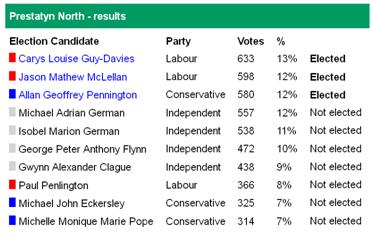
It’s a story that started as mildly amusing, passed through farcical around October, and is now just an all-round total embarrassment. It’s most easily understood by seeing the election result as announced by the Returning Officer (RO), from which you may also be able to guess the problem.

prestatyn table

Source: Denbighshire County Council

Yes, one of the Conservative candidates and one of Labour’s have quite similar surnames, and, while many electors certainly will have split their three votes between candidates of different parties, a Labour-Conservative split result of these dimensions looks, to say the least, odd. It was. Without getting too nerdy, Pennington (Con) had been credited with a share of the votes of those who voted en bloc for all three Labour candidates, and Penlington (remember: L for Labour) with the rather smaller share of the ‘straight slate’ Conservative ballots. In electoral administration jargon, there was a screw-up.

At which point, I would say two things. First, such inept-but-innocent counting screw-ups happen more often, and with more significant consequences, than you might think. In Broxtowe (Notts) last year, the names of a Lib Dem husband and wife were transposed in copying them from the corresponding numbers list to the count summary sheet, and the wife was officially declared elected, despite polling 21 fewer votes than her now officially defeated husband.

Waltham Forest in 2010 managed a mix of Broxtowe and Prestatyn. In copying Labour’s en bloc votes, Labour’s three candidates each received 2,451 instead of 1,451 – sufficient to enable the party’s third-placed candidate to be elected, rather than the leading Lib Dem. And in a much publicised case in Birmingham’s Kingstanding ward in 2006, a BNP candidate was elected, having been gifted an extra 981 votes in a double-counting of all those ballot papers on which electors split their two votes between candidates of different parties.

With these Waltham Forest and Birmingham cases in mind, my second point is that the numbers of votes involved in these screw-ups can be not only large, but beyond the bounds of arithmetical possibility. The combined votes of all candidates – announced, it’s worth emphasising, by the ROs, after recounts rigorously scrutinised by candidates and agents of all parties – totalled respectively 1,397 and 2,367 more than would have been possible, even if every voter completing a ballot paper had used every vote available to them.

This is the bit that, to me anyway, passeth all understanding. Can candidates have so little idea of how the election’s gone that they’re not curious about why their vote is 50% higher than they might have expected? And how come none of these key actors involved in the counts could do even simple addition?

Whatever the explanation, once a candidate is declared elected, these essentially innocent administrative errors immediately become seriously costly. It might seem convenient, if an embarrassed RO were able publicly to admit that “Oops, I made a boo-boo. Can we all go back five minutes?”  Sadly, election law and convention decree that this is not on. In the UK the only way to challenge a declared result is legally, and expensively, for a miffed candidate or elector to issue an election petition within three weeks of the election, pay the £465 fee, and also ‘give security’ for all relevant costs arising – up to £5,000 in a parliamentary election, £2,500 in a local. No security, no petition.

Here’s where the trouble starts and where fundamental reform is decades overdue.  A robust procedure for challenging the result, whether on the grounds of innocent administrative error or deliberate fraudulent practice, is a vital part of any sound electoral system. It should have the attributes of ARTESSA, being accessible, rational, transparent, efficient, straightforward, swift and affordable. Our petition procedure today, little changed from that set out in the 1868 Parliamentary Elections Act to deal with bribery, treating, personation, undue influence and other corrupt practices, is none of these, as Prestatyn North’s hapless Paul Penlington is still discovering the hard way.

That there had been a substantial counting error was first realised apparently by the RO and Council Chief Executive. Labour, both candidate and party, were slow to protest – one suggested reason being that, without knowing the exact number of wrongly assigned votes, there was the real possibility of a correction letting in not Penlington, but the fourth-placed Mike German, a one-time Labour councillor before he defected to help form the Democratic Alliance of Wales – than whom even a usurping Conservative might be marginally preferable. Eventually, however, a petition was issued, to have the votes recounted and the result overturned.

Despite the Council having admitted from the outset its “fundamental error”, it still took until late July for the jury-less High Court to authorise a recount, and a further three months for that count to take place in, for some reason, London.  Unhurried, certainly, but only now does the tale become truly incredible.

The result of a recount can only be officially announced and accepted by a special two-judge election court, which took nearly a further three months to convene – again in London. Only on January 23rd, therefore, were the correct figures finally declared – Penlington 606, Pennington 341 – and the original result overturned.

You wouldn’t, by now, expect the ruling to come into effect immediately, and of course it didn’t.  The duly elected Councillor Penlington should, though, have taken his seat a week later – had former-Councillor Pennington not decided that the loss of his allowances would put his “livelihood at stake”, refused to give up his seat, and objected in writing to the court’s decision.  Incidentally, legal costs, awarded against the Returning Officer, were estimated at this point to have passed £20,000, with the clock presumably still ticking.

There is so much wrong here that, even given the space, it would be hard to know where to start: the time, the cost, the arcane and detrimental procedures, the irrationality and inflexibility? Why the great rush to issue a petition, when the judicial process meanders as it pleases? Why can one elector challenge a parliamentary election, while four are required for a local election? Why can’t a Returning Officer or a political party initiate a petition?  And so much more – most now thankfully documented in the Electoral Commission’s excellent report, Challenging Elections in the UK.

Prestatyn North may be just a quirky contemporary footnote, but it does illustrate one key aspect of the problem. The petition procedure was designed to deal with 19th Century corrupt practices in parliamentary elections. Its requirement today is to deal with 21st Century corrupt practices, and more frequently with innocent errors and administrative misjudgements, in local government elections – for which it is hopelessly ill-equipped.

There were 52 parliamentary petitions tried in 1868 alone, all dealing with alleged malpractice. Since 1929, however, there have been just 11, including six from Northern Ireland and three from the single constituency of Fermanagh & South Tyrone. They sometimes make headlines – the then Anthony Wedgwood Benn’s disqualification as a Peer in 1961, ex-Labour minister Phil Woolas’s disqualification in 2010 for making false statements about his Lib Dem opponent – but they’re rare.

Local government election petitions are not rare. Since 1997, at least 44 from principal councils have gone to trial, plenty more from town and parish councils, and still more have been withdrawn before trial, usually due to lack of funds. Of the 16 in the past five years, two (both subsequently withdrawn) claimed a candidate was disqualified to stand, and three alleged corrupt or illegal practices committed by or on behalf of a candidate.

The remaining 11 concerned actions by electoral officials: either administrative Prestatyn-type errors or process decisions causing the election not to have been conducted ‘substantially in accordance’ with the rules – actions, in short, wholly different from those with which petitions were designed to deal.  

The Law Commission has embarked on a comprehensive review of electoral law, aimed ambitiously at collating and reforming the existing morass of primary and secondary legislation into something more coherent, and conceivably even a single modular UK Electoral Act. It’s still in its early stages, and its members may hope that when they eventually reach ‘Challenging the election result’, they’ll be almost there. The sorry saga of Prestatyn should remind them that they won’t be.

game

Chris is a Visiting Lecturer at INLOGOV interested in the politics of local government; local elections, electoral reform and other electoral behaviour; party politics; political  leadership and management; member-officer relations; central-local relations; use of consumer and opinion research in local government; the modernisation agenda and the implementation of executive local government.