Bankruptcies, scofflaws and aldermen: differentiated by a common language

Chris Game

It must have happened to you. You come across a word for, as far as you’re aware, the first time in your life, you learn its meaning, and then read or hear it again in a quite different context just a few days later.

It’s possibly just one of those exaggerated coincidences – like the birthday paradox of needing only 23 people in a room to have better than even odds of two of them sharing a birthday. But, even if it is, my recent experience still struck me as worth sharing in a blog – especially as I rather like the word in question, and without too much contortion can give it a local government slant.

I’ve just returned from an academic conference in Chicago. The paper I presented was mainly about English local government finance, but part of it touched on the usage and meaning of words – in this case BANKRUPTCY; and no, that’s not the ‘new’ word I’ve just discovered!  I wanted to explain why English local authorities, no matter how financially stressed, would not be going bankrupt in the same way as Detroit and several other American cities have done over the past couple of years – and that Chicago itself conceivably could too, were the Illinois state constitution to permit it.

It’s true the B-word has entered UK local government discourse in recent months – in relation, as it happens, to what in population terms are our largest (Birmingham) and smallest (West Somerset) principal councils.  But here it’s used actually or effectively in quotation marks, signalling unusual usage, and indeed signalling is what the recourse to the B-word is mainly about: signalling – to these councils’ residents and taxpayers, but above all to government ministers – that they’re getting close to being unable to meet their legal obligations with the funding foreseeably available to them.

They are not signalling that, to take Chicago’s case, they have approaching $30 billion of unfunded pension liabilities, a now junk-approaching credit rating, and that they’ve managed to set a 2014 general budget with a shortfall of only $339 million. There are several ways in which municipal bankruptcy has a different meaning and different connotations this side of the pond, not least of which is that little clause in successive Local Government Acts requiring local authorities to set their council tax at a level that will balance the budget. US municipalities can and do set deficit budgets, some of them year after year.

Anyway, this bankruptcy stuff meant I was probably at least subconsciously on the lookout for particularly American words and usages – the two countries separated by a common language idea – when I happened upon SCOFFLAW. It’s not remotely a neologism, its meaning is quite easily guessable, and you may well be familiar with it yourself. But, until it crossed my path in three entirely different situations in the space of a few days, I wasn’t.

It originated in the Prohibition era, as a label for someone who literally scoffed at the law and illegally drank, sold or manufactured alcohol.  It’s since been extended to anyone who flouts any law, but it remains very much an Americanism. Indeed, it may be that its widespread usage is concentrated around the Chicago area, because my first sighting was the Scofflaw bar/restaurant in Logan Square, near to where I was staying in Lincoln Park.  Not, disappointingly, as edgy as it sounds. Unless there’s a local ordinance outlawing tractor seat barstools or menus containing exceptionally weird cocktails, chocolate chip cookies, and Brussels sprouts, the name must refer more to historic than present-day custom and practice.

There was no doubt, though, in my second encounter, a couple of days later. State Governor, Pat Quinn, was there on my TV, explaining his new law allowing the Illinois Tollway to post public lists naming and shaming the ‘Top Toll Scofflaws’ and the amount of fines and unpaid tolls owed by each violator.

It’s to such traffic law violations and similar comparatively minor offences that the scofflaw tag seems mainly applied nowadays – but clearly not exclusively.  For, immediately upon returning home, I heard a US diplomat explain on Radio 4’s The World Tonight how, if President Obama were to launch a military attack on Syria without Congressional and/or UN authorisation, it would not only constitute an impeachable offence, but “would bolster the already widely held view that America is a scofflaw nation that acts impetuously and unilaterally outside the framework of international law”. You can see his point: first you’re defying liquor laws, then evading traffic fines, and, before you know it, you’re attacking Syria.

Another word you hear much more of in Chicago City government than over here is perhaps more surprising: ALDERMAN – an office that, except for the City of London, we abolished in the 1970s. Chicago, however, is, one of several US cities that retains them and so, a little oddly, has a 50-member legislative city council comprising entirely elected aldermen (unlike ours, who were indirectly elected) – and that includes the 16 women, who presumably feel they have better things to do than argue about whether they should be alderwomen or even alderpersons.

They almost certainly do, for the contrast between the range of the actual and potential powers of Chicago aldermen and those of the 120 members of Birmingham City Council – with which Chicago is twinned – is hard to overstate. First, some numbers.  The US has nearly 39,000 ‘general purpose’ local governments, compared to the UK’s 434 principal local authorities – but its council memberships are much smaller. While Birmingham’s councillors represent wards with populations averaging 27,000, making them the largest in the country, Chicago’s aldermen represent districts of roughly 57,000, which are easily the smallest of any major US city. New York’s 51 city councillors represent an average of 165,000; Los Angeles’ 15 councillors over 250,000.

As large-scale representatives, but even more so as legislators, Chicago’s aldermen are far better financially compensated and administratively supported than our councillors: an average salary of around $115,000 (£74,000); a staffing budget of some $200,000, to employ typically a chief of staff, a couple of ward services staff, plus maybe a receptionist and a ‘scheduler’; and an additional general office budget of $75,000. And yes, there is a ‘Better Government Association’ that, like our TaxPayers’ Alliance, monitors all this and campaigns for the council to be cut by up to a half.

In truth, though, for aldermen to perform effectively even their legislative role, there would need to be more, rather than fewer, of them, with better, rather than reduced, support. Since Rahm Emanuel became mayor in May 2011, there have been around 30,000 measures introduced to the City Council. Even taking only the 2,000+ proposals flagged by the City Clerk’s office as ‘key’ legislation with a city-wide impact, aldermen lack the time, staff and expertise either to contribute significantly to the shaping of these measures or to scrutinise their implementation.

In practice, then, the mayor drives the city-wide agenda, largely unchallenged, but leaves the aldermen a similarly free rein – in fact, almost a free reign – over what happens in their wards. I noted recently in another blog how US municipalities’ zoning powers enabled them to limit the spread of payday loan stores in a way that many of our councils would like to. Well, in Chicago – far more, I believe, than in most cities – that power is exercised as a kind of unwritten aldermanic prerogative, with the alderman having almost a de facto veto power over any development project in their ward. Which pretty obviously, even without all their other powers, makes them both extremely influential, but also potentially extremely influenceable – and brings us back where we started, to scofflaws.

game

Chris Game is a Visiting Lecturer at INLOGOV interested in the politics of local government; local elections, electoral reform and other electoral behaviour; party politics; political leadership and management; member-officer relations; central-local relations; use of consumer and opinion research in local government; the modernisation agenda and the implementation of executive local government.


The ‘Detroit question’ and Parish Councils

Ian Briggs

The agenda on public service integration continues apace: discrete organisations working together in partnership has been the ideal in the past, but we are now in a world where the boundaries between organisations are becoming blurred and important questions are being asked again around the overall structure of our public services.

We recently hosted an interesting roundtable for Police and Crime Commissioners here at INLOGOV where the debate somewhat expectantly turned to the potential advantages of gathering the so called ‘Blue Light’ services together. Indeed, there has been a lot of progress in this field: certain first responder paramedic services can and are delivered by fire fighters and there are other examples of this integration which make a great deal of sense. It makes sense economically and, importantly, from the public perspective it makes sense too. Little attention is paid by a citizen or service user as long as the need is met and the service adds value. So we can safely say that some useful, realistic and economically advantageous integration projects are now well underway.

However, there is one aspect of integration that is rarely discussed but appears to be gathering a bit more attention recently. It goes something like this…. “As a District Council we are a billing authority, we send out the council tax bills and residents can see proportionately where their council tax is being spent. They can see that a proportion is retained by us; they can see a fair bit goes to the county council, the Fire service and police and little bit at the end is called the precept for the Parish Council. When we look at the totality for the parish and town councils precept it adds up to a fair sum. Why is it that when we can hardly afford the electricity bill to keep the lights on in our district council, the parishes and town councils have a load of loot?”

The councillor in this conversation also goes on to say that they have invested a great deal of time and energy in reshaping services and entered into complex partnering arrangements to bring efficiency benefits for us and the county, but “we seem to have overlooked the role of parish and town councils”. Looking recently at one multi tier area in the West Midlands that is heavily and actively parished suggests that the total precept adds up to quite a few million pounds; a rough calculation also suggests that for most town and parish councils they have discretionary control over more than half of their budgets (according to CLG the total English council precept for town and parish councils is over £540m -2013/13).

Decisions on spend, often set against some reasonably realistic and thoughtful parish plans, do deliver real and appreciated benefits for local communities but those parish plans, whilst submitted for approval to the district council (the billing authority in question), are administratively accepted and gather dust just to be treated as another bit of ‘administrivia’.

Granted, some councils are working well with their parish and town councils. They go beyond mere consultation and actively engage them in priority setting and are working towards much stronger integrated working, but that is not the case in many instances. There must some mileage in extending this debate to have a near seamless integration of priorities and social outcomes that dig deep into the work that parish councils do. Why is it that when the parish council budget is set it often accounts for a myriad of small contracts that are judged upon their worthiness but are rarely bound into the higher order outcomes that higher tier councils are working towards? It is logical to think that where a parish council has responsibility for open spaces and its efficacy in the management of those places is judged upon how effectively the grass is cut that those same open spaces are a resource that can have a significant role in meeting outcomes around public health, wellbeing, youth activities and a whole host more that are sought in higher tier councils.

The problem here is twofold – firstly it is rare for local parish and town councils to be engaged with these issues and secondly it is equally rare for many higher tier councils to even try to do so. There are also the attendant issues of poor integration of expenditure and budgets.

Although I have tried to bring together neighbouring parishes to coordinate and share their basic contracts (as a kind of horizontal integration that brings an economy of scale) little has been achieved and there has been little progress in taking this debate upward too.  As we are becoming more outcomes focused it is somewhat surprising that more is not done to encourage an integrative approach to what parish councils are doing on the ground and what the higher tier councils are seeking to achieve in this respect.

There have been some recent initiatives that have sought to bring this about – Selby in North Yorkshire should be commended for their approach to grouping parish and town councils and one county in the West Midlands that we are aware of has undertaken some preliminary work to engage with parish ad town councils better. However, where there have been some attempts to bring about this vertical integration, some resistance can be found too. It centres on the lack of focus on larger more holistic outcomes to be found in some, though perhaps not all parish and town councils and the potential lack of administrative and client skills they can call upon. But there may also be a lack of will on behalf of higher tier councils to stimulate this debate – it can be a tall order to effectively engage with a varied and disparate group of organisations that quite rightly guard their independence and local connectivity and in some cases district councils can have upwards of hundreds of parishes to deal with – engaging with them can be resource intensive in the extreme.

So, as some councils are facing highly uncertain futures – there is some polemic in the media about a handful of councils pulling up the shutters soon – it might be time to open this debate up and look at where there could be useful approaches to vertical integration in local government. It might be the first step in avoiding a UK Detroit.

briggs

Ian Briggs is a Senior Fellow at the Institute of Local Government Studies. He has research interests in the development and assessment of leadership, performance coaching, organisational development and change, and the establishment of shared service provision.

Why do we need a new model of public services?

Catherine Staite

Public services, including those commissioned and delivered by local government, have changed substantially in the past ten years. There have been changes in service delivery mechanisms, in relationships between users and services, in organisational structures and in partnership arrangements. It appears likely that the next ten years will bring at least as much change, if not more. One thing is clear: the old model of public services – people expect and services provide – is no longer tenable.  The growing gap between demand and resources has been described in terms of ‘the jaws of doom’.  That is one way of looking at the future.  Another way is to see the opportunities which we have to renegotiate ‘the deal’ between people and public services.

INLOGOV is working with a wide range of local authorities and other bodies to test a new model of public services. The model draws together many of the themes in current debates about the ways in which the public sector is likely  to have to change, in particular, how public services can manage demand, build capacity and achieve better mutual understanding, through the development of stronger relationships with communities as well as through co-production and behaviour change.  The purpose of this model is to support public service leaders – both political and managerial – to make better sense of a complex world.

INLOGOV’s model brings together the disparate cultural, structural, political and financial challenges facing local government and wider public services into an integrated framework, which takes account not only of individual drivers of change but also of the inter-relationship between changes in public services and the wider political and social context in which those changes are taking place. If we have a coherent model which reflects current and future realities it will be easier for us to explore possible solutions together.

We have concentrated on the challenges and opportunities for local government, in partnership with other local and national institutions.  That is not because we think local government is the most important player on the public service stage, it is because we think it plays a unique role as a convenor and mediator between conflicting interests within complex networks of players.  It is in this role that it can provide the creativity and connectivity to help shape solutions to the seemingly intractable problems of rising demand and falling resources.

The key drivers for a new model are: building stronger relationships with and between individuals and communities, increasing co-production of better outcomes by focusing on capacity, as well as need, and changing expectations and behaviours.  Before we can deliver these benefits we will need to change the way we think, plan and act.  There are many good, small scale examples of innovation which are delivering real change but now we need to scale up change to have a real impact – reducing dependency, building confidence and improving outcomes.  These are not quick fixes, so the sooner we start and the more energy we invest the sooner we’ll be able to achieve a sustainable relationship between public services and the communities they serve.


This blog post summarises some of the key messages in:

Why do we need a new model for public services? By Catherine Staite

Ch. 1 in Staite, C. (ed.)(2013). Making sense of the future: can we develop a new model for public services? (Birmingham: University of Birmingham/INLOGOV).

Catherine Staite

Catherine Staite is the Director of INLOGOV. She provides consultancy and facilitation to local authorities and their partners, on a wide range of issues including on improving outcomes, efficiency, partnership working, strategic planning and organisational development, including integration of services and functions.

Towards a model of sector-led improvement in UK local government

This post is based on Iain Taylor-Allen’s MSc dissertation, which he completed at INLOGOV earlier this year.

Iain Taylor-Allen

New policy is emerging from a political doctrine espousing the need to re-engage society in governance through the decentralisation of power, responsibility and accountability to the lowest possible level. In addition, fiscal reality serves to accelerate the desire for change. Whilst the new order is still emerging, the extent of reform to date has brought local government organisations front and centre.

Despite an exhaustive review spanning three decades, and covering both the public and private sector improvement literature, I could find little suitably developed theory on sector-led improvement pertinent to the current (or comparable) context of the UK local government sector. In response I designed and undertook an original piece of inductive research with the purpose of establishing an understanding of local government sector-led improvement in the UK, and identifying the key components of a sustainable model of sector-led improvement.

The research revealed a dynamic understanding of local government sector-led improvement, providing a provisional, high level definition of the phenomena focused on three key themes:

  • Mutual responsibility for the local government sector to support itself to improve and to share learning and best practice
  • Securing effective and value-for-money improvements to achieve better outcomes for service users
  • Ownership for improvement with a focus on local priorities.

Following further analysis three headline themes emerged, each comprising of key components identified by interviewees as critical to establishing a sustainable model of local government sector-led improvement:

  • Leadership (engagement and ownership)
  • Credibility  (assurance and improvement
  • Environment

Taken together the themes identified comprise the key components of what is referred to here as a provisional model of sustainable local government sector owned and led improvement, set in an environment that embraces the values identified to support the sector to realise improvement from within.

The model highlights the key components required for sector-led improvement to achieve the primary aim of positive citizen and service user outcomes, and be sustainable. These core components of leadership and credibility must exist within a reciprocally supportive, transparent and action focused environment characterised by a culture of mutual respect and ‘positive’ challenge from within the sector on behalf of the sector. Expressed in terms of establishing engagement as a basis for securing ownership for improvement from within the sector, effective leadership is a pre-requisite for developing and establishing the necessary level of credibility both within and outside the sector for the approach to be sustainable. Here, credibility is understood in terms of a cycle of assurance and improvement, focussed on robust performance base lining as a basis for securing the understanding and confidence to engage in improvement activity.

The findings highlight enthusiasm from within the sector to take on the challenge and responsibility of improvement, as well as drawing attention to the raft of potential benefits of a widespread adoption of the approach. Moreover, it provides researchers and practitioners alike a glimpse of the potential of a local government sector-led approach to improvement to enhance the efficiency and effectiveness of local service provision, and hopefully the much needed stimulus for consistent, applied research to develop policy and practice to realise the potential benefits.

taylor-allen

Iain Taylor-Allen is an Adult Social Care Performance Manager. He has a keen interest in public management – specifically focusing on leadership, organisational culture and transformation; sector-led approaches to improvement; and the use of qualitative and quantitative measures to drive service/ contract/ organisational performance.

Citizen participation through the looking glass

This blog post is based on Catherine Jackson-Read’s MSc dissertation, which she completed at INLOGOV earlier this year.

Catherine Jackson-Read

My dissertation explores the experiences of local residents, elected representatives and local authority officers in Malvern, Worcestershire, as they negotiate the transfer of the management of a community asset from the County Council to a local community trust.

A series of themes emerge which may be symptomatic of the relationship between citizen and state today; the challenges inherent in the role of local elected members; the tension between representative democracy and citizen participation; the conflict between local needs and priorities at a district level and the broader strategic agenda; and the capacity of the state to facilitate active citizenship. These experiences suggest that new rules and norms are emerging and that citizens are creating new spaces for engagement and participation particularly in the form of alternative models of management of public services and facilities. The challenge is not so much about the willingness of the state to work collaboratively with citizens, the challenge is in their ability to do so.

Fundamental questions emerge about the efficacy of the current model of local government. There are inherent tensions and conflicts in the role of locally elected members and the challenges of acting in multiple capacities as committee members directing or contributing to strategic policy; representatives of a constituency, responding to the needs and wishes of a local community; and party activists with political values and a commitment to a party line. Elected members are caught between a rock and a hard place. Conservative District Council Members cannot both support the wishes of the local community and their party’s county-wide austerity programme. County Council Members have to juggle two potentially conflicting policies, supporting local service delivery and reducing service costs.

These tensions and conflicts are exacerbated by a diverse party political and multi-tiered local authority context that together create an adversarialism that makes meaningful and informed debate extraordinarily difficult. At the time of the study both Worcestershire County and Malvern Hills District Councils were Conservative controlled. However a Liberal Democrat councillor represented the electoral Division in which the community asset – a Youth Centre – is located. These tensions are not necessarily new. However, I would argue that the extent of the cynicism about, and mistrust between, citizens and politicians and the decision making processes are. As a candidate in the recent local elections where turn out for the Division was a paltry 26%, I felt citizen anger and frustration at first hand.

Multi tiered local authority structures and the opportunity they present for political point scoring add to the challenges of decommissioning and the tensions between localism and wider strategic priorities. Perceptions and priorities differ at a locality and county level. Services and buildings have different associations for local communities who may recognise the rationale for changing the former but are reluctant to let go of the latter. Distanced leaders of county authorities need to understand the local community story better and find ways of engaging constituents in dialogue if the decommissioning of physical assets and services is not to become a battle ground for localism versus strategic policy making or party politics.

Questions about the fit between local authority decision making processes and citizen participation in service delivery also emerge. Local community groups are expected to demonstrate behaviours and ways of working that model the local authority’s way of working and that potentially undermine the very flexible, informal and organic approach that engaged local people in the first place. The facilitative role adopted by local authority officers in this case suggests that they are adapting to this new scenario. Council processes and how elected members use them, however, still appear to be in need of reform.

The study offers some interesting insights into citizen participation and representative democracy. The community group in the study forge their own path. They utilise local government processes, but only in so far as working with the representative system of democracy will enable them to achieve their objectives. That they operate “without” rather than “within” the system suggests we are seeing the emergence (or re-emergence?) of a model of citizen participation that poses a challenge to prevailing behaviours and practices; members of a local community directly representing themselves and assuming community leadership and service delivery roles divorced from the structures and institutions of the state.

The real challenge facing the state is how to marry, and potentially harness, citizen participation which is predominantly protest based, localised and issue specific with local democratic processes which aim to balance a wider range of policy and political interests.

Jackson-Read

Cathy Jackson-Read is an experienced facilitator and organisational development consultant who has worked at strategic and operational levels with a variety of statutory service providers, regional and sub-regional agencies and voluntary and community organisations, to enable cross sector liaison and collaborative working. Cathy currently works as a senior manager with Onside Independent Advocacy, a Worcester based charity providing services and support to vulnerable and disadvantaged adults. She also recently stood as a Liberal Democrat candidate in the Worcestershire County Council elections and leads the local party’s Adult Health and Social Care Group.

The 13 NOC counties and unitaries: runners, riders and results

[This post, incorporating the final results, was updated by the author on 5th June 2013]

Chris Game

In May 2010 David Cameron and Nick Clegg took just five days to form their national coalition. By contrast, starting in June 2010, the Belgians took 18 months to form theirs. English local government falls between the two.

It’s well over a month now since the national media completed their coverage of the local elections. They’d added up the seats won and lost by the various parties, calculated the national vote share they’d have received if the elections had been held in different parts of the country, and how many seats they’d have won in a 2015 General Election – but they left as unfinished business the 13 county and unitary councils they conveniently lumped together in their tables as ‘NOC’ (No Overall Control). And, though it was a short sprint by Belgian standards, it took most of that month for most of us to learn, in several of these 13 cases, the answer to that basic question the elections were supposedly about: who will actually govern?

The reasons are various: more parties, plus variegated independents, involved in negotiations; party leaders losing their own seats, or having to be re-elected or deposed at party meetings; and, above all, the fact that any inter-party agreements can only be officially implemented at pre-scheduled Annual Council Meetings, which, in some of the affected councils, only took place in the last week of May.

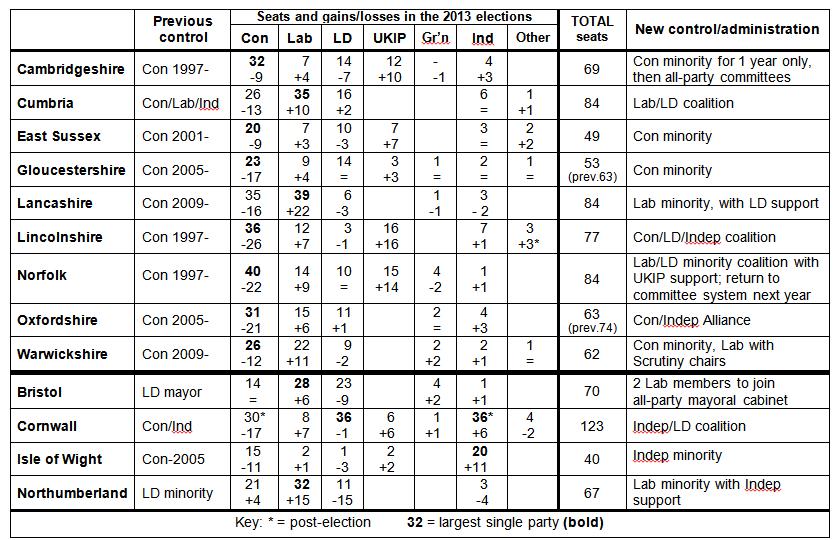
This blog attempts to fill in the gaps. It’s a kind of ‘runners and riders’ guide to the 13 county and unitary councils in which no single party has a majority of seats: how they got that way, and what subsequently happened.

game table june 2013

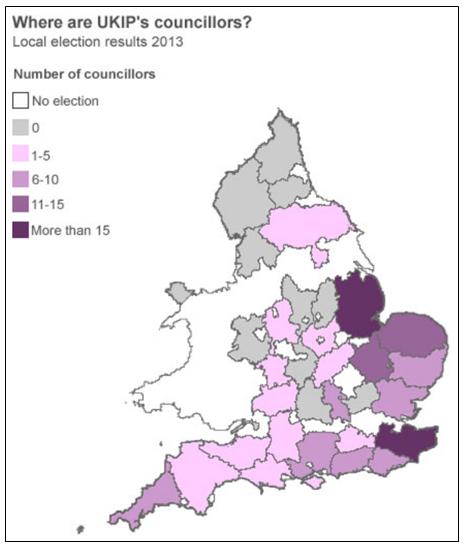
First, the counties, in alphabetical order. CAMBRIDGESHIRE, along with Lincolnshire, Norfolk, and to a lesser extent East Sussex, was one of the previously staunchly Conservative counties that became hung largely as a result of being UKIPped. As the BBC map shows, this was a much patchier experience than was suggested by some commentators at the time – with 7 of the 27 counties still having no UKIP councillors at all and only 4, all in the south and east, having more than 10.

game map may 17

Source: BBC News

The Conservative leader, Nick Clarke, was one of those who lost his seat to UKIP, and the party’s remaining 32 seats left them well short of a majority. The new leader, Martin Curtis, wanted to go it alone as a minority administration, but the Independents ruled that out, while Labour and the Lib Dems refused to join UKIP in supporting an Independent-led non-Conservative rainbow coalition. Eventually, the Conservatives got half their cake: Curtis will head a minority administration for 12 months, but then UKIP’s preference, for ‘opening up’ council decision-making, kicks in and cabinets will be replaced by all-party committees.

In CUMBRIA, previously run by a Con/Lab/Independent coalition, the elections effectively reversed the standings of the Conservatives and Labour, with the latter regaining their customary position as largest party, and the slightly strengthened Lib Dems in the role of potential kingmakers. Under a new leader, Jonathan Stephenson, they opted for coalition with Labour, deputy leadership of the council, and four cabinet posts.

EAST SUSSEX is a much smaller council than Cambridgeshire, but proportionately the party arithmetic is broadly similar. Here, though, the other parties seem readier to accept a Conservative minority administration, and, as in Cambridgeshire, although a Conservative-UKIP deal could have produced a majority, none appears to have been seriously pursued.

GLOUCESTERSHIRE was a hung three-party council from 1981 to 2005, with Lib Dems generally the largest group – before, in 2009, the Conservatives suddenly took 42 of the then 63 council seats. The reduction of 10 seats, accompanying boundary changes, and the prospect of at least some recovery by Labour and possibly the Lib Dems led close observers to predict a return to NOC, and they were right. The Conservatives, though, will continue in office as a minority administration, and the Lib Dems as the main opposition party, miffed reportedly at a suspected Con-Lab deal over Scrutiny Management and other committee chairs.

Meanwhile, the county’s badgers, temporarily reprieved last autumn from the Government’s planned cull, seem to have lobbied with some effect in the elections, the new council voting by 25 to 20 with 7 abstentions to oppose the cull, now due to start later this month.

In LANCASHIRE Labour either controlled the council or were the largest party from 1981 until 2009, and were hoping to regain majority control in one go. Sensing a lifeline, the Conservatives tried talking with anyone who might be interested in forming what would presumably be an anti-Labour coalition. But the Independents didn’t want an alliance with anyone and in the end the Lib Dems agreed to support a Labour minority administration – support that will include Labour’s budget, but not necessarily much more.

LINCOLNSHIRE Conservatives are unused to coalition politics, but the party’s leadership reacted quickly to the loss of nearly half its seats by negotiating a coalition deal with the Lib Dems and Independents, before the 16 new UKIP members could even elect themselves a leader. In the week they spent doing so, the party’s regional chairman pooh-poohed on their behalf any coalition with the Conservatives, and effectively condemned them to opposition from a starting point that might have yielded rather more. The Lincolnshire Independents group were also outsmarted – three of their number breaking away to join the coalition, one with a seat in the cabinet, with rumours that others could follow them into what is still a group-with-no-name.

Across The Wash, in equally traditionally Conservative NORFOLK, the outmanoeuvred group were the Conservatives themselves. At a full council meeting, the party’s re-elected leader, Bill Borrett, apparently thought he had an agreement with the Lib Dems at least to abstain in any vote, thereby enabling him to head a minority Conservative administration. He hadn’t, and nor was he able to nail down a more explicit coalition agreement with the Lib Dems involving some key specified posts. By far the largest group thus finds itself in opposition to a minority coalition of Labour and the Lib Dems based on just 29% of council members.

UKIP’s 15 votes were needed to get this deal off the ground – plus support from the Greens and an Independent – and the UKIP group describes itself as part of the coalition. That part, though, involves no cabinet seats, but rather the achievement of a Cambridgeshire-style agreement to abolish cabinet government and return to a committee system this time next year.

Before the Conservatives swept into power in 2005, OXFORDSHIRE had been a hung council for 20 years. Labour’s comeback was limited, and, on a now a significantly smaller council, the Conservatives finished within one seat of retaining their overall majority – a position they’ve restored thanks to a CIA: a Conservative/Independent Alliance probably less alarming than it initially sounds. No cabinet seats are involved, but three Independents have agreed to work with a Conservative minority administration in the kind of ‘confidence and supply’ arrangement that many thought was as far as Cameron and Clegg would dare to go in 2010, and indeed to which they may still, before 2015, conceivably turn.

In WARWICKSHIRE Labour, though never the majority party, have regularly run the council as a minority and were hoping to regain this position. They didn’t, but they did do a deal with the Conservatives, the outcome being a Conservative minority administration, headed by the council’s first woman leader, Izzy Seccombe, with Labour holding the Scrutiny chairs, and the Lib Dems and Greens out in the cold, complaining of a stitch-up.

Now to the four hung unitaries. In BRISTOL Labour became again the largest single party and has agreed that two of its members should join Mayor George Ferguson’s all-party cabinet, which will now comprise 2 Labour members, 2 Lib Dems, I Conservative, and I Green. That may sound straightforward, but it most certainly wasn’t. Last November a similar proposal, though supported by Labour councillors, was overruled by the local party and eventually by the National Executive, and had cost the group its leader, Peter Hammond. It seems a sensible decision, but it would be surprising if that sentiment were shared universally within Labour circles.

In CORNWALL, as in Lincolnshire, some candidates continue running around long after the electoral music has stopped. Here, one of the elected Conservative members defected after 10 days to the Independents, bringing the latter group up to parity with the Lib Dems. This proved, though, less crucial than it might have, as both groups were already in discussions over some form of agreement – one possibility being an all- or multi-party rainbow alliance that could be presented to the public as a ‘Partnership for Cornwall’. What actually emerged was more mundane: an Independent/Lib Dem coalition with the more or less positive support of Labour, UKIP and Mebyon Kernow (the Party for Cornwall), the Conservatives having rejected as tokenism a scaled-back offer of two cabinet seats.

The ISLE OF WIGHT was once a Lib Dem showcase, controlled by the party either as a majority or in coalition for 16 years until 2005. It seems like history now, though, and this year’s election was largely about the exchange of seats between the Conservatives and Independents – the latter at least slightly helped by Labour and UKIP not contesting every seat that they might have done. The Island Independents, led by Ian Stephens, one of the possible beneficiaries of these arrangements, took over as easily the largest group, and will run the council as a minority administration – for the first time since 1973-77.

Having dominated the former county council, Labour will run unitary NORTHUMBERLAND for the first time as a minority administration, with the support of the three Independents – one of whom will be back as Chairman of Audit, the post she held as a Conservative councillor before resigning from the party following alleged victimisation by a senior colleague. And to think, there are some who say the local government world is boring.

game

Chris is a Visiting Lecturer at INLOGOV interested in the politics of local government; local elections, electoral reform and other electoral behaviour; party politics; political leadership and management; member-officer relations; central-local relations; use of consumer and opinion research in local government; the modernisation agenda and the implementation of executive local government.