Council Tax Benefits: A Case of Seriously Muscular Localism

Chris Game

I noticed recently that, among the links on the right-hand side of this page, we still listed the We Love Local Government blog – which, despite its having been wound up, in characteristic style, several months ago, rather pleased me. It deserves to live on, and, should its belatedly unveiled authors, Glen Ocsko and Gareth Young, happen to see this blog, they may take it as a small personal tribute to them and their … I was going to type ‘baby’, but that would make them filicidists … creation.

WLLG was written by local government officers – often critical of aspects of the world in which they worked, but who managed at the same time to love it – or at least sizable chunks of it, for quite a bit of the time. This, of course, is what made it and them different – from so many of their fellow citizens who achieve only the harshly critical bit. This blog is addressed to these gripers, in the hope that, if ever there were a sequence of events that might arouse in them a tad of sympathy for local councils, it could well be the latest episodes of the Government’s council tax benefit changes, summarised below and using as an illustration Birmingham City Council.

These benefit changes are a pivotal and controversial Coalition policy, revealing what critics claim is the true nature of its welfare philosophy, its commitment to genuine localisation, and its sheer managerial ineptitude. Details are on Birmingham City Council’s website under ‘Council Tax Support’ – so what follows is a brief summary for the late arrivals at the Taxpayers’ Ball.

From next April, the Government is abolishing Council Tax Benefit (CTB), a means-tested benefit currently paid by the Department for Work and Pensions (DWP), but administered by local government – in Birmingham’s case, £100 million to approximately 137,000 council tax payers. Replacing it will be Council Tax Support – financial support schemes determined and operated by local authorities themselves.

This ‘localisation’ of welfare sounds a commendable transfer of responsibilities from Whitehall to town hall – until you examine the attached strings. First, the policy forms a key part of the Coalition’s deficit reduction programme, aimed at reducing the current CTB bill by 10% by strengthening councils’ incentives to get people into work, and cutting the fraud and error that the DWP was unable to control. And councils will need to achieve all this immediately, apparently, as the Government would pay them 10% less for their new schemes than for CTB, creating for Birmingham a funding gap of £10.9 million.

Second, the Government decreed that pensioners receiving CTB must be protected against any reduction in support. In Birmingham this means 54,000 pensioners are protected, while 83,000 working-age recipients (those born after October 1951) shoulder potentially the whole savings burden.

So far, so centralist, for it is only here that the localist part begins, with councils able to devise their own schemes to achieve these savings, provided they do so by January 2013.

In practice, this discretion amounts to three unenviable choices: spreading the funding cut equally across virtually all CTB recipients apart from pensioners; giving the rebate to certain groups only; or continuing with the full rebate, and filling the gap either through raising council tax or finding savings elsewhere, on top of those already being demanded by the Government – for Birmingham, a possible £600 million over the next five years.

The Council’s selected option – essentially a version of the spread-the-pain-equally model – was revealed in early September in two documents: one setting out the proposed tax support scheme, the other asking for residents’ views by 2 December. Almost all working-age people could expect to pay at least 24% of their council tax – which this year would be £178 or £3.43 a week on a Band A property. Main exceptions would be those with a dependent child under six, and those receiving a disability or disabled child premium or war-related pension. A modest contribution to the scheme’s cost should come through removing council tax discounts on second homes, as permitted when the Local Government Finance Bill eventually completes its unhurried progress through Parliament.

Now here, I thought, is where the sympathy might come in – for the contemptuous treatment councils regularly receive, even from Community and Local Government ministers who are supposed to be vaguely on their side.

First, there’s the constitutional arrogance of requiring councils to prepare and consult on detailed schemes before the authorising legislation is even passed. Yes, it’s equally contemptuous of the Queen’s Royal Assent, but it seems almost standard procedure nowadays.

Then there’s the Government’s brand of centralist localism – ‘muscular localism’, as Secretary of State Eric Pickles calls it – which involves both setting all the main rules, then changing them in what ministers must know is the middle of councils’ consultations, but that to them presumably is merely a game.

In late October, weeks after most councils had formulated their support schemes and gone out to consultation, DCLG ministers announced that they’d had a quick whip-round and found an extra £100 million ‘transition grant’ for councils whose schemes were ‘well-designed’ and maintained positive incentives to work.

As they say in professional cycling, if it sounds too good to be true, then it probably is. Ministers’ idea of ‘well-designed’ turns out mainly to mean that those currently receiving full council tax support should pay no more than 8.5% of their council tax liability, or barely a third of Birmingham’s proposed 24%.

So, back to the drawing board – or perhaps not, who knows.  An unpredictable share of the £100 million would represent a fraction of councils’ 10% funding cut and complicate budget-making. Besides which, collecting costs will cancel out much of the arbitrary 8.5% tax payments: £1.21 per week on a Birmingham Band A property. The smart money is on most councils sticking with their intended schemes.

Clearly, though, ministers have been spooked by the savage impact on the poorest households of their own inflexible funding restrictions – of which they were repeatedly warned, and which might have been largely avoided, had they allowed councils not just to remove tax discounts from empty properties, but, as proposed by the LGA, to reduce even slightly the 25% single person’s discount.

But no, that was another ministerial rule: “the Government has no intention of introducing a ‘stealth tax’ on eight million people” – a benefit cut on even more, even poorer people being apparently something other than a stealth tax, or anyway one for which councils would take the blame. Now, no doubt, they’ll get additionally blamed, whether they change their proposed schemes or not – and if that lot doesn’t earn them a scintilla of sympathy, I’m at a loss to think what might.

Chris is a Visiting Lecturer at INLOGOV interested in the politics of local government; local elections, electoral reform and other electoral behaviour; party politics; political  leadership and management; member-officer relations; central-local relations; use of consumer and opinion research in local government; the modernisation agenda and the implementation of executive local government.

The Council Tax Freeze, Part 3: Who’ll Be On This Year’s Roll of Shame?

Chris Game

East Cambridgeshire, East Hampshire, East Northamptonshire, South Hams, South Ribble, West Devon – anything you reckon they might have in common, apart from ‘compass point’ names that for most of us require translation to make much sense: Ely/Newmarket, Petersfield/Alton, Rushden, Totnes, Leyland, Tavistock/Okehampton, if you were wondering.

No? OK, let’s add Surrey, Cambridgeshire, Huntingdonshire, Epsom and Ewell, Tonbridge & Malling, Tunbridge Wells.

Top of the DCLG indices for least deprived local authorities? Nice try, but no cigar.  No Labour-controlled London or metropolitan boroughs? Getting warmer. Conservative heartlands?  Almost there. Ministers’ favourite councils? Oh dear – back to freezing, but freezing’s the clue as well as the direction of travel.

Far from being Pickles’ pets, they were on what the Daily Telegraph took to calling the ‘Roll of Shame’ – the 35 councils that decided, in the face of frequently fierce ministerial pressure, not to freeze their 2012/13 council tax rates

They did the math, and calculated that the offer of one-off central funding equivalent to a 2.5% tax increase, but creating a potential budget gap from 2013/14, was not in their residents’ longer-term interests. So they chose to set their own budgets – insofar as these things are possible nowadays – and raise their tax rates by between 2.5 and 3.5%, the latter being the point at which a referendum and its attendant costs would have been triggered.

Unlike the previous year, when the Government’s financial incentive ran for the four-year funding term and all councils took the money and froze, this time one in ten rebelled – and the biggest single party group were, yes, 16 Conservative councils, for many of whom featuring on a naughty list must have been an  interestingly novel experience.

There were, hardly surprisingly, nearly as many Labour councils – though again not those that might have been at the top of most people’s guess lists: no London boroughs, only St Helens among the mets, Leicester, Nottingham, Darlington, Stoke, Preston, Luton, York. But, with the possible exception of the three Teesside unitaries (minus Hartlepool) – Middlesbrough, Redcar & Cleveland, and Stockton-on-Tees – this was no more a co-ordinated, politically driven anti-Government protest than among the Conservative rebels.

Rather, it was councils and their finance officers doing the sums and concluding that this tax freeze offer simply did not constitute for many authorities the advantageous deal that Ministers had tried to claim – before switching their sales pitch to blustering to councillors about how freezing was a moral duty, regardless of its costs.

One of the things that will make the coming few months interesting, at least for detached observers, is that the terms of the Government’s 2013/14 tax freeze offer, announced this week, have changed once again, and can be headlined in one of those ‘Good news, bad news’ games.

This year freezers will receive a grant equivalent to just a 1% tax rise, instead of 2.5% (bad news); but they will also get an extra year’s baseline funding, “to ensure that there is no cliff-edge in funding in 2014/15” – apart, that is, from any already incurred this year (good news); but the referendum threshold comes down from a 3.5% rise to one of just 2% (bad news) – or is it?

Two observations occur to me. The first is to recall all those statements when the Conservatives were in opposition about how damaging capping was, because it took the power of decision about local spending and taxation out of the hands of local voters and handed it to remote central bureaucracies.  As we enter the third year of tax freezing by ministerial arm-twisting, it’s really hard to see it as anything other than local budget setting by remote central bureaucracy.

Second, there must be a likelihood of at least a few councils seriously considering the referendum option, and making the case for restricting the speed and severity of service cuts in the general community interest – except that there seem to be so many rather substantial details still to be determined about how these referendums would actually work: the form of ballot; wording of the question(s); timing; all- or part-postal, or maybe included with annual tax demand notices; restriction to council tax payers – to name but a few.

A further non-detail, in addition of course to the cost of the whole thing, is the very principle of having a one-off referendum on a single year’s proposed tax increase, which must have the effect of making long-term planning even more difficult than it is already.

There was a question in the DCLG’s council tax referendum consultation back in 2010 that asked specifically about whether, with the abolition of capping, there was any reason why authorities should be required to calculate a budget requirement each year. The possibility of being able to frame a referendum around a medium-term financial plan, including staged council tax increases over a number of years, might be a more attractive proposition to some councils, and it’s a topic that would seem worth revisiting.

Chris is a Visiting Lecturer at INLOGOV interested in the politics of local government; local elections, electoral reform and other electoral behaviour; party politics; political  leadership and management; member-officer relations; central-local relations; use of consumer and opinion research in local government; the modernisation agenda and the implementation of executive local government.
Local Government and the Democratic Mandate: An Outdated Model?

Martin Stott

Local government could never be described as fashionable, yet today there is more talk than ever about the importance of ‘the local’.  However, this has converted into less, rather than more, freedom to act locally.  Whitehall’s desire to control is strong, as the current freeze on council tax rises demonstrates.  Local government hasn’t suffered as much at the hands of Whitehall as the NHS, where the current reorganisation follows countless previous ones – none of which have any clear rationale other than to undo the actions of a previous Minister and ‘prove’ that the new Minister is in charge.

The reason that local government has remained untouched by similar reorganisation is because it has one priceless asset that the NHS has never had.  An independent democratic mandate.

But that’s the rub.  Nothing drives Westminster politicians wilder than others challenging their supposedly democratic right to rule.  But local government did and still does.  Hence it’s abiding unpopularity in Whitehall and Westminster.  The excuses are many and varied – ‘inefficiency’ (when was democracy ever efficient?), ‘cost’ (let us try and recall local government equivalents of Whitehall’s IT and defence procurement fiascos, amongst others), ‘postcode lotteries’ (isn’t that a subjective term for local decision-making?), ‘poor quality of elected members (remind me which political parties put up these candidates?).

In the end though, the reality was summed up for me by a member of Tony Blair’s Cabinet, himself ex-local government, who when I asked him once over dinner how many local authorities he thought there should be in England, replied firmly “one”.

The government’s plan for fragmentation, competing foci of accountability and localism without democracy (‘localism lite’) has continued apace.  Examples of this include:

  • Police Commissioners.  Elections in November 2012 will confer a certain cloak of democratic legitimacy but with a few exceptions, their jurisdictions will have little connection to existing democratic jurisdictions.
  • The NHS.  It’s hard, even now, to know what the NHS reforms will really mean in practice, with local authorities having been ‘given’ responsibility for public health – as if environmental health, trading standards or waste management had nothing to do with the subject already.  And will GP Commissioners engage effectively with local authorities about the health of their populations when their accountability remains to Whitehall?
  • Schools.  Not long ago, local authorities were deliverers of education from 4-18, however this is now disappearing with the introduction of academies, foundation schools, free schools and the like.  The mantra is ‘freeing schools from local authority control’, but this means that the schools will have no direct democratic link with their localities.
  • The planning system.  The right of individual property owners to develop their land was nationalised under the 1947 Town and Country Planning Act.  The process of granting or refusing ‘planning permission’ was then delegated to local authorities.  Brick by brick, the Localism Act, and the Infrastructure Planning Commission and its successors have removed the foundations of democratic local determination.
  • Elected Mayors.  The argument for mayors is simple.  A single point of accountability for things that go wrong – or right – in a locality.  The problem is that giving a single person a lot of power can be a recipe for corruption, and doesn’t allow for the nuances, ambiguities and consensus-building that is so important in local democracy.

Despite all this, by and large, local government has risen to the challenges of the last two decades.  Gone are the command and control attitudes – the diverse ecology of local public service provision has made a new way of working essential and local government has found itself sharing responsibility rather than working alone.

There remains a distinct division of opinion in local government between the ‘local authority as service provider’ view and the ‘local authority as community leader and local voice’ perspective.  The two aren’t necessarily in conflict, but the rise of the customer has led to a view in some quarters that service provision is all.  High quality value for money public services are a very important part of what local government offers.  But if that was all it offered, why both with the democracy bit?

There are plenty of companies delivering high quality public services efficiently, but there is a gap in the market for local leadership, the championing of ‘place’, the focus for the expression of local democratic legitimacy.  Sadly the trend seems to be in the wrong direction as, rather than bolstering local government, its powers and responsibilities are being stripped.

Martin Stott was Head of Environment and Resources at Warwickshire County Council until the autumn of 2011, when he concluded a 25 year career in local government.  He has recently become an INLOGOV Associate.

Tax Collection Rates: Central and Local

Chris Game

Council tax collection rates have become an annual Commons ritual, pleasingly coinciding with the first week of Wimbledon.  Party whips select a tame Government backbencher – the parliamentary equivalent of a first-round loser – to lob up a couple of juicy written questions for the high-seeded Communities and Local Government Minister to smash away, adding for good measure some unsubtle party spin. This year, though, there were a couple of interesting variations.

First, the questions were tabled not by a neophyte Tory backbencher, but by Helen Jones, four-term Labour MP for Warrington North and Shadow Local Government Minister. Second, she wanted to know about council tax arrears as well as collection rates, for each billing authority, in cash and percentage terms.

To most people, the two things are clearly distinguishable. Uncollected taxes relate to the most recent financial year and, fairly or not, can be seen as an indicator of administrative inefficiency.  Arrears are uncollected taxes over several years that are still being chased as, in principle, collectable. Presentationally, they should be more problematical, for even fruitless chasing sounds more diligent than just giving up and writing them off.

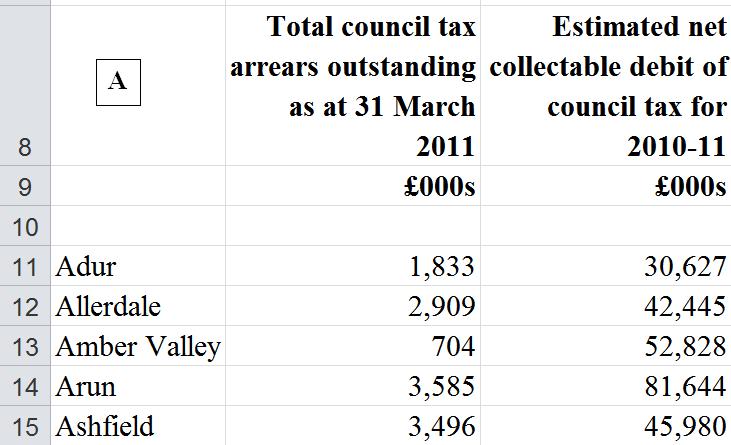
But to ministers this is a distinction without a difference: they can attach their political message equally easily to either set of statistics. Combining Jones’ two questions, Local Government Minister, Bob Neill, placed in the Commons Library a two-column table (Figure A), showing for each alphabetically listed billing authority their accumulated council tax arrears at 31 March 2011, and the total tax they were attempting to collect in 2010-11.


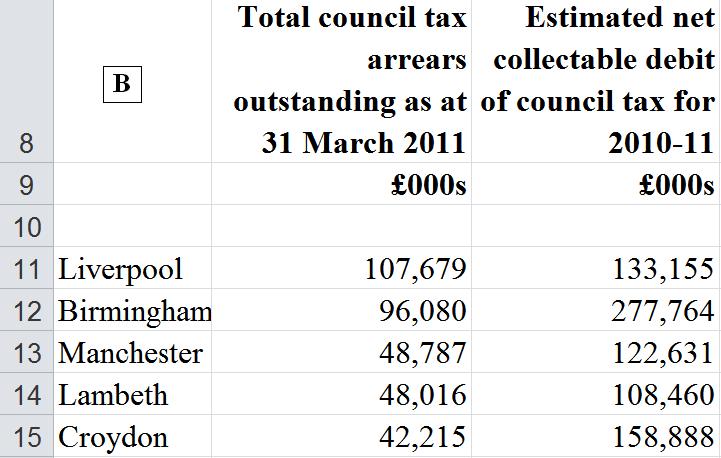
More helpful would have been the 2011-12 figures, which were in fact available to us all a couple of days later. Still, not to worry; other assistance was on the way. Ministers were naturally concerned that the full partisan significance of these figures might be lost, if MPs, let alone journalists, were forced to sift through all 326 of these authorities. So a Spad (ministerial special adviser) circulated the media with a list re-ranking them in order of their total tax arrears at the end of 2010-11 (Figure B).

Guessing the sections of the media likely to run their story, the Spad also added some useful quotes. The revised list was “a league table of the worst offenders”, in which “9 out of 10 of the worst authorities are Labour run”. There were some interpretative comments too from his ministerial master, Eric Pickles:

“This roll call of shame is familiar reading, with Labour councils year in, year out, topping the table of local authorities who squander millions by failing to collect our council tax. If these Labour authorities stopped complaining about the legacy of cuts left by their own party and actually chased up these tax dodgers, they could use the money to protect hundreds of frontline jobs.”

Yes, the DCLG ministerial world is apparently that simple.  All uncollected council tax is attributable to tax dodging and the compliance of lazy, inefficient and moaning Labour councils.  Oh dear – just where do you start?

First, perhaps, with the most obvious.  Yes, Labour Liverpool did top the 2010-11 arrears table, but two of the top five places were occupied by Birmingham, run until May by a Conservative-Lib Dem coalition, and Conservative Croydon. Even the Daily Mail worked out that 9 of the top 10 couldn’t therefore be Labour – albeit in a story whose snappy title left little doubt as to its content: “£2 billion of council tax left uncollected by town halls who then moan about cuts by Whitehall”.

If this arrears listing were indeed a ‘roll call of shame’, Croydon’s prominence would be embarrassing over and above its political control.  As would be expected – by anyone sensing that uncollected tax may not be entirely due to ‘Won’t Pay’, rather than ‘Can’t Pay’ – there is a consistent overall correlation between councils’ annual tax collection rates and their position on the DCLG’s own Indices of Deprivation.

Manchester and Liverpool, for example, are ranked 3rd and 4th on the national Index of Multiple Deprivation, behind Hackney and Tower Hamlets. Birmingham and Lambeth are 13th and 14th. Croydon, by contrast, is no higher than the 20th most deprived borough in London.

As we’ve seen, though, the listing provided to Helen Jones and the Commons Library ranks councils by their accumulated council tax arrears – and in cash terms, moreover, not as a percentage or efficiency measure of anything at all. Big cities, London and metropolitan boroughs are almost bound to head such rankings. If any of the “worst offenders”, Croydon included, wanted to drop down the list and, presumably, earn ministerial brownie points, they could simply change their corporate write-off policy, stop chasing these really hard-to-recover debts, and write them off. Would that genuine efficiency gains were that easy!

To make their party propaganda properly, ministers should have had their Spads rank order not councils’ arrears, but their tax collection rates – their actual tax receipts for the financial year as a proportion of the total due. We now have these figures for 2011-12, and they make interesting reading (Table 7 of hyperlink).

English local authorities collected £22.1 billion in council tax and £20.8 billion in non-domestic rates (NDR), or 97.3% and 97.8% respectively of the totals due to them. Shire districts’ council tax percentages were slightly above the overall average (98.2%) and those of London and metropolitan boroughs (96.3 and 96.1%) and unitaries (97.2%) slightly under.

Highest collection rates in Inner London were in Conservative Wandsworth (98%) and Labour Camden (96.7%), the lowest in Labour Hackney (93.7%) and Lewisham (93.9%). In Outer London, the spread was rather greater, largely due to Newham’s 89.6% – which was 4.5% lower than any other OL borough and, most oddly, 10% lower than its 99.6% NDR collection rate, the highest in London. Supposedly inefficient Croydon was precisely on the Outer London average (96.6%).

Among metropolitan districts, the only three to top a 98% collection rate were an assorted West Midlands trio – Conservative Solihull and Dudley, and Labour Sandwell – followed by Conservative Trafford and Labour Rotherham.  Lowest were Salford (91.3%) and Manchester (92.3%).

Even from this small selection of extremes, it is clear that politically the picture is more complicated than Eric Pickles would have us believe. It is also clear – and, surely, hardly surprising – that Conservative councils overall do have at least slightly higher collection rates than Labour. There may be good explanations for the variations, from year to year and across apparently similar types of authority, but the questions do need asking, which is why these statistics, properly understood and deployed, are so important. After all, if Newham raised its collection rate to that of the hardly more affluent Tower Hamlets, it would bring in an additional £4 million; if Birmingham matched Sandwell, it would collect an extra £10 million.

Of course, other questions too suggest themselves: how, for example, does local government’s £600 million council tax collection gap look when compared with those for HMRC-administered taxes? To which the answer is: not too shabby.

HMRC helpfully produces an annual report on this very subject – Measuring Tax Gaps – and the latest estimates, for 2009-10, include: direct taxes (income tax, NI contributions, capital gains tax) – £14.5 billion or 5.8%; VAT – £11.4 billion or 13.8%; corporation tax – £4.8 billion or 11.7%; beer, spirits, cigarette, tobacco duty – £2.4 billion or roughly 10%. And the total gap: just the cool £35 billion or 7.9% (Table 1.1 of hyperlink). It kind of puts local government’s 2.7% into a slightly different perspective, doesn’t it, Minister?

Chris is a Visiting Lecturer at INLOGOV interested in the politics of local government; local elections, electoral reform and other electoral behaviour; party politics; political  leadership and management; member-officer relations; central-local relations; use of consumer and opinion research in local government; the modernisation agenda and the implementation of executive local government.

Not a blizzard, just Pickles’ latest battlefield

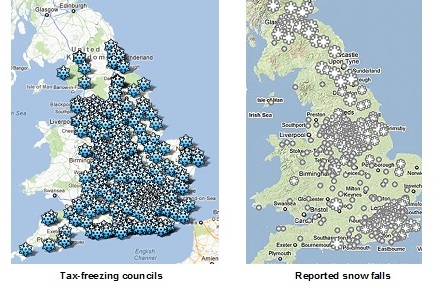
My first thought, when I glimpsed it in a CLG departmental press notice, was that there had been a Conservative power grab within the Coalition. What looked for all the world like a snow report map suggested that Eric Pickles had snatched the Met Office away from the Lib Dems’ Vince Cable at the Department for Business Innovation and Skills, and, having sorted out local government, was turning to the weather and climate control.

The truth, sadly, proved more mundane. It was simply the Secretary of State’s latest move in his battle to bully local authorities into freezing or cutting their council tax next year, and the snowflake-covered map recorded the more than 300 who have so far apparently agreed to do so – each crystalline flake ingeniously representing a virtuous ‘freezer’.

Image

I really feel I must be getting soft in my old age. I have spent much of my academic life explaining to students, councillors, overseas visitors, and indeed anyone who’ll listen, just how centrally controlled and ministerially dominated our local government system is. Yet I’ve still found myself surprised at the lengths to which ministers have gone, at the duplicity of their arguments, and the intemperance of the language they’ve used, in this particular campaign over what, after all, was supposed to be one of those offers you could refuse.

I blogged about it back in January, during Pickles’ early attacks on councillors, when he tried to argue that it was not only their political responsibility but their moral duty to vote against a council tax freeze – even if, in doing so, they would be consciously leaving their council facing a funding shortfall and even higher tax increases in future years.

Ministers then, in quick succession: (1) claimed that the Government’s offer of funding for a 2012-13 freeze had been deliberately designed to limit the growth in councils’ tax bases – though no mention of it was made at the time; (2) confused this new position by suggesting that ongoing funding for the 2011-12 freeze might be protected beyond the current spending review period; and (3) anticipated a possible rule change, whereby councils raising their tax would not be permitted to keep their new tax base next year.

At the same time, having attacked the integrity of councillors, Ministers switched to questioning the professionalism of officers. Chief finance officers who advised their members to put up council tax were likely to be doing so with the intention of “filling the town hall coffers”, and risked involving themselves in politics. Now, through CLG press notices, we’re being treated to almost daily bulletins not merely reporting, but applauding, each new council of any political complexion that signals its intention to freeze or cut its tax.

Part of the reason for recalling these developments is that they coincided neatly with the publication of an interesting report – 2012 Reform Scorecard – from the centre-right think tank, Reform.

The report is an assessment of the achievements of the Coalition Government’s public service reform agenda during 2011, and the scorecard takes the form of an almost CPA-style assessment of the progress made, or not made, by each of the relevant Whitehall departments. “Real reform” has been achieved, the report reckons, by Justice – “has made the best arguments for competition of any department, and translated them into action”; Defence, with the Levene Review – the shining example of Civil Service reform across government”; and, perhaps surprisingly, by the Home Office, with its policing reforms.

At the other end of the spectrum are the departments judged to be “Going Backwards”: Health – “The Government’s original reforms were flawed and 2011’s retreat from reform has made them worse”; Higher Education – “greater freedom to set tuition fees has been overshadowed by market distortions and tighter restrictions on universities”; and HM Treasury – “ring-fencing of the health and schools budgets has put a handbrake on reform and efficiency in those sectors”.

In between these extremes are the departments assigned to a category initially proposed for the CPA, but later abandoned – “Coasting”.  One such department, by the process of elimination, is CLG. The Reform report has both positive and negative things to say under each of its main headings – Accountability, Flexibility, and Value for Money – but its overall assessment can be summarised as follows (pp.41-42):

“The Government’s rhetoric [on localism] has sent an important signal that it is willing to give councils the flexibility they need to deliver services as they see fit”.

Yet this ostensible commitment to localism has been repeatedly undermined by attempts to exercise power over local issues from Whitehall. The Communities and Local Government Secretary has repeatedly called upon councils to maintain weekly bin collections, terming them ‘a basic right’ and creating a £250 million fund to support weekly collections. The Prime Minister, David Cameron, has circumvented local responsibility on the issues of adoption and problem families. In November, the Chancellor announced the extension of a freeze on council tax until 2012-13, mitigated by £675 million worth of funding support for councils to maintain levels of council tax.

“These attempts to impose central controls and pressure over essentially local issues subvert local responsibility and flexibility and firmly enforce Ministerial and bureaucratic responsibility in the place of local democratic accountability” (emphasis added).

And that, of course, was written before Ministers had even started implementing their ‘voluntary’ freeze.

Chris Game

Chris is a Visiting Lecturer at INLOGOV interested in the politics of local government; local elections, electoral reform and other electoral behaviour; party politics; political  leadership and management; member-officer relations; central-local relations; use of consumer and opinion research in local government; the modernisation agenda and the implementation of executive local government.