From Ghana to Birmingham: How a Global Learning Network reinvigorated Public Managers

Shailen Popat

What happens when city managers from Ghana and governance experts from the UK sit around the same table? Ideas spark, assumptions are challenged, and new ways of working begin to take shape. That’s the story behind the Ghana City Managers Community of Practice (CoP) – a bold experiment in international collaboration that’s changing how we think about public management. The full article published in the Education in Practice journal can be found here.

Why This Matters

Public managers everywhere face “wicked problems” – issues like urbanisation, climate resilience, and service delivery that defy simple solutions. Traditional training often falls short because it’s one-off and disconnected from real-world complexity. Enter Communities of Practice: long-term learning networks where practitioners and academics share experiences, co-create solutions, and build trust. They’re not just about knowledge – they’re about relationships and sustained engagement. CoPs are powerful because they bridge the gap between theory and practice. They allow managers to learn from each other, adapt ideas to local contexts, and build confidence in tackling complex challenges. For countries like Ghana, where decentralisation and urban growth create both opportunities and pressures, this approach offers a way to strengthen governance without imposing external models.

The Big Idea

In March 2025, the University of Birmingham hosted 14 senior Ghanaian officials for a week of immersive learning. Backed by the UK’s International Science Partnerships Fund, the visit wasn’t a typical study tour. It was a strategic intervention to launch a transnational CoP – one that blends academic insight with practical experience and positions both Ghana and the UK as partners in governance innovation.

The goals were clear:

  • Forge lasting institutional partnerships
  • Co-design training materials rooted in Ghanaian realities
  • Build capacity through comparative insights
  • Shape future research on urban resilience and inclusive governance

This initiative reflects a broader shift in development practice – moving away from top-down technical assistance towards partnership-based models that prioritise mutual benefit and knowledge reciprocity.

Inside the Week: What We Did

The programme kicked off with a high-energy plenary featuring voices from both sides of the partnership: Prof. Samuel Bonsu (GIMPA), Dr Nana Ato Arthur (former Head of Ghana’s Local Government Service), and Mo Baines (CEO, APSE). Their message was clear – governance challenges may differ, but the principles of collaboration and accountability are universal.

Photograph of the CPD participants and some trainers at the Edgbaston Campus

Workshops tackled decentralisation, participatory planning, and sustainable cities. These weren’t lectures – they were conversations, with Ghanaian managers sharing frontline realities and UK experts offering comparative perspectives. Institutional visits added texture: at the West Midlands Combined Authority, delegates explored regional governance and economic development strategies; at Birmingham’s Lord Mayor’s office, they saw the symbolic power of civic leadership in action. The week ended with a roadmap: virtual meet-ups, annual exchanges, and joint research projects. Participants left not just with ideas, but with commitments to keep the momentum going.

What Changed?

The impact was immediate and tangible:

  • Partnerships Deepened: UoB, GIMPA, and Ghana’s Local Government Service agreed on joint research and staff exchanges
  • Capacity Built: Delegates gained practical insights into governance models they could adapt at home
  • Training Co-Created: New modules blend academic theory with Ghanaian case studies – tools designed by practitioners, for practitioners
  • Policy Influence: Senior officials pledged to embed lessons into local reforms
  • Research Horizons Expanded: Themes like digital governance and urban resilience emerged as priorities for future collaboration
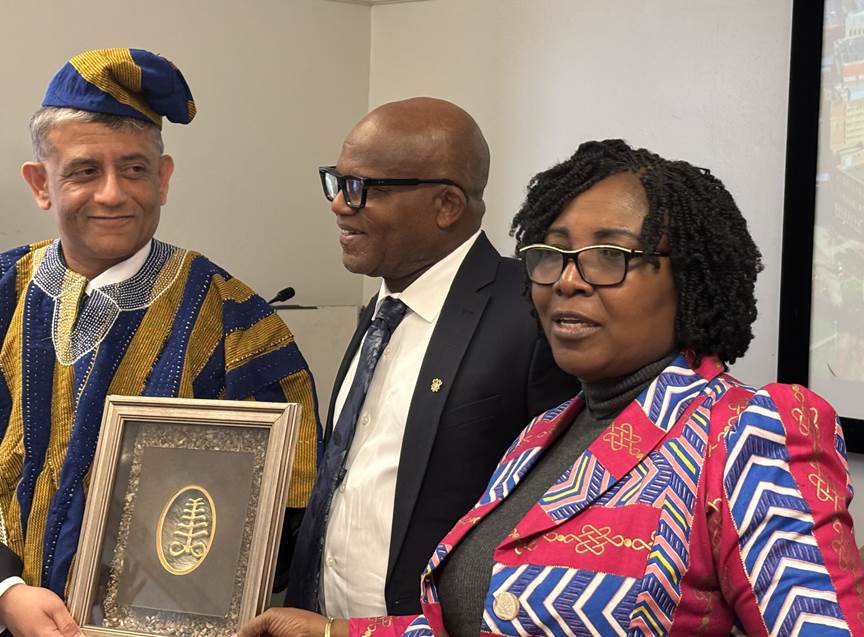
The Head of the Ghanian Local Government Service, Dr Stephen Nana Ato Arthur and the Chief Director of the Office of the Head of the Local Government Service, Madame Felicia Dapaah Agyeman-Boakye, honouring Shailen at the end of the CPD in Edgbaston.

Why It’s Different

This isn’t about exporting UK models or ticking boxes for donor reports. It’s about mutual learning and knowledge democracy – valuing local expertise as much as global frameworks. It’s also about universities stepping up as conveners of global networks, using their resources and credibility to drive real-world change. The co-designed training materials exemplify this ethos. They combine global frameworks with Ghanaian case studies, creating tools that are contextually grounded and practically useful. This approach aligns with calls to decolonise development practice – moving away from prescriptive solutions towards collaborative innovation.

What’s Next?

The Ghana CoP is just the beginning. Plans are underway to bring in managers from other African and UK cities, creating a richer, more diverse learning ecosystem. Future funding bids will build on the success of this pilot, ensuring the network grows and thrives. For INLOGOV, this story is a call to action: let’s champion collaborative governance, not as a buzzword, but as a practice that transforms institutions and communities. The challenges facing public managers are too complex for isolated solutions. By investing in relationships, shared learning, and co-production, we can create governance systems that are adaptive, inclusive, and resilient.

Dr. Shailen Popat works as an Assistant Professor in Public Policy and is the Director of the MSc in Public Management at the University’s Institute of Local Government Studies. He completed his PhD at the University of Oxford and his thesis explored the sensemaking processes of School Principals when enacting a significant new policy. He specialises in supporting public managers to enact policies in a manner that can be effective in their context and is a founding partner of a partnership between the University, GIMPA, and Ghana Local Government. Known for his student-centred approach and ability to explain complex concepts in a comprehensible manner, Shailen is considered to be an outstanding lecturer and tutor and was awarded the accolade of ‘Teacher of the Year’ at the 2022 University of Birmingham Teaching Awards, and in 2023 he was awarded a Senior Fellowship of the UK Higher Education Academy for his Educational Leadership.
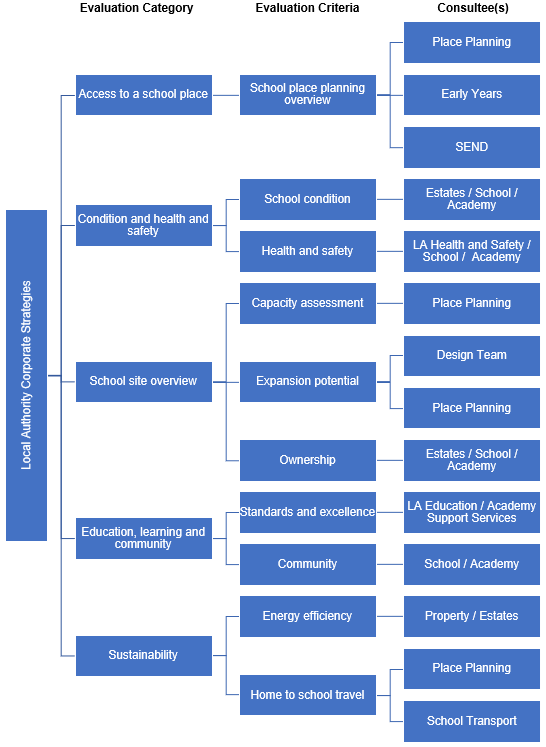
An evidence-based assessment criteria framework for school relocations

Sarah Finn

Local Authorities in England have responsibility of ensuring there are sufficient school places to meet the demands of the population now and in the future. When new housing developments are proposed which result in a demand for additional school places, options include the expansion of an existing school, provision of a new school, or relocating an existing school to a new building on a new site.
The assessment of school relocation proposals is a complex process, impacted by financial constraints and silo-thinking within the public sector.

The project designed a School Relocation Assessment Tool (SRAT) which encourages officers to outline the financial impact of school relocation within the context of the council’s corporate strategies, and to consider short-term and long-term impacts of a variety of evaluation criteria in a holistic way, with weighting to support balanced decision-making. Critically, collaboration is a central factor of the tool.

Key points
• Where appropriately located land is available, some councils are starting to consider the option of relocating and expanding an existing school to a new site.
• Councils are currently only able to request developer contributions to fund the additional places required to mitigate the impact of the development, whereas re-provision of existing places must be met by council borrowing.
• The SRAT tool requires information to be gathered about multiple factors horizontally, across vertical silos within the Council to enable consideration of council priorities in a holistic way rather than being in competition with each other, thus mitigating the negative impacts of silo- thinking by making the assessment joined-up and strategic.
• The project identified several factors to evaluate when assessing school relocation opportunities, including home to school travel distances, community use, and school condition.

Background
Local Authorities in England have a statutory responsibility for education and have a duty to ensure there are sufficient school places to meet the needs of the population now and in the future. Traditionally, mitigating strategies adopted to provide additional pupil places generated by proposed new housing will involve either the provision of an entirely new school setting or an expansion to an existing provision. However, where appropriately located land is available, some councils are starting to consider a third option of relocating and expanding an existing school to a new site (school relocation).
The financial impact is particularly pertinent as councils are currently only able to request developer contributions to fund the additional places required to mitigate the impact of the development, whereas re-provision of existing places must be met by council borrowing.

What we knew already
Where strategic perspectives are not aligned within organisations there is a risk that obstacles to successful collaboration are created across administrative silos, where organisational parts of government [work] in isolation from each other. It’s been argued that reduced budgets have encouraged retreat into departmental silos, rather than collaboration.
Successful strategy relies on several overlapping strategic decisions being made in conjunction with one another, with financial constraints balanced against strategic priorities.
This research project involved both a systematic literature review and a group discussion with four senior council officers concerned with school standards, performance, and infrastructure.

What this research found
Financial and short/long term decision making
The current financial pressures faced by LAs encourages decision-makers to pursue the ‘least-cost’ option, without concern for externalities. The impact of school relocation should be considered within the context of wider council corporate strategies. A strategic perspective encourages LAs to take a longer-term approach to their decision-making.

The SRAT tool requires information to be gathered about multiple factors horizontally, across vertical silos within the Council to enable consideration of its priorities in a holistic way rather than being in competition with each other, thus mitigating the negative impacts of silo- thinking by making the assessment joined-up and strategic.

The project identified several factors to evaluate when assessing school relocation opportunities, including home to school travel distances, community use, and school condition.


School Relocation Assessment Tool (SRAT)

Conclusions
The aim of this research was to formulate an assessment criteria framework for school relocations. To achieve this, the project sought to understand how school relocation decision-making processes were impacted by financial constraints and silo-thinking, and to explore what criteria should be assessed when school relocations are considered.
The resultant SRAT has been successfully designed to encourage officers to outline the financial impact of school relocation within the context of a council’s corporate strategies, to consider short-term and long-term impacts of a variety of evaluation criteria in a holistic way with weighting to support balanced decision- making. Most significantly, it guides officers to collaborate with other teams across the council to ensure joined-up strategy is achieved.
During the research process, the researcher recognised that the literature around school relocation was lacking. The creation of a tool to assess both numerical and non-numerical evaluation factors of school relocations, drawing upon both practical and academic research, appears to have not previously been attempted until now. To build upon this research, different occupational viewpoints should be sought regarding the effectiveness of the tool to improve its validity, particularly from a financial perspective.


About the project
This research was a Master’s dissertation as part of the MSc in Public Management and Leadership, completed by Sarah Finn and supervised by Shailen Popat.

Some thoughts on how universities can benefit the people and communities that they serve

Shailen Poppat

On Wednesday 12th and Thursday 13th June 2024, I will be speaking on a panel with Dr. Rhiannon Jones of the University of Derby and Martin Ferguson of Socitm who invited us as part of their annual President’s Conference on the approaches that can be provided by universities for the benefit of the people and communities that they serve. As time is short on the day, I thought that I would put a few points in writing.

Hub for Collaborations

A University can provide a hub for collaboration between organisations in multiple sectors. Universities inhabit an in-between space – they are part of the country where they are situated and also very international both in terms of the composition of students and staff, and in the reach of their networks and research collaborations. Universities also exist in the cloud, with many courses being entirely online or hybrid, and many library resources now being electronic. Universities are measured on impact and therefore they also lie in that in-between space between academic knowledge and real-world practice within increasing emphasis to show how research and teaching is impacting communities outside of the institutions. Universities are also large employers and magnets for resource in their geographical location. Many suppliers have contracts with universities and many local businesses rely on student expenditure during university term times. This gives a university the influence and gravitas to be able to bring people together in a way that very few institutions can do, and I would advocate that it is something that we need to do much more of in a more organised manner. It does happen but it tends to be driven by individual academics or certain research projects rather than as part of a wider strategic plan either by a college or school.

Spaces to Reflect

Public service workplaces are busy places and over these last 15 years everyone has had to adopt the mantra of achieving more with less resource! This means that public service workers have been doing more than one person’s job which consequently means less time for them to reflect, learn, and develop themselves. Conversations with colleagues provide valuable support within stressful and complicated situations, however, they can often be action and task focused – we are talking shop when we talk to each other in a workplace. And this is where the learning development partnership with universities can be so helpful. I would say that a university course can provide a public service practitioner space to think about bigger philosophical themes that do not get focus in the workplace although implicitly public service practitioners know what these are. At the Institute of Local Government Studies, we deliver three master’s programmes, two of which are part-time programmes and one which is full-time programme. All of these programmes take a student through a learning journey to reflect upon six key questions:

Unless we are thinking about these things we just carry on moving on the treadmill without pausing and considering whether there are alternative approaches to the way things are currently.

Connecting Academic Knowledge with Practice Knowledge

When I am training practitioners or attending knowledge-exchange events, I always keep in-mind that I have to convince people that academic knowledge can be of relevance to their work. Both types of knowledge (academic and practice) can inform each other as much research is really the observation of practice and then taking those observations and formulating theories that can help us to better understand exactly what’s going on. For example, one of my roles in the School of Government is to represent us in a partnership with a civil service college in Ghana. I conducted a training there in March on the topic of understanding organisational cultures which was quite a novel topic for them. One of the models that I used from the academic literature in a workshop format was this one by Johnson et al. (2008).

Participants were mayors, assembly members, city managers, and other public managers, and they were asked to use the model to reflect upon their own work situation for approximately 15 minutes. They then split into smaller groups and shared experiences with each other and this seemed to provide them with a rich understanding of the dynamics that they were experiencing day-to-day but they would not necessarily have analysed what was going on without this exercise, and the academic framework provided a structure in which they could contain their thoughts. The feedback that I received was very positive for example,

‘After the CPD training, I have been able to gradually change the attitude of some staff towards work in terms of lateness, absenteeism, efficient use of material resources, client focus, participation, etc.’

‘By understanding the organization’s mission, vision and goals, as well as foster collaboration, innovation, learning and team effort in achieving the organizational overall objectives. Organizational culture also helps me build shared values and unified efforts among my colleagues, hence it helps to contribute to achieving the organization goals and objectives.’

So, you can see that universities can provide practice with spectacles with which to see what is going on so the practitioners gain better clarity on how to create change.

Shailen Popat works as an Assistant Professor in the Institute of Local Government Studies at the University of Birmingham where he is Director of the MSc in Public Management. In 2022, he was awarded the accolade of University Outstanding Teacher, and in 2023, he was awarded a Senior Fellowship of the Higher Education Academy.

Universities of the future: making work-based higher education work

Dr Abena Dadze-Arthur, Anita Mörth & Professor Eva Cendon

The COVID-19 pandemic is not the only significant event that marks the dawn of a new era. According to UNESCO’s International Institute for Educational Planning (IIEP-UNESCO), globally an estimated 590 million people will be in higher education (HE) by 2040, including more non-traditional learners, who work and study at the same time, than ever before. Inevitably, this begs the question: how can higher education institutions keep up with this expansion and diversification, while effectively equipping graduates for what the World Economic Forum refers to as the fourth industrial revolution?

A new urgency

The good news is that modern conceptualisations of ‘knowledge’ already recognise the imperative of joining up what was regarded hitherto as two incongruous entities: academic scholarship and professional practice. Ongoing debates highlight various compelling imperatives for effectively integrating academia and the world of work within the context of HE: economists emphasise the pertinence of spurring economic growth and re-fashioning national skill formation by aligning formal HE with the needs of contemporary and future labour markets. Educationalists stress the importance of creating competitive knowledge economies by shifting to learner- and employer-centred models of HE, and prioritising continuous professional development and lifelong learning. Moreover, policy-makers and governmental leaders call to mind the Bologna process, and the commitment of national HE systems to implement far-reaching institutional, organisational and cultural changes that respond to the advances of the 21st century.

The inevitability of work-based higher education

As a result, it is slowly dawning on HE institutions worldwide that in order to form skills, knowledge and behaviours that are not only relevant to contemporary and future labour markets, but also meet a nation’s economic and welfare priorities of the 21st century, university students must be exposed to classroom-based learning at the university as well as experiential learning in the workplace. Consequently, systematic collaborations between academic and professional stakeholders are increasingly inevitable in modern tertiary education. There is a substantial role for HE institutions in workforce development, just as much as employing organisations and industry sector bodies have an important part to play in higher education. Universities of the future must provide work-based, or at least work-integrated, learning opportunities that place students at the centre as self-directed learners and self-managing practitioners.

A paradigmatic change

However, evolving higher education institutions to become universities of the future requires a paradigmatic shift that ‘creatively disrupts’ deeply entrenched beliefs, practices and institutions around the incongruity of academia and the world of work. Such a shift must come with a new pedagogy that bridges unhelpful binaries between ‘theory’ and ‘practice’, ‘knowledge’ and ‘competence’, and ‘classroom’ and ‘work-site’. The transformative processes associated with a paradigmatic change must also facilitate new innovative collaborations with non-traditional partners, bringing together HE institutions, employers, industry associations, sector bodies, and professional or technical educational providers. Moreover, the change must bring with it novel approaches to calibrating HE education to employer and sector needs that adopt a long-term view and are capable of avoiding the temporary or short-term priorities of industries and economic sectors. Last but not least, the transformation will not be sustainable if university operating procedures fail to undergo far-reaching reforms in the way they ‘do’ admission, registry, finance, marketing and liaison with external stakeholders.

No one size fits all

Of course, the old adage ‘different strokes for different folks’ holds true and there is no single, one-size-fits-all blueprint that universities are able to follow in transforming and joining-up HE with forms of experiential learning in professional practice. Instead, HE providers, and their constituent faculties, have to develop their very own, tailored approaches to adapting work-based HE. Without a doubt, this is no easy task as a successful transformation hinges not only on a university’s internal structures, institutions and its opportunities for agency, but also on external factors, such as legal frameworks, national and regional policies, local economies, regional labour market demands, employer needs, industry standards, and so forth. Having said that, good practice examples can be powerful catalysts in achieving a paradigmatic change because they not only make explicit the factors that create positive results and drive transformation, but they expand conceptions of what is possible.

International trailblazers

The recently published report ‘International Trailblazers: Work-Based Higher Education in Selected HE Institutions in the US, England and Denmark. Results of an International Case Study Research Project’ offers just such insight into good practice by mapping in detail the diverse approaches to work-based higher education of five trailblazers across the US, England and Denmark. Innovative, work-based study programmes developed by visionary departments and institutes at Drexel University, University of Pennsylvania, Middlesex University, University of Birmingham, and Aarhus University are presented using a case study approach and deploying data triangulation from national and institutional perspectives. Although the cases differ widely, the report is able to identify a range of factors as pertinent for making work-based education work, including productive partnerships, a purposeful division of staff roles, formalised links to ensure a pedagogy that systematically integrates theoretical, experiential and peer-based learning, permeability between HE and professional training routes, deliberate but flexible government policies and funding incentives, and an impetus for change. Those HE providers that are ready to transform to universities of the future can gain a great deal from these insights, including much inspiration for structural, institutional, operational, pedagogical and cultural changes.


Abena Dadze-Arthur is a public management scholar and currently researches work-based higher education for Germany’s Federal Ministry of Education and Research at the University of Hagen in Germany. She also works as an Associate at INLOGOV, where she has been teaching online master-level courses since 2012. Prior to that, Abena spent 10 years working as a public policy reform specialist for various governments in Abu Dhabi, London, and Paris. Her main research interests focus on the transferring and brokering of knowledge across and within institutional and cultural boundaries, and situated agency and cognition under conditions of change.

Photo copyright: Hardy Welsch

Anita Mörth is an educational scientist working with the Department for University Continuing Education & Teaching and Learning at the FernUniversität in Hagen, Germany. Prior to that she was working in quality management at a university for professional studies in Austria before she became a research associate and quality manager at the Berlin University for Professional Studies, Germany. Her main research interests focus on identifying key concepts of current and future formations of continuing higher education, as well as conceptions of learning, gender, and diversity. 

Eva Cendon is an educational scientist and Head of the Department of University Continuing Education & Teaching and Learning at the FernUniversität in Hagen, Germany. She also heads the research team of a government-funded German-wide initiative “Aufstieg durch Bildung – offene Hochschulen“ (Advancement through Education: Open Universities), which involves her working with over 100 universities in Germany on developing new programmes for lifelong learning. Her main research interest lies in linking academic and professional knowledge in university teaching and learning. She engages in participatory, future oriented research on issues concerning universities of the future.