Grubby-handed local politicians? It’s called local democracy and devolution, Sarah!

Chris Game

The BBC’s Radio 4 Today programme isn’t what Americans would call a Hot Talk show, and nicely spoken presenter Sarah Montague, even in her own fantasies, is no shock jock. So listeners must have been slightly surprised to hear her, while questioning the proposed devolution of NHS funding to Greater Manchester’s combined authority, talk of “local politicians sticking their grubby hands into the decision-making process” (07.50).

She tried laughing it off and rephrasing, but it was already out there – an unintended confirmation of the dismissiveness with which so much of our London-centric media treat sub-central government. For them, it’s apparently a world too complicated to try to understand and explain; one in which every small service variation is a product not of local democratic choice, or the Lyons Report’s ‘managed difference’ (p.3) – but a ‘postcode lottery’ and thus an easy cue with which to stir up listener and viewer outrage.

With Scotland and Devo Manc putting down serious markers and new combined authorities springing up seemingly every week, English devolution will be a major issue at and following the General Election, whether parties and voters want it or not.

Voters, we know, aren’t clamouring for it. A YouGov/Prospect poll just after last September’s Scottish referendum presented a large sample of English voters with a list of 18 specific things Britain’s government might do over the next few years, and asked them which four or five they felt were the most important.

Probably unsurprisingly, tightening immigration rules came first, favoured by 55%, then providing more money for the NHS and holding down gas/electricity prices. “Giving more powers to English regions and local councils” came 17th, just 12% according it any importance at all.  Unpromising, but, unlike England’s cricket World Cup campaign, there are some definite positives out there.

First, as many local authorities used to find when they could still afford to commission annual surveys of residents’ views, councils and councillors generally have a better image, not only than Westminster and Whitehall, but than they themselves sometimes realise.

The Local Government Association (LGA) still does undertake such surveys, its most recent, by Populus last October, broadly confirming previous findings. Around 70% say they’re satisfied with their own council, and, asked who they’d trust most to make decisions about how services are provided in their local area, 72% said councillors, 11% MPs, and 7% government ministers.

But that’s the easy bit. These encouraging levels of satisfaction and trust relate to councils’ currently very constrained tax powers and policy discretion. They quickly dissipate when it’s suggested those powers be extended or more strategic service decisions be made locally.

The YouGov/Prospect poll also asked its English respondents at which level – England-wide, regional, local – decisions on ten services should be made. For six services the choice was overwhelmingly national, including VAT and unemployment benefit rates, the core curriculum, and NHS drug and hospital treatments. Refuse collection frequency was the only decision even a bare majority (53%) allocated to local councils, and 38% wanted even that to be national or regional.

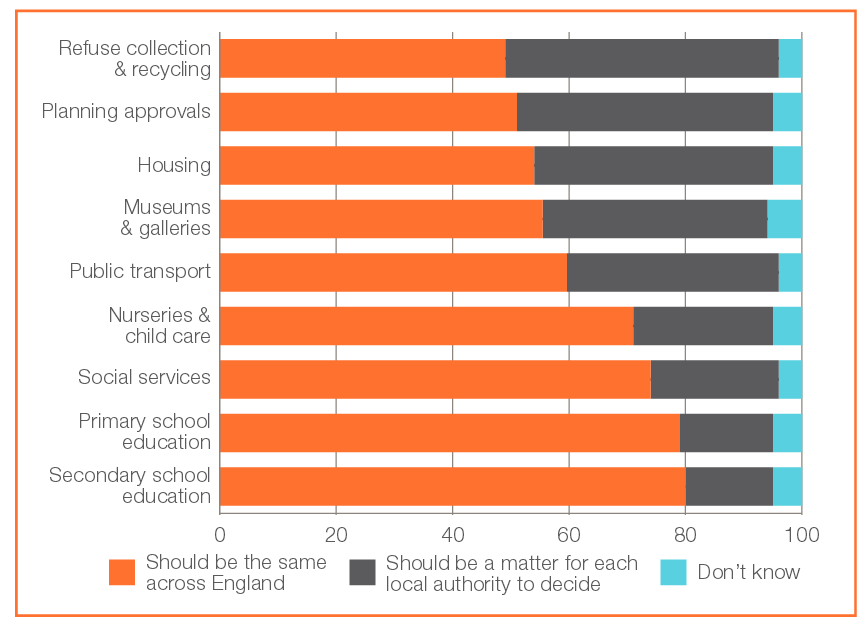
This English predisposition towards uniform national standards in almost everything can seem extreme, but it clearly runs deep and is well documented.  A 2012 YouGov survey for the Institute of Public Policy’s Future of England report asked a similar question: whether certain policies should be the same across the whole of England or should be matters for local authorities to decide.

Again, as shown in the chart, there wasn’t a single service – refuse collection, planning approvals, housing, museums and galleries – that a majority of respondents saw as a chiefly local government responsibility.
Game blog pic

It’s perfectly possible, even reasonable, to suggest that differently worded questions would elicit different answers; that, if you put respondents in a focus group, presented them with evidence, and let them think for more than five seconds before answering, they’d change their minds; even that, dammit, they’re just wrong. The fact remains that this is what they instinctively think and say, and it presents an unignorable hurdle for would-be devolvers, especially politicians. There are signs, though, that at least the height of the hurdle is adjustable.

Returning to the recent YouGov/Prospect survey, although, refuse collection excepted, there was no service on which respondents came near to preferring local to England-wide decision-making, the picture changed a bit when regional and local preferences were combined.

Put brutally, it’s ‘local councils’ – the label, the actuality, or both – that aren’t trusted with anything more than our rubbish. Combine them with ‘regional level’, and there are clear majorities for the sub-national determination of strategic policing priorities (64%), siting of new towns and major new housing projects (60%), and rules governing social housing rents (52%).

Interestingly, there were some arguably similar findings in the surveys of Londoners and ‘London business decision-makers’ by ComRes in January.  In both surveys there were majorities (56% and 60% respectively) in favour of “Local Government having greater control in London over tax levels and how those taxes are spent”.

It quickly turned out that the tax levels most respondents had in mind were limited to business rates and stamp duty land tax. Nor was there anything remotely approaching majority support for even business rates being set by ‘local borough councils’. But again, combine local and ‘regional’ tiers – in this case the boroughs and Greater London Authority/’City Hall’ – and majorities in both samples (58% and 73% respectively) were in favour of ‘Local Government in London’ setting business rates, with over a third in each case prepared to add stamp duty land tax as well.

All of which seems to suggest that, in a future of large, and in some cases almost regional-scale, combined authorities, committed devolvers have at least something positive to work with – provided, of course, media presenters keep their grubby centralist hands out of the debate.

Chris Game - pic

Chris Game is a Visiting Lecturer at INLOGOV interested in the politics of local government; local elections, electoral reform and other electoral behaviour; party politics; political leadership and management; member-officer relations; central-local relations; use of consumer and opinion research in local government; the modernisation agenda and the implementation of executive local government.


Core Activities: notes from the Core Cities Summit, February 2015

On the 11th February over 300 people from across the public sector met for the Core Cities Summit in Glasgow. This post summarises the point reached so far and some of the conference’s live issues, and suggests three areas for further consideration: how to involve MPs and MSPs more fully, engaging communities in the debate and considering what kind of country the UK should become.

Core Cities at the forefront of innovation

The Core Cities buzz continued in Glasgow on 11th February at its well attended summit which launched the next stages in cities-based devolution discussions. The Core Cities’ approach to innovation through collaboration has challenged the government by setting the pace. It was a cross-border event which included a look at how the next round of devolution proposals will affect Glasgow, as an indication of the next stages of the development of the Core Cities campaign.

The event pages are online and the Twitter hashtag #devosummit is searchable for reactions. The summit launched both the Core Cities charter for devolution ‘A Modern Charter for Local Freedom’ and the Respublica report Restoring Britain’s City States.

A charter for devolution and recommendations for action

The Charter sets itself in the context of the 800th anniversary of Magna Carta and the waves of change emanating from the 2014 Scottish Referendum vote. It calls for action to consider what a ‘modern, mature state for the UK’ would look like, one which enables prosperity, equality and democracy. It sees itself as being applicable to the whole of the UK and not just to the Core Cities.

Devolution to local places is at the heart of its proposals with local freedom to make strategic decisions, to tax and invest, and to determine the shape of strategic planning and service delivery at the sub-regional level. To enable this, it calls on the Government to establish an independent body to facilitate devolution and oversee change, while ensuring that communities are strengthened, key investments are made, services are transformed and decision making devolved further to the appropriate level in communities, neighbourhoods and individuals.

Respublica’s report, Restoring City States, focuses on city devolution. It seeks to build on the recent city deals with Manchester and the Sheffield City Region in order to forge a ‘rebalancing of the relationship between central government and cities. Many of the issues set out in the Charter for Devolution are explored in more depth and underpin the report’s eight recommendations.

Core Cities’ case for change

Opening the Summit, Cllr Sir Richard Leese stressed that the summit was about a constitutional settlement, not just the devolution of powers. Ben Page highlighted the fact that whilst people are dubious about whether devolution is of relevance, they are concerned about inequality and there is potentially the space to try something new and to engage them in debate, as shown in the Scottish Referendum. In the Scottish context, Jim Murphy MP sought greater devolution by the Scottish Government to its cities. However Keith Brown MSP wondered whether local government could make more of its existing powers and was uncertain whether legislative change was really needed to achieve the Core Cities’ aims, a rehearsal of some of the debate nationally.

Considering reform to powers and fiscal matters, Danny Alexander MP wanted to see the government look at the devolution of stamp duty, amongst other measures, with a clear fiscal base to municipal re-empowerment. Philip Blond, Respublica, considered that the post 1945 model of the state was no longer fit for purpose and sought a new model to deal with a much more complex public service challenge. He considered that there might need to be some intervention in some ‘trailing’ cities to jump-start change, but considered cities to be the only agents nationally capable of bringing equality in an age of globalisation. Cllr Nick Forbes called for the next Comprehensive Spending Review to be based on place, rather than the individual spending limits of departments.

On the future form of devolution, Cllr Nick Forbes also stressed the need for cities not to be ‘walled cities’ but ones open to their surrounding partners, rooted in their local hinterland, pulling together to develop infrastructure, and linked into ideas about social justice. Pat Ritchie highlighted the need for devolution to be capable of adaptation to the different needs of different places. And Mayor Jules Pipe, speaking for London Councils, highlighted a need for devolution thinking to extend nationally, with further change needed in London, for example, to meet the extent of empowerment sought by the Core Cities.

Gaps and challenges

The focus of the day focused more on the growth agenda that it was on the social development of cities, although they are of course entwined, there were also some interesting gaps and unresolved issues.

The first gap relates to national politicians, the devolution debate has made much of devolving from government to city or place, but little has been said about the role of MPs (or MSPs). All of the cities involved in the discussion have numerous national representatives who are currently not part of the picture. There was talk on the day about the development of local Public Accounts Committees but as yet no sign of the development of a shadow version to see if it might work and help to hold a core city to account.

The second gap points out there has been little discussion of the quality of community in cities and aspirations for their development. Perhaps understandably much of the discussion has been aimed at central government, but the relationship of local people to each other and to the local state needs to be as much a part of the desired debate about the modern form of the state as a whole as any of the issues highlighted at the summit.

The third gap relates to the fundamental question of the kind of state the UK wants to be in the future (and here it is worth pointing out that this has been almost solely a local government led debate which of necessity does not yet include key local players in national services such as the NHS). This is a debate which perhaps should be at the core of the general election campaign, but is currently not on the agenda.

Next steps for everyone?

In its submission to the Political and Constitutional Reform Committee’s consultation on the constitution, INLOGOV said (amongst other things):

English devolution to a system based around London and the core cities would carry considerable risks if it becomes an exercise which bolts-on powers without thinking through the systemic change that is needed. We need to resolve the question of responsibilities, of citizens, communities, cities and regions, before the reallocation of powers.

… The UK’s greatest potential is contained in its networked nature, and the same can be said of the best cities and counties. What is needed is therefore constitution which does not just chunk up centralised power and devolve it.

… There should be a clear agreement about how power is shared (rather than devolved) between different legitimate and competent parts of the UK state, including local, regional and national governments.

So the current debate is a necessary one about devolution, but perhaps needs to develop into one about power sharing. To return to the Magna Carta theme, the Barons sought limitations to the exercise of central power and a clear basis for sharing it. They also did not rely solely on rational argument but potentially had the means to force King John to comply with their demands. It will be interesting to see how the Core Cities muster their forces and deploy them during the coming election and beyond.

As Sir Richard Leese recognised, the number of places that can be considered as core cities is necessarily limited. However it is clear that the approach that Core Cities have set out is one which has its application across England especially and the UK as a whole. All can benefit from the learning about ‘what works’ in creative, collective approaches to change and the development of confident, positive narratives about places and their people. And INLOGOV is uniquely placed to offer support by sharing learning and exploring approaches which challenge barriers of stagnation, short-sightedness, parochialism or old rivalries, all of which get in the way of what is important: long-term development based on outward-looking collaboration.

Know your local Councillor Photographs - St Albans - May 2008

Daniel Goodwin is an Associate Fellow of INLOGOV. He was previously Executive Director of Finance & Policy at the Local Government Association and Chief Executive of St Albans City & District Council.

The future is Intercommunality – yes, but with whom?

Chris Game

Rom com/date movies aren’t really my thing, so my excuse for watching the recent Words and Pictures was that I was a captive plane passenger – and that the ever-watchable Juliette Binoche was playing a rheumatoid arthritic abstract painter and prep school art teacher. The title refers to the silly challenge she charily accepts from alcoholic poet turned plagiarising English teacher, Clive Owen, to ‘prove’ whether Words or Pictures are more meaningful.

One of the Owen character’s numerous obnoxious ways of irritating colleagues is with his show-off polysyllable game: I’ll give you a five-syllable word, you give me one of six syllables, etc. Binoche, at least initially, won’t play, which, while entirely understandable, I personally found slightly disappointing, as I could SO have helped her.

For starters, I know that the seven-syllable word most frequently used conversationally was calculated (don’t ask!) to be, not homosexuality, which was one of the commoner guesses, but telecommunication – followed pleasingly by the one that describes INLOGOV: interdisciplinary. In the near future, though, it will surely be intercommunality – at least in local government conversations, most of which currently seem focused on Combined Authorities (CAs).

At present, we have just five: Greater Manchester, very much first off the blocks in 2010/11, followed earlier this year by West Yorkshire, Liverpool and Sheffield City Regions, and the North-East. But over the past fortnight alone, quite apart from the general ‘Please sir, can we have some of whatever Scotland’s getting’ pleas, we’ve had almost daily reports of CA discussions – among five Tees Valley councils, all 14 in Lancashire, some or many in Hampshire, six in West London, and four (or maybe five, six, or more) in the West Midlands, all seeking, through the formation of CAs, to grab some of the devolution goodies that Greater Manchester negotiated with George Osborne in exchange for a directly elected metro-mayor.

Of course, only in the UK could it possibly be deemed nationally newsworthy that a number of contiguous local authorities were thinking of working together in the interests of more efficient service delivery. I’m no specialist, but even I recall back in 2007 a whole book of country case studies of Inter-Municipal Co-operation in Europe (ed. by Hulst & van Montfort), demonstrating what a widespread phenomenon it had become in much, if not most, of Europe.

One reason I recall it is that it appeared around the same time as an article by Josie Kelly (Aston U) entitled ‘The Curious Absence of Inter-municipal Co-operation in England’ – a curiosity, I felt, that evaporated quite quickly, once you considered surely the single most basic explanation: namely, the structure and sheer scale of our local government.

With that in mind, let me start this brief backstory with a few figures on scale. England’s population is 54 million, and we have 326 unitary or lower-tier district authorities, with an average population of 165,000. The equivalents in France, population 66 million, are 36,700 lower-tier communes, average population 1,800.

Most communes date back to the 1789 Revolution, and the French are very attached to them – voting for their councillors and mayors in roughly twice the numbers we do. Successive Presidents tell them this ‘millefeuille’ structure of micro-communes is outdated, inefficient and must be reformed, but French citizens care more than us and they resist. No enforced mergers, humongous ‘local’ authorities, arbitrary boundary lines on maps, and meaningless council names for them.

So, French governments were forced to develop a compromise: intercommunal cooperation. By a mix of threats and incentives, communes were persuaded to group themselves into some 2,500 cooperative communities of varying shapes and sizes.

Biggest, most integrated, and with most powers and fiscal autonomy, are 16 urban communities (communautés urbaines) for the largest metropolitan areas. Smaller urban areas have communautés d’agglomération, and rural areas, without an urban core of 15,000 residents, have communautés de communes, which account for the great majority of the total.

With its ultra-local communal structure, France’s network of inter-municipal co-operation is one of Europe’s most extensive. But Spain has its mancomunidades (municipal associations), Italy its Unioni di Comuni (municipal unions), Germany Zweckverbände, and so on. As in so many things European, it is we who are the real exceptions. England’s enormous and largely self-sufficient local authorities, and their minimal responsibility for what in many countries are still public utilities, mean that our insularity has extended to a near absence of formal inter-municipal co-operation.

But the future, we’re told, will be different. The future is partnership working in general, and Combined Authority intercommunality in particular – which is fine, unless you happen to live, as I do, in Birmingham. First, you find you’ve missed out on the possibility of living in a regional Powerhouse, like a good chunk of ‘the North’ apparently will be. And second, it’s far from clear exactly who, when the music stops, we’ll be communing with.

Our problem, as ever, is Manchester. I had occasion last year to puncture its pretensions to be ‘Britain’s second city’ but now, it seems, it’s become English government’s José Mourinho, the special one. Worse, like Chelsea’s manager, it not only has a powerful and supportive backer, but is also pretty smart itself.

That smartness was seen in the city council’s being first to utilise Labour’s 2009 Local Democracy, Economic Development and Construction Act by orchestrating the creation of a Greater Manchester Combined Authority. The Act’s chief purpose was to set up local authority leaders’ boards to replace the abolished Regional Chambers, but it also provided for the creation of combined authorities covering multiple, contiguous local authority areas. In fact, the GMCA recreated the Thatcher-abolished 10-borough Metropolitan Council, by pooling newly devolved powers on public transport, skills, housing, regeneration, waste management, carbon neutrality and planning permission.

Though conceived under Labour, the GMCA’s establishment dates from 2011 and, perhaps surprisingly for an invariably Labour-dominated body, its principal backers have been Coalition ministers and most notably northern MP and Chancellor, George Osborne. Manchester especially has consistently opposed elected mayors, the Government’s proclaimed condition for further devolution. Nevertheless, it was the GMCA’s 2012 City Deal that included a ground-breaking ‘earn back’ tax provision, enabling it to recoup annually from government up to £30 million from increased business rates for reinvestment in a revolving infrastructure fund.

None of the other seven 2012 City Deals – even Liverpool’s, announced on the very day the city council took the decision itself to have an elected mayor – were as expansive, and the reason seemed inescapable. Though called City Deals, ministers had to negotiate any regional dimension they involved, not with a statutorily based, politically led, service-delivering CA, but with Local Enterprise Partnerships (LEPs) – voluntary, business-led, minimally resourced alliances of councils and businesses that help coordinate local economic development. More than talking shops, but not serious intercommunality.

You didn’t need a weatherman to know the wind direction. City-based LEPs, particularly where wholly or largely coterminous with a former metropolitan county, began negotiating for CAs, and, as noted above, there are now four more, leaving the West Midlands as the only ex-met county without one. Meanwhile, both major parties claim to see CAs, rather than ever larger merged councils, as the best vehicles to implement their vague, fluctuating, but still important devolution plans. For the present, though, the dealer’s chair is still occupied by George Osborne – yes, this is definitely Treasury, not DCLG, stuff – and first bidder for the next wave of devolution deals was once again Greater Manchester.

This time a price tag came with the Chancellor’s ‘Northern Powerhouse’ deal – a required and reluctantly agreed directly elected metropolitan mayor. The £1 billion of devolved funding and services s/he will share with the CA, while unremarkable in many EU countries, constitutes a big deal here, and everyone else desperately wants one too. The problem is that not everyone has Greater Manchester’s nicely polycentric coherence – seven of its nine surrounding boroughs sharing borders with the core city; or its unambiguous identity, its established record of intercommunal cooperation, and, above all, its undisputed name.

Demonstrably, the West Midlands doesn’t, which is why the recent stream of feverish announcements from local council leaders has seemed half-baked, unconvincing, and – who knows? – even potentially self-defeating. First, a West Midlands CA of Birmingham and the four Black Country boroughs (Dudley, Sandwell, Walsall, Wolverhampton – all Labour), with Coventry (Labour) an unsigned probable, but Solihull (Conservative, and Coventry’s only contiguous borough) an unsigned reluctant, which raises questions at the very least about an integrated transport policy.

Then, there are the Worcestershire and Staffordshire districts in the Birmingham/Solihull LEP and those in Coventry/Warwickshire LEP – apparently, they’re maybes or haven’t-yet-been-askeds. An elected mayor, twice rejected by Birmingham, is an unmentionable, and as for the name – the obvious but toxic Greater Birmingham? West Midlands? Birmingham City Region? Mercia?? Nobody is keener than I on the devolution of significant powers and fiscal discretions to our cities and city regions, but even I would take some convincing about somewhere that couldn’t make up its collective mind on its area, composition, name or form of governance.

gameChris Game is a Visiting Lecturer at INLOGOV interested in the politics of local government; local elections, electoral reform and other electoral behaviour; party politics; political leadership and management; member-officer relations; central-local relations; use of consumer and opinion research in local government; the modernisation agenda and the implementation of executive local government.

Achieving better outcomes for the troubled family of local government

In this debate, Simon Parker (NLGN), Catherine Staite (INLOGOV) and Tony Bovaird (INLOGOV) agree that the current state of UK local government is unsustainable – but see different routes to rescuing a sustainable future.

Simon Parker

The UK is currently renegotiating its social contract. You could be forgiven for not having noticed. After all, our national politicians don’t really want to talk about it. But at the local level this debate is impossible to avoid: councils will either have to invent the next generation of government or find themselves one nostril above the waterline.

So far, so consensual. The big challenge lies in whether and how a positive kind of change might happen, and this is perhaps where recent work on the future of local government differs most strikingly. The more hopeful scenarios in INLOGOV’s recent report with Grant Thornton (2020 Vision: Exploring finance and policy future for English local government) rely heavily on changes from Westminster. They ask for a major recalibration of the central/local relationship as the only way to preserve local public services.

This is a risky strategy. It is far from clear that any government in 2015 is really prepared to take the kind of radical action that would be necessary to put local services on a sustainable footing.

How would a new localist settlement reach the political agenda? Do we really believe the English question is a powerful-enough driver, especially when the agenda has been shunted into either the watery promise of a constitutional convention or English votes for English laws?

Isn’t more incremental muddle still the likeliest outcome? It would have been interesting to see INLOGOV’s report puzzle this one through in more detail.

This is not a counsel of despair. My own recent work is optimistic about the potential for a combination of incremental national change combined with rapidly accelerated local innovation to drive the creation of a new way of doing local government. I don’t pretend this will happen evenly across the country. Innovation never does, especially in a society where resources and opportunity are so unequally distributed.

But we only need a few authorities to make the breakthrough to a new mode of operating so they can show others the way. Waiting for the centre is far riskier.

Simon Parker is director of NLGN. He started his career in journalism and has since worked in management consultancy, lobbying and research, most recently as a fellow at the Institute for Government. Simon has published widely on public service reform in the UK and internationally.

Tony Bovaird

The 2020 Vision report suggests that only ‘disruptive innovation’ can save the English local government system. However, it also gives plenty of evidence that neither central government nor most local authorities are likely to be keen on disruptive innovation in practice – and some local authorities wishing to espouse it may turn out to be no good at it. The report also stresses (p.32) that ‘any new system is likely to fail if it is imposed upon a local government sector which does not agree with its broad outline’.

So disruptive change is needed, is likely to be resisted and cannot successfully be imposed externally. This is a bleak picture. However, there appears to me to be one get-out available – giving real ‘localists’ their head.

The whole point of local government is that it should be locally different, so that it can be locally appropriate. ‘Locally appropriate’ carries a price, of course – it means that locally appropriate resources need to be available, in order that locally appropriate outcomes are achieved. This is the question that has to be solved in order that we have ‘locally different’ local government. Because we DON’T have ‘locally different, locally appropriate’ local government, it is no surprise that the public doesn’t know much about local government, nor care much, nor protest at the current evisceration of councils.

So, let’s design a pathway to ‘disruptive innovation’ that does not rely on policy wonks in Whitehall. Let’s give to local authorities wishing to be really ‘localist’ the right to a local tax (perhaps they should be allowed to choose local income tax, local sales tax or local mansion tax?). And let’s give them the right to pool their budgets with other local public service agencies, to share data with any other local public service agency and to use their budgets to take compulsory short-term leases (at low rents) on any properties (housing or commercial) in their area which have been empty for more than a year.

In this way, the full power of local resources (not just local council budgets) would become available to local government.

And how should these ‘really localist’ local authorities be chosen? Well, not by Whitehall, for sure. Nor by any central mechanism (such as the LGA nominating some of its members). No, let residents decide – any local authority should be allowed to go down this route if it gets support in a local referendum.

tony-bovaird-Cropped-110x146Tony Bovaird is Professor of Public Management and Policy at INLOGOV.  He worked in the UK Civil Service and several universities before moving to the University of Birmingham in 2006.  He recently led the UK contribution to an EU project on user and community co-production of public services in five European countries, and is currently directing a project funded by the Arts and Humanities Research Council on using ‘nudge’ techniques to influence individual service co-producers to participate in community co-production.

Catherine Staite

We have a settlement which is the most centralised in the world. There are two sides to the balance of power between central and local government and two things have to change – local government needs to take back some powers, including over local taxation, but central government also needs to let go.

My heart lies with local government but my head observes that it has not yet made a compelling case for devolution – from the risk averse perspectives of Whitehall and central government. So what are the factors which would encourage and enable Whitehall to let go?

The first one must be demonstrable competence. Local government can make a good case that they are pretty good at what they do. Of course, bad things do happen and sometimes lessons aren’t learned, resulting in serial failures. These instances get into the news because they are so rare. All major failures involve other agencies but local government often ends up holding the blame instead of getting recognition for what it is very good at – holding the ring in a complex system of public services.

Sadly, the effective financial management, reliable service delivery and inspired leadership of place, which characterise the majority of local authorities, doesn’t make the news. You just don’t see ‘residents reasonably happy’ as a news headline but perhaps more public recognition by central government of local government’s competence would help to strengthen mutual trust.

The second one would be a coherent, agreed approach on the shape of local government in the future, but we are a long way from that. The competitive habits of some county councils – arguing that county unitaries are the only way forward for two-tier areas – have generated more heat than light as well as flying in the face of the evidence success of a number of long running collaborative arrangements between districts.

The process of agreeing the boundaries and then creating the 2009 unitaries was fraught, in several areas, with the worst sort of behaviour but Combined Authorities have now begun to demonstrate just what can be achieved when old rivalries are buried and everyone is focusing on the future not the past. This suggests that collaborative, rather than competitive approaches will deliver a brighter future for local government. That would be better for everyone, as counties seem to forget that, in a change to unitary status, they would also be abolished. In the elections following the creation of the 2009 unitaries, former district members did better than former county councillors.

The third useful thing would be democratic re-engagement. Of course, it is hard for members to engage with their residents when the residents can see quite clearly that most important things, like how much money the council has, are decided a long way away in Whitehall. That would change if we had some devolution but, in the meantime, there are a lot of things which could be done now. The profiles of elected members in terms of age, ethnicity and gender don’t match the communities they serve. This is the result of two significant failures, that of political parties to invest in the recruitment and development of excellent and diverse candidates and that of many members to adapt to the modern world. A lot of complex and challenging questions remain unanswered, including what level of allowances would enable someone who has not already retired on a good pension to become a member.

Members often resist becoming involved in development activities and using new technology, but unless they have the skills to become more strategic and make better use of their time, they’ll be presiding over the councils which are sliding from ‘a nostril above the water’ to being completely submerged.

Catherine StaiteCatherine Staite is the Director of INLOGOV. She provides consultancy and facilitation to local authorities and their partners, on a wide range of issues including on improving outcomes, efficiency, partnership working, strategic planning and organisational development, including integration of services and functions.

Devo max – what it is and why it won’t happen

Chris Game

Devo Max – it sounds like a 99% efficient toilet cleaner, or a dodgy West Country car dealer, but either way I visualise its initials in upper case. And that’s its problem. It’s undoubtedly the ‘must use’ expression of the month. It’s not complicated, like ‘full fiscal autonomy’ or the Barnett formula, so anyone feels able to drop it authoritatively into even casual conversation. And everyone has their own idea of what it is.

For party leaders, desperate to save the Union in the final hours of the Scottish referendum campaign, it was perfect Looking-Glass, Humpty Dumpty-speak: it means just what we choose it to mean.  Sign up now, check it out on Friday the 19th.

For YesScotland campaigners it was a verbal Blob, impossible to pin down and attack – and especially frustrating, as they were the ones who had no need to check it out. They knew its precise meaning because they’d invented it, and knew that it wasn’t at all what most wavering voters imagined they were being offered.

It actually originated in a 2009 Scottish Government options paper, Fiscal Autonomy in Scotland. Five distinctive options were spelt out, ranging from the SNP Government’s preferred full fiscal autonomy (FFA) in an independent Scotland to a minimally changed current fiscal framework, which gave Scotland considerable discretion over spending but little over tax revenue raising, borrowing, or broader monetary policy.

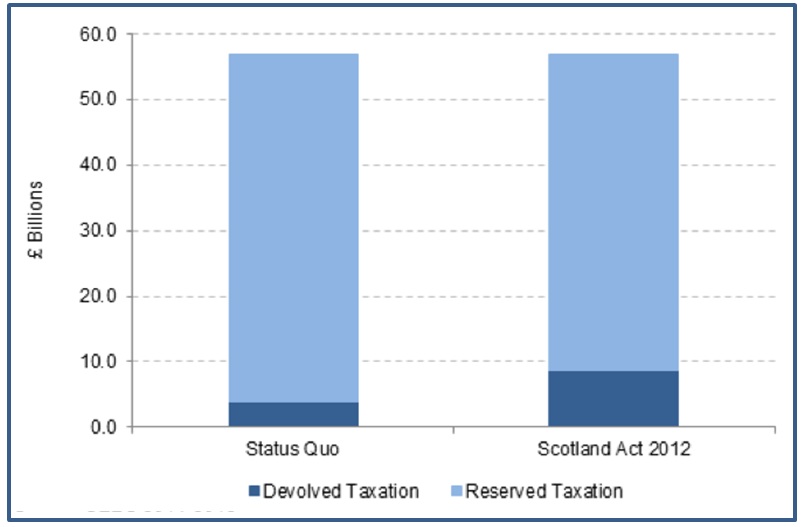
‘Devolution max’ was the SNP’s fall-back option, clearly defined as FFA within the UK. The Scottish Government would be responsible not only for most of the public spending in Scotland, but for raising, collecting and administering virtually all revenues – instead of the estimated 15% it would control even after the 2016 implementation of the 2012 Scotland Act, the famously “biggest transfer of fiscal powers in 300 years.”

game

The precision of its definition, as well as its content, makes Devo max entirely different from the third option of merely ‘enhanced devolution’, which really does sound vague, manipulable Humpty Dumpty-speak, and hardly surprisingly is unacceptable to the SNP.

Devo max, though, is not just definable. It can, its advocates would claim, be viewed and studied in practice, for it broadly resembles the system in the northern Spanish autonomous communities of Navarre and the Basque Country. Part of their autonomy is that the devolved governments are responsible for raising and collecting all direct taxes, including corporation tax, although, to conform with EU legislation and retain a harmonised social security system, indirect and payroll taxes remain centralised. The two regions have used their powers to lower certain taxes below the rates elsewhere in Spain, thereby creating a relatively more competitive tax regime, which is, of course, also an SNP aspiration.

The problem, as critically noted by the 2009 Calman Commission on Scottish Devolution (ch.3), is that Scotland – constitutionally, economically, as well as meteorologically – isn’t Spain.   A tax-based FFA might be operable in Spain, and at least conceivable in an independent Scotland.  However, attempted within the UK, it would clash with the Treasury’s expenditure-based economic model and its pooling and redistribution of taxes to fund common standards of public services and welfare benefits.

Tax experts will argue that the devolution of some additional taxes – personal income tax, land and sales taxes, alcohol and tobacco duties – is perfectly feasible and even desirable. In other cases, though, for combinations of practical, legal and political reasons, it is less feasible, and heading this list in the UK are usually the highly desirable corporation tax and the highly disputed oil and gas revenues.

In the UK, then, full fiscal autonomy short of independence is unattainable, and, even if attainable, would be effectively incompatible with the redistributive policies of our existing welfare state, and also with the controversial population-based Barnett allocation formula that all three major party leaders committed themselves to retain in their extraordinary orchestrated ‘Vow’ on the front page of the Daily Record.

So, whatever additional powers Scotland eventually gets, they won’t amount to Devo max. It might, therefore, be a good idea if we stopped trying to appropriate the label rather meaninglessly for English local government (with perhaps one exception), and looked instead to the persuasive and realistic cases already being made by those with first-hand experience of running local authorities.

By all means, use Scotland as a benchmark – as in the challenge issued by Graham Allen MP, Chair of the Commons Political and Constitutional Reform Committee: “I don’t see any reason why English councils are not capable of taking on the powers that go to Scotland.”  And London as another. The legislation is different, but the key recommendations of last year’s neatly titled report of Tony Travers’ London Finance Commission, Raising the Capital, are both applicable to other major authorities and possibly more straightforwardly implementable – particularly the proposed control over all property taxes: council tax, business rates, stamp duty land tax, capital gains property development tax, and the like.

It’s been good this past week to see the County Councils Network, with its pre-election Plan for Government, 2015-20 and the Key Cities Group of 23 mid-sized cities with its Charter for Devolution, both determined not to have their distinctive voices and proposals drowned out by the noise of the big cities.

There’s no doubt, though, that it’s in and around the big or the eight Core Cities where the main devolutionary action is, and particularly those who’ve been able create Combined Authorities. These are legal structures set by the Secretary of State following a request from two or more English authorities and a governance review. They may take on transport, economic development and potentially other functions, and they have a power of general competence.

They were a third-term New Labour idea, and the enabling legislation – the Local Democracy, Economic Development and Construction Act – was a full five years ago now. Greater Manchester CA, bringing together 10 authorities, was first in the field in 2011 and for some time out on its own, but since April we have had four more – West Yorkshire (5), Sheffield (4), Liverpool (6), and the North-East (7). There are reports too that councils in Derbyshire, Nottinghamshire and Buckinghamshire, as well as the Welsh Local Government Association, are all at least considering combined authorities as an alternative to a possible future of enforced mergers.

If anything, though, Greater Manchester is stretching its early lead, with its reluctant agreement to a directly elected mayor in exchange for the “complete place-based settlement” proposed on its behalf by the independent think tank, Res Publica – “an incremental process leading to the full and final devolution of the entire allocation of public spending”. Even this, for the reasons given above, wouldn’t technically amount to Devo max, but since they already seem to have appropriated it in the cause of alliteration – Devo Max – Devo Manc: Place-based public services, it’s the one exception I’m prepared to concede.

game

Chris Game is a Visiting Lecturer at INLOGOV interested in the politics of local government; local elections, electoral reform and other electoral behaviour; party politics; political leadership and management; member-officer relations; central-local relations; use of consumer and opinion research in local government; the modernisation agenda and the implementation of executive local government.

The Political Colour of an English Parliament

Chris Game

One of the closing questions put to Professor Eastwood following his recent Distinguished Lecture on The British State: Past, Present and Future concerned the place, if any, of an English Parliament in the kind of future federal or quasi-federal Britain about which the lecture had speculated. Pressure of time permitted only a brief answer, but one reason proffered for what I took to be Professor Eastwood’s instinctive scepticism concerning such an institution was that it would be likely to have “a permanent Conservative majority”.

Even here in the Midlands, which could lay claim to be its most obvious location, a separate English Parliament has hardly captured the popular imagination as being the answer to Britain’s unfinished devolution project.  Much preferred, certainly within the present Government, would be ‘English votes for English laws’ – English MPs having the final say on purely English legislation – which has the considerable advantage that it wouldn’t itself require legislation, simply a change in the Standing Orders of the Commons.  Some suspect that an English Parliament would undermine the Union almost as seriously as Scottish independence. Still, that’s no reason not to consider what politically an English Parliament might look like, if there were one.

I’ll take the most improbable scenario first. If a devolved English Parliament were to comprise all the 533 English constituency MPs elected at the 2010 General Election, the Conservatives, even with their 39.5% of the English vote, would indeed have an overall majority – with 297 seats to Labour’s 191 (from 28% of the vote) and the Liberal Democrats’ 43 ( from 24%). It’s even further from proportional representation than was the actual Westminster result, thereby avoiding the need for any coalition negotiations. That, however, with great respect to the Vice Chancellor, is about as far as a permanent Conservative majority goes. In 1997, 2001 and 2005 Labour would have had very comfortable overall majorities of 127, 117 and 43 respectively.

It is, though, politically inconceivable that a new, devolved English Parliament would contain anything approaching the present number of English MPs – which would put it amongst the dozen largest national lower chambers in the world. For illustrative purposes, therefore, I will use a 180-seat chamber, loosely modelled on the Scottish Parliament and Welsh Assembly, as proposed in a 2011 policy paper by The Wilberforce Society. Obviously, if that two-thirds cut in membership were the only change posited, then the same results in recent General Elections would produce the same outcomes: overall, if numerically smaller, majorities for the Conservatives in 2010 and for Labour previously. But it wouldn’t be the only change.

Like the Scottish and Welsh devolved bodies, a devolved English Parliament would almost certainly be elected by some system of Proportional Representation (PR) – not least to reduce the prospect of any one party being able to obtain an overall majority on the basis of a minority vote. The Wilberforce Society’s model uses the Scottish and Welsh Additional Member System (AMS), in which each elector has two votes: a constituency vote and a party vote. 120 of the 180 MDEPs (Members of the Devolved English Parliament) would be elected from single-member constituencies, and the remaining 60 additional or ‘top-up’ members from regional party lists, in such a way as to make the Parliament’s final membership as proportionally reflective as possible of the party votes cast.

It needs to be remembered that PR isn’t itself an electoral system, but simply the broad aim of many different systems, some more perfectly arithmetically proportional than others. The German system, used to elect the Bundestag, is almost perfectly proportional, having exactly equal numbers of constituency and top-up members.  The Scottish Parliament and Welsh Assembly systems aren’t, with only 43% and 33% of top-up members respectively, which partly explains how the Scottish National Party, despite having only 44% of the party vote in 2011, achieved 69 of the 129 Parliamentary seats and an overall majority.

It would be possible, therefore, for a single party – say the Conservatives – to win an overall majority even in an English Parliament elected by a supposedly proportional electoral system like AMS. It would also be possible to prevent it: simply by adopting the German, rather than the Scottish, variant.

game

Chris Game is a Visiting Lecturer at INLOGOV interested in the politics of local government; local elections, electoral reform and other electoral behaviour; party politics; political leadership and management; member-officer relations; central-local relations; use of consumer and opinion research in local government; the modernisation agenda and the implementation of executive local government.