‘If the rules aren’t written, you can write your own’ – Flexibility, Elected Mayors and Combined Authorities

Max Lempriere

At the first of a series of workshops hosted in early November by the College of Social Sciences at the University of Birmingham, with input from INLOGOV, The Public Services Academy and City-REDI, practitioners and academics from the world of local government came together to share experiences on the current combined authorities and city-region devolution agenda. In the first of a series of posts Max Lempriere, a doctoral researcher studying the formation of combined authorities, reflects on the day’s major talking points. 

Combined authorities are emerging as the arrangement of choice for local authorities across England keen to harness greater powers and funding from central government. Five have so far been established with another six in the pipeline. More will follow in the coming months and years.

One of the clearest challenges coming out of our discussion is that there is no ‘blueprint’ to follow in their design. It is up to each prospective combined authority to ‘bid’ for a package of powers and funding that reflects local needs and priorities in negotiation with central government. But what does this mean for those on the ground involved in those deliberations?

Underlying much of the discussion was an optimism that this kind of flexibility presents. One participant remarked ‘if the rules aren’t written, you can write your own’. But, accompanying this was also a frustration at the ambiguity and uncertainty that accompanies this kind of design flexibility. The need to ensure public value, a resilient institutional arrangement and a design that can achieve specific foundational objectives certainly raises the stakes.

Take the issue of elected-mayors. Agreeing to adopt an elected mayor is a necessary condition to achieving the full range of powers and funding available, but again there is flexibility in terms of what powers and competencies the mayor will have. If nothing else the mayor will become the figurehead of the combined authority, so a lot rests on ensuring their success.

There is a danger that if not carefully thought through the ‘mayor issue’ could undermine the success or resilience of the combined authority. A functional economic geography may be an appropriate basis from which local authorities can come together but the congruence of economic and political geographies is not a given. Participants agreed that the powers and ‘design’ of the mayoralty must be carefully negotiated to reflect local identities, political priorities and political geographies. Take the West Midlands, for example. Here the development of a combined authority has to navigate the deep historical tensions between Birmingham, the Black Country, and Solihull/Coventry. Would a mayor be able to negotiate these differences? Would any attempts to do so be met with hostility and, if so, what would that mean for the legitimacy of the mayor? Several participants at our workshop were concerned that if the mayor was to be seen as ineffective there is a danger that the whole combined authority could be at stake.

So what does this mean for combined authority designers?  The most obvious conclusion is that local authorities need to be leading the discussions, not central government. In the words of one participant, local authorities need to be ‘feisty’ in their negotiations and unafraid to ‘flex their muscles’. There isn’t a comprehensive deal without an elected mayor and there isn’t a combined authority without an effective mayor. How the mayor is presented, engaged with and positioned within the combined authority is more fluid and contingent than a set of formal powers suggests. Combined authorities should not rest on their laurels and assume that just because their mayor ‘works’ today it will do so tomorrow.

So should we write off their potential? Far from it! There are real, tangible opportunities to seize back control from central government. Everyone involved must be sensitive to both the enormous opportunities this presents but also the potential pitfalls of flexible, negotiable institutional design.

This series of workshops is being supported by the Economic and Social Research Council, Local Government Association and the Society of Local Authority Chief Executives (SOLACE) and is led by Catherine Staite, Director of INLOGOV and SOLACE’s Research Facilitator for Local Government.

lempriere

Max Lempriere is a final year PhD researcher at the University of Birmingham. His research interests include flexible institutional design, local government policy making, the politics of sustainable planning and construction and ecological modernisation.

Devolution: a journey into the unknown?

Catherine Staite, Director, INLOGOV

A key theme of the discourse on devolution in recent months has been the thrill of the new, through the creation of new local institutions – combined authorities – and new relationships between central and local government.  Some old hands will have noted the similarities with previous ‘resources/powers in return for performance/compliance’ offers such as Local Area Agreements, Multi-Area Agreements and City Deals.  Those ventures were characterised by big promises,  wearisome competitive processes and few real benefits for local government. Those disappointments were often attributed to the dead hand of Whitehall.

So what is different now?  The power dynamic is different. If DCLG tries to drive change it is at the mercy of the Treasury.  When the Treasury drives change it happens.  The prizes seem bigger too but perhaps the biggest difference is the pace of change.  It’s certainly galvanising local authorities into action. Long-standing differences have been overcome and a sense of common purpose established in many areas.  Devo deals are being negotiated and agreed at regular intervals.

So what next? Creating a combined authority and signing the deal is merely the end of the beginning.  How will these new institutions and changed relationships need to develop over time? Will governance structures conceived in optimism be sufficiently strong and flexible to meet future challenges? How will politicians need to adapt their leadership style to a shared leadership model with the added  ingredient of an elected metro mayor?  Will the combined authorities withstand changes among the key leaders and chief executives? If one of the leaders runs for mayor will all the others stop speaking to him/her? If the mayor throws their weight about, will all the leaders withdraw their goodwill?

Academics have given significant attention to both the previous waves of change and the implications of the current approach to devolution. There is much evidence to be mined and that will help the key players in combined authorities continue to shape their governance arrangements and manage their challenges. Devolution and all its ramifications has been the hot topic at recent conferences, such as the SOLACE Summit, as well as for the LGC and MJ. However, there have been few opportunities for academics and local authorities to come together to share experiences and intelligence.  The pace of change has left little time for reflection but the scale of change demands that key decisions are informed by evidence.

INLOGOV is offering four such opportunities over the next few months, starting on 5th November.  These free events are also supported by academics from the Public Services Academy and City REDI, the new economic modelling unit recently established by Birmingham Business School.  Our purpose is to enable local authorities to talk to each other about all the critical issues; their experiences of negotiating with central government, of creating an effective approach to shared leadership and of hammering out shared priorities across diverse areas – as well as to take advantage of the insights which research offers about new ways to solve old problems. We hope this sharing of knowledge and experience will help ensure that this latest wave of change really does bring bring significant and lasting benefits for local authorities, their partners and – most importantly –  the people they serve.

staite-catherine01

Catherine Staite is the Director of INLOGOV. She provides consultancy and facilitation to local authorities and their partners, on a wide range of issues including on improving outcomes, efficiency, partnership working, strategic planning and organisational development, including integration of services and functions.

Only a Georgian Devolution Revolution, but maybe Catherine wasn’t completely wrong

Chris Game

If, like Catherine Staite, you’re Director of an organisation and you risk entitling even an ironic blog: “Oh dear, … I’m wrong again!”, you must at least secretly hope that your underlings will be tripping over themselves to assure you that of course you’re not, either before or now.

If so, two months must seem a disconcertingly long wait, but my personal excuse is that I was waiting for a suitable peg on which to hang my grovel. Let us give thanks, then, for last week’s Conservative Party conference. Even before Chancellor George Osborne’s rabbit-out-of-hat business rates announcement, it had amply validated Catherine’s concern about the party political primacy of the Government’s whole devolution policy. And its timing also offered a useful opportunity for an update on devolution developments since my own last blog on the topic some of which, I wondered, might have prompted her to modify her earlier pessimism.

Recapping briefly: Catherine’s blog was about how neither of the two key opportunities for local government that she hoped for from the Government’s Devolution/Combined Authority agenda – the development of a sufficiently sizable scale of operation to enable the delivery of ‘big ticket change’ (her business jargon, I’m afraid), and “to improve collaboration by drawing in reluctant partners” – looked, at least in late July, like being significantly realised.  Her vision of “a range of CAs operating at different scales and across varied geographies, receiving different devolution deals”, she felt, was proving to be self-delusion.

Her reasons included: George Osborne’s fixation with his Northern Powerhouse and metro mayors, and relative unconcern with counties and sub-regions; central government’s lack of either commitment or capacity to deliver effective devolution deals on any scale; and the sheer difficulty facing diverse and traditionally self-sufficient local authorities trying to develop convincing collaborative devolution bids within a ludicrously short time-frame.

The Treasury’s early September deadline was tough. Moreover, dictated by November’s Spending Review, it seemed to reinforce Labour sceptics’ suspicions of the Government’s whole strategy being more about the devolution of cuts than of powers, or, in the neat Newcastle version, passing the buck without the bucks. It was noticeable, however, that even some of those issuing such warnings, like Oldham Council leader Jim McMahon, were equally insistent that councils should still take “every bit of power from the Tories that we can. We have a responsibility to. It is our duty.”

For their part, ministers, or their civil servants, spent pre-conference week frantically negotiating, in order to maximize the political capital involved in such devolution giveaways by announcing at least one big one at the ideally located Manchester event. Cornwall’s (non-mayoral) settlement, rightly headline-making back in July, was politically now history, and it seemed the North East were being groomed as conference darlings. But then Sheffield City Region came up fast on the inside and breasted the tape on the Friday, before conference delegates had even convened.

Last year, the four South Yorkshire met boroughs comprising the CA were openly opposed to an elected mayor – and openly disappointed with the consequential paucity of their December ‘devo-lite’ deal.  Since then, though, the addition of five Derbyshire and Nottinghamshire districts as non-constituent members, the General Election outcome, and the Cities & Local Government Devolution Bill had changed minds. Having accepted an elected mayor as the non-negotiable price of a worthwhile devolution deal, the region is for the moment head of the Manchester-chasing pack.

If the Bill weren’t sufficient confirmation that an elected mayor is indeed the price, regardless of anything electors themselves might have to say, this new agreement is peppered with references to the functions for which “the directly elected Mayor of the Sheffield City Region Combined Authority” will be responsible, and of course accountable. These include strategic planning and the region’s transport budget – with the delivery of a ‘smart ticketing’ service – while at CA level council leaders will get access to funding of £30 million a year for 30 years to boost local growth and invest in local manufacturing and innovation. From what I could tell, the Sheffield leaders got at least close to their bid document ‘offer’, which brings me to the second part of this blog.

Given the tight deadline and the known difficulty some aspiring CAs faced even agreeing their full memberships, the total of 38 “landmark devolution bids” seemed to impress others as well as, very obviously, the Government itself.  The 38 included three from Scotland, one from Wales, and some constituting ‘expressions of interest’, rather than definite bids or, as DCLG Permanent Secretary Melanie Dawes put it, “offers that cannot be refused”. Several were manifestly eleventh-hour concoctions and/or overlapping, including no fewer than five from Yorkshire.  So, while the modesty was disarming, it was hardly news when Grant Thornton’s timely survey found “around 1 in 5” of their interviewed local government leaders conceding that their devolution proposals were “fairly” or “very weak” (p.41). Even so, in this age of adjectival inflation, it seems all 38 must be referred to, irrespective of rationale or content, as ‘landmark’ proposals (LPs), just as Manchester’s deals are always ‘ground-breaking’, and all working class electors patronised as ‘hard-working families’.

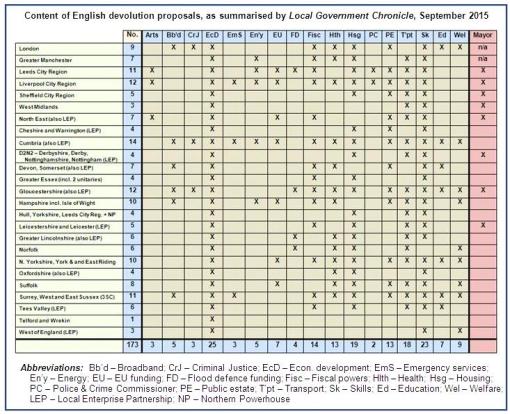
These LPs were not public documents, and it was up to CAs themselves to release whatever details they wished. Any comprehensive comparison, therefore, has been impossible. Nevertheless, some attempted to do the best they could, perhaps most notably the Local Government Chroniclewhose analysis of 26 of the relatively more detailed English bids is summarized here in slightly amended and more easily comparable form.
CA devolution bids (2) (1)

Bid proposals were coded into 18 policy areas, including ‘Fiscal powers’, plus the expressed readiness to consider an elected mayor. This latter was obviously unnecessary for Greater London and Greater Manchester, vital for the other metropolitan/city regional CAs – the more so after Osborne’s announcement that they alone will be able to raise business rates and levy a dedicated infrastructure tax – but interesting too in the bids involving counties.

Catherine referred somewhat sceptically to what Treasury officials reportedly envisaged as an at least three-county ‘East Midlands Powerhouse’. In the end, Derbyshire and Nottinghamshire agreed to submit a joint 19-authority D2N2 bid based on their two-county LEP, and there is talk, though not in the bid document itself, of an elected CA mayor.  However, Leicestershire stuck with its single-county, but also LEP-based, bid,  and, perhaps predictably, Leicester City mayor, Sir Peter Soulsby, has advised against another for the CA.

Whether these and the other county- and county/unitary-based bids will be judged to have, in Catherine’s phrase, “ticked all the boxes”, or at least a sufficient number of them, remains to be seen. Both East Midlands documents, and particularly the former, seem to me to constitute substantial and substantiated ‘offers’, the more persuasive in their having clearly emanated from directly relevant LEP and SEP (Strategic Economic Plan, not Someone Else’s Problem) experience and the partnership working involved, and the same could reasonably be expected of other such bids.

Moreover, even if boxes do remain unticked – and here I think Catherine may have been wrong – the signs are that it’s NOT “too late now”, particularly for these acknowledgedly more difficult multi- and cross-county arrangements.

Anyway, it’s the number, composition and comprehensiveness of some of these county- and county/unitary-based bids that I thought might possibly have prompted Catherine to wonder if she hadn’t slightly rushed to judgement and written off her hopes over-hastily. So I tried categorizing the 28 English non-city region bids (all those on the DCLG list, including Cornwall, not just those in the LGC list). It was obviously based in some cases on minimal knowledge and arbitrary judgements – particularly where whole-county LEPs are involved – but it provided a very rough statistical confirmation of what Catherine feared and what in the circumstances was only to be expected: that the bulk and probably a majority of these non-metropolitan bids – 15 of the 28, by my reckoning – would come from single counties.

The explanations will vary, but many will centre on the sheer shortage of time. Some took seriously ministers’ message about 5 September being the deadline for councils wanting to develop plans based on an existing or fairly solidly agreed Combined Authority with an elected mayor. Most counties, even more than most urban authorities, don’t want mayors, so why rush? But then over the summer the ministerial line changed to one of trying to drum up as many bids, or even expressions of interest, as possible – too late, though, for most counties, even if they’d wished, to respond other than individually.

Given a more generous time frame, and taking account of reported earlier discussions, it seems likely that at least some of, say, Norfolk and Suffolk, Oxfordshire, Buckinghamshire and Northamptonshire, Worcestershire and Herefordshire, Wiltshire (and Swindon), might have followed the D2N2 route and produced the joint, rather than individual authority, bids that the Treasury apparently favours. Which suggests that some may yet do so, and personally I’m particularly hoping the Oxon/Bucks/Northants combo progresses beyond its ‘England’s Economic Heartland’ transport alliance, thereby enabling me to note their questionable grasp of anatomy, with Bucks certainly appearing considerably closer to Gall-bladder-land.

Other existing multi-county bids, in addition to D2N2, include Surrey, West and East Sussex and Heart of the South West (aka Devon and Somerset), plus four that I categorized as primarily LEP-based: Cheshire and Warrington, the North East, Tees Valley, and West of England.

This left me with a motley group of 6, comprising Swindon, which may at some point resolve its ‘misunderstanding’ with LEP partners Wiltshire, Telford & Wrekin, which has since applied to become a non-constituent member of the West Midlands CA, and the shambles of Yorkshire, which would take a substantial blog on its own.

This blog, already over-long, I’ll bring to a close with two very brief conclusions. One, to date, both the Chancellor’s business rate plans and his devolution deals balance too calculatedly their freedoms and checks to constitute, outside the heady excitement of a party conference, a ‘Devolution Revolution’. Two, given what we know of local government’s initial positive response to the Government’s devo agenda and that the door seems definitely still open, I’d suggest Catherine’s early optimism has certainly not yet proved entirely misplaced.

Chris Game - pic

Chris Game is a Visiting Lecturer at INLOGOV interested in the politics of local government; local elections, electoral reform and other electoral behaviour; party politics; political leadership and management; member-officer relations; central-local relations; use of consumer and opinion research in local government; the modernisation agenda and the implementation of executive local government.

Metro mayors: this time at least feels different from 2012

Chris Game

Despite what service users doubtless feel on occasions, things can move quite fast in local government. Four weeks ago (from when I’m typing this) many of us were anticipating a Labour-led government. Three weeks ago in these columns Daniel Goodwin reported George Osborne’s Manchester announcement that the Conservative Government’s Queen’s Speech would include a Cities Devolution Bill. In the actual Queen’s Speech, eight days ago, it was renamed – to general approval – the Cities and Local Government Devolution Bill (CLGDB).  Six days ago the Bill was published, together with Explanatory Notes, and received its First Reading in the Lords. Next Monday it will be generally debated and receive its Second Reading.

It seemed a little remiss that since Daniel’s blog we’ve not posted even a comment on something that could bring the most significant power-shift in English government in generations, so I thought I’d give an airing to my thoughts on metro mayors. Which is fine, if you know where they fit into the CLGDB. But just in case, I’ll start with an albeit cumbersome one-sentence précis of what it thinks it’s about.

The Bill aims to boost growth and increase local government efficiency, by legislating to deliver the Greater Manchester Devolution Agreement and other future combined authority deals – in large cities which choose to have elected mayors, but in other places too [hence the Bill’s name change] – as part of a devolution strategy of moving powers out of Whitehall and building a Northern Powerhouse.

The rest of this blog is a slightly nerdy look at why most of these large cities don’t have elected mayors already. And my chance starting point is that the weekend before the Queen’s Speech I happened to read More Human: Designing a World Where People Come First, the manifesto-style book written by Steve Hilton and two Stanford University colleagues, and extensively plugged, reviewed, commended, and pompously rubbished over recent weeks.

Hilton is best known here as, from 2010 to 2012, David Cameron’s ‘blue-sky thinker’ and strategy adviser. His book is not about local government per se, but, as its title intimates, it contains much of interest, once you sift the perspicacities from the platitudes, to anyone sensing that our own local government scale and structures too often hinder rather than assist our instincts to behave more humanly/humanely.

As it happens, I enjoyed it, but its mention is mainly to enable me to quibble with its author. Specifically, I question Hilton’s accusation, in an interview with The Sunday Times’ Camilla Cavendish (May 17), that the Coalition’s failure in 2012 to introduce elected mayors to most of England’s biggest cities was due to the policy’s ‘sabotage’ by the Lib Dems in general and Nick Clegg in particular – rather than to, say, general ministerial neglect and incompetence.

Nowadays it’s Conservative policy to blame the Lib Dems for everything – including not winning enough seats to prevent the Government having to implement the nastier parts of its manifesto. But to hold their ex-leader responsible for voters in nine of 10 cities rejecting elected mayors amounts to rewriting history – highly relevant history too, for, as already noted, metro mayors are back in a big way.

Chancellor George Osborne has been commendably transparent and consistent about his enthusiasm for them. If a combined metropolitan authority, like the West Midlands, aspires to a “full suite of devolved powers” – city-wide responsibilities for transport, policing, economic development, health and social care, plus worthwhile fiscal discretion – the accountability price includes an elected metro-wide mayor who “takes the decisions and carries the can”.

Exactly which decisions will be in the mayor’s can and which in the combined authority can is still unspecified, though we may learn more in Monday’s debate. It is clear, though, and worth emphasising, that the very fact of devolved functions being divided between mayor and authority means that, to quote the House of Commons Library blog, “this is emphatically not the ‘London model’ of a strong elected mayor controlling city-wide public services” that enthusiasts would favour and detractors fear.

But mayors there will be, without any further referendums, because, ministers insist, it was all covered in a sentence on page 13 (lucky for some) of the Conservative manifesto: “We will devolve far-reaching powers … to large cities which choose to have elected mayors”.

Cities which choose – or, rather, cities whose leaders choose. Certainly for new combined authorities, there will be no imposition of mayors, which antagonised so many last time. Osborne’s challenge to existing city council leaders is simple: elected mayor = far-reaching powers; no elected mayor = no far-reaching powers. Your call.

This time, therefore, things really are different from 2012.  There’s a very senior minister – in fact, with Communities Secretary Greg Clark, two senior ministers – genuinely committed to devolution; the devolvable powers are more explicit, more realisable, and more substantial; and we’re talking not cities but city regions.

The fact remains, though, that this case would be far easier to make, certainly to the public, had not nearly a million city voters participated just three years ago in referendums that decisively rejected mayoral models of government.

So back to Steve Hilton, who, as strategy adviser, foresaw the difficulty. If there’s an iron law of referendum drafting, it’s to have your preference as the status quo – staying in the EU, retaining an up-and-running mayoral system – and as the positive Yes option.

“That’s why Michael Heseltine and I felt it important that people experience the difference a strong mayor could make before they were invited to take a view” (my emphasis). Fine – but now Hilton’s memory begins to fade.

“Both the 2010 Conservative manifesto and the Coalition Agreement”, he claims, “pledged to introduce a mayor to the biggest cities and to let people vote later in a ‘confirmatory referendum’ (my emphasis). “The Lib Dems reneged on that deal.  When a question was asked in parliament, Clegg made clear there would be no mayors without referendums”.

Here, Hilton is WRONG, in almost every particular. There was no deal or publicly shared understanding, because the key phrase in both manifesto (p.76) and Coalition Agreement (p.12) was, presumably deliberately, left ambiguous: “We will create directly elected mayors … subject to confirmatory referendums …” (my emphasis).   Mayors first, or referendums – Hilton, and everyone else, could claim whichever they preferred.

Prior to the Localism Bill’s publication in December 2010, different (Conservative) ministers gave completely conflicting statements. Communities Secretary Eric Pickles reassured MPs: “Of course we will not [impose mayors]. That is completely out of the question” (col. 1117) – following which his Bill proposed doing precisely that.

As minister, Pickles would have powers under Section 9N of the Bill to order a council to create a ‘shadow mayor’ in 2011, and to operate a mayor/cabinet form of governance until it be confirmed or rejected in a 2012 referendum – in short, the Hilton/Heseltine formula.

The Lib Dems have never, as a party, liked mayors, but opposition to their apparent imposition on unconsulted local authorities was near-universal – through most of the local government world, all major parties in the Lords, and particularly the city councils directly affected. Shadow mayors were finally dropped from the Bill on the very first day’s debate of its Lords committee stage in June 2011, the announcement made not by Clegg, but Conservative local government minister Lady Hanham (col. 1062).

The following May, nine of the 10 ‘big city’ referendums rejected elected mayors by majorities ranging from Manchester’s 53%, through Birmingham’s 58%, to Sheffield’s 65%. The exception was Bristol, swiftly rewarded by being invited with London to jointly host this October’s inaugural Global Parliament of Mayors.

Despite there being over 30,000 directly elected municipal mayors in EU countries alone, the global dimension in the 2012 referendum ‘debate’ barely stretched beyond The Simpsons’ Diamond Joe Quimby and New York’s 9/11 hero Rudy Giuliani. Generally, the Yes campaigns were half-baked and the No campaigns puerile – Birmingham’s intellectually challenging contribution being ‘Vote No to a Power Freak’. Serious information and ministerial leadership were as minimal as they were six months later in the Police and Crime Commissioner elections.

Yet most, if not all, of these referendums were almost certainly winnable. Early campaign opinion polls showed clear majorities of respondents in favour of their city having a directly elected mayor – 53% to 37% in Birmingham, 54 to 23 per cent across the five South and West Yorkshire cities. That the referendums were lost, and that public opinion today is far more negative than it was then, is attributable not to Clegg and the Lib Dems, but to Conservative ministerial indifference and leadership failure.

One thing the Government both could and should have done, and advocated at the time in these columns, was to introduce a power of recall, to deal with the frequently raised concern of voters being unable – unlike in some other mayoral systems – to remove an elected mayor in whom a large proportion subsequently loses confidence.

It should have been done, because ministers said they would in the Localism Bill’s 2011 impact assessment (p.9): if mayors were going to exercise additional powers, the accountability regime should include a recall mechanism.

Like Osborne’s famous balanced books, the “later date” at which it was supposed to happen never arrived. So, if we’re to accept his dogmatic insistence that elected mayors and only elected mayors will meet his accountability requirements, now would be a good time to resuscitate recall and hurry it along.

Chris Game - pic

Chris Game is a Visiting Lecturer at INLOGOV interested in the politics of local government; local elections, electoral reform and other electoral behaviour; party politics; political leadership and management; member-officer relations; central-local relations; use of consumer and opinion research in local government; the modernisation agenda and the implementation of executive local government.

A day for devolution

Daniel Goodwin

Thursday 14th May 2015 might not see celebrations in 800 years’ time in quite the same way as Monday 15th June 1215, which saw the sealing of Magna Carta. However it did see two events which are quietly momentous in local government terms. In the morning the Core Cities launched their Devolution Declaration in London, setting out five actions that they sought from government. And in the afternoon, in Manchester, George Osborne appeared to meet the first of these by announcing that the Queen’s Speech would include a Cities Devolution Bill, granting powers over housing, transport, planning and policing.

The Core Cities were caught by surprise and, whilst apparently delighted, had to make hasty arrangements to be present at the announcement. It remains to be seen whether the other actions set out in their package of measures will be implemented quite as speedily, time will tell. However they include a devolution commission, a place-based Comprehensive Spending Review, much broader fiscal retention and devolution and a Constitutional Convention to address UK-wide issues.

There has already been much comment in the local government press and on social media about the two events, so I will not try to summarise them here. However I am struck not only by the pace of change, but also the tenor of the debate. I have compared these with the points made by INLOGOV in its response to the Political and Constitutional Reform Committee’s work on codifying the UK constitution.

We considered that any form of devolution will need to be addressed in the round. It should not just bolt on new service or tax based powers. Our response considered that there needs simultaneously to be a review of the responsibilities of individuals, communities, cities, regions and countries within the UK. In doing so it should also consider the questions of the extent of devolution of local government within all four countries and not just restrict itself to England. We considered that there should be some key guarantees on local determination, perhaps in line with the European Charter for Local Self Government, to which the UK is a signatory.

The 2015 General Election has left the UK with a highly diverse political picture in the four nations and at the more local level within them. The Government’s challenge is to find strengths in that diversity and prevent it turning into division. The key question is whether the changes will provide sufficient means of self-determination and self-government and embed these effectively in the as yet unwritten constitution. This will depend on the extent to which they are founded on community leadership and capability rather simply expediency in facing service cuts. Will the discussion be one about the principles of power sharing rather than long-winded discussions about structure? Can we have a debate on the future of the UK as a modern nation rather than one focused on service structures in England?

The Core Cities are to be commended for setting out their Declaration. It is an ambitious document which sees the challenge as ‘working together nationally and locally in a different way [to] transform the lives of millions and ensure our country can compete in an increasingly globalised and complex world’. The Cities Devolution Bill, with careful attention to principle as well as expediency and in the context of wider constitutional renewal, could just be the way to start to make that happen and help to address the wider devolution challenges which the UK faces following the General Election.

Know your local Councillor Photographs - St Albans - May 2008

Daniel Goodwin’s career has mainly been in local government, starting in libraries and cultural services and progressing through policy and corporate services. He is particularly interested in policy into practice issues, the links between strategy and finance, local leadership and the politics of communities and place. He is a regular contributor to journals, conferences and seminars.