‘If the rules aren’t written, you can write your own’ – Flexibility, Elected Mayors and Combined Authorities

Max Lempriere

At the first of a series of workshops hosted in early November by the College of Social Sciences at the University of Birmingham, with input from INLOGOV, The Public Services Academy and City-REDI, practitioners and academics from the world of local government came together to share experiences on the current combined authorities and city-region devolution agenda. In the first of a series of posts Max Lempriere, a doctoral researcher studying the formation of combined authorities, reflects on the day’s major talking points. 

Combined authorities are emerging as the arrangement of choice for local authorities across England keen to harness greater powers and funding from central government. Five have so far been established with another six in the pipeline. More will follow in the coming months and years.

One of the clearest challenges coming out of our discussion is that there is no ‘blueprint’ to follow in their design. It is up to each prospective combined authority to ‘bid’ for a package of powers and funding that reflects local needs and priorities in negotiation with central government. But what does this mean for those on the ground involved in those deliberations?

Underlying much of the discussion was an optimism that this kind of flexibility presents. One participant remarked ‘if the rules aren’t written, you can write your own’. But, accompanying this was also a frustration at the ambiguity and uncertainty that accompanies this kind of design flexibility. The need to ensure public value, a resilient institutional arrangement and a design that can achieve specific foundational objectives certainly raises the stakes.

Take the issue of elected-mayors. Agreeing to adopt an elected mayor is a necessary condition to achieving the full range of powers and funding available, but again there is flexibility in terms of what powers and competencies the mayor will have. If nothing else the mayor will become the figurehead of the combined authority, so a lot rests on ensuring their success.

There is a danger that if not carefully thought through the ‘mayor issue’ could undermine the success or resilience of the combined authority. A functional economic geography may be an appropriate basis from which local authorities can come together but the congruence of economic and political geographies is not a given. Participants agreed that the powers and ‘design’ of the mayoralty must be carefully negotiated to reflect local identities, political priorities and political geographies. Take the West Midlands, for example. Here the development of a combined authority has to navigate the deep historical tensions between Birmingham, the Black Country, and Solihull/Coventry. Would a mayor be able to negotiate these differences? Would any attempts to do so be met with hostility and, if so, what would that mean for the legitimacy of the mayor? Several participants at our workshop were concerned that if the mayor was to be seen as ineffective there is a danger that the whole combined authority could be at stake.

So what does this mean for combined authority designers?  The most obvious conclusion is that local authorities need to be leading the discussions, not central government. In the words of one participant, local authorities need to be ‘feisty’ in their negotiations and unafraid to ‘flex their muscles’. There isn’t a comprehensive deal without an elected mayor and there isn’t a combined authority without an effective mayor. How the mayor is presented, engaged with and positioned within the combined authority is more fluid and contingent than a set of formal powers suggests. Combined authorities should not rest on their laurels and assume that just because their mayor ‘works’ today it will do so tomorrow.

So should we write off their potential? Far from it! There are real, tangible opportunities to seize back control from central government. Everyone involved must be sensitive to both the enormous opportunities this presents but also the potential pitfalls of flexible, negotiable institutional design.

This series of workshops is being supported by the Economic and Social Research Council, Local Government Association and the Society of Local Authority Chief Executives (SOLACE) and is led by Catherine Staite, Director of INLOGOV and SOLACE’s Research Facilitator for Local Government.

lempriere

Max Lempriere is a final year PhD researcher at the University of Birmingham. His research interests include flexible institutional design, local government policy making, the politics of sustainable planning and construction and ecological modernisation.

Devolution: a journey into the unknown?

Catherine Staite, Director, INLOGOV

A key theme of the discourse on devolution in recent months has been the thrill of the new, through the creation of new local institutions – combined authorities – and new relationships between central and local government.  Some old hands will have noted the similarities with previous ‘resources/powers in return for performance/compliance’ offers such as Local Area Agreements, Multi-Area Agreements and City Deals.  Those ventures were characterised by big promises,  wearisome competitive processes and few real benefits for local government. Those disappointments were often attributed to the dead hand of Whitehall.

So what is different now?  The power dynamic is different. If DCLG tries to drive change it is at the mercy of the Treasury.  When the Treasury drives change it happens.  The prizes seem bigger too but perhaps the biggest difference is the pace of change.  It’s certainly galvanising local authorities into action. Long-standing differences have been overcome and a sense of common purpose established in many areas.  Devo deals are being negotiated and agreed at regular intervals.

So what next? Creating a combined authority and signing the deal is merely the end of the beginning.  How will these new institutions and changed relationships need to develop over time? Will governance structures conceived in optimism be sufficiently strong and flexible to meet future challenges? How will politicians need to adapt their leadership style to a shared leadership model with the added  ingredient of an elected metro mayor?  Will the combined authorities withstand changes among the key leaders and chief executives? If one of the leaders runs for mayor will all the others stop speaking to him/her? If the mayor throws their weight about, will all the leaders withdraw their goodwill?

Academics have given significant attention to both the previous waves of change and the implications of the current approach to devolution. There is much evidence to be mined and that will help the key players in combined authorities continue to shape their governance arrangements and manage their challenges. Devolution and all its ramifications has been the hot topic at recent conferences, such as the SOLACE Summit, as well as for the LGC and MJ. However, there have been few opportunities for academics and local authorities to come together to share experiences and intelligence.  The pace of change has left little time for reflection but the scale of change demands that key decisions are informed by evidence.

INLOGOV is offering four such opportunities over the next few months, starting on 5th November.  These free events are also supported by academics from the Public Services Academy and City REDI, the new economic modelling unit recently established by Birmingham Business School.  Our purpose is to enable local authorities to talk to each other about all the critical issues; their experiences of negotiating with central government, of creating an effective approach to shared leadership and of hammering out shared priorities across diverse areas – as well as to take advantage of the insights which research offers about new ways to solve old problems. We hope this sharing of knowledge and experience will help ensure that this latest wave of change really does bring bring significant and lasting benefits for local authorities, their partners and – most importantly –  the people they serve.

staite-catherine01

Catherine Staite is the Director of INLOGOV. She provides consultancy and facilitation to local authorities and their partners, on a wide range of issues including on improving outcomes, efficiency, partnership working, strategic planning and organisational development, including integration of services and functions.

Combined Authorities – Why Birmingham doesn’t have a city region like Leeds

Chris Game.

“Cornwall leapfrogs West Midlands in devolution race” was the headline over one report of the Government’s recent devolution deal with Cornwall Council, giving the county greater control over adult skills spending and regional investment, and, with the Isles of Scilly, the prospect of integrating health and social care services.

For a West Midlands resident it seemed a depressing message – almost depressing enough to make one contemplate shooting the messenger. However, I happen to know him, so I’ve settled for shooting his metaphor, and in doing so providing a further update of events that could bring what I described in a previous blog as the most significant power-shift in English government in generations.

First thing to concede is that, predictably from this wholly centralist and Osborne-choreographed devolution exercise, it absolutely is set up as a race – certainly against time. It was outlined on p.63 of the Summer Budget’s Red Book:

“To fulfil its commitment to rebalance the economy and further strengthen the Northern Powerhouse, the government is working towards further devolution deals with the Sheffield City Region, Liverpool City Region, and Leeds, West Yorkshire and partner authorities, to be agreed in parallel with the Spending Review.”

We’ll return to the detailed wording later. The point here, apart from the redundant reminder of the Chancellor’s tunnel-visioned insistence on an elected mayor as the only acceptable accountability mechanism, is the Spending Review deadline, repeated a few paragraphs later:

“The government remains open to any further proposals from local areas for devolution of significant powers in return for a mayor, in time for conclusion ahead of the Spending Review.”

This week, a fortnight after the Budget and just seven summer holiday weeks before his chosen submission deadline, the Chancellor realized it would be useful for others to know the relevant Spending Review dates. Its conclusions, we learned, will be outlined on 25 November. But deal-seeking councils need to check p.15 of another Treasury document:

“City regions that want to agree a devolution deal in return for a mayor by the Spending Review need to submit formal, fiscally neutral proposals and an agreed geography to the Treasury by 4 September 2015.”

Numerous race analogies suggest themselves – obstacle, hurdle, handicap – but I see the devolution race less as a single race and more like the London Marathon – several races taking place simultaneously with different categories of participants starting off from different places at different times.

Take Cornwall. As the first rural council to negotiate a devolution deal, it clearly deserves credit, and doubtless its methods are being studied closely by other counties rushing to recruit partners and submit bids by the Chancellor’s deadline.

These county areas, though, are effectively in a different race from the big city regions. Their bids will vary greatly, in scale and aspiration, and in London Marathon terms their equivalents are perhaps the ‘Good for Age’ racers, who secure guaranteed entry by running a specified time considered good for their age group. They’ll hopefully win the appreciation of their friends and residents, but the big prizes will inevitably go to the Elite runners, the 150 miles a week guys, who need a certified 2 hours 20 time just to qualify, and sub-2 hours 10 to get into the serious prize money.

In the devolution race there’s only one elite entrant even to have glimpsed serious fiscal devolution-type money – Greater Manchester. The region starts with natural advantages, with its geographical and political coherence, and its 10-council team of runners was first out of the blocks in 2011, in applying to become the first Combined Authority (CA).

Moreover, they run as a team, agreeing to accept the race sponsor’s favoured elected mayor along with all that devolved funding, and now the prize money keeps arriving on a regular basis – most recently on Budget Day, when they won £30 million funding for ‘Transport for the North’ plus control of the fire service, Land Commission, children’s services and employment programmes.

Following the elite runners in the London Marathon are the Championship entrants – registered members of an athletics club, with a certified 2 hours 45 race time. The devolution equivalent is the exclusive Combined Authority club – still just the five members, those joining Greater Manchester being, to give them their official names, West Yorkshire, the North East, and the Sheffield and Liverpool City Regions.

West Yorkshire, Sheffield and Liverpool are actual or, in Liverpool’s case, near reincarnations of the areas’ 1972-86 metropolitan counties, and in that sense similar to Greater Manchester. The North East CA is different – hugely bigger than the former Tyne & Wear met county, but having at least the coherence of covering the same area as the North-East Local Enterprise Partnership (LEP).

As we have seen, the three former met county CAs were all name-checked by George Osborne in his Summer Budget speech – though few seemed to notice the precise names he used: “the Sheffield and Liverpool City Regions and Leeds, West Yorkshire and partner authorities” (my emphasis).

Having undertaken a serious resident and stakeholder consultation exercise back in March, North East leaders were rather peeved not to have made Osborne’s list. Since then, though, they’ve moved fast – not exactly embracing, but at least dropping their outright opposition to, an elected mayor, and opening talks on a “radical devolution deal” with Communities Secretary Greg Clark.

Temporarily at least, therefore, this might seem to put them ahead of Sheffield and Liverpool, but what exactly is happening in West Yorkshire? How is Leeds – unlike Birmingham, which has to make what noise it can under the ‘West Midlands’ banner – apparently managing to retain its nominal identity in its devolution deal?

Prior to the election, it was assumed that big city devolution deals would be negotiated with, where they existed, Combined Authorities. But then, in late June, Greg Clark delivered his remarkable eulogy to LEPs. These partnerships between business and councils were evaluated recently by the Royal Town Planning Institute as having “an opaque remit”, lacking “firm institutional foundations”, and being overly responsive to central government direction. In the new minister’s view, however, they represent:

“a phenomenal revolution [that has] completely changed the way investment and growth is done in this country. The areas that combined authorities are now following are the same areas defined by LEPs as being the true economic geography of our nation. As such, no devolution deal will be signed off unless it is absolutely clear that the LEPs will be at the heart of arrangements (my emphasis).

Anyway, whoever’s verdict you prefer, LEPs are where Leeds City Region comes in. A city region is an economists’ and planners’ term to describe the functional region around a city – its ‘true economic geography’, as Greg Clark might put it. The label dates back at least to Derek Senior’s Memorandum of Dissent in the 1969 Redcliffe-Maud Report. But institutionally not much happened until the arrival in the late-2000s of Multi-Area Agreements (MAAs) – voluntary agreements between a number of local authorities and the government to work collectively to improve local economic prosperity.

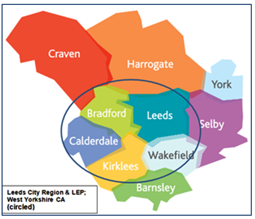
There were eventually 15 of them. Of the big cities, those for Greater Manchester, South Yorkshire, Liverpool, and Tyne & Wear took the forms their respective CAs now do. But, instead of West Yorkshire, there was Leeds City Region, as shown in the accompanying map: the five former West Yorkshire metropolitan county boroughs, plus Barnsley from South Yorkshire, and Craven, Harrogate, York and Selby from North Yorkshire.
Leeds 1

MAAs were formally wound up by the incoming Coalition, but in practice most, like Leeds City Region’s, accompanied their authorities into their new LEPs. Which explains why West Yorkshire’s devolution bid is focused, as the Chancellor convolutedly but correctly described, on ‘Leeds, West Yorkshire and partner authorities’, or, more succinctly, Leeds City Region.

Not surprisingly, Birmingham also had a Multi-Area Agreement and a city region partnership, but in its case the emphasis is firmly on the past tense. It went under the catchy name of the Birmingham, Black Country and Coventry City Region and produced, among other things, an MAA for Employment and Skills. But it was short-lived, with Coventry soon opting out to concentrate on developing its links with Solihull and Warwickshire.

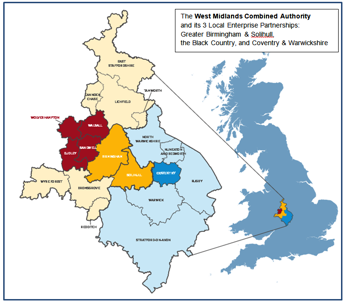
And there’s Birmingham’s devolution problem in a nutshell: no convincing city region. Instead of the pubescent MAA partners developing together, perhaps with the addition of adjoining authorities, into a single LEP corresponding to Clark’s ‘true economic geography’ of the city region, it split instead into three: Greater Birmingham & Solihull, which struggles to look convincing even on the map, the Black Country, and Coventry & Warwickshire.
west mids

The present situation is – how to put this – not exactly setting pulses racing. We have a recently, and for some unenthusiastically, agreed proposal for a Combined Authority of the seven former West Midlands metropolitan council boroughs – Birmingham, Coventry, Dudley, Sandwell, Solihull, Walsall and, Wolverhampton – to run transportation, regeneration and economic development.

It clearly can’t claim, in Greg Clark’s words, to have any of its three LEPs “at the heart of arrangements” – although that could change with the possible addition of some or more councils in Warwickshire, Worcestershire and Staffordshire – a state of uncertainty that Police & Crime Commissioner David Jamieson, the West Midlands only elected official, described this week as “an absolute dog’s breakfast”.

Finally, far from it having been agreed that the CA should have accountability through an elected mayor, it apparently won’t have any individual leadership at all. Apart from numerous commitments to “collaborative working”, the Launch Statement has nothing to say about governance, although the understanding is that each council leader will take responsibility for an individual policy portfolio.

Returning to the London Marathon analogy, Greater Manchester obviously crossed the Mall finish line some time ago, has donned its foil blanket, collected its Virgin Money finishers’ medal, and is heading back up the M6. Several others are on that home stretch between Big Ben and Buck House, but it seems the WMCA still has some miles to go to reach the Embankment.

A reply to Fraser Nelson: the only thing astonishing is how little power local authorities have

Catherine Staite

Fraser Nelson’s article on Birmingham City Council last Friday was a very disappointing offering from an experienced journalist and a reputable paper – more Daily Mail then Daily Telegraph. 

It was riddled with inaccuracies.

Birmingham City Council does not have ‘astonishing power’. What is astonishing is how little power local authorities have, even in big cities.  Central government has as iron grip on local government. Money – how it is raised and spent – and policy – the thinking which underpins those choices – are the two key levers of government and central government controls them both.

The average amount of local authority income derived from Council Tax is 16%.  Council Tax is a regressive tax based on 1991 property valuations and bears no relation to the real costs of providing local public services.  LAs cannot increase CT by more than 2% without a referendum, for which they must pay.

The remainder of their income is made up of rents, fees and charges (local authorities can’t make a profit) and business rates (which central government gathers and re-distributes to a national format).  The remainder comes from grants from central government. BCC’s take from Council Tax is only 7.5% because of poverty and property values, which means it is disproportionately dependent on central funding, which has been cut by 35% since 2010.

The gap between rising demand and falling resources is getting wider by the minute in Birmingham, just like it is in Chicago.  The difference is that Chicago can run a deficit of billions – and has done so for the last ten years.  BCC has to balance its books.  It is still obliged to deliver over 1700 statutory duties – from trading standards to disposal of the dead to the protection of children. Year by year it has less and less room to manouvre.

What is really astonishing is that Birmingham and other local authorities still manage to deliver very good services. A recent Ipsos Mori poll showed satisfaction remains high.  That is because authorities have protected frontline services in spite of losing 15% of their jobs since 2010.

Splitting up Birmingham City Council would make no sense at all. The comparison with Manchester is entirely spurious.  The geography and demography of the ten unitary authorities in the Greater Manchester area is very different to Birmingham but the success of that area is built on collaborative upscaling not on separatism. They have banded together to create a Combined Authority. It’s the only way to get the economies of scale and critical mass to compete, bring growth and deliver infrastructure.

The West Midlands is not made up of unitary councils – it is a mixture of unitaries and two tier areas – encompassing counties and districts.  This makes it harder for Birmingham and the wider West Midlands to emulate Greater Manchester’s collaborative progress.  In Birmingham, some services are run at a neighbourhood level, and a district structure helps support better engagement and differentiation but there is nothing to be gained by splitting the city.

Birmingham is a global city, competing with Chicago, Melbourne and Guangzhou and dividing it up would be a nonsense.  Last week senior people from Birmingham City Council were in China, drumming up business for the city.  Would Beijing be interested in talking to Kings Heath District Council? I think not.

Blaming Birmingham City Council for the architectural failings of the 1950s is like blaming David Cameron for Suez.  It’s entirely pointless. Most cities have some 1950s and 1960s monstrosities but Birmingham is being very successful in transforming the city centre. The Bull Ring works, New Street Station is being transformed and whatever Prince Charles thinks about the new library, I think it is truly amazing.  It is beautiful and original.  What is more important is that it works.  Hundreds of thousands of people have flooded through its doors and librarians have had to work hard to keep up with the huge rise in demand for books.  That is the real measure of its success.

People hark back to the happy days of Joseph Chamberlain who as Mayor in the 1870s and thereafter transformed the city and created the legacy of civic splendor, including the University of Birmingham.  The difference between then and now is that he did have ‘astonishing power’ because he had control of both the money and the policy.  In spite of the herculean efforts of Lord Heseltine, central government controls the big money for skills, growth and infrastructure.  It is to the credit of Birmingham that they have done so much with so little.

Poverty is indeed a problem in Birmingham but not one which the city council can solve. National policies drive national poverty which is then concentrated in big cities. Birmingham is super-diverse and has a high proportion of young people.  Ethnic minorities and the young have been disproportionately effected by the recession.  Central government’s cuts to benefits to vulnerable people are shunting the costs of poverty onto local government at a time when they have few resources with which to respond.

Child protection is a stark example of this phenomenon.  Most child abuse has its roots in poverty, drug and alcohol addiction, domestic violence and mental illness.  Local government cannot solve all those ills alone.  Every serious case review and every inquest highlights a very simple lesson.  Children can only be protected when all the key agencies work together – schools, GPs, mental health services, the police, the hospitals – as well as children’s social care.  Cuts in public sector funding have a knock on effect on child protection.  West Midlands police cannot attend all the case conferences they should.  It is in those circumstances that children fall through the net.

Somehow it is always the Council that gets the blame.  They do hold the ring in a complex network of agencies, professionals and responsibilities – but they cannot always be expected to hold the blame.

Catherine Staite

Catherine Staite is the Director of INLOGOV. She provides consultancy and facilitation to local authorities and their partners, on a wide range of issues including on improving outcomes, efficiency, partnership working, strategic planning and organisational development, including integration of services and functions.