In praise of … the Japan Local Government Centre

Chris Game

The Guardian newspaper has what it calls a daily editorial encomium: a short, benign tribute to a person or phenomenon featuring generally somewhere on the fringe of the day’s news. Entitled ‘In praise of’, its recent subjects have included Arunima Sinha – the first woman amputee to scale Everest – half-term holidays, male skirts, and Ringo Starr. This uncharacteristically uncritical blog is a lot longer than a Guardian encomium, but comes in a similar spirit.

The Japan Local Government Centre (JLGC) is the London (Whitehall) office of the Council of Local Authorities for International Relations (CLAIR) a joint organisation of Japanese local authorities, supported by the Ministry of Internal Affairs, and dedicated to ‘localised internationalism’: the fostering of international relations at the local level in Japan and the promotion of local Japanese culture and activities abroad.

It is the institutionalisation of a Japanese instinct that the British, not least in local government, tend not to share: a belief in the benefits, both intrinsic and instrumental, in seeking to understand how other countries do things. In addition, therefore, to its branches in each of Japan’s 47 prefectures (similar to our counties) and 20 designated cities (a case in point of a practice from which we could well learn), CLAIR also has seven overseas offices. The London office’s remit covers bits of northern Europe and Scandinavia, plus a responsibility for responding to research requests from the Japanese local authorities who provide most of its funding and a majority of the dozen or so staff.

That research function is one explanation of the extensive contacts we in INLOGOV have enjoyed over the years with JLGC, its rotating directors – mostly seconded from the Ministry of Internal Affairs – and both Japanese and UK staff. But far from the only one.

My personal association dates back to 1997, when I had the good fortune to be selected as a member of one of the Centre’s early annual study tours – in my case as one of a group of 10 mainly local government officers for a heavily subsidised and enormously enjoyable 10-day visit centred on Yokosuka City and Kanagawa Prefecture, just south-west of Tokyo. Unforgettable is almost as overused an adjective nowadays as incredible, but in this instance it is literally true and it paved the way for numerous succeeding contacts, relationships and revisits – from the latest of which, as it happens, I have recently returned.

I might well have blogged about it anyway, but that wouldn’t have justified the ‘In praise of’ peg, which by Guardian convention requires a relevant news item. That news item is (I shall resist typing ‘of course’) Japan400. In truth, the title refers to the yearlong programme of cultural events commemorating 400 years of diplomatic, trading and cultural relations between our two countries – as conducted through myriad organisations like CLAIR and the JLGC.

But the undoubted focal point of the year’s celebrations came on June 11th – exactly 400 years since the Clove, an aptly-named ship of the East India Company, finally made it across the East China Sea, up past Nagasaki to the south-west island of Hirado, and became the first British-commanded vessel to land in Japan.

The nautical detail is vital – especially for any like me, who, on first hearing of Japan400, were confused by thinking we’d already celebrated this quatercentenary more than a decade ago. I recalled clearly a fellow member of that 1997 study tour – Peter McLean, from the then Gillingham Borough Council’s Business Liaison Office (and the first UK local government officer I met who had a bilingual English/Japanese business card) – impressing upon us at every conceivable opportunity how the first Englishman to set foot in Japan, in 1600, had famously and indisputably been William Adams, a seaman from, yes, Gillingham in Kent.

Indeed, Peter, as was his wont, went further: presenting us all with a little book about the great man, The Blue-eyed Samurai, and his remarkable story of finding favour with the Shogun, becoming his trusted adviser, shipbuilder and the only officially recognised Western samurai, being granted a house and land, and spending the rest of his life in his adopted country.

All true and authenticated, and duly celebrated in 2000 in what by then, following Gillingham’s merger with Rochester, was the unitary Medway authority. William Adams was indeed Japan’s first English tourist, but – the big BUT – the ship on which he sailed was equally irrefutably Dutch: part of a Dutch fleet, owned by the Dutch East India Company, and commanded by a Dutch captain.

The Clove’s arrival 13 years later was very different. Though the voyage itself was hardly, as it were, plain sailing, it was heading from the outset to a known and at least minimally settled destination, and there was none of the drama occasioned by Adams’ landing. Quite the contrary, for the convoy commander, John Saris, brought official letters and gifts from King James I, and in turn was warmly welcomed by the local ruler – which I suppose makes it the more appropriate event from which to date the establishment of diplomatic and cultural relations.

It also offers a really clunky segue back to my own recent visit, during which I too met and was welcomed by local rulers, although they tend nowadays to take the form of elected prefecture governors and municipal mayors, rather than daimyo and samurai. I’m hoping to write something loosely comparative on local government leadership in the UK and Japan, and thought I’d take advantage of the invitation of a friend and former colleague to observe his ‘campaign’ for re-election as mayor of Setouchi, a ‘new city’ of about 40,000 residents in Okayama prefecture, roughly midway between Osaka and Hiroshima.

There are two sets of inverted commas in that last sentence, both intended to signal distinctive usage. First, the city. Though in area roughly the size of Manchester, Setouchi isn’t in truth a city at all, but rather the product of a 2004 merger of three real towns that now, of course, have lost most of their governmental identity – rather like Gillingham and Rochester. And Setouchi too is an artificial name, derived from ‘Seto inland sea’, in which as few people actually live as in the River Medway.

In much the same way as we have been relentlessly merging real places into ever larger and artificial constructs like Medway, the Japanese have been engaged on a fiscally incentivised merger spree that has to date cut the number of municipalities from over 3,200 in 1999 to barely 1,700 – one striking difference, though, being that some of the meaningless names adopted by their new creations at least sound more attractive than ours – Sakura (cherry blossom) City, Asagiri (morning mist) Town, and the like.

That, however, is not my point here. Rather, it is to note that this governmental engrossment, and the substantial reduction in the number of local politicians, seems to have done little to stimulate either greater electoral competition or greater voter participation. Japanese mayoral elections can take place in almost any month, but in over a quarter of the 80 held in April of this year the mayors were elected or re-elected without a contest; and in over 60% of the cities in which elections did take place, voter turnout hit record low levels. Political parties in this country aren’t the most popular of institutions, but democratically a weak and ineffectual party system is surely worse.

My friend was also re-elected unopposed, and, while I’m sure that was a testament to the breadth of his personal appeal, the excellence of his mayoral record, and his undoubted political negotiating skills, even I would be that much more reassured, had he not also been unopposed when first and previously elected.

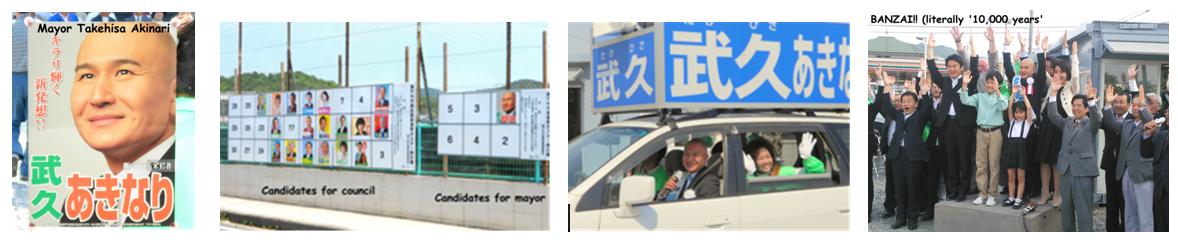
It did not, incidentally, mean that there was no ‘campaign’ at all for me to witness, following my 6,000 mile journey. There were the personal posters, on publicly provided display boards, that are an integral part of all Japanese elections; loudspeaker campaign cars, organised hospitality, and endless meeting, greeting and exchanging of business cards. But it’s the final picture – the triumphal and collective BANZAI! (in which the ‘distinguished foreign guest’ enthusiastically participated) – that most truly captures the spirit of this particular election: considerably more acclamation than confrontation.
game japan

None of which should be taken to suggest that Japanese mayors, particularly of larger cities, aren’t important political figures with substantial powers and influence, or that the country’s local politics is invariably low key. Last November’s mayoral election in Okinawa, for example, became effectively a referendum on the challenger’s platform of removing all US bases from the city and replacing the US-Japanese Security Treaty with a treaty of friendship – albeit one that he lost by quite a distance.

As for the politician currently receiving by far the greatest media coverage, both nationally and internationally, and performing the Farageiste role of scaring the hell out of the established political parties in the run-up to next month’s Upper House elections, Toru Hashimoto isn’t in Parliament at all, but the mayor of Osaka.

More of which possibly in the nearish future. For the present, though, simply a grateful reflection that, were it not for the JLGC, it’s quite likely that I’d never even have got interested in this stuff.

game

Chris is a Visiting Lecturer at INLOGOV interested in the politics of local government; local elections, electoral reform and other electoral behaviour; party politics; political leadership and management; member-officer relations; central-local relations; use of consumer and opinion research in local government; the modernisation agenda and the implementation of executive local government.
The 13 NOC counties and unitaries: runners, riders and results

[This post, incorporating the final results, was updated by the author on 5th June 2013]

Chris Game

In May 2010 David Cameron and Nick Clegg took just five days to form their national coalition. By contrast, starting in June 2010, the Belgians took 18 months to form theirs. English local government falls between the two.

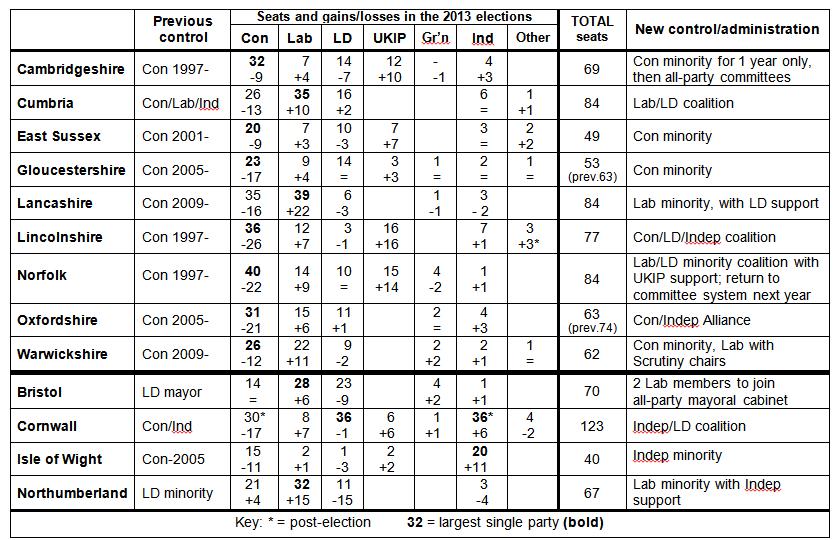
It’s well over a month now since the national media completed their coverage of the local elections. They’d added up the seats won and lost by the various parties, calculated the national vote share they’d have received if the elections had been held in different parts of the country, and how many seats they’d have won in a 2015 General Election – but they left as unfinished business the 13 county and unitary councils they conveniently lumped together in their tables as ‘NOC’ (No Overall Control). And, though it was a short sprint by Belgian standards, it took most of that month for most of us to learn, in several of these 13 cases, the answer to that basic question the elections were supposedly about: who will actually govern?

The reasons are various: more parties, plus variegated independents, involved in negotiations; party leaders losing their own seats, or having to be re-elected or deposed at party meetings; and, above all, the fact that any inter-party agreements can only be officially implemented at pre-scheduled Annual Council Meetings, which, in some of the affected councils, only took place in the last week of May.

This blog attempts to fill in the gaps. It’s a kind of ‘runners and riders’ guide to the 13 county and unitary councils in which no single party has a majority of seats: how they got that way, and what subsequently happened.

game table june 2013

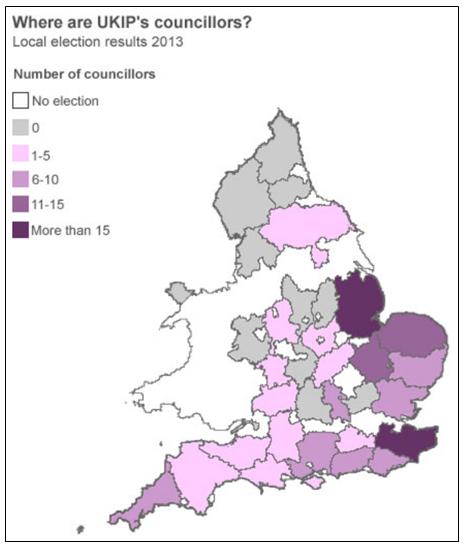
First, the counties, in alphabetical order. CAMBRIDGESHIRE, along with Lincolnshire, Norfolk, and to a lesser extent East Sussex, was one of the previously staunchly Conservative counties that became hung largely as a result of being UKIPped. As the BBC map shows, this was a much patchier experience than was suggested by some commentators at the time – with 7 of the 27 counties still having no UKIP councillors at all and only 4, all in the south and east, having more than 10.

game map may 17

Source: BBC News

The Conservative leader, Nick Clarke, was one of those who lost his seat to UKIP, and the party’s remaining 32 seats left them well short of a majority. The new leader, Martin Curtis, wanted to go it alone as a minority administration, but the Independents ruled that out, while Labour and the Lib Dems refused to join UKIP in supporting an Independent-led non-Conservative rainbow coalition. Eventually, the Conservatives got half their cake: Curtis will head a minority administration for 12 months, but then UKIP’s preference, for ‘opening up’ council decision-making, kicks in and cabinets will be replaced by all-party committees.

In CUMBRIA, previously run by a Con/Lab/Independent coalition, the elections effectively reversed the standings of the Conservatives and Labour, with the latter regaining their customary position as largest party, and the slightly strengthened Lib Dems in the role of potential kingmakers. Under a new leader, Jonathan Stephenson, they opted for coalition with Labour, deputy leadership of the council, and four cabinet posts.

EAST SUSSEX is a much smaller council than Cambridgeshire, but proportionately the party arithmetic is broadly similar. Here, though, the other parties seem readier to accept a Conservative minority administration, and, as in Cambridgeshire, although a Conservative-UKIP deal could have produced a majority, none appears to have been seriously pursued.

GLOUCESTERSHIRE was a hung three-party council from 1981 to 2005, with Lib Dems generally the largest group – before, in 2009, the Conservatives suddenly took 42 of the then 63 council seats. The reduction of 10 seats, accompanying boundary changes, and the prospect of at least some recovery by Labour and possibly the Lib Dems led close observers to predict a return to NOC, and they were right. The Conservatives, though, will continue in office as a minority administration, and the Lib Dems as the main opposition party, miffed reportedly at a suspected Con-Lab deal over Scrutiny Management and other committee chairs.

Meanwhile, the county’s badgers, temporarily reprieved last autumn from the Government’s planned cull, seem to have lobbied with some effect in the elections, the new council voting by 25 to 20 with 7 abstentions to oppose the cull, now due to start later this month.

In LANCASHIRE Labour either controlled the council or were the largest party from 1981 until 2009, and were hoping to regain majority control in one go. Sensing a lifeline, the Conservatives tried talking with anyone who might be interested in forming what would presumably be an anti-Labour coalition. But the Independents didn’t want an alliance with anyone and in the end the Lib Dems agreed to support a Labour minority administration – support that will include Labour’s budget, but not necessarily much more.

LINCOLNSHIRE Conservatives are unused to coalition politics, but the party’s leadership reacted quickly to the loss of nearly half its seats by negotiating a coalition deal with the Lib Dems and Independents, before the 16 new UKIP members could even elect themselves a leader. In the week they spent doing so, the party’s regional chairman pooh-poohed on their behalf any coalition with the Conservatives, and effectively condemned them to opposition from a starting point that might have yielded rather more. The Lincolnshire Independents group were also outsmarted – three of their number breaking away to join the coalition, one with a seat in the cabinet, with rumours that others could follow them into what is still a group-with-no-name.

Across The Wash, in equally traditionally Conservative NORFOLK, the outmanoeuvred group were the Conservatives themselves. At a full council meeting, the party’s re-elected leader, Bill Borrett, apparently thought he had an agreement with the Lib Dems at least to abstain in any vote, thereby enabling him to head a minority Conservative administration. He hadn’t, and nor was he able to nail down a more explicit coalition agreement with the Lib Dems involving some key specified posts. By far the largest group thus finds itself in opposition to a minority coalition of Labour and the Lib Dems based on just 29% of council members.

UKIP’s 15 votes were needed to get this deal off the ground – plus support from the Greens and an Independent – and the UKIP group describes itself as part of the coalition. That part, though, involves no cabinet seats, but rather the achievement of a Cambridgeshire-style agreement to abolish cabinet government and return to a committee system this time next year.

Before the Conservatives swept into power in 2005, OXFORDSHIRE had been a hung council for 20 years. Labour’s comeback was limited, and, on a now a significantly smaller council, the Conservatives finished within one seat of retaining their overall majority – a position they’ve restored thanks to a CIA: a Conservative/Independent Alliance probably less alarming than it initially sounds. No cabinet seats are involved, but three Independents have agreed to work with a Conservative minority administration in the kind of ‘confidence and supply’ arrangement that many thought was as far as Cameron and Clegg would dare to go in 2010, and indeed to which they may still, before 2015, conceivably turn.

In WARWICKSHIRE Labour, though never the majority party, have regularly run the council as a minority and were hoping to regain this position. They didn’t, but they did do a deal with the Conservatives, the outcome being a Conservative minority administration, headed by the council’s first woman leader, Izzy Seccombe, with Labour holding the Scrutiny chairs, and the Lib Dems and Greens out in the cold, complaining of a stitch-up.

Now to the four hung unitaries. In BRISTOL Labour became again the largest single party and has agreed that two of its members should join Mayor George Ferguson’s all-party cabinet, which will now comprise 2 Labour members, 2 Lib Dems, I Conservative, and I Green. That may sound straightforward, but it most certainly wasn’t. Last November a similar proposal, though supported by Labour councillors, was overruled by the local party and eventually by the National Executive, and had cost the group its leader, Peter Hammond. It seems a sensible decision, but it would be surprising if that sentiment were shared universally within Labour circles.

In CORNWALL, as in Lincolnshire, some candidates continue running around long after the electoral music has stopped. Here, one of the elected Conservative members defected after 10 days to the Independents, bringing the latter group up to parity with the Lib Dems. This proved, though, less crucial than it might have, as both groups were already in discussions over some form of agreement – one possibility being an all- or multi-party rainbow alliance that could be presented to the public as a ‘Partnership for Cornwall’. What actually emerged was more mundane: an Independent/Lib Dem coalition with the more or less positive support of Labour, UKIP and Mebyon Kernow (the Party for Cornwall), the Conservatives having rejected as tokenism a scaled-back offer of two cabinet seats.

The ISLE OF WIGHT was once a Lib Dem showcase, controlled by the party either as a majority or in coalition for 16 years until 2005. It seems like history now, though, and this year’s election was largely about the exchange of seats between the Conservatives and Independents – the latter at least slightly helped by Labour and UKIP not contesting every seat that they might have done. The Island Independents, led by Ian Stephens, one of the possible beneficiaries of these arrangements, took over as easily the largest group, and will run the council as a minority administration – for the first time since 1973-77.

Having dominated the former county council, Labour will run unitary NORTHUMBERLAND for the first time as a minority administration, with the support of the three Independents – one of whom will be back as Chairman of Audit, the post she held as a Conservative councillor before resigning from the party following alleged victimisation by a senior colleague. And to think, there are some who say the local government world is boring.

game

Chris is a Visiting Lecturer at INLOGOV interested in the politics of local government; local elections, electoral reform and other electoral behaviour; party politics; political leadership and management; member-officer relations; central-local relations; use of consumer and opinion research in local government; the modernisation agenda and the implementation of executive local government.
It’s not Labour or the LGA who are out of touch. It’s you, Minister!

Chris Game

Are you up to speed with your local finance jargon? If so, I wonder if you can explain the difference between a ‘widows tax’ and a ‘Bridget Jones tax’? No, it’s no use reaching for your £445 copy of the CIPFA Guide to Local Government Finance. The answer’s not in there. It’s the Conservative press you’re after, and specifically the Daily Mail and Daily Telegraph.

Monday’s edition of the Mail (that’s Monday, 6th May) thought it would be fun to scare its Bank Holiday readers with the news that “Labour plots ‘Bridget Jones tax’: Party accused of demanding an end to council tax discounts for singletons”.

Evidently the rest of what we once called Fleet Street was out to lunch, because it wasn’t until Thursday 9th that the Telegraph caught up with the story, by which time it obviously had to invent its own slant: “Town halls seek to levy ‘widows tax’”.

They are of course exactly the same thing – and neither, as we’ll see, remotely qualifies as news. But let’s stay with the papers for a bit. The Mail’s story opened as follows:

“Labour has been accused of plotting a ‘Bridget Jones tax’ on singletons as its local authorities demand an end to council tax discounts for those living alone.
In a formal submission to ministers, the Local Government Association [LGA] is calling for the power to end the 25 per cent discount offered in recognition of the fact single people place fewer demands on local services.
More than seven million are thought to benefit from the discount, at a cost of around £2.7 billion a year.”

It’s an interesting bit of reporting. The basic story is broadly accurate. One proposal in the LGA’s 24-page submission to the Government’s June Spending Review does indeed call for “the full and unconstrained ability to vary locally all council tax discounts including the single person discount”. In fact, it’s a kind of ‘belt and braces’ demand, because it could be seen as already implicit in the LGA’s more comprehensive proposal for “the removal of restrictions on council tax, so that councils can determine with their communities the appropriate level of tax and be accountable through local elections for doing so”.

The interesting bit is that the LGA is Conservative-led and Conservative-controlled – the party having been in control of over half of all English and Welsh councils following last year’s local elections. The Chairman of the LGA is therefore Conservative – Sir Merrick Cockell, from the Royal, and very Conservative, Borough of Kensington & Chelsea – and the Conservatives are also the largest group on the Association’s Executive. It would represent quite a coup for the minority representation of Labour authorities, if they had been able to hijack almost certainly the single most important document the LGA will produce this year – were it true.

Having already implied that the LGA was Labour-run, there wasn’t any real need for the Mail to offer further explanation, but there was a rather limp mention of that all-purpose stand-by for bewildered journalists – their anonymous ‘sources’. In this case, the “sources claim the campaign to end the discount is being driven by Labour authorities including Liverpool, Sheffield, Islington and Exeter”.

“and Exeter”. Brilliant. The sources certainly earned their pay-off there: three of the oldest recidivists around, and then, out of the blue, Exeter, to add real authenticity. A council that last year set one of the lowest district council tax rates in the country – so low that this year it was specifically allowed by Ministers to increase its bills by £5. A dangerous trouble maker, if ever there was one.

But it was more than enough for Communities Secretary, Eric Pickles, who not only ran with it, but suggested a name for what would have to be presented, of course, as a new tax: “There is clearly a well-orchestrated campaign being pushed forward by Labour councillors to target the most vulnerable. This is a Bridget Jones tax and shows how out of touch Labour are”.

Not, however, to quite the degree that his colleague, Brandon Lewis, appears to be. The Local Government Minister explained to the Daily Telegraph that it is in fact the LGA that “is completely out of touch by calling for stealthy council tax hikes – how strange they didn’t have the courage of their convictions to highlight this before election day.”

So let me get this straight. Our Conservative Minister would have liked it publicised, during the county council elections campaign, that the Conservative-led LGA was calling for stealthy council tax hikes? I find it a little surprising, but, if that was what he really, really wanted, he could have announced it himself – because the whole Spending Review submission – including, in bold type, the council tax discounts bid – had been produced back in March and had been in the public domain and available for every one of us to read throughout the campaign.

So which is it? Had he not read it, or forgotten it, or not realised its potential political exploitability? Whatever, I don’t think he’s in much of a position to make accusations about others being out of touch.

game

Chris is a Visiting Lecturer at INLOGOV interested in the politics of local government; local elections, electoral reform and other electoral behaviour; party politics; political leadership and management; member-officer relations; central-local relations; use of consumer and opinion research in local government; the modernisation agenda and the implementation of executive local government.
Thursday’s local elections: Catzilla and the county councils

Chris Game

I really wish sometimes – OK, occasionally – that I still did my British Government undergraduate lectures. This would be revision season, with lectures atypically well attended, by previously unseen students hoping for hints about exam questions. And there’d be the local elections, and the opportunity to point out once more that, as students, many of them could not only register twice, at home and at their term-time address, but also in these elections vote twice – and try to persuade them to do both at least once.

It’s not easy. Post-election opinion polls tell us that in the 2010 General Election, for example, 56% of 18-24 year olds didn’t vote, compared to 35% of all electors and only 24% of over-65s. They don’t usually tell us, though, that most of those 56% couldn’t vote, because they weren’t even registered. The Electoral Commission can, though, and their statistics on the inaccuracy of electoral registers are alarming. Using known population growth rates, the Commission reckoned the April 2011 registers, showing an electorate of around 45 million, were 15% inaccurate, that at least 6 million people in GB were unregistered, and among 17-24 year olds the non-registration rate was 44%.

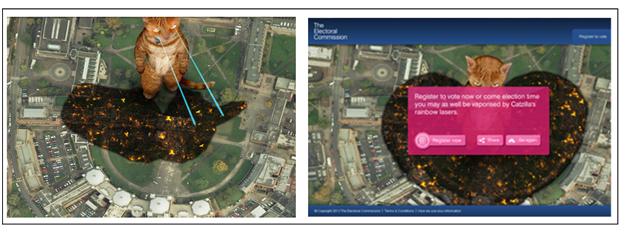
The Commission runs regular campaigns to promote registration, this year’s being clearly aimed at these elusive young people. I’m not sure about its effectiveness, but I’d certainly use it, and I can recall few visual aids of whose student appeal I would be more confident. ItsYourVote is a website whose home page comprises a satellite image of the UK, and a warning that “Without a vote, you have no say in what happens in your local area”. To learn what fearful fate that might be, you enter your postcode, whereupon the satellite homes in and you discover that, should you fail to register, “come election time, you may as well be vaporised by Catzilla’s rainbow laser eyes”, or possibly seized by a massive disco fairground grabber, or swept up by a giant ice cream scoop.

catzilla
Source: ItsYourVote

The Daily Mail thinks the website “absurd” and an appalling waste of public money. But I fear it misses the subtlety. While obviously the ice cream scoop is a bit silly, you can see that Catzilla, though provoked by the under-registration of Birmingham University students, has been impressively selective in his vaporisation of our Edgbaston campus – wiping out the Law faculty and the entire University administration, but leaving untouched, for instance, the Muirhead Tower and my civic-savvy, fully registered INLOGOV colleagues.

As it happens, the Commission’s efforts would be wasted on most of our students this year, for, as noted in my elections preview blog, this is the one year in four when the metropolitan boroughs like Birmingham, along with most unitary authorities and shire districts, don’t elect any of their councillors. This leaves just 37 councils in England plus one in Wales holding any kind of local elections this week, and, with that first blog having at least briefly covered those in the 8 unitaries and the mayoral elections in Doncaster and North Tyneside, the remainder of this one will focus on the 27 county councils.

They were previously elected in 2009, when Labour’s standing in the opinion polls was desperate – 16% behind the Conservatives, at 23% to 39%, with the Liberal Democrats on 19%. Reflecting those figures, the Conservatives, the dominant party anyway in this tier of local government, won nearly nine times as many seats as Labour – 1,261 to 145, with the Lib Dems taking 346 – and took majority control of every one of the 27 councils except Cumbria, where they became the leading party in a Conservative/Labour/Independent coalition.

2009 is therefore the baseline against which to assess the prospects and eventual performance of the various political parties, whose standings in the polls today are, of course, dramatically different. In this week’s Sunday Times YouGov poll, Labour have a 9% lead (40% to 31%) over the Conservatives, with the Lib Dems and UK Independence Party (UKIP) level on 11%, and the Greens on 3%. These figures indicate a Conservative –> Labour swing of nearly 13% since 2009, and no swing at all between the Conservatives and Lib Dems. It’s a blunt measure, but about the best we have for assessing the electoral chances of the major parties.

In the same poll, incidentally, UKIP leader, Nigel Farage, gets a higher rating as a party leader – 44% saying he’s doing a good job – than Cameron (36%), Ed Miliband (29%), or Nick Clegg (21%). Partly because of headlineable findings like these, and partly because they are a real, but unpredictable, threat to all parties in these elections, UKIP have, as Karin Bottom noted last week, been attracting the bulk of media attention. In terms of seats, though not councils, gained, they will undoubtedly be among Friday’s winners – indeed, it’s about the one knowable thing about them – but mainly because they’ve virtually nothing to lose.

UKIP like boasting of their “army of councillors sitting on borough, town, county and parish councils across the UK”. This army, though, would make Gideon’s little band of soldiers that took on the Midianites seem like a legion. In fact, its massed ranks contain just over 100 town and parish councillors (out of 75,000) and about 30 on principal authorities – including 11 (out of 1,800+) on county councils. And there’s a similar economy with the truth in its manifesto claim that “where UKIP is in charge of local government, we use that power to cut costs … we believe that council taxes should go down, not up”. Back on Earth, the only local government of which UKIP has ever had charge is Ramsey Town Council in Huntingdonshire, Cambs., and since taking ‘power’ in 2011 they have ‘slashed’ the council tax precept by +28%, from £42.56 on Band D to £54.61 in 2012-13.

Council tax rates are, quite properly, a big issue in these elections, but hardly a straightforward one. First, Coalition Government ministers have from the outset done their utmost to set – that is, freeze – all councils’ tax and spending totals themselves, by bribing them with limited and potentially disadvantageous freeze grants. Second, it is the districts, not the county councils being elected this week, who are the billing authorities who will have sent out the bills and be trying to collect the taxes, even though it’s the counties who do about 90% of the actual spending.

Third, this year, although almost all counties obediently accepted their one-off grant deals and froze their tax precepts, well over a third of the districts refused them and raised their tax bills – more than half of whom were Conservative-controlled. So, does a voter in one of these ‘naughty’ districts, urged by David Cameron to vote Conservative for lower council taxes, punish the council that raised its tax or reward the county that didn’t?

It’s nothing like as simple as, for instance, street-lighting. It’s not, perhaps surprisingly, a statutory obligation for any council, but, if your street lights are being dimmed or switched off in the interests of economy, it’s almost certainly the county who control the photo-electric timers. So, either way, if you approve of the cost and carbon savings, or disapprove of jeopardising safety and security, you know how to vote.

So how many of the 27 counties, all Conservative today, will be differently controlled come Friday? In Cumbria, the one that half got away in 2009, Labour in recent years has usually had a plurality, if rarely a majority, and will be looking to regain that position of largest single party. However, a Conservative Police and Crime Commissioner (PCC) was elected in November, and, as elsewhere, Ed Miliband’s claim to be “fighting for every vote” is undermined by the party fielding 14 fewer candidates than in 2009, while Greens are up from 15 to 31, UKIP from 4 to 52, and, in another sign of the times, the British National Party (BNP) down from 41 to 9.

While becoming largest party may be fine in Cumbria, in the four councils Labour held virtually uninterruptedly from 1981 until 2005, anything short of winning back majority control will surely count as failure. Derbyshire was numerically the Conservatives’ narrowest capture, with 33 of the council’s 64 seats, and they have already lost that overall majority, with one councillor having to resign for unsavoury personal reasons and another switching allegiance to UKIP. Even a modest swing should do. Nottinghamshire is much trickier, for in 2009 Labour lost seats variously to the Conservatives, the Lib Dems, UKIP (in Ashfield), and assorted Independents, especially in Mansfield. A straight swing of even 10% from the Conservatives might not be enough, but a repeat of those with which they won by-elections in Worksop and Rufford certainly would. In Lancashire too Labour need almost to reverse the trouncing they suffered at the hands of all parties, including the Greens and BNP. A 5% swing from the Lib Dems in Burnley, where they have already won back one seat in a by-election, and a 10% swing from the Conservatives elsewhere should do it – even without ousting the notoriously independent Idle Toad, Tom Sharratt, from his South Ribble fastness.

If Lancashire was a trouncing, Staffordshire was a bloodbath, from which Labour crawled out with just 3 of its former 32 seats. With nearly two-thirds of divisional boundaries having been changed, it is difficult even to assess the scale of the task of regaining majority control from such a tiny base, the most promising guide being perhaps the results in the three districts that held elections last year. In both Cannock Chase and Newcastle-under-Lyme Labour took majority control of the council by gaining a total of 15 seats from the Conservatives, Lib Dems, and in Newcastle also from UKIP. In Tamworth too they won seats from the Conservatives, and across the three councils there was an average Conservative –> Labour swing since 2009 of 14%, which, repeated on Thursday, would indeed have been sufficient, without boundary changes, for Labour to reverse the horrors of 2009. In November, on the other hand, the electorate – or a very small portion of them – preferred a Conservative PCC.

Had the Lib Dems gone into opposition in 2010, rather than national coalition, they too would be aiming to regain the councils they lost in 2009: Somerset, Devon and, although it became a single-county unitary at the same time, Cornwall. But two years of depressing opinion polls and local election results are taking their toll, and Devon, for example, seems to be one of several counties in which UKIP candidates will outnumber Lib Dems. Indeed, Ilfracombe, in Lib Dem hands for years, appears to be being surrendered without even a defence.

Somerset, where almost all contests are between the Conservatives and Lib Dems, and the latter were in majority control for most of the period between 1993 and 2009, is a much stronger prospect. Again, extensive boundary changes make projections difficult, but even a 5% Conservative –> Lib Dem swing on existing boundaries would be enough for the Lib Dems to regain control. But, as noted above, there’s been no perceptible swing at all, and the easy victory of an Independent in the Avon & Somerset PCC election may suggest that this is particularly promising territory for independents and smaller parties.

As for the rest, it might seem that in these uncertain times, if a case can be made for Staffordshire being recoverable by Labour from a councillor base of three, almost anything is possible. Well, yes – but realistically, even a really good result for Labour would probably be limited to depriving the Conservatives of their overall control in a few more councils. One could be Warwickshire, which, as a minority administration Labour have run for longer in recent years than have the Conservatives, and another Northamptonshire, one of apparently a small handful who are all claiming to have “the lowest council tax set by any of the 27 shire counties in England”.

Clearly they can’t all be right, and, this being an academic blog, I feel it’s appropriately pedantic to close by citing the relevant House of Commons note reporting that Northamptonshire’s Band D equivalent precept of £1,028.11 is in fact only third lowest, behind Staffordshire (£1,027.25) and Somerset (£1,027.30).

game

Chris is a Visiting Lecturer at INLOGOV interested in the politics of local government; local elections, electoral reform and other electoral behaviour; party politics; political leadership and management; member-officer relations; central-local relations; use of consumer and opinion research in local government; the modernisation agenda and the implementation of executive local government.

Budget cuts, outsourcing, council mergers: 12,000 miles travelled, but Cornwall’s ex-CE will find plenty that’s familiar

Chris Game

Even allowing for local government’s legendary Stakhanovite working practices, the sector can’t usually manage that many hot news stories on Christmas Eve, so you do tend to notice them, especially if they contain a strand of possible personal interest. I remember well, then, the BBC’s announcement this past Christmas Eve that Cornwall Council CE, Kevin Lavery, had accepted a five-year appointment as CE of Wellington City Council and would be moving to New Zealand to take up the post in March – oh yes, at an annual salary of NZ$400,000, which converted then into £203,000, but today into £219,000 (I note irritably).

The reason (for my remembering, not for his moving) was that I happened to know that England’s cricketers would be playing the second Test Match in their series against the New Zealanders at Wellington’s charming and historic Basin Reserve ground in March – and I was planning to watch it. How brilliant, I thought, if I could do a quick interview with Lavery, just a couple of weeks into his new job, about his first impressions, contrasts with Cornwall, etc. Unfortunately, it quickly turned out that – for, I have to concede, eminently good reasons – ‘March’ in fact meant 31st March, by which time I would be well back in the UK.

More recently – like this morning – it also turned out that the final day of the said Wellington Test Match would almost certainly be rained off. So, lacking anything better to do, I thought I’d report anyway on some of the stuff that the interview might have covered.
First, the contrasts and similarities. Wellington City has a population of 200,000 and the biggest of 9 and a bit elected councils (1 regional, 8 and a bit city and district – don’t ask!) in the Wellington region. The council has an elected mayor (currently Green), 14 councillors, employs 1,500 staff, and has a budget of NZ$400 million (£220 million).

Cornwall has a population of 535,000 and a 123-member council – roughly the number of councillors plus mayors in the whole Wellington region. The council employs 19,000 staff – not far short of NZ local government’s total employment – and has a budget of about £1 billion.

In short, Lavery’s new job represents an apparently significant drop in scale, but barely a drop at all in remuneration. I quoted his salary at the outset, partly because the NZ media (and possibly public) are at least as fascinated/obsessed with executive pay, pay-offs, etc. as ours are, but mainly because so far his financial cost is one of the very few things that most Wellingtonians, including most councillors, know about their new CE. He was head-hunted in a recruitment process that cost NZ$157,000, including NZ$12,000+ to fly him out for interview; he can claim up to NZ$40,000 removal costs, and is promised a ‘golden parachute’ payment of up to NZ$200,000, if the job disappears in the regional governmental reorganisation expected over the coming couple of years. As one councillor put it: “We don’t know what we’re getting, but he’s cost us a bomb to get and he’ll cost us a bomb if he goes”.

So it’s fair to say that his relations, initially at least, with some councillors could be as touchy as they were with some of those in Cornwall, where, it may be recalled, the Conservative leader, Alec Robertson, was deposed and plans for a massive Lavery-driven shared services joint venture project had to be halted after they’d failed to win majority councillor backing.

Reportedly, Lavery was first sounded out by the Wellington headhunters immediately following the leadership change and the resulting withdrawal of one of the two bidders for the shared service joint venture, leaving only BT, one of Lavery’s former employers. But whatever the detailed sequence of events, the reputation preceding him to Wellington has been that of a ‘Marmite (or perhaps Vegemite) bureaucrat’ – you either love him or loathe him – and one with an undisguised enthusiasm for privatising and outsourcing services.

From which you might suppose that the costly new appointment was perhaps a symbolic act on the part of a council whose leadership had recently taken a shift to the right, and was looking at one and the same time to signal its political authority and a major change in policy direction. You might, but you’d be quite wrong.

If party politics in Cornish local government is, by UK standards, relatively low-key, in Wellington – and indeed in NZ local government generally – it is barely visible and almost uninterpretable to the untrained eye. In the city’s 2010 local elections, only 3 of the 14 successful candidates had stood openly under party labels (2 Labour and 1 Green), and the Mayor, elected for the first time (like councillors, for a three-year term), though a Green party member, had campaigned as an Independent.

Celia Wade-Brown’s election as Mayor seemed to surprise her almost as much as it did pretty well everyone else. Born and brought up in England, she came to NZ only in her late twenties, and, with little prior public warning, decided in 2010 not to recontest her council seat, but instead to challenge the high-profile mayoral incumbent, Kerry Prendergast, seeking her fourth term of office. In the STV election, Prendergast was a comfortable 6% ahead after the count of first preference votes, was still ahead on the second, third and fourth counts, but was overtaken by Wade-Brown on the fifth and final count by just 176 out of more than 60,000 votes cast.

The mayoral and councillor results combined were interpreted as representing at least a modest move towards the centre-left, but if voters were looking for a significant leftward policy swing, most must have been disappointed. Indeed, the CE appointment, involving as it did the personally humiliating dismissal of the former CE after 15 years and for apparently nothing very particular, was one of the few visible signs of an intended change of direction. As far as the 2013/14 Draft Annual Plan and budget is concerned, the headlines must look as familiar to Wellington electors as they do to us: large-scale savings (NZ$240 million over 10 years), necessitating service cuts, job losses, increases in fees and charges, and ongoing outsourcing.

A major reason for Lavery not taking up his post until the end of the month is that there are three important events taking place between now and then, the consequences of which will take up a sizeable chunk of his in-tray. One is the Council vote on 27th March to approve the Draft Annual Plan, detailing the Council’s work programme and proposed rate and fee increases, following which it will, as required, go out for a month’s public consultation, before coming back to the Council for final approval in June.
This year’s Draft Plan cuts council spending by NZ$9 million and proposes a rate (property tax) increase of 2.8%, and several of the detailed cuts especially are controversial: restricted library opening hours, increased parking charges, “changing the operating model” of the aquatic centre crèche (unsubtle euphemism there!), reduced grants to the Zoo Trust and ‘Positively Wellington Tourism’. All can, of course, and doubtless will be compared to the new CE’s salary.

Before that, on 21st March, another public consultation begins – on three options for local government reform across the whole Wellington region. Two of the three are alternative ‘super city’ models, as favoured by the regional reform working party. The third is a minimally modified status quo, added by the Mayor and councillors who oppose a super-city solution and argue that the public should be presented with a wider-ranging choice. Lavery will be on familiar territory here.

Also on 21st March Wellington councillors vote again on the national Transport Agency’s proposal for a 300-metre long, 9-metre high concrete flyover to ease the perpetual congestion round the huge roundabout within which is situated the Basin Reserve cricket ground (where in fact I should be sitting at this moment). We cricket fans fear the flyover would seriously blight our spectating, to say nothing of its impact on hundreds of local residents. The Mayor – for whom almost any kind of road development is anathema – and a majority of councillors argue that the congestion can be resolved by a combination of other means. However, some of the Mayor’s phraseology is worrying. She talks rather vaguely of ‘fine-tuning’ the present roundabout, and of how Basin Reserve “must not be blighted by a naked block of concrete”, as if various forms of pleasingly attired concrete were available alternatives. And now there’s talk of a couple of the eight councillors who opposed the flyover in December maybe switching sides following a two-month council staff investigation. What a pity I couldn’t have given the new CE a short personal briefing on the issue.

game

Chris is a Visiting Lecturer at INLOGOV interested in the politics of local government; local elections, electoral reform and other electoral behaviour; party politics; political leadership and management; member-officer relations; central-local relations; use of consumer and opinion research in local government; the modernisation agenda and the implementation of executive local government.

Prestatyn’s election farce and the busted petition process

Chris Game

Remember the 2000 US Presidential election, the seemingly endless Florida recounts, and how we mocked an electoral system that took 35 days to produce a winner?  Well, it’s now over eight times as long – 287 days and counting – since last May’s Welsh local elections. Yet, with a tad less riding on the result, one of the winning candidates in Denbighshire County Council’s Prestatyn North ward has still to take his seat. And if that doesn’t signify a busted system, utterly unfit for purpose, it’s hard to imagine what might.

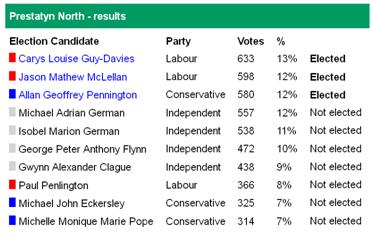
It’s a story that started as mildly amusing, passed through farcical around October, and is now just an all-round total embarrassment. It’s most easily understood by seeing the election result as announced by the Returning Officer (RO), from which you may also be able to guess the problem.

prestatyn table

Source: Denbighshire County Council

Yes, one of the Conservative candidates and one of Labour’s have quite similar surnames, and, while many electors certainly will have split their three votes between candidates of different parties, a Labour-Conservative split result of these dimensions looks, to say the least, odd. It was. Without getting too nerdy, Pennington (Con) had been credited with a share of the votes of those who voted en bloc for all three Labour candidates, and Penlington (remember: L for Labour) with the rather smaller share of the ‘straight slate’ Conservative ballots. In electoral administration jargon, there was a screw-up.

At which point, I would say two things. First, such inept-but-innocent counting screw-ups happen more often, and with more significant consequences, than you might think. In Broxtowe (Notts) last year, the names of a Lib Dem husband and wife were transposed in copying them from the corresponding numbers list to the count summary sheet, and the wife was officially declared elected, despite polling 21 fewer votes than her now officially defeated husband.

Waltham Forest in 2010 managed a mix of Broxtowe and Prestatyn. In copying Labour’s en bloc votes, Labour’s three candidates each received 2,451 instead of 1,451 – sufficient to enable the party’s third-placed candidate to be elected, rather than the leading Lib Dem. And in a much publicised case in Birmingham’s Kingstanding ward in 2006, a BNP candidate was elected, having been gifted an extra 981 votes in a double-counting of all those ballot papers on which electors split their two votes between candidates of different parties.

With these Waltham Forest and Birmingham cases in mind, my second point is that the numbers of votes involved in these screw-ups can be not only large, but beyond the bounds of arithmetical possibility. The combined votes of all candidates – announced, it’s worth emphasising, by the ROs, after recounts rigorously scrutinised by candidates and agents of all parties – totalled respectively 1,397 and 2,367 more than would have been possible, even if every voter completing a ballot paper had used every vote available to them.

This is the bit that, to me anyway, passeth all understanding. Can candidates have so little idea of how the election’s gone that they’re not curious about why their vote is 50% higher than they might have expected? And how come none of these key actors involved in the counts could do even simple addition?

Whatever the explanation, once a candidate is declared elected, these essentially innocent administrative errors immediately become seriously costly. It might seem convenient, if an embarrassed RO were able publicly to admit that “Oops, I made a boo-boo. Can we all go back five minutes?”  Sadly, election law and convention decree that this is not on. In the UK the only way to challenge a declared result is legally, and expensively, for a miffed candidate or elector to issue an election petition within three weeks of the election, pay the £465 fee, and also ‘give security’ for all relevant costs arising – up to £5,000 in a parliamentary election, £2,500 in a local. No security, no petition.

Here’s where the trouble starts and where fundamental reform is decades overdue.  A robust procedure for challenging the result, whether on the grounds of innocent administrative error or deliberate fraudulent practice, is a vital part of any sound electoral system. It should have the attributes of ARTESSA, being accessible, rational, transparent, efficient, straightforward, swift and affordable. Our petition procedure today, little changed from that set out in the 1868 Parliamentary Elections Act to deal with bribery, treating, personation, undue influence and other corrupt practices, is none of these, as Prestatyn North’s hapless Paul Penlington is still discovering the hard way.

That there had been a substantial counting error was first realised apparently by the RO and Council Chief Executive. Labour, both candidate and party, were slow to protest – one suggested reason being that, without knowing the exact number of wrongly assigned votes, there was the real possibility of a correction letting in not Penlington, but the fourth-placed Mike German, a one-time Labour councillor before he defected to help form the Democratic Alliance of Wales – than whom even a usurping Conservative might be marginally preferable. Eventually, however, a petition was issued, to have the votes recounted and the result overturned.

Despite the Council having admitted from the outset its “fundamental error”, it still took until late July for the jury-less High Court to authorise a recount, and a further three months for that count to take place in, for some reason, London.  Unhurried, certainly, but only now does the tale become truly incredible.

The result of a recount can only be officially announced and accepted by a special two-judge election court, which took nearly a further three months to convene – again in London. Only on January 23rd, therefore, were the correct figures finally declared – Penlington 606, Pennington 341 – and the original result overturned.

You wouldn’t, by now, expect the ruling to come into effect immediately, and of course it didn’t.  The duly elected Councillor Penlington should, though, have taken his seat a week later – had former-Councillor Pennington not decided that the loss of his allowances would put his “livelihood at stake”, refused to give up his seat, and objected in writing to the court’s decision.  Incidentally, legal costs, awarded against the Returning Officer, were estimated at this point to have passed £20,000, with the clock presumably still ticking.

There is so much wrong here that, even given the space, it would be hard to know where to start: the time, the cost, the arcane and detrimental procedures, the irrationality and inflexibility? Why the great rush to issue a petition, when the judicial process meanders as it pleases? Why can one elector challenge a parliamentary election, while four are required for a local election? Why can’t a Returning Officer or a political party initiate a petition?  And so much more – most now thankfully documented in the Electoral Commission’s excellent report, Challenging Elections in the UK.

Prestatyn North may be just a quirky contemporary footnote, but it does illustrate one key aspect of the problem. The petition procedure was designed to deal with 19th Century corrupt practices in parliamentary elections. Its requirement today is to deal with 21st Century corrupt practices, and more frequently with innocent errors and administrative misjudgements, in local government elections – for which it is hopelessly ill-equipped.

There were 52 parliamentary petitions tried in 1868 alone, all dealing with alleged malpractice. Since 1929, however, there have been just 11, including six from Northern Ireland and three from the single constituency of Fermanagh & South Tyrone. They sometimes make headlines – the then Anthony Wedgwood Benn’s disqualification as a Peer in 1961, ex-Labour minister Phil Woolas’s disqualification in 2010 for making false statements about his Lib Dem opponent – but they’re rare.

Local government election petitions are not rare. Since 1997, at least 44 from principal councils have gone to trial, plenty more from town and parish councils, and still more have been withdrawn before trial, usually due to lack of funds. Of the 16 in the past five years, two (both subsequently withdrawn) claimed a candidate was disqualified to stand, and three alleged corrupt or illegal practices committed by or on behalf of a candidate.

The remaining 11 concerned actions by electoral officials: either administrative Prestatyn-type errors or process decisions causing the election not to have been conducted ‘substantially in accordance’ with the rules – actions, in short, wholly different from those with which petitions were designed to deal.  

The Law Commission has embarked on a comprehensive review of electoral law, aimed ambitiously at collating and reforming the existing morass of primary and secondary legislation into something more coherent, and conceivably even a single modular UK Electoral Act. It’s still in its early stages, and its members may hope that when they eventually reach ‘Challenging the election result’, they’ll be almost there. The sorry saga of Prestatyn should remind them that they won’t be.

game

Chris is a Visiting Lecturer at INLOGOV interested in the politics of local government; local elections, electoral reform and other electoral behaviour; party politics; political  leadership and management; member-officer relations; central-local relations; use of consumer and opinion research in local government; the modernisation agenda and the implementation of executive local government.