Tax Collection Rates: Central and Local

Chris Game

Council tax collection rates have become an annual Commons ritual, pleasingly coinciding with the first week of Wimbledon.  Party whips select a tame Government backbencher – the parliamentary equivalent of a first-round loser – to lob up a couple of juicy written questions for the high-seeded Communities and Local Government Minister to smash away, adding for good measure some unsubtle party spin. This year, though, there were a couple of interesting variations.

First, the questions were tabled not by a neophyte Tory backbencher, but by Helen Jones, four-term Labour MP for Warrington North and Shadow Local Government Minister. Second, she wanted to know about council tax arrears as well as collection rates, for each billing authority, in cash and percentage terms.

To most people, the two things are clearly distinguishable. Uncollected taxes relate to the most recent financial year and, fairly or not, can be seen as an indicator of administrative inefficiency.  Arrears are uncollected taxes over several years that are still being chased as, in principle, collectable. Presentationally, they should be more problematical, for even fruitless chasing sounds more diligent than just giving up and writing them off.

But to ministers this is a distinction without a difference: they can attach their political message equally easily to either set of statistics. Combining Jones’ two questions, Local Government Minister, Bob Neill, placed in the Commons Library a two-column table (Figure A), showing for each alphabetically listed billing authority their accumulated council tax arrears at 31 March 2011, and the total tax they were attempting to collect in 2010-11.
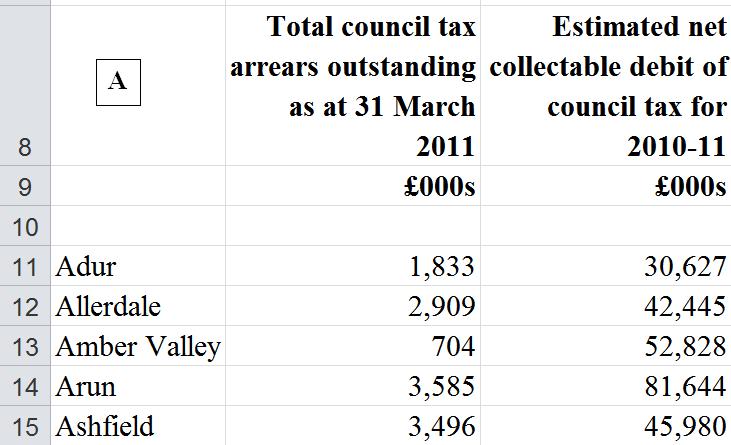
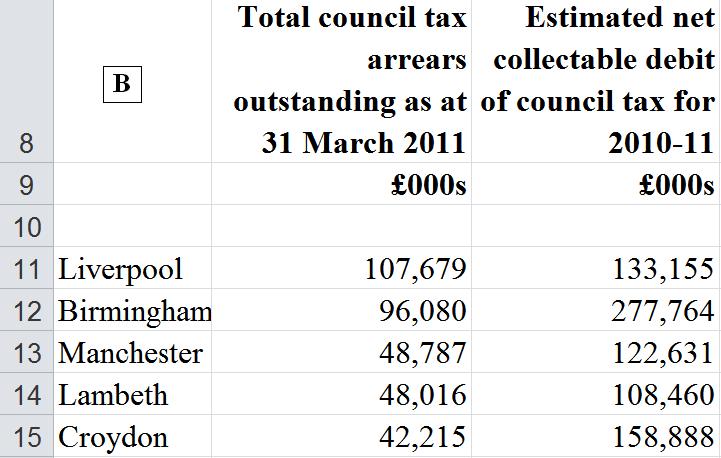


More helpful would have been the 2011-12 figures, which were in fact available to us all a couple of days later. Still, not to worry; other assistance was on the way. Ministers were naturally concerned that the full partisan significance of these figures might be lost, if MPs, let alone journalists, were forced to sift through all 326 of these authorities. So a Spad (ministerial special adviser) circulated the media with a list re-ranking them in order of their total tax arrears at the end of 2010-11 (Figure B).

Guessing the sections of the media likely to run their story, the Spad also added some useful quotes. The revised list was “a league table of the worst offenders”, in which “9 out of 10 of the worst authorities are Labour run”. There were some interpretative comments too from his ministerial master, Eric Pickles:

“This roll call of shame is familiar reading, with Labour councils year in, year out, topping the table of local authorities who squander millions by failing to collect our council tax. If these Labour authorities stopped complaining about the legacy of cuts left by their own party and actually chased up these tax dodgers, they could use the money to protect hundreds of frontline jobs.”

Yes, the DCLG ministerial world is apparently that simple.  All uncollected council tax is attributable to tax dodging and the compliance of lazy, inefficient and moaning Labour councils.  Oh dear – just where do you start?

First, perhaps, with the most obvious.  Yes, Labour Liverpool did top the 2010-11 arrears table, but two of the top five places were occupied by Birmingham, run until May by a Conservative-Lib Dem coalition, and Conservative Croydon. Even the Daily Mail worked out that 9 of the top 10 couldn’t therefore be Labour – albeit in a story whose snappy title left little doubt as to its content: “£2 billion of council tax left uncollected by town halls who then moan about cuts by Whitehall”.

If this arrears listing were indeed a ‘roll call of shame’, Croydon’s prominence would be embarrassing over and above its political control.  As would be expected – by anyone sensing that uncollected tax may not be entirely due to ‘Won’t Pay’, rather than ‘Can’t Pay’ – there is a consistent overall correlation between councils’ annual tax collection rates and their position on the DCLG’s own Indices of Deprivation.

Manchester and Liverpool, for example, are ranked 3rd and 4th on the national Index of Multiple Deprivation, behind Hackney and Tower Hamlets. Birmingham and Lambeth are 13th and 14th. Croydon, by contrast, is no higher than the 20th most deprived borough in London.

As we’ve seen, though, the listing provided to Helen Jones and the Commons Library ranks councils by their accumulated council tax arrears – and in cash terms, moreover, not as a percentage or efficiency measure of anything at all. Big cities, London and metropolitan boroughs are almost bound to head such rankings. If any of the “worst offenders”, Croydon included, wanted to drop down the list and, presumably, earn ministerial brownie points, they could simply change their corporate write-off policy, stop chasing these really hard-to-recover debts, and write them off. Would that genuine efficiency gains were that easy!

To make their party propaganda properly, ministers should have had their Spads rank order not councils’ arrears, but their tax collection rates – their actual tax receipts for the financial year as a proportion of the total due. We now have these figures for 2011-12, and they make interesting reading (Table 7 of hyperlink).

English local authorities collected £22.1 billion in council tax and £20.8 billion in non-domestic rates (NDR), or 97.3% and 97.8% respectively of the totals due to them. Shire districts’ council tax percentages were slightly above the overall average (98.2%) and those of London and metropolitan boroughs (96.3 and 96.1%) and unitaries (97.2%) slightly under.

Highest collection rates in Inner London were in Conservative Wandsworth (98%) and Labour Camden (96.7%), the lowest in Labour Hackney (93.7%) and Lewisham (93.9%). In Outer London, the spread was rather greater, largely due to Newham’s 89.6% – which was 4.5% lower than any other OL borough and, most oddly, 10% lower than its 99.6% NDR collection rate, the highest in London. Supposedly inefficient Croydon was precisely on the Outer London average (96.6%).

Among metropolitan districts, the only three to top a 98% collection rate were an assorted West Midlands trio – Conservative Solihull and Dudley, and Labour Sandwell – followed by Conservative Trafford and Labour Rotherham.  Lowest were Salford (91.3%) and Manchester (92.3%).

Even from this small selection of extremes, it is clear that politically the picture is more complicated than Eric Pickles would have us believe. It is also clear – and, surely, hardly surprising – that Conservative councils overall do have at least slightly higher collection rates than Labour. There may be good explanations for the variations, from year to year and across apparently similar types of authority, but the questions do need asking, which is why these statistics, properly understood and deployed, are so important. After all, if Newham raised its collection rate to that of the hardly more affluent Tower Hamlets, it would bring in an additional £4 million; if Birmingham matched Sandwell, it would collect an extra £10 million.

Of course, other questions too suggest themselves: how, for example, does local government’s £600 million council tax collection gap look when compared with those for HMRC-administered taxes? To which the answer is: not too shabby.

HMRC helpfully produces an annual report on this very subject – Measuring Tax Gaps – and the latest estimates, for 2009-10, include: direct taxes (income tax, NI contributions, capital gains tax) – £14.5 billion or 5.8%; VAT – £11.4 billion or 13.8%; corporation tax – £4.8 billion or 11.7%; beer, spirits, cigarette, tobacco duty – £2.4 billion or roughly 10%. And the total gap: just the cool £35 billion or 7.9% (Table 1.1 of hyperlink). It kind of puts local government’s 2.7% into a slightly different perspective, doesn’t it, Minister?

Chris is a Visiting Lecturer at INLOGOV interested in the politics of local government; local elections, electoral reform and other electoral behaviour; party politics; political  leadership and management; member-officer relations; central-local relations; use of consumer and opinion research in local government; the modernisation agenda and the implementation of executive local government.
Managed Difference, Local Solutions, Market Forces – Anything but Postcode Lotteries!

Chris Game

It was over six years ago that Sir Michael Lyons launched his campaign to abolish ‘postcode lotteries’ from the local government lexicon.  As he wrote in his 2007 report, “I would hope to see debate about postcode lotteries being replaced, over time, by discussion of ‘managed difference’ – recognising the right and ability of local communities to make their own choices, confident in their own competence, and in the knowledge of their own preferences.”

Others, doubting perhaps the rallying appeal of ‘managed difference’, proposed alternatives – local difference, local solutions, postcode preferences – but to nil avail. The campaign made no more headway than most of the Lyons Report’s substantive recommendations, as was painfully apparent last week – during which the populist media brought us what seemed like a new PL each day, each of course with its accompanying outrage and public alarm. 

First was the Diabetes Treatment Postcode Lottery. A National Audit Office (NAO) report showed “significant variation in quality of care received by people with diabetes across the NHS”. Quality of care was defined here solely in terms of the 9-process care regime advised – yes, only advised – by the Department of Health (DH) and National Institute for Health and Clinical Excellence (NICE), and the most recent data were from 2009-10.

Still, I mean, the results were, like, just incredible. The 151 English PCTS and 34,000 GPs clearly weren’t all following fully and identically the DH’s recommended care package.

Next came the seasonal Holiday Cash Postcode Lottery. Which? magazine sent mystery shoppers to a range of different currency exchange providers across the UK on the same day and – surprise! – found they weren’t all offered exactly the same number of euros for their £500s. In fact, there were regional variations, with London and Glasgow shoppers getting more euros than those in Birmingham, Sheffield and, yes, Haverfordwest – except that there weren’t really, since over a two-month period the Post Office and Thomas Cook offered the best deals, irrespective of region. 

Then lgcplus ended the week with the Child Care Postcode Lottery, choosing to lead its news round-up on 25th May with a Times story: “‘Postcode lottery’ in child care proceedings”.  A Cafcass (Children and Family Court Support and Advisory Service) report found that, in the three years since the Baby Peter Connelly case, there has been an increase of over 60% in local authority care applications – but, again amazingly, not spread absolutely equally across all 152 relevant local authorities.

Let’s start with the child care case. First, I’m fairly certain the Cafcass report itself contains no mention whatever of a ‘postcode lottery’. The cheap and misleading headline was chosen by The Times – presumably to rubbish local government in general and certain councils in particular – and then, regrettably, recycled by LGC.

Second, the report’s main findings constituted a generally highly positive local government news story – though you’d never know it from The Times’ version, since the very term ‘lottery’ has deliberately negative connotations.  

To quote directly from the report: “as a result of intensive work on behalf of children, court applications to protect vulnerable children are being made in a more timely way than in 2008 and at an earlier stage of local authority involvement with a family. In particular, neglect cases are being acted on more quickly … and local authorities are more fully prepared coming into court”.

Third, the whole point of a lottery is that there are unmistakeable winners and losers, good and bad outcomes. For the media, the good guys here are, no question, those councils heading the league table of public law applications per 10,000 children. That’s not, however, the Cafcass view.

Cafcass CE, Anthony Douglas, stressed that it’s impossible from the statistics alone to know whether high appliers are being diligently active or defensively over-reactive, and whether low appliers are being slow or perhaps have much better family support services.

The authors warn that their study “does not provide evidence about what the ‘proper’ level of care applications should be”, and admit they were hesitant about publishing statistics in this form, given the likelihood of their prompting comparison of authorities’ levels of intervention. Perhaps they should have hesitated longer.

The diabetes treatment case is not dissimilar. Again ‘postcode lottery’ comes not from the NAO report, but is a media tag to justify the pillorying of, in this instance, Primary Care Trusts. Again too the lottery headline obscured an at least partly positive story: that the proportion of diabetes patients receiving the full recommended care package had increased significantly since the previous audit.

This time, however, the report’s authors were quite certain who the lottery losers were: diabetes patients in PCTs in which only relatively small numbers – say, under 40% – received all nine DH-recommended care processes in 2009-10, regardless of any other treatment they may have received.

Almost as striking, though, is that in not one of the 151 PCTs were more than 69% of diagnosed diabetics receiving all nine processes. Which, to an outsider, suggests either that there are no even moderately high performing PCTs in this field – which seems unlikely – or that many, including the best, are employing other tests and other forms of care, in which the NAO were not apparently interested.

They, it seemed, were more into the blame game – the problem being to decide whether it was the recalcitrant PCTs themselves at fault or the DH’s sloppy monitoring.

By contrast, my problem – indeed, my profound irritation – is that none of these three cases is at all accurately or usefully labelled a ‘postcode lottery’. The cheap point here, of course, is that postcodes were designed for the purposes of delivering mail – the clue’s in the name – and therefore have little to do with council, PCT, or any other political or administrative boundaries.

I’ll tell you what a postcode lottery is. It’s if you happen to live in the Galashiels postcode area in TD9, 12 or 15, and may be either in Scotland or England; or in the Newport postcode area in NP7, 16 or 25, and not know which side of Offa’s Dyke you are.

No, the postcode bit is just silly. It’s the lottery bit that’s serious. Variations in policy and practice across local authorities or PCTs aren’t products of chance. They result from people exercising their right to make decisions in what they judge to be the best interests of those to whom they are answerable – for example, to follow official guidance or try an alternative that is or might be better or more locally appropriate, or from which they and others might learn.

In both the diabetes and child care cases, the ‘postcode lottery’ presentation of the story was not only misleading, and possibly unnecessarily alarming, but militated against our understanding of what the reported variations actually do represent. As for the exchange rate differences, they result from straightforward high street competition, that Which? magazine must surely have come across before.

Chris Game is a Visiting Lecturer at INLOGOV interested in the politics of local government; local elections, electoral reform and other electoral behaviour; party politics; political  leadership and management; member-officer relations; central-local relations; use of consumer and opinion research in local government; the modernisation agenda and the implementation of executive local government.
The Barnet Graph of Doom – not new or classified, but definitely sensitive

Chris Game

A recent SocietyGuardian article on the impact of demographic change on local authority service provision by David Brindle, the paper’s Public Services Editor, produced considerable social media comment, but not apparently any actual sighting of the item that kicked the article off: the so-called Barnet Graph of Doom. Time, therefore, for an unveiling, and some demystification.

 Brindle introduced the BGoD as:

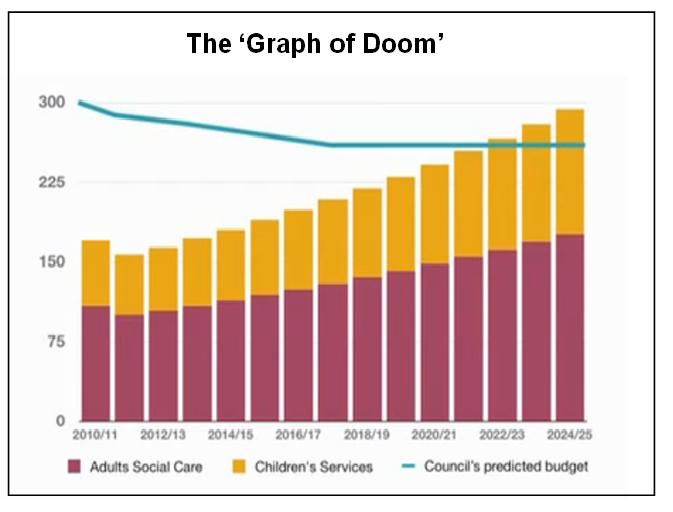
 “a PowerPoint slide, showing that within 20 years, unless things change dramatically, [Barnet Council] will be unable to provide any services except adult social care and children’s services. No libraries, no parks, no leisure centres – not even bin collections.”

Dramatic enough in itself, you’d have thought, but Brindle ratchets up the drama by seeming to imply that the Doom Graph is both new and so sensitive as to be virtually classified:

“The slide … now features regularly in presentations by Sir Bob Kerslake, permanent secretary at the [DCLG] … Whether he has dared to show it to communities secretary Eric Pickles, defender of the Englishman’s inalienable right to a weekly bin round, is unknown.”

In fact, speculation is unnecessary, as the slide in question has been in the public domain for nearly eight months now. It comes from a three minute video presented by Councillor Dan Thomas, Cabinet Member for Resources, as part of one of Barnet Council’s regular budget consultation exercises. The presentation is on both the Council’s website and YouTube, and therefore as available to the minister as it is to Barnet residents, you and me. 

Whether Sir Bob makes use of more than the single slide Brindle doesn’t say. But, unable to break a lecturer’s lifelong weakness for promising visual aids, I certainly would have done – in fact, will do so here – because I reckon the video, though brief, provides a better introduction to the causes and scale of the challenges facing all major local authorities over the coming few years than many have managed.

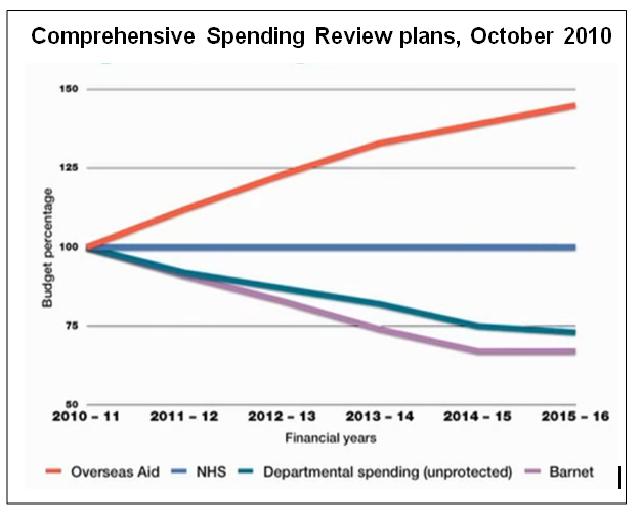
The video starts from the Government’s October 2010 Spending Review plans to cut total public spending by £81 billion by 2014-15, but not equally across the board. With the NHS budget (nearly 13% of the total) protected and Overseas Aid, though small, increased, the hit taken by the unprotected DCLG, and as a result by local government, would be over 28%.

The video starts from the Government’s October 2010 Spending Review plans to cut total public spending by £81 billion by 2014-15, but not equally across the board. With the NHS budget (nearly 13% of the total) protected and Overseas Aid, though small, increased, the hit taken by the unprotected DCLG, and as a result by local government, would be over 28%.

For Barnet, other things too will change.  With a population of 350,000, the borough is already the largest in London and faces further growth at both ends of the age spectrum – 17% more 5-to-9s and 25% more over-90s by 2016. There is substantial development in the west of the borough, currently requiring more reception places and in future more secondary school places. Which brings us to the Graph of Doom.

Barnet Council estimates that over the four-year Spending Review period it will lose roughly 30% of its income, requiring matching reductions in spending. The bar chart plots the predicted spending on adult social care and on children’s and family services over the coming decade – showing that, without significant changes in the way these services are provided and/or in councils’ funding, the increasing numbers it will be supporting mean that by 2022-23 it would be providing only social services, there being no money left for anything else.  Not classified information, then, but definitely sensitive.

The graph’s original purpose, it should be remembered, was to prompt Barnet residents to think about what their spending priorities would be for the immediate and medium-term future – and, no doubt, to concentrate the minds of members and officers. It was not the product of a sophisticated modelling exercise and, as its authors would surely acknowledge, it has obvious limitations.

It takes no account, for example, of future economies and efficiency savings or of increased income stemming from planned regeneration, particularly of the Cricklewood/West Hendon/Brent Cross area. On the other hand, though, it seems to assume a more or less neutral 2013 Spending Review, rather than another round of austerity measures, as currently looks more likely. In short, though not all-inclusive, its depiction of a calculably approaching funding crisis is more than ‘real’ enough to warrant serious attention from all who should be concerned.

The new Coalition Government seemed concerned – when one of its first actions was to ask Andrew Dilnot, a former Director of the Institute for Fiscal Studies, to chair a three-person Commission on the funding of elderly care and report back, with recommendations, within the year.

The Commissioners were emphatically concerned. They found the current funding system barely comprehensible, frequently unfair, and urgently in need of reform. Their key recommendations proposed:

•   capping individuals’ lifetime contributions towards their social care costs – at around   £35,000 – after which they should be eligible for full state support;

•   increasing the means-tested threshold, above which people are liable for their full care costs, from £23,250 to £100,000;

•   limiting liability for the costs of accommodation and food paid by people in a care home to £10,000 p.a.

The Commission’s full set of proposals, it estimated, would increased public spending by £1.7 billion p.a., rising to £3.6 billion by 2025 – equivalent to 0.25% of the total: “a price well worth paying” to remove people’s fear of having to sell their homes and spend almost all their wealth on care.

Ministers, particularly those in the vicinity of the Treasury, then became concerned to the point of agitation – at the capping proposal and the overall price tag. Dilnot was welcomed, but, as Health Secretary Andrew Lansley put it, as “a basis for engagement” – to be followed by more consultation, a delayed White Paper, and legislation “at the earliest opportunity thereafter”.

Whereupon the LGA became volubly concerned, with good reason. In an unusual cross-party initiative, Chairman Sir Merrick Cockell wrote to the three main party leaders on behalf of all LGA political groups, pointing out that social care already takes up more than 40% of council budgets, that demographic pressures alone will add £2 billion p.a. to these costs by 2015, and calling on Ministers to work urgently with local government in introducing radical Dilnot-type reforms.

Since then, the White Paper has been further postponed and will not address the funding issue anyway, the Queen’s Speech contained no relevant legislation whatever … and Doom gets ever closer.

Chris Game is a Visiting Lecturer at INLOGOV interested in the politics of local government; local elections, electoral reform and other electoral behaviour; party politics; political  leadership and management; member-officer relations; central-local relations; use of consumer and opinion research in local government; the modernisation agenda and the implementation of executive local government.
Hilary Benn – not always so brilliant, or even believable

Chris Game

“Later, I heard that Hilary Benn had been appointed [as a Minister for International Development in a 2003 Blair reshuffle]. Lucky old Hilary. That’s the second time he’s stepped into my shoes, but I can’t complain. He’s brilliant.”

Deliverer of this unusually effusive politician’s compliment was the actor playing Chris Mullin, the former Sunderland Labour MP and junior minister, whose well-received diaries were recently adapted into one of the more surprising of recent London theatre hits, A Walk On Part: The Fall of New Labour.

Well, with due respect to Mr Mullin, his hero hasn’t been so brilliant – or even, apparently, honest – in his attempts to spin this year’s council tax figures to his party’s advantage.

On April 16, Mr Benn, Labour’s Communities and Local Government Spokesperson, posted a news items on Labour’s official website, headed ‘New figures reveal residents in Labour areas pay less council tax than in Tory or Lib Dem areas’.

Nothing remarkable there, I agree.  It could have been an early April headline from pretty well any year since Labour decided that tax-raising was an embarrassing activity for a social democratic party to be engaged in.  Still, I did wonder where the ‘new figures’ came from, as the only ones I knew of that analysed by political control were those helpfully produced by Matthew Keep in the House of Commons Library (Council Tax 2012/13 – Standard Note: SN/SG/6276).

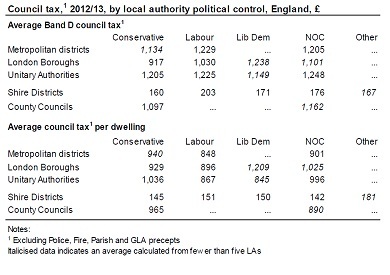
As a politician, Mr Benn sees no need to source his ‘new figures’ or the ‘research’ that produced them, but they are at such variance with those of the Commons Library – as in the table reproduced below – that they are worth comparing, or contrasting, more closely.  It may be, of course, that Mr Benn’s data are somehow more complete than those in the table, or maybe differently calculated – in which case it’s a particular shame that we weren’t informed.

Benn: ‘In Labour local authorities, the Band D council tax rate is £81 lower than in Tory areas and £42 lower than in Lib Dem areas’.
Commons Library: Wrong.  In ALL Labour authorities – all types and therefore all collectively – average Band D council tax is HIGHER than in Conservative authorities and, higher too than in Lib Dem authorities, with the exception of London borough, of which they control just two.

Benn: ‘Households in Labour-controlled authorities pay on average £220 less per year than those in Tory areas and £101 less than those in Lib Dem areas’.

Commons Library: Partly wrong. Households in Labour-controlled London and metropolitan boroughs and unitaries do pay less on average than those in Conservative areas, but the difference is much less than £220 p.a., and in shire areas those in Labour-controlled districts pay slightly more. Comparisons with Lib Dem authorities vary more by type of authority.

None of this, it should be emphasised, is surprising.  Indeed, the surprise would be if the picture painted by Mr Benn’s figures really were true. The truth, however, is that this is one of the more irritating ritual arguments in which the major parties engage every year in the period between council tax-setting and the local elections. It has become an inevitable by-product of the way in which our unreformed tax system works – as I sought to explain in this space last April.

The tax base for council tax is a ratio system centred around Band D: Band A paying 6/9 (2/3) of Band D; Band B 7/9, and so on up to Band H paying 18/9 (2x) of Band D. Councils calculate their tax base by weighting the number of dwellings in each band to Band D, and report their budget headlines in terms of ‘Council tax for council services (Band D)’.

Band D has thus become a benchmark for comparative purposes, and it is therefore perfectly reasonable that the Conservatives tend to use it – as they could with this year’s Commons Library figures – to claim that average Band D tax rates are normally lower in Conservative than in Labour or most Liberal Democrat areas.

Reasonable, but disingenuous. Not so much because only a small minority of properties (15% in England) are actually in Band D, but because, exacerbated by the absence of any revaluation since 1991, the mix of property bands across authorities and regions nowadays varies starkly. In my own authority of Birmingham 56% of properties are in Bands A and B, and just 14% in Bands E to H combined. Neighbouring Solihull has 19% A and Bs and 41% E to Hs. In the North East there are 56% Band As, in the South East 9%, in London 3%.

All of which obviously means that, to raise a certain tax income in an authority with mainly Band A to C properties requires a significantly higher Band D tax than in one comprising many E to H properties. The average bills paid by tax payers will vary similarly – being generally higher than the Band D figure in affluent and Conservative-inclined areas, and lower in poorer or Labour-inclined ones.

Hence Labour’s equally disingenuous preference for using average tax bill figures as their political comparators.  North East: Average Band D council tax £1,525; average tax bill per household £1,072. South East: Average Band D council tax £1,475; average bill per household £1,381. As the anthropomorphic Russian meercat, Alexsandr Orlov, would confirm: simples!

Mr Benn, though, wasn’t finished. His ‘research’ had also revealed that more Conservative than Labour councils had rejected the Government’s one-off grant in exchange for freezing or reducing their council tax in 2012/13. “16 Tory councils have increased council tax this year, as opposed to 15 Labour councils”.

This really is foolishness, on several different levels. First, is Benn really suggesting the 15 Labour councils were wrong: that they should have cravenly fallen in with the Government’s capping policy and accepted the one-off grant, even if they judged it detrimental to their residents’ longer-term interests? If so, it’s interesting that we didn’t hear more about it at the time, when Eric Pickles and his fellow Ministers were positively bullying Conservative councils into obedience.

Second, aren’t the numbers of councils controlled by the respective parties just a tiny bit relevant here?  The Conservatives have roughly two-and-a-half times as many as Labour, which makes the 16-15 comparison look a bit lame.

Third, if Benn really is following Pickles’ line – that it was councillors’ moral duty in these austere times to freeze council taxes – it’s presumably worth taking account of the percentage increases imposed by the respective groups of offending councils, and how close they came to exceeding the 3.5% that would have triggered a referendum.

The full list was published by the Local Government Chronicle on March 21, and, by my calculation, the average Conservative council increase was under 3%, while Labour’s average – with 8 of their 15 going for the full 3.5% – was 3.27%.

Mr Benn’s brilliance, it would seem, is more in the field of international relations than local government finance.

Chris is a Visiting Lecturer at INLOGOV interested in the politics of local government; local elections, electoral reform and other electoral behaviour; party politics; political  leadership and management; member-officer relations; central-local relations; use of consumer and opinion research in local government; the modernisation agenda and the implementation of executive local government.

If Ministers want us to vote for mayors, why make it so hard?

Chris Game

Even allowing for all the undecideds and the “ooh-I’ve-not-heard-anything-about-it”s, opinion polls suggest that several, perhaps even most, of the ten referendums on May 3rd could produce Yes majorities for elected mayors. None suggest, though, that there isn’t everything still to play for. Why, then, are Government Ministers, who claim to want this potentially momentous change, making life so difficult for the Yes campaigners?

Two issues come up at every mayoral meeting: What additional ‘hard’ powers would a mayor in my city have? and How do we kick out one who’s no good? With the Localism Act offering little help, and Ministers even less, this blog attempts to provide some at least partial answers.

Powers were intended to be easy. In the original Bill, undefined additional powers – transferred ‘local public service functions’ – would go to mayoral authorities only. They were the bribe to get us to vote for the mayors that only false consciousness had prevented us realising we really wanted all along.

But the Lords crucially amended this bit of the Bill, enabling functions to be transferred to any ‘permitted authority’, provided the transfer “would promote economic development … or increase local accountability”.  The mayoral bribe had gone – replaced only by a thinly disguised code.

December’s Cabinet Office prospectus, Unlocking Growth in Cities, stated that cities wanting significant new powers and funding would “need to demonstrate strong, visible and accountable leadership and effective decision-making structures” –universally interpreted as having an elected mayor.

This document launched the Government’s policy of ‘City Deals’ – bespoke packages of new powers, projects and funding sources, negotiated with the leaders of individual cities, in exchange for an agreement to work with the Government, the private sector and other agencies to unlock these cities’ “full growth potential”.

It sounds encouragingly localist – until you realise the Catch-22.  Ministers want to negotiate individual city deals with elected mayors; they can’t say what any specific deal will comprise without knowing who they’ll be negotiating with; but voters, unless they know the likely content of their deal, are much less likely to opt for mayors.

Though inconvenient, this logic might just be acceptable, had Ministers themselves not completely ignored it in publicising early deals with one city still to elect a mayor and another outspokenly opposed to the whole idea.

Ministers could yet decide, as was hinted at before the Budget, to reveal some meaningful detail about the discussions already held with the leaderships of other referendum cities, but it now seems unlikely.  Yes campaigners, therefore, must make the most of the Liverpool and Greater Manchester deals that we do know about – by no means, as it turns out, too discouraging a task.

Liverpool’s city deal was announced on February 7th – the same day as the Labour Council, bypassing its electorate, took the decision itself to have an elected mayor who, once elected on May 3rd, would lead its implementation.

All involved insisted, however, that the deal was not dependent on the city having a mayor – which means that any city whose electors have actually voted for a mayor will surely expect to negotiate a deal worth proportionately at least as much as Liverpool’s.

Liverpool Council’s website headlines the deal’s additional economic development money as initially £130 million – “including £75 million of new money from government” – with the potential to grow to between £500 million and £1 billion.

Other goodies include: an Environmental Technology Zone, with the resulting growth in business rate income going to the Local Enterprise Partnership (LEP) and five Mayoral Development Zones; a Mayoral Investment Board to oversee the city’s economic and housing strategy; and a Secondary School Investment Plan to build 12 new secondary schools.

Sceptics will, entirely reasonably, note the big questions here barely even addressed. How much of all of this is genuinely new money, as opposed to money that would have come to Liverpool anyway from existing or abolished funding sources?  How much of this city deal has to be shared with the city-region LEP? How much freedom of action will the Mayor have to do things that Ministers don’t like? And, of course, the perennial question of additional revenue-raising, as opposed to capital-raising, powers.

However, even to Kenny Dalglish and Liverpool FC, £500 million-plus is hardly loose change. Moreover, most of what relatively little criticism there has been of the package came, significantly, only after the announcement of Greater Manchester’s deal, whose ‘earn back’ tax provision – the first allowing local government to take directly a slice of national taxes – was rightly acknowledged as a genuinely ground-breaking policy innovation.

Importantly, Manchester’s is not a deal with the City Council, but with the Greater Manchester Combined Authority (GMCA) – the strategic authority for all ten Manchester boroughs, whose statutory city region status is clearly accepted by Ministers as having at least the strength and accountability of a city mayor.

Under the deal the GMCA will invest £1.2 billion in infrastructure to promote economic growth, and – the headline bit – will be able to earn back up to £30 million of the extra growth-generated tax revenues to reinvest in a revolving infrastructure fund, in which the money is returned on a payment-by-results basis.

The whole deal aims to create and protect a total of over 6,000 jobs, with other provisions – including devolution of the Northern Rail franchise, 6,000 more apprenticeships, a low carbon hub, and up to 7,000 new homes through a Housing Investment Board – detailed on the DCLG website.

Its total potential impact on the city and regional economy is huge, and, exceptional as the GMCA may be, this publicised deal has to be seen as a massive precedent, and, surely, a major addition to the Yes campaigners’ armoury.

Removal of mayors should also have been settled by now. In its Impact Assessment in January 2011, the Government asserted (p.9) that, if mayors were going to exercise additional powers and freedoms, the accountability regime should include a recall mechanism – to be introduced “at a later date … having considered the issue alongside proposals for recall for other public officials.”

It would have been useful had Ministers reminded voters of this pledge and given some vague hint of when the “later date” might arrive. Still, it remains Government policy, and the answer, therefore, to the question: “If we’re going to directly elect a mayor, how can we directly unelect a rubbish one?” is that, by the time the possibility arises, some recall mechanism should, as promised, be in place.

But what kind of mechanism?  The Warwick Commission Report on Elected Mayors seems to suggest that “an appropriate recall process”, enabling the removal of a mayor “in extremis”, might be one exercised through a no confidence vote by the full council (pp. 10,34). Which is not dissimilar to the Government’s current attempt to introduce a recall mechanism for MPs, controlled by other MPs, rather than by voters – and rapidly unravelling as a consequence, which probably explains why Ministers are keeping so stum about recall for mayors.

In what is supposed to be a major extension of direct democracy, “an appropriate recall process” would seem logically to be one in which voters are the key players. A set percentage of a disgruntled electorate sign a petition, and thereby trigger a recall vote in which those same electors are asked if they want their mayor to be recalled, with a Yes vote triggering in turn a by-election.

Finally, there is the in extremis issue. The Recall of Elected Representatives Bill – the one introduced, regrettably, not by the Government, but as a Private Member’s Bill by Conservative MP, Zac Goldsmith – proposes that recall should kick into action not in extremis, but in any circumstances in which representatives lose the confidence of their electorate: if, say, they’ve acted financially dishonestly or disreputably, intentionally misled the body to which they’ve been elected, broken promises made in an election address, or behaved in a way likely to bring their office into disrepute (Clause 1(2b).

It’s almost certainly not what Ministers have in mind, but I bet it wouldn’t half boost the Yes vote on May 3rd and maybe even the turnout.

Chris is a Visiting Lecturer at INLOGOV interested in the politics of local government; local elections, electoral reform and other electoral behaviour; party politics; political  leadership and management; member-officer relations; central-local relations; use of consumer and opinion research in local government; the modernisation agenda and the implementation of executive local government.

Not a blizzard, just Pickles’ latest battlefield

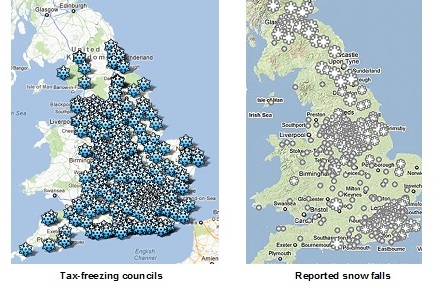
My first thought, when I glimpsed it in a CLG departmental press notice, was that there had been a Conservative power grab within the Coalition. What looked for all the world like a snow report map suggested that Eric Pickles had snatched the Met Office away from the Lib Dems’ Vince Cable at the Department for Business Innovation and Skills, and, having sorted out local government, was turning to the weather and climate control.

The truth, sadly, proved more mundane. It was simply the Secretary of State’s latest move in his battle to bully local authorities into freezing or cutting their council tax next year, and the snowflake-covered map recorded the more than 300 who have so far apparently agreed to do so – each crystalline flake ingeniously representing a virtuous ‘freezer’.

Image

I really feel I must be getting soft in my old age. I have spent much of my academic life explaining to students, councillors, overseas visitors, and indeed anyone who’ll listen, just how centrally controlled and ministerially dominated our local government system is. Yet I’ve still found myself surprised at the lengths to which ministers have gone, at the duplicity of their arguments, and the intemperance of the language they’ve used, in this particular campaign over what, after all, was supposed to be one of those offers you could refuse.

I blogged about it back in January, during Pickles’ early attacks on councillors, when he tried to argue that it was not only their political responsibility but their moral duty to vote against a council tax freeze – even if, in doing so, they would be consciously leaving their council facing a funding shortfall and even higher tax increases in future years.

Ministers then, in quick succession: (1) claimed that the Government’s offer of funding for a 2012-13 freeze had been deliberately designed to limit the growth in councils’ tax bases – though no mention of it was made at the time; (2) confused this new position by suggesting that ongoing funding for the 2011-12 freeze might be protected beyond the current spending review period; and (3) anticipated a possible rule change, whereby councils raising their tax would not be permitted to keep their new tax base next year.

At the same time, having attacked the integrity of councillors, Ministers switched to questioning the professionalism of officers. Chief finance officers who advised their members to put up council tax were likely to be doing so with the intention of “filling the town hall coffers”, and risked involving themselves in politics. Now, through CLG press notices, we’re being treated to almost daily bulletins not merely reporting, but applauding, each new council of any political complexion that signals its intention to freeze or cut its tax.

Part of the reason for recalling these developments is that they coincided neatly with the publication of an interesting report – 2012 Reform Scorecard – from the centre-right think tank, Reform.

The report is an assessment of the achievements of the Coalition Government’s public service reform agenda during 2011, and the scorecard takes the form of an almost CPA-style assessment of the progress made, or not made, by each of the relevant Whitehall departments. “Real reform” has been achieved, the report reckons, by Justice – “has made the best arguments for competition of any department, and translated them into action”; Defence, with the Levene Review – the shining example of Civil Service reform across government”; and, perhaps surprisingly, by the Home Office, with its policing reforms.

At the other end of the spectrum are the departments judged to be “Going Backwards”: Health – “The Government’s original reforms were flawed and 2011’s retreat from reform has made them worse”; Higher Education – “greater freedom to set tuition fees has been overshadowed by market distortions and tighter restrictions on universities”; and HM Treasury – “ring-fencing of the health and schools budgets has put a handbrake on reform and efficiency in those sectors”.

In between these extremes are the departments assigned to a category initially proposed for the CPA, but later abandoned – “Coasting”.  One such department, by the process of elimination, is CLG. The Reform report has both positive and negative things to say under each of its main headings – Accountability, Flexibility, and Value for Money – but its overall assessment can be summarised as follows (pp.41-42):

“The Government’s rhetoric [on localism] has sent an important signal that it is willing to give councils the flexibility they need to deliver services as they see fit”.

Yet this ostensible commitment to localism has been repeatedly undermined by attempts to exercise power over local issues from Whitehall. The Communities and Local Government Secretary has repeatedly called upon councils to maintain weekly bin collections, terming them ‘a basic right’ and creating a £250 million fund to support weekly collections. The Prime Minister, David Cameron, has circumvented local responsibility on the issues of adoption and problem families. In November, the Chancellor announced the extension of a freeze on council tax until 2012-13, mitigated by £675 million worth of funding support for councils to maintain levels of council tax.

“These attempts to impose central controls and pressure over essentially local issues subvert local responsibility and flexibility and firmly enforce Ministerial and bureaucratic responsibility in the place of local democratic accountability” (emphasis added).

And that, of course, was written before Ministers had even started implementing their ‘voluntary’ freeze.

Chris Game

Chris is a Visiting Lecturer at INLOGOV interested in the politics of local government; local elections, electoral reform and other electoral behaviour; party politics; political  leadership and management; member-officer relations; central-local relations; use of consumer and opinion research in local government; the modernisation agenda and the implementation of executive local government.