Birmingham – second city’s acceptable, but second most unequal?

Chris Game

Google “Birmingham – Britain’s second city” and you get 110,000 results; for “Birmingham – Britain’s third city” just three – all ignorant, obviously prejudiced, or both. By contrast, “Manchester – Britain’s second city” gets 895 results, only just outscoring “Manchester – Britain’s third city” with 866. QED – unofficial as the title is, if there’s going to be a second city, it’s Birmingham. Simples!

Except it’s not – not if you live and work in Birmingham, anyway. In vox pops and even proper opinion polls, Manchester more often than not edges it – and, as you may sense from the opening paragraph, we can get ever so slightly defensive about it. Which is why, if we’re offered ‘second city’ status, we generally welcome it – if only to stick it to Manchester.

Second most unequal city, however, is altogether different; and second most unequal city in the second most unequal country in Europe sounds, to me anyway, awful. Yet statistically that’s what Birmingham is.

Latest evidence comes in Cities Outlook 2013, the annual report on the economic performance of UK cities by the urban policy think tank, Centre for Cities. Now in its sixth edition, Cities Outlook is wide-ranging and influential, having played a major part in promoting the key role of cities, and particularly city-regions, as drivers of economic growth and recovery.

For policy purposes, this city-region emphasis is understandable, but it does make the title, Cities Outlook, a bit misleading. For it’s not in fact a comparative survey of 64 UK cities and their respective local authorities, but of 64 things called PUAs – Primary Urban Areas, or the built-up areas of cities, which may cover a whole bunch of authorities.

It’s fine for studying trends over time, but less so for comparing, say, Coventry and Birmingham, because Coventry PUA is the city, with its population of 319,000, while Birmingham PUA includes Dudley, Sandwell, Solihull, Walsall and Wolverhampton – and a population of 2.4 million. So you have to keep remembering: ‘Birmingham’ is actually Birmingham-plus.

Though entitled Cities Outlook 2013, the report’s data were collected back when we fondly imagined we were emerging from a mere double-dip recession, rather than slithering into a triple-dip one. The report assesses how its 64 city/PUA economies weathered the two dips, which in Birmingham’s case could be described as OK-ish. Not great; we’re in the half of cities more, rather than less, severely affected in both recession periods; but there are plenty of places that economically have had it much worse.

The trouble with OK-ish is that, while it may be mildly reassuring, hovering just below mid-table in any league doesn’t get you many headlines. So I tried looking for measures where Birmingham was near the top or bottom of a table.

In itself, of course, it’s easy. In any table measuring sheer quantity, Birmingham-plus is so large that it’s got to be right up there. Not surprisingly, we have the second highest population, second highest public and private sector employment, second largest housing stock, and second grossest CO2 emissions.

Not helpful. We need things measured in percentages or ratios – like inequality.  Cities Outlook uses a proxy indicator for inequality, dividing its cities into neighbourhoods with average populations of 1,500 and counting the percentages of Jobseeker’s Allowance (JSA) claimants in each neighbourhood. A city’s inequality is the gap between the neighbourhood with the highest JSA claimant percentage – assumed to be the poorest or most deprived – and that with the lowest.

In November 2012, the highest Birmingham-plus neighbourhood claimant rate was 24.1% and the lowest 0.4%, giving a gap of 23.7%, second only to Glasgow’s 25.4%. Obviously, there are other possible measures – household income, for example, or even personal wealth, as in last week’s other circumstantial inequality evidence, the Birmingham Post Rich List (see below). But JSA disparities are easier and less contentious. If you accept, as most statisticians do, their broad validity, Birmingham is currently the most economically unequal city in England, and second most unequal in the UK.

Though inequality isn’t directly related to size, large cities are almost bound to be more unequal than medium-sized and smaller ones, and six of the 10 largest cities are indeed among the 10 most unequal. London, though, was only 7th, Newcastle 9th, Manchester 13th and Liverpool 23rd, all with inequality gaps of less than 20 per cent. The truth is that, just as several of the smallest cities – Hastings, Gloucester, Ipswich – are by no means the most equal, the largest don’t have to be as unequal as some of them are.

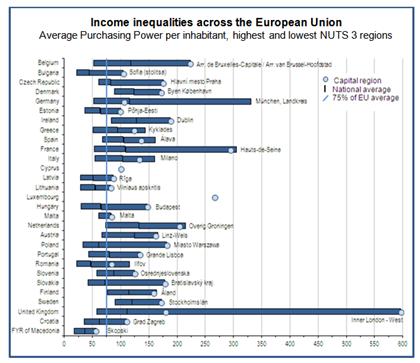
And essentially the same is true of nations. There are numerous measures of national income inequalities, and, if you’re into visual aids, one of the most vivid depictions of Britain’s extreme economic inequality is that based on the regions into which, for statistical purposes, EU nations are divided: NUTS (Nomenclature of Units for Territorial Statistics). The NUTS 3 level comprises ‘small regions’, the UK’s 139 consisting mainly of upper-tier and unitary authorities.  For each NUTS 3 region the average individual Purchasing Power is calculated and standardised (PPS), and a country’s income inequality is the difference between its highest PPS region and the lowest.
game table

Source: Office for National Statistics

The UK national average PPS is 110.6, that in the highest region (Inner London – West) 596, and in the lowest regions (Wirral and West Wales) 57 – a tenfold inequality that is almost twice that in Germany and France, three times that in Italy and Spain, and five times that in Denmark, Finland and Sweden.

Dramatic as these ratios are, it should be emphasised that they are derived from workplace, rather than residential, data: individuals’ incomes are related to where they work, not where they live. The much more widely used measures of national income inequality are those based on the Gini coefficient or ratio, developed by the Italian sociologist, Corrado Gini. He was Mussolini’s favourite statistician, with some dubious ideas about nations having life cycles, and ‘young’ nations fulfilling their destiny by expanding at older nations’ expense, through a combination of wars and cross-breeding with younger races.

Happily, his stats were less flaky, and the Gini coefficient of national income distribution is widely used around the world, generally based in more developed countries on disposable, post-tax income. Data are collected through household surveys, and the coefficient runs from a hypothetical zero or perfect equality, where everyone has exactly the same income, to a similarly hypothetical 1, where one person has the lot.

In the latest statistics published by the 34-nation OECD (Organisation for Economic Co-operation and Development), the overall coefficient is 0.31, and the range extends from Slovenia (0.24) and Denmark (0.25), through the US (0.38) and Turkey (0.41) to Mexico (0.48) and Chile (0.49). Taking the EU-27 alone, highest is Portugal’s 0.35, closely followed by the UK on 0.34.

So Birmingham is the second most unequal city in the second most unequal country in the EU – which doesn’t altogether surprise me, but certainly isn’t something I’d want to celebrate. Nor the OECD, who are pretty clear what their figures represent: “High income inequalities typically imply a waste of human resources, in the form of a large share of the population out of work or trapped in low-paid and low-skilled jobs.”

Yes, I can see that, but then I’m not one of the 50 on the Birmingham Post’s West Midlands Rich List, published by pleasing coincidence in the same week as Cities Outlook. The net worth of the lucky 50 rose last year by just the 13.8% or £3.46 billion. That’s right, the single-year increase of these 50 mainly-male Midlanders alone equalled Birmingham City Council’s total budget, or roughly half of the real-terms funding loss of all English councils put together over the 2011-15 spending cycle.

Which, say our business leaders, is “very good news … [for] with wealth creation goes job creation and this is to be applauded.”  You can almost hear Thatcher, can’t you: “Our job is to glory in inequality”.  Remember the trickle-down theory? The rich perform a public service by getting richer still, because their prosperity would automatically trickle down to the poor. There are many still waiting for that trickle to reach them, and who must be relieved that the City Council’s ‘living wage’ policies at least sound as if they make sense.

game

Chris is a Visiting Lecturer at INLOGOV interested in the politics of local government; local elections, electoral reform and other electoral behaviour; party politics; political  leadership and management; member-officer relations; central-local relations; use of consumer and opinion research in local government; the modernisation agenda and the implementation of executive local government.


Equal Pay: Birmingham’s Seriously Disagreeable Christmas Sprout

Chris Game

You probably caught Monday’s headlines: “Country’s largest authority hit by £757 million equal pay bill”; “Birmingham taxpayers face massive service cuts to pay for growing compensation bill”; “Council bankrupt if Government withholds borrowing permission”.

If so, they may have prompted a feeling of déjà vu – both recent and distant. Recent, because these November 12th headlines reported only Birmingham City Council’s delayed official reaction to the genuinely headline-meriting event a fortnight earlier: the Supreme Court’s landmark ruling against the Council and in favour of 174 former employees seeking compensation under the Equal Pay Act 1970 (now the Equality Act 2010). Distant, because – to the shame of all those materially responsible – this lamentable case has been dragging on, chapter by chapter, for a good proportion of the 42 years since Barbara Castle’s historic legislation was passed in the final days of the 1960s’ Wilson Governments.

It’s inevitably a complex story, and the basis of the Supreme Court’s 3-2 majority judgement exceptionally so. But it also has potentially huge implications for other public and private sector employers. A bit of background, therefore, may be useful.

The Equal Pay Act outlawed unequal treatment of men and women, by permitting equal-pay claims to be made by women in the public and private sectors, who were engaged in the same or broadly similar work as men. Though passed in 1970, the Act’s implementation was put back until 1976, thus allowing employers what many felt was a generous period in which to make the necessary ‘adjustments’. Don’t laugh!

It took local government decades seriously to consider its adjustments, but in 1997 the National Joint Council for Local Government Services (NJC) – representing local government employers and the main trade unions: UNISON, UNITE and GMB – negotiated a Single Status Agreement, intended finally, or at least by 2007, to implement the Act without wholesale recourse to employment tribunals. The aim was to develop, through systematic job evaluation schemes, a common pay and grading scale for all manual, administrative and clerical jobs, based on the principle of equal pay for women employed in jobs of equal value to those typically done by men.

Whatever may have been fondly imagined, Single Status could never be cost-neutral. With (in Birmingham) men earning up to four times more than women doing identically pay-graded jobs, there would be losers as well as winners, with local authorities having to find very large sums of money on top of their required efficiency savings, and without jeopardising their primary task of improving local services. They had to devise and negotiate a more expensive unified structure, and compensate those discriminated against under the existing regime, while also ensuring that the now ‘downgraded’ bin men and road sweepers would not be penalised excessively – either through pay cuts or the withdrawal of the supposedly output-based bonus payments that tended to be the preserve of male-dominated jobs.

Righting a major long-term injustice is inevitably difficult, but 10 years was a fair time-frame.  Nevertheless, in 2010, three years after the deadline, one in five councils had still not implemented a Single Status Agreement. Few emerge from the saga with much credit. Ministers set no staged timetable, enabling them to refuse to provide extra funding for back-pay settlements. They also capped, initially at a hopelessly inadequate £200 million, the total ‘capitalisation’ sum councils could borrow against their own assets: a figure that, even in 2006, would barely have covered the then estimated costs of Birmingham City Council alone.

The generally male-run unions resisted any national campaign, giving the impression of putting men’s wages – and Labour councils’ interests – above those of their women members. ‘No win, no fee’ lawyers rushed in to fill the vacuum, taking action against recalcitrant councils, against unions who had settled for less than maximum compensation, and trousering up to 25% of any payout. In a particular irony, employment tribunals, which Single Status was designed to bypass, eventually took centre-stage. One decreed that up to six years’ compensation should be paid for past injustice, instead of the two years that had become the norm – thereby adding further huge sums to councils’ pay bills.

Then, in April 2010, 4,000 women won potentially the biggest pay-out of all in a tribunal judgement against Birmingham City Council. The tribunal found that thousands of women workers – cooks, cleaners, carers, clerks – were entitled to the same pay as men working as gardeners, refuse collectors and grave diggers, who had earned several times as much through large and discriminatory cash bonuses ‘awarded’ for tasks such as picking up refuse sacks and completing rounds on time. Adding insult to the financial injury of conceivably up to £3 billion, the tribunal criticised the Council for wasting public resources in misguidedly incurred legal fees, and its senior management for having continually pushed the problem to one side ‘like a disagreeable sprout on a Christmas dinner plate’.

Obviously, given where we are today, the advice was not heeded. Christmases came and went, the sprout increased in size and disagreeability, but the Council persisted in pushing it around. It took the above case to the Employment Appeal Tribunal, where it was dismissed. Meanwhile, it was facing other cases in the courts – brought by former-employee claimants, unable to go to employment tribunals because of the rules limiting their jurisdiction to cases brought within six months of the termination of the claimant’s employment.

This was how the present case started, and what it is essentially about. The Abdulla Group, as it became known after the first alphabetically listed claimant, comprised 170 women and 4 men who had missed out on the Council’s equal pay compensation payments paid to women still working for the Council in 2007/08 or who had recently left and taken their cases to an employment tribunal. The 174 had all left more than six months earlier, which the Council cynically decided meant that, since they would be time-barred from going to a tribunal, they could be safely excluded from the compensation scheme.

The Council’s case was that ordinary courts should refuse to consider such claims. In the words of the 1970 Act, the court should “direct that the claim be struck out”, on the grounds that it “could more conveniently be disposed of separately by an employment tribunal” – as indeed all previous equal pay claims had been, generally to the considerable benefit to the claimants, in costs, time and accessible expertise.

In the High Court, however, the deputy judge was less concerned with precedence than with Parliament’s intended meaning of ‘more conveniently’. Grossly oversimplifying the literally hours of judicial time since expended on this innocent little phrase, the judge’s interpretation was that a tribunal could hardly dispose of a case more conveniently, if it was time-barred from considering it at all, and that this surely cannot have been Parliament’s intention.

Nearly a year later, in November 2011, the Court of Appeal took the same view, and so two weeks ago did three out of five Supreme Court judges. Former employees have the right to bring claims in the civil courts, where the relevant time limit is not six months, but six years – which, with this case having started in 2010, includes anyone who was still working for the Council from 2004.

The District Auditor estimates that the Council will need to find £757 million to cover actual and potential equal pay settlements, which will mean going cap in hand to Communities and Local Government Secretary Eric Pickles for permission to borrow £325 million on top of the £430 million already secured to help fund the pay claims.

At the same time, struggling finally to digest their wretched Christmas sprout, the Council’s leaders have the nerve to moan at the long succession of referees who’ve ruled against them: “Employment tribunals and the courts have changed their opinion around the law over this period of time always in one direction, which has added significantly to the amount of claims we have had and the cost of them.” To which the thousands of exploited women employees will surely chorus: well, you could always have settled sooner, or even not discriminated in the first place.

Chris is a Visiting Lecturer at INLOGOV interested in the politics of local government; local elections, electoral reform and other electoral behaviour; party politics; political  leadership and management; member-officer relations; central-local relations; use of consumer and opinion research in local government; the modernisation agenda and the implementation of executive local government.

Council Tax Benefits: A Case of Seriously Muscular Localism

Chris Game

I noticed recently that, among the links on the right-hand side of this page, we still listed the We Love Local Government blog – which, despite its having been wound up, in characteristic style, several months ago, rather pleased me. It deserves to live on, and, should its belatedly unveiled authors, Glen Ocsko and Gareth Young, happen to see this blog, they may take it as a small personal tribute to them and their … I was going to type ‘baby’, but that would make them filicidists … creation.

WLLG was written by local government officers – often critical of aspects of the world in which they worked, but who managed at the same time to love it – or at least sizable chunks of it, for quite a bit of the time. This, of course, is what made it and them different – from so many of their fellow citizens who achieve only the harshly critical bit. This blog is addressed to these gripers, in the hope that, if ever there were a sequence of events that might arouse in them a tad of sympathy for local councils, it could well be the latest episodes of the Government’s council tax benefit changes, summarised below and using as an illustration Birmingham City Council.

These benefit changes are a pivotal and controversial Coalition policy, revealing what critics claim is the true nature of its welfare philosophy, its commitment to genuine localisation, and its sheer managerial ineptitude. Details are on Birmingham City Council’s website under ‘Council Tax Support’ – so what follows is a brief summary for the late arrivals at the Taxpayers’ Ball.

From next April, the Government is abolishing Council Tax Benefit (CTB), a means-tested benefit currently paid by the Department for Work and Pensions (DWP), but administered by local government – in Birmingham’s case, £100 million to approximately 137,000 council tax payers. Replacing it will be Council Tax Support – financial support schemes determined and operated by local authorities themselves.

This ‘localisation’ of welfare sounds a commendable transfer of responsibilities from Whitehall to town hall – until you examine the attached strings. First, the policy forms a key part of the Coalition’s deficit reduction programme, aimed at reducing the current CTB bill by 10% by strengthening councils’ incentives to get people into work, and cutting the fraud and error that the DWP was unable to control. And councils will need to achieve all this immediately, apparently, as the Government would pay them 10% less for their new schemes than for CTB, creating for Birmingham a funding gap of £10.9 million.

Second, the Government decreed that pensioners receiving CTB must be protected against any reduction in support. In Birmingham this means 54,000 pensioners are protected, while 83,000 working-age recipients (those born after October 1951) shoulder potentially the whole savings burden.

So far, so centralist, for it is only here that the localist part begins, with councils able to devise their own schemes to achieve these savings, provided they do so by January 2013.

In practice, this discretion amounts to three unenviable choices: spreading the funding cut equally across virtually all CTB recipients apart from pensioners; giving the rebate to certain groups only; or continuing with the full rebate, and filling the gap either through raising council tax or finding savings elsewhere, on top of those already being demanded by the Government – for Birmingham, a possible £600 million over the next five years.

The Council’s selected option – essentially a version of the spread-the-pain-equally model – was revealed in early September in two documents: one setting out the proposed tax support scheme, the other asking for residents’ views by 2 December. Almost all working-age people could expect to pay at least 24% of their council tax – which this year would be £178 or £3.43 a week on a Band A property. Main exceptions would be those with a dependent child under six, and those receiving a disability or disabled child premium or war-related pension. A modest contribution to the scheme’s cost should come through removing council tax discounts on second homes, as permitted when the Local Government Finance Bill eventually completes its unhurried progress through Parliament.

Now here, I thought, is where the sympathy might come in – for the contemptuous treatment councils regularly receive, even from Community and Local Government ministers who are supposed to be vaguely on their side.

First, there’s the constitutional arrogance of requiring councils to prepare and consult on detailed schemes before the authorising legislation is even passed. Yes, it’s equally contemptuous of the Queen’s Royal Assent, but it seems almost standard procedure nowadays.

Then there’s the Government’s brand of centralist localism – ‘muscular localism’, as Secretary of State Eric Pickles calls it – which involves both setting all the main rules, then changing them in what ministers must know is the middle of councils’ consultations, but that to them presumably is merely a game.

In late October, weeks after most councils had formulated their support schemes and gone out to consultation, DCLG ministers announced that they’d had a quick whip-round and found an extra £100 million ‘transition grant’ for councils whose schemes were ‘well-designed’ and maintained positive incentives to work.

As they say in professional cycling, if it sounds too good to be true, then it probably is. Ministers’ idea of ‘well-designed’ turns out mainly to mean that those currently receiving full council tax support should pay no more than 8.5% of their council tax liability, or barely a third of Birmingham’s proposed 24%.

So, back to the drawing board – or perhaps not, who knows.  An unpredictable share of the £100 million would represent a fraction of councils’ 10% funding cut and complicate budget-making. Besides which, collecting costs will cancel out much of the arbitrary 8.5% tax payments: £1.21 per week on a Birmingham Band A property. The smart money is on most councils sticking with their intended schemes.

Clearly, though, ministers have been spooked by the savage impact on the poorest households of their own inflexible funding restrictions – of which they were repeatedly warned, and which might have been largely avoided, had they allowed councils not just to remove tax discounts from empty properties, but, as proposed by the LGA, to reduce even slightly the 25% single person’s discount.

But no, that was another ministerial rule: “the Government has no intention of introducing a ‘stealth tax’ on eight million people” – a benefit cut on even more, even poorer people being apparently something other than a stealth tax, or anyway one for which councils would take the blame. Now, no doubt, they’ll get additionally blamed, whether they change their proposed schemes or not – and if that lot doesn’t earn them a scintilla of sympathy, I’m at a loss to think what might.

Chris is a Visiting Lecturer at INLOGOV interested in the politics of local government; local elections, electoral reform and other electoral behaviour; party politics; political  leadership and management; member-officer relations; central-local relations; use of consumer and opinion research in local government; the modernisation agenda and the implementation of executive local government.

The Council Tax Freeze, Part 3: Who’ll Be On This Year’s Roll of Shame?

Chris Game

East Cambridgeshire, East Hampshire, East Northamptonshire, South Hams, South Ribble, West Devon – anything you reckon they might have in common, apart from ‘compass point’ names that for most of us require translation to make much sense: Ely/Newmarket, Petersfield/Alton, Rushden, Totnes, Leyland, Tavistock/Okehampton, if you were wondering.

No? OK, let’s add Surrey, Cambridgeshire, Huntingdonshire, Epsom and Ewell, Tonbridge & Malling, Tunbridge Wells.

Top of the DCLG indices for least deprived local authorities? Nice try, but no cigar.  No Labour-controlled London or metropolitan boroughs? Getting warmer. Conservative heartlands?  Almost there. Ministers’ favourite councils? Oh dear – back to freezing, but freezing’s the clue as well as the direction of travel.

Far from being Pickles’ pets, they were on what the Daily Telegraph took to calling the ‘Roll of Shame’ – the 35 councils that decided, in the face of frequently fierce ministerial pressure, not to freeze their 2012/13 council tax rates

They did the math, and calculated that the offer of one-off central funding equivalent to a 2.5% tax increase, but creating a potential budget gap from 2013/14, was not in their residents’ longer-term interests. So they chose to set their own budgets – insofar as these things are possible nowadays – and raise their tax rates by between 2.5 and 3.5%, the latter being the point at which a referendum and its attendant costs would have been triggered.

Unlike the previous year, when the Government’s financial incentive ran for the four-year funding term and all councils took the money and froze, this time one in ten rebelled – and the biggest single party group were, yes, 16 Conservative councils, for many of whom featuring on a naughty list must have been an  interestingly novel experience.

There were, hardly surprisingly, nearly as many Labour councils – though again not those that might have been at the top of most people’s guess lists: no London boroughs, only St Helens among the mets, Leicester, Nottingham, Darlington, Stoke, Preston, Luton, York. But, with the possible exception of the three Teesside unitaries (minus Hartlepool) – Middlesbrough, Redcar & Cleveland, and Stockton-on-Tees – this was no more a co-ordinated, politically driven anti-Government protest than among the Conservative rebels.

Rather, it was councils and their finance officers doing the sums and concluding that this tax freeze offer simply did not constitute for many authorities the advantageous deal that Ministers had tried to claim – before switching their sales pitch to blustering to councillors about how freezing was a moral duty, regardless of its costs.

One of the things that will make the coming few months interesting, at least for detached observers, is that the terms of the Government’s 2013/14 tax freeze offer, announced this week, have changed once again, and can be headlined in one of those ‘Good news, bad news’ games.

This year freezers will receive a grant equivalent to just a 1% tax rise, instead of 2.5% (bad news); but they will also get an extra year’s baseline funding, “to ensure that there is no cliff-edge in funding in 2014/15” – apart, that is, from any already incurred this year (good news); but the referendum threshold comes down from a 3.5% rise to one of just 2% (bad news) – or is it?

Two observations occur to me. The first is to recall all those statements when the Conservatives were in opposition about how damaging capping was, because it took the power of decision about local spending and taxation out of the hands of local voters and handed it to remote central bureaucracies.  As we enter the third year of tax freezing by ministerial arm-twisting, it’s really hard to see it as anything other than local budget setting by remote central bureaucracy.

Second, there must be a likelihood of at least a few councils seriously considering the referendum option, and making the case for restricting the speed and severity of service cuts in the general community interest – except that there seem to be so many rather substantial details still to be determined about how these referendums would actually work: the form of ballot; wording of the question(s); timing; all- or part-postal, or maybe included with annual tax demand notices; restriction to council tax payers – to name but a few.

A further non-detail, in addition of course to the cost of the whole thing, is the very principle of having a one-off referendum on a single year’s proposed tax increase, which must have the effect of making long-term planning even more difficult than it is already.

There was a question in the DCLG’s council tax referendum consultation back in 2010 that asked specifically about whether, with the abolition of capping, there was any reason why authorities should be required to calculate a budget requirement each year. The possibility of being able to frame a referendum around a medium-term financial plan, including staged council tax increases over a number of years, might be a more attractive proposition to some councils, and it’s a topic that would seem worth revisiting.

Chris is a Visiting Lecturer at INLOGOV interested in the politics of local government; local elections, electoral reform and other electoral behaviour; party politics; political  leadership and management; member-officer relations; central-local relations; use of consumer and opinion research in local government; the modernisation agenda and the implementation of executive local government.

Whose budget is it – the mayor’s or the council’s?

Chris Game

Earlier in the year, during the mayoral referendum debates, I remember using the example of North Tyneside to illustrate how the constant attempts to compare our elected mayors with those in the US were seriously misleading, as ours had and would have considerably more constrained powers than their American counterparts.

Budget-setting was one example I had in mind.  Technically it’s a ‘co-decision’ power shared with the full council, which, if it can assemble a two-thirds majority, can amend or reject an elected mayor’s proposed budget and the council’s other policy framework documents.  That’s what happened this year in three existing mayoral authorities – Hartlepool, North Tyneside and Doncaster – but whether all the voting councillors grasped fully the process they were engaged in seems unlikely.

Hartlepool’s mayor is Stuart Drummond, erstwhile football mascot, but elected three times now as an Independent against all other parties.  He’s never had a majority of supporters on the council, but, with a cross-party cabinet, has managed to govern effectively and generally peaceably.  Not this year, though.

Labour cabinet members, having agreed a budget containing proposals that included the controversial privatisation of the council’s IT services, were evidently pressured by their party colleagues and failed to attend, and therefore vote in, the relevant full council meeting.  The mayor lost his budget, was saddled with Labour’s alternative, and, not surprisingly, removed the mutineers from his cabinet.

North Tyneside’s mayor is Conservative Linda Arkley.  She governs with an entirely Conservative cabinet, although her party is and was in a minority on the council.  In fact, back in March, Labour (34) and the Lib Dems (6) could muster, just, the two-thirds of votes necessary on the 60-seat council to reject her budget – which they did.

The mayor, therefore, was forced to accept a budget containing the opposition parties’ alternative proposals.  These included scrapping above-inflation increases in fees for allotments, sports facilities and bowling greens, and freezing the price of school dinners and meals-on-wheels, but also measures delivering savings aimed at obviating the need for the mayor’s mass outsourcing strategy: axing the post of chief executive, asking high-earning staff to accept a voluntary 10% pay cut, and all council staff to take a one-hour reduction in working hours.

It’s at this point that understandable confusion can arise, even among councillors, over the respective roles and powers of mayor and council.  Indeed, ‘whose budget is it?’ is one of the many issues that could usefully have been addressed in the public information campaign that ministers ought to have seen as their responsibility to mount in the run up to the mayoral referendums.

‘The budget’ in this context means the key figures proposed, in a mayoral authority, by the mayor and cabinet: revenue expenditure for the coming year on various services and projects, and sources of income to cover this expenditure, including the real biggie, the level of council tax.  The full council’s role is to approve the mayor’s framework or, with the requisite two-thirds majority, substitute an agreed alternative.  Even in the latter circumstances, though, implementation of the budget is the mayor’s job – necessarily, as the framers of the Local Government Act 2000 saw it in their guidance to local authorities.

“Once the budget has been adopted, the executive will need to be able to respond quickly to changing circumstances, which might require reallocation of funds from one service to another.  A local authority’s financial regulations will need, therefore, to allow the executive to reallocate monies within the budget [or] take any decision contrary to or not wholly in accordance with the budget, providing that any additional costs incurred can be offset by additional income, contingency funds, or savings from elsewhere within the budgetary allocations“.

The phraseology may sound sloppy, but it does indicate where the 2000 Act intended to draw the line between the mayor/executive and the full council.  The full council’s role is to make financial provision for the spending proposed in the budget, not to determine, let alone micro-manage, its content.

When the Act forbids the mayor/executive from acting “contrary to, or not wholly in accordance with, the budget“, it should be taken as referring to the total budgetary allocation, not to any detailed items.  Spending contrary to the budget is OK, providing it can be covered within the agreed total.  Logically, therefore, not spending on something specified in the budget must also be OK.

This latter situation is what they’ve been arguing about in Doncaster, and, if the role division in the 2000 Act wasn’t previously clear enough, we now, following a constitutionally significant Administrative Court case concerning the town’s libraries, have it on judicial authority.

Doncaster’s elected mayor is Peter Davies, an English Democrat, who chairs a Conservative-Lib Dem cabinet in a 64-member council, 50 of whom are Labour.  Arithmetically it’s not a formula for unalloyed harmony, and there isn’t much, especially where libraries are concerned.

Despite reportedly never having borrowed a public library book himself, the mayor’s library strategy aims to improve the town’s service: better stocked libraries opening for longer hours, in improved buildings in convenient locations – but just not so many of them and more reliant on volunteers.  That’s the problem – the closures, two of which had already happened.

The mayor’s draft budget incorporated the library proposals and was approved by 43 to 6 in full council, but with a significant amendment, allocating funds to re-open the closed libraries and retain the staff required to run the 12 others.  The mayor, however, stuck with his strategy.  There were no re-openings, and a local resident, back by the Save Our Libraries campaign, applied successfully for judicial review.

The review itself, though, was less successful, except in the cause of constitutional clarification.  The pleasingly named Judge Gary Hickinbottom doesn’t do nuance: “It would be a remarkable invasion of the executive function of the Mayor if, as part of the budgetary process, the full Council could interfere and reverse such an executive decision by amending the budget to give, not only an allocation of funds for the library service, but a direction that funds must be spent and spent precisely in accordance with the direction that they have made“.

Back in North Tyneside, the council’s Labour-Lib Dem majority – now four-fifths following the May elections – must feel similarly thwarted.  The invitations to those earning over £50,000 to accept a voluntary pay cut were more and less politely declined, and – surprise, surprise! – the unions weren’t terribly keen on the reduced working hours for all staff, so that too bit the dust.

Now the Council has announced the outcome of the key partner procurement phase of the mayor’s Change, Efficiency and Improvement – or mass outsourcing – programme.  Two hefty blocks of services – a Business Package, comprising finance, procurement, revenues and benefits, ICT, customer services, and human resources – and a Technical Package, comprising property services, planning, engineering, consumer protection, and environmental health – have been let respectively to Balfour Beatty and Capita Symonds on potentially 15-year contracts.

Coming within days of Local Government Association Chairman Sir Merrick Cockell‘s warning to councils of the dangers of having a blind faith in the virtues of outsourcing, and of becoming commissioners rather than providers of services, Mayor Arkley’s announcement might have been better timed.  But, as they say, that’s for another day.  The subject here is not what mayors do, but the incontrovertible legality with which they do it.

Image

Chris is a Visiting Lecturer at INLOGOV interested in the politics of local government; local elections, electoral reform and other electoral behaviour; party politics; political  leadership and management; member-officer relations; central-local relations; use of consumer and opinion research in local government; the modernisation agenda and the implementation of executive local government.

The LGA are Right – In the Team Benchmarking Stakes, Residents’ Panels Don’t Even Medal

Credit where it’s due – in this case to the Local Government Association’s recent decision that data gathered from local residents’ panels about their views of and satisfaction with their councils cannot be used for benchmarking purposes. The ruling could have come sooner and will be criticised by some of the LGA’s own member authorities, but it is surely right. The reverse decision would have damaged the interests of local government in general, and ultimately would have done no favours either for those critics’ own authorities. 

The decision and the story behind it are largely technical – about the different methodologies used to measure residents’ perceptions of their councils’ performance – which is perhaps why it has received less attention than it deserves as one of the more important current developments in our local government world. It stems from the Coalition’s move away from central targets and assessments – generally welcomed but also coinciding with local authorities having to operate on ever tighter budgets.

The biennial Best Value User Satisfaction/Place surveys undertaken separately but coordinatedly by all English authorities between 2000 and 2008, coupled with the accompanying Ipsos MORI analyses, provided better information on the user’s perspective of council services than was available in Comprehensive Performance Assessments, and also allowed robust comparisons of perception-based performance indicators (PIs) across authorities.

Then in 2010 all this infrastructure was swept away. Now, supplanting CPA’s successor, Comprehensive Area Assessment, we have sector-led improvement and peer challenge, and, seeking to fill the gap left by the scrapping of the Place Survey, there is Local Government Inform (LG Inform) – a new online LGA service intended to give local authorities and eventually the public easy access to resident satisfaction data about councils and their areas, and to enable comparisons with other councils.

The comparison part is crucial. A resuscitated BV-style centrally driven survey is out, on both political and financial grounds. But some standardisation of methodologies and questions, as formerly ensured by the DCLG, is clearly necessary. The LGA and London Councils therefore commissioned Ipsos MORI to undertake a review and develop a set of questions – on residents’ satisfaction and their views of crime and community cohesion – which, as with the BVPI questions, councils could slot into their own local surveys, thereby producing a sufficiently consistent and methodologically robust subset of data for comparative and benchmarking purposes.

The review was a useful document, explaining and illustrating the key issues of data collection methods, sampling and question design with welcome clarity. Its core was naturally the presentation of the set of 12 recommended questions and advice on their usage and analysis, but the preceding technical review also contained plenty of useful dos and don’ts.

The questions were divided into three tiers: a core benchmarking set, which should be a priority for all councils, worded identically, and ideally opening the survey; a second tier, also recommended for benchmarking, and a likely priority for most councils; and a third tier of more detailed questions, of interest to probably only some councils. The three core and three second-tier questions are:

  • Overall, how satisfied or dissatisfied are you with your local area as a place to live
  • Overall, how satisfied or dissatisfied are you with the way [name of council] runs things?
  • To what extent do you agree or disagree that [name of council] provides value for money?
  • Overall, how well informed do you think [name of council] keeps residents about the  services and benefits it provides?
  • How strongly do you feel you belong to your local area?
  • How safe or unsafe do you feel when outside in your local area after dark? / How safe or unsafe do you feel when outside in your local area during the day?

As every survey researcher will tell you, though, who and how you ask are at least as important as what. Different modes of data collection will produce different responses, even to identically worded questions. For example, satisfaction ratings tend to be higher in face-to-face interviews than in self-completed postal questionnaires, and higher still in volunteer telephone interviews. Asking about satisfaction with the council before a question about value for money will produce higher ratings than the reverse order. Which means that, for benchmarking purposes, comparisons should be limited to results generated by the same methods, or at least methods in which the respondent’s experience is essentially the same.

Statistically, the gold-standard survey design is that used by the early Best Value surveys: face-to-face interviews with random samples of preferably at least 1,000 respondents, drawn from a robust sampling frame – nowadays the Royal Mail’s Postcode Address File – in which every household or person in the target population has an equal, random, and known probability of selection, and results can be generalised to the total population with calculable degrees of confidence.

But, as with Olympic medals, silver and bronze standards are also very acceptable, and, under specified conditions, smaller sample sizes, rigorously drawn quota samples (with face-to-face or telephone interviews), and self-completed postal or online questionnaires (with random samples) may all pass muster for benchmarking purposes.

The fundamental condition, stripped of its details, has already been noted: for inter-authority comparisons and benchmarking, compare only ‘like-for-like’ data, collected by the same method – which means that LG Inform will require detailed reporting of sampling and data gathering methods when authorities come to upload their data.

Which brings us to residents’ and users’ panels – on which Ipsos MORI’s professional advice is unambiguous and emphatic: NO!  In themselves, they’re absolutely tickety-boo. They’re an easy and efficient consultative tool for, say, testing prospective policy initiatives, or tracking attitude changes over time. But, even if panel members are recruited to represent proportionately the council’s population, they will be volunteers, rather than a statistically selected sample, and their responses should not therefore be compared with data systematically collected from another council’s genuinely random survey.

It’s the same point that the Scottish Government was attempting to make last week over same sex marriage. Responses to a consultation exercise, no matter how numerous or passionate, are not the same as the results of statistically representative sample surveys: not worse, or better, simply different.

Understanding residents’ or users’ views and how they compare with those in similar or neighbouring council areas is a vital part of local authority performance management. But cutting corners in order to make such comparisons at precisely the time when the sector is endeavouring to demonstrate its ability to manage and improve itself would be a seriously false economy – maybe not as daft as drug-cheating in the quest of a medal, but still a really, really bad idea.

Chris is a Visiting Lecturer at INLOGOV interested in the politics of local government; local elections, electoral reform and other electoral behaviour; party politics; political  leadership and management; member-officer relations; central-local relations; use of consumer and opinion research in local government; the modernisation agenda and the implementation of executive local government.