Equipping local governments to deliver national and local priorities

Jason Lowther

Today we launched our latest report, Equipping local government to deliver national and local priorities. Local government is critical to the delivery of the new government’s five key missions, and to improving life across the country. We argue that, once a series of critical reforms are in place, government should have confidence to equip local authorities with more power and (when public finances allow) prioritise additional resources there, enabling local and national priorities to be delivered. But critical reforms are needed in financial management, audit and performance management, and in community power and participation.

The new government inherited many challenges. Council budgets per person in England have been cut by 18% in real terms since 2010. Councils are hitting financial crises: twelve have issued section 114 notices in the last six years, compared with zero in the previous 17 years. Representative institutions at all levels of government are suffering from declining legitimacy and increasing polarisation. Local government plays a vital role in increasing democratic relationships and trust.

But councils’ wide remit, local knowledge, democratic accountability, public service ethos, and key roles in working with partners and shaping local places make them critical to the delivery of all five of the government’s key missions. Local governments are best placed to operationalise solutions to interconnected problems, for example, improving public transport and encouraging more cycling and walking helps meet net zero targets. It can also deliver health benefits, reducing the burden on the NHS, as well as increasing productivity by giving businesses access to a wider and healthier workforce.

Action is required to ensure that councils are fit for purpose to make the type of contribution that central government requires of them. Underlying this is a lack of confidence in local government on the part of ministers and civil servants.  We have identified three areas in which the government must be confident if it is to equip the local level with more power: financial sustainability, performance standards, and community power and participation. 

Policy recommendations

Financial arrangements

  1. Provide multi-year funding.
  2. End competitive bidding and deliver a “single funding pot” for each council/ local area that has been allocated fairly and sensitively to the needs and assets of the community.
  3. Abolish council tax capping.


Audit and performance management

  1. Strengthen the evaluation of councils’ performance management.
  2. Make OFLOG independent and extend its remit and approach.
  3. Reintroduce effective management and support of council external audit by independent bodies.


Community power and participation

  1. Strengthen the role of councillors as facilitators and catalysts of community-driven change.
  2. Embed participatory governance to ensure lived experience and marginalised voices drive policy and service delivery.
  3. Develop public-commons partnerships and community-wealth building to support community-driven sustainable economies.

As the Layfield Commission concluded 50 years ago, local government funding should promote responsible and accountable government. Beyond welcome recognition of acute financial challenges and commitment to multi-year funding settlements, there is a pressing need for additional immediate and longer-term action to improve Councils’ financial position and strengthen local accountability.

Local authorities have different needs for funding, depending for example on levels of population and its composition, deprivation, and spatial factors. Central and local government should develop updated funding formulae and funding models which are as simple as practicable whilst capturing the key elements of local need, and as transparent as practical in operation.  There are many reports researching available options for fairer funding, approaches to fiscal devolution, and local government funding options

Local audit, performance regimes and regulation each have a part to play. Both a parliamentary select committee and the Redmond Review into the Oversight of Local Government have sought to investigate the failings in local government audit.  The latter in 2020 critiqued market driven audits, stating that the new audit arrangements have undermined accountability and financial management. 

The adoption of the Redmond Review’s proposal for an Office for Local Audit Regulation would provide oversight on procurement, management, and regulation of external audits of local authorities. The government could extend the oversight of local government performance management processes while avoiding the creation of an overly powerful national regulator, by adopting key recommendations on the future arrangements of OFLOG (the Office for Local Government).

Proximity means that local government can play a crucial role in improving relationships between government and citizens. By creating conditions to mobilise the diverse expertise and resources of communities, local government can ensure that public policies and funding are informed by the assets, priorities and needs of local people and places.  There are already many examples where local government has made progress with innovations such as citizens’ panels and juries, the delegation of power to the hyper-local level and in building inclusive economies

We have over thirty years’ worth of research on deliberative democracy, social innovation, and co-production evidencing the value of collaboration with diverse communities and stakeholders. Participatory governance is less about finding perfect solutions and more about transforming organisations to engage with communities in processes of co-producing mutual understanding, shared solutions, and a sense of collective ownership.  

Our work on the 21st Century Councillor can help with enabling the role of councillors not just as democratic representatives but also as facilitators and boundary spanners between institutions, communities, civil society and local businesses.

Community-wealth building, pioneered in Preston and several London boroughs, can help strengthen the local economy with insourcing, linking public procurement to local cooperatives and social enterprises. These novel forms of governance can be formalised through Public-Commons Partnerships.

Equipping local government to deliver national and local priorities will leave a long-lasting legacy of a well-resourced, effective, accountable, and engaged local government.

The full report is available here

The report was edited by Jason Lowther and Philip Swann, with particular thanks to the following contributors (alphabetically by last name): Dr Koen Bartels, Dr Sonia Bussu, Prof Nicole Curato, Dr Timea Nochta and Dr Philip Whiteman. With thanks to other colleagues and associates in INLOGOV.

Where next for England’s city regions? How will the new government and Brexit impact devolution and combined authorities?

Dr. Max Lemprière & Professor Vivien Lowndes 

If you’re a local authority leader today you will doubtless be considering opportunities to gain devolved powers and funding from central government as part of a Combined Authority (CA) deal. Or perhaps you are already part of the joint leadership of a new Combined Authority (CA)? Since the emergence of the Greater Manchester Combined Authority in 2011, a further nine have been formed, with eight in total holding elections for directly elected mayors. New deals are in the pipeline, and those who have yet to strike one fear being left behind.

We’ve spent the last few years following these developments, asking what their emergence tells us about the nature of devolution and central-local relations. We’ve highlighted the role of well-defined leadership, existing institutional structures that favour joint working, and a range of locally specific factors, like shared identities and partnership culture.

But what is also clear is that English devolution policy is constantly evolving, responding to (and seeking to capitalise upon) broader political and economic trends. It is that which we want to discuss here.

CAs are voluntary collaborations between elected local authorities in England that have received devolved powers and funding from central government to support infrastructure and economic development, on the basis of negotiated settlements. Since 2010, central government has championed CAs as a vehicle for stimulating regional economic growth and rebalancing the economy away from London and the South East. They vary in terms of their powers, funding, priorities and governance. New CAs have been formed at different points since 2010, and are working to different deadlines for performance reporting to central government and negotiating follow-on packages of additional funding and devolved powers

We have argued elsewhere that the devolution policy underpinning CAs represents a noticeable shift in central-local relations. Rather than imposing a ‘one-size-fits-all’ model of devolution, the policy has been based upon bespoke negotiated agreements between groups of local authorities and Whitehall. The policy is also morphing in response to developments in Westminster and beyond.

The most significant developments are the arrival of Boris Johnson as prime minister, in the context of the 2019 Conservative landslide, and the ongoing Brexit agenda.

What these highlight is that the political saliency of the CA agenda varies depending on the will of political leadership at the national level and their existing policy priorities. What’s more, they show that, as CAs become more empowered and begin to bed-in and develop trajectories and momentum of their own, a tussle emerges between the CA and national level, particularly in the on-going battle for a further devolution of powers and funding.  For example, the Greater Manchester CA has made vocal appeals for repatriated powers and funding over transport and skills training to land at the regional rather than national level.

Boris Johnson is a former directly elected mayor of London. In the 2019 general election, he based his claims to be able to ‘get things done’ as PM on his record at London mayor. Johnson’s power and influence in that role, and personal visibility, owed everything to New Labour’s devolution policy, which had created the mayorality and Greater London Assembly in 2000. He has now promised to ‘do devolution properly’, signalling an opportunity for existing CAs to expand their capacity and influence, especially in the North of England. Many CAs represent areas in the former ‘Red Wall’, where support for Labour crumbled and voters ‘lent’ their support to Johnson’s Conservatives. Now, many see an opportunity to call in the favour and make demands for further devolution.

Overshadowing all of this is Brexit. Voters in these regions shifted their allegiance towards the Conservative Party in order to ‘get Brexit done’, but Brexit itself presents opportunities and potential pitfalls for existing and proposed CAs. Many see an opportunity emerging for CAs (rather than Whitehall) to claim some of the powers being repatriated to Britain. Could Brexit lead to regions ‘taking back control’ as well as the national government? Johnson’s premiership represents a critical juncture for the devolution policy, which had stalled between 2016-19 in the face of struggles over Brexit, and an ideal opportunity for regional leaders to strengthen their calls for further powers

Johnson is on record as supporting the CA agenda. New CAs are currently being negotiated with the Treasury (for example in Yorkshire and Lancashire), and Johnson has advocated for further devolution of funding and powers to existing CAs, particularly over transport and infrastructure, in line with his government’s broader domestic agenda. The commitment to a Northern Powerhouse Rail programme suggests the agenda may be gaining traction. Regional leaders are hoping that Johnson has learnt about the benefits of locally controlled infrastructure from his experience at the helm of the most well developed regional transport body, Transport for London.

This new breath of life for the devolution policy follows a period of uncertainty following the departure of Chancellor George Osborne in 2016. Under David Cameron’s government, Osborne had been the architect of the CA agenda, personally pushing the agenda and getting the deals signed off the deals. Following the Brexit referendum, Theresa May’s government let the devolution policy flounder, preoccupied with the fall-out from the ‘leave’ vote.

The CA agenda may well be gaining new traction, as a result of both bottom-up and top-down demands. Recent years have seen many success stories, from the Greater Manchester poster-child, to ongoing negotiations with Lancashire, to further rounds of devolution for some of the UKs biggest cities. As time goes on, CAs are likely to gain the confidence they need to challenge central government in the on-going tit-for-tat that has characterises UK central-local relations. This isn’t to say that there haven’t been failures; our own research for example has shown how the North East Combined Authority failed to negotiate a meaningful devolution package with central government due to poorly constructed economic and political geographies and a lack of congruence or leadership. Having said that, a new North of Tyne Combined Authority has arisen from its ashes and negotiated a successful deal with central government.

But this also points to the way that CAs will continue to evolve in the future. Brexit was, to some extent, a product of social division, and a distrust amongst those at the local level about politics and priorities driven by Westminster and Whitehall. Beyond London and the South East there was a particularly powerful distrust of elites and a feeling among many that they had been ‘left behind’ by the dominant economic model. Indeed, the CA agenda itself was an attempt to alleviate growing regional discontent in England in the aftermath of New Labour’s devolution to the Scottish government and Welsh. Renewing the CA policy provides an opportunity to decentralize responses to the demand to ‘take back control’. English devolution has the potential to rebalance the economy whilst also reducing social division and mistrust in Westminster politics.

It remains to be seen whether combined authorities are able to capitalise on these opportunities, and indeed whether Westminster is serious about pursuing them. What we also need to watch out for is whether it is only those existing CAs, which have already proved themselves to be adept at bidding for power and funding (Greater Manchester and the West Midlands come to mind), that will be able to win the tussle for extra post-Brexit powers, or whether the bounty will be shared more evenly. The danger is, of course, that what is already seen by some as an uneven distribution of powers and funding away from Westminster will be aggravated further.

lempriere

Max Lempriere is an Associate at INLOGOV. His research interests lie in local governance, institutions, sustainable development and urban planning. He completed a PhD in the politics of sustainable urban development.


Vivien Lowndes photo

Vivien Lowndes is Professor of Public Policy at INLOGOV.  She undertakes research, teaching and knowledge transfer on local governance, political institutions, citizen participation, gender and migration.  Professor Lowndes is Chair of the Politics and International Studies Sub-Panel for REF 2021, the UK’s periodic assessment of research quality. 


The tax so popular it has its own song

Chris Game

A good crossword anagram should have real meaning, ideally laced with a bit of humour. Like my personal long-time favourite, “I’m Tory Plan B”, which many Labour supporters still reckon fairly describes their three-time election winner, Tony Blair MP or PM.

As Labour leader, his latest successor looks like being ‘Mr Streaker’, aka Keir Starmer, with eliminated Emily Thornberry left ruing “my horrible entry”.

Switching to ministers, this week’s headlines are all about Home Secretary, Priti Patel – a clearly sensitive soul, and I entirely understand her feeling that “Rip it, petal”, was inappropriate advice from a senior male civil servant.

Next week, though, is still scheduled as Budget Week, when the headliner will be the new Chancellor, Rishi Sunak. Potentially another anagrammatical pain, with only ten letters to juggle, but saved by the extreme haste of his appointment and some flashy punctuation: “Ask? I rush in!”

By long established Budget custom, the Chancellor reveals little of any planned tax proposals in advance. It gained attention, therefore, when Sunak deliberately pre-announced his intended “fundamental” review of business rates, and their replacement with a Land Value Tax.

“A riski hunch” perhaps, and yes, I know it’s not a perfect anagram, and yes, I promise it’s my last effort.

The political rationale was clear enough. Scrap an unpopular tax, paid not by landowners, but on rental values by small businesses and potentially Conservative-voting tenant retailers, and earn credit for enabling your Leader to claim he is saving struggling high streets.

But here’s the thing. Sunak chose not just to use the provocative T-word, but actually to call it a Land Value Tax (LVT – which a certain person I know thinks stands for Luxury Vinyl Tiling).

The idea – the tax, not the tiling – has been around for literally ages, advocated by, among many others, the 4th Century BCE Confucian philosopher Mencius, 18th Century classical economists, Adam Smith and David Ricardo, the then Liberal MP, Winston Churchill, and the very up-to-the-minute Institute for Fiscal Studies.

It’s also possibly the only tax with its own song – or, more precisely, 19th century hymn. Entitled ‘God made the Land for the People’ and too long to quote extensively here, it is available on Wiki and includes:

“Why should we beg work and let the Landlords take the best? Make them pay their taxes on the land, just like the rest; The Land was meant for the People!”

Now try it to the tune of ‘Marching Through Georgia’, it really is a bit better.

So there’s no shortage of pedigree, or of possible alternative labels that might make it sound a bit less communistic to some of Sunak’s own party supporters. ‘Levy’ and ‘site-value’ both sound a bit vaguer, so why not try ‘site-value rating’ or – possibly my own choice – Location Value Rating?

Yet Sunak chose the very term that his actual political enemies – Labour, Lib Dems and Greens – had all used in their 2017 manifestos and that the Greens especially outlined in some detail in 2019:

“Our Green plan to transform land and property taxes will abolish Council Tax and Business Rates, replacing them with an LVT. The LVT will also absorb National Non-domestic Rates, Stamp Duty and Inheritance Tax on land, Capital Gains Tax on land sales, and Income Tax on land for owner-occupiers. The new LVT will charge the landowner a proportion of the capital value of the land each year (estimated to be around 1.4% of current values.)”

 I doubt Sunak is thinking on this scale, but the key point still holds. Long-term simplification and rationalisation take time – which most councils’ finances don’t currently have.

Anyway, on this topic at least, Labour’s 2019 manifesto was even more cautious than 2017’s. That manifesto pledged to “initiate a review into reforming council tax and business rates and consider new options such as a land value tax, to ensure local government has sustainable funding for the long term” (my emphases).

It may sound an open-minded, evidence-driven approach to policy development, but to the Tory ‘Red Top’ media it was raw meat, and they eviscerated it.

Re-badging it a ‘Garden Tax’ – misleadingly, with garden values already included in council tax – they reckoned it would cost the average home (in South-East England, that is) an extra £4,000-plus, treating the unlaunched review as if it were Commons-ready legislation. I expect Sunak’s proposal will receive similar treatment – no, just kidding!

Labour’s 2019 manifesto was more tentative still, restricting any review to business rates and emphasising that any LVT would apply to commercial landlords. Politically understandable, but it undermines much of its full potential, as outlined by the Greens.

So why do I prefer Location Value Rating? Because I feel it’s easier to understand. Land’s true ‘location’ value derives considerably less from the actions of individual property owners than from the wider, longer-term efforts of the community in creating transport links, schools, hospitals and other infrastructure.

It is therefore the community that should benefit from this ‘value added’ or ‘unearned betterment’, not frequently absentee landowners who currently have no incentive even to put their properties on the market.

Next Wednesday, though, those actually in local government, rather than bossing it, want to hear about the immediate, not medium-term, future. Above all, what is the Government’s policy on further, and ultimately full, business rates retention, that it’s been piloting for nearly three years now? And is this LVT talk just a distraction?


Chris Game is an INLOGOV Associate, and Visiting Professor at Kwansei Gakuin University, Osaka, Japan.  He is joint-author (with Professor David Wilson) of the successive editions of Local Government in the United Kingdom, and a regular columnist for The Birmingham Post.

Spending beyond Your Means during a Recession? Not So Much for Local Governments Constrained by Fiscal Rules

Lang (Kate) Yang
The Great Recession, which started nearly a decade ago, may feel like a distant memory for some, as the United States economy is expanding for a ninth consecutive year. However, local governments in the nation still experience turmoil in their finances. National League of Cities’ 2016 City Fiscal Conditions report shows that city revenue has recovered to about 96 percent of precession (2006) levels. While many cities have improved service provision efficiency or cut back services and workforce during the recession, another option to weather the shock is to run a deficit and spend beyond the means. While structural or persistent fiscal imbalances are undesirable for local officials and can even lead to credit rating downgrades, deficit financing during recessionary periods may be justified for maintaining the necessary level of public service provision when regular tax and other revenue collection does not suffice.

Local governments achieve deficit spending through either borrowing or dipping into their reserves, if they have built one going in to a recession. Neither option is free. Borrowing from banks or investors on the municipal bond market requires interest payments, while leaving that reserve alone usually means investment returns. To what extent local governments are willing to take on a deficit during the recession depends on factors including local governing structure, managerial preference and expertise, level of savings, access to the debt market, and the capacity of paying back debt or replenishing reserves after the recession ends.

It is the last factor and its relationship with tax and expenditure limits that I explore in the recent paper published in Local Government Studies. Tax and expenditure limits are fiscal rules imposed on local governments by state governments (through legislations) and statewide voters (through referendums) to limit how much revenue localities can raise in any given year. For example, the famous Proposition 13 in California limits annual real estate tax on a parcel of property to one percent of its assessed value and the assessed value can only increase by a maximum of two percent per year. For cities constrained by a tax and expenditure limit, their capacity of paying back debt or replenishing reserves is predictably limited. The paper explores whether these cities were less likely to deficit spend during and after the Great Recession than unconstrained cities.

Data collected from the largest 50 cities’ comprehensive annual financial report show that cities subject to a tax and expenditure limit indeed were less likely to spend beyond their means. Their expenditure levels grew at a slower pace. As a result, their net assets, which are assets net of any payback liabilities, decreased at a slower pace as well. The difference between cities subject to tax and expenditure limits and unconstrained cities was especially pronounced immediately after the crisis (years 2011 and 2012), possibly because cities first pursued other means of weathering the shock than cutbacks and because the hit on city finance is delayed compared to the hit on the general economy.

Many cities saw their streetlights shut off, community centers shuttered, and bus services cancelled during the recession. While some may rather prefer the cuts than spending, others may see the value of maintaining a stable level of service provision despite decreased revenue collection. Although the paper refrains from evaluating whether deficit spending in general is beneficial to city governments and residents, it is ultimately a decision up to the localities. The paper finds that fiscal rules imposed by a higher-level government have an impact on city financial decisions. This finding indicates that deficit financing following a recession is no longer a “pure” local decision. Financial management conservatism caused by tax and expenditure limits might have contributed to more painful cuts in some cities than others.


Picture1

Lang (Kate) Yang is an assistant professor at George Washington University. Her research interest includes state and local government taxation, budgeting, and financial management. Her recent publications in Public Budgeting & Finance and National Tax Journal examine how local governments respond to fiscal rules imposed by higher-level governments.

Combined Authorities – Why Birmingham doesn’t have a city region like Leeds

Chris Game.

“Cornwall leapfrogs West Midlands in devolution race” was the headline over one report of the Government’s recent devolution deal with Cornwall Council, giving the county greater control over adult skills spending and regional investment, and, with the Isles of Scilly, the prospect of integrating health and social care services.

For a West Midlands resident it seemed a depressing message – almost depressing enough to make one contemplate shooting the messenger. However, I happen to know him, so I’ve settled for shooting his metaphor, and in doing so providing a further update of events that could bring what I described in a previous blog as the most significant power-shift in English government in generations.

First thing to concede is that, predictably from this wholly centralist and Osborne-choreographed devolution exercise, it absolutely is set up as a race – certainly against time. It was outlined on p.63 of the Summer Budget’s Red Book:

“To fulfil its commitment to rebalance the economy and further strengthen the Northern Powerhouse, the government is working towards further devolution deals with the Sheffield City Region, Liverpool City Region, and Leeds, West Yorkshire and partner authorities, to be agreed in parallel with the Spending Review.”

We’ll return to the detailed wording later. The point here, apart from the redundant reminder of the Chancellor’s tunnel-visioned insistence on an elected mayor as the only acceptable accountability mechanism, is the Spending Review deadline, repeated a few paragraphs later:

“The government remains open to any further proposals from local areas for devolution of significant powers in return for a mayor, in time for conclusion ahead of the Spending Review.”

This week, a fortnight after the Budget and just seven summer holiday weeks before his chosen submission deadline, the Chancellor realized it would be useful for others to know the relevant Spending Review dates. Its conclusions, we learned, will be outlined on 25 November. But deal-seeking councils need to check p.15 of another Treasury document:

“City regions that want to agree a devolution deal in return for a mayor by the Spending Review need to submit formal, fiscally neutral proposals and an agreed geography to the Treasury by 4 September 2015.”

Numerous race analogies suggest themselves – obstacle, hurdle, handicap – but I see the devolution race less as a single race and more like the London Marathon – several races taking place simultaneously with different categories of participants starting off from different places at different times.

Take Cornwall. As the first rural council to negotiate a devolution deal, it clearly deserves credit, and doubtless its methods are being studied closely by other counties rushing to recruit partners and submit bids by the Chancellor’s deadline.

These county areas, though, are effectively in a different race from the big city regions. Their bids will vary greatly, in scale and aspiration, and in London Marathon terms their equivalents are perhaps the ‘Good for Age’ racers, who secure guaranteed entry by running a specified time considered good for their age group. They’ll hopefully win the appreciation of their friends and residents, but the big prizes will inevitably go to the Elite runners, the 150 miles a week guys, who need a certified 2 hours 20 time just to qualify, and sub-2 hours 10 to get into the serious prize money.

In the devolution race there’s only one elite entrant even to have glimpsed serious fiscal devolution-type money – Greater Manchester. The region starts with natural advantages, with its geographical and political coherence, and its 10-council team of runners was first out of the blocks in 2011, in applying to become the first Combined Authority (CA).

Moreover, they run as a team, agreeing to accept the race sponsor’s favoured elected mayor along with all that devolved funding, and now the prize money keeps arriving on a regular basis – most recently on Budget Day, when they won £30 million funding for ‘Transport for the North’ plus control of the fire service, Land Commission, children’s services and employment programmes.

Following the elite runners in the London Marathon are the Championship entrants – registered members of an athletics club, with a certified 2 hours 45 race time. The devolution equivalent is the exclusive Combined Authority club – still just the five members, those joining Greater Manchester being, to give them their official names, West Yorkshire, the North East, and the Sheffield and Liverpool City Regions.

West Yorkshire, Sheffield and Liverpool are actual or, in Liverpool’s case, near reincarnations of the areas’ 1972-86 metropolitan counties, and in that sense similar to Greater Manchester. The North East CA is different – hugely bigger than the former Tyne & Wear met county, but having at least the coherence of covering the same area as the North-East Local Enterprise Partnership (LEP).

As we have seen, the three former met county CAs were all name-checked by George Osborne in his Summer Budget speech – though few seemed to notice the precise names he used: “the Sheffield and Liverpool City Regions and Leeds, West Yorkshire and partner authorities” (my emphasis).

Having undertaken a serious resident and stakeholder consultation exercise back in March, North East leaders were rather peeved not to have made Osborne’s list. Since then, though, they’ve moved fast – not exactly embracing, but at least dropping their outright opposition to, an elected mayor, and opening talks on a “radical devolution deal” with Communities Secretary Greg Clark.

Temporarily at least, therefore, this might seem to put them ahead of Sheffield and Liverpool, but what exactly is happening in West Yorkshire? How is Leeds – unlike Birmingham, which has to make what noise it can under the ‘West Midlands’ banner – apparently managing to retain its nominal identity in its devolution deal?

Prior to the election, it was assumed that big city devolution deals would be negotiated with, where they existed, Combined Authorities. But then, in late June, Greg Clark delivered his remarkable eulogy to LEPs. These partnerships between business and councils were evaluated recently by the Royal Town Planning Institute as having “an opaque remit”, lacking “firm institutional foundations”, and being overly responsive to central government direction. In the new minister’s view, however, they represent:

“a phenomenal revolution [that has] completely changed the way investment and growth is done in this country. The areas that combined authorities are now following are the same areas defined by LEPs as being the true economic geography of our nation. As such, no devolution deal will be signed off unless it is absolutely clear that the LEPs will be at the heart of arrangements (my emphasis).

Anyway, whoever’s verdict you prefer, LEPs are where Leeds City Region comes in. A city region is an economists’ and planners’ term to describe the functional region around a city – its ‘true economic geography’, as Greg Clark might put it. The label dates back at least to Derek Senior’s Memorandum of Dissent in the 1969 Redcliffe-Maud Report. But institutionally not much happened until the arrival in the late-2000s of Multi-Area Agreements (MAAs) – voluntary agreements between a number of local authorities and the government to work collectively to improve local economic prosperity.

There were eventually 15 of them. Of the big cities, those for Greater Manchester, South Yorkshire, Liverpool, and Tyne & Wear took the forms their respective CAs now do. But, instead of West Yorkshire, there was Leeds City Region, as shown in the accompanying map: the five former West Yorkshire metropolitan county boroughs, plus Barnsley from South Yorkshire, and Craven, Harrogate, York and Selby from North Yorkshire.
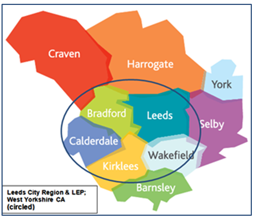
Leeds 1

MAAs were formally wound up by the incoming Coalition, but in practice most, like Leeds City Region’s, accompanied their authorities into their new LEPs. Which explains why West Yorkshire’s devolution bid is focused, as the Chancellor convolutedly but correctly described, on ‘Leeds, West Yorkshire and partner authorities’, or, more succinctly, Leeds City Region.

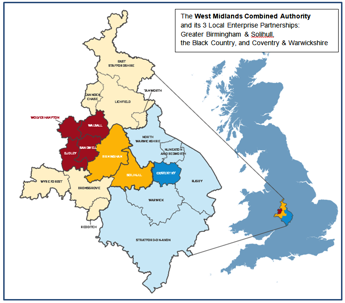
Not surprisingly, Birmingham also had a Multi-Area Agreement and a city region partnership, but in its case the emphasis is firmly on the past tense. It went under the catchy name of the Birmingham, Black Country and Coventry City Region and produced, among other things, an MAA for Employment and Skills. But it was short-lived, with Coventry soon opting out to concentrate on developing its links with Solihull and Warwickshire.

And there’s Birmingham’s devolution problem in a nutshell: no convincing city region. Instead of the pubescent MAA partners developing together, perhaps with the addition of adjoining authorities, into a single LEP corresponding to Clark’s ‘true economic geography’ of the city region, it split instead into three: Greater Birmingham & Solihull, which struggles to look convincing even on the map, the Black Country, and Coventry & Warwickshire.
west mids

The present situation is – how to put this – not exactly setting pulses racing. We have a recently, and for some unenthusiastically, agreed proposal for a Combined Authority of the seven former West Midlands metropolitan council boroughs – Birmingham, Coventry, Dudley, Sandwell, Solihull, Walsall and, Wolverhampton – to run transportation, regeneration and economic development.

It clearly can’t claim, in Greg Clark’s words, to have any of its three LEPs “at the heart of arrangements” – although that could change with the possible addition of some or more councils in Warwickshire, Worcestershire and Staffordshire – a state of uncertainty that Police & Crime Commissioner David Jamieson, the West Midlands only elected official, described this week as “an absolute dog’s breakfast”.

Finally, far from it having been agreed that the CA should have accountability through an elected mayor, it apparently won’t have any individual leadership at all. Apart from numerous commitments to “collaborative working”, the Launch Statement has nothing to say about governance, although the understanding is that each council leader will take responsibility for an individual policy portfolio.

Returning to the London Marathon analogy, Greater Manchester obviously crossed the Mall finish line some time ago, has donned its foil blanket, collected its Virgin Money finishers’ medal, and is heading back up the M6. Several others are on that home stretch between Big Ben and Buck House, but it seems the WMCA still has some miles to go to reach the Embankment.

All eyes on Manchester

Catherine Needham

If you live in Birmingham, like I do, you could be forgiven for feeling slightly green-eyed at what is going on in Manchester at the moment. After the unprecedented devolution package that the city secured at the end of 2014, it has today been announced that Greater Manchester will be given complete control of its £6 billion NHS budget.

This means that Greater Manchester, led by a directly elected mayor, will have control of the budgets for social care; GP services; mental health; and acute and community care, as well as public health. There is clearly enormous potential here for the Manchester region to make integrated health and social care a reality. Whilst the dust settles on the details of the new arrangements, there are a few issues to consider:

  • There are increasing calls for integration to be at the level of the individual rather than the system, to avoid some of the problems of previous attempts at structural integration such as Care Trusts. Further structural reorganisation will also be resisted by local NHS bodies, still recovering from the Lansley reforms. Can the region be imaginative in its approach to integration, and learn lessons from what has worked and not worked in the past?
  • A new Greater Manchester Health and Wellbeing Board is being created to oversee the budget. Health and Wellbeing Boards are increasingly seen as the host for tackling all sorts of complex health and social care issues, and researchers at the University of Manchester have warned of placing ‘unrealistic expectations’ on the ability of boards to deliver on these agendas.
  • Will the notoriously centralised Department of Health really be willing to let go control on such a grand scale? Who will bear the reputational risk when problems occur?
  • The success of directly elected mayors has been distinctly mixed where they have been tried elsewhere in the UK. In the Greater Manchester context, where a mayor has been forced on the region by Whitehall, how likely it is that there will be sufficient public interest and support for the role to make the holder of the office a dynamic political force?
  • Does the announcement signal the end of the National Health Service, and if so should we mourn its passing? Local political control is very attractive in what has previously been such a centralised state, and is clearly in line with what is happening in Scotland and Wales already. However fragmentation brings the inevitability of postcode lotteries and the need for a robust political response to such differences, but it may also create new entry points for other political agendas, such as an increase in privatisation.

It must be a very exciting time to live in Manchester, although the role of pioneer can also be a rather exposed and risky place. Let’s hope that Birmingham and the other core cities can watch, learn from what’s worked and what hasn’t, and be ready soon to work with their own near neighbours to secure more local control.

needham-catherine2

Catherine Needham is Reader in Public Policy and Public Management at the Health Services Management Centre, University of Birmingham, and is developing research around public service reform and policy innovation. Her recent work has focused on co-production and personalization, examining how those approaches are interpreted and applied in frontline practice.  Follow Catherine on Twitter: @DrCNeedham.

This blog can also be found here on the Health Services Management Centre’s website