Doing local politics differently: learning from an inspiring community campaign against the cuts

Catherine Durose

For the second time in as many years, the south Manchester neighbourhood of Levenshulme where I live, has faced the closure of vital public facilities. This time, the library and swimming pool have been targeted. Both these facilities are community hubs which bring people in a diverse, and in many ways disadvantaged, community together. To continue to build cohesion and understanding in our community, we need these spaces. In an economic context, where literate, educated, skilled people are the key to our future growth as a city, closing the library seems a perverse decision. In an area with some of the worst health outcomes in the city, where health services are stretched and we desperately need to encourage people to take responsibility for their own health, closing down the swimming pool seems obscene. The context of these closures is that Manchester is facing one of the toughest and most unfair financial settlements for local government which has been compounded by the loss of substantial deprivation linked funding. Many in Levenshulme feel that the proposal to close our local facilities is not only short-termist, but is self-defeating.

The anger in the community has been directed in a sustained, vibrant, thoughtful and provocative campaign to save our facilities, which has engaged hundreds of people. Yesterday, a flash mob of dancers from Levenshulme wearing masks of council leader Sir Richard Leese’s face performed a routine outside Manchester Town Hall proclaiming a ‘Lev-olution’. Last week, local people held a ‘beach party’ protest outside the pool before occupying it into the night. These actions followed months of well-attended demonstrations, occupations, vigils, petitions, fundraising events and public meetings which have attracted extensive local and national media coverage. These actions reflect the importance not only of persistence – a similarly vital community effort saved the swimming baths and sports hall in 2011 – but also of a sense of humour in mobilising people. We documented similar approaches in our recent INLOGOV pamphlet, ‘Beyond the State – Mobilising and Co-Producing with Communities’.

Today sees both – in a timetable which has generated a somewhat cynical interpretation in the community – the ending of the consultation by Manchester City Council on proposals for a new community hub in Levenshulme to open in Autumn 2014 and the debate of these proposals in full council. These proposals now have an amendment, tabled by local councillors following local pressure, to work with community groups to explore whether a viable business plan can be developed to allow our existing facilities to remain open until replacement facilities are available. Teams of local people are actively working to find a way to make this happen.

The council has been unable or unwilling – until demanded to by the community campaign – to communicate with the communities in Levenshulme and unable to – until led by the community –find a way to work in collaboration to find community-based solutions to dealing with unprecedented cuts to public services. Hopefully, the inspiring community campaign in Levenshulme adds another example of how local authorities can begin to learn to do local politics differently.

durose

Catherine Durose is Director of Research at INLOGOV. Catherine is interested in the restructuring of relationships between citizens, communities and the state. Catherine is currently advising the Office of Civil Society’s evaluation of the Community Organisers initiatives and leading a policy review for the AHRC’s Connected Communities programme on re-thinking local public services.

Shocking but not surprising: the problem is not with women but with the political parties

Catherine Durose

EHRC research exploring the under-representation of women and other groups protected under the Equality Act (2010) has been used to support a call for the Coalition to act to address the issue of women’s representation in Parliament. Women from the Political Studies Association’s Women and Politics group challenge the government to accept the logic of sex quotas and introduce legislation for elected institutions in Great Britain.

In the call for legislative quotas, researchers from the PSA women and politics group argue that if local parties are worried about having local candidates they can recruit and support local women to stand for selection. Supporting more candidates locally can have the benefits of reducing the costs (and barriers) of candidature and election and can potentially ‘open up’ politics to a wider range of people, as well as reinforcing the constituency link in national politics. As the Councillor’s Commission suggested, one way to do this is to encourage more civic and issue-based activists into politics. Such activists bring not only important skills but also an authenticity currently seen to be lacking in politics.

The Call

Claire Annesley, Rosie Campbell, Sarah Childs, Catherine Durose, Elizabeth Evans, Francesca Gains, Meryl Kenny, Fiona Mackay, Rainbow Murray, Liz Richardson and other members of the UK Political Studies Association (PSA) Women and Politics group.

This last week has seen the issue of women’s representation in Parliament hit the headlines, once again: Samantha Cameron apparently lamented the lack of women in politics to her husband; mid-week, job-shares for MPs were put forward as a new way to increase the number of women in the UK Parliament and there have been calls for quotas for the National Assembly for Wales. Over the weekend the Liberal Democrats launched two inquiries into the alleged sexual harassment of prospective women candidates and this Monday the 2013 Sex and Power Report was published, documenting the ‘shocking’ absence of women from all areas of public life. The findings of Sex and Power may be ‘shocking’ but they did not come as a shock to feminists. Enough is enough, it’s time that the Coalition Government stepped up and implemented the recommendations of the 2008-10 Speaker’s Conference on Parliamentary Representation. It should follow the evidence commissioned by Parliament, accept the logic of sex quotas, and introduce legislation, for Westminster and other elected institutions in Great Britain.

Party leaders have said it before, and no doubt they’ll say it again: In the words of David Cameron:

“Companies, political parties and other organisations need to actively go out and encourage women to join in, to sign up, to take the course, to become part of the endeavour”.

The problem is that exhorting women to participate in politics will never address the ‘scandalous’, as Cameron also put it, under-representation of women at Westminster. Men are nearly 80 % of the House of Commons. Women are not even half-way to equal presence. Labour does the best with a third of the Parliamentary Labour Party female. The Tories at 16 percent, come second, and they did more than double their number at the last election. The Lib Dems trail in last, at just 12 percent, with fewer women candidates and fewer women MPs in 2010 than in 2005.

The situation is depressingly familiar at other levels of government in the UK. Despite Nordic levels of women’s representation when the Scottish Parliament and the National Assembly for Wales were first created, the overall trends are of stalling or falling with campaigners calling for legislative quotas in devolved and local government and for the Speaker’s Conference to be replicated.

Fewer women than men currently want to be politicians – we need to address the reasons why and make sure that there is greater diversity overall in Parliament – but the most pressing problem is not with women but with the political parties and their willingness to select and support the qualified women who would like to stand in seats where they have a good chance of winning. Cameron himself acknowledged this last week:

“Just opening up and saying ‘you’re welcome to try if you want to’ doesn’t get over the fact that there have been all sorts of barriers in the way”

These multiple barriers were examined extensively in evidence given to the specially convened Speakers Conference which looked at how to improve the diversity of representation at Westminster. Only some of its recommendations have since been introduced. One key recommendation was that candidate selection data be routinely published so the public can see who was being selected by the parties. Unfortunately the Coalition has opted for a voluntary approach to the publication of this data. In its absence, political parties will likely get away with shifting the blame onto women when what is at issue is their failure to recruit women.

The Equality and Human Rights Commission’s evidence to the Speaker’s Conference was just one of many to identify the barrier of party demand: a perceived gap between the rhetoric for equality of representation by national party elites and the reality of decision making at the critical point of candidate selection on the ground. EHRC research shows local parties frequently opt to pick candidates who fit an archetypal stereo-type of a white, male professional. The Conservatives, Labour and Lib Dems choose to address this particular barrier in different ways – with only the Labour party addressing it by using a party quota, All Women Shortlists. Yet, the Speaker’s Conference recommendations were clear that in the absence of significant improvements in 2010, Parliament should consider legislative quotas. There was no such significant increase. And looking forward, there is, if anything, talk of declining numbers of Conservative and Liberal Democrat women in 2015.

The global evidence on quotas is clear: well designed and properly implemented quotas are the most effective way to address the under-representation of women. Shouldn’t the Government follow the evidence? Other measures can and do make some difference. It is why we support the call for MP job-shares; the training for women candidates that all parties provide; and diversity training for party selectorates, amongst other measures. And it’s why we welcomed the Conservative Party’s A list at the 2010 general election, even if it could not guarantee the selection of greater numbers of women. But the gains across the board have just been too slight and are taking too long.

The Coalition could – if it really wanted to – act on this issue now. Introducing legislative quotas – making all political parties implement quotas – would give the two party leaders ‘political cover’. Both leaders’ positions on quotas are on the record: they gave commitments to the Speaker’s Conference in person. Clegg said he wasn’t ‘theologically opposed’ and Cameron said he would use some AWS before the last election, although in the end he didn’t. And we are pretty confident that Labour would support legislative quotas: how could it not given its own record on this issue?

We acknowledge that hostility to quotas is out there, but criticisms can be challenged. Quotas are not the electoral risk that some activists suggest. Studies show that being an AWS candidates does not cause electoral defeat. If the principle of merit troubles, one can counter that current selection processes are themselves not meritocratic. Cameron said so himself. Nor do quotas produce unqualified or poor quality women MPs – few know which of Labour’s 1997 intake were selected on AWS, and they were equally as successful in terms of promotion. And we simply don’t buy the argument that there are not enough qualified women out there – each party has its ‘folder’; and if it is perceived to be a bit thin, some good old fashioned searching will find more. Evidence from the US shows us that party demand begets a greater supply. The Government can also make other changes to increase the supply of potential candidates – let’s give the House more professional hours and ensure that families can afford to live and work in both London and the constituency, for example. Finally, and for some the bottom line, is criticism of what local parties regard as top-down measures. But if the truck is with ‘outsider’ women ‘being imposed’ then local parties can recruit local women to stand for selection.

Candidates are being selected as we write – the time to act is now. So, Messers Clegg and Cameron, be constitutionally radical (there’s not been too much success so far here) and leave a legacy of gender equality from the Coalition Government. Let’s have a House of Commons that closer approximates the sex balance of the UK in 2015. You could, at a minimum, set up a Second Speaker’s Conference with the remit to implement the recommendations of its predecessor and to work with other parliaments and assemblies across the four nations. Or be even more bold: to expedite women’s representation the Government need only introduce a Bill establishing legislative sex quotas. The alternative is for us to wake up the day after the 2015 election and find the party leaders once again bemoaning the continuing under-representation of women at Westminster.

This post was originally featured on the PSA Women and Politics blog.

A shortened version of this post was also published by the Huffington Post.

The EHRC research cited here was led by Catherine Durose (University of Birmingham) with Liz Richardson, Francesca Gains, Ryan Combs and Christina Eason (University of Manchester) and Karl Broome (University of Sussex).

The work has also been cited in the recent report of the Communities and Local Government Select Committee, ‘Councillors on the frontline‘.

For further discussion of these findings see Durose, C., Richardson L, Combs, R., Easton, C., and Gains, F. (2012) ‘Acceptable Difference’: Diversity, Representation and Pathways to UK Politics. Parliamentary Affairs.

durose

Catherine Durose is Director of Research at INLOGOV. Catherine is interested in the restructuring of relationships between citizens, communities and the state. Catherine is currently advising the Office of Civil Society’s evaluation of the Community Organisers initiatives and leading a policy review for the AHRC’s Connected Communities programme on re-thinking local public services.

Council tax: the new poll tax

Martin Stott

The Poll Tax riots in 1990 famously brought down Mrs Thatcher and led to the hasty introduction of the Council Tax. Twenty three years later are the reforms to Council Tax (due for implementation in less than a month) about to bring the Poll Tax back from the grave?

From 1 April, instead of the current 5.9 million recipients of Council Tax Benefit (CTB) receiving cash to cover all or most of their bill, as part of the Government’s policy to roll back and cut the cost of the welfare state the fund for CBT will be cut by 10%. At the same time the Government has localised the system, transferring responsibility for it from Government to the 326 local authorities responsible for Council Tax collection.

From April, in order to balance their budgets, councils will be faced with maintaining current levels of support and making greater cuts elsewhere, removing other exemptions. The most commonly cited is Council Tax (CT) exemption on second homes, or asking those who currently don’t pay CT or only pay a very small amount, to pay. As the date for this change looms, it seems that the vast majority of councils will opt for the latter. The calculations are made particularly tricky by the Government’s stipulation that current levels of support must be maintained for pensioners – meaning that the burden will fall entirely on the working-age poor.

The Resolution Foundation has published a report setting out exactly what all this means. If you are poor and not a pensioner, it doesn’t look pretty. Just as important though, if you are a local authority, especially one with quite a few claimants and not many second homes to tax, the financial implications look terrifying.

With 5.9 million recipients, Council Tax Benefit is claimed by more households than any other means tested benefit or tax credit. On 1 April it will be replaced by 326 ‘Council Tax Support Schemes’. The Resolution Foundation report shows that almost three quarters of English local authorities are planning to respond to this localisation by introducing less generous systems of support.

For individuals and their families the implications of this are huge. The effect of this new localisation of council tax support will see many of the 2.5 million working-age recipients of CTB who are not in employment, i.e. those who receive maximum CTB and pay no council tax, having to pay something. Depending on the wealth of the locality they live in and importantly the number of exempt pensioners, the figures are likely to vary between £100 and over £300 per annum with an average of £247pa. North Hertfordshire has already announced a figure of £322.40 pa and Birmingham, Britain’s biggest local authority, has announced a minimum charge of £200 pa. One of the reasons for the variation is the exclusion of pensioners from the charges. This immediately increases the apparently marginal 10% to an average 19% reduction for working age recipients, and in some areas with high proportions of pensioners this rises to 33%.

This is all in a context where Universal Credit is introduced in October with as yet unknown implications, but with a computer system that probably isn’t up to the job; benefits increases capped at 1% pa for the next three years – a real terms cut; the ‘bedroom tax’ just about to kick in and food banks springing up all over the country. Figures from the Institute of Fiscal Studies reported in the Resolution Foundation report show that the average working family will lose £165 pa from these changes and the average non-working family will lose £215pa. It doesn’t take a genius to see that this combination of pressures will have huge impacts on low income families and individuals, and that paying Council Tax won’t be anywhere near their top priority.

The implications for local authorities and their finances are almost as stark as those of individuals. While the average of £247pa sounds, and is, a lot for poor households, collecting £4.75 a week is likely to prove uneconomic for local authorities, especially if collection attempts go as far as hiring bailiffs or going to court. Work by the campaign group False Economy has found that more than 70 councils are resigned to seeing swaths of residents refusing to pay the tax. Harlow council is expecting to get barely one sixth of its 5,000 poor households paying up and is budgeting for a £1.14m shortfall in its finances in 2013/14. Gravesham is expecting only a 30% payment rate. Most councils are more optimistic, but the False Economy work suggests that overall, councils are expecting one third of those who are supposed to pay, won’t.

Ministers are planning to save £500m by cutting and localising the CTB bill. But even Conservative former ministers are sounding alarm bells. Patrick Jenkin, a key architect of the poll Tax, told the BBC last year:

‘The Poll Tax was introduced with the proposition that everybody should pay something….. we got it wrong. The same factor will apply here, that there will be large numbers of fairly poor households who have hitherto been protected from Council tax who are going to be asked to pay small sums’.

Faced between the choice of heating their homes (ever more expensively), feeding their families, or paying £247 per annum in Council Tax, which is likely to go first? In trying to save £500m a year, the new arrangements look like causing huge financial problems for many councils and bad publicity for Government as these councils try to chase non-payers through the courts, that only that kind of money can buy. Welcome to the New Poll Tax.

stott

Martin Stott has been an INLOGOV Associate since 2012. He joined INLOGOV after a 25 year career in local government, both as an elected member and as a senior officer.

Council officers as local democracy makers

Philip Lloyd-Williams

To what extent does the lack of training and development of senior officers at local councils impact on the practice of local democracy? Can ‘democracy’ even be taught? It’s a question that has been with me for a while. I have no answers but can offer some personal reflections following research I undertook into the role of senior officers in managing local democracy. From personal knowledge I knew that Chief Executives and Directors of local authorities advised, negotiated and shaped not only the delivery of services but also how citizens engaged with their Councils. As a result, I saw them as what I termed Local Democracy Makers as they held a position of influence and authority which could impact democratic practice – so I decided to have a more detailed look.

Much has changed in local government in the last 20 years. We now have Executive decision making structures with fewer Councillors being involved as decision makers. Commonly services are delivered in partnership or from commissioned providers, often on long term contracts with opaque accountability arrangements. However, what is often mentioned when local government is discussed is the challenge of engaging and connecting with communities, inspiring interest in elections, bucking the trend of low turnout for voting and the senior age profile of Councillors. Securing the democratic mandate and involvement (however it is defined or described) is still considered an integral part of local government. Thus, local democracy is of importance and how it is then shaped, moulded and operated matters. The senior officers as Local Democracy Makers have a powerful and authoritative position in the organisation of local government to have a material bearing on the way local democracy is discharged locally.

Senior officers are well versed and often highly trained in management but there is little training or teaching in the management of political relationships or local Democracy. It’s mostly ‘on the job training’ which in turn influences how the senior officers behave as Local Democracy Makers. I interviewed and observed senior officers interacting with the politicians and I discovered that, unsurprisingly, their own world view of politics, localities and democracy would inform how they enabled and restricted local democracy. Often, the heavy hand of regulation, managerialism, audit and the management of risk would result in a narrow view of how local decisions should be informed by local people. Other elites had several deep political scars that made them suspicious of allowing a more deliberative democratic practice. For certain, the push to achieve a good ranking in performance, financial management and consumer reputation has the effect of marginalising the place of local democracy. Perhaps such findings are to be expected, but when they have an impact on how democracy is practiced it becomes more acute.

So, are we doing enough to raise awareness of the impacts of management arrangements on democratic practice? My research tells me that not enough discussion, debate and possibly training is given to the principles of local democracy in the management and administration of local services. It suggests to me that too much emphasis is placed on the ‘management’ abilities and not enough of the importance of democracy. Like it or not, senior officers in local government act as Local Democracy Makers and we need to actively support them in this role.

lloyd-williams

Philip’s doctorate from the University of Aston was on the role of local authority officials as ‘makers of democracy’. His career has given him extensive experience of working with elected representatives in local government as a Solicitor. He is an INLOGOV Associate Member and contributes to its Management Development programmes.

Reflections on the paradoxes of public sector leadership development

Ian Briggs

The question of how we play a part in encouraging future generations of leaders has never really been more acute than at the present. The question has been around for quite a while now but perhaps never really satisfactorily answered. Some years ago a PhD study looked at the career paths of Local Authority Chief Executives and the startling conclusion appeared to be that actually wanting to be a chief executive was the only real common feature.

Clearly having the drive and the will as well as a fair modicum of talent was also pretty crucial, but how do talented people accrue the required characteristics needed to get into those positions? How do people learn to be good leaders and from where do they form their ideas about what constitutes an effective leader? Higher education clearly plays a key role in supporting this, and those that sponsor career-minded individuals to study expect us to support the way they form their ideas about effective leadership – but we have a problem.

Some pretty uncomfortable issues are in the ether arising from the Mid Staffordshire Hospital debacle, where managers may have been more focused upon targets and less attenuated to the needs of patients; and from some councils who feel that top managers are an expense and offer little value added to the way that complex organisations function. So the whole question is: what attributes do we need to acquire in order to be able to sit at (or close to) the top of public sector organisations in the future?

We are on the eve of commencing a new round of the Local Government Graduate Programme and we should remember the LGA in their wisdom resource this programme to reinforce the supply side of the equation to add to the talent pool – and very laudable it is. Yet it is easy to detect that these younger individuals as well as some of our postgraduate students are often a bit reluctant to play by the rules that the current power elite want to impose on them.

This can be contrasted with an event at a recent gathering of senior leaders where the issue of ‘networking’ became the hot topic of conversation. Being in contact with a group of likeminded, like placed people with similar challenges and problems was near universally reported to be a key feature of their role. They were asked to explore this in a little more depth and offer the criteria they would apply to the question of “what does having a good network actually look like”? The top three were:

1. Something that looked a little like benchmarking – are my ideas and interpretations of the problems the same as others who occupy similar roles, a kind of support for innovative thinking
2. Gaining early warning of emergent good and innovative practice (mildly surprising that was second)
3. Most interesting was the potential advance warning of possible career openings if I ‘fell foul’ of my current employer!

I am not suggesting that this was a totally representative group and that everyone identified with this last point. It did cause the most debate and even alarm in some, but where those with the most positional power are acting so defensively and needing others who would help them get out of a career fix suggests that younger talented people have some sizable hurdles to overcome if they are to be seen and valued as potential successors. The group were challenged as to who had potential future leaders in their networks and few immediately reported that they had – they did see it as a vital part of their roles to talent spot, but what kind of talent were they spotting? Most saw this issue as something that was separate to having a good and effective network and more a part of the job of being at the top!

All this suggests that we are facing a clash between an increasingly defensive power elite with a new generation who are more reluctant to accept the old traditions and thinking. This presents teachers and facilitators of advanced leadership development with a big problem. Should we focus our study on today’s senior people to try and distil out a model that shows clearly what is needed to perform at the top, or should we look to develop more sophisticated approaches to support development where the talented form their own models of effective leadership to prepare them for when they are ready to enter the realms of the new power elite? We favour the latter approach and whilst it is important to offer key messages from the history of leadership research, space must also be found for these proto leaders to shape their own thinking and become aware of what drives them to seek greater responsibility and accountability.

For the last two years we have asked groups of postgraduate students to explore their personal implicit models of being an effective leader. We have offered them a template from wider research into implicit leadership theory (ILT) and some interesting findings are emerging. At the top of the list is a powerful rejection of forming ‘power distance’ between them and others, they are possibly more comfortable with uncertainty and they seek to be part of something that is more collective and socially shared than just wishing to be part of a like minded group. If this is true then we can perhaps be comforted by the fact that future leaders may start from a position of wishing to be embedded within an organisation rather than sitting on top of it and that they could create new organisational forms that are more fluid and representative of wider society. If so, this can only be good for our public services and our traditions of local democracy.

Let’s hope this is true and it comes to pass that future leaders will be significantly different from the leaders we currently have – however please note we still have some fantastic leaders today – not all are putting energy into defending their roles, but the reported level of pressure we are placing on top leaders is unsustainable and something is bound to break. Can we as developers, teachers and facilitators help to overcome the very real pressures of being socialised into a role that causes people to perform outside of their own values system? If we can, then we must help those who are on career trajectories to the top to resist the processes of socialisation to become the new old guard.

In the 1960’s, Alvin Toffler took a leaf from the works of Isaac Asimov and suggested that there is a ‘ghost in every machine’ – organisations are so complex and powerful that they can twist people to behave in a way that they have vowed never to do. The story centres around a young employee in a fictitious future organisation who is treated miserably by his boss, he is psychologically abused and bullied and vows that if he ever achieves promotion he will not behave in the same way as a boss himself. Yes, you have guessed right – he does become his boss in time.

A more detailed account of trends in leadership learning can be found in Briggs, I and Raine, J.W. (forthcoming) Rethinking leadership learning in postgraduate public management programmes. Teaching and Public Administration.

briggs

Ian Briggs is a Senior Fellow at the Institute of Local Government Studies. He has research interests in the development and assessment of leadership, performance coaching, organisational development and change, and the establishment of shared service provision.

Happy Anniversary, Greens – especially from local government

Chris Game

An unambiguously positive title, I trust you’ll agree – not least because I plan to stick a gentle boot in later on. We must start, though, with full credit where it’s due. This weekend, the Green Party of England and Wales celebrates its 40th anniversary – a remarkable achievement indeed for a party that, in its own folklore anyway, owes its origins to a guy in Coventry picking up a Playboy magazine.

The Coventrarian was Tony Whittaker, a solicitor and onetime Conservative councillor, and the story goes that his eye was caught and his political inspiration sparked not by Playmate of the Month, but by an interview with the American biologist, ecologist, and population alarmist, Paul Ehrlich. Now it so happens that 40 years ago I, like Professor Ehrlich, was working for Stanford University, California, and I remember distinctly that his Playboy interview had appeared some three years earlier, in 1970, shortly after the publication of his controversial book, The Population Bomb. I conclude, therefore, that either Whittaker was a serious Playboy collector and addict, or the Ehrlich interview played a somewhat less singular role in Green Party history than is sometimes suggested.

Whatever. What is indisputable is that Whittaker and some likeminded associates were alarmed by Ehrlich’s doom warnings of population growth threatening the Earth’s delicately balanced environment and ultimately human survival. Despairing of Britain’s existing political parties even seriously acknowledging the problem, they resolved, at a meeting on 23rd February 1973, to form a new one. Its initial name was simply People, but by the time of the two 1974 General Elections it had morphed into the People Movement – albeit a modest-sized one. Suffice to report that in February its six candidates’ combined 4,576 votes constituted statistically 0.0% of the total, and in October it was rather less successful.

Time for a more meaningful name, and in 1975 the Ecology Party was founded and almost straightaway won its first council seat, in Rother, East Sussex. It also acquired a high-profile spokesperson in (now Sir) Jonathon Porritt, and under his chairmanship election performance improved dramatically, membership rose to over 5,000, and it could lay genuine claim to be “the fourth party in UK politics, ahead of the National Front and Socialist Unity”.

By now, though, ‘Greenness’, previously associated largely with the Greenpeace environmental movement, was becoming more party politicised. Actual Green parties were emerging across Europe – Die Grünen in Germany, Les Verts in France – and in 1985, partly to avoid being outflanked, the Ecology Party underwent another name-change to the Green Party, initially UK-wide but since 1990 just of England and Wales, there being separate parties in Scotland and Northern Ireland.

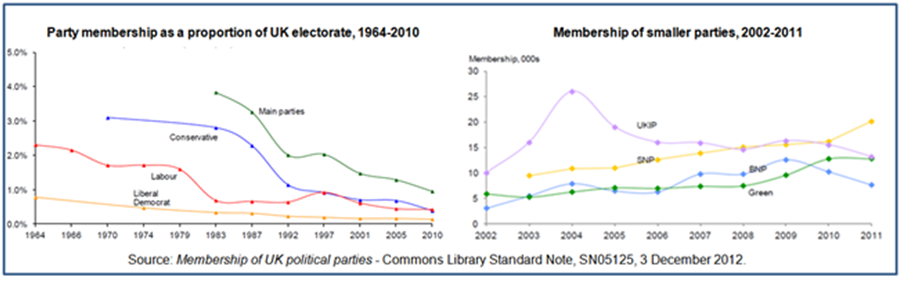
By most measures of party vitality, the Greens’ record over the past quarter-century would be judged one of steady, if frustratingly gradual, progress. As shown in the graphs below (http://www.parliament.uk/briefing-papers/SN05125), in an era in which membership of most major parties in most western democracies has been declining, Green Party membership has grown more or less uninterruptedly from 5,000 in 1998 to a 2011 count of 12,800. Its parliamentary vote has increased at each election since 1997, and 2010 saw party leader, Caroline Lucas, returned as the first Green MP.

chris graph

Despite never again reaching its spectacular 15% vote share in the 1989 European Parliament elections, the party has had 2 MEPs since 1999 and has increased its vote at each five-yearly election since 1994. Three Greens were elected to the first London Assembly in 2000, and the party’s gradually increasing representation on principal councils is currently approaching 150. This includes running the unitary Brighton and Hove Council as a single-party minority administration, and Lancaster City Council as part of a Labour/Green coalition. And, at least as important as it must sometimes be irritating, it has received the double-edged compliment of seeing Green ideas and policies permeate, or blatantly appropriated by, the so-called mainstream parties.

There can be no serious doubting, then, that anniversary congratulations are well in order. There is, however, a ‘however’.  I note that the Greens, perhaps with their celebrations in mind, are again claiming to be the fourth party in UK politics – and, reluctant as I am to rain on the parade, I respectfully beg to differ. That reluctance is increased by the fact that a close INLOGOV colleague, Professor John Raine, somehow manages to double as an industrious Green councillor, and so it is with particular apologies to John that I suggest that the Greens’ bid for fourth party status, notwithstanding all that gradual progress, is probably less persuasive today than when it was originally made back in the 1980s.

It may be the party itself senses the holes in its case, for it talks of having “up to a million supporters in this country, and tens of millions across Europe” – John Vidal, The Guardian, 18 February 2013 – . Supporters are good, especially in large numbers, but they’re slippery customers – not reliably countable and cashable, like subscribing members, voters, or elected representatives. If your case rests on alleged supporters, it’s shaky.

Chris2

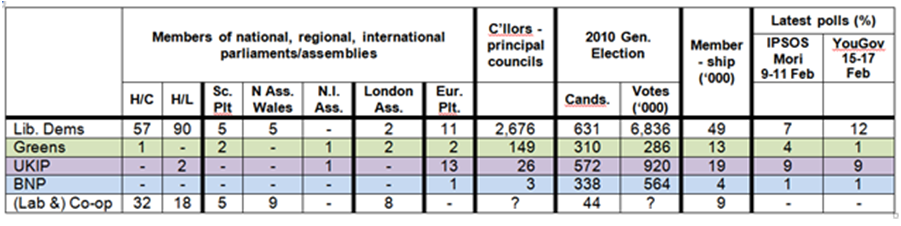
A Green bid for fourth-party status based on the data in the accompanying table would rest to an extent on Caroline Lucas in the Commons, its sister-party members in the Scottish Parliament and Northern Ireland Assembly, and its record in successive Euro-elections, but above all on its local government representation – hugely exceeding that of UKIP, who have no more than three members on any single council.

No minor party does well out of first-past-the-post parliamentary elections, but, leaving Ms Lucas aside, UKIP in recent elections has fielded considerably more candidates and gained far more votes. In fact, in 2010 the BNP too fielded more candidates and won more votes. UKIP’s Euro record is also much the superior, its membership has consistently been and is today significantly higher, and, certainly at present, it’s closer in the opinion polls to challenging the Lib Dems than it is to being headed by the Greens.

I reckon therefore that, unless you give extra weighting to councillor representation – a pleasing idea, I grant you – UKIP’s case is overall the more persuasive, though definitely not as compelling as its website would have us believe, as, on the back of a few striking by-election results and opinion polls, it promotes itself as “the UK’s third political party – and the only one now offering a radical alternative”.

One final thought.  In preparing the above table it occurred to me that, depending on the criteria you use, there is arguably another candidate for the UK’s fourth largest party, and one almost certain to increase its visibility over the next few years: the Co-operative Party. We tend not to think of it as a party in its own right, but, apart from the minor snag of not fielding its own candidates in UK elections, it has all the other attributes of the legally separate party that it is: a leadership structure, membership subscriptions, local branches, an annual conference, and a distinguished history dating back to the First World War.

It is the political arm of the co-operative movement and since 1927 a sister party to Labour – the two parties working jointly to promote, among various shared aims, co-operative working and other forms of mutual organisation. This joint-working includes an electoral alliance, under which the parties put forward and partially fund the election expenses of ‘Labour and Co-operative Party’ candidates – 44 in the 2010 General Election, of whom 28 were elected, including Shadow Chancellor of the Exchequer, Ed Balls.

As the table shows, there are also Labour and Co-operative Peers, members of the Scottish Parliament and Welsh Assembly, and, says the party, “hundreds of councillors”, although the latter are difficult to count, as in multi-member wards the party must endorse all candidates before they are permitted to use the designation on ballot papers. Whatever the number, they are definitely increasing – including in the Greens’ proverbial backyard of Brighton and Hove, where Labour councillors became the first to change their name officially to the Labour and Co-operative Group. Others have followed suit, and, as Labour nationally and locally starts seriously embracing ideas of mutualism and co-operation, the sister party must be sensing something of a new dawn. So make the most of your 40th anniversary, Greens – only four years to the centenary of the Co-op Party.

game

Chris is a Visiting Lecturer at INLOGOV interested in the politics of local government; local elections, electoral reform and other electoral behaviour; party politics; political  leadership and management; member-officer relations; central-local relations; use of consumer and opinion research in local government; the modernisation agenda and the implementation of executive local government.