Localisation of the Discretionary Social Fund – from cash loans to food stamps and Asda cards

Chris Game

Two recent Japanese visitors to INLOGOV included among their ‘etiquette gifts’ a set of Furusato or prefecture stamps – postage stamps produced to promote local government in, in this case, Hyogo, one of the 47 prefectures that are the equivalent of our counties. The stamps are attractive and easy to admire, and we inevitably wondered out loud how much Birmingham – or even the West Midlands region, whose 5.6 million population is similar to Hyogo’s – might pay for a similar PO issue .

Not out loud, I also wondered about mentioning that by coincidence some of our local authorities too would shortly be launching their own sets of stamps. But, with these being not pretty promotional ones, but wartime-echoing food stamps, I decided against it. But I will do here.

So many welfare and tax changes are being introduced at the start of this financial year that, apart obviously from planning how to spend the 5% tax cut on our £150,000+ incomes, it’s genuinely hard to keep track of them all. Almost all the changes, moreover, are controversial, which probably partly explains why the abolition or localisation of much of the Discretionary Social Fund (DSF) – a vital but admittedly small part of the total welfare system – has received less, and less critical, attention than it should have done.

The Social Fund was set up in the 1980s, to provide interest-free loans and grants through both a regulated scheme and a cash-limited discretionary scheme. There are four regulated fund payments: cold weather, winter fuel and funeral payments, and Sure Start maternity grants. These will continue, and the Social Fund itself, therefore, is not being abolished.

The discretionary scheme is intended to be the final welfare safety net – the safety net’s safety net, as it were – and it comprises three distinct elements. Budgeting Loans, the largest element, are interest-free loans for people on benefits who have difficulty managing intermittent expenses such as the replacement of white goods and household items, and who might otherwise turn to loan sharks.

Community Care Grants are non-repayable grants, conditional on receipt of income-related benefit, and intended to help vulnerable people – young people leaving a children’s home or foster care, women fleeing from domestic violence – to return to or remain in the community, or to ease exceptional pressure following a family breakdown or other emergency.

Crisis Loans are modest, interest-free loans available to anyone, whether on benefit or not. Applicants must show that, following an unforeseen emergency or disaster, they or their family cannot meet immediate short-term needs and would otherwise face serious risk to their health or safety. Loans, already being ‘managed back’ to pre-2006 levels, before telephone claims were introduced, are restricted to what are defined as essential items.

All three elements will now change, but in different ways. Budgeting Loans will become Budgeting Advances, provided as now by the Department for Work and Pensions (DWP), and, for those eligible, will gradually be incorporated into Universal Credit. It’s the other two – Community Care Grants and Crisis Loans – that particularly concern us here, for it is these that are actually being abolished, with funding being made available to English local authorities (and the devolved administrations in Scotland and Wales) to enable them to provide new locally-administered assistance to vulnerable groups, under existing powers.

Mark those last three words. They may sound harmless, but they’re crucial. They mean that councils have no new statutory duty to provide any specific form of support, for some of the poorest and most marginalised members of our society, out of funding that is not ‘ring-fenced’, and at a time when their diminishing resources are already under the acutest pressure.

Ministerial guidance to councils is expressed in questionable English, but impeccably localist rhetoric. “The Government has decided it would not be appropriate to place a new duty on local authorities in respect of the new provision you are planning. You need to be able to flex the provision in a way that is suitable and appropriate to meet the needs of your local communities.”

Even Ministers, though, acknowledge that it’s much more about savings than about ‘flexing provision’: “It will mean that individuals will have to take more responsibility in managing their own finances and plan for their future, rather than building up benefit debts they can ill afford.” You local councils, in other words, must be even tougher that we in central government have been. And, by the way, we no longer accept any responsibility for this ultimate safety net of our supposedly national welfare system.

It’s similar to what’s happening with Council Tax Benefit: systems run till now by the DWP being transferred to local authorities, but with significant reductions in funding and minimal preparation time. In both cases, localisation is a good principle which in time should provide more efficient, more responsive and more integrated services for local residents. But here in Birmingham, for example, the Council has been expected to devise and launch a scheme of ‘back-stop’ local welfare provision, with all its attendant criteria and considerations – eligibility rules, forms of assistance, degrees of discretion, advice to unsuccessful applicants, appeals procedures, and, of course, action if or when the money runs out – with ‘start-up’ funding of just over ₤60,000.

Naturally, councils have been ‘flexing’ their own schemes and coming up with differing solutions.  Some will issue charity food parcels; others plan to give cash grants to food banks to enable them to employ full-time staff and extend opening hours. A minority will continue the practice of cash payments for specified emergency items, or maybe low-interest (rather than interest-free) loans with local credit unions. It’s clear, though, that most have opted, more or less reluctantly, for what generically seem likely to become known as ‘food stamps’: not cash loans, but one-off vouchers redeemable for a list of approved goods, such as food and nappies.

Birmingham’s Labour council has negotiated its own, to date unique, form of voucher scheme, outlined in its publication – Local Welfare Provision (LWP): What is happening in Birmingham from April 2013?  The ‘provision’ is described initially in terms of ‘awards’ and ‘grants’, but by page 3 it becomes clear, in the boldest type, that one big thing that’s happening is that “There will be no cash alternative as part of the LWP scheme”. What there will be, for successful applicants “in crisis”, are pre-paid Asda cards, enabling the purchase of emergency food and essentials – as opposed to, although they’re not actually mentioned, tobacco, alcohol, phone-related items, and other undesirables.

Quite apart from the inflexibility and inconvenience of prepaid cards, and the almost predictable technical teething problems, there are obviously some pretty hefty principles involved in this cash-to-cards switch – enough indeed to justify a blog in their own right. As refugee support agencies and human rights organisations have argued over the years, they’re potentially humiliating, stigmatising, socially marginalising, and ultimately infantilising.

And yet (you can probably guess what’s coming next) it’s the so far exclusive deal with Asda – scarcely involving a genuine point of principle at all – that has attracted all the media attention and a public ‘clarification’ by the Council, who say they’re also in negotiation with a wide range of other retailers. We shall see, but my personal bet is that, unless they sign up a good few others pdq, they’ll acquire, and find it very difficult to lose, the adhesive tag of ‘the Asda council’ – the one consolation being that they won’t need to spend too much on publicising the scheme.

Note: Earlier (and longer) version of this article posted by our fine colleagues at The Chamberlain Files.


game

Chris is a Visiting Lecturer at INLOGOV interested in the politics of local government; local elections, electoral reform and other electoral behaviour; party politics; political leadership and management; member-officer relations; central-local relations; use of consumer and opinion research in local government; the modernisation agenda and the implementation of executive local government.
Street names – Mid Devon fails Birmingham’s comma sense test

Chris Game

Mid Devon District Council has just had to reprint and re-issue tens of thousands of council tax demands, after sending the majority of its taxpayers bills for up to £5 more than they were due to pay.  A hapless council officer had miscalculated the parish precept part of the bills, thereby costing the council an estimated £12,000 in re-billing charges.

A pretty big deal, you might think – one that would surely top the agenda at this week’s cabinet meeting.  But you’d be wrong. Sure, folks are annoyed and the Council’s taken some flak, but the annoyance and flak over this expensive and embarrassing boo-boo are NOTHING compared with the literally global outcry prompted by the Council’s announcement that it was planning to formalise its street naming guidelines by, among other things, avoiding in new street names and signs “all punctuation, including apostrophes”.

Yes, I’m fully aware we’re approaching April 1st, but I promise you, this is serious stuff. The professionals, or obsessionals, set the pace. The Apostrophe Protection Society thought it “appalling, disgusting, pointless”. The Plain English Society was less hesitant, and in very plain English wondered, after the “murder” of the apostrophe, “where’s it going to stop? Are we going to declare war on commas, outlaw full stops?”

Then the locals leapt in – the obligatory quote from the Exeter University Eng lit lecturer; a tweet from Exeter MP and former Culture Secretary, Ben Bradshaw, who, if encouraged, would tweet about his breakfast; and the local politician, with a beautifully crafted own goal. The Mayor of Tiverton Town Council, possibly still peeved by the fact that, when first invented in 1974, the meaningless ‘Mid Devon’ was in fact Tiverton District, thought “it’s ridiculous just to remove them” (they weren’t; the proposal was for new street names only). “If for example Blundell’s Road belongs to Blundell then it should have an apostrophe.”

Precisely. And, if it no longer does, then presumably it shouldn’t. Blundell’s Road and Avenue in Tiverton are two of only about four currently apostrophised street names in the whole Mid Devon district. They are named after the extremely rich 16th Century merchant, Peter Blundell, but probably never actually belonged to him, and certainly don’t today. Game and set, one would think, to the Mid Devon reformers, but sadly, as we shall see, not the match.

By now, any Birmingham readers will have recalled that we went through all this sound and fury back in 2009, when the City Council similarly decided to formalise what had become conventional practice and remove all apostrophes from those place and street names that still, sometimes and arbitrarily, retained them. The author of the policy was a Lib Dem councillor for Moseley and Kings Heath ward and Chair of the Transportation Scrutiny Committee, Martin Mullaney.

Mullaney’s initial concern was to get a ruling on Kings Heath and Kings Norton, which wasn’t easy. The Gazetteer of British Place Names, for example, refuses even to recognise any such place name without a possessive apostrophe, if there’s any chance at all that it might once have warranted one. So Acock’s Green (another Birmingham ward) remains apparently the possession of one member of the Acock family, Druid’s Heath (in the same South Birmingham area) the playground of a single druid, and King’s Heath and King’s Norton are treated as if they were still part of the property portfolio of a monarch who flogged them off more than two centuries ago.

To any right-thinking person this is barmy, and thankfully the City Council had long recognised it as such.  Some decades previously, it had followed the lead of the Americans (of course) and several other English-speaking countries and dropped the possessive apostrophe completely from Birmingham place names – though more in the interests of convenience and economy than of improving historical or grammatical logic.

And to me, convenience or what one might call comma sense, are the key points in this particular debate. On the whole, I’m pretty keen on using punctuation properly and observing its rules. I don’t want, as the Plain English Campaign puts it, to “murder” the apostrophe, or any other punctuation mark. I’ve no wish to be rid of it altogether, even though it’s often more trouble than it’s worth (despite the potential confusion between it’s and its, you’d still understand this sentence, even if I’d left out all six apostrophes), and in the real world is on its way out anyway. It’s the possessive pronoun in names and signs, not its ‘omission’ purpose of signalling missing letters, that I’d do away with.

We know from linguistic historians that the apostrophe’s use to signify possession, as opposed to indicating letters omitted, is a punctuation oddball – a latecomer, essentially in the 19th Century, owing more to printers than grammarians, with rules that are never clear cut and frequently unknowable. Why, to pick just one example, no apostrophe with possessive pronouns – hers, his, yours, ours, its – but with the possessive of some indefinite pronouns – one’s, anyone’s, somebody’s?

When it comes to names, if, in order to use the apostrophe correctly, you need to research the life history of the person or place (as with Tiverton’s Peter Blundell), or know the chosen corporate preference of the company, then you’re better off without it. I think it was Queens College that decided me. As an academic, I happen to know that it’s The Queen’s College, Oxford and Queens’ College, Cambridge. And the reason – come on, pay attention there! – is that the former was founded in honour of one Queen (Philippa of Hainault – the then French one, not the East London one), while the latter commemorates the two Queens of Henry VI and Edward IV. Yes, I’m not certain even Michael Caine knows that.

Companies, sports stadia and the like are even trickier. If you’re pro-apostrophe, you’ve got Sainsbury’s with you and Morrisons against you; Blackwell’s with you, Foyles and, since last year, Waterstones against; McDonald’s for, Harrods, Selfridges and Starbucks against; Lord’s (cricket ground) for, Ladbrokes against; St Andrew’s (Birmingham City) and St James’ Park (Newcastle) for, St James Park (Exeter) against.

Which brings us back to Birmingham.  In 2009 the Council attracted just the same OTT outrage and ridicule as Mid Devon has. Councillor Mullaney got himself on New Zealand television, and similarly Mid Devon has been reported and mocked by the Belfast Telegraph, the Canberra Times and Newstrack India. The big difference has been that, whereas Councillor Mullaney and Birmingham City Council stood their ground, went ahead and abolished, their Mid Devon counterparts have rather pathetically caved in.

The Council’s Conservative Leader, hyphenated Peter Hare-Scott, having reviewed the situation, decided against taking on the out-of-town punctuation fascists, and, when Agenda Item 4(c): Street Naming and Numbering comes up, will recommend that the Cabinet “amend the policy so that street names may in future have apostrophes”. Eric Pickles for one will be pleased. A spokesman from the Department for Communities and Local Government said: “Whilst this is ultimately a matter for the local council, ministers’ view is that England’s apostrophes should be cherished.”  Their view of Conservative-led councils who cost their hard-working taxpayers money by miscalculating their council tax demands isn’t recorded

Note: A version of this blog post appeared previously on TheChamberlainFiles.com

game

Chris is a Visiting Lecturer at INLOGOV interested in the politics of local government; local elections, electoral reform and other electoral behaviour; party politics; political leadership and management; member-officer relations; central-local relations; use of consumer and opinion research in local government; the modernisation agenda and the implementation of executive local government.
The Budget Red Book – the small print containing local government’s big headlines

Chris Game

I do love Wikipedia. It being Budget Week, I thought I’d check out what it had to say about the Red Book, as the documented version of the Chancellor’s Financial Statement and Budget Report is generally known among those to whom these things matter. As ever, it had plenty – almost 50 separate entries.

I skipped the music – Bacharach and David’s (and Manfred Mann’s) ‘My Little Red Book’; also Mao’s pocketbook of catchy quotations, Monty Python’s Big Red Book, and the notorious 1969 Danish-originated and UK-prosecuted Little Red School Book of practical advice to young people on how to do sex and drugs. ‘Reference manuals’ seemed more promising, and there are Red Books aplenty on landscape gardens, fire-service training, paediatric infectious diseases, and much else besides. But no mention of the UK Treasury, nor indeed of the Bank of England’s entirely separate ‘Red Book’, its money market manual with which the Treasury’s publication is occasionally confused.  So, characteristically entertaining, Wiki, but this time, no cigar!

The Red Book I was after – Budget 2013, to give it its official title – is where you go to check exactly what the Chancellor said, or meant, and the story and statistics underpinning it all.   It’s obviously primarily about the national economy, and much of it is beyond me, or at least beyond my interest. But this year I reckon there are two or three items that between them constitute the 120-point headlines for local government over the coming few years.

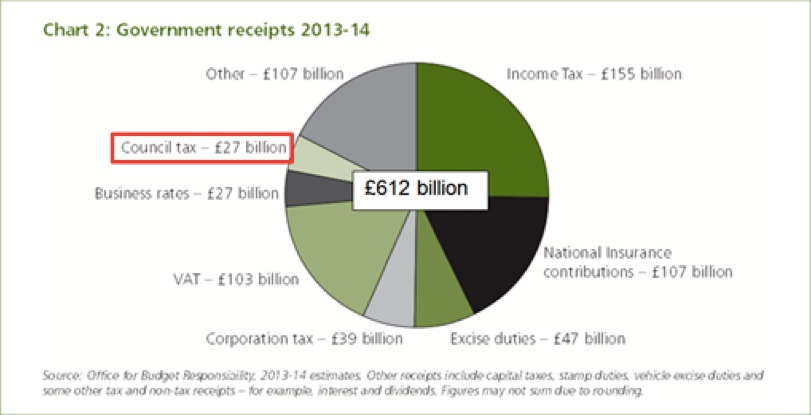
First, not exactly a headline, but an updated and always useful reminder for those of us seeking to educate people about the realities of UK local government: that, of every £1 we pay in tax, over 95% goes to the central Exchequer, and less than 5p or 5% to our local councils – compared to between 12% and 18% in France, Italy and Austria, and between 20% and 32% in Finland, Denmark, Spain, Germany and Sweden.

Gamefig1

In fact, the figures in the chart on p.6 of the Red Book show that Eric Pickles’ largely effective attempts to freeze council tax have reduced its contribution to total government receipts from a figure that in 2010-11 rounded up to 5% to today’s just 4.4%. This, however, is about as low as it’s likely to go, as the inflation calculations of the Office for Budget Responsibility (OBR) are assuming a 2% annual increase in council tax from next year, no matter how much Mr P or his successors may protest.

All that means, though, is that ‘locally financed current expenditure’ will constitute a fractionally higher proportion of a steadily, and increasingly alarmingly, falling total. The immediate and upfront task of the Budget was to ‘fix the envelope’ for total government spending for 2015-16, prior to the publication of individual departmental budgets in June. But for local government I’d suggest this Budget’s real headlines are embedded in the Government’s updated assumptions beyond 2015-16:

“In line with previous policy, this Budget sets a fiscal assumption that TME [Total    Managed Expenditure] in 2016-17 and 2017-18 will continue to fall in real terms at               the same rate as over the Spending Review 2010 period.” (para. 1.59)

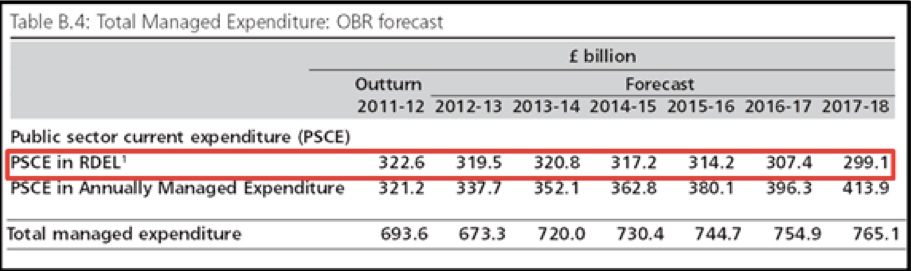
So, more of the same, for longer than we were fearing – it’s hardly good news, but alarming?  Certainly, there’s no alarmism in the explanatory Red Book text, but that’s because the actual figures, and particularly those for 2017-18, are revealed only in the supplementary tables at the end. The key lines are in Table B.4 on p.103, and I’m afraid they probably require – at least for those readers a bit hazy about the precise meaning of ‘PSCE in RDEL’ – an embarrassingly over-simplified introduction to some of the jargon used by Resource Accountants and Budget wallahs.

GameFig2

Public Sector Current Expenditure (PSCE) is divided into two categories, according to the degree to which it is controllable within three-year spending cycles by the Government departments responsible for it. For their supposedly controllable expenditure, departments must account to the Treasury against Departmental Expenditure Limits (DELs), the Resource DEL (RDEL) being current expenditure – pay, running costs – and also some non-cash items, like depreciation.

Departments are also responsible, though, for Annually Managed Expenditure (AME) – demand-led spending, like social security benefits, tax credits, central government debt interest, and, of course, locally-financed council spending – for which departments can’t be held accountable in the same way, and which therefore doesn’t form part of their DELs or of Spending Review settlements.

You can see immediately what’s been going on, and will continue to go on, and to an escalating degree, well into the next Parliament.  TME will carry on rising annually in cash (though not in real) terms, solely through the AME expenditures that the Government can’t actually stop, while RDELs take all the hits – down by £3.6 billion in 2014-15, then a further £3.1 billion in 2015-16, £6.8 billion in 2016-17, and £8.3 billion in 2017-18.

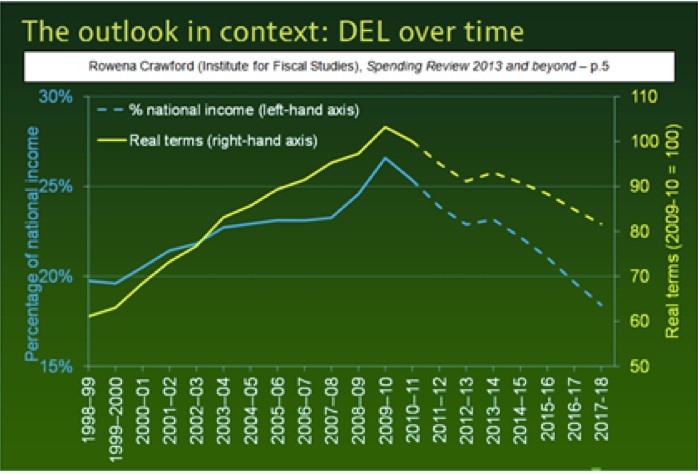
Dramatic as these figures are, they don’t in themselves capture the suddenness and severity of the U-turn forced upon this controlled element of public expenditure since 2010-11. For that you need a graph, of the kind produced by the Institute for Fiscal Studies (IFS) in one of their admirable post-Budget analyses.

GAMEFIG3

In the words of the IFS’ own summary (p.11): “Departmental spending [is] forecast to be cut by more than 18% in real terms from its 2010-11 level by 2017-18 – [that is] back to around 2002-03 level of real spending and pre-1998 level as % of national income”.

We’re still, though, talking about all departmental current spending – and in the present context misleadingly, for since the 2010 Spending Review several major expenditure heads have been and will continue to be either frozen or ‘protected’: notably, Overseas Development Assistance, ‘front-line’ NHS spending, plus spending on schools, 16-19 participation, and Sure Start. The impact of this service apartheid on what finance expert, Tony Travers, calls “the unloved and unprotected” – local government, defence, the police, fire, transport, business services – made itself felt immediately, and has been modelled through to 2017-18 in another IFS analysis.

We are looking at a real terms drop in total RDEL spending between 2010-11 and 2017-18 of 16.9%. Within that figure, though, spending on the NHS would have increased by 2.9%, on schools by 0.6%, and on the albeit modest-sized aid budget by 41.7% – while that on the unprotected remainder would have fallen by 31.5% (p.12). Local government from the outset has been among the most “unloved and unprotected” and, as Travers notes, “if capital spending becomes a greater priority, the impact on revenue spending within the unprotected part of DEL will be greater still. It now seems likely that local government … will face a real terms reduction of at least 50 per cent in expenditure over the period to 2017-18” – .

With figures like these, there is no need to speculate about the consequences of the Chancellor’s economic growth projections proving once again to be overly optimistic. Even if they’re right, the unavoidable truth is that local government as a sector and (remaining) local councils individually will be organised and will operate in fundamentally different ways from in the past, and, while there wasn’t a great deal in the Budget to cheer about, there were perhaps, again tucked away in the Red Book, some more positive headlines of what those different ways of operating might look like.

In, as it happens, the paragraph (1.58) immediately preceding the one about the Government’s fiscal assumptions beyond 2015-16, we read about the need for “ongoing reform of public services”:

“The four areas that participated in the recent Whole Place Community Budget pilots   estimate that they can save £800 million over five years by implementing their plans. To support the local adoption of similar approaches, the Government is establishing a new multi-agency network and will announce plans to extend the benefits of this approach across the country at the 2015-16 Spending Round.”

Oh dear! That £800 million: so big, so rounded, so headlineable – and so suspect.  Sometimes, fierce competition though there is, the Government’s own worst enemy can be itself. The figure appears to come from – though I’m fairly sure doesn’t actually appear in – the National Audit Office (NAO) review of the four Whole-Place Community Budget pilots that had been published the previous week. The report, as would be expected from the NAO, is a good one: thorough, insightful, critical, cautious, and constructive – but not shouty.

In Budget Week, however, the Government decided it needed shouty, so out came the Arthur Daley pocket calculator and added together the four areas’ estimates of potential savings – savings defined in different ways, reflecting different projects and activities, across different service areas, over different time periods (Westminster, Kensington & Chelsea – 1 year; Greater Manchester, and Cheshire West & Chester – 5 years; ‘Whole Essex’ – 6 years), and with differing degrees of assuredness. Total: £810 million; round down for luck, and you have your £800 million.

Normally, you’d run a mile from something so patently tacky, but there are two big considerations here. First, the indications are that this Government is rather more committed, at least at present, to the Whole-Place Community Budget approach than its predecessors were to similar earlier initiatives – local and multi-area agreements, Total Place, etc.  In apparent confirmation of that commitment, a letter has already gone out from Local Government Minister, Brandon Lewis, asking councils to submit expressions of interest to join the new multi-agency network to share learning from the existing four Community Budget pilots.

This letter more or less coincided with an estimate from Ernst & Young that the community budget approach to pooling budgets in a local area and working across public agencies could save up to £20.6 billion over the next five years. Another magic figure perhaps, but it brings us to the second big consideration – that Whole-Place Community Budgets would seem the only game in town capable of making any significant dent in all those lost billions identified earlier.

game

Chris is a Visiting Lecturer at INLOGOV interested in the politics of local government; local elections, electoral reform and other electoral behaviour; party politics; political leadership and management; member-officer relations; central-local relations; use of consumer and opinion research in local government; the modernisation agenda and the implementation of executive local government.
Budget cuts, outsourcing, council mergers: 12,000 miles travelled, but Cornwall’s ex-CE will find plenty that’s familiar

Chris Game

Even allowing for local government’s legendary Stakhanovite working practices, the sector can’t usually manage that many hot news stories on Christmas Eve, so you do tend to notice them, especially if they contain a strand of possible personal interest. I remember well, then, the BBC’s announcement this past Christmas Eve that Cornwall Council CE, Kevin Lavery, had accepted a five-year appointment as CE of Wellington City Council and would be moving to New Zealand to take up the post in March – oh yes, at an annual salary of NZ$400,000, which converted then into £203,000, but today into £219,000 (I note irritably).

The reason (for my remembering, not for his moving) was that I happened to know that England’s cricketers would be playing the second Test Match in their series against the New Zealanders at Wellington’s charming and historic Basin Reserve ground in March – and I was planning to watch it. How brilliant, I thought, if I could do a quick interview with Lavery, just a couple of weeks into his new job, about his first impressions, contrasts with Cornwall, etc. Unfortunately, it quickly turned out that – for, I have to concede, eminently good reasons – ‘March’ in fact meant 31st March, by which time I would be well back in the UK.

More recently – like this morning – it also turned out that the final day of the said Wellington Test Match would almost certainly be rained off. So, lacking anything better to do, I thought I’d report anyway on some of the stuff that the interview might have covered.
First, the contrasts and similarities. Wellington City has a population of 200,000 and the biggest of 9 and a bit elected councils (1 regional, 8 and a bit city and district – don’t ask!) in the Wellington region. The council has an elected mayor (currently Green), 14 councillors, employs 1,500 staff, and has a budget of NZ$400 million (£220 million).

Cornwall has a population of 535,000 and a 123-member council – roughly the number of councillors plus mayors in the whole Wellington region. The council employs 19,000 staff – not far short of NZ local government’s total employment – and has a budget of about £1 billion.

In short, Lavery’s new job represents an apparently significant drop in scale, but barely a drop at all in remuneration. I quoted his salary at the outset, partly because the NZ media (and possibly public) are at least as fascinated/obsessed with executive pay, pay-offs, etc. as ours are, but mainly because so far his financial cost is one of the very few things that most Wellingtonians, including most councillors, know about their new CE. He was head-hunted in a recruitment process that cost NZ$157,000, including NZ$12,000+ to fly him out for interview; he can claim up to NZ$40,000 removal costs, and is promised a ‘golden parachute’ payment of up to NZ$200,000, if the job disappears in the regional governmental reorganisation expected over the coming couple of years. As one councillor put it: “We don’t know what we’re getting, but he’s cost us a bomb to get and he’ll cost us a bomb if he goes”.

So it’s fair to say that his relations, initially at least, with some councillors could be as touchy as they were with some of those in Cornwall, where, it may be recalled, the Conservative leader, Alec Robertson, was deposed and plans for a massive Lavery-driven shared services joint venture project had to be halted after they’d failed to win majority councillor backing.

Reportedly, Lavery was first sounded out by the Wellington headhunters immediately following the leadership change and the resulting withdrawal of one of the two bidders for the shared service joint venture, leaving only BT, one of Lavery’s former employers. But whatever the detailed sequence of events, the reputation preceding him to Wellington has been that of a ‘Marmite (or perhaps Vegemite) bureaucrat’ – you either love him or loathe him – and one with an undisguised enthusiasm for privatising and outsourcing services.

From which you might suppose that the costly new appointment was perhaps a symbolic act on the part of a council whose leadership had recently taken a shift to the right, and was looking at one and the same time to signal its political authority and a major change in policy direction. You might, but you’d be quite wrong.

If party politics in Cornish local government is, by UK standards, relatively low-key, in Wellington – and indeed in NZ local government generally – it is barely visible and almost uninterpretable to the untrained eye. In the city’s 2010 local elections, only 3 of the 14 successful candidates had stood openly under party labels (2 Labour and 1 Green), and the Mayor, elected for the first time (like councillors, for a three-year term), though a Green party member, had campaigned as an Independent.

Celia Wade-Brown’s election as Mayor seemed to surprise her almost as much as it did pretty well everyone else. Born and brought up in England, she came to NZ only in her late twenties, and, with little prior public warning, decided in 2010 not to recontest her council seat, but instead to challenge the high-profile mayoral incumbent, Kerry Prendergast, seeking her fourth term of office. In the STV election, Prendergast was a comfortable 6% ahead after the count of first preference votes, was still ahead on the second, third and fourth counts, but was overtaken by Wade-Brown on the fifth and final count by just 176 out of more than 60,000 votes cast.

The mayoral and councillor results combined were interpreted as representing at least a modest move towards the centre-left, but if voters were looking for a significant leftward policy swing, most must have been disappointed. Indeed, the CE appointment, involving as it did the personally humiliating dismissal of the former CE after 15 years and for apparently nothing very particular, was one of the few visible signs of an intended change of direction. As far as the 2013/14 Draft Annual Plan and budget is concerned, the headlines must look as familiar to Wellington electors as they do to us: large-scale savings (NZ$240 million over 10 years), necessitating service cuts, job losses, increases in fees and charges, and ongoing outsourcing.

A major reason for Lavery not taking up his post until the end of the month is that there are three important events taking place between now and then, the consequences of which will take up a sizeable chunk of his in-tray. One is the Council vote on 27th March to approve the Draft Annual Plan, detailing the Council’s work programme and proposed rate and fee increases, following which it will, as required, go out for a month’s public consultation, before coming back to the Council for final approval in June.
This year’s Draft Plan cuts council spending by NZ$9 million and proposes a rate (property tax) increase of 2.8%, and several of the detailed cuts especially are controversial: restricted library opening hours, increased parking charges, “changing the operating model” of the aquatic centre crèche (unsubtle euphemism there!), reduced grants to the Zoo Trust and ‘Positively Wellington Tourism’. All can, of course, and doubtless will be compared to the new CE’s salary.

Before that, on 21st March, another public consultation begins – on three options for local government reform across the whole Wellington region. Two of the three are alternative ‘super city’ models, as favoured by the regional reform working party. The third is a minimally modified status quo, added by the Mayor and councillors who oppose a super-city solution and argue that the public should be presented with a wider-ranging choice. Lavery will be on familiar territory here.

Also on 21st March Wellington councillors vote again on the national Transport Agency’s proposal for a 300-metre long, 9-metre high concrete flyover to ease the perpetual congestion round the huge roundabout within which is situated the Basin Reserve cricket ground (where in fact I should be sitting at this moment). We cricket fans fear the flyover would seriously blight our spectating, to say nothing of its impact on hundreds of local residents. The Mayor – for whom almost any kind of road development is anathema – and a majority of councillors argue that the congestion can be resolved by a combination of other means. However, some of the Mayor’s phraseology is worrying. She talks rather vaguely of ‘fine-tuning’ the present roundabout, and of how Basin Reserve “must not be blighted by a naked block of concrete”, as if various forms of pleasingly attired concrete were available alternatives. And now there’s talk of a couple of the eight councillors who opposed the flyover in December maybe switching sides following a two-month council staff investigation. What a pity I couldn’t have given the new CE a short personal briefing on the issue.

game

Chris is a Visiting Lecturer at INLOGOV interested in the politics of local government; local elections, electoral reform and other electoral behaviour; party politics; political leadership and management; member-officer relations; central-local relations; use of consumer and opinion research in local government; the modernisation agenda and the implementation of executive local government.

Doing local politics differently: learning from an inspiring community campaign against the cuts

Catherine Durose

For the second time in as many years, the south Manchester neighbourhood of Levenshulme where I live, has faced the closure of vital public facilities. This time, the library and swimming pool have been targeted. Both these facilities are community hubs which bring people in a diverse, and in many ways disadvantaged, community together. To continue to build cohesion and understanding in our community, we need these spaces. In an economic context, where literate, educated, skilled people are the key to our future growth as a city, closing the library seems a perverse decision. In an area with some of the worst health outcomes in the city, where health services are stretched and we desperately need to encourage people to take responsibility for their own health, closing down the swimming pool seems obscene. The context of these closures is that Manchester is facing one of the toughest and most unfair financial settlements for local government which has been compounded by the loss of substantial deprivation linked funding. Many in Levenshulme feel that the proposal to close our local facilities is not only short-termist, but is self-defeating.

The anger in the community has been directed in a sustained, vibrant, thoughtful and provocative campaign to save our facilities, which has engaged hundreds of people. Yesterday, a flash mob of dancers from Levenshulme wearing masks of council leader Sir Richard Leese’s face performed a routine outside Manchester Town Hall proclaiming a ‘Lev-olution’. Last week, local people held a ‘beach party’ protest outside the pool before occupying it into the night. These actions followed months of well-attended demonstrations, occupations, vigils, petitions, fundraising events and public meetings which have attracted extensive local and national media coverage. These actions reflect the importance not only of persistence – a similarly vital community effort saved the swimming baths and sports hall in 2011 – but also of a sense of humour in mobilising people. We documented similar approaches in our recent INLOGOV pamphlet, ‘Beyond the State – Mobilising and Co-Producing with Communities’.

Today sees both – in a timetable which has generated a somewhat cynical interpretation in the community – the ending of the consultation by Manchester City Council on proposals for a new community hub in Levenshulme to open in Autumn 2014 and the debate of these proposals in full council. These proposals now have an amendment, tabled by local councillors following local pressure, to work with community groups to explore whether a viable business plan can be developed to allow our existing facilities to remain open until replacement facilities are available. Teams of local people are actively working to find a way to make this happen.

The council has been unable or unwilling – until demanded to by the community campaign – to communicate with the communities in Levenshulme and unable to – until led by the community –find a way to work in collaboration to find community-based solutions to dealing with unprecedented cuts to public services. Hopefully, the inspiring community campaign in Levenshulme adds another example of how local authorities can begin to learn to do local politics differently.

durose

Catherine Durose is Director of Research at INLOGOV. Catherine is interested in the restructuring of relationships between citizens, communities and the state. Catherine is currently advising the Office of Civil Society’s evaluation of the Community Organisers initiatives and leading a policy review for the AHRC’s Connected Communities programme on re-thinking local public services.

Shocking but not surprising: the problem is not with women but with the political parties

Catherine Durose

EHRC research exploring the under-representation of women and other groups protected under the Equality Act (2010) has been used to support a call for the Coalition to act to address the issue of women’s representation in Parliament. Women from the Political Studies Association’s Women and Politics group challenge the government to accept the logic of sex quotas and introduce legislation for elected institutions in Great Britain.

In the call for legislative quotas, researchers from the PSA women and politics group argue that if local parties are worried about having local candidates they can recruit and support local women to stand for selection. Supporting more candidates locally can have the benefits of reducing the costs (and barriers) of candidature and election and can potentially ‘open up’ politics to a wider range of people, as well as reinforcing the constituency link in national politics. As the Councillor’s Commission suggested, one way to do this is to encourage more civic and issue-based activists into politics. Such activists bring not only important skills but also an authenticity currently seen to be lacking in politics.

The Call

Claire Annesley, Rosie Campbell, Sarah Childs, Catherine Durose, Elizabeth Evans, Francesca Gains, Meryl Kenny, Fiona Mackay, Rainbow Murray, Liz Richardson and other members of the UK Political Studies Association (PSA) Women and Politics group.

This last week has seen the issue of women’s representation in Parliament hit the headlines, once again: Samantha Cameron apparently lamented the lack of women in politics to her husband; mid-week, job-shares for MPs were put forward as a new way to increase the number of women in the UK Parliament and there have been calls for quotas for the National Assembly for Wales. Over the weekend the Liberal Democrats launched two inquiries into the alleged sexual harassment of prospective women candidates and this Monday the 2013 Sex and Power Report was published, documenting the ‘shocking’ absence of women from all areas of public life. The findings of Sex and Power may be ‘shocking’ but they did not come as a shock to feminists. Enough is enough, it’s time that the Coalition Government stepped up and implemented the recommendations of the 2008-10 Speaker’s Conference on Parliamentary Representation. It should follow the evidence commissioned by Parliament, accept the logic of sex quotas, and introduce legislation, for Westminster and other elected institutions in Great Britain.

Party leaders have said it before, and no doubt they’ll say it again: In the words of David Cameron:

“Companies, political parties and other organisations need to actively go out and encourage women to join in, to sign up, to take the course, to become part of the endeavour”.

The problem is that exhorting women to participate in politics will never address the ‘scandalous’, as Cameron also put it, under-representation of women at Westminster. Men are nearly 80 % of the House of Commons. Women are not even half-way to equal presence. Labour does the best with a third of the Parliamentary Labour Party female. The Tories at 16 percent, come second, and they did more than double their number at the last election. The Lib Dems trail in last, at just 12 percent, with fewer women candidates and fewer women MPs in 2010 than in 2005.

The situation is depressingly familiar at other levels of government in the UK. Despite Nordic levels of women’s representation when the Scottish Parliament and the National Assembly for Wales were first created, the overall trends are of stalling or falling with campaigners calling for legislative quotas in devolved and local government and for the Speaker’s Conference to be replicated.

Fewer women than men currently want to be politicians – we need to address the reasons why and make sure that there is greater diversity overall in Parliament – but the most pressing problem is not with women but with the political parties and their willingness to select and support the qualified women who would like to stand in seats where they have a good chance of winning. Cameron himself acknowledged this last week:

“Just opening up and saying ‘you’re welcome to try if you want to’ doesn’t get over the fact that there have been all sorts of barriers in the way”

These multiple barriers were examined extensively in evidence given to the specially convened Speakers Conference which looked at how to improve the diversity of representation at Westminster. Only some of its recommendations have since been introduced. One key recommendation was that candidate selection data be routinely published so the public can see who was being selected by the parties. Unfortunately the Coalition has opted for a voluntary approach to the publication of this data. In its absence, political parties will likely get away with shifting the blame onto women when what is at issue is their failure to recruit women.

The Equality and Human Rights Commission’s evidence to the Speaker’s Conference was just one of many to identify the barrier of party demand: a perceived gap between the rhetoric for equality of representation by national party elites and the reality of decision making at the critical point of candidate selection on the ground. EHRC research shows local parties frequently opt to pick candidates who fit an archetypal stereo-type of a white, male professional. The Conservatives, Labour and Lib Dems choose to address this particular barrier in different ways – with only the Labour party addressing it by using a party quota, All Women Shortlists. Yet, the Speaker’s Conference recommendations were clear that in the absence of significant improvements in 2010, Parliament should consider legislative quotas. There was no such significant increase. And looking forward, there is, if anything, talk of declining numbers of Conservative and Liberal Democrat women in 2015.

The global evidence on quotas is clear: well designed and properly implemented quotas are the most effective way to address the under-representation of women. Shouldn’t the Government follow the evidence? Other measures can and do make some difference. It is why we support the call for MP job-shares; the training for women candidates that all parties provide; and diversity training for party selectorates, amongst other measures. And it’s why we welcomed the Conservative Party’s A list at the 2010 general election, even if it could not guarantee the selection of greater numbers of women. But the gains across the board have just been too slight and are taking too long.

The Coalition could – if it really wanted to – act on this issue now. Introducing legislative quotas – making all political parties implement quotas – would give the two party leaders ‘political cover’. Both leaders’ positions on quotas are on the record: they gave commitments to the Speaker’s Conference in person. Clegg said he wasn’t ‘theologically opposed’ and Cameron said he would use some AWS before the last election, although in the end he didn’t. And we are pretty confident that Labour would support legislative quotas: how could it not given its own record on this issue?

We acknowledge that hostility to quotas is out there, but criticisms can be challenged. Quotas are not the electoral risk that some activists suggest. Studies show that being an AWS candidates does not cause electoral defeat. If the principle of merit troubles, one can counter that current selection processes are themselves not meritocratic. Cameron said so himself. Nor do quotas produce unqualified or poor quality women MPs – few know which of Labour’s 1997 intake were selected on AWS, and they were equally as successful in terms of promotion. And we simply don’t buy the argument that there are not enough qualified women out there – each party has its ‘folder’; and if it is perceived to be a bit thin, some good old fashioned searching will find more. Evidence from the US shows us that party demand begets a greater supply. The Government can also make other changes to increase the supply of potential candidates – let’s give the House more professional hours and ensure that families can afford to live and work in both London and the constituency, for example. Finally, and for some the bottom line, is criticism of what local parties regard as top-down measures. But if the truck is with ‘outsider’ women ‘being imposed’ then local parties can recruit local women to stand for selection.

Candidates are being selected as we write – the time to act is now. So, Messers Clegg and Cameron, be constitutionally radical (there’s not been too much success so far here) and leave a legacy of gender equality from the Coalition Government. Let’s have a House of Commons that closer approximates the sex balance of the UK in 2015. You could, at a minimum, set up a Second Speaker’s Conference with the remit to implement the recommendations of its predecessor and to work with other parliaments and assemblies across the four nations. Or be even more bold: to expedite women’s representation the Government need only introduce a Bill establishing legislative sex quotas. The alternative is for us to wake up the day after the 2015 election and find the party leaders once again bemoaning the continuing under-representation of women at Westminster.

This post was originally featured on the PSA Women and Politics blog.

A shortened version of this post was also published by the Huffington Post.

The EHRC research cited here was led by Catherine Durose (University of Birmingham) with Liz Richardson, Francesca Gains, Ryan Combs and Christina Eason (University of Manchester) and Karl Broome (University of Sussex).

The work has also been cited in the recent report of the Communities and Local Government Select Committee, ‘Councillors on the frontline‘.

For further discussion of these findings see Durose, C., Richardson L, Combs, R., Easton, C., and Gains, F. (2012) ‘Acceptable Difference’: Diversity, Representation and Pathways to UK Politics. Parliamentary Affairs.

durose

Catherine Durose is Director of Research at INLOGOV. Catherine is interested in the restructuring of relationships between citizens, communities and the state. Catherine is currently advising the Office of Civil Society’s evaluation of the Community Organisers initiatives and leading a policy review for the AHRC’s Connected Communities programme on re-thinking local public services.