Something old, something new, something borrowed, something blue: is ‘Blue Labour’ part of the left response to the rise of UKIP?

Martin Stott

It is a commonplace for commentators to say that the recent success of UKIP in the shire elections poses a threat to Labour as well as the Tories. There is some truth in this, but a strand of thinking in the Labour Party has been grappling with some of the issues UKIP poses from a left perspective for several years. This is referred to as ‘Blue Labour’.

Essentially it is a critique of both Old and New Labour. It understands that the relentless progress of the last Labour Governments caused many Labour supporters to feel as if their communities had been left soulless. It recognises that Labour developed a top-down style of government and is critical of its neo-liberal view of the world – globalisation understood entirely on terms set by finance capital. Instead it focuses on a different approach to socialism, stressing communitarianism, self reliance and mutuality.

The debate has been driven by the credibility of many of those leading it, most notably the Labour MP and Milliband’s policy review chief, John Cruddas and cultural studies professor, Jonathan Rutherford. They set out the Blue Labour stall thus:

“…today Labour is viewed by many as the party of the market and the state, not of society. It has become disconnected from the ordinary everyday lives of the people. In England Labour no longer knows who it represents; its people are everyone and no one. It champions humanity in general but no one in particular. It favours multi-culturalism but suspects the popular symbols and iconography of Englishness. It claims to be the party of values, but nothing specific. Over the past decade it has failed to give form to a common life, to speak for it and defend it against the forces of unaccountable corporate power and state intrusion”.

A lot of people on the left can relate to that and the ‘Blue Labour’ argument is essentially that the loss by Labour of over five million votes between 1997 and 2010 is a reflection of this, encapsulated in Tony Blair’s famous 2004 comment “Leave the past to those who live in it”.

The problem with that mind-set is that this view of Labour supporters certainly does resonate with UKIP recruits from Labour. Recent focus groups of UKIP supporters when, after rehearsing a lengthy catalogue of things they didn’t like were asked what they did like about Britain, reportedly responded, ‘The past’. Cruddas’s summary of the trajectory of New Labour under Blair is:

“At its best New Labour encompassed both the progressive and the traditional, captured in Tony Blair’s, early recognition of the need for a ‘modern patriotism’. Over time however, it became all about the ‘progressive new’. By the end it embraced a dystopian destructive neo-liberalism cut loose from the traditions and history of Labour”.

What ‘Blue Labour’ is trying to articulate is a direction of travel that is different from a ‘progressive’ politics that uncritically embraces globalisation, neo-liberalism, consumerism and a market economy that leaves great swathes of the population behind and whose guiding principles were graphically exposed by the banking crisis of 2008.

By contrast, the current Government is a constant source of dismay to its supporters as it takes its admiration of all things ‘Blairite’ to new heights, with its attempts to flog off parts of English common life to the highest bidder, forests, waterways, parks, the Post Office, sport and culture, not to mention that national institution, the National Health Service. Hence the mass defections to UKIP from the Tories

By contrast ‘Blue Labour’ is attempting to create a polity through a set of values rooted in relationships – reciprocity, mutuality, solidarity and co-operation rather than the managerial, the bureaucratic and the corporate. It is not just a critique of New Labour though – Blue Labour is not that keen on Old Labour either.

As long ago as 1952, Richard Crossman in an article entitled “Towards a philosophy of Socialism” recognised that the post-war project, the creation of the Welfare State, the triumph of Fabianism, took for granted that politics was the business of maximising general happiness through social planning.

However a welfare state administered centrally in Whitehall sapped the life blood of the Labour Movement. “Before 1945, for hundreds of thousands of active trade unionists and party workers, socialism was a way of life and a vocation”. Now (and this was in 1952!), it seemed that it was exclusively the business of politicians at Westminster acting through an unreformed civil service. Those activists who had previously helped run municipal “gas and water socialism” were given “no vision of new socialist responsibilities”. ‘Blue Labour’ takes a similar view and indeed a deep scepticism of the Welfare State seems to be one of its defining features.

Navigating a credible path between a critique of the Welfare State, hostility to globalisation and neo-conservative economics, and a potentially reactionary nostalgia, is not easy. Labour’s traditions of solidarity, at their best, have been cross-class, cross-generational, cross-gender and cross-national. That is why the bust-ups over immigration prompted by the comments of the original exponent of ‘Blue Labour’ Maurice Glasman (enobled by Ed Miliband in 2011), hurt. It is also true that the ‘flag, faith and family’ tag has more than a hint of not just nationalism, but patriarchy. Some have denounced its perceived conservatism as a ‘Janet and John’ 1950’s style approach to family life. But the Labour Movement has a ‘tradition’ that embraces feminism, internationalism and more recently, multiculturalism. In this regard, ‘Blue Labour’ needs to be a lot more nuanced than current public perception of it.

It has also been criticised for having no coherent economic policy. Certainly talk of limiting the market, bemoaning the “commodification of human beings” and the promotion of regional banks and ‘city parliaments’, doesn’t constitute an economic policy. But unlike the “Big Society”, a shameless Tory ‘borrowing’ of the narratives of community and mutuality, ‘Blue Labour’ is not utterly silent on the market.

Whatever we think of the specific prescriptions that have emerged so far, what we are seeing with ‘Blue Labour’ is a return of something that was repressed under New Labour. Labour is once more talking about class and ideology and from that, some constructive new thinking and a credible response to the UKIP threat, should emerge.

stott

Martin Stott has been an INLOGOV Associate since 2012. He joined INLOGOV after a 25 year career in local government, both as an elected member and as a senior officer.

Why sharing is the future: A public administration perspective on the mesh economy

Tutik Rachmawati

It is common knowledge that in the study of public administration, initiatives for improving the performance of public organisations are very much borrowed from the private sector. In 1993, Osborne & Gaebler, for instance, established ten principles to reach entrepreneurial government. They offered ways to develop entrepreneurial, flexible and outcome-oriented organisations in the public sector.

Furthermore, the concept of New Public Management, which emphasises economic rationalism and private sector management practices, has also been adapted across nations. The implementation of information technology into business practices has also driven public organisations to launch e-government to transform the way they engage with citizens and business. Recently, under the ideas of entrepreneurial government and New Public Management, the duties of many public organisations have been commissioned to other parties, including in the private sector.

It can be argued that the principles of Mesh Economy can appropriately be applied in public organisation for several reasons. Firstly, the principle of partnership and other parties’ involvement. Strategic Commissioning in public organisations stresses the importance of partnership and involvement of other parties. It aims at reducing overlap and duplications, and further creating scope for efficiency and savings. This is an idea that is very much in line with Mesh Economy which highlights business operation through a collaborative approach to providing organisations with better ideas that then allows customers to receive flexible and more sustainable products and services.

Secondly, the principle of sustainability and the global anti-waste approach in the Mesh Economy is similar to the principle of sustainable management of services and assets demands in strategic commissioning. Strategic commissioning focuses on the quality and value for money – not necessarily at lowest cost- so that more is achieved with less in an environmentally friendly way.

Thirdly, consumer driven free economy in the Mesh Business is similar with co-production in strategic commissioning of public organisations. While the Mesh Business sends people recommendations and/or advertising messages based on their personal behavioural patterns, co-production service users know things that many professionals do not know – hence services can be produced more effectively. Co–production conceives the services users as active asset-holders rather than passive consumers. Therefore, both Mesh Business and Co-production empower and build trust in customers/consumers. Customers in Mesh Business build trust by disclosing personal behavioural patterns, while in co-production users, citizens, partners and voters build trust in the work of the public sector including the risks of losing the shared assets with other parties.

Sharing is the future business of private sector, and it will also be the future of public organisations as both share common characteristics. However, there are lessons to be learned for public organisations from the Mesh Economy.

Firstly, the mesh economy is based on strong relations with customers, as it is through more frequent contact with customers that a greater flow of customer data is produced which at the end makes the business successful by making more profit. Even though profit is not the raison d’être of the public organisation, it is still valid to have good relations with citizens. Public organisations also generate large amounts of citizen data which eventually will be useful to perfect the public organisation’s performance in providing public services. Public organisations need to learn from the Mesh Business on how to utilize the ongoing connections with citizens and to use citizen data constructively to serve citizens better.

Secondly is the issue of managing resources efficiently. The rule of thumb in mesh business is ‘ownership is out, access is in’. It means that mesh business can and does deploy assets they don’t own but can easily access. It is rightful for public organisations to apply this as the potential for efficiency and saving a huge amount of money is high. Learning from this will enable public organisations to channel their budget for the betterment of public service provision. Furthermore, as public organisations, governments and local governments suffer from financial burden, the need to share rather than buy and own is more appropriate.

Thirdly, public organisations will need to learn from the mesh economy on how to design a public services that is more resilient so that they could last longer even after multiple uses by different members or users. Every public service needs to meet the four criteria of mesh products: it should be durable (well-built and safe), flexible (accommodates different users), repairable (has standardized parts that allow easy repair) and sustainable (reduces natural resources waste).

To conclude, sharing as the core concept of the mesh economy should be applied in public organisation settings. Its core principles are needed for public entrepreneurs to level up public organisations’ performance.

s200_tutik.rachmawati

Tutik Rachmawati is a PhD student at INLOGOV, University of Birmingham, and is a Japan-Indonesian Presidential Scholarship Awardee. She has research interests in public entrepreneurship and local economic development.

This post previously appeared on Puzzle Minds.

It’s not Labour or the LGA who are out of touch. It’s you, Minister!

Chris Game

Are you up to speed with your local finance jargon? If so, I wonder if you can explain the difference between a ‘widows tax’ and a ‘Bridget Jones tax’? No, it’s no use reaching for your £445 copy of the CIPFA Guide to Local Government Finance. The answer’s not in there. It’s the Conservative press you’re after, and specifically the Daily Mail and Daily Telegraph.

Monday’s edition of the Mail (that’s Monday, 6th May) thought it would be fun to scare its Bank Holiday readers with the news that “Labour plots ‘Bridget Jones tax’: Party accused of demanding an end to council tax discounts for singletons”.

Evidently the rest of what we once called Fleet Street was out to lunch, because it wasn’t until Thursday 9th that the Telegraph caught up with the story, by which time it obviously had to invent its own slant: “Town halls seek to levy ‘widows tax’”.

They are of course exactly the same thing – and neither, as we’ll see, remotely qualifies as news. But let’s stay with the papers for a bit. The Mail’s story opened as follows:

“Labour has been accused of plotting a ‘Bridget Jones tax’ on singletons as its local authorities demand an end to council tax discounts for those living alone.
In a formal submission to ministers, the Local Government Association [LGA] is calling for the power to end the 25 per cent discount offered in recognition of the fact single people place fewer demands on local services.
More than seven million are thought to benefit from the discount, at a cost of around £2.7 billion a year.”

It’s an interesting bit of reporting. The basic story is broadly accurate. One proposal in the LGA’s 24-page submission to the Government’s June Spending Review does indeed call for “the full and unconstrained ability to vary locally all council tax discounts including the single person discount”. In fact, it’s a kind of ‘belt and braces’ demand, because it could be seen as already implicit in the LGA’s more comprehensive proposal for “the removal of restrictions on council tax, so that councils can determine with their communities the appropriate level of tax and be accountable through local elections for doing so”.

The interesting bit is that the LGA is Conservative-led and Conservative-controlled – the party having been in control of over half of all English and Welsh councils following last year’s local elections. The Chairman of the LGA is therefore Conservative – Sir Merrick Cockell, from the Royal, and very Conservative, Borough of Kensington & Chelsea – and the Conservatives are also the largest group on the Association’s Executive. It would represent quite a coup for the minority representation of Labour authorities, if they had been able to hijack almost certainly the single most important document the LGA will produce this year – were it true.

Having already implied that the LGA was Labour-run, there wasn’t any real need for the Mail to offer further explanation, but there was a rather limp mention of that all-purpose stand-by for bewildered journalists – their anonymous ‘sources’. In this case, the “sources claim the campaign to end the discount is being driven by Labour authorities including Liverpool, Sheffield, Islington and Exeter”.

“and Exeter”. Brilliant. The sources certainly earned their pay-off there: three of the oldest recidivists around, and then, out of the blue, Exeter, to add real authenticity. A council that last year set one of the lowest district council tax rates in the country – so low that this year it was specifically allowed by Ministers to increase its bills by £5. A dangerous trouble maker, if ever there was one.

But it was more than enough for Communities Secretary, Eric Pickles, who not only ran with it, but suggested a name for what would have to be presented, of course, as a new tax: “There is clearly a well-orchestrated campaign being pushed forward by Labour councillors to target the most vulnerable. This is a Bridget Jones tax and shows how out of touch Labour are”.

Not, however, to quite the degree that his colleague, Brandon Lewis, appears to be. The Local Government Minister explained to the Daily Telegraph that it is in fact the LGA that “is completely out of touch by calling for stealthy council tax hikes – how strange they didn’t have the courage of their convictions to highlight this before election day.”

So let me get this straight. Our Conservative Minister would have liked it publicised, during the county council elections campaign, that the Conservative-led LGA was calling for stealthy council tax hikes? I find it a little surprising, but, if that was what he really, really wanted, he could have announced it himself – because the whole Spending Review submission – including, in bold type, the council tax discounts bid – had been produced back in March and had been in the public domain and available for every one of us to read throughout the campaign.

So which is it? Had he not read it, or forgotten it, or not realised its potential political exploitability? Whatever, I don’t think he’s in much of a position to make accusations about others being out of touch.

game

Chris is a Visiting Lecturer at INLOGOV interested in the politics of local government; local elections, electoral reform and other electoral behaviour; party politics; political leadership and management; member-officer relations; central-local relations; use of consumer and opinion research in local government; the modernisation agenda and the implementation of executive local government.

Bring back committees – all is forgiven!

Andrew Coulson

Governance by Committees goes back to the origins of local government in the UK. It precedes the Municipal Corporations Act of 1835 which created a legal framework whereby local government can only do what central government says it can do. It is the natural way to run an organisation. The boards of directors who run companies (or quangos) are committees. The trustees of a charity are a committee. A parliament is a committee – albeit a large and unwieldy one.

Of course not everyone on a committee is equal. The Chair has a unique position, with control of agendas, public relations, and often patronage. The secretary writes the minutes – with the subtle power to play up or play down some of what has happened. The treasurer controls the money, day to day.

Committees served local government well for at least 150 years. They were the envy of public administrators in many other parts of the world. Harold Laski promoted them, in 1935, as an extension of Athenian democracy – the advantages of a city-state running its own affairs. Forty five years later, George Jones saw them as “an essential element of a pluralist society” and a bulwark of countervailing power against an over-mighty centralising state. Thousands of councillors, over the years, learnt their trade in committees, listening to officials explaining what they wanted to do, and more experienced councillors asking questions, and having a real sense of ownership in the decisions that resulted.

Why then were committees in English local government so brusquely brushed away, to be replaced by directly elected mayors (the Labour government’s clearly preferred choice at the time) or cabinets and leaders? Why, in contrast, were they preserved, in emasculated form, in Development Control and Licensing Committees, and in councils representing populations of less than 85,000? And why are they now slowly coming back, under the liberating powers of the Localism Act, through which perhaps as many as 30 councils may have moved back to governance by committees by 2014?

By 2000 the system had, perhaps, grown out of control. The desire of councillors to be involved in every significant decision led to a proliferation of committees and subcommittees. Birmingham had more than 60. Many had delegated powers. They enabled small cliques of councillors to get things done, but many of them could not be described as open or democratic. This system also meant that cross-cutting matters (and most matters in local government are cross cutting to greater or lesser extent) went the rounds of several committees before a final decision was made – a slow and frustrating process, especially for officials. The system institutionalised silos – as each committee tenaciously defended its interests and its budgets. And it was often taken over by the party-group system, which ensured that almost all the important decisions were taken in private meetings of a political party before the official meetings in public.

It is sometimes said that committees were abolished because of Hilary Armstrong’s frustrations as a backbench member of the unwieldy and ineffective Education Committee of Durham County Council, on which she sat before becoming the MP who took the Local Government Act through the House of Commons. But it is also clear that much was wrong, that the system needed to be streamlined, and that it struggled in the new emerging world of partnerships and contracting out. F expressed in The Audit Commission summed up the frustrations in its 1990 pamphlet, We can’t go on meeting like this.

But the grass is not always greener on the other side of the hill. We can now see the limitations of mayors and cabinets. An over-concentration of power in a small number of hands, which may not be representative, or reflect the plurality of interests in something as complex as a city or county. A still confusing lack of clarity as to whether paid officials or politicians hold the real power. Weakness in standing up to bosses in London – and a creeping centralisation.

Above all, councillors are not content – especially backbench and Opposition councillors, who could make major contributions under the committee system but have almost no similar opportunities with cabinets or mayors.

And so the tide turned. The Localism Act enshrined a Conservative promise ahead of the 2010 election to give councils the chance to return to committee governance. There was no great rush – only four councils changed in 2012 (Nottinghamshire County, the London Borough of Sutton, Brighton and Hove, and South Gloucestershire). They brought in streamlined systems, with much power in the hands of Policy and Resources Committees or equivalent. These may involve little more than giving voting and speaking rights to Opposition councillors on what is still, effectively, a small cabinet or executive. But at least another 10 councils are likely to make the change at their 2013 Annual General Meetings. Others are talking about it or considering it.

INLOGOV is one of the few places that has been monitoring this change, and assisting councils to think through the issues – how to plan the detail to get the best out of a return to committees while avoiding the unsatisfactory practices that could be a problem in the past.

We have convened two workshops for councils or councillors considering making the change – and a third will take place on 27 June. Councillors and officers from councils which have changed will be present. We will not take a stand, that one system is right and the other wrong – it depends on the detail, and on local circumstances. But we will defend the right of councils to make the change, and to govern themselves as they think fit (in fact we would like to see a much wider set of systems open for consideration and experiment). If the previous workshops are anything to go by, the debate will be lively and extremely well informed.

To book a place at the workshop on 27th June, complete this booking form.

andrew coulson blog

Dr. Andrew Coulson is Lead Consultant on Overview and Scrutiny at INLOGOV, University of Birmingham, with wide experience of Overview and Scrutiny. He has recently launched one of the first assessed qualifications on the subject. His further research interests include partnerships and governance, economic and environmental strategies, and local government in Central and Eastern Europe.

Why don’t people vote?

David Craven

In an event that could be completely predicted, last week’s local elections have seen an average turnout of between 30% and 35%, almost unchanged from last year’s. The now-traditional question of why people do not vote in local elections will be asked once again.

There is a stunning lack of knowledge about local politics. Almost nobody knows to which party their councillors belong, never mind their names. I asked a few people here in Birmingham, all of whom regularly vote in local elections, and most weren’t sure how often elections take place, how many candidates per ward there are, or even which party is in control of the city council. (The trick question was when I asked whether they planned to vote in this year’s election: there are no elections in Birmingham this year, but nobody knew this). This admittedly unscientific straw poll reinforces what is a common belief, that local elections simply aren’t important in most people’s minds, at least important enough for people to know things about them.

There are other posited explanations: a more mobile workforce means that people are less likely to take an interest in local politics; the fact that local politics is more widely considered to be corrupt or more wasteful than national politics; the safe-seat situation depressing the belief that a person’s vote actually counts for anything. Everyone has their own reasoning, and there have been many things written both in academia and in the media.

One way we can try to see whether these reasons are factors is by-elections. If people voted based on perceived importance of the elections then by-elections should see similar numbers of people turn out to vote: the reality is very different. It is rare for more people to vote in by-elections than in the previous general election, with only fourteen British by-elections having increased turnouts since 1945, compared with the same number of British by-elections taking place in the current parliament alone. In those latest elections, turnout was down by about 20% on the general election, bringing it to an average of 37.2%, a typical local election turnout in recent times. In case one thinks this is a fluke, turnout during the previous parliament in by-elections was down by 15% on the previous general election.

My personal theory is that it is media coverage, or rather the lack thereof, that influences whether people vote. Before a general election there is near-blanket coverage, ensuring that everyone knows about the election, knows when it is, and has some idea of what the main parties claim to want to do should they be elected. Before a local or European election, however, there is very little in the way of media coverage from the national television networks, the source of most of the nation’s news, and believed by people to be the most trustworthy. The local newspaper industry is dying quicker than the national newspaper industry, and local television is consistently unwanted (although that isn’t stopping the government from trying again, so there is no real help from these quarters. The national media are neither interested nor really able to focus on local issues, and these issues become marginalized. Faced with a dearth of information and a lack of interest from others, we stop considering local elections, European elections, by-elections, and so on, and they do not even register in our minds. This third of the population that votes in general elections but not local elections suffer from a kind of local disenfranchisement, where they do realize that they should vote, but the reasons seem to get lost when they need to vote for something that doesn’t appear in the headlines on TV.

I’ll finish with one more possible reason: what if the general election fills many people with a spirit of camaraderie, that the country is going out to choose a government? If that’s the reason that some people vote only in general elections, then it will be very difficult to convince them otherwise.

craven-david

David Craven is a Royal Society Research Fellow and Birmingham Fellow in the School of Mathematics at the University of Birmingham. His interests are primarily in mathematics, although branch out into chemistry and social choice theory.

UKIP exceeds expectations but what do the results tell us?

Karin Bottom

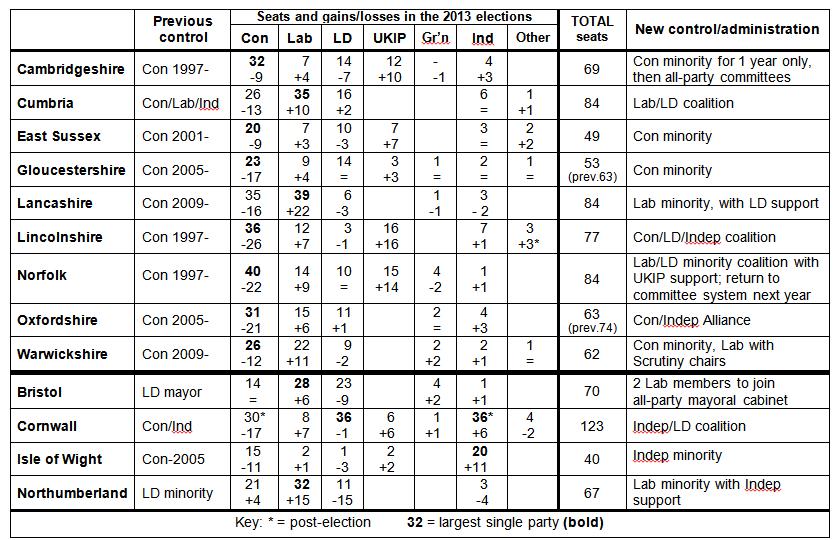
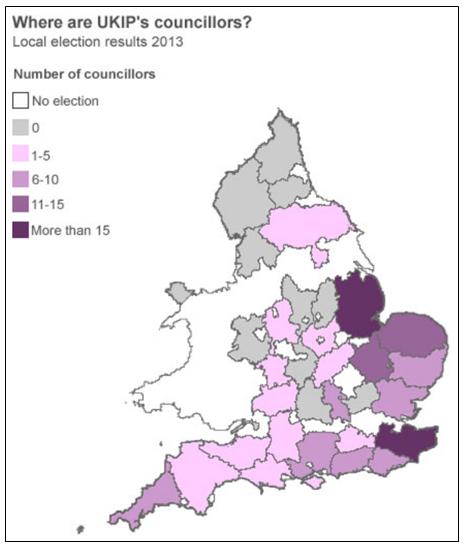
It is now clear that UKIP exceeded most expectations in the local elections on May the 2nd, garnering around 26 per cent of the vote. Yet as the dust settles, we must now ask what these results mean? Of course, at this stage it is hard to be sure and a certain amount speculation is involved but one thing is clear, the mainstream has a fight on its hands.

To label UKIP’s support as mere articulation of protest is naive, simplistic and lazy. More to the point, the ‘protest label’ implies that any vote for parties outside the mainstream – whatever their hue – is pathologically wrong and requires correction: this is not healthy analysis. While a number of voters may well be sending a message to their usual party of choice or just the ‘big three’ in general, a proportion of the population does appear to support UKIP and what it stands for. The sentiments which underpin much of the party’s support are also hard for the mainstream to swallow, particularly on the left and though all three are beginning to see the bigger picture and respond, they can’t escape from the fact that they are all linked with the problems the country faces right now: Labour is seen as responsible while the Conservatives and Liberal Democrats are denigrated for not reversing the situation. UKIP on the other hand claims to offer the electorate solutions and has no track record of failure, a very attractive quality which – given the right circumstances – can facilitate substantial success.

Yet, perhaps the most interesting questions concerning UKIP ask, what is it exactly? Is it a pressure group or is it a party? Hitherto labelled as a single issue organisation it has never shied away from its long-term key objective which is a retreat from the European Union. Recently though, it has expanded its arguments, rhetoric and goals. Initially marketing itself as a force for change, it now seems to hold a somewhat longer term view of its future.

Before the count was in, Farage’s discussion with Evan Davis on Radio 4’s Today Programme was particularly revealing when he when equated UKIP’s potential for bringing about change with that generated by the SDP’s success in the early 1980s. He argued that UKIP now has the capacity to be part of the political solution and this suggests that the party is developing in a new direction: indeed, the BBC’s Nick Robinson now argues that UKIP has made the transition from pressure group to political party. Only time will tell if this is the case but one thing is for sure, speculation and judgment of UKIP will only intensify.

Next year’s elections to the European Parliament and the 2015 General Election will certainly go some way in establishing the nature of UKIP and the type of organisation it really is; but in the meantime, its message is resonating with a sizeable proportion of the electorate and the mainstream is not sure what to do.

bottom-karin

Karin Bottom is Lecturer in British Politics and Research Methods at INLOGOV, University of Birmingham. Her core research areas comprise parties (particularly small and the BNP), party systems and party theory. She is particularly interested in concepts of relevance and how national level theories can be utilised at the sub-national level.