The 2014 local elections – a preview

Chris Game

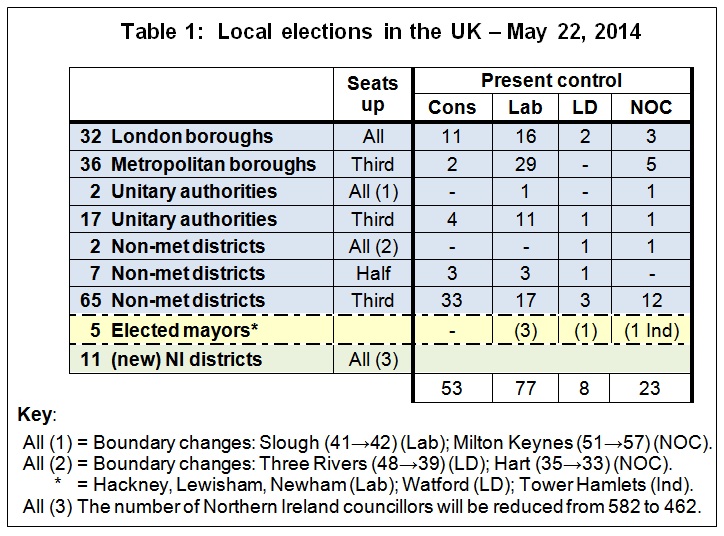
Two EU countries this May will hold local elections that coincide with their European parliamentary elections: Greece and ourselves. On Sunday 25 May Greeks vote in the second, ‘run-off’ round of elections to all their 13 regions and 325 municipalities. England, though nearly five times as populous as Greece, also has 325 lower-tier and unitary authorities. We, however, will elect mostly only fractions of fewer than half of our councils, yet still it takes seven lines of a table to summarise the 161 authorities whose voters on Thursday 22 May will probably have both a local and Euro vote. We bemoan our disappointing local turnouts, but we don’t make the system exactly voter-friendly.
game

Inevitably, the Euro elections will dominate the campaign, and the all-out London borough elections will dominate the local results. In this preview too – though less so in the longer INLOGOV Briefing Paper – all-out elections are accorded priority.

May 2010, when most of this year’s retiring councillors were elected, was Labour’s second worst parliamentary election performance in 80 years. Given a different context, though, its local and particularly its London election performance would have been justifiably celebrated – three boroughs won directly from the Conservatives (Ealing, Enfield and Harrow), seven more from No Overall Control (NOC), and more London seats than the Tories for the first time since 1998.

There’s no mystery about the national-local discrepancy – just two big reasons: the four-year electoral cycle and the General Election-boosted turnout.  The seats up in 2010 were those contested in 2006, when Labour’s estimated 26% of the national vote barely topped the Lib Dems’ 25% and was way adrift of the Conservatives’ 39%. By 2010 that 13% national vote gap had halved, bringing big Labour gains in both votes and councils – thanks partly also to hugely increased turnouts of over 60%, benefiting the large parties, especially Labour, at the expense of minor ones.

Of nearly 1,600 minor party and independent candidates in London, just 23 were elected: 2 Greens, down from 12 in 2006 (Camden, Lewisham); 1 Respect, down from 15 (Tower Hamlets – now 2); no BNP, and no UKIP – though the party has since reached double figures, mainly through Tory defections. This year turnouts will be down again, and minor party representation – including, but not only, that of UKIP – equally certainly up.

London is not a UKIP priority, and its best prospects may be in those boroughs where it already has defectors – Hounslow, Merton and Havering (from the Conservatives), Barking & Dagenham (from Labour). But UKIP influence – countrywide but particularly in London, where electors have potentially three local votes – will also be more subtly felt through vote-splitting, helping Labour to gain control, or possibly the Lib Dems to retain it, where they might not otherwise have done so.

With its long-term opinion poll lead, though, it is again Labour that will be expecting to win councils as well as seats. Back in early January, Sadiq Khan, Shadow Minister for London, announced the party’s ‘suburban mindset’ strategy, and its five Outer London ‘battleground boroughs’ – Conservative-controlled Barnet and Croydon, and the currently hung Harrow, Merton and Redbridge.

The latter are the proverbial low-hanging fruit. In HARROW Labour actually won a majority in 2010, but then, as described in a blog at the time, lost it through splits and defections, handing control to the current Conservative minority administration.  In MERTON it took minority control, strengthened it through Conservative defections to UKIP, and achieved a good result in last summer’s Colliers Green by-election.  In REDBRIDGE the Conservatives and Lib Dems signed a partnership agreement just as their leaders were doing the same at Westminster. In all three boroughs Labour will be aiming for majority control, in Redbridge for the first time ever.

In CROYDON the Conservatives narrowly retained a 4-seat majority through an electoral system rewarding nearly 19% of Lib Dem voters with no councillors at all. Here too a modest swing would give Labour an equally workable majority, and more than justify the party’s decision to employ a full-time agent.

BARNET, though, seems an altogether tougher proposition. Numerous issues have incensed residents – from the ‘One Barnet’ mass privatisation of council services, through the closures of libraries and children’s centres and the scrapping of sheltered housing wardens, to the ever-contentious increased parking charges.  But Labour has never won more seats than the Tories, and to do so would require a nearly 10% swing plus the Lib Dems clinging on to their three very marginal Childs Hill seats.

Labour’s last listed London target is the TOWER HAMLETS mayoralty, held by the controversial Independent and Labour expellee, Luftur Rahman.  Opponents have accused him of everything, from dubiously selling off and granting planning permission for the hotel conversion of the listed Poplar Town Hall to trying to buy his own re-election, but little of the mud really seems to stick and it may, if anything, boost his support. Panorama recently had a go, following which Eric Pickles sent in his inspectors – though not to report back until well after the May elections.

The other four mayoral contests all involve incumbents who were elected in 2002 and are now seeking their fourth consecutive terms: Jules Pipe (Hackney), Steve Bullock (Lewisham) and Robin Wales (Newham), all Labour, plus the Lib Dem Dorothy Thornhill in WATFORD. All four have their policy initiatives and successes, but only Thornhill can claim in addition to have totally recast the politics of her town and council.  Watford in 2002 was an apparently permanently Labour-run town. Yet its voters chose as their mayor a Lib Dem councillor and assistant head teacher, whose party coattails have since transformed the council chamber to the extent that two-thirds of members today are Lib Dems.

Returning to London, with the Lib Dems’ local election performance having collapsed almost as grimly as its national poll ratings, the party’s two majority-controlled London boroughs are bound to be under scrutiny. SUTTON they’ve held since 1990 and, although they lost one councillor to Labour, arithmetically at least they look safe for another term. In KINGSTON UPON THAMES, though, with one councillor resigning to sit as an Independent, plus a lost by-election following their disgraced leader’s imprisonment, their 2010 six-seat majority now hangs on a single seat – and on the hope that UKIP may take votes from the Conservatives in the right places.

The other all-out elections are those caused by boundary reviews, two resulting in slightly enlarged unitary councils and two in smaller district councils. MILTON KEYNES has been run in the recent past by all three major parties, and since 2011 by a minority Conservative administration.  Labour will be aiming to become at least the largest party on the new, enlarged council.  SLOUGH, it is totally safe to say, will continue to be Labour. In THREE RIVERS the Lib Dems will seek to maintain the majority control they’ve held since 1999; and in HART Labour will be wistfully recalling when it last won even a ward – in 1976.

Of the 36 metropolitan boroughs, Labour already controls 29 and so has little need of a target list here. Of the two Conservative councils, TRAFFORD looked the more vulnerable even before the recent shock resignation of Matt Colledge as both council leader and councillor. Having reduced the Tories’ majority to 3 in a recent by-election, Labour will hope to win its own for the first time since 2003. The SOLIHULL Conservatives look securer, partly because their principal challengers, the Lib Dems (now 9), have been defecting to the Greens (now 7), who will be seeking to supplant them as the official opposition.

The West Yorkshire trio of Bradford, Calderdale and Kirklees have all been hung since at least 2000, but this could be about to change.  In BRADFORD Labour’s 2012 hopes of turning its minority control into a majority were thwarted by the coattails effect of George Galloway’s parliamentary by-election victory for Respect. The coattail councillors all resigned last October to become Independents, and Labour should make it this time.

KIRKLEES and CALDERDALE travel in parallel. Five years ago, both boroughs were run by Conservative minorities, which were replaced by Labour-Lib Dem coalitions, which were succeeded in turn by Labour minority administrations. In both boroughs all three main parties have groups numbering at least double figures – a measure of the difficulty any one party has in trying to win an overall majority. Arithmetically Kirklees looks the more attainable for Labour, but the party would probably have to take seats from the Conservatives, Lib Dems and Greens. In Calderdale, in the wards being defended that require swings of less than 10% to change hands, Labour is unlikely to be the chief beneficiary, having finished in second place in 2010 in just three to the Conservatives’ ten.

In STOCKPORT, the Lib Dems now have only minority control of their metropolitan flagship, and are defending 12 of their 29 seats. Labour is the leading opposition, but, having finished second in only two of them in 2010, its gains may be limited. Already the largest party in WALSALL, its chances should be better. If it won the same wards as in 2012, but without this time losing a couple of others to Independents, the party could gain majority control for the first time this century.

game

Chris Game is a Visiting Lecturer at INLOGOV interested in the politics of local government; local elections, electoral reform and other electoral behaviour; party politics; political leadership and management; member-officer relations; central-local relations; use of consumer and opinion research in local government; the modernisation agenda and the implementation of executive local government.

The Great NHS Robbery – and the great fraud headline con

Chris Game

Some social phenomena are exceptionally tricky to measure: the black economy, white-collar crime, illegal immigration.  So when someone claims to have done so, no matter how flaky their findings, they attract huge, and largely uncritical, media attention. Like last week’s excitement about the scale of NHS fraud.

The catalyst was a Panorama programmeThe Great NHS Robbery – that needed some pre-transmission headlines. The programme consisted mainly of specific cases of GPs, dentists, pharmacists, private contractors and suppliers who’d been found guilty of defrauding the NHS. It alleged that the Government’s official NHS fraud figure of £229 million p.a. is a huge under-count or under-estimate, and suggested that, having cut the staffing and budgets of NHS Protect and other fraud investigators, the Government was turning a proverbial blind eye to the scale of the problem, especially by comparison with the increased resources it allocated to the detection of the much smaller quantum of benefit fraud.

Old cases and political sniping, however, don’t make major headlines. What Panorama needed were some seriously big and scary figures, and fortunately there were some to hand – just down the M3 at the University of Portsmouth’s Centre for Counter Fraud Studies (CCFS). By happy coincidence, the CCFS was about to co-publish, on the very same day as the first showing of The Great NHS Robbery, a report analysing, as the programme put it, “the most rigorous data on health care fraud in the world”, and containing some “staggering” findings for the NHS.

The BBC had its headlines“NHS fraud and error costing the UK £7 billion a year” – and Panorama had its audience. Other contemporaneous media headlines were all apparently taken either from the BBC’s plug story or the programme itself. Some were fractionally more cautious, like The Guardian’s “NHS fraud could be as high as £5 billion a year, says former health service official”; others less, like the Nursing Times“Fraud costs NHS £7 billion – enough to pay for 250,000 nurses”.

None of the authors, it seemed, went to the CCFS report to check how the loss figures were arrived at and what they represented – possibly imagining that a global report on such a complex and technical topic, representing the product of several years’ research, would be vast, probably undownloadable, and incomprehensible to the average reader.

Interestingly, though, it’s none of these things. The Financial Cost of Healthcare Fraud 2014: What data from around the world shows runs to just 16 pages, including the two covers. The rest comprises: Contents, Foreword, three prefaces, three pages about the authors and publishers, a full-page picture, a blank page … and a 4½-page ‘report’. There are no “data from around the world”, so, even with the glossy pictures, you could, if you wished, download it in about a second.

However, to save you having to plough through all 4½ pages yourselves, let me take you through the methodology step by step.

1.  Do a literature review of the 92 studies of healthcare fraud and error losses that you’re  able to find that have been undertaken since 1997 – not ‘globally’, but in languages you can understand: the UK, US, France, Belgium, the Netherlands and New Zealand;

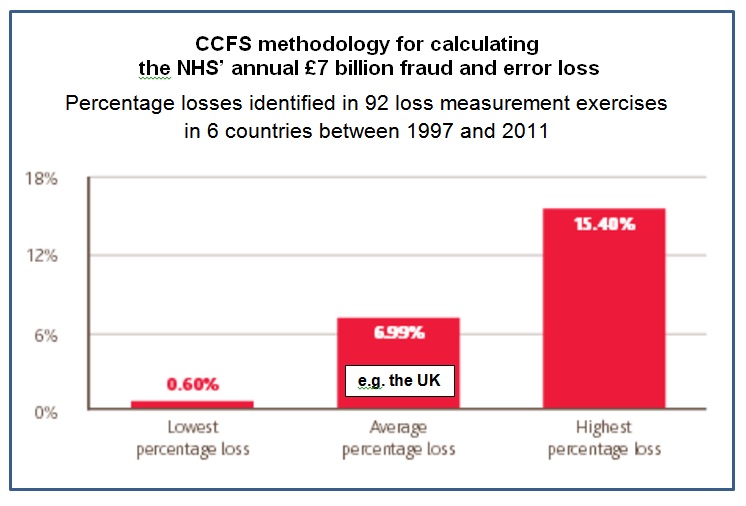
2.  Don’t worry about the studies being in numerous completely different areas of health care, but average out the quoted financial loss figures in all 92 studies and cite that average with real authoritative precision – i.e. not 7%, but 6.99% – because, remember, these have to look like “the most rigorous data on health care fraud in the world”;

3.  Globalise your ‘research’ by finding a figure for global healthcare expenditure for some recent year (no, not ‘global’ as in your six countries, but really global) – say, $6.97 trillion for 2011 (or £4.48 trillion) – and again don’t worry about whether they’re US or International $$ or what the figure actually represents, for this is one of those footnote- and reference-free reports;

4.  Divide (3) by (2), and again state the sum with great precision: that this shows that £313 billion is being lost by the world’s healthcare services each year – or 25% more than when you last did the sum in 2008;

5.  Guess – because you’ve apparently no evidence one way or the other – that the financial integrity of the NHS is probably about average for the six countries you’ve studied, and assert that it is therefore losing 7% of expenditure each year – or £7 billion out of its roughly £100 billion total – in ‘fraud and error’, making sure, of course, that you emphasise the fraud bit.

6.  Add a little diagram, as shown below with the addition of my clarification of where the UK figure comes from.

game graph

I must confess at this point to having misled you a little. I mentioned that the report contains no “data from around the world”, and indeed there are no figures for the UK or any other individual country.  The £7 billion came in the Panorama programme, from one of the report’s two principal authors, Jim Gee. Gee is the former health service official referred to The Guardian’s headline: former CEO of the NHS Counter Fraud Service and now Director of Counter Fraud Services at BDO LLP – not, sadly, the British Darts Organisation, but Binder, Dijker, Otte and Co., an accountancy firm specialising in anti-fraud services – and Chair of the CCFS at the University of Portsmouth. Gee left it to the programme’s presenter to add that “he puts more than £5 billion of that £7 billion down to fraud, rather than financial error” – which explains the other part of The Guardian’s headline.

Though certainly not on the same scale as its undercover filming of LSE students in North Korea, Panorama’s decision to rest the central argument of this programme on such flaky statistics, produced at least in part to further the interests of a self-promoting business services company, seems to me another clear editorial misjudgement. Certainly it irritated me when I pieced together the above account and realised that in effect I’d been conned.

Much more importantly, though, it must in anything other than the short term undermine, rather than substantiate, the key points the programme was seeking to make: that the way the Department of Health currently measures and estimates NHS fraud is grossly inadequate and damagingly misleading; that governments, and this Government in particular, see it in their interests to under-record the scale of fraud (and financial error, for that matter); and that more, rather than less, funding should be being invested in fraud detection and inspection services.

The sad truth is that Panorama seized on CCFS/BDO’s £5 to £7 billion because there was nothing better or more accurate available. Jim Gee’s ‘methodology’ suggests to me that he’s probably underestimating global healthcare financial losses and overestimating those of the NHS, but neither I nor the Government have any way of officially demonstrating it. Nor is there any likelihood of the Government, since it is substantially in denial, embarking on a programme to reduce the losses by up to the 40% within 12 months that Gee, wearing his BDO hat, considers feasible. I doubt if many others agree, but, to adapt the proverb: in the land of the dataless, the one-figure man is king.

game

Chris Game is a Visiting Lecturer at INLOGOV interested in the politics of local government; local elections, electoral reform and other electoral behaviour; party politics; political leadership and management; member-officer relations; central-local relations; use of consumer and opinion research in local government; the modernisation agenda and the implementation of executive local government.

Why do some PPPs fail to meet objectives? Evidence from Ireland

Eoin Reeves

Governments around the world are seeking new ways of meeting the challenges of renewing and providing new infrastructure.  Factors such as disenchantment with traditional procurement methods and increasing pressures on public finances (intensified by the global economics crisis) have encouraged governments to look to public-private partnerships (PPP) for the purpose of meeting these challenges.  The use of PPP is however a recent phenomenon and the evidence on whether it achieves goals such as better value for money and speedy delivery of infrastructure is patchy.

My recent article in Local Government Studies, The Not So Good, the Bad and the Ugly:  Over Twelve Years of PPP in Irelandseeks to add to the emerging evidence on the experience with PPP by focusing on the case of Ireland.  The Irish government initially adopted PPP in an effort to meet the demands placed by rapid economic growth in the late 1990s.  Since then it has, in relative terms, become one of the world leaders in PPP procurement.  The Irish case therefore provides a valuable country-based case study of PPP procurement.

The article adopts a framework that embraces perspectives from the literature on economics and governance.  From an economic perspective the case for adopting PPP rests on the proposition that it yields positive net social returns (in other words, the benefit-cost ratio is positive).  However, governments tend to articulate the objective of PPP in terms of faster delivery of projects and value for money compared to traditional procurement.  While satisfying these criteria is indicative of a degree of success it does not necessarily ensure a positive benefit-cost ratio.  This is attributable to the fact that these criteria are too narrow and fail to include transaction costs.

PPPs also have important governance dimensions.  A key governance issue concerns contract design and framing incentives to encourage the performance of the PPP contractor.  In a PPP context the question of incentives largely centres on the allocation of risks.  Other governance issues concern the development of mechanisms that protect accountability.  Stakeholder consultation and transparency are important in this respect and the advantages of making PPP arrangements more accessible and assessable are widely recognized.

The article adopts a case-study approach and analyses three separate PPPs at the level of local government.  Two cases are drawn from the water services sector and the third case covers the PPP adopted for the regeneration of a housing estate in Dublin’s inner city.

In the three PPP cases examined, parties to the contracts grappled with the complexity/uncertainty associated with the implementation of PPP.  In each case there was little experience on the public sector side with procurement under PPP.   Both water service cases illuminated shortcomings in the early stages of procurement especially the conduct of value for money assessments (VFM).  However, in the case where the level of stakeholder consultation extended to in-depth analysis of the initial VFM assessment there were clear benefits derived from the sharing of information between stakeholders and the adoption of a co-operative approach to preparing for PPP.

The social housing case represents one of the biggest PPP contract failures in Ireland to date.  In this case, procurement was terminated following the collapse of the Irish housing market in mid-2008.  The termination of this PPP can be mainly understood in terms of the failure to adequately transfer risk to the private sector.  The (possibly) loss-leading contractor withdrew from the contract due to inability to absorb the financial risks associated with the collapse of the Irish housing market.  The contractor also pleaded an inability to assume planning risks which materialized in some contracts.  The private contractor’s behaviour in this case exemplifies how failure to adequately transfer risk can have drastic social consequences.

These cases show how policy makers and public sector managers face difficult challenges if the PPP model is to be adopted successfully.  These include framing PPP policy, organizing competitive markets for contracts, designing contracts, enforcing risk transfer and ensuring that the thread of accountability between service providers and citizens is strong.  This may be a tall order but unless these challenges are met PPP will not improve economic efficiency or social welfare.

Eoin Reeves Profile Photo (2)

Dr. Eoin Reeves is a Senior Lecturer in the Department of Economics and Director of the Privatisation and PPP Research Group at the University of Limerick.  Eoin researches market-based reforms of the public sector and the regulation of infrastructure including privatisation, liberalisation, and different forms of private sector participation in the delivery of public services.

Councillors and their disappearing pensions

Chris Game

There’s no doubt about the domestic conversation topic of the past week: pension pots. Which for many councillors, following a budget with little good news for local government – unless you’re a pothole hoping for a makeover under the Chancellor’s ‘potholes challenge fund’ – must have felt like being kicked when already down. No tricky Lamborghini or Bugatti choice for them. Their ministerial April Fools’ Day gift is having their Local Government Pension Scheme policies terminated at the end of their current term of office, and barred to their successors.

To put it in context, only a minority will be affected, they’ve had fair warning, and it’s unlikely their constituents, should they hear of it, will be overly distressed. There is another perspective, though: the democratic one – which, by chance, is being debated in Strasbourg this week by the Congress of Regional and Local Authorities of the Council of Europe (CoE).

The Congress of the Council of Europe (not to be confused with the wholly different Council of the EU) is the representative voice of Europe’s 200,000 regions and municipalities in the 47 CoE member states. Its function is to promote local democracy, which it does in myriad ways, including writing expert monitoring and advisory reports – like that being presented in Strasbourg, on the state of local democracy in the UK.

Disappointing and worsening would fairly summarise the report’s verdict, which is particularly critical of our councils’ highly centralised grant funding, their very limited local tax base and financial discretion, and the severity of the budget cuts imposed on them through the Government’s debt reduction programme. The effect can be to leave elected councillors, “the backbone of the local government system”, unable to exercise properly their political choice of weighing the benefit of services provided against the cost to the local taxpayer or user.

Ministers, by contrast, would seemingly prefer a completely invertebrate system. As the CoE report politely put it, they prefer and promote a “part-time logic of engagement” for councillors, who should see themselves not as paid elected representatives, but as altruistic volunteers – like scout troop leaders, the comparison chosen by Conservative Chairman, Grant Shapps, in a BBC Today interview last year.

European observers’ basic difficulty with this ‘logic’ is a linguistic one. They’re used to the ‘local’ in local government meaning, well, local – as in local pub, or shops, or school, or bus stop; stuff in one’s locality or neighbourhood.

They accept the French are a bit extreme with their 36,000 communes, whose mayors and roughly half-million councillors they are currently electing, and all of which constitutionally have more powers and service responsibilities than our district councils.

But, even excluding France, their Europe is one in which the bigger countries’ most local tier of government comprises several thousand local councils, with an average population of 8,000. England has just 325 equivalent councils with an average population of 160,000, and consisting – in cases like Cornwall (population bigger than Luxembourg), and Northumberland (area the size of Trinidad and Tobago) – of what even we until recently called ‘county’, rather than ‘local’, government.

And that’s our councillor problem. Successive national governments have taken a Tescoesque approach to local authorities and their elected members.  Instead of “Pile’ em high, flog ‘em cheap”, it’s been “Make ‘em huge, and pay ‘em peanuts”.

It’s a logic that bewilders advocates of local democracy like the CoE, who would prefer local government on a recognisably local scale, but also accept that there is a choice. If you want councillors to be genuinely part-time volunteers, then the size of councils, of councillor workloads and their ward electorates has to be kept manageable by sufficient numbers of such volunteers.

But if, in the interests of what you consider to be efficiency, you want enormous councils, huge budgets, large wards and the smallest number of councillors you can get away with, then you should acknowledge the time commitment that’s inevitably involved and allow them to be paid accordingly.

Trying to have it both ways – humungous local authorities run by overstretched, parsimoniously paid part-timers – is a recipe for poor quality government and a betrayal of local democracy. For many councillors, the apparent choice is: get out and leave it to those who don’t need the money, or grab what financial compensation you legitimately can through other means, like pensions.

Ministers should recognise the phenomenon, because it’s essentially the same as they and their parliamentary colleagues do: making up what they consider their inadequate salaries by ‘stretching’ their expenses. The difference, of course, is that MPs do get salaries, of £66,400, while the average councillor’s basic annual allowance – before PAYE and National Insurance deductions – is around £7,000 and already incorporates a Public Service Discount of between 25 and 50%, in explicit recognition of the principle of council work as voluntary service.

Despite Labour’s pledge to vote against abolition in Parliament, the Blair Government’s intention, when it first proposed extending council employees’ Local Government Pension Scheme (LGPS) to councillors, was to restrict eligibility to those receiving Special Responsibility Allowances.

Not surprisingly, the Local Government Association (LGA) wanted the LGPS open to all councillors, arguing that any differentiation on the basis of work patterns would be both discriminatory and unhelpful to the cause of attracting and retaining councillors. But it was the Occupational Pensions Regulatory Authority who ruled that, for pension law purposes, all councillors should indeed be treated as employees, and therefore entitled to join the LGPS – which is what happened.

Ministers invariably label them ‘gold-plated’ or ‘taxpayer-funded’ pensions – as if councillors themselves made no contribution. They do, of course, but the package is undeniably attractive. It’s a tax-approved, career-average scheme with retirement and death benefits based on years in the scheme and average pay over those years in basic allowances and SRAs. Councillors contribute a flat-rate 6% of their current allowances, with the council paying the employer’s contribution, at a fluctuating rate averaging, according to the Government, around 22%.

The TaxPayers’ Alliance (TPA) found that in 2010/11 over 4,500 or one in five UK councillors were enrolled on the LGPS – at an estimated annual cost, now quoted authoritatively by Ministers, of £7 million.

Numbers, though, aren’t really the issue.  Nor, apparently, is making any coherent case for change – the best the Government has bothered with being that allowances look a bit like a salary (a mini-salary, presumably), which could blur the distinction with paid employees, compromise councillors’ independence to represent their communities, and so have a negative effect on local democracy.

Really?  A more negative effect than gratuitously insulting and financially punishing your local democratic representatives?  Intriguing argument.

Rebalancing Britain

Martin Stott

The Scottish referendum campaign is having an interesting knock-on impact on English political debate. The position and dominance of London – the place Scots most dislike about the United Kingdom in its present form – is being looked at more critically. There have been a couple of think tank reports recently, but the debate has moved quite a way beyond the narrow audiences that these reports usually attract. That in itself is a reflection of the way the ground is shifting.

First out of the blocks was the Centre for Cities’ ‘Cities Outlook 2014’ report. The document is mainly pretty dry, though jazzes up with unusual graphics and some different takes on the issues. Basically it is saying that London has become super dominant in the UK economy, so much so that four out of five private sector jobs are created in London and that every major city outside the South East is losing young people to London with one in three 22-30 year olds ending up there. Put another way, London accounted for ten times as many private sector jobs as any other city and also saw a growth in public sector jobs as well. By contrast Bradford, Sheffield, Bristol, Southampton, Blackpool and Glasgow all saw employment shrink in both the public and private sectors.

All this is very much backed up by word done for the Core Cities group (Birmingham, Bristol, Manchester, Leeds, Nottingham, Liverpool, Newcastle and Sheffield) who have initiated an Independent City Growth Commission chaired by Jim O’Neill, the Manchester born ex- Goldman Sachs Chief Executive. Their focus is on how to make Britain less focused on London in order to promote higher levels of national growth and create a less divided nation. Their plan is to issue a final report in the autumn in an attempt to set the agenda for the period leading up to the 2015 General Election. Essentially, the Core Cities interim report ‘metro growth: the UK’s economic opportunity’ argues that cities outside the South east need to be built into larger economic zones with better connections between them to create bigger markets and the kind of economies of scale for business that are to be found in London and the South East.

Meanwhile, the BBC’s Evan Davis has been busying himself on a very similar topic. His mini-series ‘Mind the gap: London vs the rest’ on BBC 2 looked at how London manages to earn more than one fifth of Britain’s income and continues to pull away in terms of growth and development while other regions still feel the sting of recession. Davis had some jolly japes in tall cranes and large diggers across London in search of the answers to his questions, but he knew that one very important answer was staring him in the face: public investment in intrastructure. Transport infrastructure investment is currently running at £5000 per person pa in London (think Cross Rail) and just £700 per person pa in the English regions.

Slightly perversely Davis took his viewers to visit the centre of his proposed new city-region-to-challenge-London: Hebden Bridge. But of course he had a point and it was that Hebden Bridge is in the centre of a huge potential city region stretching across England from Liverpool to Hull via Manchester and Leeds. Hebden Bridge is in the middle of this city region in the Pennines, rather winningly described by one of its residents as the city centre with an ‘inverted green belt’ – and places like Manchester and Leeds as its ‘suburbs’. This is far from outlandish. This part of the north of England really did challenge London for economic supremacy in the 19th century with its coal, steel and cotton as well as ports to export to the Empire.

But can it be revived as an economic counter-balance to London? That seems to depend on political will and a desire to invest in the area, especially its transport infrastructure. The Centre for Cities report makes a telling comparison. While acknowledging that the combined economies of Leeds and Manchester are just one fifth the size of London, it argues that they are unlikely to make the best of this combined scale because of ‘weak transport links’ citing ‘the distance between Leeds and Manchester is around 30% shorter than between Cambridge and London, yet the quickest train takes four minutes longer’. Jim O’Neill makes a similar point in an Observer interview about HS2, which he thinks will exacerbate the problem and simply make Birmingham a suburb of London, arguing that the money should be spent instead on creating a web of good links in the north: ‘In my judgement, for the national economy, that is way more important than improving the speed of the link from London to any of these places’.

Improving transport links in a new ‘super city’ is one dimension, but a couple of other factors are worthy of mention as well. London is the financial, political and cultural capital of the UK. This doesn’t give a lot of space for other cities to shine, unlike in say Germany with Frankfurt as its financial capital, Berlin as its political capital and Hamburg as its cultural capital. The same is true in Italy (Rome/Milan) and the USA, amongst others. Moving Whitehall and Westminster out of London would do them a power of good. If Scotland stays in the UK, the British Parliament could meet in London occasionally, but the four ‘nations’ would have Parliaments of their own in other cities.

More prosaically, the Centre for Cities report suggests that all the core cities should have access to the same policy powers as London has, i.e. strategic planning powers, powers over the budget for its transport system and police force, and a super-city wide elected assembly and directly elected mayor. A revival of regional identity and local government could yet come out of these debates, and not before time.

stott

Martin Stott joined INLOGOV as an Associate in 2012 after a 25 year career in local government.

The impact agenda and political agency

Matthew Wood

Why should we, as political scientists, ‘bother’ with impact? My answer is that as social actors we cannot avoid ‘impacting’ on society in one way or another, just like any other profession. The question is how we should choose to influence society. As British political scientists our choices are, thankfully, quite broad. Our discipline in this country is eclectic, our research agendas are diverse. Critically, our jobs also allow us significant autonomy to shape our individual identities, practices and relations with the outside world. The crucial thing is how we choose to shape that autonomy. Put in satisfyingly theoretical terms, it’s about how we exercise our political agency. This is why impact appeals to me and why I think it should appeal to others. In this blog I’m going to suggest how we, as researchers, might think about shaping our agency despite some of the problems with the current impact agenda.

The Trouble with Impact

The trouble, as Helen Turton demonstrates, is that there are significant pressures out there that seek to shape our agency as researchers in particular ways, narrow our research agendas and stop us speaking truth to power. Paradoxically, this includes the ‘impact agenda’ itself: everything from the REF’s ‘impact case studies’ to the Lib-Con Coalition’s fetish for behavioural psychology and the suspiciously parochial ‘nudge’. When academics look at this ‘agenda’, they understandably balk about being pushed into a positivistic straight jacket. Though I have yet to come across anyone at conferences who disagrees with the idea of ‘impact’, broadly constituted, many harbour an understandable distaste towards how it is currently being implemented.

So we are faced with a struggle over how to define what we mean by impact – broad or narrow. If we interpret it narrowly, then we risk curtailing our political agency. If we interpret it broadly, then we open up a lot more opportunities. I think we should interpret impact broadly, but the question is how do we do this while still acknowledging there are problems with the existing agenda? There are, I think, two ways we can think about impact, and they involve being reflexive about a few scholarly myths about epistemology and thinking about our communication with the outside world.

Epistemology

Firstly, we should question the myth that ‘positivist’ research, the development of universal laws of politics that can be implemented by policymakers, is somehow the holy grail of ‘impactful’ research. While it is certainly true that policymakers like graphs, stats, and anything that makes a claim to being authoritative, they also prefer research that is easily accessible and straightforwardly communicated, rather than a set of complex regression tables and formulae. The de-funding of political science programmes in the US is evidence enough that a hermetically sealed discipline concerned with establishing causal laws of political life will not wash with a practically focused policy world.

Similarly, we should challenge the myth that post-modern or constructivist research, or theoretically-driven work, is ‘non-impactful’. This clearly isn’t the case. Just take interpretive theory, deliberative theory, postcolonialism, eurocentrism, feminism, etc. These deal with weighty real-world issues of crucial societal importance, and to deny this is to cede ground to those who would cut funding for this kind of work.

The point is we should recognise the value of the full spectrum of political research, and never seek to close down our ontological, epistemological or methodological positions because we think the public will think the findings are less ‘relevant’. The topics we research almost always have connection to relevant societal issues. Often, it’s how we talk about our research to others that matters, and this leads me to the issue of communication.

Lost in Translation?

It’s somewhat of a hackneyed cliché that academics are poor communicators, stuck in an ivory tower talking pretentious gobbledygook. We can easily take umbrage at this, but can also see it as an opportunity for reflecting and improving the language we use. My own doctoral research was on ‘depoliticisation’, a concept with a fairly scholastic lineage, and I find it useful when thinking about communicating my work to do two things.

Firstly, I remind myself that academia has specialist language for a reason. We should cherish our ability to be creative in addressing our research topics, and remember that research starting out in relative theoretical obscurity can become publicly salient. Concepts are also identified with academic career trajectories (if you ‘invent’ a concept then you get a lot of credit for it), and we should never draw an arbitrary barrier at a point where we have ‘enough concepts’ and shut a generation of researchers out from having the potential to be identified with new ideas.

However, as Matt Flinders suggests, the ‘art of translation’ is a good way of thinking about how we can get across the interesting and creative concepts and ideas we come up with to different audiences that speak different languages. So, secondly, I think about how to explain my research in a way that, say, a bus driver or a doctor would understand. This is not me trying to ‘dumb down’ but to reflexively think about how my research would be understood or interpreted by a range of different people. This, I find, is useful not only for getting my research across to the ‘outside world’ on an everyday level, or in blog posts, but also feeding back into my academic work as a fresh perspective. Crucially, if our research is better understood by different audiences, then we have a better chance of getting the insights of our research noticed.

It’s perhaps important to remember that not all the barriers to impact are of our own making. Funding streams, government agendas, etc. are all oriented towards a particular ‘impact’ agenda that is, as Helen and Katie make clear, problematic. The important thing though is that impact is on the agenda, and therefore the potential is there for us as researchers to broaden our capacities for ‘agency’, which we should celebrate and engage with. After all, I began researching Politics because I thought I could change the world for the better by helping our understanding of it. That may be stupidly naïve, but it’s what I keep coming back to.

mattwood2

Matt is a Postdoctoral Research Fellow at the University of Sheffield Department of Politics, and Deputy Director of the Sir Bernard Crick Centre for the Public Understanding of Politics. He is currently researching ‘everyday politics’ and solutions to political disengagement in advanced liberal democracies.