Devo max – what it is and why it won’t happen

Chris Game

Devo Max – it sounds like a 99% efficient toilet cleaner, or a dodgy West Country car dealer, but either way I visualise its initials in upper case. And that’s its problem. It’s undoubtedly the ‘must use’ expression of the month. It’s not complicated, like ‘full fiscal autonomy’ or the Barnett formula, so anyone feels able to drop it authoritatively into even casual conversation. And everyone has their own idea of what it is.

For party leaders, desperate to save the Union in the final hours of the Scottish referendum campaign, it was perfect Looking-Glass, Humpty Dumpty-speak: it means just what we choose it to mean.  Sign up now, check it out on Friday the 19th.

For YesScotland campaigners it was a verbal Blob, impossible to pin down and attack – and especially frustrating, as they were the ones who had no need to check it out. They knew its precise meaning because they’d invented it, and knew that it wasn’t at all what most wavering voters imagined they were being offered.

It actually originated in a 2009 Scottish Government options paper, Fiscal Autonomy in Scotland. Five distinctive options were spelt out, ranging from the SNP Government’s preferred full fiscal autonomy (FFA) in an independent Scotland to a minimally changed current fiscal framework, which gave Scotland considerable discretion over spending but little over tax revenue raising, borrowing, or broader monetary policy.

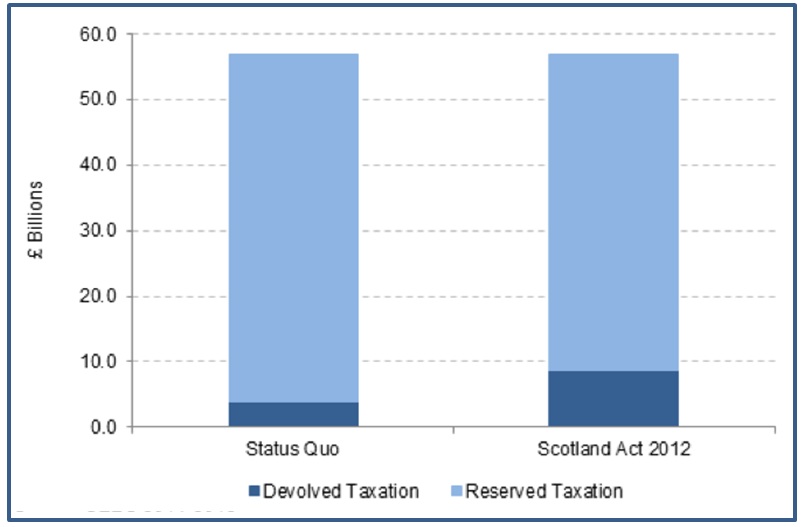
‘Devolution max’ was the SNP’s fall-back option, clearly defined as FFA within the UK. The Scottish Government would be responsible not only for most of the public spending in Scotland, but for raising, collecting and administering virtually all revenues – instead of the estimated 15% it would control even after the 2016 implementation of the 2012 Scotland Act, the famously “biggest transfer of fiscal powers in 300 years.”

game

The precision of its definition, as well as its content, makes Devo max entirely different from the third option of merely ‘enhanced devolution’, which really does sound vague, manipulable Humpty Dumpty-speak, and hardly surprisingly is unacceptable to the SNP.

Devo max, though, is not just definable. It can, its advocates would claim, be viewed and studied in practice, for it broadly resembles the system in the northern Spanish autonomous communities of Navarre and the Basque Country. Part of their autonomy is that the devolved governments are responsible for raising and collecting all direct taxes, including corporation tax, although, to conform with EU legislation and retain a harmonised social security system, indirect and payroll taxes remain centralised. The two regions have used their powers to lower certain taxes below the rates elsewhere in Spain, thereby creating a relatively more competitive tax regime, which is, of course, also an SNP aspiration.

The problem, as critically noted by the 2009 Calman Commission on Scottish Devolution (ch.3), is that Scotland – constitutionally, economically, as well as meteorologically – isn’t Spain.   A tax-based FFA might be operable in Spain, and at least conceivable in an independent Scotland.  However, attempted within the UK, it would clash with the Treasury’s expenditure-based economic model and its pooling and redistribution of taxes to fund common standards of public services and welfare benefits.

Tax experts will argue that the devolution of some additional taxes – personal income tax, land and sales taxes, alcohol and tobacco duties – is perfectly feasible and even desirable. In other cases, though, for combinations of practical, legal and political reasons, it is less feasible, and heading this list in the UK are usually the highly desirable corporation tax and the highly disputed oil and gas revenues.

In the UK, then, full fiscal autonomy short of independence is unattainable, and, even if attainable, would be effectively incompatible with the redistributive policies of our existing welfare state, and also with the controversial population-based Barnett allocation formula that all three major party leaders committed themselves to retain in their extraordinary orchestrated ‘Vow’ on the front page of the Daily Record.

So, whatever additional powers Scotland eventually gets, they won’t amount to Devo max. It might, therefore, be a good idea if we stopped trying to appropriate the label rather meaninglessly for English local government (with perhaps one exception), and looked instead to the persuasive and realistic cases already being made by those with first-hand experience of running local authorities.

By all means, use Scotland as a benchmark – as in the challenge issued by Graham Allen MP, Chair of the Commons Political and Constitutional Reform Committee: “I don’t see any reason why English councils are not capable of taking on the powers that go to Scotland.”  And London as another. The legislation is different, but the key recommendations of last year’s neatly titled report of Tony Travers’ London Finance Commission, Raising the Capital, are both applicable to other major authorities and possibly more straightforwardly implementable – particularly the proposed control over all property taxes: council tax, business rates, stamp duty land tax, capital gains property development tax, and the like.

It’s been good this past week to see the County Councils Network, with its pre-election Plan for Government, 2015-20 and the Key Cities Group of 23 mid-sized cities with its Charter for Devolution, both determined not to have their distinctive voices and proposals drowned out by the noise of the big cities.

There’s no doubt, though, that it’s in and around the big or the eight Core Cities where the main devolutionary action is, and particularly those who’ve been able create Combined Authorities. These are legal structures set by the Secretary of State following a request from two or more English authorities and a governance review. They may take on transport, economic development and potentially other functions, and they have a power of general competence.

They were a third-term New Labour idea, and the enabling legislation – the Local Democracy, Economic Development and Construction Act – was a full five years ago now. Greater Manchester CA, bringing together 10 authorities, was first in the field in 2011 and for some time out on its own, but since April we have had four more – West Yorkshire (5), Sheffield (4), Liverpool (6), and the North-East (7). There are reports too that councils in Derbyshire, Nottinghamshire and Buckinghamshire, as well as the Welsh Local Government Association, are all at least considering combined authorities as an alternative to a possible future of enforced mergers.

If anything, though, Greater Manchester is stretching its early lead, with its reluctant agreement to a directly elected mayor in exchange for the “complete place-based settlement” proposed on its behalf by the independent think tank, Res Publica – “an incremental process leading to the full and final devolution of the entire allocation of public spending”. Even this, for the reasons given above, wouldn’t technically amount to Devo max, but since they already seem to have appropriated it in the cause of alliteration – Devo Max – Devo Manc: Place-based public services, it’s the one exception I’m prepared to concede.

game

Chris Game is a Visiting Lecturer at INLOGOV interested in the politics of local government; local elections, electoral reform and other electoral behaviour; party politics; political leadership and management; member-officer relations; central-local relations; use of consumer and opinion research in local government; the modernisation agenda and the implementation of executive local government.

In case you missed it: the Local Government (Independence) Bill

Chris Game

It was partly the timing. In combination, the suddenly increased likelihood of both Scottish independence and a Coalition break-up were bound to eclipse last Friday’s scheduled Second Reading of the Local Government (Independence) Bill. It was unfortunate, though.  After all, local government independence would be a pretty big deal too, wouldn’t it?

You bet it would – though, if you’re at all serious about the betting bit, I’d suggest you check the bookies’ odds first. On a Scottish Yes vote you could get 2/1, and 66/1 on UKIP winning the General Election. On local government independence the giggling bookie would probably let you name your own odds.

That’s not to say that Friday’s events in Westminster weren’t important. They were, but they need setting in context.

The LG(I) Bill, not surprisingly when you hear its content, wasn’t a Government Bill, but a Private Members’ Bill, which limited its prospects for a start. Moreover, it wasn’t a Ballot Bill, introduced by one of the 20 lucky MPs whose names were drawn in the annual backbenchers’ ballot and whose chosen Bills stand most chance of eventually becoming law, partly through being prioritised on the limited number of Fridays set aside for private members’ legislation.

The LG(I) Bill was a Presentation Bill, microscopically few of which get anywhere near the Statute Book. True, there was a Protection of Birds (Amendment) Bill that apparently passed all its Commons stages in 67 seconds during one Friday sitting. That Friday, though, was in 1976, which explains why the LG(I) Bill’s sponsor, Graham Allen, Labour MP for Nottingham North, wouldn’t have been unduly optimistic, especially after seeing the Order of Business.

On an already curtailed parliamentary day, the LG(I) Bill was listed behind four Ballot Bills, headed by Liberal Democrat MP Andrew George’s Affordable Homes Bill – aka the Bedroom Tax (Embarrassing the Coalition Amendment) Bill – which made the improbability of Allen’s Bill being debated an effective certainty.

The Affordable Homes Bill would substantially undermine one of the Coalition’s most controversial welfare reforms, by allowing poor social housing tenants to retain their ‘spare room subsidy’ until they actually have somewhere smaller to live. The Lib Dems indicated they would join Labour in supporting George’s Bill, whereupon the Conservatives, unusually for a Friday, imposed a three-line whip on their MPs.

It guaranteed an extraordinary attendance, but not the defeat of the Bill, which received an acclaimed Second Reading by 306 votes to 231.  It was a momentous loss for the Government, in substance, scale and in its damage to inter-party relations within the Coalition. Its immediate effect, though, was that debate on the second Ballot Bill was adjourned at 2.30, and Allen’s Bill wasn’t reached.

It was obviously disappointing, but not much more: at worst, maybe, only the end of the beginning.  For in Graham Allen’s epic constitutional reform agenda, the most immediate objective was already achieved. The LG(I) Bill exists. It’s in the parliamentary machine, and Allen can proceed with his next stage of trying to convince all three main parties to pledge in their manifestos to support such a Bill in the next Parliament.

It’s ambitious, but perhaps not quite as quixotic as it sounds. For Allen is also the extremely active Chair of the Commons Political and Constitutional Reform Committee, whose major project throughout the present Parliament has been to explore the case for and against the UK having, like virtually every other country, a formally codified constitution.

With, I suppose, a forgivable and topical gesture, this project has been entitled ‘A New Magna Carta?’ and its first main product – a 400-page report, compiled in collaboration with King’s College, London – was published in July and put out to public consultation – http://www.parliament.uk/new-magna-carta-consultation. 

The committee takes no views on the desirability of codifying the current heap of common law, Acts of Parliament, European treaties and unwritten conventions into a clearer, more balanced and democratic set of constitutional arrangements. That’s for us to say through the consultation process.

Rather, the report presents three blueprints of how codification could be approached: a Constitutional Code, a Constitutional Consolidation Act, and, most interestingly and set out in full in the report, a completely new written constitution by which the UK, with or without Scotland, would be governed.

‘Principles of local government’ get just one of 53 chapters in this draft constitution, but it is these principles, embodied in a statutory Local Government Independence Code – drafted, incidentally, by former INLOGOV colleague, Professor Colin Copus – that largely comprise Graham Allen’s LG(I) Bill. 

The Bill’s purpose is to declare local and central government equal to and independent of each other, to separate their finances, to regulate the local-central relationship through a statutory code, and to set out procedures restricting any future parliamentary amendment or repeal of the code.

Many of the Bill’s provisions may sound fairly unexceptional. Local authorities’ accountability, the code would assert, is to their electorates, not to Whitehall. Local authorities are autonomous, democratically-elected bodies which independently decide upon, administer and regulate public affairs and deal with all matters of concern within their boundaries that are not the statutory responsibility of another body.  A local authority’s geographical boundary can be altered only by a proposal from the authority itself or from its electorate.

These things would indeed be unremarkable in most countries, with less centrally controlled systems of local government. In our system, unfortunately, concepts like local and territorial autonomy, operational independence, and ‘all matters of concern’ are enough to seize ministers and civil servants with a collective attack of the vapours.

And that’s before we get near to the real biggie: ‘local government financial integrity’.  Local authorities, the code would declare, shall be financially independent of central government, which may not place any restriction on decisions by local authorities about the exercise of their financial powers.

Each local authority shall receive from central government an agreed and guaranteed share of the annual yield of income tax. Local authorities may, with their electorates’ consent, raise additional sources of income in their areas in any way they wish – just like the Scots, if they behave themselves and vote No.  Central government shall not cap, or otherwise limit, local authorities’ taxation powers.

All that and more is in the first of nine Schedules. These substantive proposals, though, are possibly not constitutionally the most radical. That prize would probably go to the hurdles facing any future government seeking to amend or repeal the code: a minimum ‘super-affirmative’ requirement of unanimous approval by each parliamentary House, or by a two-thirds majority of the total membership of each House.

Which is why I suggested at the start of this blog that the LG(I) Bill’s lack of progress on Friday was only partly about its timing. Even without the Affordable Homes Bill, and setting aside much of the LG(I) Bill’s own content, the idea of abolishing two of Parliament’s most precious rights – to determine the country’s level of taxation, and to change or repeal any previous legislation – would be several bridges too far for many MPs.

For the present, therefore, local government independence must be considered to have been put on hold – though not, one can but hope, indefinitely.

game

Chris Game is a Visiting Lecturer at INLOGOV interested in the politics of local government; local elections, electoral reform and other electoral behaviour; party politics; political leadership and management; member-officer relations; central-local relations; use of consumer and opinion research in local government; the modernisation agenda and the implementation of executive local government.

Councils should have the power NOT to tax supermarkets

There’s no shortage of reasons to dislike supermarkets generally and Tesco in particular – their flimsy carrier bags, their irritating BOGOFs and BOGOHOs (Buy One, Get One Half Off), their unpoliced disabled parking bays, their Everyday Value instant coffee granules. Then there are all the economic, environmental and social reasons – the ones understandably more emphasised in Derby City Council’s recent proposal that local authorities be given the power to introduce a levy of 8.5% of rateable value on large retail outlets: a supermarket or Tesco tax, as it was instantly labelled by the media.

Supermarkets, the council claims, cost local jobs, increase waste- and traffic-generated environmental pollution, damage British agriculture, undermine local economies and community life, underpay their staff, and damage public health through being the largest suppliers of tobacco and alcohol – among other things.

The council’s cabinet actually approved the policy last December, with the acknowledgment – unfortunate for an education authority – that costs could include sponsoring a Bill through Parliament to ‘Royal Ascent’ (p.3).  But, after the public were consulted and support mustered, it was only formally announced in late July, at the start of the holiday season, with the result that reaction, including from local government, has been both less voluble and less co-ordinated than might have been expected.

After all, it sounds a popular, even populist, proposal. Tesco’s sales and share price may have fallen recently, and likewise its CE and finance director – with, almost needless to add, humongous payoffs. But its tax haven use is notorious and its Fair Tax Mark of just 3 out of 15, while marginally better than the 2s of Sainsbury and WH Smith, is set in its true context by Greggs’ perfect 15.

In short, supermarkets could afford their own tailored levy – amounting to maybe 0.1% of their total income – without passing it straight on to customers. Moreover, the legislation would require that the proceeds go directly to help local economic activity and services. Certainly, most early reaction supported Derby’s initiative, in addition to the more than 60 councils from across the party spectrum that the bid claimed had already indicated their backing.

The proposal was submitted under the 2007 Sustainable Communities Act, which gives councils the opportunity to ask central government to remove legislative barriers currently preventing them optimising the economic, social and environmental wellbeing of their area. Though the Act was introduced under a Labour government, the roughly 200 proposals initially submitted were inherited by the Coalition. The nearly two-thirds judged broadly consistent with Coalition policy were grouped into Action Areas and implemented wholly or in part, and the remainder rejected. This latter group, importantly for the eventual fate of Derby’s supermarket levy, included all tax-related proposals, from chewing gum to plastic bags, on the grounds that tax decisions are the Chancellor’s responsibility and therefore made as part of the overall annual budget process.

Most of the proposals from my own local authority, Birmingham, on the other hand, were deemed less threatening, and have contributed, for example, to the introduction of Accelerated Development Zones to fund new infrastructure investment, extended financial incentives to promote renewable energy generation, the revision of legislation to enable councils to provide more allotments and community gardens, and the discretionary power to regulate vehicles parking on and damaging grass verges.

Which all sounds, for maybe three seconds, very localist and encouraging – until you wonder why on earth one of the largest local authorities in Europe should be grovelling to ministers to allow it to spend my money on providing allotments and protecting grass verges.

And so, back to the Tesco tax, which, however much it’s described as a rateable value-based levy, is to ministers going to look, swim and quack like a tax – and a tax they’ll undoubtedly claim will threaten investment, push up food prices, and hit the ‘hard-working families’ on low incomes that they’re electorally anxious to be seen protecting.

Business opinion is overwhelmingly hostile, and makes the reasonable point that most recent supermarket expansion has been through convenience stores, not highstreet-destructive, out-of-town sheds. Even local government, though, isn’t unitedly enthusiastic, particularly some of the bigger cities. Manchester quickly announced that it didn’t fit in with its economic vision for the city: “We work very hard to bring in big supermarkets because they provide much-needed regeneration. We want to encourage them, not put them off.”. Last week Kirklees took a similar view.

Levy supporters invariably mention knowingly that similar schemes are already in operation in Northern Ireland and Scotland, but neither are precisely the same as that proposed by Derby, and evidence of their success is, at best, mixed. The money raised by Northern Ireland’s Large Retail Levy on all outlets with a rateable value of over £500,000 goes directly to the relief of rates paid by small businesses, and its impact is therefore more immediately visible than would be the case in England.

And the Scottish Health Levy on ‘big shops selling alcohol and tobacco’ (otherwise known as supermarkets), threatening as it does Scotland’s boast to have the UK’s most competitive business rates regime, has become so bitterly unpopular that its axing next year has already been announced.

Scotland, though, has something else, something much more fundamental, to contribute on this topic – namely, the final report of its Commission on Strengthening Local Democracy, set up to consider “how we do democracy here in Scotland”, whatever the outcome of the independence referendum.

It defined its task as turning around 50 years of centralisation, and its many radical recommendations include tripling Scotland’s current 32 councils to around 100 of a more genuinely local, Scandinavian-style, size, with the freedom to raise more than 50% (instead of just 18%) of their income locally. To do so, they would have full local control of the whole range of local taxes – council tax, business rates, land and property transaction tax, and, if there were one, a supermarket levy.

And that, I suggest, is what English local authorities should have: the choice to tax, or NOT to tax, their own local supermarkets, without first having to beg for ministerial permission.

game

Chris Game is a Visiting Lecturer at INLOGOV interested in the politics of local government; local elections, electoral reform and other electoral behaviour; party politics; political leadership and management; member-officer relations; central-local relations; use of consumer and opinion research in local government; the modernisation agenda and the implementation of executive local government.

From repression to co-production with citizens: Why we need behaviour change in healthcare

Jörgen Tholstrup

What’s the mission of health care?

Highland Hospital, Sweden_2

I’ve been working as a physician and gastroenterologist both in Denmark and Sweden for more than 30 years. Over time, I’ve become more and more puzzled about our healthcare system and how otherwise responsible human beings can tolerate the way that common behaviourial rules are suspended when you access healthcare.

In my role I am supposed to order people named ”patients” to behave the way that I or the ”science” believe is the right way to behave. At the same time, most medical practitioners know that their patients will not in fact behave the way recommended. Most studies on “compliance” with recommended treatment show that only 40-50% of patients actually follow therapy recommendations (WHO, 2003). This behaviour is most often a result of their conscious choice and does not arise from stupidity or ignorance. This mismatch is remarkable and the result is devastating to health as more than 50% of patients will be untreated for treatable or preventable diseases.

So, how did we get into this paradoxical situation?

To understand the modern healthcare system and its rules of behaviour, it is necessary to look back in time and try to understand how and why the system has developed. The healthcare system reflects society and is the result of the outlook and the values of citizens. From the beginning of the 16th century, the institutionalisation of health care started in monasteries. Naturally, the rules of behaviour (i.e. obedience and silence) were in accordance to monastic rules. The history of silence, and how we as humans can use the expectation of silence as a tool through which to rule over others, is fascinating. The monasteries aimed at helping people in need – but to get help you were expected to conform to the rules of the organisation.

In the early industrial period, and continuing into the post-world-war era, there was a widespread Western European political vision of the perfect society, in which blessed citizens would live happy and productive lives and where the state would look after all citizens. As a result of industrialization and urbanization, individuals who were not productive or who were a danger to public health (e.g. those suffering from tuberculosis or other infectious diseases or psychiatric conditions) were isolated in hospitals or sanatoria, which was a generally accepted approach. In Sweden this idealized state was named  ”Folkhemmet” (”the people’s home”) but the fundamental ideas and dreams were quite uniform throughout Western Europe.  Moreover, there was a belief that the State would help vulnerable groups by creating special enclaves designed to meet their specific needs.

The organisational models of the healthcare systems evolved by inspiration from the most advanced industrial model of the between-the-wars era, namely the car industry in Detroit. Therefore, healthcare was organized in departments and special units in order to focus upon production  outputs instead of supporting people. The idea that the employees of the healthcare system should and could dictate how “patients” should behave is probably a consequence of the roles and rules arising from history, reinforced by the influence of an industry handling production outputs and seeking very hard to standardize. The term “patient” is revealing, as a problematic and stigmatizing construction. It is not connected to “patience” (although often you do need to be patient to put up with the wait for healthcare). It actually comes from the Greek word ”pathos” – ”to suffer” – which marks the people concerned as different from “us”, making a repressive approach more possible.

This first post-war era ended when politicians such as the UK’s Prime Minister Margaret Thatcher recognized that this vision of an ”idealised” society went beyond the bounds of possibility and that, even if it could be achieved, this would only be at the price of an intolerable repressiveness towards individuals. What politicians like Thatcher realized (I believe) is that society actually is a conglomeration of individuals. This led inevitably to marketing the ideas of individualisation and personalisation.

However, this led to many health care workers getting stuck in an antiquated system with an extremely conservative structure. The reason why it has been so hard to change is difficult to understand. However, I think that one of the key reasons is that it is a very hierarchical system and that people at the top of the system are comfortable with it, so they do not have much motivation to change. Furthermore, it is becoming increasingly obvious that modern public management systems are focusing on processes instead of results, which preserves the current system.

How can we change healthcare towards a more human system?

Co-production with patients_Sweden 1We have to accept that the behavioural rules underlying the traditional system are unacceptable and out of line with citizens’ expectations in the 20th century.  So we need to redesign the system. To do this we will have to change the way we think about healthcare. In particular, we need to develop an alternative approach, harnessing the skills and capabilities of human beings instead of continuing to use repressive approaches. We have to incorporate principles of co-design and co-production into how we think and interact – with staff, clients and their families, friends and networks.

This is how I started to transform my ward at in the Highland Hospital in Eksjö hospital in 2001 as described in the Governance International case study.

Co-production with patients_Sweden 2

One important driver of co-productive forms of behavior in healthcare may be greater transparency. Since we have moved to giving patients a much greater understanding of their own conditions, and how to interpret all of the information which we have on how their condition is progressing, we have had great improvements in our results. New ways of reinforcing this are now becoming available. For example, in the US and Sweden the rules are now changing so that patients have internet access to their own health record in order to help patients make proper choices. In the future, patients may even have the opportunity to add their own notes to health records which will open new possibilities.

Fundamentally this is a political issue, the basic question is how to let individuals take control of their own lives in a way that is in accordance with the 20th century.

Joergen Tholstrup

Jörgen Tholstrup is the Chief Medical Officer  at the Highland District County Hospital in Eksjö, Sweden. Until December 2013 he was the head of the gastroenterology unit in that hospital.


A view from Barnet’s Chris Naylor: how the class of 2014 are responding to perma-austerity

Chris Naylor

Two weeks ago I gave the lunchtime pep talk to a dozen young hopeful students each vying for a coveted place on Barnet’s graduate programme. Furiously clever, ambitious for Barnet and public services more generally – I didn’t envy those with the task of making a final selection. Like the alumni who have come through the Council’s programme before them, many of whom a decade on, as senior managers, continue to make a profound contribution to the success of the borough, the Class of ’14 will truly be the 21st Century Public Servants. Over the course of the next 40 years (probably 50….) they, with others, will come to define the scale, purpose and breadth of public services locally, nationally and perhaps beyond.

Along the way, the challenges that they will face are beginning to take shape. There are three striking features:

  •  deficit reduction and growing service demand, particularly in health and social care will mean public sector spending reduction and then restraint that has the potential to last deep into the second quarter of the century;
  •  meanwhile customer service expectations are rising exponentially and the public sector has so far proved too slow in response. From an inability to book appointments with the doctor, to the maddening requirement for the citizen to constantly re-provide to the state, information about themselves the state already knows and in some cases originated – serves to frustrate, erode trust and catalyse disengagement. And this coming at time when the scale of change facing the public sector requires greater proximity, not less; and
  • traditional interventionist measures to promote social mobility and other social outcomes will be challenged by a scarcity of public resources. Furthermore, rising health and social care demand, highlights the need to ensure that the public sector can properly demonstrate that services are provided fairly. Indeed there may well be a need to properly demonstrate that services are withdrawn fairly too. Fairness, of course being a concept that is ripe for debate and challenge!

Over the last 12 months Barnet Council has been working hard to develop ideas and options that address these trends, particularly as we expect them to manifest in the second half of this decade. The Council’s “Priorities and Spending Review” sets out a range of ideas to save money and achieve priority outcomes. They include many of themes identified by those interviewed by the 21st Century Public Servant Project: efficiency-particularly through the application of new technology; measures to promote economic growth; demand management; greater community enablement and facilitation and partnership working/integration. In Barnet, over the coming months these ideas and others will now be considered politically and with service users, residents and other stakeholders so that a conclusion can be reached. These decisions won’t be easy, by the end of the decade Barnet will be spending roughly half what it did in 2010 on the provision of public services.

In this context our workforce will quite understandably be concerned about job security. Not least because on the 1st April 2016 our workforce budget will be £68m per annum, while our savings target for the period 2016-2020 will be higher at £72m. All other things being equal – that will feel like a circle that can’t be squared. But the public sector will not disappear, realistically Barnet will still spend some hundreds of millions of pounds and employ many hundreds of staff, directly or indirectly, to provide services that require heavy personal involvement – Google has not replaced teachers, even if it has changed and enhanced the way they teach.

More importantly local government will continue to consist of good people doing good things for people – and it is this sense of moral purpose that attracts the Class of ’14, in much the same way it has attracted others before them. In this context, for public service leaders, at all levels and at all points in their career the truth is that the magnitude of change before them is not just a challenge to their skills and capability, but for some – many perhaps – it is a challenge to their philosophical outlook. To exemplify the point,consultation we undertook to inform the Priorities and Spending review revealed that many residents want Barnet to effectively market council services and the talents of staff – they are willing our organisation and workforce to be more entrepreneurial. It’s not, however, an attribute that universally characterises the culture of most local authorities. Indeed some folk will find the very notion alien to a public sector ethic. In Barnet the desire to be entrepreneurial has led us to establish ‘Re’, a joint venture with Capita to market our development and regulatory services. Several of the staff in the service/company have joint employment contracts, enabling them to provide a commercial service alongside their regulatory responsibilities. From its inception, it is a proposition that has had its supporters and opponents, notwithstanding the fact that the business model for Re sees a growth in employment and not a reduction. Winning the support and commitment of those staff transferring to the joint venture has been the leadership challenge both during the development of the proposal and for the post go live period. At the risk of sounding glib, the only way to win the hearts and minds of workforce in question has been to appeal to both their hearts and their minds. Reason, coupled with an on-going conversation and debate about their motivation and conviction to achieve good outcomes in Barnet.

One final observation: The 21st Century Public Servant research, rightly alerts to the tension between technology-led commoditisation of public services and the desire/requirement for a more ‘relational state’. But I would challenge a view that asserts too strongly that both responses are mutually exclusive. Insight derived from joined up data gives us the potential to engage more directly with individual residents based specifically on the services they use or the place where they live. For example we can already send details of a planning application in a resident’s street directly to the phone in their pocket. Ideally they could use that phone to work out their chances of getting their child into a particular school.  And if we know they’ve been looking at catchment areas, much as Amazon directs to similar products, we too should point “here are some children’s events in our libraries”. We hold that information, we just need to get it packaged and sent in a way that is useful to a resident.

The Class of ’14 were born between 1992 and 1994. They’ve been using social media and the internet before they became teenagers. The application of new technology to re-design services and better engage service users isn’t a novel idea – to them it’s both obvious and assumed. Over the coming years we should expect them to adopt the best levels of personal engagement from the most customer orientated parts of the private sector and develop new forms of civic engagement – using big data to make small but regular differences that change our residents lives for the better.

Chris Naylor is Chief Operating Officer at Barnet Council.

How can the 21st century public servant survive an era of perma-austerity?

Catherine Mangan

We are launching the first theme from our 21st Century Public Servant project – the need to survive a seemingly unending period of austerity – to coincide with the Local Government Association conference, where austerity is a central theme.

Our research with local government and other public service delivery organisations found that ‘perma-austerity’ is both inhibiting and catalysing change, as organisations struggle to balance short-term cost-cutting and redundancies with a strategic vision for change.

In our interviews with people working in public service delivery and in national stakeholder organisations (more details on research design are here) some talked about the current ‘narrative of doom’ is preventing progress – some talked about a sense of loss and grief for the past; with organisations paralysed by the impact of the cuts, and unable to provide a new vision to work towards. As one put it, ‘No message of hope – leadership is putting council into survival mode by the language they’re using. Nobody is planning for post austerity.’ One interviewee spoke about the effect of losing large numbers of staff: ‘You hear the language of loss everywhere. I get affected by it.’

Although interviewees accepted that the financial context offered opportunities for doing things differently, some commented on the challenge of moving forward whilst dealing with the reality of the impact of large scale redundancies: ‘The cuts are forcing us to confront change. In public service, change doesn’t necessarily happen unless there is a crisis or a disaster, or it happens very slowly. But think tanks and consultancies can find it exciting, for them it’s a massive playground. We have to remind them that people are losing their jobs, services are being cut. There has to be a balance.’ Others commented that the enormity of the challenge needs to be recognized and responded to: ‘It’s not salami slicing because you wouldn’t have salami that big, it’s hacking things off. It’s about rethinking the role of the state in light of the changing economy, technology, the changing ways that people live their lives. The cuts are so big that we have to confront the questions we have been putting off: what is a library service, what is a leisure service?’

The biggest shift being driven by austerity is developing a different relationship with citizens: ‘We won’t have the money so we will have to focus on the enabling and facilitating, enabling the rest of community to do it.’ As one interviewee put it: ‘You can only get so far by being a supply side mechanic, cutting and slicing. You need a better sense of what your people are like, who they are, what their networks are, how they can do more not for themselves but how they can be more a part of the value that you create about what you do as a council.’

However another interviewee described the difficulties she encountered in reconciling the austerity agenda with more relational ways of working: ‘There is a complicated tension between the desire on the one hand for efficiency and rational processes versus the expectations and needs of customers which is more relational and focused on the personal and local. We are expected to do both, to move to the more relational in the government’s commitment to localisation and neighbourhoods. But elsewhere we are moving to customer relationship management and call centres. You phone or visit a call centre, pick up a ticket, it’s not a holistic relationship with the person on the other end of the phone.’

The 21st century public servant will have to ‘find a way through that knot’.

Portrait of OPM staff member

Catherine Mangan is a Senior Fellow at INLOGOV.  Her interests include public sector re-design, outcomes based commissioning and behaviour change.  Prior to joining INLOGOV she managed the organisational development and change work for a not-for-profit consultancy, specialising in supporting local government; and has also worked for the Local Government Association, and as Deputy Director of the County Councils Network.  She specialises in adult social care, children’s services and partnerships.