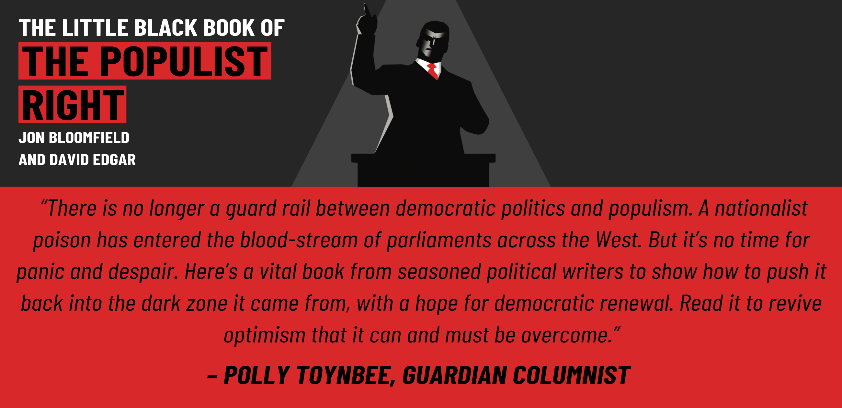
The Little Black Book of the Populist Right

Jon Bloomfield

The spectre of the Populist Right haunts our politics: Farage and Trump, Orban and Le Pen. Why and how has this reactionary movement managed to redraw the political map from Warsaw via Workington to Wisconsin? Co-written with playwright David Edgar, our Little Black Book of the Populist Right is a crucial analysis of one of the greatest challenges of our time. Who votes for the 21st century demagogues eroding our politics – and why? What structural forces have aligned to enable their rise to power around the world?

In one short book, we provide a concise, accessible history and analysis of the Populist Right.

  • How the failures of globalisation – wealth inequality, outsourcing, the instability of global financial markets – and the retreat of social democratic parties from their traditional defence of ‘the labour interest’ and public services has left the space for cynical right-wing demagogues to exploit and come to power under the guise of “taking back control”.
  • How its ideology of national populism rewrote the right’s playbook, throwing up charismatic, often racist leaders, who appealed to new coalitions of abandoned voters.
  • How descendants of the interwar far right sanitised their parties, new anti-immigration movements emerged in Europe and the populist right invaded existing mainstream parties in Britain and America.

The book exposes the fallacies, flaws and fantasies of national populism. It tackles head-on the ideas of its main ideologues – the 4 Gs: Matthew Goodwin, David Goodhart, John Gray and Maurice Galsman. It then shows how progressives can fight back.

To halt the forward march of the populist right, we argue for a new paradigm, a progressive, bold vision of an alternative globalisation; a politics built on empathy and solidarity; new industrial and urban development strategies; and much, much more.

“Combines clear and concise analysis with a compelling case for action” Professor Jonathan Portes.

“A brilliant book” Neal Lawson, Director of Compass.

“Vital reading” Helena Kennedy KC

Available in all good bookshops £9.99 or on-line. Populist Right — Byline Books

Dr. Jon Bloomfield. Honorary Research Fellow, Institute of Local Government Studies, University of Birmingham.

When paradiplomacy becomes a performative act: Istanbul’s Imamoglu and his quest against competitive-disharmony

Dr. Ahmet Cemal Erturk & Dr. Nur Sinem Kourou

Paradiplomacy involves multi-level actors in global politics and allows for local governance even within strict unitary state borders. These borders are sharper when regional or sub-national entities diverge from the central government’s policy position. Moreover, political constraints can be intimidation tactics, with authoritarian measures tightening control over municipal autonomy. Therefore, sub-national entities may adopt various strategies to bypass these limitations. Paradiplomacy could become a way out. Sub-national actors may take paradiplomacy as an outlet to counter political pressure and push back against central government authoritarianism. The opportunities created through paradiplomacy also bring local leaders to the forefront of foreign policy. Post-2019 Turkey stands as a benchmark for analysing this issue.

It would not be wrong to describe paradiplomacy as the lifeline of some local governments not aligned with Turkey’s ruling party after the 2019 local elections. Let us look at the background of the situation. AKP’s leading position in national and local governments since its first elections (2003 national, 2004 local) was shaken by the loss of metropolitan municipalities such as Istanbul and Ankara to the main opposition CHP in the 2019 local elections. Since then, a competitive-disharmony phase has opened between the CHP municipalities and the AKP government. In a pattern of competitive-disharmony, local leaders turn foreign relations into a political performance on stage. By strategically communicating and leveraging foreign ties for political gain, sub-national entities can demonstrate their ability to fulfill the needs of both domestic constituents and international partners, thereby positioning themselves to compete with the central government effectively.

The most notable politician in this respect has been Ekrem Imamoglu, the Mayor of Istanbul. This is not only because İmamoğlu is a skilful leader. In the absence of the backing of the national government to run a Megapolis like Istanbul, he has had to pursue other possibilities, making him the actor of paradiplomacy. Disharmony naturally emerges in these relationships, driven by state officials viewing sub-national authorities as existential threats. In centralized and authoritarian contexts, paradiplomacy within competitive-disharmony emerges in two critical areas of foreign policymaking: economic and political. Local leaders build reputations by overcoming these constraints while forging their path through diplomacy. In a sense, they endeavour to become actors in the game to avoid appearing as mere recipients of international actors. By doing so, they become the legitimate, albeit unofficial, government representative in the vacant areas.

The most recent example of this occurred last summer. President Erdoğan’s decision not to attend the 2024 Paris Olympics provided a diplomatic opening for İmamoğlu, who has consistently expressed his desire to host international events like the Summer Olympics. Riding the momentum of his victory in the March 2024 local elections, İmamoğlu travelled to Paris with nearly all CHP district mayors, supporting the national athletes and carving out a new space for diplomacy as he sets his sights on bringing the 2036 Olympics to Istanbul. Imamoğlu’s intention and diplomatic endeavours are also physically present in Paris under the name ‘İstanbul House.’ ‘İstanbul House’ was founded to showcase Istanbul’s sporting and cultural heritage and share the city’s future vision with the world. İmamoğlu’s high-profile involvement in the Paris Olympics and the opening of ‘Istanbul House’ was criticized as a ‘wasteful’ effort by people in Turkey who have struggled with the current economic crisis, yet from a diplomatic perspective, it was another step in the paradiplomacy he has been pursuing in since 2019.

Since the beginning of İmamoğlu’s tenure, instances such as the example of Paris have been evident. Economically, his first term has been marked by a persistent pursuit of external funding, with a focus on leveraging foreign sources such as Deutsche Bank and the French Development Agency. This strategy was designed to bypass the obstacles imposed by domestic funding authorities. Politically, İmamoğlu has also tested the limits of competition with the central government. In a highly unprecedented move in Turkish political history, he appeared as a guest speaker at the 2022 Munich Security Conference, where he outlined an agenda that directly challenged the government’s official foreign policy stance. His speech highlighted the growing democratic regression both domestically and globally, transforming his address into a cautionary narrative for those in attendance.

Although İmamoğlu still has four years remaining as Istanbul’s mayor, experts widely agree that his ambitions extend far beyond his current position. These aspirations are clearly reflected in his approach to paradiplomacy. While the volatility of Turkish politics leaves little room for certainty, one expectation remains clear: the longstanding tension between Erdoğan’s increasingly centralized government and İmamoğlu’s municipality is unlikely to dissipate. Considering the ambitious goals of both parties—one driven by a quest for power, the other by an insatiable pursuit of total hegemony—it is reasonable to expect that competition between the two will persist over the coming half-decade.

This blog post is based on Ertürk, A.C. and Kourou, N.S., 2024. Unlocking pathways in constrained local governance: exploring paradiplomacy under competitive-disharmony through the case of Istanbul. Local Government Studies, pp.1-22. Available here: https://www.tandfonline.com/doi/pdf/10.1080/03003930.2024.2377223

Dr. Ahmet Cemal Erturk is an Assistant Professor of International Relations at Istanbul Kultur University. He completed his Bachelor of Science degree in International Relations at Middle East Technical University, followed by a Master’s degree from the the University of Manchester and a second Master’s degree from the London School of Economics. Dr. Erturk further pursued his academic journey by obtaining a Ph.D. from the European Institute of Marmara University. Dr. Erturk’s research focuses on pivotal areas such as EU-Turkey relations, sustainable transport policies within the EU framework, and the process of Europeanization in Turkey.

Dr Nur Sinem Kourou is a lecturer at Istanbul Kültür University. She conducts research on the relationship between gender and politics, gender opposition, and women’s political participation in Turkey. Kourou completed Ph.D at Boğaziçi University in 2022. During their doctoral studies, she was a visiting researcher at Yale University. In 2022, Kourou received the Dicle Koğacıoğlu Article Award from Sabancı University’s Center for Gender and Women’s Studies Excellence, ranking first. Currently, she is a Postdoctoral Researcher on a research project supported by the British Academy

An evidence-based assessment criteria framework for school relocations

Sarah Finn

Local Authorities in England have responsibility of ensuring there are sufficient school places to meet the demands of the population now and in the future. When new housing developments are proposed which result in a demand for additional school places, options include the expansion of an existing school, provision of a new school, or relocating an existing school to a new building on a new site.
The assessment of school relocation proposals is a complex process, impacted by financial constraints and silo-thinking within the public sector.

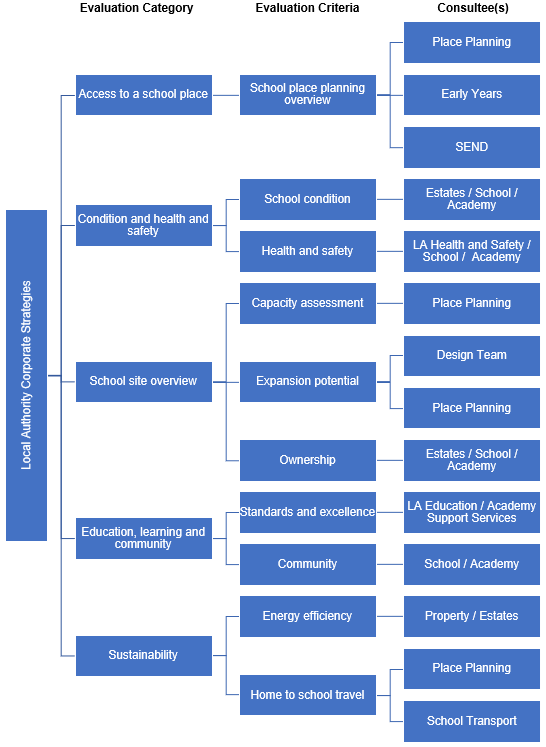
The project designed a School Relocation Assessment Tool (SRAT) which encourages officers to outline the financial impact of school relocation within the context of the council’s corporate strategies, and to consider short-term and long-term impacts of a variety of evaluation criteria in a holistic way, with weighting to support balanced decision-making. Critically, collaboration is a central factor of the tool.

Key points
• Where appropriately located land is available, some councils are starting to consider the option of relocating and expanding an existing school to a new site.
• Councils are currently only able to request developer contributions to fund the additional places required to mitigate the impact of the development, whereas re-provision of existing places must be met by council borrowing.
• The SRAT tool requires information to be gathered about multiple factors horizontally, across vertical silos within the Council to enable consideration of council priorities in a holistic way rather than being in competition with each other, thus mitigating the negative impacts of silo- thinking by making the assessment joined-up and strategic.
• The project identified several factors to evaluate when assessing school relocation opportunities, including home to school travel distances, community use, and school condition.

Background
Local Authorities in England have a statutory responsibility for education and have a duty to ensure there are sufficient school places to meet the needs of the population now and in the future. Traditionally, mitigating strategies adopted to provide additional pupil places generated by proposed new housing will involve either the provision of an entirely new school setting or an expansion to an existing provision. However, where appropriately located land is available, some councils are starting to consider a third option of relocating and expanding an existing school to a new site (school relocation).
The financial impact is particularly pertinent as councils are currently only able to request developer contributions to fund the additional places required to mitigate the impact of the development, whereas re-provision of existing places must be met by council borrowing.

What we knew already
Where strategic perspectives are not aligned within organisations there is a risk that obstacles to successful collaboration are created across administrative silos, where organisational parts of government [work] in isolation from each other. It’s been argued that reduced budgets have encouraged retreat into departmental silos, rather than collaboration.
Successful strategy relies on several overlapping strategic decisions being made in conjunction with one another, with financial constraints balanced against strategic priorities.
This research project involved both a systematic literature review and a group discussion with four senior council officers concerned with school standards, performance, and infrastructure.

What this research found
Financial and short/long term decision making
The current financial pressures faced by LAs encourages decision-makers to pursue the ‘least-cost’ option, without concern for externalities. The impact of school relocation should be considered within the context of wider council corporate strategies. A strategic perspective encourages LAs to take a longer-term approach to their decision-making.

The SRAT tool requires information to be gathered about multiple factors horizontally, across vertical silos within the Council to enable consideration of its priorities in a holistic way rather than being in competition with each other, thus mitigating the negative impacts of silo- thinking by making the assessment joined-up and strategic.

The project identified several factors to evaluate when assessing school relocation opportunities, including home to school travel distances, community use, and school condition.


School Relocation Assessment Tool (SRAT)

Conclusions
The aim of this research was to formulate an assessment criteria framework for school relocations. To achieve this, the project sought to understand how school relocation decision-making processes were impacted by financial constraints and silo-thinking, and to explore what criteria should be assessed when school relocations are considered.
The resultant SRAT has been successfully designed to encourage officers to outline the financial impact of school relocation within the context of a council’s corporate strategies, to consider short-term and long-term impacts of a variety of evaluation criteria in a holistic way with weighting to support balanced decision- making. Most significantly, it guides officers to collaborate with other teams across the council to ensure joined-up strategy is achieved.
During the research process, the researcher recognised that the literature around school relocation was lacking. The creation of a tool to assess both numerical and non-numerical evaluation factors of school relocations, drawing upon both practical and academic research, appears to have not previously been attempted until now. To build upon this research, different occupational viewpoints should be sought regarding the effectiveness of the tool to improve its validity, particularly from a financial perspective.


About the project
This research was a Master’s dissertation as part of the MSc in Public Management and Leadership, completed by Sarah Finn and supervised by Shailen Popat.

The realisable benefits of place-based narratives

Liam Hornsby

Whilst the concept of place perception has been studied by academics since the 1990s, it is only recently that local authority-led place brand narratives have started to emerge. There has been a wealth of academic literature on the drivers of place brand narratives and the impact that they have on perception. Despite publicly accessible guidance available for local authorities recommending the development of a place brand narrative, however, there remains a gap in research related to the tangible benefits that can be derived from the development and establishment of such an approach.
This research project explores the tangible benefits of place brand narratives for local authorities, using Watford Borough Council as a case study. It investigates key drivers for establishing place brand narratives, such as tourism, inward investment, and business growth, and develops measures to evaluate their impact through quantifiable data. The research concludes that place brand narratives can significantly enhance socio-economic outcomes.

Key points
• Place brand narratives can lead to improved town centre footfall, visitor economy, commercial property occupancy, resident employment, enterprise growth, reduced crime perception, and enhanced resident happiness.
• Political and resident buy-in is crucial for successful implementation of place brand narratives.
• Authenticity in the narrative is important.
• Place brand narratives can justify investment in their development, despite the challenges of stretched council budgets and prioritization of investments.
• The study acknowledges limitations such as reliance on qualitative data and potential bias from data provided by local authorities with vested interests.

Background
The perception of a place is crucial for the prosperity of towns and cities. Recently, local authorities have leveraged social media and digital tools to strategically shape public perception of their areas. This effort, once limited to major cities and tourist spots, now sees many councils developing place brand narratives to attract investment, boost tourism, and enhance civic pride. However, research on the tangible benefits of these narratives has been scarce.
This study aims to fill that gap by quantifying the benefits, providing local authorities with data to support investments in place branding. The research demonstrates a link between place perception and benefits such as increased town centre footfall, improved visitor economy, resident happiness, reduced crime, and higher inward investment. By comparing these outcomes to national averages, the study seeks to justify the investment in place brand narratives, even amidst budget pressures and the need for long-term rather than quick solutions.

What we knew already
The study of place brand narratives has evolved from early 1990s concepts of linguistic place-construction, where language was seen as a tool to enhance place appeal. Initially, the focus was on how names and labels could change people’s perceptions of a place. Over time, scepticism grew about the effectiveness of mere name changes in altering perceptions – it became clear that just renaming places isn’t enough to change people’s views significantly. Instead, modern approaches emphasise the need for creating a robust narrative that tells a compelling story about the place that highlights its history, achievements, and future potential.
Effective place branding should connect with both residents and outsiders, gaining support from the community and political leaders. It’s important for the narrative to be realistic and recognizable to those who live and work there. However, research on their quantifiable benefits is limited, highlighting a gap in understanding the effectiveness of implementation versus development.

What this research found
In order to find reliable links between place brand narratives and benefits, this research collected data from 277 local authorities from across the United Kingdom using Freedom of Information requests. Of these, 57 responses indicated the existence of a place brand narrative in their locality and identified specific benefits as part of the business case. From the responses, a sample group of five councils with similar populations sizes and socio-economic indicators was selected to further explore in detail the benefits that can be expected from place brand narratives.

The identified benefits

What do these results indicate?
The sample group of local authorities with place brand narratives performed variably compared to UK averages. While the number of enterprises and business units grew, they did not match the national average, suggesting limited impact on business growth.
However, in other areas, the sample group outperformed the UK average. These authorities saw smaller decreases in resident happiness and commercial property voids, a significant reduction in recorded crimes, and greater increases in economically active residents. Notably, they experienced substantial growth in the visitor economy and footfall, likely influenced by increased domestic tourism during the COVID-19 pandemic, which affected international travel.
This suggests that places with brand narratives recovered more quickly from the pandemic’s economic impact. Despite mixed results for business growth, the overall positive performance in other areas underscores the potential benefits of place brand narratives. The results further indicated that significant sums of money are not required to leverage benefit. Rather, the success of the place brand narrative could be in the way it was developed and implemented.

Conclusions
This research concludes that there is a positive relationship between place brand narratives and various benefits for local authorities. Councils investing in these narratives can expect increased tourism, footfall, and economically active residents, along with reduced crime and fewer commercial property vacancies. Although the impact on business growth metrics is less clear, none of the areas studied saw a decline.
This study supports the business case for place brand investment, aligning with commentators who advocate for its benefits and providing political justification crucial for success. Local authority managers can use these findings to make informed decisions, conduct benefit-cost analyses, and allocate budgets effectively during challenging financial times. Further research is recommended to explore the development and implementation of place brand narratives and their long-term benefits. In addition, the COVID-19 pandemic’s economic effects suggest that repeating this research in the future could provide even more accurate insights.


About the project
This research was a Master’s dissertation as part of the MSc in Public Management and Leadership, completed by Liam Hornsby and supervised by Dr Timea Nochta.

Implementing Asset Based Community Development (ABCD) in a transformative way

Jonathan Hayes

Asset Based Community Development (ABCD) is an approach to community development and service provision that seeks to ‘reorient theory and practice from community needs, deficits, and problems to a focus on community assets, strengths, and power’. It has become a popular concept in public sector policy, but can too easily be used as mere rhetoric, rather than resulting in actual, transformative practice. Furthermore, the existing ABCD literature tends to focus on the steps involved in implementing the approach, rather than giving insights into how organisations can enable frontline staff to implement it successfully. The dissertation involved a case study in a large Metropolitan District Council in the north south of England, concerning a Council-wide transformation project aiming to develop work with local communities to more of an asset-based approach.

Key points
• The Asset-Based Community Development (ABCD) approach emphasizes community strengths rather than deficits.
• Implementing an ABCD approach requires that frontline workers operate in very different ways from their traditional professional and institutional norms.
• Adopting and adapting ABCD at the frontline involved conscious use of the ABCD ‘brand’ and acknowledging issues of power.
• The support of both the political leadership and the senior officer leadership of the Council is critical in adopting an ABCD approach and then being given the time and resources to make it successful.
• Local residents can be resistant to losing dependency on services and may be suspicious about ‘ulterior motives’ such as cutting budgets.

Background
Local Authorities in England have a statutory responsibility for education and have a duty to ensure there are sufficient school places to meet the needs of the population now and in the future. Traditionally, mitigating strategies adopted to provide additional pupil places generated by proposed new housing will involve either the provision of an entirely new school setting or an expansion to an existing provision. However, where appropriately located land is available, some councils are starting to consider a third option of relocating and expanding an existing school to a new site (school relocation).
The financial impact is particularly pertinent as councils are currently only able to request developer contributions to fund the additional places required to mitigate the impact of the development, whereas re-provision of existing places must be met by council borrowing.

What we knew already
The Asset-Based Community Development (ABCD) approach, championed by John Kretzman and John McKnight, emphasizes community strengths rather than deficits. Their research in North American neighbourhoods revealed that low-income communities, despite challenges, had inherent assets. In their foundational work, ‘Building Communities from the Inside Out,’ they rejected the view of these neighbourhoods as needy and problematic. Instead, they highlighted community assets like solidarity and local groups.
In the UK and Ireland, Cormac Russell’s book, ‘Rekindling Democracy,’ emphasises starting with community strengths to address issues. Russell traces ABCD’s roots to social critic Ivan Illich, who challenged institutionalism, who argued that communities must perform essential functions independently, without undue institutional interference. Illich argues that the ABCD approach requires a major shift in thinking as well as in practice, involving a re-orientation to ‘start with what’s strong, not what’s wrong’.
Implementing an ABCD approach requires that frontline workers operate in very different ways from their traditional professional and institutional norms. For example, Russell (2020) argues that the role is one of ‘community builder’, and he introduces the idea of ‘stepping back’ meaning that instead of taking a key role in, or worse control of, a community initiative, the worker must instead know when to ‘step back’ from being too closely involved and allow the gifts and skills of local people to move the initiative forward.
Whilst the concepts and challenges of the ABCD approach are clearly defined, where the existing ABCD literature is lacking, is in understanding how frontline workers can be enabled to make the necessary shift in their thinking and practice, so as to be able to successfully implement an ABCD approach in a transformative way.
This research involved qualitative interviews in a case study local authority identified as exemplary practice in ABCD. Interviews were held with the Community Development Team Leader, their service manager, and four community development practitioners.

What this research found
Theme 1: Adopting and adapting ABCD at the frontline
Frontline workers adopted and adapted aspects of the ABCD policy initiative so that it had meaning and applicability to the situations and challenges that they faced. First, they used the opportunities that the introduction of a new policy initiative gave them to implement it in a way that they felt would be most effective. Second, they had to adapt this to ways of working that were most appropriate to the communities they work in. Third, they used it to try and achieve outcomes that they are committed to, but which may not have been the original intention of the policy.
Some interviewees felt that proponents of ABCD have rediscovered community development and re-branded it as ‘ABCD’, in a way which was helpful to regain the trust and belief of politicians and senior officers in community development as a way of working in communities. However, some frontline workers felt they were not remaining true to the ‘pure’ spirit of ABCD and were, on occasion, doing things, if not ‘to’, then definitely ‘for’, people in the community.
ABCD was seen as using in addressing issues of ‘power’. Interviewees felt that the naming of power and getting people (residents, colleagues and politicians) to think about how power operates in their community is a key element of the ABCD approach. This is reflected in their multi-agency training course on ABCD being called ‘Growing the power of communities’, when they could have called it ‘An introduction to ABCD’.

Theme 2: Enablers to implementing ABCD
All of the interviewees mentioned the support of both the political leadership and the senior officer leadership of the Council as a key factor in them being able to both adopt an ABCD approach and then being given the time and resources to make it successful. Whilst not mentioning ABCD specifically, the Corporate Strategy had as one of its five ‘building blocks’ that the Council will “develop people, places and partnerships . . . releasing the expertise and resources of empowered communities”. The level of investment that has been made by the Council was also mentioned as an indicator of the high level of institutional support, not just in terms of the community development team but also in training for Council and other agency staff and the commitment to the Voluntary and Community Sector (VCS) in terms of grants, training and learning circles that are all focussed on working in an asset-based way.
The setting up of a dedicated team of community development professionals within the Council’s Neighbourhood Service appears to have been key to the success of this approach. Furthermore, the fact that they were given two years to train, develop and reflect upon their practice as a team without any pressure to achieve performance targets or specified outcomes helped them to deeply embed the ABCD approach into their way of working. Implementing ABCD successfully required both a certain amount of faith and a lot of time.


Theme 3: Barriers or challenges to implementing ABCD
Interviewees felt that the resistance they encountered from local residents was primarily due to the ‘dependency on services’ that had arisen from ‘fifty years of people depending on the system’, encouraged by previous ‘you said, we did’ approaches. There were also citizen concerns about ‘ulterior motives’ such as cutting budgets.
Interviewees suggested that some council staff want to help people starting from a council agenda, rather than building community capacity starting from theirs. Another institutional barrier can be silo working, where each service or department carries on with their own work without sufficient thought of, or communication with, other services/departments.
The tendency towards needs-based thinking and practice can be a further barrier to ABCD, particularly experienced from colleagues at a strategic level.
The attitudes and activities of elected Councillors can present a number of challenges in the implementation of an ABCD approach, such as a tendency to ‘fix and solve’ problems for citizens.

Conclusions
The successful implementation of an ABCD approach in a transformative way requires a shift in both thinking and practice that operates at three different levels: institutional, professional and personal.
Institutionally, senior politicians and managers must provide clear commitment to being a ‘development’ council, which is reflected in the Corporate Strategy. Councils should consider investing in a distinct community development team, with suitable training for these and other staff and residents. Allowing that team to have two years to embed its approach, to spend significant amounts of time in reflective practice and not burdening it with the expectation of meeting set targets, also appears to have had a significant effect.
Professionally, the key success factor here appears to have been the bringing together of a team of professionally qualified community development practitioners who have the skills to implement an ABCD approach, can see the benefits of working in that way, and recognise it as a sustainable way of working with communities. However, their previous needs-based practice and temptation to do things ‘for’ people have had to be ‘unlearned’.
At the personal level, the CD workers needing to have ‘faith’ in the approach they were being asked to implement. This is a departure from previous ways of working. It also demands great patience and a willingness to let go and let others lead.


About the project
This research was a Master’s dissertation as part of the MSc in Public Management and Leadership, completed by Jonathan Hayes and supervised by Dr Koen Bartels.

Politicians’ Conceptions of Fairness

Clive Stevens

Fairness is clearly very subjective and even categorising it will be a step forward.

The theory I am relying on comes mainly from the field of Social Psychology, which draws its evidence from experiment and Social Anthropological ethnography. Add in philosophical works on Social Justice, a sprinkling of Schön and Rein’s framing and spiced up with biases of empathy, risk and power.

I have chosen councillors as I was one myself, which has proved useful in gaining access as well as for writing engaging vignettes. The three I use are based on Local Government case studies. They took a year to write and are pumped full of triggers, suggestions, biases and frames to see what and how many conceptions of fairness come into view.

The vignette content has been carefully reviewed by four experts (the Expert Panel) including an INLOGOV academic; their modifications were incorporated. The vignettes are driving the conversation, so much so that I don’t actually have to ask many questions!

The first one tempts councillors to break the usual rules for housing allocation by pushing the sympathy button ever so strongly; it looks at breaches where policy and procedures exist (Planning and Housing). The second vignette is placed in a sector with no policy and no procedure – a rare occurrence I know – and the final one tests adherence to policy almost to destruction. I can’t reveal the results, not until next year – sorry.

Thematic analysis (inductive and deductive) is picking up between 80 and 100 conceptions per interview fitting into 11 broad categories. Eight of these are different categories of fairness, or realms as I call them, each having an approach appropriate for certain circumstances. The other three are moral foundations of care, loyalty and liberty.

My current struggle is not the thematic analysis itself, but wondering whether I should investigate if there is any qualitative link between conceptions offered up by councillors compared with the suggestion, trigger or framing at that part of the vignette. For example, if a section of a vignette is supposed to prompt feelings of equality, then how to analyse a reply which ignores equality and concentrates on merit? Surely such occurrences are as significant (not statistically) than a comment discussing equality? Answers on a postcard please.

So where does this fit into Public Policy you may ask? Indeed, my supervisors ask that too. Clearly democratic legitimacy (moral rather than legal) relies to an extent on fairness of inputs and throughputs, and output effectiveness. I have heard, “What’s the point of democracy, if it doesn’t deliver fairness?” Additionally, the resolution of Wicked Problems and getting issues onto Political Agendas require understanding of differing moral values including conceptions of fairness. So, I would suggest, quite a lot really.

Moving briefly away from English Local Government to US Foreign Policy, I recently came across a 2022 paper on International Relations. The authors appeared to be lambasting their colleagues for focussing on just one conception of fairness: equality. Powers et al. the authors, used Social Psychology’s Moral Foundation Theory to explain why the American public and politicians think aspects of foreign policy like burden sharing for defence, peacekeeping, environmental clean ups and emergency response are unfair.

Their paper proposes the field introduce a second conception, proportionality, which they called equity. In the UK Social Sciences, we reserve equity to mean fairness based on need. Fairness conceived as proportionality would suggest, for example, that it might be seen as fairer for NATO countries to pay their way by putting in a similar percentage of GDP rather each country putting in what it can. I hope they succeed for all our sakes but I’m dreading the thought of having to tell them that there might be up to eight conceptions of fairness!

Back to Local Government and I’ll leave the last word with one of my councillor interviewees. I paraphrase, “You know Clive, we don’t really talk much about it, it’s rules and regulations, there’s comfort in them. These vignettes are very interesting to actually spend time thinking about fairness.”

As an ex-councillor in Bristol and author of the book on Local Government, After The Revolution, Clive needed to follow up on politicians’ conceptions of fairness. He is now in Year 3 of a PhD at the University of Bristol interviewing current councillors. His personal blog site is: https://sageandonion.substack.com/