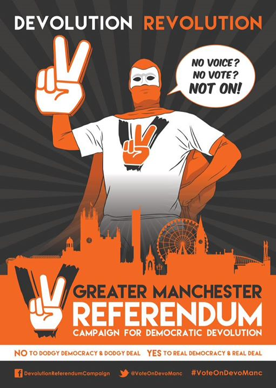
Devolution: a journey into the unknown?

Catherine Staite, Director, INLOGOV

A key theme of the discourse on devolution in recent months has been the thrill of the new, through the creation of new local institutions – combined authorities – and new relationships between central and local government.  Some old hands will have noted the similarities with previous ‘resources/powers in return for performance/compliance’ offers such as Local Area Agreements, Multi-Area Agreements and City Deals.  Those ventures were characterised by big promises,  wearisome competitive processes and few real benefits for local government. Those disappointments were often attributed to the dead hand of Whitehall.

So what is different now?  The power dynamic is different. If DCLG tries to drive change it is at the mercy of the Treasury.  When the Treasury drives change it happens.  The prizes seem bigger too but perhaps the biggest difference is the pace of change.  It’s certainly galvanising local authorities into action. Long-standing differences have been overcome and a sense of common purpose established in many areas.  Devo deals are being negotiated and agreed at regular intervals.

So what next? Creating a combined authority and signing the deal is merely the end of the beginning.  How will these new institutions and changed relationships need to develop over time? Will governance structures conceived in optimism be sufficiently strong and flexible to meet future challenges? How will politicians need to adapt their leadership style to a shared leadership model with the added  ingredient of an elected metro mayor?  Will the combined authorities withstand changes among the key leaders and chief executives? If one of the leaders runs for mayor will all the others stop speaking to him/her? If the mayor throws their weight about, will all the leaders withdraw their goodwill?

Academics have given significant attention to both the previous waves of change and the implications of the current approach to devolution. There is much evidence to be mined and that will help the key players in combined authorities continue to shape their governance arrangements and manage their challenges. Devolution and all its ramifications has been the hot topic at recent conferences, such as the SOLACE Summit, as well as for the LGC and MJ. However, there have been few opportunities for academics and local authorities to come together to share experiences and intelligence.  The pace of change has left little time for reflection but the scale of change demands that key decisions are informed by evidence.

INLOGOV is offering four such opportunities over the next few months, starting on 5th November.  These free events are also supported by academics from the Public Services Academy and City REDI, the new economic modelling unit recently established by Birmingham Business School.  Our purpose is to enable local authorities to talk to each other about all the critical issues; their experiences of negotiating with central government, of creating an effective approach to shared leadership and of hammering out shared priorities across diverse areas – as well as to take advantage of the insights which research offers about new ways to solve old problems. We hope this sharing of knowledge and experience will help ensure that this latest wave of change really does bring bring significant and lasting benefits for local authorities, their partners and – most importantly –  the people they serve.

staite-catherine01

Catherine Staite is the Director of INLOGOV. She provides consultancy and facilitation to local authorities and their partners, on a wide range of issues including on improving outcomes, efficiency, partnership working, strategic planning and organisational development, including integration of services and functions.

Creating our fate through our own behaviours

Anthony Mason, Senior Associate INLOGOV

The American author Henry Miller is supposed to have said “we create our fate every day . . . most of the ills we suffer from are directly traceable to our own behaviour”.  Funnily enough, if you use a well-known search engine to try to find where and when he recorded this weary aphorism, you end up with pages of circular references to quotation lists.  But given his complex love life (five wives and many lovers) it sounds just like the sort of thing he should have said, whether or not he did.

Those local authorities currently in deep negotiations around devolution deals or on complex partnerships with health organisations should hear Miller’s (supposed) words ringing in their ears.  INLOGOV has recently completed research for the District Councils’ Network to look at a range of partnerships either led by or centred on districts.  The resulting report “Building Better Collaboration” is now available from INLOGOV’s website.  It was launched – perhaps appropriately – at a joint district/county summit on devolution in two tier areas.

One of our roles is to ensure that relevant research is given a practical application, so the study draws on a considerable body of academic material about partnership working to stress that individuals who will be good at collaborative working can too often be hidden away in vertical structures.  “Boundary spanners” and “collaborative champions” are needed in every partnership and need to be identified, developed and encouraged.

We identify five organisational behaviours/attributes that seem to be disproportionately important in determining the success or failure of collaborative ventures: leadership, selflessness, trust, momentum and risk.  Of these, the most significant for project outcomes seem to be: “audacious” early leadership; trust – grounded in an organisational culture of self-awareness; and momentum – where too many projects proceed at the speed of the slowest partner.

We noticed that in many of the partnerships we reviewed, there was at least one partner that seemed to put in much more than it could ever expect to get out in measureable benefits.  We termed that selfless behaviour and the term captures something of the particular contribution that the best districts can make to partnership working.  We explored why this was so – and in a way, the answer is a simple one: for districts, selflessness is actually role-appropriate behaviour.  Districts represent local communities and geographies; and so minding their local interest in collaborative projects must be “creating their fate…through their own behaviours”.

As you find so often, there is a flip-side to selflessness heard in the charge of parochialism levelled at a few districts, especially by some business voices.  Districts might reflect that being only champions of the local can have downsides – especially where a wide range of interests have to be reconciled for the common good, for example around a combined authority bid.

We suggest that the national local government bodies – the LGA, CCN and DCN can do much more to model good collaborative practice.  Where this goes wrong, they might reflect that “…most of the ills we suffer from are directly traceable to our own behaviour.”

Anthony Mason

Anthony Mason is a senior associate at INLOGOV where he specialises in consultancy around partnership and collaboration.  He started his career in local government and then spent more than 20 years in PwC’s public sector consultancy practice.  His professional background is in housing and neighbourhood regeneration.

Catherine Staite reflects on the need for 21st century partnerships in Birmingham

Catherine Staite, Director, INLOGOV

Working in partnership in the public sector has never been easy.  Diversity in size, ambition, buying power, influence and democratic legitimacy, create real challenges for partnerships. The imposition by central government of one size fits all models of partnership as a means of control didn’t help. Add the problems that arise from personality clashes and petty rivalries and its easy to see how partnerships came to be described as  ‘mutual loathing in search of funding’.

Of course it wasn’t all bad. Some LSPs developed a strong collective vision for their area and some LEPs can claim significant achievements. Many partnerships demonstrated that when you involve the right people, who behave in the right way, you can establish relationships of trust that will weather challenges. That is helpful as that experience is now providing the foundations for different sorts of partnership.

The role of councils within partnerships has always been contested.  Many councils espoused the view that their democratic mandate placed them in a pre-eminent position and they were leaders by right. It was the duty of partners to do their bidding. Many of their partners compounded this problem by  too passive, assuming that it was the responsibility of the council to provide everything from the vision to the lunch.

Partnerships in Birmingham have always been challenging. The monolithic nature of the council and the diversity of the city have created a long running battle for control of leadership space that has damaged relationships to the detriment of residents.  Many of the problems were highlighted in the Kerslake Report and resolving them is now one of the top priorities of the both the government appointed Birmingham Improvement Panel and the council itself.

The idea of co-production – harnessing the capacity of people to come together to achieve positive change – has been around for many years. Birmingham has many inspiring and energetic people who don’t buy into a cynical and defeatist narrative about Birmingham being too big to manage.  They are willing to give their time and energy to work together, with but not for the council, to create a positive narrative about Birmingham, its people and its future.  Birmingham Partners has a small informal steering group which is working hard to create a self-sustaining network of diverse functional partnerships and communities of interest  – thereby making  itself redundant.  The role of the steering group is to facilitate, not control, discussions about an agenda for change.  Practical support for meetings, public events and social media is provided by the University of Birmingham, Birmingham City University and Aston University.

It’s not easy for the council to let go of control. Real change is slow and messy and they are under pressure to deliver demonstrable improvements quickly.  There are lots of views about what needs to happen next.  The council will therefore always have a pivotal role, holding the ring and ultimately making the very difficult choices forced on them by austerity.  Widening engagement and participation in those debates will both strengthen the legitimacy of those choices and mitigate their negative impact. Things can only get better – and they will.

Catherine Staite

Catherine Staite is the Director of INLOGOV. She provides consultancy and facilitation to local authorities and their partners, on a wide range of issues including on improving outcomes, efficiency, partnership working, strategic planning and organisational development, including integration of services and functions.

Only a Georgian Devolution Revolution, but maybe Catherine wasn’t completely wrong

Chris Game

If, like Catherine Staite, you’re Director of an organisation and you risk entitling even an ironic blog: “Oh dear, … I’m wrong again!”, you must at least secretly hope that your underlings will be tripping over themselves to assure you that of course you’re not, either before or now.

If so, two months must seem a disconcertingly long wait, but my personal excuse is that I was waiting for a suitable peg on which to hang my grovel. Let us give thanks, then, for last week’s Conservative Party conference. Even before Chancellor George Osborne’s rabbit-out-of-hat business rates announcement, it had amply validated Catherine’s concern about the party political primacy of the Government’s whole devolution policy. And its timing also offered a useful opportunity for an update on devolution developments since my own last blog on the topic some of which, I wondered, might have prompted her to modify her earlier pessimism.

Recapping briefly: Catherine’s blog was about how neither of the two key opportunities for local government that she hoped for from the Government’s Devolution/Combined Authority agenda – the development of a sufficiently sizable scale of operation to enable the delivery of ‘big ticket change’ (her business jargon, I’m afraid), and “to improve collaboration by drawing in reluctant partners” – looked, at least in late July, like being significantly realised.  Her vision of “a range of CAs operating at different scales and across varied geographies, receiving different devolution deals”, she felt, was proving to be self-delusion.

Her reasons included: George Osborne’s fixation with his Northern Powerhouse and metro mayors, and relative unconcern with counties and sub-regions; central government’s lack of either commitment or capacity to deliver effective devolution deals on any scale; and the sheer difficulty facing diverse and traditionally self-sufficient local authorities trying to develop convincing collaborative devolution bids within a ludicrously short time-frame.

The Treasury’s early September deadline was tough. Moreover, dictated by November’s Spending Review, it seemed to reinforce Labour sceptics’ suspicions of the Government’s whole strategy being more about the devolution of cuts than of powers, or, in the neat Newcastle version, passing the buck without the bucks. It was noticeable, however, that even some of those issuing such warnings, like Oldham Council leader Jim McMahon, were equally insistent that councils should still take “every bit of power from the Tories that we can. We have a responsibility to. It is our duty.”

For their part, ministers, or their civil servants, spent pre-conference week frantically negotiating, in order to maximize the political capital involved in such devolution giveaways by announcing at least one big one at the ideally located Manchester event. Cornwall’s (non-mayoral) settlement, rightly headline-making back in July, was politically now history, and it seemed the North East were being groomed as conference darlings. But then Sheffield City Region came up fast on the inside and breasted the tape on the Friday, before conference delegates had even convened.

Last year, the four South Yorkshire met boroughs comprising the CA were openly opposed to an elected mayor – and openly disappointed with the consequential paucity of their December ‘devo-lite’ deal.  Since then, though, the addition of five Derbyshire and Nottinghamshire districts as non-constituent members, the General Election outcome, and the Cities & Local Government Devolution Bill had changed minds. Having accepted an elected mayor as the non-negotiable price of a worthwhile devolution deal, the region is for the moment head of the Manchester-chasing pack.

If the Bill weren’t sufficient confirmation that an elected mayor is indeed the price, regardless of anything electors themselves might have to say, this new agreement is peppered with references to the functions for which “the directly elected Mayor of the Sheffield City Region Combined Authority” will be responsible, and of course accountable. These include strategic planning and the region’s transport budget – with the delivery of a ‘smart ticketing’ service – while at CA level council leaders will get access to funding of £30 million a year for 30 years to boost local growth and invest in local manufacturing and innovation. From what I could tell, the Sheffield leaders got at least close to their bid document ‘offer’, which brings me to the second part of this blog.

Given the tight deadline and the known difficulty some aspiring CAs faced even agreeing their full memberships, the total of 38 “landmark devolution bids” seemed to impress others as well as, very obviously, the Government itself.  The 38 included three from Scotland, one from Wales, and some constituting ‘expressions of interest’, rather than definite bids or, as DCLG Permanent Secretary Melanie Dawes put it, “offers that cannot be refused”. Several were manifestly eleventh-hour concoctions and/or overlapping, including no fewer than five from Yorkshire.  So, while the modesty was disarming, it was hardly news when Grant Thornton’s timely survey found “around 1 in 5” of their interviewed local government leaders conceding that their devolution proposals were “fairly” or “very weak” (p.41). Even so, in this age of adjectival inflation, it seems all 38 must be referred to, irrespective of rationale or content, as ‘landmark’ proposals (LPs), just as Manchester’s deals are always ‘ground-breaking’, and all working class electors patronised as ‘hard-working families’.

These LPs were not public documents, and it was up to CAs themselves to release whatever details they wished. Any comprehensive comparison, therefore, has been impossible. Nevertheless, some attempted to do the best they could, perhaps most notably the Local Government Chroniclewhose analysis of 26 of the relatively more detailed English bids is summarized here in slightly amended and more easily comparable form.

CA devolution bids (2) (1)

Bid proposals were coded into 18 policy areas, including ‘Fiscal powers’, plus the expressed readiness to consider an elected mayor. This latter was obviously unnecessary for Greater London and Greater Manchester, vital for the other metropolitan/city regional CAs – the more so after Osborne’s announcement that they alone will be able to raise business rates and levy a dedicated infrastructure tax – but interesting too in the bids involving counties.

Catherine referred somewhat sceptically to what Treasury officials reportedly envisaged as an at least three-county ‘East Midlands Powerhouse’. In the end, Derbyshire and Nottinghamshire agreed to submit a joint 19-authority D2N2 bid based on their two-county LEP, and there is talk, though not in the bid document itself, of an elected CA mayor.  However, Leicestershire stuck with its single-county, but also LEP-based, bid,  and, perhaps predictably, Leicester City mayor, Sir Peter Soulsby, has advised against another for the CA.

Whether these and the other county- and county/unitary-based bids will be judged to have, in Catherine’s phrase, “ticked all the boxes”, or at least a sufficient number of them, remains to be seen. Both East Midlands documents, and particularly the former, seem to me to constitute substantial and substantiated ‘offers’, the more persuasive in their having clearly emanated from directly relevant LEP and SEP (Strategic Economic Plan, not Someone Else’s Problem) experience and the partnership working involved, and the same could reasonably be expected of other such bids.

Moreover, even if boxes do remain unticked – and here I think Catherine may have been wrong – the signs are that it’s NOT “too late now”, particularly for these acknowledgedly more difficult multi- and cross-county arrangements.

Anyway, it’s the number, composition and comprehensiveness of some of these county- and county/unitary-based bids that I thought might possibly have prompted Catherine to wonder if she hadn’t slightly rushed to judgement and written off her hopes over-hastily. So I tried categorizing the 28 English non-city region bids (all those on the DCLG list, including Cornwall, not just those in the LGC list). It was obviously based in some cases on minimal knowledge and arbitrary judgements – particularly where whole-county LEPs are involved – but it provided a very rough statistical confirmation of what Catherine feared and what in the circumstances was only to be expected: that the bulk and probably a majority of these non-metropolitan bids – 15 of the 28, by my reckoning – would come from single counties.

The explanations will vary, but many will centre on the sheer shortage of time. Some took seriously ministers’ message about 5 September being the deadline for councils wanting to develop plans based on an existing or fairly solidly agreed Combined Authority with an elected mayor. Most counties, even more than most urban authorities, don’t want mayors, so why rush? But then over the summer the ministerial line changed to one of trying to drum up as many bids, or even expressions of interest, as possible – too late, though, for most counties, even if they’d wished, to respond other than individually.

Given a more generous time frame, and taking account of reported earlier discussions, it seems likely that at least some of, say, Norfolk and Suffolk, Oxfordshire, Buckinghamshire and Northamptonshire, Worcestershire and Herefordshire, Wiltshire (and Swindon), might have followed the D2N2 route and produced the joint, rather than individual authority, bids that the Treasury apparently favours. Which suggests that some may yet do so, and personally I’m particularly hoping the Oxon/Bucks/Northants combo progresses beyond its ‘England’s Economic Heartland’ transport alliance, thereby enabling me to note their questionable grasp of anatomy, with Bucks certainly appearing considerably closer to Gall-bladder-land.

Other existing multi-county bids, in addition to D2N2, include Surrey, West and East Sussex and Heart of the South West (aka Devon and Somerset), plus four that I categorized as primarily LEP-based: Cheshire and Warrington, the North East, Tees Valley, and West of England.

This left me with a motley group of 6, comprising Swindon, which may at some point resolve its ‘misunderstanding’ with LEP partners Wiltshire, Telford & Wrekin, which has since applied to become a non-constituent member of the West Midlands CA, and the shambles of Yorkshire, which would take a substantial blog on its own.

This blog, already over-long, I’ll bring to a close with two very brief conclusions. One, to date, both the Chancellor’s business rate plans and his devolution deals balance too calculatedly their freedoms and checks to constitute, outside the heady excitement of a party conference, a ‘Devolution Revolution’. Two, given what we know of local government’s initial positive response to the Government’s devo agenda and that the door seems definitely still open, I’d suggest Catherine’s early optimism has certainly not yet proved entirely misplaced.

Chris Game - pic

Chris Game is a Visiting Lecturer at INLOGOV interested in the politics of local government; local elections, electoral reform and other electoral behaviour; party politics; political leadership and management; member-officer relations; central-local relations; use of consumer and opinion research in local government; the modernisation agenda and the implementation of executive local government.

Who do we think we are? A personal reflection on the immigration debate.

Catherine Staite, Director, INLOGOV

This week Teresa May has argued that immigrants bring no benefits to our country – just problems. Its not unusual for politicians to assert things which fly in the face of the evidence but it is unusual to hear something presented as fact which is so demonstrably untrue. Birmingham has provided a home for many different waves of immigrants over the last century and they have helped to create a diverse and vibrant city. Migration is an issue, like many others today, where prejudice trumps evidence.

The latest mass movement of refugees from Syria, Iraq and parts of Africa – fleeing unspeakable violence and oppression – has brought the issue of migration into sharp focus. The sight of so many traumatised people and so many drowned children as well as the terrible stories of cruelty, as a result of which enormously dangerous journeys became the only possible course of action, has made it hard for xenophobes to maintain a fictional narrative in which migrants are opportunists, pootling about the world in search of generous welfare benefits.

Each episode of ‘Who Do You Think You Are’ highlights both the rich diversity of our heritage and the, sometimes astonishing, parallels between previous episodes from history and the current mass movements of people. The programme illustrates the impact of the major upheavals of history through the small stories, the unsung heroism and heartbreaking tragedies of its subjects’ ancestors. It humanizes history.

Until recently, we might have thought that systematic brutality and persecution in the developed world were things of the past. We might have flattered ourselves that, with all the benefits of instant communication and our ability to mobilise resources to respond to emergencies, we would never see such suffering in Europe again – but we are. As was often the case in the past, many of our politicians have turned a cold and indifferent face to that suffering or used it to drive fear. They have been more interested in maintaining their own political careers than in ensuring the safety and well being of their fellow human beings. They have also been wilfully blind to the evidence of the opportunities and benefits that migrants bring, focusing instead on the costs and the risks.

Will a successor programme, in a hundred years time, tell some British national treasure the story of her ancestors, illustrated by a film of defenseless women and children being attacked by pepper spray, through a metal fence, in Europe in 2015? Will that person weep, as so many subjects of the programme do now, when they contemplate so much suffering? What will they think of us, that we allowed it to happen?

Evidence of the benefits of migration include Boris Johnson, who is descended from George III, a German and also has Turkish ancestry. He seems to be making a contribution to public life. Michael Portillo’s family fled oppression in Spain. Say what you like about his politics, he presents a great railway travelogue. Derek Jacobi’s family were Huguenots, fleeing religious persecution in France in the 17th century and bringing their skills as weavers to the English economy. Now we enjoy his skills as an actor. Jane Seymour’s Polish Jewish family suffered in the Warsaw ghetto in the same way that people are suffering now in Homs and Aleppo. We have all those people in our national life today because, at some point, Britain gave their ancestors a home.

However, some might argue that politicians are right to worry about the consequences of migration when you think of the heritage of one recent subject of the programme, Frank Gardiner – so quintessentially English – who discovered that his ancestor had arrived without the proper documents, subverted the local culture by making everyone speak his language and had taken a job previously held by a local. Perhaps he’s the exception that proves the rule. He was William the Conqueror.

Catherine Staite

Catherine Staite is the Director of INLOGOV. She provides consultancy and facilitation to local authorities and their partners, on a wide range of issues including on improving outcomes, efficiency, partnership working, strategic planning and organisational development, including integration of services and functions.

Corbyn’s voter registration drive – as forecast by me

It’s safe to assume that, for all their passion, compassion and general humanity, Jeremy Corbyn’s orations aren’t the kind that will subsequently be read carefully, section by non-sequential section, even by devoted Corbynistas. So, if I don’t mention that the detail underpinning one of the more structured sections of his leader’s conference speech could have come straight from my recent Electoral Integrity Project workshop paper, it’s highly unlikely anyone else will.

Corbyn’s account and call-to-action came about three-quarters of the way through:

“Just before the summer, the Tories sneaked out a plan to strike millions of people off the electoral register this December – a year earlier than the advice of the independent Electoral Commission … They want to gerrymander electoral boundaries across the country by ensuring new constituencies are decided on the basis of the missing registers when the Boundary Commission starts its work in April 2016.

Two million or more people could lose their right to vote. From today, Labour starts a nationwide campaign for all our members to work in every town and city, in every university as students start the new term, to stop the Tory gerrymander.”

If we’re being picky, “millions” is, as used by Corbyn, rhetorical hyperbole – though that doesn’t diminish the story’s importance. Secondly, Labour’s new campaign is a piggy-back on the Daily Mirror’s existing ‘No Vote, No Voice’ campaign.  Thirdly, the Conservatives’ ploy may be a cynical, anti-democratic connivance, but it doesn’t involve the manipulation of constituencies’ geographical boundaries in the traditional American map-drawing sense of ‘gerrymandering’.

Fourthly, you might feel, is: So what? – none of this seems much to do with local government. But you’d be wrong: there are two big links. The first elections contested on the December electoral registers with which Corbyn is initially concerned are next May’s London Mayoral and Assembly elections – the first massive electoral test of his leadership – and the other regional and local elections on the same day.

The other link is that voter registration in the UK – as in most of Western Europe, Russia, China, and Kazakhstan, but not that many other places – is a responsibility of local government, in our case through local Electoral Registration Officers (EROs). Indeed, it is with them that this story starts.

We’re currently nearing the completion of the biggest change to UK voter registration since the introduction of the universal franchise: the replacement of the essentially Victorian household- and annual canvass-based registration system, and the extension into Great Britain elections of Individual Electoral Registration (IER) – belatedly following its 2002 adoption in Northern Ireland. The actual completion of the transition will now, following the Government’s “sneaked-out plan” referred to by the Labour leader, be this December, with the publication of the new electoral registers.
Game1

Revised and updated as usual, these registers will also have removed all the household-registered voters whose names were ‘carried forward’ to enable them to vote in last May’s general and local elections, but who have not or not yet registered individually. This removal, as specified in the 2013 Electoral Registration and Administration (ERA) Act, was to have taken place in December 2016, and the Electoral Commission (EC) estimated that on the May 2015 registers there were 1.9 million of these ‘carried forward’ entries (4% of the total).

Obviously, some of these names will have registered since May, others will have died, or moved elsewhere and registered individually at a new address. But, if 1.9 million was good enough for the Commission, and ministers unable to question it by keeping the registers open, it’s hard to blame Corbyn for rounding it up to a possible “two million or more”.

But that’s only the first of his concerns. The second – and undoubtedly the driver of the Conservatives’ whole strategy – is that, with the UK being one of those countries using electoral registers rather than population as the basis for determining the size of parliamentary constituencies, it is these December registers that will be used, almost certainly exclusively, in the forthcoming Parliamentary Boundary Review, which in addition will cut the number of MPs in the 2020 parliament from 650 to 600.

The virtue of these December registers will be that they provide the Review with a high degree of accuracy and relatively few false entries. Their downside is that they will have a higher, though unknowable, level of incompleteness than if the transition had run its additional 12 months. Missing – either because they’ve been ‘carried forward’ and haven’t got round to registering individually, or because they were among the 7.5 million electors estimated by the Electoral Commission to have been incorrectly registered on the February/March 2014 registers (p.10) – will be mainly disadvantaged, marginalised and hard-to-reach groups (under-25s, especially students, social class DE, private and social renters, some BME groups) particularly in big towns and cities, who, were they to vote in 2020, would be disproportionately likely to support the Labour Party.

Sacrifice completeness for accuracy, keep potential Labour voters off the registers, reduce – more than the boundary review would anyway – Labour’s share of winnable seats, secure another five-year Conservative majority, and keep Labour out of government indefinitely. It was the scenario that some Labour supporters saw as the by-product or hidden agenda of IER from the outset, even when it featured in the Brown Government’s 2009 Political Parties and Elections Act. But, with the Coalition’s ERA Act speeding up the transition in order to introduce it in a “far more cost-effective way”, it became a key Conservative strategy.

Three tactics in particular have been deployed – and formed the core of my workshop paper. First was the ERA Bill’s proposal to change voter registration from the statutory requirement or civic duty it is widely taken to be in the UK into a “personal choice”. Anyone would be able to opt out simply by doing nothing. This shocked even MPs, who envisaged registration rates plummeting to around this year’s 65 per cent turnout rate, and Ministers were eventually persuaded to drop the opt-out option.

Secondly, the Coalition Government chose to save £74 million by scrapping the autumn 2014 full annual door-to-door household canvass – the traditional basis of household registration that the Electoral Commission wanted as the launch-pad for IER. Instead, IER forms were mailed to those on the February/March 2014 registers – those on which the Commission based its estimate of around 7.5 million electors being incorrectly registered.

Thirdly, again rejecting Electoral Commission advice, the Government laid before Parliament on Thursday 16 July – a maximum of three working days before the summer recess, and so possibly justifying Corbyn’s “sneaked out” – the Electoral Registration and Administration Act 2013 (Transitional Provisions) Order, proposing that, to avoid jeopardising the accuracy of the registers for the Parliamentary Boundary Review, the IER transition period should end in December 2015, 12 months earlier than specified in the ERA Act

The Order came into effect on 6 August, but in theory could be rejected by the Commons or the Lords at any time before 2 November. The Lib Dem MP Tom Brake tabled before the recess an Early Day Motion calling for the Order’s annulment and there’s an equivalent motion in the Lords. Brake’s signatories have dawdled up to 40, but their composition – 8 Lib Dems, 14 SNP, 1 Green, and 17 Labour, excluding Corbyn and pretty well all his Shadow Cabinet except Lucy Powell, previously Shadow Leader of the Commons – says everything that needs saying about the chances of this particular Early Day arriving any time soon.

Hence my suggestion, before he was elected, that, “Win or lose, Corbyn’s greatest gift to Labour could be voter registration”. He had already been largely responsible for increasing Labour’s membership by more in three months than Blair managed in three heyday years, quite apart from his 100,000+ Corbynite ‘registered supporters’. It seemed obvious, therefore that, irrespective of the leadership election outcome, if he and his team could galvanise their comrades into a ten-week voter, rather than party, registration drive, Labour might not win in 2020 but could easily gain or save itself some seats.

To this end, he made a useful, if widely overlooked, start by appointing the Ashfield MP Gloria De Piero to his Shadow Cabinet with responsibility for Young People and Voter Registration, and this week’s launch of a Labour registration campaign was a natural follow-up. There will continue to be questions about the leader’s personal electability, but this is potentially a significant step towards increasing the electability of more Labour candidates in five years’ time.

Chris Game - pic

Chris Game is a Visiting Lecturer at INLOGOV interested in the politics of local government; local elections, electoral reform and other electoral behaviour; party politics; political leadership and management; member-officer relations; central-local relations; use of consumer and opinion research in local government; the modernisation agenda and the implementation of executive local government.