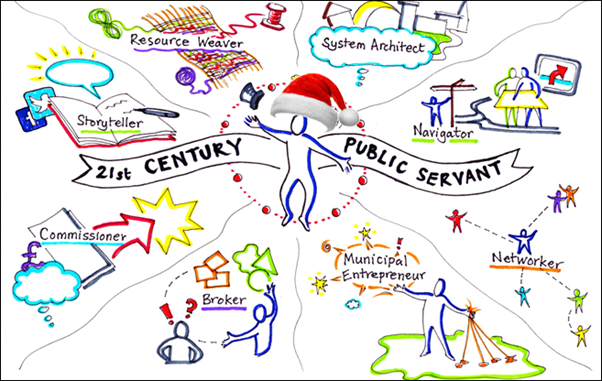
How many public servants does it take to organise Christmas?

21c-public-servant

Catherine Mangan

As 2016 draws to an end, INLOGOV would like wish ‘Happy Christmas’ to all the inspirational public servants we have met and worked with over the past year.   The work of INLOGOV brings us into contact with a range of people dedicated to improving the lives of their citizens.  These include the graduate trainees who have just joined local government; our part time Masters students, juggling full time, demanding jobs with gaining a qualification that will stand them in good stead for their future careers; senior leaders who are working across organisations to develop innovative solutions to our most challenging ‘wicked issues’, and front line staff who continue to support residents in a variety of innovative and thoughtful ways, in spite of budget cuts.

Continue reading

Ministers say they’re pro-devolution, but don’t they listen even to themselves?

Chris Game

The signs are that we’ll be seeing fewer overseas students in Birmingham in the future. Which is regrettable in so many ways and deserves public airing and protest – but it isn’t, I confess, the real prompt for this blog. The best link I can manage is to suggest that, were students from a pretty high proportion of the 150-odd nations represented on our campus to read some of this week’s media headlines, they’d surely be surprised at how centrally dominated and fiscally weaker even England’s biggest local authorities (like Birmingham City Council) seem than sub-national governments in their own, often reputedly less democratic, countries.

Continue reading

Can we commission for outcomes?

Anniina Tirronen

‘Outcomes-based commissioning’ has become the dominant approach to commissioning services in the United Kingdom, with similar concepts such as value-based purchasing and payment by results being explored in the United States and Australia.  Instead of determining the volume or exact nature of services, outcomes-based commissioning focuses on desired ‘outcomes’, such as changes, healing or other effects that take place as a result of services, allowing producers and clients to shape the way targets are reached.  But what effect does commissioning for outcomes have, and is it a better way to commission services?

Continue reading

The only thing necessary for the triumph of evil is for good men to do nothing.

Professor Catherine Staite

Something very bad is happening to our country. The sense of solidarity and common humanity that has helped our complex society to function is being eroded.  Empathy has fled and so children escaping the terrors of war are feared and despised, not welcomed.  We are peddled the old lies that immigrants are dark strangers who cause our problems, even though they are net contributors to our economy, as well as essential to endeavors as diverse as the NHS and agriculture. Hate is becoming embedded in political discourse, encouraged by the tabloid press and has unleashed shocking levels of bullying, racism and misogyny.

Continue reading

Can High Speed Two Bridge the North-South Divide? Weighing the Evidence

Rebecca O’Neill

The Government recently announced its preferred route for Phase 2 of HS2 from Crewe to Manchester and the West Midlands to Leeds. This news will be welcomed by many in the North of England who believe that the new high speed rail line will bridge the ‘North-South divide’, referring to the cultural and economic differences between the South of England, in particular the South East, and the North. Currently, the gap between the two geographical areas in terms of life expectancy and economic trends has grown to the extent that they are almost separate countries.

Continue reading

‘Secret plans to close hospitals’: the perils of centralism

Catherine Staite

The Kings Fund’s warning, that there are ‘secret plans’ to close hospitals, comes as no surprise to local government. A number of local authorities, including Birmingham City Council, Sutton and Camden have decided to publish the NHS’s ‘Sustainable Transformation Plan’ (STP) for their area, against the wishes of the NHS, because of concerns about lack of transparency and particularly the lack of engagement with communities about the best outcomes.

Continue reading