The Power of Community Organising: Reflecting on Citizens UK: Birmingham’s Commonwealth Games Assembly

Catherine Durose

Diverse, joyful, inspiring and hopeful are not words that I would usually associate with meetings, but they are wholly appropriate to describe my experience of being involved as Co-Chair of Citizens UK: Birmingham’s Commonwealth Games Assembly.

A chapter of a national organisation, Citizens UK: Birmingham is a diverse civil society alliance bringing together over 25 member institutions, including education, community, trade union and faith-based organisations from across the city-region. They are committed to using community organising to generate collective power for social change and convene a series of local campaigns on issues of social justice. In Birmingham’s Town Hall on 7 March 2018, Citizens UK brought together nearly a thousand people from communities across the city to celebrate that Birmingham is now confirmed as the host of the Commonwealth Games in 2022.

Amidst the celebration, Citizens UK sought pledges from the head of the organising committee on a set of citizen’s guarantees to ensure community benefit from the Games. These guarantees focus attention on the once in a lifetime opportunity offered by the Games for a catalyst and a legacy of social change for the city. Citizens UK called for a working relationship to deliver a living wage games with a legacy of opportunity for children and young people from across all our communities in Birmingham, ranging from paid work experience to access to sports facilities to permanently affordable social housing.

The Assembly was a celebratory occasion, full of music, performance and laughter. But it was also an important political event. Assemblies are a form of political theatre, highly choreographed and intending to take the audience on a journey. The songs sung by school choirs, performances from diasporic community groups and the powerful testimony from often least represented voices in our society speaking truth to power about their own lives are all deeply emotional experiences and deliberately so. It is easy to be cynical about politics and democracy, particularly in the current climate, but this event offered an important starting point for a different kind of political conversation.

Assemblies fulfil a series of important political functions. Assemblies are designed to be about political accountability, a public holding to account of those with formal decision-making power, a forging of a relationship beyond the ballot box between voters and those they elected. Assemblies demonstrate a different kind of political power, a power generated by organising and mobilising. Assemblies provide a political education, a new kind of political training ground, inspiring active citizens and forging the political leaders of tomorrow. Assemblies are also about political efficacy, building the hope and belief that not only is social change possible, but showing people that they have an active role to play in achieving it. As a fellow Leader noted at the Assembly; whilst people often think that action comes from hope, it’s the other way round, hope comes from action.

I was at the Assembly as part Citizens UK: Birmingham’s Leadership Group and a member of the Citizens UK National Council, representing the University of Birmingham’s College of Social Sciences, which have been a Principal Partner in this alliance since March 2015. Why would a university be involved in community organising? The answer is that there is a need for universities to be actively engaged with their local communities. We have a role and moreover a responsibility to work locally as well as globally to improve the conditions and opportunities for our local communities.

Community organising also recognises self-interest, being part of this civil society alliance helps us to build capacity for civic engagement in our research, teaching and impact. I was joined on Wednesday by over sixty colleagues and students from the University of Birmingham, ranging from final year students working with Citizens UK on placement as part of their Professional Development module to members of a recent Senior Leader’s cohort who have worked with Citizens UK on a project developing new modes of research access and engagement, to a Professor using community organising to pioneer inclusive business support for minority ethnic entrepreneurs. Civic engagement of this kind is crucial to what we are as a College.

To get involved:

On 6 June, we will be holding the second in our annual CoSS Citizens UK lecture series where Professor Guy Standing (SOAS) will be talking on the subject of universal basic income. The lecture will be followed the next day by a Civic Academy, where civil society leaders will be discussing how to take action on this issue in the city. As a precursor we are screening the film, ‘Free Lunch Society’ on Wednesday 25 April on the University of Birmingham’s campus. If you want to register for any of these events, please email me at [email protected].

Catherine Durose 2017Dr Catherine Durose is a Reader in Policy Sciences at INLOGOV. She undertakes research, teaching and impact work on urban governance and public services, with particular interests in participation, intermediation and co-production. She is part of Citizens UK: Birmingham’s Leadership Group and a member of Citizens UK National Council.

Home Care – the challenge

Cllr Ketan Sheth

“For every complex problem, there’s a solution that is simple, neat, and wrong,” wrote the American journalist Harry Mencken. It is an aphorism which is now often quoted by organisational thinkers.

Well, home care is just such a complex problem. Having chaired Brent Council’s overview and scrutiny task group on home care, I learned something of the difficulty of finding solutions to the problems facing the provision of this service.

Home care, also called domiciliary care, is a vital service in the lives of many older people as well as adults with physical and learning disabilities, who without it would struggle to live independently. The service allows them to do day-to-day tasks with the help of a care worker, meaning that they can stay in their own homes instead of going into residential care. For me, this assistance to our most vulnerable residents is the essence of local government and public service values.

We are all familiar with the perfect storm which is heading towards adult social care as demand continues to rise while central funding for local government is reduced. In Brent, this situation is particularly severe. The pressures on adult social care budgets are extreme even though home care, unlike healthcare, is not free at the point of access and many people are assessed as having to contribute towards their care.

Brent Council, like many local authorities, commissions home care externally rather than providing it directly in-house. So, there is a marketplace and we are dependent on agencies to whom we pay an hourly rate. In turn, they recruit and pay their workforce who delivers the front-line service. This means that there is a complex chain of commissioning and contracts at the end of which are some of the borough’s most vulnerable residents. Furthermore, all of this is being provided in the midst of the biggest financial crisis for local government in a generation and national concerns about the sustainability of the home care market.

Having reviewed the existing home care provision, it is clear that there are no simple answers, but there are some solutions we should explore to help improve the service. One such solution my task group explored and recommended to Brent Council’s cabinet is that in future the commissioning should ensure an incremental introduction of the London Living Wage for the local home care workforce. This will of course be difficult financially and we estimate that it will result in an extra £5.3million in costs for the council over a period of three years, but in the long run we think that it is part of the solution to the local sector’s issues.

Our home care workers, who are largely women and from black and ethnic minority communities, typically earn above the national legal minimum wage, but too few are paid the London Living Wage. These are people who do demanding, caring and skilful roles to look after our vulnerable residents. We found that agencies too often experience a high turnover of staff, meaning that provision is often disrupted. Undoubtedly, poor pay is at the heart of this problem, as workers move between agencies in search of better terms and conditions. If all the agencies in Brent were paying the living wage for London, it would reduce this disruptive turnover of staff. Consequently, I am convinced that productivity would increase and employers’ recruitment and retention costs would fall. Paying the living wage for London would help to stabilise the local market and support this dedicated workforce. It is what they thoroughly deserve.

It may be simple, but it’s not wrong.

To read the home care task group report here

ketan

Cllr. Ketan Sheth is a Councillor for Tokyngton, Wembley in the London Borough of Brent. Ketan has been a councillor since 2010 and was appointed as Brent Council’s Chair of the Community and Wellbeing Scrutiny Committee in May 2016. Before his current appointment in 2016, he was the Chair of Planning, of Standards, and of the Licensing Committees. Ketan is a lawyer by profession and sits on a number of public bodies, including as the Lead Governor of Central and North West London NHS Foundation Trust.

A World Mayor Prize for women mayors only? Bring it on!

Chris Game

Any teaching academic will recognise it – the feeling of relief when your lecture-ending “Any questions?” produces one that could have been quite tricky, but which luck has decreed you’ve had a chance to consider.  My most recent example came following a lecture on devolution to international students – from, interestingly, a young Japanese woman.  What did I think of the City Mayors Foundation (CMF), the internet-based urban affairs think tank, restricting its biennial World Mayor Prize in 2018 to women mayors only?  International Women’s Day seemed an appropriate moment to reflect on my answer.

I should explain that the CMF is nowadays but one of a plethora of what I label BMT organisations. Not Business Management Training, although that may sometimes be a sub-plot, but simply Bringing-Mayors-Together.  Over the past two decades, as ever more countries in both Western and post-Communist Central and Eastern Europe turned to a model of governance once associated mainly with the US, Latin America, France and Southern Europe, these BMT organisations have similarly mushroomed.

There are now mayoral world conferences, covenants, summits, forums and most notably (in my view, anyway) the Global Parliament of Mayors, founded by the distinguished and sadly missed Dr Benjamin Barber, author of If Mayors Ruled the World, and due to meet, if Bristol’s Mayor Marvin Rees can pin down the funding, in his city this October.

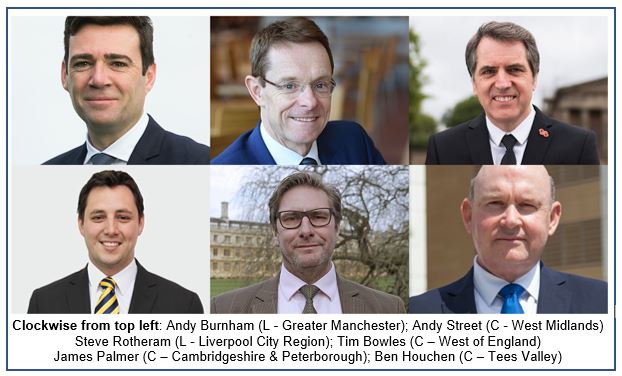
I should also mention probably the newest BMT event – “the first ever international metro mayors summit” held last December at London’s tallest building, The Shard, and part-organised by the independent think tank, Centre for Cities. Its timing suggested that, international aspirations notwithstanding, it was custom-designed for our new Combined Authority mayors – elected only last May, and so possibly uncertain which, if any, of the other get-togethers they qualified for.  And its advance publicity reinforced that impression – featuring a block set of their six headshots.

CA Mayors

I’ve no idea if this latter helped boost attendance, but I do know, because I regularly use a near-identical powerpoint slide, the immediate impression it inevitably conveys: that, if you don’t happen to be a white, 50s-ish, jacket-and-tie-wearing male, then maybe these new, exciting-sounding governmental roles aren’t for you.

Which is unfortunate, and obviously not their fault. Virtually no one predicted the six elections would split 4-2 to the Conservatives.  If they hadn’t, one of the six, or nearly 17%, would almost certainly have been female, which isn’t that shy of the 23.5% for our existing mayors – four out of a grand total of 17.

For us, clearly, mayoral government, launched nearly 20 years ago in the still sunlit days of New Labour, has been the slowest of burners, and, as we turn to the international stage, it’s worth adding some statistical context. Such is the humungous scale of what we still for tradition’s sake call our ‘local’ government that, had the new Government done what some mayorists proposed and required, rather than invited, all English districts/municipalities with populations over, say, 50,000 to switch from their longstanding committee systems to elected mayoral government, we’d still have only about 320 mayors – compared to France’s 36,000, Germany’s 11,000, Italy’s 8,000, Hungary’s 3,000, and so on. True, many of these are indirectly elected or even appointed, but all will be prominent figures and have significant powers in their respective communities, and all presumably are available for Mayoral Get-Togethers – should that happen to be their socialisation mode of choice.

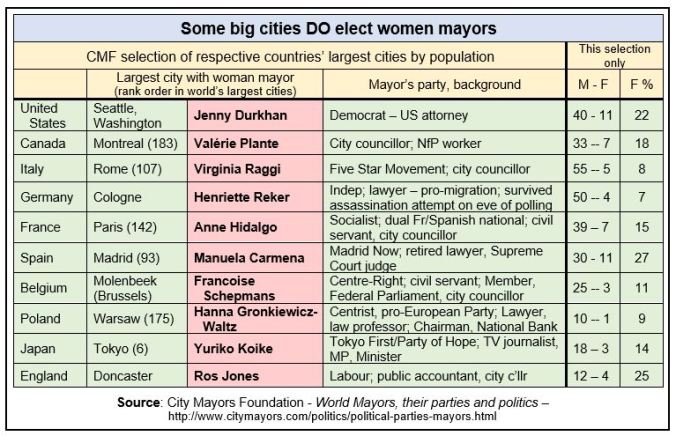
Which leads easily, in my mind anyway, back to the question of what fraction of these thousands are women, and back therefore to the City Mayors Foundation. It’s not primarily a research body and doesn’t do precise number counts, but its estimate is that only 20% of the world’s mayors are women. And its detailed data about individual countries’ local governments enable at least some examination of the proposition that, even where significant numbers of women are elected as mayors, it’s only rarely in their countries’ biggest cities. It is a rough examination – Birmingham, for a start, being confused with the West Midlands – but overall the CMF’s most recent figures are hard to argue with: one woman mayor in the world’s 50 largest cities, five in the 100 largest, and 26 (8.7%) in the 300 largest, which equates to populations of over 500,000.

Women mayors table

My table, based on some of the CMF’s studies of the largest cities in individual countries – most, obviously, way under 500,000 – amplifies these figures in the right-hand columns, but also highlights some of the exceptions. And not least, as my Japanese questioner was well aware, the remarkable achievement of Yuriko Koike’s 2016 election as Governor (the equivalent of Mayor) of Tokyo, recorded at the time in these columns.

So what I was being asked was: if, even in a country with Japan’s still conservative gender role attitudes, a woman can be elected to the top local government post, isn’t a World Mayor Prize open to only a fifth of the world’s mayors, both unnecessary and somewhat patronising?  I admit that, when I first read about it, I myself was rather surprised. I also recalled a Scottish National Gallery exhibition of Modern Scottish Women Painters and Sculptors a couple of years ago that I’d rather enjoyed, but that attracted rather more than just artistically critical attention.  I needed the security of some more directly relevant data.

If these things worked perfectly, the CMF’s estimate of 20% women mayors would mean than the eight rounds of World Mayor Prizes to date – each awarding a main prize and two runners-up Commendations – would have produced two women prize winners and perhaps three commendations. Rather remarkably, they have. The 2005 Award went to Athens Mayor, Dora Bakoyannis – helped by the successful staging of the 2004 Olympics, but also for her fight against the terrorist organisations that in 1989 had assassinated her parliamentarian husband. Winner in 2008 was Helen Zille, Cape Town Mayor, leader of South Africa’s opposition Democratic Alliance, and within a year Premier of Western Cape Province.

That’s the good news, though. The less good is that those two winners plus one runner-up came in the first four rounds, with women taking just two commendations in the four rounds since 2008. If the organisers were getting concerned, they had two options. Fiddle the next contest: possible, in a year-long election conducted entirely through a CMF dedicated website, with readers doing all the nominating and voting, but the organisers all the short-listing and counting. Or, how much nicer, fix the outcome.

This wasn’t quite how I responded to my Japanese questioner. I did, though, indicate that, for essentially the same reasons as I have long supported electoral gender quotas to increase women’s representation in national parliaments, the idea at this time of restricting for one year a World Mayor Prize to women mayors seemed acceptable: regrettable that it was felt necessary, but acceptable.

My only personal condition would be that the CMF urgently consider at least side-lining, this time round, the Prize awarded to the winner – about the most masculin sculpture imaginable: an unambiguously male figure being inspired or overwhelmed by three massive cubes, squares of squares, clearly referencing the male symbol in any genogram or family tree. It makes me wince.

World Mayor Prize sculpture

chris gameChris Game is a Visiting Lecturer at INLOGOV interested in the politics of local government; local elections, electoral reform and other electoral behaviour; party politics; political leadership and management; member-officer relations; central-local relations; use of consumer and opinion research in local government; the modernisation agenda and the implementation of executive local government.

5 reasons why we need a new female leadership paradigm for the public sector

Catherine Mangan

As it’s International Women’s Day, I’m reflecting on the fabulous women I have the privilege to work with as part of the national leadership programmes we convene. One recurring question I’m asked by women (and one that I often ask myself) is whether they ‘fit’ the prevailing paradigm of a leader in the public sector. They have often been told (typically by male colleagues) that they need to act more like a leader – be more assertive, more confident, and speak up more in meetings – in other words, told to act more like current male role models.

This seems to me an outdated view of leadership, which is no longer fit for the complex world of public service. And on International Women’s Day I’m feeling empowered and provocative and (putting aside for the moment the debate about whether male and female styles of leadership map onto being men and women) I’m going to suggest that we need a new, more female paradigm of leadership for public services.

There are (at least) 5 reasons why:

  1. Female leaders, in my experience, not only talk to their staff, and residents, but they actively listen to them. They gather ideas and opinions from others, are genuinely interested in what different people have to say, and create a better solution from working with others. They are also prepared to change their minds. This is not a weakness, but a strength.
  2. They say ‘Come with me’ rather than ‘Do what I tell you’. They take time to explain to people why changes are necessary and offer encouragement and sense making. This is not a lack of direction, but an approach which recognises that change is difficult for people.
  3. They don’t view their role as a competition with other leaders. Rather, they have a level of humility that helps them to understand that it’s not about who can take the credit for the new initiative, it’s about whether it makes life better for their residents. This is not a sign of selling out, or not protecting the interests of your organisation. It’s effective systems leadership.
  4. They don’t think that they know the answer to everything. They recognise the complexity of the world in which they are working and understand that they can’t do everything on their own and need to collaborate with others rather than shying away from revealing a lack of knowledge. Asking others to help come up with potential solutions is the only way to tackle the wicked issues public services deal with.
  5. They have self-doubt about their abilities. This means they ask for feedback, they check out the impact of their approach, and are reflective practitioners who learn from their own practice.

So I say to all those women who think they don’t fit the mould of a leader – don’t try and shape yourself to fit an outdated mould – let’s re-shape the leadership paradigm so it looks a lot more like us.

mangan-catherineCatherine Mangan is Director of INLOGOV, co-convenes the Win Win network at the University of Birmingham, and facilitates national leadership programmes including Total Leadership, Aspiring Directors of Public Health and the National Graduate Development Programme

Why You Get More Than Just a Degree When You Study at INLOGOV

Yulei Lei graduated from INLOGOV last year and reflects on the time she had with us…

As I was finishing my undergraduate studies at my university in China, I decided I wanted to go on to further study. My undergraduate was in accounting, but I decided I wanted to study a topic that would broaden my areas of expertise and that I wanted to come to the UK. Then the most exciting thing happened – I received an unconditional offer to study an MSc in Public Management (taught) at the University of Birmingham.

Like that, in September of 2016, I started studying at INLOGOV at the University of Birmingham. I remember the 22nd was the first day I came to INLOGOV. I still remember how excited I was. That day I met all my classmates who were coming from so many different countries. And the lecturers introduced us to many things which were relevant to my time on the Masters; for example, the modules, the career events, and many other activities on campus. As an international student, my favorite part was the BIA English class and Lunch Time English, which were a complimentary offer from the University to support international students in order to improve their English. It was very interesting and useful.

The modules I took at INLOGOV were divided into two different parts: compulsory core modules, which were Public Management, Performance Management, Strategic Management and a dissertation; and three optional modules – I chose Leadership in Public Services, Regulation and Finance, and Community and Local Governance. I enjoyed all these modules to the point that I could not say which one was best, because all of the modules had a fabulous professional lecturer who would not let the course become boring or tedious. My favorite part of class was group discussion. In this part, you were able to express your thoughts and discuss them with your classmates and lecturer, and they always helped me clear my mind and put forward my ideas. This was very helpful to me because I did not have much experience with practical examples, as opposed to the professors and many of my classmates, who had abundant experience from their jobs. Also, the teaching staff in INLOGOV were very friendly and helpful, they are very open to answering your questions and give you a hand on your assignments. It can figuratively be said that it was as if one were ‘standing upon the shoulders of Giants’ (Isaac Newton).

Group class photo.jpeg

Studying at INLOGOV, what I got was not only a degree, but also many friends from many different countries. We discussed the differences concerning the social situation in our own countries and shared ideas on how to improve things in public management. Then we summarized the good experiences to be used in our own projects. This is a good way to understand optimum outcomes. The module leaders and students can show you different ways of thinking and stimulate your brain to search for and discover many good ways to improve your skills in public services and management. INLOGOV is a department which brings many different cultures together to learn from one and other. Through our group, we exchanged thoughts, expressed ideas and completed projects successfully.

Besides studying, I also took part in some activities with the Student Guild of the University of Birmingham, I met new friends there and learnt new skills, for example how to grow a shrub and how to cut down a tree for gardening management. Moreover, I do love the new 360 sports centre which is the place I also often went to in my spare time. The facilities are new and it has a fabulous swimming pool.

All in all, my year of masters study at the University of Birmingham was very joyful. I met very professional staff and made lovely friends. I acquired lots of new knowledge and learnt lots of skills. I will miss all the things from when I was at INLOGOV, in the University of Birmingham, and in the UK for my Masters journey. Also, I hope I can use what I learnt from INLOGOV in my future career. If possible, I wish to take what I have learnt and apply it in my own country to help to improve the performance management systems in different organizations, not only in the public sector.

Yulei Lei graduation photo (2)Yulei Lei graduated from INLOGOV in December 2017 with an MSc in Public Management. She is from South West China.

Find out more about our postgraduate programmes here.

Children’s Services Spending: Where has the axe fallen?

Calum Webb (University of Sheffield) and Paul Bywaters (Huddersfield University)

Children’s and Young Peoples’ Services, encapsulating children’s centres, safeguarding and social work, family support, services associated with looked after children, often totals nearly £10 billion of spending annually. Despite this, limited attention is paid to how these funds are spent, and much less is known about how such spending has changed over time. Has spending increased or decreased under austerity? Have budgets for front-line services for some of the most vulnerable and voiceless members of society – children at risk of abuse and neglect – been protected, as is often claimed, or axed, in the face of the rising strain placed on local government finances? Where cuts have been made to cope with reduced budgets, where have they fallen? Have cuts to children’s services been greater in more deprived local authorities, as previous research by the Joseph Rowntree Foundation has indicated, further disadvantaging children from poorer communities and with greater needs?

The contradictory findings from government departments does not inspire confidence in their ability to answer any of these questions convincingly. A 2016 report from the National Audit Office concluded that expenditure on children’s services had risen by approximately 12 per cent between 2012 and 2015. This report, however, only looks at a sum of between £1.6 billion and £1.8 billion, and we had no luck replicating this figure – not with any combination of categories or adjustments for inflation.

A more recent report published by the Department for Education came to fundamentally different conclusions, namely that total expenditure had fallen by 9 per cent between 2010 and 2016, and that between 2012 and 2015, the same period covered by the NAO report, spending had reduced from £9.2 billion to £8.9 billion, a 3 per cent reduction.

The problem is partly down to the quality of the data – the inconsistency of categories between years prevents any meaningful long term comparisons of very specific spending areas. A few of the broader spending categories are fairly stable over time, namely spending on looked after children and spending on safeguarding, and the remainder of categories can loosely be considered ‘preventative’ or ‘early intervention’ services. These are the Sure Start centres or family support services that are intended to address the difficulties children in need may face before these problems develop to the point that they require more drastic interventions.

The second major problem with the official reports is the tendency to only focus on changes in the total national levels of expenditure, rather than focusing on what has been happening on a local authority level. All it takes is a few of the larger local authorities, the ‘big spenders’, to see an increase to dwarf many negative trends in smaller local authorities. This approach therefore doesn’t necessarily reflect the reality for children across England.

When we looked at expenditure after taking these things into account we found very clear patterns. The most deprived 20 per cent of local authorities had seen reductions in spending of 25 per cent, whereas the least deprived 20 per cent have had cuts of 4 or 5 per cent. When we split local authorities into three equally sized groups of 50 (the City of London and Isles of Scilly LAs are excluded as outliers), based on their deprivation scores, we found significant differences in the expenditure trends: rapid rundowns of expenditure per child in the 50 most deprived local authorities, less extreme cuts for the 50 ‘middle’ deprived local authorities, and far less severe cuts for the 50 least deprived local authorities. This is in part due to the indiscriminate way in which austerity measures have been introduced, without attention to the fact that more deprived local authorities typically have higher spending per child to meet greater levels of more complex needs. This means a hypothetical 10 per cent cut in Middlesbrough is going to result in a much bigger loss of £-per-child than a 10 per cent cut in Wokingham.

What’s more is that the share of spending across the different services has changed substantially, mirroring patterns in social work practice more broadly. The share of spending has shifted away from the aforementioned preventative and support services in favour of maintaining the share of safeguarding spending and increasing the share of looked after children spending. On average, local authorities spent around 46 per cent of their children’s services budget on more prevention focused services in 2010-11. By 2014-15 this had fallen to only 33.5 per cent. This has been fairly universal across all local authorities, but slightly more extreme in the most deprived third, and is best seen visually.

CW graph for blog feb

We don’t know completely what impact this will have on the lives of children, but we do know that since 2010 there has been evidence of an increase in demand for children’s social services; with average Looked After Children rates increasing from 57.5 children per 10,000 in 2010-11 to 62 children per 10,000 in 2014-15, and the number of children in the population rising by approximately 750,000 since 2010. Furthermore, this population increase has been largely concentrated in the most deprived local authorities (12%) compared to the least deprived local authorities (4%), meaning stable intervention rates – such as rates of children in care – actually represent a substantial increase in workload for practitioners. This is just one part of a complex picture of disadvantage that children living in poverty face. What we do know is that there needs to be a clear commitment to improving the quality and detail of the data that is collected about expenditure and deprivation because, as Ofsted’s Annual Report has acknowledged, there is a link between this and the quality of the services children receive across the country.

The research presented here was funded by the Nuffield Foundation and is part of the Child Welfare Inequalities Project and will be published in Local Government Studies in February 2018. Evidence from the project is being presented to an APPG for Children on the 7th February 2018.

Calum WebbCalum Webb is an ESRC White Rose postgraduate research student at the University of Sheffield’s Department of Sociological Studies. He has recently contributed to the ESRC funded research project ‘Developing a Policy Learning Tool for Anti-Poverty Policy Design and Assessment’ and the Nuffield Foundation funded ‘Child Welfare Inequalities Project’. His PhD research investigates approaches to the longitudinal measurement of multidimensional poverty. Calum tweets using @cjrwebb

Paul BywatersPaul Bywaters is Professor of Social Work at Huddersfield University working in the Centre for Applied Childhood, Youth and Family Research. He has led a series of research projects funded by the Nuffield Foundation and the Joseph Rowntree Foundation which have examined inequalities in the incidence of and responses to child abuse and neglect between and within the four UK countries. For more information can be found here. Paul tweets using @PaulBywaters