Gone Missing – 500 Councillors

Chris Game

I should have been voting this week.  I’m a longstanding Birmingham resident, almost unhealthily fascinated by local politics and particularly electoral politics, and it’s one of the years in our electoral cycle when the metropolitan boroughs, like Birmingham, have elections.  What more to wish for?

A lot, as it happens – but it involves a quick sprint through recent history, starting in 2014.  That was when Communities and Local Government Secretary, Eric Pickles – and a surely coerced Birmingham City Council Labour Leader, Sir Albert Bore – asked Sir Bob Kerslake, chief DCLG civil servant, to review the Council’s governance and organisational capabilities, with a view to increasing its efficiency and effectiveness.

Sir Bob wasn’t impressed, as his report made starkly clear. The Council was dysfunctionally big, visionless and broke, he reckoned, one perhaps secondary but still significant solution to its bigness being to slash the number of councillors from the then 120, giving them even more residents to deal with, and having them all elected in the same year.  Interesting, from an accountant turned career civil servant.

Whereupon the Local Government Boundary Commission piled in, thought it would be fun to have a mix of one- and two-councillor wards, and changed all the boundaries – confusing electors and predictably reducing the proportion of women councillors all in one go.  In case you’re uncertain about the latter assertion, there are currently 27 women councillors in the 32 two-member wards (37%), and just 7 in the 37 one-member wards (19%).

There were protests aplenty, but ministers had spoken, and last May we duly elected our new slimmed-down council.  Which is why Birmingham is the only West Midlands metropolitan council with no elections this week – the other two non-voting mets being Rotherham, which, following its sexual abuses scandal, was required (by Pickles again) to hold all-out elections in 2016 and then every fourth year, and Doncaster, that chose a four-yearly cycle from 2017 to coincide with its mayoral elections.

As you’ll sense, I wasn’t personally terribly enthusiastic about the councillor cull.  But nor did I really, to quote Bob Dylan’s deathless Subterranean Homesick Blues, need a weatherman to know which way the wind blows.  It was blowing, in seemingly increasingly strong gusts, towards ever larger councils and ever fewer councillors. Resistance seems pointless, and the most I can do is to record the trends for the benefit of those who don’t instinctively realise that where Birmingham leads, others invariably follow.

Every local elections season opens, as it will close, with the incomparable analyses of Colin Rallings and Michael Thrasher.  This year, the Local Government Chronicle sub-headlined their preview: ‘The local electoral landscape is undergoing a quiet revolution’.  The scale of that revolution was captured by R & T’s opening statistics: that, whereas four years ago, at the same point in our electoral cycle, more than 9,300 seats were contested in 279 authorities, this week it would be 1,000 fewer seats in 248 authorities.

And the reasons, the causes of the revolution: “some councils being merged or abolished, others having their elections cancelled as they await the same fate, and yet others either moving to a new pattern of elections or having often quite sharp reductions in councillor numbers following review by the Local Government Boundary Commission.”

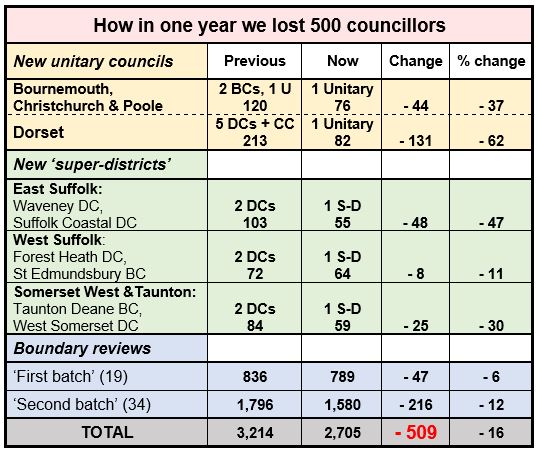
R & T then went on to their ‘round the grounds’ predictions.  I, more nerdily, thought it might be interesting to count the numbers.  Some of the “1,000 fewer” seats are easily explained – like the 116 contested four years ago in Birmingham, Doncaster and Rotherham.  Others, as noted, are awaiting their fate or changing their electoral cycles. But, by my reckoning, we have actually lost at least 500 seats and councillors – perhaps a dozen councils-worth – since 2014.  The Birmingham councillor culling policy is steadily being rolled out across England, but without anyone bothered even to mention, never mind justify, it to us mere voters.

To emphasise: even without change, our councillors have long been expected to represent several times as many constituents as in other European countries, and now, literally year by year, the multiple is increasing as our councillor numbers are steadily cut – through a combination of council mergers and boundary reorganisations.

500 councillors_Chris Game.JPG

This year sees the election in Dorset of two new unitary councils in place of the former county, two boroughs, five districts, and a unitary – and a cut in councillor numbers of over half: 333 down to 158.  Plus three new ‘super-districts’ in Suffolk and West Somerset, councillors there reduced by a mere third, from 259 to 178. Next year it’s the turn of Buckinghamshire (county council-promoted), Northamptonshire (imposed punishment), and possibly others.

Which brings us to the Local Government Boundary Commissioners, who make all these decisions.  They conduct reviews of English local authorities to improve levels of electoral equality, ensuring all councillors represent approximately the same number of electors.  But theirs is an odd equality: applying only WITHIN individual authorities, with no comparative reference whatever even to neighbouring councils.

And here’s the other thing.  The Commissioners’ statutory criteria include promoting “effective and convenient local government” – but for whom?  Do councillors invariably work more effectively having responsibility for hundreds more residents?  And do these residents always find it more convenient having so many fewer councillors?  Because that’s how it almost always works out nowadays.

This week 53 ‘new’ post-review councils are being elected, like Birmingham last year. In the most recent ‘batch’ of 34 reviews, the councils started with 1,796 councillors.  Rutland increased its councillor numbers from 26 to 27.  The other 33 ended with 217 or 12% fewer – all in the name of more equal, effective and convenient local government.  Interesting!

chris gameChris Game is a Visiting Lecturer at INLOGOV interested in the politics of local government; local elections, electoral reform and other electoral behaviour; party politics; political leadership and management; member-officer relations; central-local relations; use of consumer and opinion research in local government; the modernisation agenda and the implementation of executive local government.

The views expressed in this blog are those of the author and not INLOGOV or the University of Birmingham.

Chance to Shape a Healthier Future

By Ketan Sheth

The announcement that plans to close Ealing and Charing Cross A&Es will no longer go ahead was not a surprise to those of us who work closely with the North West London NHS. In recent meetings in public, they have been very open about the fact that they were reconsidering their plans given the lack of available capital and the context of the new NHS Long Term Plan.

What was a little surprising was the way in which the news was broken. It seemed odd for the Health Secretary, Matthew Hancock, to make the announcement on the 26th March 2019 in response to a parliamentary question from an MP. It was clear on the day that many in the NHS had not been made aware of what Mr Hancock was planning to say. We hear much from the government about the importance of the NHS and local councils like mine working together in partnership to develop plans for services in their area. Most of us are doing what we can to support this. Making an announcement like that over all our heads was not a very good example of such partnership working.

Nonetheless, the NHS decision to shelve those parts of the Shaping a Healthier Future programme that had caused most public controversy does give us a real opportunity to move forward together in North West London. There are major challenges facing health and social care across our eight boroughs and neither the NHS nor local authorities can resolve these alone.

Making sure all of us get the care we need and that the right staff are there to deliver it are matters that should concern us all. If you add in the problems of crumbling buildings and lack of money – the North West London NHS has a massive problem with its estate, with some of our hospitals close to falling down – then you can see there is an agenda where local authorities and NHS leaders should be working together. And government support will be needed too.

It is not all doom and gloom. Despite the lack of money, there are real opportunities to work with local people to improve their health. We should be working together to keep people well, to make sure they don’t keep having to provide the same information to numerous doctors and nurses and to help them navigate a health and care system that can seem very complex. Better support for our children and young people, the frail, elderly and people with mental health issues or long term medical conditions are areas where the NHS and local boroughs need to cooperate closely to have any chance of success.

And if we can make our local residents active citizens – both physically and in terms of helping to shape and improve their local services – then we have the potential to deliver real and lasting change for our residents.

The proposed A&E closures were always a divisive and difficult topic. The local NHS is clear that the decision not to go ahead with them does not mean that nothing will change. The scale of the challenges we face is too great to say that. But while some difficult decisions will still have to be made, we should now see a real opportunity to work together to make our local services the best they can be – and actually shape a healthier future for local people.

ketanKetan Sheth is Councillor for Tokyngton Wembley and Chair of Brent Council’s  Community and Wellbeing Scrutiny Committee.



All views in this blog are those of the author and not those of INLOGOV or the University of Birmingham.

Winter Pressures: Why it’s not just a problem for the NHS

By Cllr. Ketan Sheth

The term ‘winter pressures,’ is a phrase we hear regularly at this time of year as hospitals struggle to meet demand. But what does it mean in practice? That’s what my scrutiny committee wanted to find out when we discussed this issue earlier in the year.

It has, for many years, been commonly perceived that winter pressures are the NHS’s problem. But is this really fair given we serve the same communities and the pressure on health and social care are significant?

In response, Brent Council, Brent Clinical Commissioning Group and London North West University Healthcare NHS Trust have teamed up to address the problem in recent years.

It is no small challenge as parts of Brent are among the most deprived places in London, and Northwick Park Hospital is one of the busiest A&E departments in the capital. Early planning and a co-ordinated cross organisational approach have helped us shape a robust winter plan that maintains patient experience, safety and clinical effectiveness during the most demanding period of the year.

This planning began with lessons learnt during the winter of 2017/18, which were subsequently built into our current plan. It boils down to keeping people out of hospital; ensuring patients who are admitted are treated and discharged quickly (and safely); and provision of adequate home support in the community.

Brent CCG responded by giving patients access to GP appointments from 8am-8pm seven days a week via a network of GP hubs. The hubs play a crucial role in curbing the number of people going to A&E with minor ailments. Their use rose by 42% between Oct-Dec 2017 and the same period a year later. The CCG also provided an enhanced service in care homes, a targeted approach to flu vaccinations and developed a closer working relationship between acute and primary care providers.

The Department of Health provided the council with a one-off payment of £1.3M to support hospital discharges. It ‘purchased’ an additional 15 beds, provided reward payments to care homes that could quickly assess and accommodate patients as well as provide an additional handyman service for home adaptations. It also invested in additional social worker, OT and co-ordinator capacity to boost its Home First initiative to get patients home with the minimum of delay.

Ambulance handover times between crews and A&E staff at Northwick Park Hospital has improved and benefited from an additional paramedic/nurse to assist with triage and advanced assessment triage area.

These plans have helped but under pinning it all is the dedication and hard work of staff on the front line.

The reality is that we face a growing population that is living longer and increasingly troubled by a host of long-term conditions. The only way we can manage this, aside from promoting greater personal responsibility for health, is for the public sector and its partners to develop a healthy working relationship, which recognises this is everyone’s problem.

ketanKetan Sheth is Councillor for Tokyngton Wembley and Chair of Brent Council’s Community and Wellbeing Scrutiny Committee


All views in this blog are those of the author and not INLOGOV or the University of Birmingham.

Why one size does not fit all: addressing the requirements of the public service leader

Stephen Jeffares

One of the key roles for Apprenticeship Week is to raise awareness of what is a relatively new form of qualification: the higher degree apprenticeship. For many years aspiring public service leaders have returned to university to study for a master’s degree. For many years this was generously funded by their organisation. However over the last decade successive austerity budgets have dramatically impacted on employer funded higher degrees. Here at INLOGOV we’ve seen the balance shift from employer to employee funded degrees. Public managers seeking that next challenge have resorted to self-funding. It has required managers to study in their spare time and take annual leave to attend campus sessions.

The arrival of master’s level degree apprenticeships offers a whole new model, a whole new opportunity. Public managers can now study for a postgraduate degree funded by their organisation’s “use it or lose it” apprenticeship levy pot. There’s a growing number of degree apprenticeships and university providers to choose from.

Of interest to aspiring senior leaders is the “Senior Leader” apprenticeship. Developed by public and private industry the standard describes the knowledge, skills and behaviours required of a senior leader. If you take a moment to read some of these 15 capabilities none will be out of place in the person specification for a chief executive of a large public organisation.

With more and more providers starting to offer degrees mapped to the new Senior Leader Apprenticeship it is important to recognise they are not all the same. Some are offered by large business schools, or traditional broad-spectrum research-intensive universities, or providers with a track record of working with mature students or innovative teaching methods.

Applicants we speak to are mostly concerned with the location of the university, the structure of the programme, and the reputation of the institution. However, another factor is the preference of the employer. Some are happy to work with a range of providers, while others want to keep it simple and work with one provider or to develop partnerships with their local universities.

As a provider of public management degrees for over 30 years, we at INLOGOV saw the development of a degree based on the Senior Leader standard as a natural transition. The Senior Leader standard set us the following challenge – how to create a programme that would equip our next generation of public service senior leaders. Whilst we recognise managerial reform has led to some blurring of public and private sector management, there are unique challenges facing public leaders that necessitates a tailored approach. Our research clearly demonstrates that effective leadership in the political environment of the public sector requires more than a generic set of management capabilities.

This challenge has led us to design and build a programme that connects the senior Leader standard with cutting edge public management research and real-world cases.

Our programme is based on three key design elements.

First is a set of six modules addressing critical public management issues, whilst also considering the required capabilities of the Senior Leader standard. Our programme addresses a broad range of important topics including public management, governance, leadership, evidence, digital, commercialisation, finance, strategy and performance (you can read more about our programme here).

Second is building the flexibility of blended learning to deliver much of the core content through a Virtual Learning Environment, thereby reducing the time spent passively learning in lecture theatres and allowing learners to fit their learning around their schedule.

Third is to retain a campus experience. Senior leaders need networks that extend beyond their own organisations or localities.

All this means participants can graduate with a dual award – both an MSc in Public Management and Leadership and a Senior Leader apprenticeship.

jeffares-stephenStephen Jeffares is Senior Lecturer in Public Policy at INLOGOV and co-Director of the Public Management and Leadership Degree Apprenticeship alongside Louise Reardon, Lecturer in Governance and Public Policy at INLOGOV.

If you are interested in joining a growing number of public agencies investing their levy in senior leadership please contact our Degree Apprenticeships Facilitator Kulvinder Buray ([email protected]). We are currently recruiting for our September 2019 start.

Using learning technologies to support our degree apprentices

Paul Dyson

An important feature of our Public Management and Leadership Degree Apprenticeship is its blended format – with learning facilitated through a combination of online and face-to-face delivery. This format provides much needed flexibility for both the apprentice and their employer.

The University of Birmingham is well placed to offer a blended learning experience. The University’s high quality teaching was awarded Gold in the Teaching Excellence Framework, and INLOGOV has recently pioneered a 100% online Distance Learning Masters of Public Administration. We are therefore able to combine these two areas of expertise into a first class blended learning experience.

Both online and class-based learning is managed through ‘Canvas’; the University of Birmingham’s Virtual Learning Environment (VLE). Each module has its own dedicated Canvas page. Each page includes all of the learning materials for each week of the module, and links to related reading materials. Throughout the programme, module convenors will interact with and support their students through Canvas as a complement to on-campus activities. Moreover, throughout the module a student forum is available for students to ask questions.

Our online content is designed to ensure it is engaging and inspiring in order to enhance the learning experience. For example, discussion boards are a key element of our online teaching and learning. On these boards, module convenors pose questions and topics, and apprentices are asked to respond and react to each other’s views and ideas, drawing on their own work experiences and learning. We also use interactive scenarios, exercises, quizzes, interactive diagrams, videos and case studies to help develop student learning.

We also use a software called Big Blue Button to host live online interactive lectures within modules and to hold academic skills sessions. The playback functionality on these platforms means that live lectures and seminars can be recorded so that those who were not able to join in live do not miss out, and enabling learners to have a programme-long resource.

It is not just in the taught component of the apprenticeship that we use technology to support our learners. All degree apprenticeships are predicated on the need to develop a portfolio that provides evidence of the apprentice’s development journey. This portfolio contains a record of the candidate’s evidence claims against national standards.  During the course of the apprenticeship programme the apprentice is required to keep a record of their evidence claims as they accumulate over time.

Here at the University of Birmingham we use PebblePad to capture evidence claims that can be mapped to the appropriate standards. This versatile software allows the learner to not only record their evidence claims but also reflect upon how these were achieved. Each portfolio has also been designed to encapsulate all the necessary record-keeping that is associated with the apprenticeship programme. This includes maintaining a digital record of progress reviews, commonly referred to as tripartite meetings, as well as providing an authentic time-stamped record of how an agreed allocation of training hours are met.

The PebblePad portfolio is an essential digital companion that supports the apprentice through to their end point assessment. Its contents ultimately showcase work achieved over the duration of the programme together with digital artefacts that demonstrate skills gained and professional behaviours exhibited. These artefacts can include video evidence, audio accounts, presentations and blogs.

Apprentices can also enjoy the benefits of the PebblePad mobile app. This app allows for the spontaneous collection of naturally occurring evidence which can in turn be sync’d back to the desktop application.

Technology plays, and will continue to play, an important role in both the undergraduate and postgraduate apprenticeship experience.

Paul DysonPaul Dyson is an Instructional Designer for the College of Social Sciences, University of Birmingham. He works closely with INLOGOV to design and develop online content and PebblePad functionality for the Public Management and Leadership programme.

Want to learn more about our Programme? Contact Kulvinder Buray our Degree Apprenticeships Facilitator: [email protected] 

An Apprentice’s View…

Robert Ellam

I’ve been doing the Public Management and Leadership apprenticeship course for around six months now, and it’s going well so far (I think).  It’s not easy, but perhaps that’s a good sign!

I’ve been a manager for a little over four years, and a leader for far longer than that (yep, it’s not just managers who are leaders).  I’ve found that moving in and out of a leadership role has suited my natural style well – I’m quite prepared to lead when I see that it’s needed, but equally I’m happy to let people get on with it where leadership isn’t needed, or when there is good enough leadership in place, and I rarely solve people’s problems for them either as a leader or a manager.

When I first joined Suffolk County Council, I was fairly sure that I would have to become a manager at some point – having seen various managers and leaders who I thought did it poorly, I was determined to try to get it right.  While I’m not sure I’ve always managed to get it right (boom boom), I’ve tried to learn from those failures.

Because of this, I started taking careful notice of good and inspirational leaders and managers whose approach I saw something good in, and who I thought I could learn something from. I was probably doing it before joining the council, but that was the first time I’d started doing it consciously.

The opportunity to do the apprenticeship came at an opportune time when I was thinking about the next step in my career, and I was really keen to have the dedicated space it provides to understand why I and others lead as we do, see other ways of leading, and think about what I can improve on in my practice.

Robert EllamRobert Ellam is a Business Intelligence Manager at Suffolk County Council and an apprentice on our Public Management and Leadership Programme.

Want to learn more? Tomorrow, Thursday 7 March at 12 noon, we are hosting a live webinar to outline the programme in more detail. Click here to sign up.