Not a blizzard, just Pickles’ latest battlefield

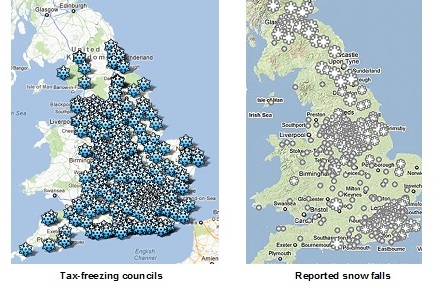
My first thought, when I glimpsed it in a CLG departmental press notice, was that there had been a Conservative power grab within the Coalition. What looked for all the world like a snow report map suggested that Eric Pickles had snatched the Met Office away from the Lib Dems’ Vince Cable at the Department for Business Innovation and Skills, and, having sorted out local government, was turning to the weather and climate control.

The truth, sadly, proved more mundane. It was simply the Secretary of State’s latest move in his battle to bully local authorities into freezing or cutting their council tax next year, and the snowflake-covered map recorded the more than 300 who have so far apparently agreed to do so – each crystalline flake ingeniously representing a virtuous ‘freezer’.

Image

I really feel I must be getting soft in my old age. I have spent much of my academic life explaining to students, councillors, overseas visitors, and indeed anyone who’ll listen, just how centrally controlled and ministerially dominated our local government system is. Yet I’ve still found myself surprised at the lengths to which ministers have gone, at the duplicity of their arguments, and the intemperance of the language they’ve used, in this particular campaign over what, after all, was supposed to be one of those offers you could refuse.

I blogged about it back in January, during Pickles’ early attacks on councillors, when he tried to argue that it was not only their political responsibility but their moral duty to vote against a council tax freeze – even if, in doing so, they would be consciously leaving their council facing a funding shortfall and even higher tax increases in future years.

Ministers then, in quick succession: (1) claimed that the Government’s offer of funding for a 2012-13 freeze had been deliberately designed to limit the growth in councils’ tax bases – though no mention of it was made at the time; (2) confused this new position by suggesting that ongoing funding for the 2011-12 freeze might be protected beyond the current spending review period; and (3) anticipated a possible rule change, whereby councils raising their tax would not be permitted to keep their new tax base next year.

At the same time, having attacked the integrity of councillors, Ministers switched to questioning the professionalism of officers. Chief finance officers who advised their members to put up council tax were likely to be doing so with the intention of “filling the town hall coffers”, and risked involving themselves in politics. Now, through CLG press notices, we’re being treated to almost daily bulletins not merely reporting, but applauding, each new council of any political complexion that signals its intention to freeze or cut its tax.

Part of the reason for recalling these developments is that they coincided neatly with the publication of an interesting report – 2012 Reform Scorecard – from the centre-right think tank, Reform.

The report is an assessment of the achievements of the Coalition Government’s public service reform agenda during 2011, and the scorecard takes the form of an almost CPA-style assessment of the progress made, or not made, by each of the relevant Whitehall departments. “Real reform” has been achieved, the report reckons, by Justice – “has made the best arguments for competition of any department, and translated them into action”; Defence, with the Levene Review – the shining example of Civil Service reform across government”; and, perhaps surprisingly, by the Home Office, with its policing reforms.

At the other end of the spectrum are the departments judged to be “Going Backwards”: Health – “The Government’s original reforms were flawed and 2011’s retreat from reform has made them worse”; Higher Education – “greater freedom to set tuition fees has been overshadowed by market distortions and tighter restrictions on universities”; and HM Treasury – “ring-fencing of the health and schools budgets has put a handbrake on reform and efficiency in those sectors”.

In between these extremes are the departments assigned to a category initially proposed for the CPA, but later abandoned – “Coasting”.  One such department, by the process of elimination, is CLG. The Reform report has both positive and negative things to say under each of its main headings – Accountability, Flexibility, and Value for Money – but its overall assessment can be summarised as follows (pp.41-42):

“The Government’s rhetoric [on localism] has sent an important signal that it is willing to give councils the flexibility they need to deliver services as they see fit”.

Yet this ostensible commitment to localism has been repeatedly undermined by attempts to exercise power over local issues from Whitehall. The Communities and Local Government Secretary has repeatedly called upon councils to maintain weekly bin collections, terming them ‘a basic right’ and creating a £250 million fund to support weekly collections. The Prime Minister, David Cameron, has circumvented local responsibility on the issues of adoption and problem families. In November, the Chancellor announced the extension of a freeze on council tax until 2012-13, mitigated by £675 million worth of funding support for councils to maintain levels of council tax.

“These attempts to impose central controls and pressure over essentially local issues subvert local responsibility and flexibility and firmly enforce Ministerial and bureaucratic responsibility in the place of local democratic accountability” (emphasis added).

And that, of course, was written before Ministers had even started implementing their ‘voluntary’ freeze.

Chris Game

Chris is a Visiting Lecturer at INLOGOV interested in the politics of local government; local elections, electoral reform and other electoral behaviour; party politics; political  leadership and management; member-officer relations; central-local relations; use of consumer and opinion research in local government; the modernisation agenda and the implementation of executive local government.


Huge Whitehall battle over mayoral powers, reveals Heseltine

There was no camouflage flak jacket, no ceremonial mace to brandish, no Downing Street front door through which theatrically to exit a ministerial career, but who needs props, if, like Michael (now Lord) Heseltine, you’re one of the great headline-makers of your political generation. He managed it again at last week’s University of Birmingham Mayoral Debate, and against the odds.

For a start, the event seemed set up more as a rally than a debate – bringing together “leaders and representatives from business, education, politics, and the community, to discuss the benefits that an elected mayor could bring to Birmingham”.  Once Catherine Staite had set the scene and identified some of the key arguments , the views of the remaining speakers – Lords Heseltine and Adonis, and CBI Regional Director, Richard Butler, a late replacement for Petra Roth, elected mayor of Frankfurt, one of Birmingham’s partner cities – ranged, though not in order of speaker, from enthusiasm to evangelism.

Mayor Roth’s absence was unfortunate.  By comparing her own experience – Mayor since 1995, and previously a member of the Hesse Land (state) parliament – with the varying powers and responsibilities, terms of office, election and recall provisions of Germany’s other major city mayors, she could have broadened the discussion and maybe even provided a headline or two. Instead, Patrick Wintour, Political Editor of The Guardian and Chair of the debate, looked to and was well served by Lord Heseltine, British politics’ answer to Sunset Boulevard’s retired silent-film star, Norma Desmond: “I’m still big; it’s the stages that got smaller”.

The prompt was a question from Councillor Sir Albert Bore, former Leader of Birmingham City Council, Leader of its now minority Labour Group, but here a mere member of the audience.  One of Labour’s earliest and strongest mayoral supporters and an aspiring future candidate, Councillor Bore asked when Ministers were going to indicate explicitly the additional powers that could be transferred to cities voting for elected mayors in the May referendums: “The Government should come clean about what powers are on offer [to mayoral cites]. If they are no more than to a current council leader, they risk losing the referendums to a No vote”.

There was no imperative for Lord Heseltine to say anything of substance. He could have treated the question as rhetorical, or left it to the other panellists – but, of course, he couldn’t resist. He couldn’t, he confided conspiratorially, reveal too much, and indeed he didn’t. He said enough, though, to give Patrick Wintour his headline: Whitehall battling to avoid losing power to mayors, says Heseltine” .

There was a “huge battle” among Ministers, Heseltine intimated, over how much extra power should be granted to elected mayors across almost all relevant functions: money raising, transport, welfare, strategic planning, and economic policy. Some ministers – and no doubt their civil servants – aren’t keen on transferring anything of significance. The Lib Dems further complicate an already dual-track policy deriving from different sections of the Localism Act. Pro-decentralisation, but anti-mayors, they want devolved powers for any city able to make a case, regardless of its form of governance. Cameron, according to Andrew Rawnsley in Sunday’s Observer, doesn’t want anything too radical, that could be attacked as yet another U-turn.  Oh yes, and the theoretical enforcer, Greg Clark, Minister for Decentralisation and Cities – responsible for the ‘City Deals’ policy that is the chief source of grief for Councillor Bore and other mayoralists – isn’t even able to punch the weight of a full Cabinet member, let alone take on the PM.

City Deals were introduced in last December’s Cabinet Office prospectus, Unlocking Growth in Cities – . The Government would work with individual cities to achieve a series of genuine two-way negotiated agreements that would enable cities to do things their way. The prospectus accordingly set out an “illustrative menu of bold options” (pp.8-9) that Ministers would be willing to discuss as part of the deal-making process – greater freedoms to invest in growth, the power to drive infrastructure development, new tools to help people acquire skills and jobs. In return, where cities wished to take on significant new powers and funding, “they will need to demonstrate strong, visible and accountable leadership and effective decision-making structures” (p.2 – emphasis added) – this last clause being universally understood as code for having an elected mayor.

In addition, “other than as part of a city deal negotiation, the Government does not intend to reach any view about specific powers that might be devolved.” (para.10 – emphasis again added)

The logic is sound, and the localist intent probably sincere. A mayoral system and the mayor (or leader) personally will determine the details of any city deal; the system will be determined by the referendum; so the content of the eventual deal cannot be known, let alone announced, before the referendum. Councillor Bore’s point, however, is equally irrefutable: without knowledge of the nature of the deal, voters may lack the incentive to vote for a mayoral system in the first place.

So is there a way out of this closed circle, or ways of signalling to voters the kinds of powers an elected mayor could bring to their city? Perhaps. First, Whitehall hostilities notwithstanding, the Government could do – maybe in the March 21st Spring Budget – what many were hoping for in its January response to its mayoral consultation, What can a mayor do for your city?, and give some indication of what mayoral cities specifically might expect from its “illustrative menu” of city deal options.

Though not comprehensive – with no mention of additional sources of revenue funding, or of police and fire services, for example – it was a wide-ranging list, much too lengthy to be reproduced here. However, it included: a single consolidated capital pot, rather than multiple funding streams; access to an additional £1 billion Regional Growth Fund; new infrastructure funding through Tax Increment Financing; devolution of local transport major funding and responsibility for commissioning rail services; devolution of Homes & Communities Agency spending and functions; and the creation of City Apprenticeship Hubs and a City Skills Fund, enabling adult skills to be tailored to the needs of employers.

No matter how enticing the list, though, it doesn’t in itself answer Councillor Bore’s question. The closest we can get to that is the one mayoral city deal that has been negotiated and publicised so far – with Liverpool. The Labour Council are bypassing the referendum process and moving straight to the election of a mayor in May, and have negotiated a deal that the Leader, Joe Anderson, hitherto a critic of a purely city mayor, feels is something both to shout about and campaign on.

The key elements of the Liverpool deal comprise:

  • A new Environmental Technology Zone, with the resulting growth in business rate income going to the LEP and five priority economic development areas (Mayoral Development Zones), and the Government prepared to add a further £75 million for economic development backed by a strong business case;
  • A Mayoral Investment Board to oversee the city’s economic and housing strategy, pooling Home & Communities Agency and other local land assets to drive economic growth;
  • Welfare Pilots, developed in collaboration with the Department for Work & Pensions, to deliver a programme of support for young people leaving the Work Programme, and a ‘Youth Contract’ pathfinder;
  • A Secondary School Investment Plan to build 12 new secondary schools, to help support the local economy and skills agenda.

The total package, according to the Council’s report, could bring the city close to £1 billion.  Multiplying up for Birmingham, with more than double Liverpool’s population, gives a number that will surely strike most people as rather more than “a few crumbs from the Westminster table” – to quote Lord Digby Jones’ recent dismissal of the value of a city mayor (Birmingham Post, March 1). Obviously, it would help mayoral campaigners and voters alike, if Ministers were prepared to support the policy they are pushing on cities with something more explicit and authoritative, but even now we have a lot more material to work with than just a few months ago.  


Chris Game

Chris is a Visiting Lecturer at INLOGOV interested in the politics of local government; local elections, electoral reform and electoral behaviour; party politics; political leadership and management; member-officer relations; central-local relations; use of consumer and opinion research in local government; the modernisation agenda and the implementation of executive local government.
An elected mayor for Birmingham?

On May 3rd, the people of Birmingham will decide if they want a directly elected mayor and if so, on 15th November they’ll decide who they want. There has been so much debate about what an elected mayor could achieve for Birmingham and the West Midlands, perhaps it is a good time to look at the evidence and compare it to the aspirations.

Do mayoral authorities perform better? Audit Commission performance data show that some mayoral authorities did improve significantly between 2005 and 2007. For example, North Tyneside and Hackney rose from ‘poor’ to ‘3 star’. This may well demonstrate the benefits of strong leadership and accountability for councils which historically had poor political leadership but correlation is not the same as causation. Many non-mayoral authorities also improved at the same time and there were exceptions to the pattern of improvement in mayoral authorities.  Doncaster and Stoke spring to mind.  Stoke is a complex story  but Doncaster is a classic example of how poor leadership and bad behaviour on the part of an elected mayor can undermine a town – whose residents turned to an elected mayor in the hope of a new start but merely replaced widespread corruption with wholesale under-performance and negligence.

Does directly accountable leadership make a difference? Research suggests that mayors have been able to use their personal leadership to good effect but so have the leaders of non-mayoral authorities.  Some cities and city regions such as Manchester and Leeds have done well in spite of not having a mayor. 

What can a mayor do for Birmingham and the West Midlands? Birmingham has long been perceived as an underperforming city, partly because of local political and economic history and partly because of regional issues such as a traditional resistance on the part of the other six  West Midlands councils to Birmingham exerting ‘too much’ influence. You can hear the hackles rise as potential mayoral candidates set out their region-wide ambitions for the role.

Cities are complex constructs: where does the city of Birmingham end and the West Midlands region begin? Many proponents of the benefits of elected mayors, such as Lord Heseltine, who has been making the case since 1991, and Lord Adonis talk about the benefits of regional or metro-mayors.  But that isn’t the model we’re getting here, in contrast to the role of the Police and Crime Commissioner, who’ll be elected on the same day with a region-wide remit.

What can mayors do? The powers of mayors under Local Government Act 2000 are limited: to be elected for four years, to decide the size and membership of the cabinet and delegation of powers and to set the budget and strategic policy framework of the council, which can be rejected by a two thirds of the council members.  Hardly a demagogues’ charter!

So what can a mayor do for Birmingham that a council leader can’t do? Under the Localism Act 2011, the Coalition Government is planning to devolve some ‘local public functions’ to councils. Cities will bid for new powers and freedoms on; economic growth, infrastructure, housing, planning and skills and employment.  Cities with mayors will automatically be considered for these new powers and freedoms because they can demonstrate ‘strong, accountable leadership’ – but they will not be granted automatically.

Might it be better to focus attention on the local, regional and national barriers to achievement in Birmingham and the West Midlands and tackle them collectively, rather than expecting the mayor to overcome them alone by heroism and enormous force of personality?  It’s a big ask.

Catherine StaiteCatherine Staite (Director of INLOGOV)
Catherine provides consultancy and facilitation to local authorities and their partners, on a wide range of issues including on improving outcomes, efficiency, partnership working, strategic planning and organisational development, including integration of services and functions.

Have public sector leadership programmes failed so badly?

From the late 1980’s a new sub industry emerged in the UK public sector, mass sector wide leadership development programmes. The Health sector was well and truly into this game by this time with huge programmes developing future leaders and the local government sector followed swiftly behind. The very best of these programmes were based upon the assumption that investment was needed to ensure a steady supply of fit for purpose leaders and good, imaginative national programmes attracted an interesting cadre of supporters and participants, some who signed up were clearly ambitious and needed successful participation in these programmes on their CV’s to be even considered for the next job up the organisational scale, others were, on reflection pushed on these programmes to ‘cure’ them of old habits or wake them up to rapidly changing circumstances.

Did they work? Well the evidence is mixed but some who participated on these programmes are now in the top jobs and others have sunk without trace. But was the programme itself a key determinant of success? Perhaps they were destined to have sharp inclines on their career trajectories anyway and the programme was at best incidental in helping them get there. But in a world where every last penny is squeezed out of budgets to fund the front line services and the best development on offer now which incidentally is free (just browsing the net?) as the remaining option means we might be missing a trick? The research evidence on how people get into top jobs is a bit hazy – the best we can glean from it is twofold – getting early experience of project based corporate working and that past performance (whilst not always the most reliable predictor) remains as the best predictor of future performance. There have also been a few interesting hiccoughs upon the way – the National College for School Leadership was a brave if not brazen attempt to demonstrate that professional classroom competence was just not enough to lead a complex entity such as a school – even if they seem to have succumbed to the magnetic pull back into professionalism as opposed to true leadership – and the National Graduate Programme for Local Government has had a bit of a stop/start journey to where it is today.

But now, as we are hollowing out many of our public sector organisations – senior strategic staff are doing the administrative work because all the expensive administrators and middle managers have been made redundant we need to find a way of bringing these hungry, ambitious and talented people out of their shells and help them find ways of transforming our public bodies. Doing it by ‘browsing the net’ will not work. Leadership development is about carefully planned and facilitated constructive socialisation – it is not about reading and knowing more about leadership theory (as interesting as that is anyway) but unless we can find the development opportunities, at the right cost, in the right place and at the right time we are running the risk of facing all the same problems we were dealing with a quarter of a century ago.

The Centre for Leadership at the University of Birmingham (CLUB)  is starting to open up this debate once again – can we find a way to rethink leadership development and inspire, not ignore those who are on the steep career trajectories? We think there is a way – keep watching this space. Leadership development cannot be done without some investment in time and energy as well as a modest financial contribution. We need to bring those people who are genuinely striving to become better leaders together, they need to spark off each other, test out their ideas and clarify how they impact upon those they are there to lead. As someone once said “Leadership – it’s a contact sport and not a virtual reality”


Ian Briggs - Inlogov

Ian Briggs (Senior Fellow)
Research interests lie in The development of effective leaders, leadership assessment and the identification of potential; Performance coaching, organisational development and large scale leadership development interventions; Organisational change and the establishment of shared service provision.

The end of Winterval? Don’t bet on it.

The last Valentines have been sent, the last Chinese New Year firecrackers ignited, the last pantomime cast dispersed – even from Bradford’s glorious Alhambra, where Robin Hood was outlawing away well into February.  In short, Winterval is indubitably over, and here in Birmingham, just possibly, over for ever. Not, please note, over for good – not as far as I’m concerned, anyway. PR disaster though it became, I liked Winterval.

I liked it back in 1997, when it was launched by the then Labour City Council, for its brief two-year lifespan.  It seemed an imaginative, inclusive and surely innocuous idea.  And, 13 years later, it still does – notwithstanding that, towards the end of every one of those years, rent-a-quote Tory politicians, publicity-seeking church leaders, and our agenda-driven, fact-careless media have used Winterval myths to mock the alleged PCGM (Political Correctness Gone Mad) of Birmingham Council in particular and local government in general. For that’s what Winterval became: not just an innocent idea pointlessly destroyed, but a long-running urban myth.

Like most effective myths, Winterval was not totally invented. Rather, it started as an unremarkable, and largely unremarked, initiative, which subsequently gained folkloric status by continual exaggerated and distorted retelling. There never was any proposed ban by ‘barmy Brussels bureaucrats’ of straight, or any other shape of, bananas; but yes, there was a European Commission regulation categorising bananas partly by their curvature.

Similarly, Birmingham City Council never proposed renaming, demeaning, let alone abolishing or banning Christmas (as if it could). But yes, it did for two years use ‘Winterval’ – a conjunction of ‘Winter’ and ‘festival’ – as an umbrella marketing strategy to promote, collectively as well as individually, the numerous religious, secular and commercial events taking place over the three-month period from, in 1998/99, Halowe’en, Guy Fawkes Night and Diwali,  through the switching-on of the Christmas lights, the Frankfurt Christmas market, Advent, nativity plays and carol concerts, Hannukah, Ramadan and Eid, Christmas, Boxing Day, and New Year’s Eve, to the January sales and the Chinese/Lunar New Year, which in 1999 fell on 16th February.

It’s how, and how extensively, this actuality was distorted into the destructive and apparently unstoppable Winterval myth – “Birmingham rebrands Christmas” – that provides one reason for revisiting it here: not because it’s exceptional, but precisely because it isn’t.  Local government suffers at least as much from this alarmist myth regurgitation as the EU and the Health and Safety Executive. Both these bodies have tried everything to quash unfounded, and potentially scary, myths – from systematically documenting their falsity to producing website lists of the most bizarre – but still they’re regularly trotted out by lazy journalists or motivated malevolents.

Local government has faced the very same problems over the years – from Baa Baa Green Sheep and manhole-renaming allegations in the Loony Left 1980s to David Cameron’s imagined conker bans in school playgrounds.  The one unusual feature of Winterval is that, thanks largely to the diligence of media blogger and tweeter, Kevin Arscott, we have a comprehensive chapter-and-verse account of who the myth-perpetrators were, from which much of the following summary is taken.

 Before examining the myth, though, here are a few Winterval facts:

  1. Birmingham City Council (BCC) did not coin the term, but it was the first body to use it on a large scale. It was not devised to avoid offending, or following pressure from, Muslims or any other faith or non-faith groups, but, as noted above, as a marketing strategy, by the Council’s Head of Events, Mike Chubb.
  2. The first Winterval was over Christmas 1997/98. It was widely welcomed, enjoyed, judged successful, and not one critical media story was recorded.
  3. The first media attack on what proved the final Winterval – “a way of not talking about Christmas” and thereby offending “people of other faiths” – came in November 1998 from the then Bishop of Birmingham, Mark Santer, in his diocesan Christmas message. The Bishop was quoted in the Birmingham Sunday Mercury as accusing BCC of censoring Christianity and “replacing Christmas”, which quickly went the 1998 equivalent of viral, becoming “cancelling” in The Sun and “renaming” elsewhere across a slaveringly receptive national media, ever on the look-out for cases of town hall PCGM. By the turn of the year, despite the Council’s repeated rebuttals, it had received the Irish Times’ ‘Clown of the Year award’ as “the city council that abolished Christmas”.  
  4. The extent of the “replacement” or whatever can be judged from the Council’s official poster. A blatant appeal to commercialism and materialism – certainly, and no doubt irksome to the Bishop. But surely even he might have conceded that sticking CHRISTMAS in a three-word headline and your alleged replacement in the bottom right-hand corner is an odd way of ‘not talking about’ something and announcing its cancellation.
    Christmas_in_Birmingham_-_Winterval_poster_1998
    Poster

It was, of course, not Christmas that was cancelled after 1998, but Winterval – although you’d never have guessed it. For the further into history Winterval itself receded, the greater the frequency with which the myth was recycled and embellished.  The dozen or so newspaper references a year from 1998 to 2004 have increased since 2005 to over 30. In the last two seasons alone, we have had, in addition to numerous ‘professional’ journalists, Jonathan Aitken, the Archbishop of York, Pope Benedict (“Pope’s Battle to save Christmas” from the depravities of Birmingham councillors – Daily Mail, 18 September, 2010), Lord (George) Carey, the Christian Institute, Frederick Forsyth, Eric Pickles and Ann Widdecombe: scrupulous fact-checkers all.

We have also had some additional twists, to keep the ball rolling. In 2004 The Sun started a ‘Don’t Sack Santa’ campaign, to restore Santa Claus to the Bullring shopping centre from which he’d never been excluded. Then the Royal Mail was dragged in, accused of ‘banning religion’ by omitting depictions of the Bible story from its Christmas stamps – by journalists evidently unaware of its policy of annually alternating between religious and non-religious themes.  

So who or what has been chiefly responsible for creating and so effectively sustaining the Winterval myth?  A combination of a carelessly ignorant bishop, sloppy journalism, and undue editorial deference to the pronouncements of church leaders, or is there something more sinister?  Kevin Arscott, documenter of these events, thinks there is. He traces how Bishop Santer’s initial, groundless suggestion that Winterval was introduced to avoid offending non-Christians has, particularly in recent years, become part of an ongoing campaign by sections of the media against political correctness, diversity, multi-culturalism, and the perceived Islamification of Britain.  The Winterval myth has been woven into an invented narrative that posits that Christianity and Christmas is under attack due to the intolerance of other faiths and ethnicities (in reality, Muslims), to create an inverse intolerance of other faiths and ethnicities.” (The Winterval Myth, p.4).     

Which brings me back to my opening paragraph and what must seem, in the light of those that followed, the rather odd suggestion that Winterval is over. Towards the end of last year, however, just as we were approaching the normal opening of the Winterval myth season, three things happened: one in itself unnoteworthy, but the other two really rather extraordinary.

First, the Daily Mail’s polemical columnist, Melanie Phillips, in a characteristic rant on PCGM, made one of her periodic references to how “Christmas has been renamed in various places ‘Winterval’”.  It was getting on for the 50th Mail article to have peddled this fiction, the single difference this time being Extraordinary Event No.1. The Mail, no doubt with the Leveson Inquiry in mind, was about to introduce a long overdue ‘Clarifications and Corrections’ policy.  Which eventually – after persistent pressure from blogs like Tabloid Watch and Minority Thought, reference to the Press Complaints Commission, much resistance from the paper, and blustering libel threats from Phillips – led to Extraordinary Event No.2.  It was 13 years late, will do nothing to undamage Birmingham’s reputation, and it must be doubted if the Mail was truly as “happy” as it claimed. But it did publish an actual apology, appended to a revision of Phillips’ column, “to make clear that Winterval did not rename or replace Christmas”.

So that’s it. The Winterval myth is dead. No more Winterval fiction by the Mail, Phillips and their like. And if you believe that, well, you’ll believe anything!

Chris Game

Chris is a Visiting Lecturer at INLOGOV interested in the politics of local government; local elections, electoral reform and electoral behaviour; party politics; political leadership and management; member-officer relations; central-local relations; use of consumer and opinion research in local government; the modernisation agenda and the implementation of executive local government.

Performance related pay and local government

Well the cat is well and truly out of the bag now. Going beyond the issue of banker bonus the government is now taking a ‘serious look’ at rewards systems in the public sector. (BBC news 13 February 2012.) We need to be alert to the fact that the research evidence for linking performance to pay is at best a little sketchy and at worst downright misleading. Where performance is exceptional then little doubt remains that if it is not rewarded properly then you run the very real risk of losing your most talented people – an argument that is paramount in the banking industry. But there are other reasons – I myself was engaged in some work in recent years that involved talking to senior high earning staff in the financial services industry and it did not take long to uncover the uncomfortable truth that in for some high bonus rewards are a product of the fear of losing some of your very sensitive commercial knowledge to a competitor. This seems never to be spoken about by those giving voice to the defence of the bonus culture. However, this is an argument that carries little weight in the public sector, true some staff may be party to sensitive information but it was not too long ago that we had a culture that if we invested in staff through a mixture of necessity and a desire to offer ‘implicit’ reward through access to training and development – that if someone who had benefited from this left and moved employment to another council then local government as a whole benefitted. The recipient individual and council would benefit but it left the door open to recruit someone who may have benefitted from another sponsors investment.

There may be little appetite for extending performance related pay in local government but we also do too little to think about the mechanisms we have to hand to reward through saying “thank you”, through offering interesting and challenging work through job design and through actually engaging people beyond the core of the job function we undertake. Sadly, in a climate of extracting the last ounce from individuals and the personal tragedy that downsizing is for thousands we have forgotten that many in local government do work for us because they want to – the work is of value and if we underpay we pay the price in de-motivation and loss of discretionary effort. So please keep the banker bonus question out of local government – it does not apply and if you are being rewarded through PRP then good luck to you – but make certain you earn it through the implicit rewards you can offer those less fortunate than yourself.

Ian Briggs - Inlogov

Ian Briggs (Senior Fellow)
Research interests lie in The development of effective leaders, leadership assessment and the identification of potential; Performance coaching, organisational development and large scale leadership development interventions; Organisational change and the establishment of shared service provision.