From Ghana to Birmingham: How a Global Learning Network reinvigorated Public Managers

Shailen Popat

What happens when city managers from Ghana and governance experts from the UK sit around the same table? Ideas spark, assumptions are challenged, and new ways of working begin to take shape. That’s the story behind the Ghana City Managers Community of Practice (CoP) – a bold experiment in international collaboration that’s changing how we think about public management. The full article published in the Education in Practice journal can be found here.

Why This Matters

Public managers everywhere face “wicked problems” – issues like urbanisation, climate resilience, and service delivery that defy simple solutions. Traditional training often falls short because it’s one-off and disconnected from real-world complexity. Enter Communities of Practice: long-term learning networks where practitioners and academics share experiences, co-create solutions, and build trust. They’re not just about knowledge – they’re about relationships and sustained engagement. CoPs are powerful because they bridge the gap between theory and practice. They allow managers to learn from each other, adapt ideas to local contexts, and build confidence in tackling complex challenges. For countries like Ghana, where decentralisation and urban growth create both opportunities and pressures, this approach offers a way to strengthen governance without imposing external models.

The Big Idea

In March 2025, the University of Birmingham hosted 14 senior Ghanaian officials for a week of immersive learning. Backed by the UK’s International Science Partnerships Fund, the visit wasn’t a typical study tour. It was a strategic intervention to launch a transnational CoP – one that blends academic insight with practical experience and positions both Ghana and the UK as partners in governance innovation.

The goals were clear:

  • Forge lasting institutional partnerships
  • Co-design training materials rooted in Ghanaian realities
  • Build capacity through comparative insights
  • Shape future research on urban resilience and inclusive governance

This initiative reflects a broader shift in development practice – moving away from top-down technical assistance towards partnership-based models that prioritise mutual benefit and knowledge reciprocity.

Inside the Week: What We Did

The programme kicked off with a high-energy plenary featuring voices from both sides of the partnership: Prof. Samuel Bonsu (GIMPA), Dr Nana Ato Arthur (former Head of Ghana’s Local Government Service), and Mo Baines (CEO, APSE). Their message was clear – governance challenges may differ, but the principles of collaboration and accountability are universal.
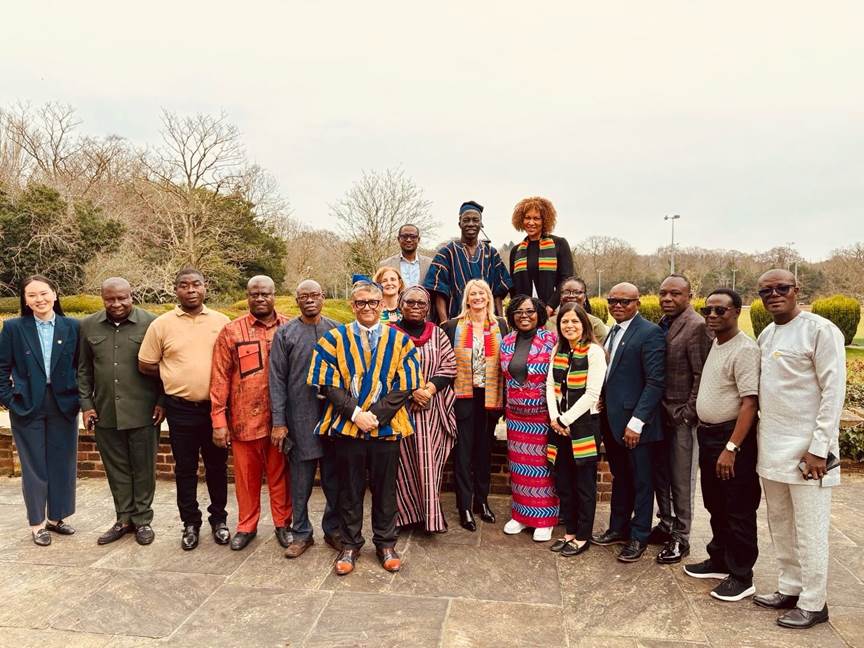
Photograph of the CPD participants and some trainers at the Edgbaston Campus

Workshops tackled decentralisation, participatory planning, and sustainable cities. These weren’t lectures – they were conversations, with Ghanaian managers sharing frontline realities and UK experts offering comparative perspectives. Institutional visits added texture: at the West Midlands Combined Authority, delegates explored regional governance and economic development strategies; at Birmingham’s Lord Mayor’s office, they saw the symbolic power of civic leadership in action. The week ended with a roadmap: virtual meet-ups, annual exchanges, and joint research projects. Participants left not just with ideas, but with commitments to keep the momentum going.

What Changed?

The impact was immediate and tangible:

  • Partnerships Deepened: UoB, GIMPA, and Ghana’s Local Government Service agreed on joint research and staff exchanges
  • Capacity Built: Delegates gained practical insights into governance models they could adapt at home
  • Training Co-Created: New modules blend academic theory with Ghanaian case studies – tools designed by practitioners, for practitioners
  • Policy Influence: Senior officials pledged to embed lessons into local reforms
  • Research Horizons Expanded: Themes like digital governance and urban resilience emerged as priorities for future collaboration
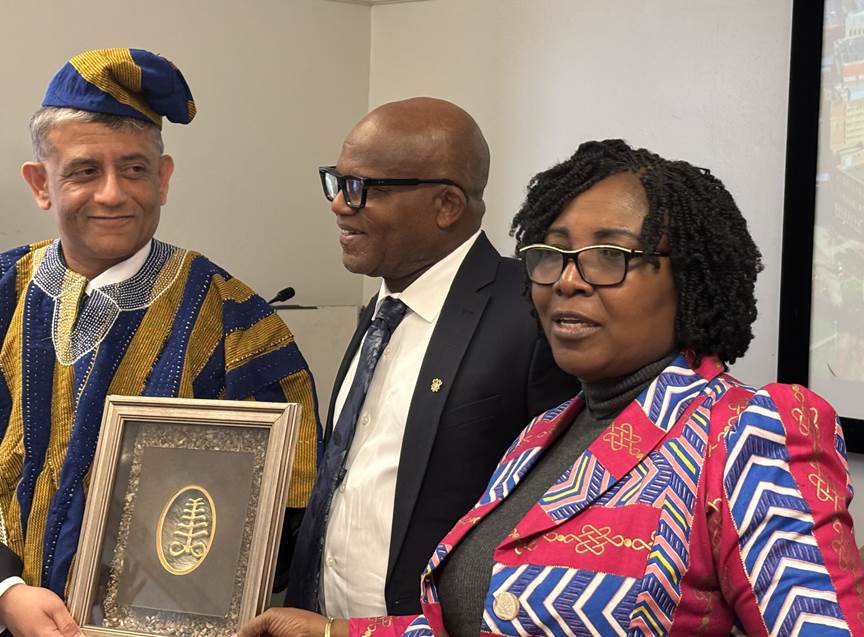
The Head of the Ghanian Local Government Service, Dr Stephen Nana Ato Arthur and the Chief Director of the Office of the Head of the Local Government Service, Madame Felicia Dapaah Agyeman-Boakye, honouring Shailen at the end of the CPD in Edgbaston.

Why It’s Different

This isn’t about exporting UK models or ticking boxes for donor reports. It’s about mutual learning and knowledge democracy – valuing local expertise as much as global frameworks. It’s also about universities stepping up as conveners of global networks, using their resources and credibility to drive real-world change. The co-designed training materials exemplify this ethos. They combine global frameworks with Ghanaian case studies, creating tools that are contextually grounded and practically useful. This approach aligns with calls to decolonise development practice – moving away from prescriptive solutions towards collaborative innovation.

What’s Next?

The Ghana CoP is just the beginning. Plans are underway to bring in managers from other African and UK cities, creating a richer, more diverse learning ecosystem. Future funding bids will build on the success of this pilot, ensuring the network grows and thrives. For INLOGOV, this story is a call to action: let’s champion collaborative governance, not as a buzzword, but as a practice that transforms institutions and communities. The challenges facing public managers are too complex for isolated solutions. By investing in relationships, shared learning, and co-production, we can create governance systems that are adaptive, inclusive, and resilient.
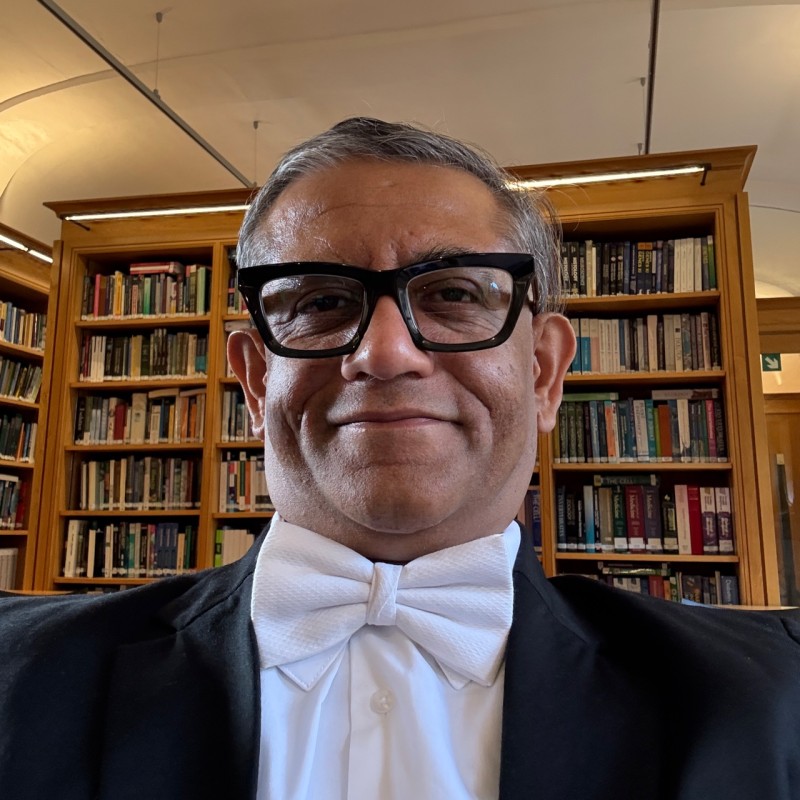
Dr. Shailen Popat works as an Assistant Professor in Public Policy and is the Director of the MSc in Public Management at the University’s Institute of Local Government Studies. He completed his PhD at the University of Oxford and his thesis explored the sensemaking processes of School Principals when enacting a significant new policy. He specialises in supporting public managers to enact policies in a manner that can be effective in their context and is a founding partner of a partnership between the University, GIMPA, and Ghana Local Government. Known for his student-centred approach and ability to explain complex concepts in a comprehensible manner, Shailen is considered to be an outstanding lecturer and tutor and was awarded the accolade of ‘Teacher of the Year’ at the 2022 University of Birmingham Teaching Awards, and in 2023 he was awarded a Senior Fellowship of the UK Higher Education Academy for his Educational Leadership.
Why Short CPD Training and Long – Term Mentoring Communities of Practice Should Work Together

Shailen Popat

In today’s rapidly changing public sector, professional development is no longer a luxury — it’s a necessity. But what’s the best way to equip public managers with the skills and mindsets they need to lead effectively? Is it through short, intensive training sessions, or through long – term mentoring and peer learning? My recent article, Reflections on Short CPD Training and Long – Term Mentoring Communities of Practice for Public Managers, explores this question through two linked initiatives in Ghana and the UK. You can read the full piece here, but here’s a summary of the key insights.

Two Initiatives, One Goal: Building Public Sector Capacity

In March 2024, I co – led a three – day Continuing Professional Development (CPD) workshop at the Ghana Institute of Management and Public Administration (GIMPA). Over forty senior local government officers came together to explore cultural intelligence, organisational culture, and change management. The workshop was highly participatory, encouraging reflection on power dynamics and leadership behaviours. It wasn’t just about technical skills — it was about shifting mindsets. A year later, in March 2025, we launched a transnational Community of Practice (CoP) in Birmingham. Fourteen Ghanaian city managers and academics joined UK counterparts for a week of collaborative learning, site visits, and strategic dialogue. Unlike the CPD workshop, this wasn’t a one – off event. It was the start of an ongoing network designed to foster mutual learning, co – produce training materials, and build institutional partnerships.

What CPD Brings to the Table

CPD is familiar to most professionals: structured, time – bound, and focused on specific competencies. It’s efficient and accessible, making it ideal for introducing new frameworks or addressing urgent skills gaps. Our GIMPA workshop, for example, gave participants analytical tools to examine organisational culture and power dynamics — critical for reforming local governance. But CPD has limitations. Without follow – up, its impact often fades. Participants in Accra voiced this concern: how could they sustain the momentum after the workshop ended? This reflects a broader critique in the literature — CPD can feel like a “tick – box” exercise if not embedded in a longer learning journey.

The Power of Communities of Practice

Communities of Practice, a concept popularised by Etienne Wenger, take a different approach. They’re about relational, situated learning — professionals learning with and from each other over time. Our Ghana – UK CoP exemplified this. Participants didn’t just absorb knowledge; they co – created it. They shared case studies, identified research priorities, and even laid the groundwork for joint projects and staff exchanges. This collaborative model builds trust, fosters innovation, and creates a sense of ownership. It also delivers tangible outcomes: institutional partnerships, co – produced training materials, and a platform for policy experimentation. In short, CoPs turn learning into a living, evolving process.

Why We Need a Hybrid Model

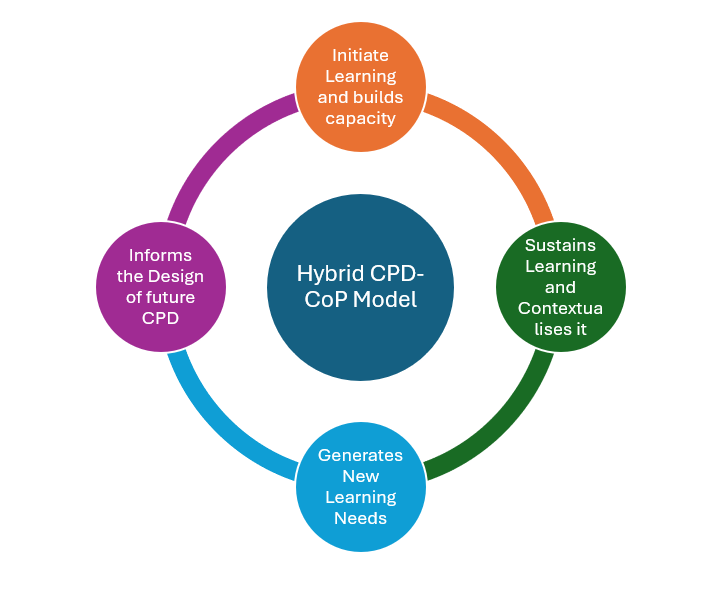
So, which is better — CPD or CoPs? The answer is both. CPD offers structure and accessibility; CoPs provide depth and sustainability. When combined, they create a dynamic learning ecosystem:

  • CPD as the entry point: Introduce core concepts and skills in a structured, time – efficient way.
  • CoPs as the follow – through: Sustain learning, contextualise it, and generate new insights for future CPD.

This cyclical relationship ensures that professional development is continuous and adaptive. It aligns with the idea of a “learning organisation” and supports the kind of hybrid professionalism today’s public managers need — technical expertise plus collaborative, contextual competencies.

The Role of Universities

Universities are uniquely positioned to make this happen. They have the research capacity, convening power, and infrastructure to sustain long – term engagement. But this requires a shift: from delivering knowledge at a distance to embedding themselves in professional ecosystems. That means co – designing curricula with practitioners, facilitating peer learning across borders, and evaluating impact not just in terms of knowledge acquisition but institutional transformation. Our Ghana initiatives show what’s possible when universities embrace this role. The CPD workshop sparked mindset shifts; the CoP built enduring partnerships and practical tools for governance reform. Together, they created a professional learning ecosystem grounded in local realities and enriched by global perspectives.

Why This Matters Now Public managers face unprecedented challenges — climate change, urbanisation, digital transformation. These are “wicked problems” that demand adaptive, collaborative leadership. Short – term training alone won’t cut it. Neither will informal networks without structure. We need integrated models that combine the best of both worlds. If you’re a public sector leader, educator, or policymaker, I invite you to read the full article here. Let’s reimagine professional development as a shared, iterative, and relational endeavour. The future of public service depends on it.

Dr. Shailen Popat works as an Assistant Professor in Public Policy and is the Director of the MSc in Public Management at the University’s Institute of Local Government Studies. He completed his PhD at the University of Oxford and his thesis explored the sensemaking processes of School Principals when enacting a significant new policy. He specialises in supporting public managers to enact policies in a manner that can be effective in their context and is a founding partner of a partnership between the University, GIMPA, and Ghana Local Government. Known for his student-centred approach and ability to explain complex concepts in a comprehensible manner, Shailen is considered to be an outstanding lecturer and tutor and was awarded the accolade of ‘Teacher of the Year’ at the 2022 University of Birmingham Teaching Awards, and in 2023 he was awarded a Senior Fellowship of the UK Higher Education Academy for his Educational Leadership.

Some thoughts on how universities can benefit the people and communities that they serve

Shailen Poppat

On Wednesday 12th and Thursday 13th June 2024, I will be speaking on a panel with Dr. Rhiannon Jones of the University of Derby and Martin Ferguson of Socitm who invited us as part of their annual President’s Conference on the approaches that can be provided by universities for the benefit of the people and communities that they serve. As time is short on the day, I thought that I would put a few points in writing.

Hub for Collaborations

A University can provide a hub for collaboration between organisations in multiple sectors. Universities inhabit an in-between space – they are part of the country where they are situated and also very international both in terms of the composition of students and staff, and in the reach of their networks and research collaborations. Universities also exist in the cloud, with many courses being entirely online or hybrid, and many library resources now being electronic. Universities are measured on impact and therefore they also lie in that in-between space between academic knowledge and real-world practice within increasing emphasis to show how research and teaching is impacting communities outside of the institutions. Universities are also large employers and magnets for resource in their geographical location. Many suppliers have contracts with universities and many local businesses rely on student expenditure during university term times. This gives a university the influence and gravitas to be able to bring people together in a way that very few institutions can do, and I would advocate that it is something that we need to do much more of in a more organised manner. It does happen but it tends to be driven by individual academics or certain research projects rather than as part of a wider strategic plan either by a college or school.

Spaces to Reflect

Public service workplaces are busy places and over these last 15 years everyone has had to adopt the mantra of achieving more with less resource! This means that public service workers have been doing more than one person’s job which consequently means less time for them to reflect, learn, and develop themselves. Conversations with colleagues provide valuable support within stressful and complicated situations, however, they can often be action and task focused – we are talking shop when we talk to each other in a workplace. And this is where the learning development partnership with universities can be so helpful. I would say that a university course can provide a public service practitioner space to think about bigger philosophical themes that do not get focus in the workplace although implicitly public service practitioners know what these are. At the Institute of Local Government Studies, we deliver three master’s programmes, two of which are part-time programmes and one which is full-time programme. All of these programmes take a student through a learning journey to reflect upon six key questions:

Unless we are thinking about these things we just carry on moving on the treadmill without pausing and considering whether there are alternative approaches to the way things are currently.

Connecting Academic Knowledge with Practice Knowledge

When I am training practitioners or attending knowledge-exchange events, I always keep in-mind that I have to convince people that academic knowledge can be of relevance to their work. Both types of knowledge (academic and practice) can inform each other as much research is really the observation of practice and then taking those observations and formulating theories that can help us to better understand exactly what’s going on. For example, one of my roles in the School of Government is to represent us in a partnership with a civil service college in Ghana. I conducted a training there in March on the topic of understanding organisational cultures which was quite a novel topic for them. One of the models that I used from the academic literature in a workshop format was this one by Johnson et al. (2008).

Participants were mayors, assembly members, city managers, and other public managers, and they were asked to use the model to reflect upon their own work situation for approximately 15 minutes. They then split into smaller groups and shared experiences with each other and this seemed to provide them with a rich understanding of the dynamics that they were experiencing day-to-day but they would not necessarily have analysed what was going on without this exercise, and the academic framework provided a structure in which they could contain their thoughts. The feedback that I received was very positive for example,

‘After the CPD training, I have been able to gradually change the attitude of some staff towards work in terms of lateness, absenteeism, efficient use of material resources, client focus, participation, etc.’

‘By understanding the organization’s mission, vision and goals, as well as foster collaboration, innovation, learning and team effort in achieving the organizational overall objectives. Organizational culture also helps me build shared values and unified efforts among my colleagues, hence it helps to contribute to achieving the organization goals and objectives.’

So, you can see that universities can provide practice with spectacles with which to see what is going on so the practitioners gain better clarity on how to create change.

Shailen Popat works as an Assistant Professor in the Institute of Local Government Studies at the University of Birmingham where he is Director of the MSc in Public Management. In 2022, he was awarded the accolade of University Outstanding Teacher, and in 2023, he was awarded a Senior Fellowship of the Higher Education Academy.

How do we strike the right balance in public sector workforce training?

Shailen Popat

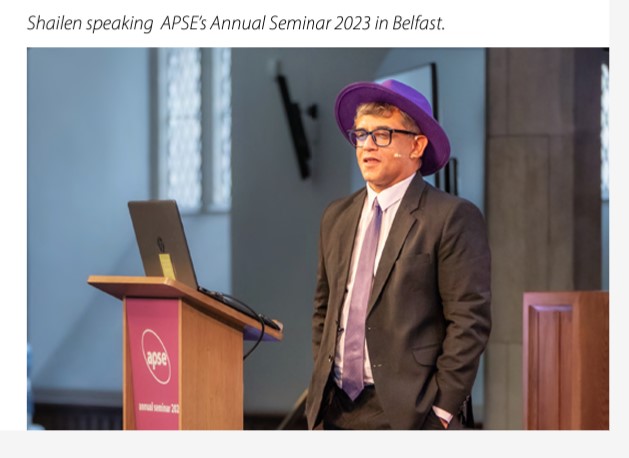
I was delighted to be invited to attend and speak at the APSE annual seminar in Belfast in September 2023. For us at the Department of Public Administration and Policy, connections with elected members and council officers are an integral part of our research and teaching, so I had no hesitation about accepting the invite and being with you.

I took the opportunity in my talk to share some questions I’ve been asking myself. The first is: do you feel that your education prepared you for a role in public management?

This is an important starting point for those of us who plan continuing professional development (CPD) for others. There is no shortage of master’s degrees and CPD courses, but we must continuously consider their pertinence and relevance. Sometimes educational courses are good learning experiences that are worth having for that reason alone, however we must reflect on whether a good learning experience is also useful in the field.

Since 2008, the public service mantra has been to ‘do more with less’. As we all know this places burdens on organisations and their staff. Having to do more with less often entails operating across multiple roles and skill sets, requiring a lot of flexibility. For example, a local authority may decide that it is more efficient to have one person covering multiple roles, whereas previously, there may have been two. This can compel public service workers to try and act as experts in areas where they are not. Similarly, elected members often have to make decisions on matters that they are not experts in, whilst engaging with those who are.

Both officers and elected members need to be able to assimilate, synthesise and communicate the rationale behind policy positions and decisions that they are not experts in. This not only poses a challenge for them but also for those who support their training. We must ask ourselves, what skills do we need to train non-experts in? And how do we train them?

A further complication is that the culture, norms, and political boundaries of an organisation may not be flexible. Even though an employee may have to work and think flexibly, the structures they operate in may be very rigid. Trainers need to consider whether they are educating people with this need for flexibility in mind.

Neuroscience tells us that learning occurs incrementally – the brain’s neural networks are constantly being revised and refined as we repeat actions. The science tells us that experience matters. However, an important part of experience is making mistakes.

Therein lies the problem, for elected members and senior executives, mistakes are a luxury that they cannot afford and are unlikely to be tolerated. This puts us in another quandary: we know that learning requires mistakes, and therefore we have to train practitioners and decision-makers to be reflective, however, if decision-makers fear making mistakes, this will hinder their learning.

 I also wonder whether this fear of making mistakes stops us from challenging ourselves to think, decide, and act differently from the norm. How much do our cultures and structures empower public service workers and elected members to be genuinely innovative? A lot of our learning occurs when we are exposed to new materials that challenge our previous beliefs and understandings.

There is also a concept called disfluency which means that not only should we learn something new but when we use and explain it to others, it begins to become clearer as to how we could enact it ourselves. ‘How much do we practice dysfluency and how can we educate for it?’ I would welcome anyone who would like to continue the discussion to email me.

Shailen Popat is Director of the INLOGOV full-time MSc in Public Management. In 2022, he was awarded the accolade of the University outstanding Teacher of the Year, and in 2023 was awarded a Senior Fellowship of the Higher Education Academy. He can be contacted via email at: [email protected]

This article was first published in the Association for Public Service Excellence (APSE) newsletter, Winter 2024

From Ladders to Squiggles: Transforming Public Service Careers

Dr Dave McKenna

Are you a public servant who has had a wiggly or a squiggly career? Do you wish you had? Μaybe you think it’s just not that important? Or perhaps it’s just too difficult to do?
 
The idea of a squiggly career, in other words, thinking less about career ladders and more about sideways, downwards and cross sector moves, is one that has gained some interest over the last few years. 
 
And it has a particular resonance in the context of public services.
 
For one thing, as working across organisational boundaries becomes more and more critical for public servants, so does the need to be able to speak the different ‘languages’ of different organisations and sectors. Having experience of actually working in those other settings could be a real help when it comes working across organisational borders.
 
Squiggly careers might also promote innovation – sideways movers bringing a fresh perspective on challenges and a handle on what has worked elsewhere. 
 
And downwards moves might be important as well. Frontline experience helps to bring empathy and understanding – both for the people receiving public services and for those colleagues providing them.
 
Of course, it might not work for everyone. Some public sector professions have set career paths and it’s not always that easy to jump organisation or sector when you are in competition with the natives.
 
Even if a clean jump is not possible there might always be the possibly of placements and secondments.
 
And shouldn’t managers be promoting these kinds of experiences and career moves? After all, isn’t it good for individuals and isn’t it good for public services in general if workers have a variety of experiences to draw on when facing the complex challenges of 21st century public service?

We’d be interested to hear your thoughts on future public service careers, to inform our work updating the 21st Century Public Servant framework.

Dr Dave McKenna is an independent consultant and researcher who helps councils and other public bodies with training, research and improvement work. He is part of the research team currently updating our 21st Century Public Servant framework.