The abolition of NHS England 

Councillor Dr Ketan Sheth,

We all recognise that the current government inherited a deeply entrenched crisis in our NHS. Years of austerity, coupled with the immense strain of the Covid pandemic, have left our health service at breaking point. Across the country, patients are facing unacceptable delays — whether in A&E, for a GP appointment, or for much-needed elective procedures. The Health Secretary, Wes Streeting, has not shied away from the truth, acknowledging that the NHS is ‘broken’. But with this recognition comes a clear responsibility to act. The commitment to investment and reform was at the very heart of the Labour government’s manifesto, and it is now our duty to ensure these promises become reality.

The three fundamental shifts outlined by Wes — focusing on prevention rather than cure, strengthening community-based care over hospital reliance, and embracing digital innovation — are undeniably the right priorities. 

These are not new challenges; they are the very issues that those of us in local government and health services have been highlighting for years. With Tom Kibasi now leading the development of the NHS’s Ten-Year Plan, there is a real opportunity to turn ambition into action. But make no mistake — this will require more than just vision. It demands political will, cross-sector collaboration, and real investment to drive lasting change.

As a councillor with deep experience in health and social care, and as Chair of a London joint health scrutiny committee, I firmly believe that elected representatives — both national and local — must have clear oversight of how the NHS delivers for our residents. The NHS is funded by the taxpayer, and accountability for its spending —amounting to hundreds of billions —must be transparent. Striking the right balance between strategic oversight and operational efficiency is key. Reducing duplication and inefficiencies between national bodies is a sensible goal, but only if it genuinely results in better care, not just headline-grabbing restructuring.

Earlier this month, the government announced that, in order to focus resources on the frontline, NHS England would be abolished and funding to Integrated Care Boards (ICBs) would be cut by half. There is a logical argument for streamlining management functions where the Department of Health and NHS England overlap. Equally, we cannot ignore the vast NHS deficits that must be tackled if we are to clear the backlog left by the previous government. Cutting costs without compromising frontline care is an extraordinarily difficult balancing act, and success will hinge on empowering local decision-making rather than imposing one-size-fits-all solutions from Whitehall.

But now we must address both the handling and the substance of these decisions.

First, the handling. The people working in NHS England and ICBs are dedicated professionals, many of whom have spent their careers serving our health service. These are individuals with expertise, commitment, and families to support — not faceless bureaucrats. It is entirely possible to debate the structure of public services without resorting to derogatory language, labelling roles as ‘flabby’ or dismissing people as ‘blockers and checkers’. That is why it was reassuring to see Wes take to the airwaves to make a crucial clarification: the target is excessive bureaucracy, not the people who keep our NHS running.

On substance, the proposal to merge the functions of NHS England with the Department of Health is a bold and potentially transformative step — but only if executed properly. Addressing duplication in management is a legitimate goal, yet we must not underestimate the sheer complexity of NHS operations. The government must ensure that what replaces NHS England’s oversight role does not become another layer of top-down control. If local government is to have greater freedoms to shape healthcare services, these must be real and meaningful, not simply a rebranding exercise where old centralised structures persist under new names.

We must also keep our focus on tackling the stark health inequalities that persist in our communities. This means:

• Reducing waiting times for GP appointments and elective procedures.

• Strengthening hospital discharge pathways to ensure patients receive the care they need at home.

• Investing in public health initiatives to drive prevention and early intervention.

• Engaging meaningfully with local communities, in line with the NHS’s statutory duty to involve them.

• Managing winter pressures effectively and ensuring higher vaccination uptake.

While we await the publication of the Ten-Year Plan, which we hope will provide clarity on these pressing issues, one thing is certain: this government must not just explain why these changes are necessary, but prove to the public how they will lead to tangible improvements in their daily lives. The NHS is more than an institution; it is a national treasure, built on the principle that healthcare should be available to all, free at the point of use.

This moment is an opportunity — a chance to build an NHS that is fit for the future. It will take determination, investment, and an unwavering commitment to those who rely on it every day. Let’s not waste it.

Cllr Ketan Sheth chairs the North West London Joint Health Scrutiny Committee

Could do better – supporting young carers at school

Elaine Campbell

Young carers provide unpaid, and often unacknowledged care, usually for parents or other family members. While caring may be viewed as a health and social care issue, most young carers who are under 18 will spend much of their time in full-time education. So it is critical that education professionals are ready and able to support young carers to achieve at school.

This study explored how a multi-agency approach could improve the educational experiences of young carers in Northern Ireland through a survey of teachers and interviews with professionals in education and health and social care.  Young carers are often unseen by medical and educational professionals, who may be unaware they are providing care or unaware of what support may be needed.

Key findings

  • Young carers and their experiences are routinely overlooked and unseen in educational and health care settings. 
  • The lack of legislative recognition for young carers has created a policy void, despite input which has explicitly identified the need to support and care for this group of young people. 
  • Existing guidance which outlines ways to support young carers in school has not been routinely implemented in schools or shared with school staff
  • A combination of a strengths-based model, combined with existing protective factors for young people has the potential to provide appropriate care and support, promote positive self-worth and improve educational outcomes for young carers.
  • A systematic failure of planning contributes to patchy and inconsistent partnership approaches which are overly reliant on individual commitment to change, rather than systems change

Background 

While my study focused on Northern Ireland, many of the issues faced by young carers are universal in nature. The literature review highlights the unseen nature of young carers as a key barrier identified by researchers and young peoples’ experience across cross-national researchers

Teachers’ understanding of impact and role of young carers is variable, and at times, dismissive. The age at which young carers may begin their caring role is often at primary school, which is unexpected by teaching and medical professionals. The study highlighted a willingness to help but also a reliance on parents or young carers disclosing their status. 

Reaching out to young carers is essential

Teachers acknowledged the difficulties of identifying young carers; other research has established that young carers may be reluctant to self-identify or to ask for support if they feel they have not been listened to. Teachers felt that parents only disclosed when they felt forced, often during a crisis. 

Transition points provide an excellent opportunity to encourage disclosure. Updating contact information each year, conversations about the transfer to post-secondary school and when young people enrol in a new school are ideal opportunities to ask if a child is undertaking caring responsibilities. This can help start the conversation about how to support them in school. Schools can include information on their websites, on posters, and use Assemblies to recognise the contribution young carers make.

The policy deficit contributes to suffering 

Resources and initiatives have been identified, but never implemented, which is both disappointing, but also provides an opportunity for change. Guidance without legislative protection is unlikely to be prioritised. Young carers are less likely to take up further education and more likely to live in poverty, and more likely to experience poor mental health.  

The sustained lack of policy attention is an issue which requires urgent redress. Existing guidance includes specific, practical examples of ways to support young carers emotionally and practically to achieve at school, and many of the suggestions require time and planning, not financial costs. A renewed effort to share and monitor this guidance, using a policy lever, could make a powerful impact on young carers. 

Shifting the focus from harm reduction to promoting wellbeing 

Professionals described a system which considers young carers primarily in terms of harm reduction. Despite the challenges, many young people are proud of their caring role and display outstanding qualities and strengths.

There is insufficient focus on working collaboratively to provide proactive support to young carers to achieve in school, take up opportunities to socialise, and enjoy breaks from caring, or to share information about this support to young carers.

Education Authority guidance, with input from young carers, highlights that what they often want most is practical support to help them get through the school day and for their teachers to show understanding of their reality.

Conclusion 

This study highlighted that there are pockets of good practice and existing multi-agency working which have contributed to collaboration, but these are exceptional rather than routine. 

The study concludes that there is a need for greater legislative recognition, including a statutory responsibility on key agencies in health and social care and education to provide support for young carers.

Agencies should be more proactive in seeking out young carers, by including information on school enrolment and admissions forms, asking during clinical admissions and review medical appointments, and signposting to young carers’ projects and other partners.

Young carers are being failed; they deserve better, and the answers are already there. What’s needed now is the impetus to follow through and deliver.

Elaine Campbell was awarded an MPA in 2023. Previously an Assistant Director at children’s charity Barnardo’s, Elaine is currently Head of Service Enablement and Improvement at Alzheimer’s Society. She is also a Chair of Board of Governors at a primary school. She can be contacted at [email protected]

Improving social care’s digital adoption

Marc Greenwood

This week we are showcasing key findings from some recent dissertations by our Degree Apprentices. This dissertation identifies the barriers to and the motivations for digital adoption in adult social care services.  By exploring the impact of governance approaches and leadership styles in influencing the adoption of digital technologies in the home, it identifies techniques and approaches for supporting social care services to accelerate and sustain digital adoption.

Key findings:

  • Care technology in the home needs to become part of the standard way of operating within adult social care.  By doing so it is possible to de-mystify care technology, helping to normalise it, thereby increasing adoption.
  • Help stakeholders become more aware of the possibilities associated with care technology.
  • Develop the skills and confidence of professionals, carers and users: if people feel confident they are more likely to use the technology, and the reverse is true if they have low skills and confidence.
  • Limitations to digital adoption, due to economic and geographical reasons, are a consistent barrier.  
  • Leaders are key to successful adoption.  Leaders need to immerse themselves in the change. This includes using the technology themselves and not underselling the value their own behaviours have in influencing others to adopt technology in adult social care.
  • Leaders need to have a strong vision for change and develop a shared narrative that followers could understand and engage with.
  • Leaders must empower others to deliver the digital adoption agenda by allowing them to try new things, and to accept that sometimes things will fail.  
  • The skill of a leader to learn and adapt their approach is key – leaders must learn from what has worked well and what hasn’t.
  • Build networks and partnerships with effective dialogue influencing the work and direction of the network. De-risk digital adoption initiatives through collaboration and risk sharing.
  • Engage with users of services to understand what they want and what works for them. This way there is the possibility of greater adoption of digital services through shared ownership and buy in.
  • The role of place level governance is one that has the potential to influence the impact of digital adoption across networks through shared ownership and accountability.

Background

The development of digital technologies in adult social care has progressed significantly in recent years with the potential to transform the public sector landscape.  From traditional telecare services, through to remote assessment collaboration tools and independent living applications, the scale and scope of technology is burgeoning.  The Covid pandemic expanded and accelerated these innovations.  There remain however social, political and economic challenges in encouraging the wider and full-scale adoption of these technologies.  The use of these technologies is often added into traditional packages of care, rather than replacing demand for traditional services.

What we knew already

The interconnected and multi-level complexity of public sector organisations requires collaboration and consensus across different actors, both internally and externally, to ensure required outcomes are achieved.  Traditional hierarchical governance models can prove ineffective in the support of the adoption of change, perhaps because bureaucratic models rely on controlling changes through a gradual process to mitigate the risk of failure – leading to creativity being stifled and the opportunity for innovation lost.

Wider adoption of technology requires more effective involvement of adult social care stakeholders.  A networked governance approach might help public sector bodies to involve a wider range of actors in the defining of, and solution finding to, entrenched problems.  The key characteristics of a networked approach are the bottom-up nature of decision making, collective group-led decisions and wider participation of different members that have a role in the taking forward collective action.  Networked governance has the potential to unlock entrenched and complex issues through this collective approach drawing on peer to peer collaboration and action.

Public leaders can create an environment for innovation, within which actors are empowered to identify and take advantage of new opportunities, through influence on the culture and values of an organisation. With fast changing technologies and public demand for innovative and effective technological access to public services, leaders need to understand their operating environment and make decisive decisions about when and how to adopt new technologies.  Leaders also have important roles in encouraging professionals and service users to adopt technology to be a replacement for traditional care services.  Adaptive leadership styles can help flex the way in which challenges and problems are addressed, through the articulation of the challenge and use of different styles and contextual approaches to problem solving, enabling followers to connect with the problem and galvanising action to resolve it.

The availability of advanced technologies is helping to redefine how people receive support and tackling issues such as social isolation and workforce gaps. Technology can provide opportunities to reduce costs and to improve the quality of care and quality of life amongst users.  However, public and professional attitudes and awareness towards the use of technology in care is mixed.  Some citizens are unable to access and use technology due to economic issues or skills deficiencies.  Some choose not to because they do not perceive sufficient positive benefits. 

Successful adoption of ASC digital technologies
The research highlighted the need for care technology in the home to become part of the standard way of operating within adult social care.  Many care users don’t know what care technology in the home is available, how it can be used and the associated possibilities.  Behavioural approaches such as exploring capabilities, opportunity and motivation for change, positive action and encouragement can help adoption of technologies.

People need to see, and sometimes even experience, the benefits of the technology before truly getting onboard with using it.  Participants highlighted opportunities for demonstrating the possibilities of care technology by using reference sites or research exemplars, where success has already been achieved.  

One of the most significant barriers to digital adoption highlighted in the research relates to the skills and confidence of stakeholders to use technology.  The concept of ‘digital buddies’ can help to provide peer to peer support, alongside addressing a lack of affordable digital infrastructure and connectivity in some areas.  There is a role here for public leaders to ensure support is provided to reduce the risks of digital exclusion. 

How leaders influence digital adoption

Leaders can play an active role in leading digital adoption, actively using and promoting the benefits of the care technology.  They can develop a clear vision and narrative with partners, helping people understand what difference care technology in the home can have to the way people work and are supported to live independent lives, focussing on specific benefits and bringing the vision to life.  Change can easily slip back into old working practices and so leaders need to remain committed to the change whilst adapting to changing situations.

For lasting adoption of digital technology in the home leaders need to explain how it’s a better way of working or receiving care.  Leaders need to acknowledge they can’t implement the change alone and need others to develop and iterate the change, empowering staff to be creative.  Leaders need to adapt to changing situations, understanding and accepting issues.  Adaptive leaders understand what isn’t working and quickly adapt to change their approach, gathering insights from real users of care technology to use their perspectives to develop understanding and learning.

The effect of governance arrangements

Networks involved in digital adoption in social care need to develop strong mechanisms for dialogue to influence their work and direction, integrating awareness of the work across partnerships so that there can start to be a sense of collective ownership for the change that is being proposed.

Partnerships can help de-risk change initiatives.  At the personal level, the adoption of digital approaches in the home can seem quite daunting for people and many appear reluctant to adopt digital changes in the home because they are unfamiliar with them. Through a partnership approach individuals and groups can come together to support each other to test and trial the technology, thus becoming more confident with it, working together to achieve their digital adoption goals.  At the organisational level, organisations may feel reluctant to adopt new technologies and ‘be the first’, perhaps because of associated social or financial risks.  By working together partnerships have the potential to reduce these risks, spreading either the financial burden or the associated social impact.  

Individuals play key roles in shaping group attitudes and behaviours, by influencing as sector leaders across adult services.  This influencing can often be an effective tool for encouraging others to adopt new initiatives, by either direct engagement or simply because they don’t want to be left behind.  Individual service users are similarly important, one focus group member talked about how it often ‘just takes one person to show the way and the rest follow once they see the benefits’ of social care technology in the home.  Working directly with users of services can improve the rates of digital adoption, ensuring that products being purchased fit the needs of users and are adopted.  

The role of place level governance has the potential to influence the impact of digital adoption across networks, normalising their use and enabling users to become familiar with the available solutions, thus leading to greater adoption.

Conclusions

Digital technologies are changing the way we interact and how we live.  The necessity to adopt and integrate technology has never been more critical in adult social care. This research provides insight into the challenges faced by professionals, carers and service users when embarking upon a digital change journey.  It illustrates how different ways of engaging and working with stakeholders can be tried and iterated to achieve the goal of digital adoption.

The research provides several key points that should be considered when addressing the challenges of digital adoption. Firstly, the awareness of, and confidence in using, digital technologies is vital for adoption to succeed.  Secondly the role of the leader in being able to own the change and empower others to shape and implement digital change is a powerful tool for supporting wider adoption. The adaptive leadership style lends itself well to being flexible and able to adjust to meet the challenges of digital adoption.

Finally, effective partnerships and networks can support digital adoption. The collaborative nature of effective partnerships enables benefits to be shared whilst reducing the risk of a single organisation undertaking a venture. The research identified the benefits of networks of service users and their carers being able to influence adoption of digital services.

_________________________________________________________________________________

About the project

This research was a Master’s dissertation as part of the MSc in Public Management and Leadership, completed by Marc Greenwood and supervised by Dr Louise Reardon.  Marc can be contacted at [email protected].  The research included interviews with leaders who had led projects or service improvement activities within their own, or partner organisations, to adopt technology in adult social care; a 15-person focus group consisting of social care users and carers; and interviews with representatives of relevant network organisations.

Further information on Inlogov’s research, teaching and consultancy is available from the institute’s director, Jason Lowther, at [email protected]    

Twitter @Inlogov            Blog       Inlogov.com
Forging an alliance with the NHS

Cllr Ketan Sheth

If local councils and the NHS do not work together as trusted equal partners, our residents are the ones that lose out.

In Brent, our local communities were among those most affected by the first and second waves of the Covid-19 pandemic, with the local hospital, Northwick Park, making the national headlines having been caught in the eye of the storm, which acutely demonstrated the terrible impact of health inequalities on real lives.

We are, of course, particularly reliant on our NHS partners to provide emergency services, planned elective care, and a full and complex mix of outpatient and specialist services, including mental health and community services.

Likewise, NHS staff are reliant on local councils (and other local partners) playing their part in delivering a seamless patient pathway, that can go from a first GP visit right through to a tailored social care package.

Delivering high quality, equitable health services take detailed planning and a solid grasp on the needs of local communities.

In Brent, we have seen increasing levels of partnership working with the local NHS trust. Collaboration is made easier because London North West University Healthcare NHS Trust (LNWH) shows a refreshingly genuine commitment to gaining a deep appreciation of the views, concerns, and perspectives of our local populations. This is reflected in the development of the trust’s new five-year strategy

In addition to undertaking vast analysis of public health, demographic and other data relating to our communities, LNWH sought engagement right from the start. The trust co-created a strategy with the help of almost 900 local community members and 40 representatives from local authority and partner organisations. Over 2,300 staff also contributed, many of who live locally and reflect the diverse population of our local communities and are frontline NHS staff who know all too well the importance of good partnership working.

I hosted one of the open forums for the trust where the local residents had an opportunity to say what they felt should be the trust’s priorities. Working in partnership with local communities and improving the quality of care came out as key themes.

This is not surprising. In Brent, our communities experience significant health inequalities when compared with regional and national levels. Local councils like Brent can only provide so much support to address these issues, so we must work with NHS partners to combat health inequalities right across our health and social care system. Indeed, we are now seeing an increased trust present at place-based and neighbourhood meetings.

One of the biggest challenges facing LNWH is the level of emergency activity. As a local council, we must work collaboratively to address systemic issues like this that the trust cannot resolve alone. Indeed, the emergency pathway is a key touchpoint for the most deprived people in Brent and partnership working presents us with a real opportunity to connect them earlier with more appropriate support in the community.

The trust’s discharge processes are perhaps the most reliant on partnership working — the NHS isn’t just its hospitals. It’s vital that we work collaboratively across organisations — the rest of the local NHS like GPs, district nursing, mental health and social care — to help the trust improve the flow of patients through its hospitals.

LNWH has called its new five-year strategy ‘Our Way Forward’. It sets out a welcome commitment to local authorities, communities, and people. We must take joint responsibility for Our Way Forward, because by working together we will forge a far better health outcomes for our residents than we can alone.

Cllr Ketan Sheth is Chair of North West London Join Health Scrutiny Committee

Mission Possible? 

Jason Lowther

With under 700 days to the next UK general election, political parties are busy developing their manifesto documents.  In February, Labour leader Keir Starmer made a major speech laying out his “five missions for a better Britain”.   How do these five missions relate to local government?  And is the turn to “mission driven” government likely to work?

The five missions vary in their level of specificity and challenge.  Securing “the highest sustained growth in the G7, with good jobs and productivity growth in every part of the country…” is a little vague but likely to be difficult, especially given we are currently ranked 6 out of 7 in terms of output per worker.  Mission #2, “make Britain a clean energy superpower”, accelerating the move to zero-carbon electricity from 2035 to 2030, is specific but very challenging.  Mission #3, reform of health and social care and reducing health inequalities, will require a re-focus from secondary (hospital) care to social care and addressing the social determinants of health.  Mission #4 is about community safety, and likely to involve more community policing.  Finally, mission #5 is to “break down the barriers to opportunity at every stage” through reform to the childcare and education systems.

Local government potentially has important roles in each of the five missions.  Local education, skills and economic development functions will be critical to improving productivity.  On energy, Net Zero requires at least a doubling of electricity generation by 2050, from decarbonised sources.  Decarbonisation strategies need to be place-based, taking account of the geography, building types, energy infrastructure, energy demand, resources and urban growth plans.   We’ve recently argued here for the key roles of councils in this area. 

Turning to health and care services, local government clearly has leading roles – including ensuring place-based planning to address the social and behavioural causes of health inequalities.  Analysis by the Liverpool and Lancaster Universities Collaboration for Public Health Research in 2021 concluded: “investment across the whole of local government is needed to level up health including investment in housing, children’s, leisure, cultural, environmental, and planning services”.  Similarly community safety, child care and education are areas where local government could be enabled to have much greater positive impact.

Perhaps as important as the specific “missions” is the approach to governing which the party is proposing.   Labour’s document characterises this as a move from top-down, target-led, short-term, siloed approaches, to government which is more “agile, empowering and catalytic”, working across the public and private sectors, and civil society.  This, it argues, requires organising government around a shared vision, focusing on real world outcomes, concentrating on ends with flexibility and innovation concerning means, devolving decision making from Westminster, increasing accountability including central and local data transparency, and adopting long-term preventative approaches including greater financial certainty for local areas. 

In some ways the idea of mission-driven government echoes the 1990s thinking of Ted Gaebler and David Osborne’s book “reinventing government”, which argued for a more entrepreneurial approach to the delivery of government.  Their work pointed to entrepreneurial companies setting overall missions and goals, and then leaving managers to figure out how best to deliver these – for example, by providing an overall budget for a service rather than detailed line-by-line budgets which disappear if not spent by year end.  The focus on managers rather than considering the perspective of politicians is one of the problems identified in subsequent evaluations of the reinventing government model, together with difficulties in sustaining the approach.

Mission-driven policies addressing ‘grand challenges’ of society are increasingly common, for example in the UN Sustainable Development Goals and various EU policies.  Mazzucato et al recently argued that addressing such challenges requires strategic thinking about: the desired direction of travel, the structure and capacity of public sector organisations, the way in which policy is assessed, and the incentive structure for the private, public (and I would add community) sectors. Labour’s paper makes a start (albeit at a very high level) on thinking through these areas. The litmus test, though, will be in developing the detail and how far this engages with local areas.   

Over the next few months, we will be contributing to the debate on the upcoming party manifestos with some research-informed thoughts on a variety of local government related policy areas.  If you would like to be involved in developing these, please get in touch

Jason Lowther is the Director of INLOGOV. His research focuses on public service reform and the use of “evidence” by public agencies.  Previously he worked with West Midlands Combined Authority, led Birmingham City Council’s corporate strategy function, worked for the Audit Commission as national value for money lead, for HSBC in credit and risk management, and for the Metropolitan Police as an internal management consultant. He tweets as @jasonlowther

Picture credit: BBC

Integrated Care Boards – a new frontline in localism?

Jason Lowther

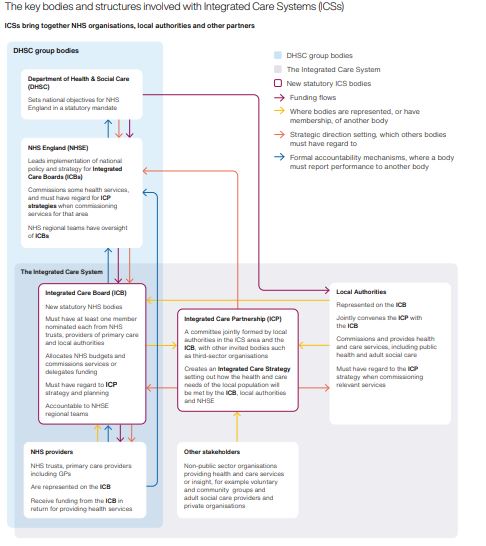
As the government once again kicks down the road decisions on vital reforms and funding for social care, local areas are establishing the Integrated Care Boards which will lead the new Integrated Care Systems (ICS), bringing together the NHS, local government and partners to plan and deliver integrated services to improve the health of the local population.  Building on the progress made since many public health responsibilities transferred back to local government in 2013, this is a great opportunity to address the determinants of health and issues around health inequality.  Might ICSs at last lead to an effective local voice in our over-centralised, top-down healthcare system?

Each ICS is supposed to plan at three levels: the neighbourhood (an area of around 40,000 people), the ‘place’ (often a LA area), and the (ICS) system (covering around 2 million people).  Working at the neighbourhood level is likely to be somewhat informal, often using a social prescribing approach and developing multi-disciplinary teams including third sector partners.  The approach to ‘place’ looks set to vary between areas, with some ICSs devolving significant responsibility (and funding) whilst others centralise these at ‘system’ level.  Meanwhile at ‘ICS system’ level, Integrated Care Partnerships (joint LA and health committees) will develop an Integrated Care Strategy to meet the assessed health and social care needs of their population identified in the Joint Strategic Needs Assessments and Wellbeing Strategies prepared by local Health and Wellbeing Boards.

Beyond the formal planning process, the success of local ICSs will partly depend on the quality of local collaborative (managerial and political) leadership – across statutory partners and with the third sector.  It will be a tough job to balance the priorities of the national health service and issues of local places, but many local authorities will be able to offer helpful experience , for example from moves to more networked governance approaches.

The National Audit Office recognises the potential but appears dubious on current prospects.  Last month it published a review, Introducing Integrated Care Systems: joining up local services to improve health outcomes, finding:

NHSE has a detailed regime to monitor performance against core NHS objectives but … it is less clear who will monitor the overall performance of local systems, and particularly how well partners are working together and what difference this new model makes…

The report notes that, whilst government is asking ICSs to set out local priorities and make progress against them, there is no protected funding and few mechanisms to ensure this happens.  This leads, as the NAO politely puts it, to “a risk that national priorities, and the rigorous oversight mechanisms in place to ensure they are delivered, crowd out attempts at progress on local issues”.  The report also identifies five “high risk” elements of effective integration: clarity of objectives, resourcing, governance and accountability (such as how ICSs will function alongside existing local government Health and Wellbeing Boards and how accountability differences between NHS and local authority bodies will be resolved), and the capacity to balance priorities other than national NHS targets. These urgently need to be addressed if ICSs are to begin to meet their potential.

At one of Inlogov’s “Brown Bag Lunch” discussions earlier this month we agreed on the importance of issues around how ICSs develop, particularly in terms of developing effective system leadership and planning, collaborating with community organisations, and links to wider devolution processes. I’d be interested to hear about experiences in local areas as these develop. 

Jason Lowther is the Director of INLOGOV. His research focuses on public service reform and the use of “evidence” by public agencies.  Previously he worked with West Midlands Combined Authority, led Birmingham City Council’s corporate strategy function, worked for the Audit Commission as national value for money lead, for HSBC in credit and risk management, and for the Metropolitan Police as an internal management consultant. He tweets as @jasonlowther

Picture credit: National Audit Office