Local councils must work harder at enabling women to be councillors

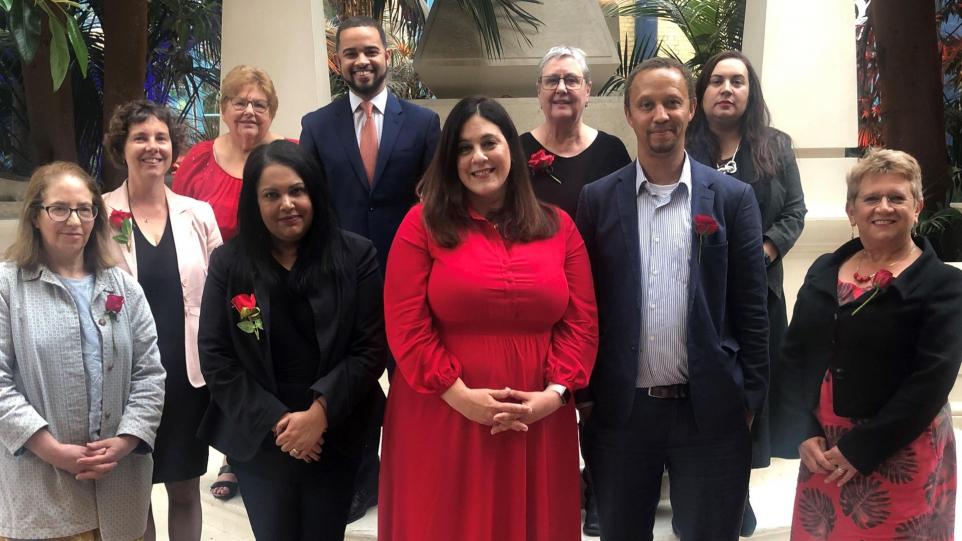
Picture: Haringey Council’s 2022 cabinet

Jason Lowther

Local councils can and must do more to enable women to be councillors. Haringey’s new cabinet shows that this can be done, but fifty years after all government elected officials across the UK were finally elected under universal suffrage, new research shows barely a third of local councillors and MPs are women, whereas earlier research showed less than a quarter of Police and Crime Commissioner (PCC) candidates were women.   This matters not only in terms of democratic fairness, but because politicians’ characteristics impact on public policy.

The research published last week by the Fawcett Society and Democracy Club reflects councillor representation in August 2022 across the UK.  To collect the data, they had to scrape individual council websites since (incredibly) there is no official record of councillors’ gender (or other protected characteristics).  This is because the relevant section of the Equality Act 2010 has still not yet been enacted and in any case as drafted would apply only to candidates in national elections.  This is in contrast to council staff, where the Equality Act applies and has led most councils to capture and publish reasonably detailed assessments of workforce equality issues – as shown by the recent SOLACE / Shared Intelligence report, ‘Understanding and Improving Equality, Diversity and Inclusion in the Local Government Workforce’ which we discussed on the blog last autumn.

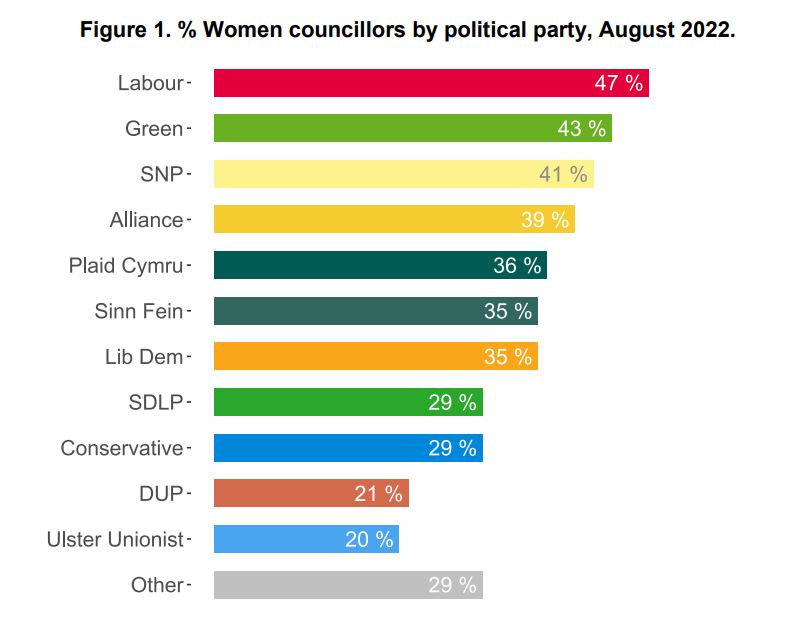
The Fawcett Society / Democracy Club results show no party yet has parity of representation between women and men, but some are doing much better than others.   The highest proportion of women is found in the Labour Party (47%) and the lowest in the Conservative Party (29%), the SDLP, DUP, and Ulster Unionist Parties. 

Source: Gender representation on local councils, Fawcett Society and Democracy Club (2022)

At individual council level, the highest proportions of women councillors were found in Haringey (65%), Rossendale (61%), Brighton and Hove (56%), Lewisham (56%), and Southwark (56%).  In contrast, Perth and Kinross, Pendle, Comhairle nan Eileen Siar and West Berkshire each have 15% or less of the council made up of women councillors.

One effect of having fewer women decision makers may be that issues that disproportionately affect women are given insufficient attention.  Policymakers play key roles in promoting status-based policies.

Recent research by Professor Francesca Gains (University of Manchester) and Professor Vivien Lowndes (Inlogov) published in the journal Politics & Gender in 2021 analysed the effect of Police and Crime Commissioner’s gender on policymaking around violence against women and girls (VAWG).  An earlier quantitative phase of their research found that policy prioritisation was linked to Police and Crime Commissioners’ own gender, with female PCCs twice as likely to prioritize VAWG.  Their later research analysed how this difference occurred, identifying ‘seven sets of rules that have shaped policy prioritization in favour of VAWG: the right to make key appointments; the requirement to set policy priorities; the obligation to utilize equalities duties; the power to commit resources; the expectation of partnership working with other agencies; the commitment to hold operational police officers to account; and the maintenance of diverse channels of contact with victims of crime and the wider public’ (Gains and Lowndes, 2022, p. 396).

To improve the situation, the Fawcett Society / Democracy Club report makes recommendations to government, political parties and local councils.  For councils, the key actions are:

  • implement parental leave policies, to make being a councillor more accessible to those with caring responsibilities;
  • ensure that caring and dependency allowances reflect the real cost of childcare and are accounted for separately from ‘main’ members’ allowance;
  • pilot alternative ways of working including online and hybrid engagement mechanisms to enable councillors with caring responsibilities to carry out their duties more effectively; and
  • adopt codes of conduct, based on the model developed by the LGA in 2020

Local councils can only be truly effective when they represent the communities they serve.  The Fawcett Society report is a timely reminder that we have a long way to go, but the first steps are clear and practical.

Jason Lowther is Director of the Institute for Local Government Studies (INLOGOV), University of Birmingham

Reference

Gains, F. and Lowndes, V. (2022) ‘Identifying the institutional micro-foundations of gender policy change: A case study of police governance and violence against women and girls’, Politics & Gender, 18(2), pp. 394-421.

Thinking about the Earthquakes in Turkey: A Call for Local Democracy

Picture: FCDO/Russell Watkins

Professor Rabia Karakaya Polat

The earthquakes that took place in Maraş province of Turkey on February 6, together with the terrible destruction they caused, also led to the questioning of state institutions and capacity. An important dimension of the subject is the relationship between central and local governments in the country. These earthquakes and what happened afterwards have been instrumental in questioning the overcentralized structure of the state in Turkey[i]. Discussions centered on why the earthquakes were so devastating[ii] as well as the inadequacies in the post-earthquake response[iii].

In Turkey, the authority to issue city planning and zoning permits belongs to the central administration. The authority to carry out urban transformation processes in existing settlements also rests with the Ministry of Environment, Urbanization and Climate Change, which is the relevant ministry of the central government. Therefore, the possibilities of municipalities to make cities earthquake resistant are very limited. The authorities of municipalities, such as controlling and licensing the buildings against earthquakes, are not used effectively enough.

Turkish people have witnessed that the excessively centralized structure also hindered the post-earthquake rescue efforts. It was not possible for local actors to take the initiative and act. The lack of timely mobilization of local capacity increased the loss of life. It is very important that not only local governments, but also civil society mobilize in such crises. However, there was a process in which non-governmental organizations and volunteers carrying out aid campaigns were also targeted[iv]. In a televised speech to the nation, President Erdoğan complained about critical news and declared that he planned to hold critical voices to account. Later, access to Twitter was throttled while rescue operations were still underway. The government claimed that it did so to prevent “disinformation”. Some government actors and their supporters also raised concerns about the extent to which public support and fund-raising has been directed at civil society organizations like Ahbap, rather than the government’s own relief organization, AFAD.

In fact, we have witnessed such challenges to local actors in the face of complex and multiple crises by the central government before. For example, during the coronavirus pandemic, the efforts of the Istanbul Metropolitan Municipality to collect aid were stopped and the donations amounting to 6.2 million liras collected in the bank accounts were confiscated and transferred to the central government bodies[v]. The 3.5 million lira aid collected by the Ankara Metropolitan Municipality was blocked. The solidarity campaigns of municipalities were evaluated by President Erdogan as “the logic of being a state within a state”[vi]. Determining the policies and practices related to the pandemic from a single center instead of being shaped according to local conditions increased the negative effects of the pandemic on the society.

Municipalities were also left alone in the refugee issue, one of the deepest crises Turkey has experienced recently. Even municipalities with a refugee population of up to a quarter of their own population did not  receive a penny of additional support from the central budget[vii]. Moreover, municipalities do not know what to do about refugees, as there is no clear legislation and coherent policy in this area. While the discourse and policy towards refugees shifts from hospitality and religious solidarity to ‘voluntary’ return, municipalities are forced to cope with this uncertainty[viii]. Despite this, they develop and implement creative and entrepreneurial projects in cooperation with civil society to meet the needs of refugees and integrate them into society[ix].

The European Charter of Local Self-Government[x], signed by Turkey in 1992, obliges the parties to implement the basic rules that guarantee the political, administrative and financial independence of local governments. Despite this Charter, which provides for the recognition of the principle of local self-government in domestic legislation and, if possible, in the constitution, trustees appointed from the center serve instead of those elected[xi]. At the local elections on March 31, 2019, the HDP (Peoples Democratic Party) won 65 municipalities in the Kurdish-majority provinces. While six of the elected mayors were not given their certificates of election, trustees were appointed by the central government to 3 metropolitan, 5 provincial, 45 district and 12 town municipalities. While the municipalities are under such tutelage in regions where Kurdish voters are concentrated, a politically motivated judicial process hangs like the sword of Damocles over the head of Ekrem İmamoğlu, Istanbul Metropolitan Municipality’s elected mayor[xii].

Earthquake is one of the realities of Turkey. However, the strict centralist structure and the authoritarian regime, which further increases its negative impact, prevent local initiatives, resilience and solidarity not only in earthquakes but also in all kinds of crises that arise today. Complex crises such as pandemics, mass migration and climate change that we have faced in recent years and will face in the future are far from being problems that a single actor can deal with at a single level. It is not possible to deal with these crises without vertical cooperation between local, national and international levels of government and horizontal cooperation networks between state and non-state actors such as civil society organizations.

Although we can see the damages of over-centralized administration most clearly in times of crisis, the cost of not having resilient and participatory local government that meets local demands is much greater than we think. Local governments cannot be ‘local’ enough because they are financially dependent on the center and because of the arbitrary and partisan practices of the central government. If this earthquake is to be a start, taking big steps to strengthen local democracy should also be a part of it.

Rabia Karakaya Polat is a professor of political science at the Department of International Relations at Işık University (Istanbul). She recently completed a British Academy-funded joint research project, with Prof. Vivien Lowndes, analysing local refugee policies in Turkey. She published numerous articles in journals such as Security Dialogue, South European Society and Politics, Citizenship Studies, Parliamentary Affairs, Government Information Quarterly, Local Government Studies and Journal of Refugee Studies. Currently, she is working on refugee integration policies at the local level.


[i] Cemal Burak Tansel (2020) Reproducing Authoritarian Neoliberalism in Turkey: Urban Governance and State Restructuring in the Shadow of Executive Centralization, Authoritarian Neoliberalism, Routledge, 88-103

[ii] https://www.nytimes.com/2023/02/28/podcasts/the-daily/turkey-buildings-earthquake-construction.html

[iii] https://www.nytimes.com/2023/03/10/opinion/erdogan-turkey-earthquake.html

[iv] https://www.mei.edu/publications/turkeys-government-prioritizing-politics-over-policy-its-earthquake-response

[v] https://www.duvarenglish.com/turkish-govt-confiscated-millions-collected-for-covid-19-victims-by-istanbul-municipality-news-60396

[vi] https://www.al-monitor.com/originals/2020/04/turkey-erdogan-goodness-claims-may-backfire-amid-coronavirus.html

[vii] https://inlogov.com/2021/01/08/no-powers-no-funds-how-municipalities-are-working-creatively-to-address-the-needs-of-syrian-refugees-in-turkey/

[viii] Vivien Lowndes & Rabia Karakaya Polat (2020) How do local actors interpret, enact and contest policy? An analysis of local government responses to meeting the needs of Syrian refugees in Turkey, Local Government Studies, 48:3, 546-569

[ix] Rabia Karakaya Polat & Vivien Lowndes (2022). How does multi-level governance create capacity to address refugee needs, and with what limitations? an analysis of municipal responses to Syrian refugees in Istanbul. Journal of Refugee Studies, 35(1), 51-73

[x] https://rm.coe.int/european-charter-of-local-self-government-eng/1680a87cc3

[xi] https://bianet.org/english/world/259590-council-of-europe-finds-appointment-of-trustees-in-turkey-contrary-to-international-law

[xii] https://www.hrw.org/news/2022/12/14/turkey-court-convicts-istanbul-mayor-ekrem-imamoglu

Mission Possible? 

Jason Lowther

With under 700 days to the next UK general election, political parties are busy developing their manifesto documents.  In February, Labour leader Keir Starmer made a major speech laying out his “five missions for a better Britain”.   How do these five missions relate to local government?  And is the turn to “mission driven” government likely to work?

The five missions vary in their level of specificity and challenge.  Securing “the highest sustained growth in the G7, with good jobs and productivity growth in every part of the country…” is a little vague but likely to be difficult, especially given we are currently ranked 6 out of 7 in terms of output per worker.  Mission #2, “make Britain a clean energy superpower”, accelerating the move to zero-carbon electricity from 2035 to 2030, is specific but very challenging.  Mission #3, reform of health and social care and reducing health inequalities, will require a re-focus from secondary (hospital) care to social care and addressing the social determinants of health.  Mission #4 is about community safety, and likely to involve more community policing.  Finally, mission #5 is to “break down the barriers to opportunity at every stage” through reform to the childcare and education systems.

Local government potentially has important roles in each of the five missions.  Local education, skills and economic development functions will be critical to improving productivity.  On energy, Net Zero requires at least a doubling of electricity generation by 2050, from decarbonised sources.  Decarbonisation strategies need to be place-based, taking account of the geography, building types, energy infrastructure, energy demand, resources and urban growth plans.   We’ve recently argued here for the key roles of councils in this area. 

Turning to health and care services, local government clearly has leading roles – including ensuring place-based planning to address the social and behavioural causes of health inequalities.  Analysis by the Liverpool and Lancaster Universities Collaboration for Public Health Research in 2021 concluded: “investment across the whole of local government is needed to level up health including investment in housing, children’s, leisure, cultural, environmental, and planning services”.  Similarly community safety, child care and education are areas where local government could be enabled to have much greater positive impact.

Perhaps as important as the specific “missions” is the approach to governing which the party is proposing.   Labour’s document characterises this as a move from top-down, target-led, short-term, siloed approaches, to government which is more “agile, empowering and catalytic”, working across the public and private sectors, and civil society.  This, it argues, requires organising government around a shared vision, focusing on real world outcomes, concentrating on ends with flexibility and innovation concerning means, devolving decision making from Westminster, increasing accountability including central and local data transparency, and adopting long-term preventative approaches including greater financial certainty for local areas. 

In some ways the idea of mission-driven government echoes the 1990s thinking of Ted Gaebler and David Osborne’s book “reinventing government”, which argued for a more entrepreneurial approach to the delivery of government.  Their work pointed to entrepreneurial companies setting overall missions and goals, and then leaving managers to figure out how best to deliver these – for example, by providing an overall budget for a service rather than detailed line-by-line budgets which disappear if not spent by year end.  The focus on managers rather than considering the perspective of politicians is one of the problems identified in subsequent evaluations of the reinventing government model, together with difficulties in sustaining the approach.

Mission-driven policies addressing ‘grand challenges’ of society are increasingly common, for example in the UN Sustainable Development Goals and various EU policies.  Mazzucato et al recently argued that addressing such challenges requires strategic thinking about: the desired direction of travel, the structure and capacity of public sector organisations, the way in which policy is assessed, and the incentive structure for the private, public (and I would add community) sectors. Labour’s paper makes a start (albeit at a very high level) on thinking through these areas. The litmus test, though, will be in developing the detail and how far this engages with local areas.   

Over the next few months, we will be contributing to the debate on the upcoming party manifestos with some research-informed thoughts on a variety of local government related policy areas.  If you would like to be involved in developing these, please get in touch

Jason Lowther is the Director of INLOGOV. His research focuses on public service reform and the use of “evidence” by public agencies.  Previously he worked with West Midlands Combined Authority, led Birmingham City Council’s corporate strategy function, worked for the Audit Commission as national value for money lead, for HSBC in credit and risk management, and for the Metropolitan Police as an internal management consultant. He tweets as @jasonlowther

Picture credit: BBC

In (Climate) Emergency Break The Mould 

Paul Joyce, Philip Whiteman and Jason Lowther

Cities must be at the heart of a successful response to the climate crisis. Hundreds of local authorities in the UK are acting responsibly by taking the climate crisis seriously, whether it is by setting net zero targets or proclaiming a climate emergency. But they will be hampered in their endeavours for a number of reasons, including the significant capacity constraints that contradict their aspirations, even though national government in the UK has also set a net zero target.  

Support for local government action could increase if government ministers listen to the recommendations of a report by the Rt Hon Chris Skidmore  Environmental Audit Committee (EAC) Chairman, who issued a report on  how the UK could better meet its net zero commitments.  It’s an impressive piece of work, reflecting over 1800 written submissions as part of the official Call for Evidence.  Central to its recommendations is the need for central government to empower regions, local government and communities to play a greater role.    

We should acknowledge that on some measures the UK is already performing relatively well on environmental issues, particularly in reducing greenhouse gas emissions.  The UK was placed joint second in Yale’s global Environmental Performance Index 2022, with Finland and behind Denmark.  It achieved the fastest improvement of the three countries (and third best globally) in the last decade. Between 1990 and 2020, the UK reduced emissions by almost 50%, driven in part by a reduction in the use of coal and toward natural gas and renewables.  Some of this success stems from historic decisions such as the 2008 Climate Change Act, which committed the UK to reaching 80% emissions reductions by 2050, and actions such as the introduction of a carbon price floor in 2013 and investments in solar and wind energy.   

It may become more difficult for the UK to keep performing well as new, more challenging actions are needed.  The EAC report is clear that local government is critical to developing and implementing the necessary actions, and that this requires a fundamental change in its relationship with central government.  We highlight four essential changes. 

First, simplify net zero funding arrangements.  The report is clear that “current central government funding arrangements are standing in the way of effective local action”.  The funding landscape is disjointed, unfair, and expensive for local authorities because of its complexity and reliance on short-deadline competitive bidding.  

Secondly, trust local government.  The report recognises that “to achieve a place-based, place-sensitive, locally-led transition to net zero, Government must place its trust in local leaders and communities to deliver”.   Analysis by UKRI found that a “place-specific” approach to decarbonisation costs 70% less and delivers 90% more benefits than one which is “place-agnostic”.  The report recommends a high-level framework and an agreement to close future partnership working between central and local government. 

Thirdly, allow local communities to determine their priorities and approach within the national framework.  The report recommends a new statutory duty on local authorities to take account of UK net zero targets.  Disappointingly, government is asked to back only “at least one” Trailblazer Net Zero city, local authority and community, with the aim for these places to reach net zero by 2030.   

Finally, align the planning system with net zero ambitions.  The current framework sometimes stands in the way of councils insisting on high standards.  And cumulative cuts to planning department budgets mean many councils lack the staff to deliver effective planning inputs quickly.  As the report says: “Reforming the relationship between central and local government on net zero will empower local authorities to deliver place-based, place sensitive action and unlock the high levels of local net zero ambition that we have across the UK. Unblocking the planning system and aligning it more closely with net zero will enable widespread pro-growth, net zero development” (p.189).  

In our discussions with local councils, we often find strong aspirations to address the environmental agenda.   To turn green aspirations into reality, we need city and town governments that are properly empowered and resourced to achieve this.  One of our concerns is that while the local authorities in the towns and cities are positive about cooperating with central government to promote sustainable development, their capacity is limited by comparison with European counterparts such as Sweden, Germany, The Netherlands, Norway, and Denmark.  In consequence, the centralised approach to public governance in the UK has produced little “depth” to sustainable development by public authorities.   Furthermore, we note that whilst may local authorities aspire to improve the environmental agenda, there is often a lack of specific or explicit connectivity to international targets, comparing less favourably to local authorities in other countries.

It is time to empower local government to become a powerful means of transformation of UK society, to give them much more fiscal autonomy, and to give them a strong mandate for sustainable development of cities and towns.  This needs to be effective not just for the biggest cities, but also for smaller cities and towns where the capacity is sometimes more limited.  Chris Skidmore’s report has recognised many of these issues, we now need to break the mould and give local government the mandate, capacity and collaborative approach it needs to succeed. 

Paul Joyce is an Inlogov associate.  Paul has a PhD from London School of Economics and Political Science. His latest book is Strategic Management and Governance: Strategy Execution Around the World (Routledge, 6 June 2022). He is a Visiting Professor in Public Management at Leeds Beckett University.

Philip Whiteman and Jason Lowther are Inlogov staff members.

Responding to National Populism

Picture credits: https://www.spiked-online.com/ and https://unherd.com/

Jon Bloomfield

The playwright David Edgar and I have written a two-part essay for Byline Times which was published before Xmas. It focuses on the role of two distinct web-sites – ‘Unherd’ and ‘Spiked’- in shaping the debate on culture wars and promoting national populist ideas across British politics. Here is a brief summary of the essay, full links below.

So, now the dust is settling, what is the ideological future of the Conservative Party? With kamikaze supply-side Trussonomics so thoroughly discredited, will Rishi Sunak and his – relatively – big-tent Cabinet return to a 2020s version of Cameronian fiscal austerity? If so, what happens to the Johnsonian cocktail of high public spending and social conservatism which proved so palatable to the voters of the Red Wall? And what is the role of online ideologues – notably writers for the websites Spiked and Unherd – in the battle for the party’s soul?

British national populism has proved much more than just a short-term political tactic, unexpectedly successful in the Brexit referendum and re-conceived as an election-winner three years later. Like the free market ideologues of Tufton Street, national populists are organised into influential groups of intellectuals and political campaigners who have gained considerable reach into mainstream media. The role of The Spectator is well-known but this article focuses on the profound influence of two websites: Unherd and Spiked

What makes these sites so significant and successful is that many of their lead writers originate not on the right but on the mainstream and indeed the far left, and now promote ideologies that seem contradictory but – in practice – are increasingly allied.

The emergence of national populism has seen strange, paradoxical political alliances emerging within the two main political parties exemplified by the Red Tory and Blue Labour tendencies. Even stranger has been the ideological overlap between the website of a formerly Marxist, now right-libertarian think tank and the main online home of anti-liberal communitarianism. So why – on the issues that are tearing Britain apart – do Spiked and Unherd appear to be bedfellows?   

Both are prolific sites supplying a daily flow of political and cultural commentary. Spiked is an outgrowth of the  Revolutionary Communist Party (RCP), which developed an increasingly eccentric version of Trotskyism with its magazine Living Marxism. Launching the website Spiked in 2000, its cadres – including former RCP guru Frank Furedi, polemicist and now Brexit-supporting peer Claire Fox, and Munira Mirza, later to become Boris Johnson’s policy chief  – continued the RCP’s trajectory towards anti-statist, economic libertarianism while retaining its original Leninist discipline and capacity for harsh polemic. 

Unherd has more conventional origins within the Conservative party.  Its founder Tim Montgomerie set out its stall in Prospect arguing for a “social Thatcherism,” which would re-balance “from a conservatism of freedom to a conservatism of locality and security.” Montgomerie argued that within the Conservative Party “the magnetism of national sovereignty has finally overtaken the magnetism of free markets.” However, Unherd has also attracted former left polemicists, including ex-Labour-supporting, Prospect-editing journalist David Goodhart – now ‘Head of Demography, Immigration and Integration’ at the right-wing think-tank Policy Exchange; academic turned national-populist advocate Matthew Goodwin; trade union activist and anti-woke campaigner Paul Embery; and the ex SWP-flirting, Tory-convert vicar Giles Fraser. 

The reason for this unexpected cross-fertilisation of ex-Trotskyites, traditionalist Tories and communitarian, socially-conservative Labourites is their ideological alignment on many of the key cultural controversies of the day. A fervent commitment to Brexit and belief in the unreformed UK nation-state are central, but what gives the two platforms their raison d’etre is the consistent vitriol directed at the mainstream left and the new social movements that have emerged around it over the last few decades. A bitter animosity against social liberalism and a caricatured ‘woke’ left is their most distinctive, current and common thrust. Their ideas – particularly on multiculturalism and the ‘woke agenda’ – have been eagerly lapped up by the mainstream right-wing media. 

Within the Sunak government, in their various ways Kemi Badenoch, Michael Gove and Suella Braverman are all signalling their wish to return to the national-populist ‘culture wars’ agenda. Like their counterparts in Europe and the US, the national-populists want to roll-back the advances that have been made in the past 50 years. The likes of Spiked and Unherd are crucial propagandists in this battle. In particular, these two sites have mounted a consistent assault on progressivism on the major social and cultural issues of the day: climate justice, feminism and anti-racism. On three of the great social issues of our era – climate change, women’s inequalities and structural racism and discrimination – the editorial lines of Spiked and Unherd are marching in lockstep, deploying similar arguments and even phraseology, to minimise the issues or to deny that there’s any problem.

National-populism has its own logic. Mobilising ethnic nationalism; arousing fears about race and religion; attacking social liberalism; overtly or covertly promoting the ‘Great Replacement’ conspiracy theory. All lead in just one direction.

This is a moment for liberals, progressives and the Left to wake up. 

It’s time for them to draw on their own history and re-build the alliances that have led to so much social and economic progress in the past.  In the more variegated, less homogenous world of 21st Century capitalism, finding the ways to navigate common ground between movements and build cross-class alliances is more important than ever.

The provocations of Spiked and Unherd stand in the way. At a moment when the hard-Right is showing a readiness to indulge in racist and nationalist politics reminiscent of dangerous eras of the not-too-distant past, it is time for progressives to prioritise unity, rebuild alliances which have done so much good in the past, and direct their firepower at their main opponents.

Red Tory to Blue Labour – How Spiked and Unherd are Keeping National Populism Alive – Byline Times

Fighting Back Against National-Populism – Byline Times

Jon Bloomfield has been involved with the EU’s Climate KIC programme for over a decade, helping to develop educational and training programmes and experimental projects which help companies, cities and communities to make effective transitions to a low carbon economy.

Local government should welcome Gordon Brown’s private bills proposal

Phil Swann

Streamlined access to local legislation must be available to help struggling councils to improve rather than rewarding those that have already done so, writes a PhD candidate in central-local government relations at INLOGOV and former director of Shared Intelligence.

In 1926 Winston Churchill, then chancellor of the exchequer, successfully opposed a private bill promoted by Bristol Corporation to establish a municipal bank in order to stop “all kinds of incompetent town councils”, particularly “socialistic” ones, from running banks. He did so despite the fact that the bill was supported by his Conservative colleague and former mayor of Birmingham Neville Chamberlain, who argued that Birmingham’s municipal bank had encouraged thrift and home ownership.

It is interesting to reflect on this dispute (not the last between these two political Titans!) in the context of the move by Gordon Brown’s Commission on the Future of the UK to promote the use of private bills by local councils. Raising the prospect of “the great cities of England” exerting similar powers to the Scottish and Welsh governments, the commission recommends a new, streamlined process enabling councils to initiate local legislation in parliament. This, the commission argues, would give councils an ability to secure the powers they need and to have a direct relationship with Parliament.

Evading centralising tendencies

It is undoubtedly the case, as the commission argues, that private legislation provided a vehicle for innovation in Victorian local government in the face of the social, economic and physical impacts of the industrial revolution. 

The genesis of public health lies in local legislation as does the creation of public utilities to provide gas, electricity and public transport. It was the ability of local corporations to promote private legislation that fuelled Joseph Chamberlain’s ambition to turn Birmingham Corporation into “a real local parliament”. Private acts were also used by enterprising councils to evade the centralising tendencies of successive governments in the second half of the 19th century.

It is also the case, however, that by the inter-war period private legislation had become a feature of the tensions in central-local government relations rather than necessarily being a solution to them. The resources and ambition required to draft and promote private legislation reinforced a growing divide between “advanced” or “progressive” councils on the one hand and “backward” or “penny-pinching” councils on the other hand. This reinforced differences between the major cities and smaller towns and rural areas. The widespread use of private legislation also contributed to the ad hoc and complex structures and powers of Victorian local government.

Significantly these trends were reflected in the justification for increasing central government intervention in local politics. In the 19th century there was a shift in ministerial focus from corruption to efficiency and action to bring “backward” councils up to the standard of the “progressive”. The first half of the 20th century saw a financially driven move to rein in the most innovative councils and drive improvement in the poorly performing ones. The dispute between Churchill and Chamberlain over the Bristol bank bill is an example of this.

Clause acts and adoptive acts

Despite these warning notes from history, the ambition of the Brown commission to enable local leaders to have access to a streamlined process to initiate local legislation should be welcomed. Many of the problems that emerged when private legislation was a common feature of local government could be overcome if it was explicitly seen as a way of testing new legislative powers prior to wider adoption – genuine pioneering.

Two other legislative devices deployed in the Victorian period could help to secure this approach if they were refreshed alongside a revival of local legislation. The first device is a clauses act, the prime example being the Town Improvement Clauses Act 1847. It brought together the provisions most commonly inserted in and effectively deployed through local legislation. Clauses acts, each of which would relate to a particular service area or initiative, would both streamline the legislative process and avoid unhelpful adhockery.

The second device, which takes this a step further, is the adoptive act. This is a piece of legislation which has been through the parliamentary process but which comes into effect only when it is adopted by individual local authorities. Acts of this type could make powers that have been successfully adopted by one authority available to be adopted by others without requiring local drafting or taking up parliamentary time.

Earned autonomy?

One other issue which requires attention is whether there should be a link between an ability to initiate local legislation and a council’s perceived performance. A sustained thread running through central-local government relations since the 1830s is the view that that councils should not benefit from new powers or responsibilities until they have met certain conditions or achieved a certain standard.

Joseph Chamberlain, who made extensive use of private legislation in Birmingham, took a different view. In 1877 he argued that “whatever the defects” of a council “I defy you to make a better one for the place except by gradually increasing its functions and responsibilities and so raising its tone.” No earned autonomy for Chamberlain!

If the increased use of local legislation is to help achieve the ambition set out by Brown and his commissioners, it is essential that streamlined access to local legislation is available to help struggling councils to improve rather than as a reward for having done so.

This article first appeared in the Local Government Chronicle on 13th December 2022.

Phil Swann is researching a PhD on central-local government relations at INLOGOV