The etymology of quangos – and academic self-effacement

Chris Game

Initialisms (abbreviations pronounced as individual letters) are obviously necessary and useful, but acronyms, properly defined (abbreviations pronounced as words), are surely more fun. That’s always been my rule of thumb, anyway. Actually, fun’s perhaps not the best word, especially as examples I’ve occasionally used include HIV/AIDS: HIV – initialism for Human Immunodeficiency Virus; AIDS – acronym for Acquired Immunodeficiency Syndrome.

I suppose “seem cleverer” is what I really mean, because, in politics anyway, most of the big acronyms, while undoubtedly worthy, are so familiar as to be almost boring: NASA, NATO, OPEC, WASP – though I quite like POTUS, as I imagine President Trump himself does. And at least they’re easier to remember or work out – easier than certainly some initialisms like, say, LGBT, LGBTQI, or is it LGBTQIA+ (Lesbian, Gay, Bisexual, Transgender, Queer, Intersex, Asexual, all other)?

In modern-day UK politics there are only two acronyms I can think of offhand, unless you count voting for RON – the rather pleasing democratic mechanism, largely confined to Students Union elections, allowing voters to choose not to elect any candidate in an election, but instead to vote for ‘RON’ and then, if ‘he’ wins, for a Re-Opening of Nominations and the process to start again, until one candidate achieves at least half of the votes and is elected.

As nearly happened this year, incidentally, for the Presidency of Trinity College Dublin Students’ Union. Not quite, though, and, while the eventual winner reckoned she had “no actual words to describe” her feelings, she most certainly found a few for her acceptance speech, which I equally most certainly won’t repeat here.

My Acronym No.2 is UKIP – the Eurosceptic, right-wing populist UK Independence Party, founded in the early 1990s and so labelled in 1993. All of which is leading to precisely … ? The Government’s promised/threatened abolition of all Acronym No.1s, of course: QUANGOS – Quasi-Autonomous Non-Governmental Organisations. OK, I know it’s not perfect, but it’s surely the best-known example.

You’ll doubtless have seen the various, and by no means co-ordinated, media announcements over the past week or so: that “Ministers could introduce legislation to abolish a swathe of quangos [nice concept in itself: a swathe of quangos!] in one go, as part of the Government’s plans to restructure the state and cut thousands more civil service jobs …. [and are] considering a Bill that will speed up the reorganisation of more than 300 arm’s-length organisations that between them spend about £353bn of public money.”

It’s apparently not quite as arbitrary as some of the early reports made it sound. As reported in The Guardian (April 6th): Pat McFadden, the Cabinet Office minister, has written to every Whitehall department, asking them to provide “compelling justification” for the existence of each ‘quango’ or risk [it] being closed, merged, or having its powers brought back into the department.

Just like NHS England, possibly the world’s biggest quango, whose 15,000 staff were judged collectively to have failed the self-justification test, as it was the first to be scrapped, and that, “under the control of ministers, [will apparently] avoid duplication, bring greater accountability and save [unspecified amounts of] money”.

There’s an enormous amount to be studied and written about these developments, but not here. The sole purpose of this blog is precisely that set out in the title: to remind readers of what, to the best of my knowledge, is the etymology of ‘Quangos’ – not least because it involves an erstwhile academic colleague of mine.

When I first started ‘studying’ UK Government in the 1960s, at the Universities of Manchester (undergrad) and Essex (post-grad), Quangos simply didn’t exist – or, rather, they weren’t labelled, categorised and studied as such. That evolution took place during the 1970s, by which time I’d moved on, eventually to Birmingham and INLOGOV.

Leaving behind, inter alia, a former colleague who, by his own, invariably self-effacing, admission, was the actual author of our Quango acronym: Anthony/Tony Barker – though he, accurately, if pedantically – called it a near-acronym. If you need confirmation, though, just try Wiki-Quango-History: “The term ‘quasi non-governmental organization’ was created in 1967 by the Carnegie Foundation’s Alan Pifer …The term was shortened to the acronym QUANGO by … Anthony Barker, a Briton, during one of the conferences on the subject”.

It’s something to be rather proud of, you might think. If it had been me, I feel I’d regret it if, say, a whole week passed, at least during term time, without my somehow managing to ease it into some lecture/seminar/casual conversation or other. “I’ve just paid my TV license – £174.40! Outrageous – it’s just another Quango, you know”. “Did you see that bit in the papers about how they’ve found a way of possibly eliminating HS2’s ‘sonic boom’? It’s actually a Quango, you know?” “Yes, as it happens, I did invent the name.”

Yet Tony Barker, almost from the outset, was dismissive of something that he felt was overused, thereby misused, and “as useless as it is inelegant”. He goes into more detail in his 1979 book, Quangos in Britain, comprising mainly the papers delivered at a conference he convened on ‘The World of Quasi-Government’, describing the “near-acronym which I derived from a rather roundabout (and originally American) technical term ‘quasi-governmental organisation”.

But here’s the thing. Even in these early accounts, while not actually disowning the term and his authorship, he was his own severest critic – seeming almost to blame himself for creating a term that others have stretched to the point of near-meaninglessness – “they may be talking about any kind of body which has a definite relationship to the government or to local government”. I can’t help wondering what he’s thinking now, as the Government’s abolition programme gets underway.

Chris Game is an INLOGOV Associate, and Visiting Professor at Kwansei Gakuin University, Osaka, Japan.  He is joint-author (with Professor David Wilson) of the successive editions of Local Government in the United Kingdom, and a regular columnist for The Birmingham Post.

Tackling social problems: why don’t we do ‘what works’?

Jon Bright

One of the most significant problems in public policy has been the persistent failure to draw on evidence of “what works”—and, perhaps more crucially, what doesn’t.

Despite a growing interest in evidence-based policy, we still have a long way to go in identifying and scaling up successful practice. Take, for example, the findings from Nesta’s 2013 report, which revealed that only three out of seventy programmes implemented by the Department of Education were well evaluated (1). Sadly, this gap in evidence was not confined to education and still applies today (2).

Public sector managers need to know what works, what doesn’t and where they should experiment intelligently. However, until the late 1990s, there was little emphasis on evidence as a basis for policy and we haven’t moved as fast as we should have since then. As a result, we have been slow to innovate, evaluate, and scale up new ideas that add value.

What have been the consequences?

That’s not to say there haven’t been some stellar examples of innovation. But these have usually been down to exceptional people or circumstances. In most public organisations, knowledge of best practice is either lacking or hard to access. Public sector managers, particularly outside of professional disciplines, often lack the skills to assess evidence or adapt successful policies to different contexts. In some cases, even when they are aware of evidence, politicians may override advice in favour of projects shaped by political pressure, ideology, or personal interest.

As a result, we keep reinventing policies rather than refining and improving them over the longer term. This makes it much harder to tackle persistent social problems. What’s worse, some policies have been introduced despite evidence that they probably wouldn’t work (3). And even when successful programs are found, we struggle to replicate or scale them up in different contexts.

The Challenges of Policy Transfer and Scaling

This is the core of the problem. A good example is the attempt by English police forces in the early 2000s to replicate a successful gang violence reduction program from the US. Unfortunately, they ignored the detail underpinning the most important components of the US model and the results were largely unsuccessful (4).

In contrast, Strathclyde Police in Scotland carefully adapted the model and successfully reduced gang-related violence. Between 2004 and 2017, the murder rate in Strathclyde halved, and the rate of knife crime dropped by 65%. This example underscores the importance of understanding not only what works, but why it works and how it can be adapted to local contexts (5).

Scaling up successful interventions presents additional difficulties. Long-term success depends on increased funding which is rarely guaranteed. Family Nurse Partnerships (FNPs), for example, have been shown to be effective but have only benefited a small fraction of eligible children in the U.K., despite their positive impact on school readiness and early education outcomes (6). There must be a better way.

Why Is This Still a Problem?

There are several reasons why doing ‘what works’ is a difficult nut to crack. not least of which is the political environment in which decisions are made. Politicians may also reject evidence-based proposals for understandable reasons: cost, public opposition or concern about how they will land with colleagues and the media. Sometimes the timing’s just not right.

Moreover, public sector organisations are often risk-averse. Innovation requires a supportive culture, special funding, expertise, and incentives—elements that are frequently absent. On the plus side, the requirement to produce a business case for new policies does encourage the search for evidence.
The most common objection to evidence-based policy is that we often don’t have the evidence. I deal with this below.

Finally, until recently, there have been too few organisations charged with bringing evidence to decision-makers.

The What Works Centres

The good news is there has been some progress. Ten independent ‘what works’ centres have been set up in recent years to provide evidence-based guidance to policymakers. These centres, covering areas such as health, education, crime, homelessness, ageing and children’s social care, help to bridge the gap between research and practice (7). Their role is to provide unbiased, rigorous, and practical advice to help public services become more effective (8).

However, the work is far from complete. While the centres have made significant strides, there is no agreed, systematic way of incorporating ‘what works’ into the development of policy and delivery of services. Additionally, there has been no independent review of the centres’ overall impact on public policy in the 10 +years since they were founded.

What next for What Works?

The Centre for Public Impact (CPI) argues that a lot of evidence simply isn’t robust enough as the sole basis for social policy (9). It suggests we should use the term ‘evidence-informed’ alongside ‘evidence-based’ and proposes a combination of evidence, expertise, and experience as the best bet for designing policies that will work in most places.
Evidence-informed practice – Centre for Public Impact

To progress the evidence-based policy agenda, five points need to be addressed:

  1. Government Commitment: Government should invest more in research and development. While private companies like Volkswagen allocate a substantial portion of their budget to R&D, most government departments spend less than 1%. Senior civil servants must also be better equipped to understand and apply evidence-based policies (10).
  2. Local Government Involvement: Much of the ‘what works’ conversation takes place at the national level. Local government and civil society must be more involved to ensure better policy and bigger impact. The Welsh Centre for Public Policy is thought effective because of its close working with the devolved government.
  3. The Limits of Evidence: Often, evidence is incomplete or not easily applied to specific contexts. Furthermore, while the Centres are good at synthesising evidence, they don’t take account of the politics of policy making. Local policy makers often query the relevance of evidence when it doesn’t address their main policy questions (11). Evidence often needs to be combined with professional expertise and local experience to tailor policies to local needs.
  4. Scaling Up Good Practice: Public sector organisations need better systems for integrating successful new approaches into their mainstream services. This reduces the need for special funding. Similarly, successful programmes should be repackaged in a form that makes them easier to replicate at scale (12).
  5. Support for Local Managers and Practitioners: User-friendly, evidence-based information is crucial. For example, the Education Endowment Foundation assesses interventions based on evidence strength, cost and impact. This helps schools make good decisions. Other centres also provide ‘what works’ toolkits (13)

During 2024/25, there have been developments in the Network. For example, the Centre for Local Economic Growth has advised local authorities and emphasised tailored interventions that consider local contexts and needs. The Centre for Children’s Social Care has been recommending practices to improve outcomes for children in care. There has been greater collaboration among the Centres including a unified digital platform to disseminate findings. Looking ahead, new centres on climate resilience and digital inclusion are anticipated. The UK government has renewed its funding to the Network.

The ‘what works’ movement is a major step forward in improving public policy. To maximize its impact, its leadership needs to be refreshed, local government and civil society better engaged, and systems created to incorporate successful practice into mainstream services.

Jon Bright is a former civil servant who worked in the Cabinet Office and Department of Communities and Local Government between 1998 and 2014.

References

  1. Cited in The What Works Network (2018) The What Works Movement Five Years On. P15.
  2. Mulgan. G and Puddick. R, (2013) Making evidence useful- the case for new institutions, National Endowment for Science, Technology and the Arts (NESTA).
    See also Institute for Government event in October 2022 ‘What works’ in Government: 10 years of using evidence to make better policy. At this event, David Halpern commented that only 8% of sample of Government programmes had evaluation plans in place.
  3. Wolchover. N, (2012) Was DARE effective? Live Science 27.3.2012; and College of Policing (2015) Scared Straight Programmes, Crime Prevention Toolkit.

4. Knight. G, (2009) How to really hug a hoodie. Prospect. November 2009. See also, Tita. G, Riley. J,
Ridgeway. G, and Greenwood. P, (2005) Reducing Gun Violence Operation Ceasefire. National Institute of Justice (USA); and Braga. A. Kennedy. D, Waring. E, Morrison Piehl. A, (2001) Problem-oriented policing, deterrence, and youth violence: an evaluation of Boston’s Operation Ceasefire. National Institute of Justice.

5.Big Issue (2020) How Scotland’s’ Violence Reduction Unit breaks the cycle of crime, Big Issue 11.9.2020;
Craston. M, et al, (2020) Process evaluation of the Violence Reduction Units Home Office Research Report 116, August 2020; O’Hare. P, (2019) How Scotland stemmed the tide of knife crime, BBC Scotland news website, 4 March 2019; and Batchelor. S, Armstrong. S, and MacLellan. D, (2019) Taking Stock of Violence in Scotland, Scottish Centre for Crime and Justice Research August 2019.

  1. National Institute of Health Research (2021) Family Nurse Partnerships Building Blocks 5-6 study.
  2. Gov.UK (2013, updated 2022) What Works Network, Evaluation Task Force. https://www.whatworksnetwork. org.uk/
  3. The What Works Network (2018) The What Works Movement Five Years On.
    See also Breckon. J, and Mulgan. G, (2018) Celebrating Five Years of the UK What Works Centres, NESTA.
  4. Snow. T, and Brown. A, (2021) Why evidence should be the servant, not the master of good policy Centre for Public Impact.10.8.2021
  5. Halpern, D presentation at an Institute for Government (2022) event op cit.
  6. Private correspondence with Jason Lowther, Head of INLOGOV.
  7. Little. M, (2010) Improving children’s outcomes depends on systemising evidence-based practice… Demos
  8. Education and Endowment Foundation – Teaching and learning toolkit. An accessible summary of education evidence https://educationendowmentfoundation.org.uk/

Transport issues are the most common concern raised in residents’ petitions in London local government

Richard Berry

The e-petitions system introduced by the UK Parliament has gained considerable attention in recent years. This is often when a noisy cause claims hundreds of thousands of signatures and forces its way onto the parliamentary agenda. At the time of writing, for instance, there are live petitions for suspending all immigration, rejoining the European Union, reducing the state pension age and changing the parliamentary electoral system.

One might question the feasibility of these suggestions. They may indicate high levels of popular support for an idea, however they call for major shifts in government policy, significant investment of public funds or far-reaching legislative change. Governments would ordinarily have determined their stance on such ideas without any further prompting from petitioners, even significant numbers of them.

In contrast, local government should be fertile ground for petitioners. The subjects of petitions submitted to councils are often hyper-local issues and, in theory at least, much more realistic in their ambitions.

Catherine Bochel and Hugh Bochel have studied the use of petitions in English local government and described the benefits to both local authorities and their residents. In summary, they have found petitions can provide access to politics for citizens without requiring a significant amount of resource. A well-run petitions system can come to decisions that are seen as fair by the petitioners, even if they do not get their desired outcomes, and can provide an educative function. For councils, a petitions system can be a means of receiving ideas and information, which may inform future policy development and service provision.

The London Assembly Research Unit has recently conducted research into how petitions are used in local government in London. We found that 28 of the 32 London boroughs (87.5%) offer an e-petitions platform on their websites. In a couple of boroughs these are only accessible to registered users of the site – that is, local residents with an online account with the council – but in most cases they were accessible to any visitor to the site.

Looking at the calendar year 2023, we were able to obtain data on the number of submitted petitions for 26 boroughs. There was significant variation, with Barnet Council receiving 45 petitions and some not receiving any. The average per borough across the year was 11 petitions.

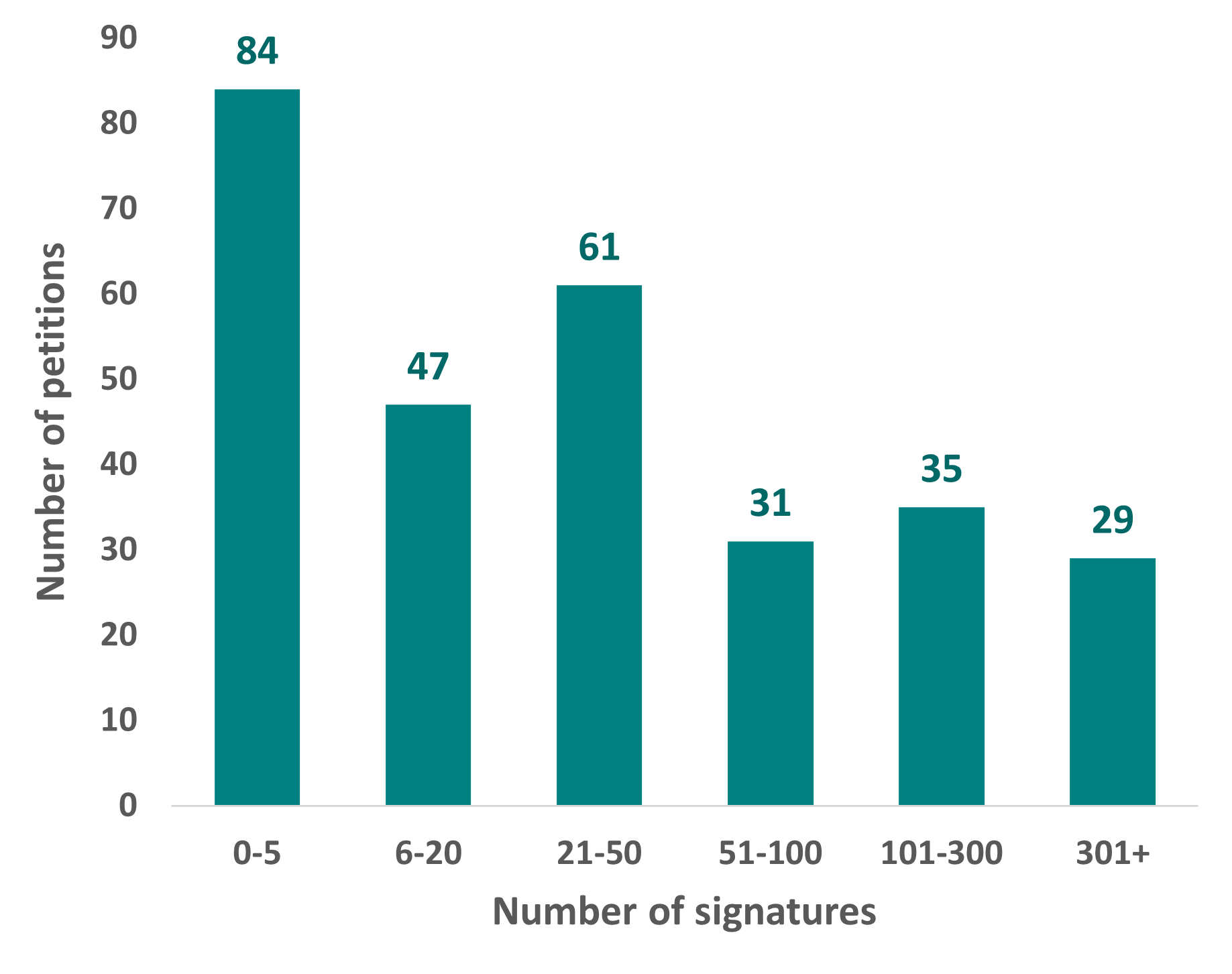
Chart 1 below presents information on the number of signatures received per petition. Most received relatively few signatures, with 26 being the median number of signatures. However, a few received very high numbers – 11 petitions across all boroughs received more than 1,000 signatures – bring the mean number of signatures per petition up to 187.

Chart 1: Number of signatures on e-petitions to London boroughs, 2023

Source: London Assembly Research Unit. Based on petitions data for 26 out of 32 boroughs

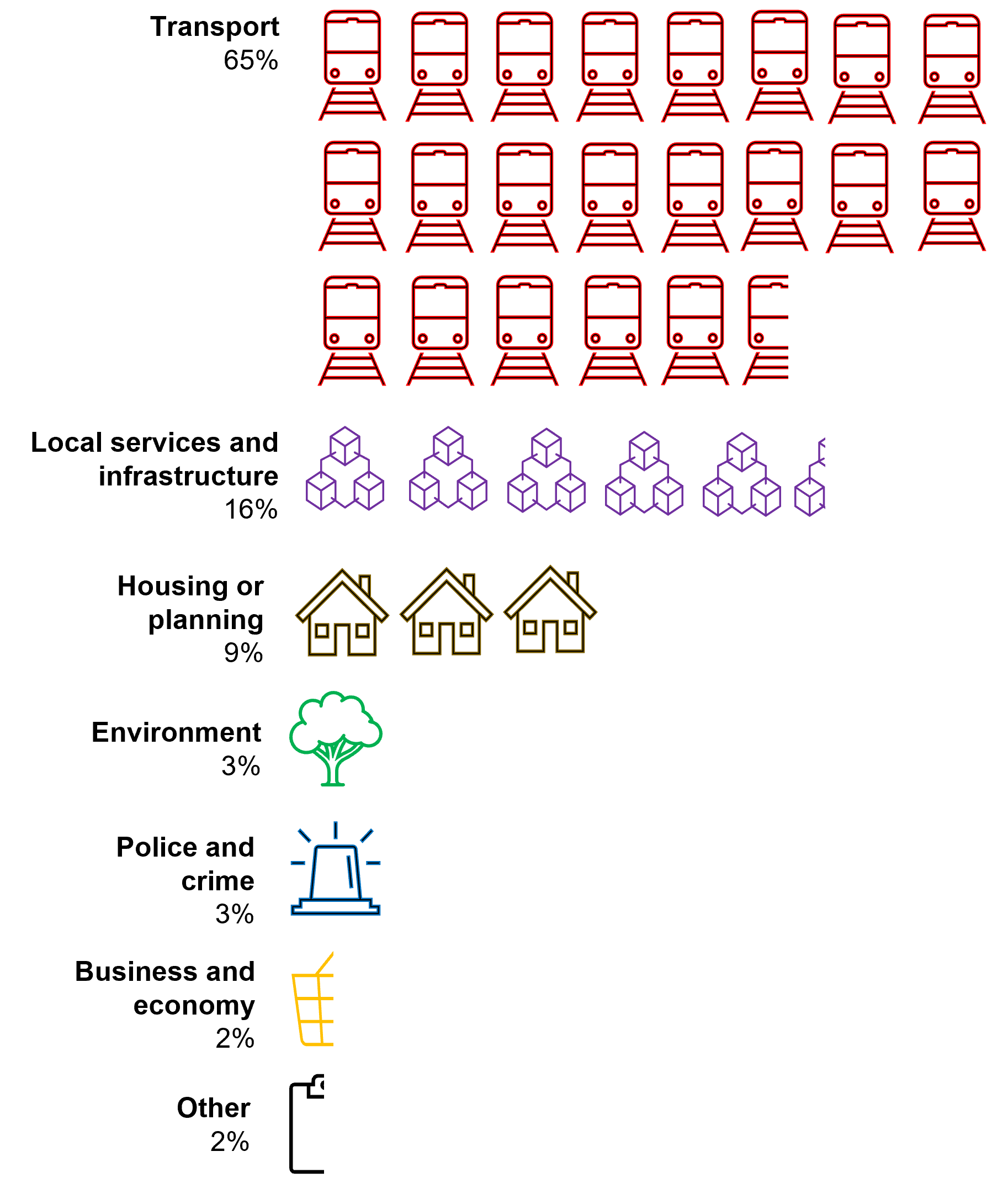
We also considered the topics of petitions submitted to boroughs. We found, somewhat surprisingly, that there was one dominant theme, transport, as shown in Chart 2.

In London, responsibility for most public transport and control of major roads is held by a city-wide strategic authority, Transport for London, overseen by the Mayor of London. Yet boroughs still control the majority of London’s roads, and we found this is where many petitions focused, as people sought changes to the streets where they live.

We see, for instance, that 71 residents of the London Borough of Ealing have called for the enforcement of the speed limit on one local road. 157 residents of the City of Westminster supported moving the location of an e-bike parking bay that had been blocking the pavement in one area. In the London Borough of Sutton, 52 residents signed a petition for the resurfacing one road in a state of disrepair.

Chart 2: Topic areas of e-petitions submitted to London boroughs, 2023

Source: London Assembly Research Unit. Based on petitions data for 26 out of 32 boroughs

The growth of online petitions systems has been the perhaps the most important development of recent times in this field. Another change that has coincided with the rise of e-petitions is that, from being the passive recipient of petitions generated externally, local authorities are now playing an active role in hosting the online platforms on which petitions are managed.

This was encouraged by the 2009 Local Democracy, Economic Development and Construction Act, which places a requirement on English local authorities to operate schemes for the handling of petitions from local residents. Although this requirement was repealed just two years later in the Localism Act 2011, systems had been introduced and in many cases have remained. In a very real sense, they are helping to facilitate campaigns focused on challenging councils’ own policies, which itself is a sign of a healthy democracy.

Richard Berry is the manager of the Research Unit at the London Assembly, which provides an impartial research and analysis service designed to inform Assembly scrutiny. The author would like to thank Kate First and William Weihermüller for conducting research cited in this article. All publications from the London Assembly Research Unit are available here.

Cotswold District Council elections – more interesting than you imagined?

Chris Game

I’ve literally just finished watching the LGIU’s promotion of its new Future Local Lab – asking me personally, albeit rhetorically (“Chris, are you ready?”): “How are we going to survive climate?”, “Will there be enough houses?”, “What can we use Artificial Intelligence for?” and a dozen other similar teasers. If this is the kind of thing you’re into, please skip this blog entirely. It’s right at the other end of whatever scale the LGIU is operating on.

I was emailed over the weekend by an erstwhile colleague who, driving back to Birmingham through the Cotswolds, noticed that there is a local by-election this week for Cotswold District Council. Interesting, eh? No, if you’re still there, don’t go away just yet – there’s a bit more to it.

No, not control of the council. Historically Independent, then Conservative, Cotswold DC is nowadays comfortably Lib Dem: 20 Lib Dems, 9 Conservatives, 2 Greens, 2 Independents. So, even though it’s a Lib Dem member who’s resigning, the politics of the council won’t change. The real issue is: for how long will there be a Cotswold DC, or, for that matter, any of the other five Gloucestershire DCs – following Deputy PM Angela Rayner’s White Paper announcement that all England’s district councils will be abolished, with regional mayors and unitary councils to be introduced in all areas?

A council which in Gloucestershire’s case would currently be odds-on to be no longer, after two decades, Conservative, but, like Cotswold DC, Lib Dem. Or would it? The general assumption following the Government’s December White Paper seems to have been that in counties like Gloucestershire all six of the district councils would merge with the county council to produce, well, a pretty large and definitely non-local Gloucestershire Unitary Council.

To which prospect, as I assume is happening quite widely across England, there has been adverse reaction. Gloucestershire would be just in the top third largest counties (by population), and in its case five of the county’s MPs have recently written to the Minister of State for Local Government and English Devolution, Jim McMahon, proposing instead something on at least a slightly less ginormous scale. In this case, that two unitary councils be created – covering, in this instance, the Forest of Dean, Gloucester and Stroud in the West, and Cheltenham, Tewkesbury and the Cotswolds in the East. The area is simply too large to be covered by one council, they argue, although, probably unsurprisingly, the County Council would disagree.

Indeed, it has been looking at how Gloucestershire could enter into an even bigger Combined Authority with neighbouring counties: variously joining Herefordshire and Worcestershire to the north, becoming part of the West of England Authority around Bristol to the south, or joining with Oxfordshire, Berkshire, Reading and Swindon to the east. I’m guessing similar deliberations are happening across the country.

Whatever – it’s not exactly ‘local government’ as my emailing ex-colleague and I once knew it! Yes, back to him, and indeed the prompt for this blog. His main reason for emailing about this week’s Cotswold Council by-election was that he knew we would both recall what was almost certainly the last time one of those was in the news – the national news, that is.

It was in May 2023, when the Lib Dems strengthened their control of Cotswold DC, thanks in part to a Chris(topher) Twells taking the Tetbury with Upton ward from the Conservatives. Yes, the same Cllr Twells who was at the time and continued for a further year to be also a member of Salford City Council, 160 miles away, just west of Manchester.

As it came to be public knowledge, it was, of course, controversial – with initially, in some circles anyway, some uncertainty about its legality, not helped by the fact that apparently even the local leadership of his new party group had been unaware of the situation. All of which seemed barely credible, since even I could have told them about the legality bit, without even checking. Anyway, soon after his Cotswold election he was suspended by his own party, “to enable a complaint to be assessed”, which had prompted my weekend emailer to contact me. But I decided even I couldn’t pad it out into a blog – until now!
Double-Cllr Twells’ own self-justification was clear enough, but didn’t do him any great favours. Most obviously it was legal because “your qualifications to stand for election can be based on occupying property or work”. Correct. Working for himself gave him the “flexibility” to attend all necessary meetings of both councils. OK. The councillor sitting on two authorities 150 miles apart had no problem fulfilling all his duties because an elected member’s workload “is not enormously onerous”. Hmm – not guaranteed to make you many friends.

And the killer punch: “I don’t want to worry anyone, but I’m technically qualified to stand for up to five districts in England and Wales”. I don’t think he meant contemporaneously, but it’s a good way of remembering just what the law says.

Chris Game is an INLOGOV Associate, and Visiting Professor at Kwansei Gakuin University, Osaka, Japan.  He is joint-author (with Professor David Wilson) of the successive editions of Local Government in the United Kingdom, and a regular columnist for The Birmingham Post.
Dusting down the cautious welcome: Initial reflections on the devolution white paper

Phil Swann

When I was director of strategy and communications at the LGA I was frequently criticised, by the late professor John Stewart among others, for issuing press releases “cautiously welcoming” one Blairite initiative or another.

The criticism was probably justified, but I would definitely have deployed that phrase in response to the government’s recently published devolution white paper.

There is undoubtedly a lot to welcome, not least the stated commitment to devolution, the additional powers for metro mayors, the revival of strategic planning, its reference to struggling small unitary councils and the focus on audit and standards.

There are, however, at least four reasons to be cautious.

First, every serious reformer of local government since George Goschen in the 1860s has argued that local government finance and structures should be reformed together. No government has ever had the political will or energy to do so. This government has also ducked the opportunity. As a result, this white paper will not fulfil its potential.

Second, the current mess and confusion in the structure of English local government is the result of incremental change. Just think of Peter Shore’s “organic change” and Michael Heseltine’s ill-fated Banham Commission. There is a real danger that this government will run out of restructuring energy or time. The contrast with Scotland and Wales, where local government was reorganised in one go, could not be starker.

Third, the effectiveness of the structures being proposed will depend on the quality of the relationships between mayors and councils, between councils and parishes and between ministers and mayors, councils and parishes. In England we are not good at relationships like these and there is precious little in the white paper to signal the trust, effort and imagination that will be needed to make these relationships work better than the previous ones did.

Finally, key to the revival of local government and effective devolution is a revival of citizen engagement in local politics and local governance. Word has it this will be addressed in a forthcoming white paper, but it should be central to this one.

So, a very cautious welcome it is.

Phil Swann is studying for a PhD on central-local government relations at INLOGOV.

How the ‘Make a Difference, Work for Your Local Council’ campaign aims to help councils address the local government recruitment crisis

Cllr Abi Brown OBE

The successful recruitment and retention of skilled professionals in local government has long been a challenge for the sector. Given the impact of the pandemic, a significant shortage of staff in several key delivery areas, increased demand on services, together with being the lowest paid part of the public sector, capacity and capability issues are at the forefront of concerns across local government. It’s why there has never been a more important time for a recruitment drive.

In a survey of local council leaders, over half of those surveyed told us that workforce capacity issues were likely to affect their council’s ability to deliver services. Of those surveyed, 94% said they were experiencing recruitment and retention difficulties, 90% said they had a capability skills gap in their management teams in at least one area, and 83% said they had a capacity skills gap in a least one area. Areas in the sector we identified as needing the most help included adult social care and children’s services, finance, planning, and environmental health.

How then do we attract the talent we desperately need when budgets are so challenging, and public perception of what we do is so misunderstood?

This was the question asked by local council HR and recruitment teams up and down the country; one that the LGA, together with SOLACE, Regional Employers Organisations, and councils across England sought to address with the launch of the ‘Make a Difference, Work for your Local Council’ campaign. Funded by UK Government as part of the LGA’s sector support offer, the campaign aims to help attract new talent and highlights the benefits that a career in local government can offer.
The national campaign was launched on 4 November 2024, this followed a successful pilot in the north east of England that took place between January and March of this year. The pilot campaign has since won an LGC Workforce Award for ‘Best Innovation in Recruitment’.

Research and planning

Working together with market research agency Habit5, we spent months understanding our audience and their challenges using a mix of focus groups and online surveys. This research was crucial in helping us prove that not only was there a wide audience base to speak to, but it identified who were the most open to the idea of working for their local council. We identified these as ‘career starters’, aged between 21 – 29, and ‘career changers’, aged between 30 – 49 (although we would absolutely encourage anyone to consider a local government career!).

The research also helped us understand which elements of working for local councils appealed most to people; this would inform the brand identity and campaign messaging. These elements were, helping their local community, flexible working, the range of roles available and career development. It’s from this detailed work that ‘Make a Difference, Work for your Local Council’ was born.

Bringing the campaign to life

We’ve been so lucky throughout this process to work with partner agencies who have not only understood our mission but have helped us to bring our ideas to life. Advertising and communications agency Storycatchers created a bespoke campaign toolkit for councils, packed with a suite of digital and print assets that are simple, yet vibrant in their design. Perhaps most importantly, they are human, using wording and imagery to resonate and identify with people wanting to make a positive change in their communities.


Together we’ve worked hard to ensure that the campaign creative is as much authentic as it is captivating to our audience. All campaign imagery and videography capture the real-life experiences of officers working on the ground in local councils across those four key professional areas. We can’t thank Kerry, Omaid, Daniel, and Susanna enough for their enthusiasm and commitment to this project which has truly brought it to life.


Getting the message out

The team at Republic of Media developed a detailed paid media strategy that has seen our campaign advertised across England via multiple channels including on digital billboards, audio channels such as national radio stations and Spotify, and social media – specifically Meta and LinkedIn.


Our dedicated website localcounciljobs.gov.uk was developed to be clear, informative and helpful. As well as giving useful insight into why a career in local government is a good choice, the website also offers job seekers a postcode search, making it quick and easy to access the council vacancies available in their area.


Sector support
The support from the local government sector and our partners has been huge, and for that we are incredibly grateful. It’s been fantastic to see councils up and down the country throwing their support behind the campaign and utilising the toolkit assets to complement their own recruitment efforts. It’s with their help and their passion for the sector that we’ve already seen some impressive results since launching on 4 November, indicating that our authentic approach is working.

The new website has attracted 62,651 users in its first month, with 34,546 postcode searches being made. Our newly launched social media channels have already gained 1,374 followers who have been excitedly sharing campaign content with their networks. So far, organic social media posts have achieved 32,399 impressions and 3,290 engagements such as likes and shares. Paid for advertising on social media has generated close to 2 million impressions, and out of home display activity continues to outperform key benchmarks week on week. Digital display advertising on websites has so far generated over 5 million impressions and 9,302 clicks to the campaign website.


On top of all of that, we’ve already heard positive feedback from local councils on how the campaign is having a direct impact on the number of job applications they are receiving. The ‘Make a Difference, Work for your Local Council’ campaign paid media activity runs until the end of January 2025, during which time we expect to hear many more examples of positive campaign impacts from across the sector.


The success so far demonstrates clearly to me what my colleagues and I already knew to be true; that the power of local government and people’s desire to make a difference in their communities still runs strong. I’m immensely proud of everyone who has collaborated on this campaign to date. The results we are starting to see is testament to all their dedication, hard work, and expertise; just some of the attributes we’re hoping to attract into local council jobs across England to secure the future of vital public services.

Cllr Abi Brown OBE, is Chair of the LGA Improvement and Innovation Board.