The English question

Martin Stott

It is worth contemplating the possibility of a scenario in which Scotland votes for independence in September and a new Government holds an ‘in/out’ referendum on the remainder of the UK’s membership of the EU in 2017 – and the vote produces an ‘out’ result.  Whether it is of the social democratic variety espoused by the SNP in Scotland, or the populist nationalism of UKIP in England, nationalism is having a profound effect on British politics.  Contested membership of the EU and the salience of immigration in the political debate are two examples of where political parties’ responses are fumbling and confused, and were these two referenda to result in Scottish independence and a British exit from the EU, the shocks  to the existing political system would be enormous.

What has this got to do with local government? The reality is that Britain has an extraordinary concentration of political and economic power in London and whatever their result, the impact of these referenda only serves to reinforce that position. None of the major political parties are seriously thinking about any kind of constitutional settlement which addresses the issue. There is a long tradition of parties praising local government to the skies in opposition and promising all kinds of devolution of powers and local taxation when they come to power, only for this to be forgotten the moment they actually obtain power.

This is particularly striking in relation to local tax raising powers. The proposed ‘mansion tax’ – a very poor substitute for a council tax revaluation (let’s not go down the path of the regressive nature of the council tax itself just now) will of course be collected by the Treasury and not local government. Labour has always seen the Treasury as a force for good, especially in the Brown era – think public expenditure and tax credits amongst other things. But the power of the Treasury combined with the influence and economic power of London and the City in particular, has hugely distorted the social and economic balance of England and the rest of the UK.

This sense of being ignored by metropolitan elites has certainly driven the rise in support for UKIP and a more general disenchantment with politics generally, where a cynical view that the elite looks after its own has been confirmed for some by the scramble for parliamentary seats by the sons of Labour grandees (think Stephen Kinnock, Will Straw and David Prescott).

A crisis of legitimacy is developing in England where the kind of top-down statism perceived to come from Whitehall and Westminster is exacerbated both by current government policies and by the dysfunctional and systematic inequality generated by markets  and inequitable public service provision over many years, both of  which have their roots in a culture of ‘Whitehall knows best’. The problem is that a lot of people don’t agree with that any more (if they ever did) and the problem for political parties is that voters are expressing that at the ballot box, where support for the major parties is ebbing away by the day, whether it be to nationalists, UKIP, independents, or simply by not voting at all.

Many Conservatives would dispute the idea that they were a party that supported the long arm of the state. But folks in local government know better. Whether it is Eric Pickles sounding off about waste collections systems (a subject he has been mercifully silent on recently) or the wickedness of councils raising revenue through ‘excessive’ parking charges, as he caps council tax rises at 2% and then decides that councils aren’t playing the game if they raise them by 1.99% and proposes that they should be capped at 1.5% in future, micro-management of local government is what Whitehall loves doing most. That is of course when it isn’t wriggling out of George Osborne’s public expenditure cuts by loading them onto errr…local government.  National Trust Chairman Simon Jenkins encapsulated this in a recent article in which he pointed out that in reality the really big loser in the recent rounds of austerity has been local government who have ‘…borne the lion’s share of the burden so as to relieve Whitehall budgets of real pain.’

The rising resentment of many outside the corridors of power about the absence of a political voice and accompanying economic levers for many different English communities is fuelling this splintering of political support and adding to the crisis of legitimacy. Yet there is plenty of evidence that complex policy challenges ranging from entrenched pockets of social disadvantage and isolation, the resource implications of a combination of long term care for the elderly and obesity and other lifestyle diseases amongst younger people, or the impacts of catastrophic climate change, are best addressed at local level, a reality briefly acknowledged  in the dying days of the Brown Government through its ‘Total Place‘ programme.

The idea of devolving more economic and political power across England is hardly a new one and a few nugatory experiments such as the Regional Development Agencies have been tried and dropped. Lots of politicians in all political parties pay lip service to the idea that the public realm means more than just the central state, but if this crisis of legitimacy isn’t to start taking an uglier form, a road map of how power will be devolved  to cities and counties in the next few years is urgently needed. A satisfactory answer to the ‘English Question’ presses, as these referenda loom, and whatever their outcomes it won’t go away any more.

stott

Martin Stott joined INLOGOV as an Associate in 2012 after a 25 year career in local government.

What does the Autumn Statement mean for local government?

Catherine Staite

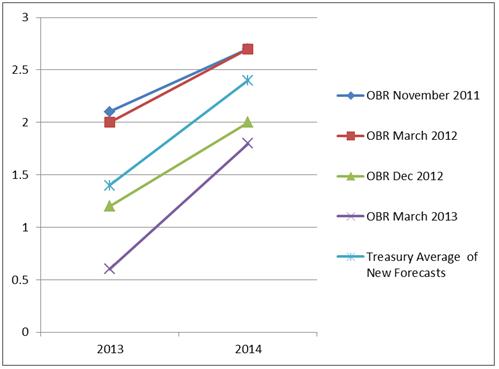
This December, in contrast to the previous two years of worse than expected news, the Chancellor has revised his growth forecasts upwards and revised his debt forecasts downwards.

Figure 1 shows successive forecasts for year-on-year GDP percentage growth (at constant prices) since November 2011 It can be seen that the forecasts have been successively revised downwards by the Office for Budget Responsibility since then, as shown by arrows a, 2 and 3.  However, the latest survey of forecasts by the Treasury for this November suggests that the Chancellor will be presented in December with a higher-than-expected forecast for GDP growth – as shown by arrow 4 – for his Autumn Statement.

staite 1

Figure 1: Growth forecasts since November 2011

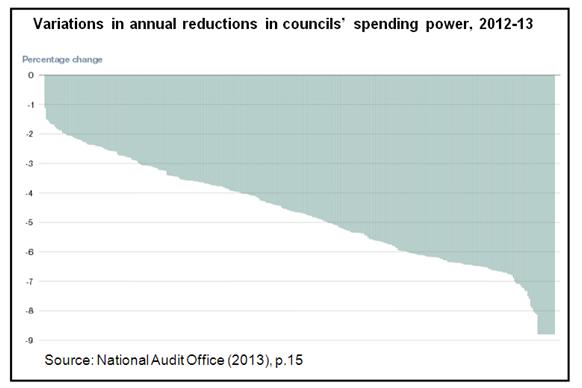
Up until now, local government has taken more than its fair share of the downward adjustments to spending plans. Funding for councils has fallen by an average 21% and ‘councils serving deprived areas have seen the largest reductions in funding relative to spending since 2010/11’.

staite 2

Figure 2: The variable impact of the cuts

Dealing with the problems generated by changing demographics, the economy and central government policy have increased pressure on council finances. Spending on homelessness has risen by 16% since 2011/2 and the number of looked after children increased by 10% between 2009 and 2012.  The pressure to meet rising urgent need means there is less to invest in early intervention which will save money and improve lives in the long term.

Local government has reduced its costs by cutting jobs and being more efficient.  Council’s can only cut so far before they become unable to meet their 1700 statutory duties, including protecting the most vulnerable and remain viable.

staite 3

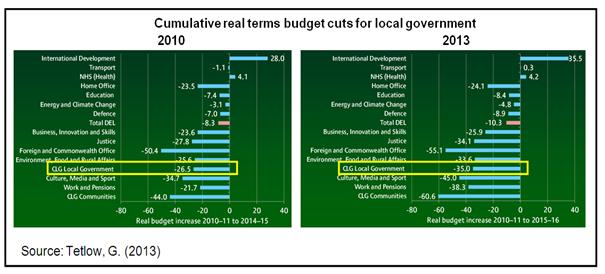
Figure 3: Cumulative cuts for CLG and local government

Because Communities and Local Government have taken a disproportionate share of previous budget cuts, local government has also taken more than its fair share of the cuts.

The news that there will be no further cuts to local government funding in 2014/5 is to be welcomed, not least because it is a tacit acknowledgement that local authorities have risen to the challenge of becoming more efficient, in an exemplary way. Perhaps it also reflects some understanding that continued cuts would further endanger services for the most vulnerable.

Local government has wearied of the confrontational style and unrelenting unpleasantness of Eric Pickles. Perhaps, today’s news is a sign that George Osborne is interested in having a more mature and productive relationship with local government.

Catherine Staite

Catherine Staite is the Director of INLOGOV. She provides consultancy and facilitation to local authorities and their partners, on a wide range of issues including on improving outcomes, efficiency, partnership working, strategic planning and organisational development, including integration of services and functions.

Want a 50% turnout in a local election? Try Neighbourhood Planning

Chris Game

Yes, there were other news stories last weekend – Grangemouth, St Jude, Plodgate, Merkel’s mobile, Lady Gaga’s new album. Still, a more than 50% turnout in something local governmenty surely merited some kind of headline.

Last autumn, remember, the national turnout in the police commissioner elections was under 15%. Yet on Thursday, in the Cheshire village of Tattenhall, they voted in droves – not for a mayor, councillor, or commissioner, but to express overwhelming backing for their neighbourhood development plan.

From the damp squib of elected mayors to the micro-meddling of Communities Secretary Eric Pickles, the Coalition’s localism agenda has hardly been an unqualified triumph. With neighbourhood planning, though, it does seem to have hit on something capable of imbuing in at least some of us “a zeal for participation”, as Nancy Holman put it in her recent, more conceptual, discussion of the topic.

Introduced in the 2011 Localism Act, neighbourhood planning is about giving people more influence over planning decisions affecting their daily lives: choosing where new homes, shops and offices should be built (or not built), what these buildings should look like, and what infrastructure is needed.

The Act allows parish and town councils or other representative community groups (as in the Upper Eden and Exeter cases described below) to formulate Neighbourhood Development Plans (NDPs), that will shape development in their area – provided they ‘have regard to’ national policies and conform with local planning strategy.

Proposed NDPs must pass an independent standards check, usually by a planning inspector, and are then put to a referendum, organised and paid for by the local planning authority. If the Plan receives majority approval, the planning authority must adopt it, and it becomes part of the legal framework with which future planning decisions must comply.

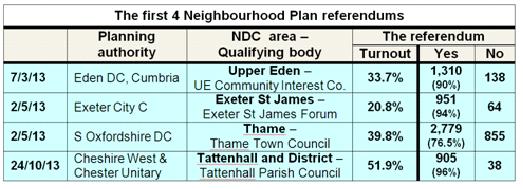
Last Thursday, in the fourth of these referendums, nearly 52% of residents turned out and 96% of them supported the Tattenhall and District NDP – which means it now has legal status? Well, not quite yet.

game table

The NDP is a professionally prepared 30-page document replete with a vision, objectives, a strategy, implementation plan, maps, appendices, and six clear policies on various aspects of community life. But not all policies are equal, and here Policy 1 on Housing Growth is clearly more equal than the others that flow from it.

There are currently 1,090 homes in Tattenhall parish and the Plan proposes allowing up to 30 new homes in the built-up village in the period to 2030, plus some smaller scale development elsewhere in the parish. Three national housebuilders, however – Wainhomes, Barratt Homes, and Taylor Wimpey – have applied to build a total of 305 homes in what the Plan regards and rejects as “large-scale inappropriate development along existing village boundaries”.

The builders contest some aspects of the Plan and also the independent examiner’s impartiality, and the first two firms have lodged a judicial review challenge, which, until the High Court has deliberated, will prevent the Plan being formally adopted and joining what Planning Minister Nick Boles has called the quiet planning revolution.

He used the phrase back in March to describe the similarly positive outcome of the first referendum in, appropriately enough, Eden – though not the Garden thereof, but Eden Valley to the east of the Cumbrian Lake District.

The Upper Eden NDP is quite different from Tattenhall’s, not least because the area is extremely sparsely populated and about 17 times Tattenhall’s size. Again, the main focus is housing, but the proposed development rate here is 40 homes a year, and 545 over the plan period to 2025 – a higher total than the 479 in the district council plan, with all 66 extra homes allocated to rural areas that the parish councils involved in preparing the NDP felt had previously been overlooked.

Other policies include increasing affordable rural housing by permitting more conversions, incentivising developers to provide more housing for older people, and improving broadband provision. This being the first NDP referendum, there was a lot riding on it, not least for Ministers, and Upper Eden delivered. In a 34% turnout – nearly double that for Cumbria’s police commissioner vote – 90% backed the Plan.

The St James area of Exeter, site of the next plan that went to referendum, is completely different again: 6,000 residents sandwiched between the city centre and university campus in a community that has been losing its traditional and diverse character through the intrusion of traffic and car parks, neglect of green space, but particularly the conversion of family homes into houses in multiple occupation (HMOs) – student occupation.

The NDP was prepared by the Exeter St James Forum, a group of local people, including students, brought together initially by residents’ associations. Key policies included restricting the spread of HMOs and bringing more social balance to the area, encouraging small businesses, a tree planting campaign, and identifying certain residential streets for ‘home zone’ treatment with reduced and slowed traffic.

In a May 2nd vote in a student-dominated ward, turnout was an unsurprisingly disappointing 21%, but the endorsement of the Plan a positively Putinesque 94%.

The last of the four NDP referendums to have taken place so far was held on the same day, in the South Oxfordshire town of Thame, and we have another quite different scenario.  For Thame’s NDP was a direct response to the core strategy in South Oxfordshire’s local plan, which proposed to allocate 600 homes on one large site on the outskirts of the town, rather than, as many residents seemingly preferred, on developable sites within the town itself.

The district council, to its credit, backed Thame Town Council’s bid for government funding to produce its own NDP, on the understanding that it could cover only non-strategic issues and not, for instance, the numbers of proposed homes. Advised by professional urban designers, the town council consulted with residents, identified more than enough potential sites, and eventually agreed on a ‘Walkable Thame’ option, the condition of which is that new homes should be within walking distance of Thame town centre.

In the May referendum it was approved by a more than 3 to 1 majority on a nearly 40% turnout. As the local media justifiably boasted, Thame residents had become the first in England to pick their own housing sites through a neighbourhood plan.

Three more referendums are currently lined up, but this is a trickle with the potential to become a flood. There are now well over 600 recognised Neighbourhood Planning Areas, and Ministers claim that over half of English local authorities are working with groups on community planning, many of whom are receiving government grant funding to help them prepare draft plans.

It’s far too early to draw any serious conclusions – as to whether neighbourhood planning will constitute a quiet revolution or anything else. But one almost instant criticism of NDPs, raised also by Nancy Holman in her references to NIMBYism, was that they would appeal most to parish and town councils in relatively less deprived rural areas in the already over-heated south-east.

It may well prove to be true, but the four very disparate Plans to have come almost arbitrarily to referendum so far offer little support.

game

Chris Game is a Visiting Lecturer at INLOGOV interested in the politics of local government; local elections, electoral reform and other electoral behaviour; party politics; political leadership and management; member-officer relations; central-local relations; use of consumer and opinion research in local government; the modernisation agenda and the implementation of executive local government.

Planning and the new (new) localism – what chance of success?

Nancy Holman

Planning in a time of austerity is never easy – budgets are cut, needs are great and regulation can be seen as stifling growth.  In England we are in just such a position and in the midst of a reformulation of planning that is on the one hand meant to deliver growth and on the other designed to empower communities. Most of these reforms are being couched in the language of localism with community participation at the forefront of policy.

However, these reforms raise a series of questions that have yet to be answered: Who will get involved in local planning? Will localism foster increased NIMBYism? And most importantly, can the localism agenda actually engender action toward policy implementation? My article, co-authored with Yvonne Rydin, examines these dilemmas through the lens of social capital and offers key insights into this latest governmental foray into local social relations.

Who will get involved?

The Localism Act provides communities with an opportunity to come together and formulate their own neighbourhood plans thereby shaping their locale.  Key to this is engaging people in sufficient, meaningful and constructive participation. Social capital suggests that this can be kindled when like-minded communities come together over locally salient issues thereby creating networks of mutual trust and reciprocity.  However, this scenario is not without problems as in order for it to work communities must believe that the benefits of participation are not offset by the opportunity costs of participating. In addition, the strong ties of bonding social capital that emerge from participative exercises can in turn foster more insular and exclusionary localities outweighing any strategic benefits to greater community involvement.

Will localism foster NIMBYism?

Even if the localism agenda fosters communities burgeoning with social capital and a zeal for participation, a real fear, from the government’s perspective, is that these communities will be those best able to resist growth, which runs counter to the Coalition’s aspiration for localist planning.  Countless studies, from the location of mobile homes in post-Katrina New Orleans to LULUs (Locally Unwanted Land Uses) in Japan, have shown that strong social capital is associated with heightened abilities to avoid unwanted development.  Whilst the government has put in place a number of measures like the New Homes Bonus to incentivise local communities to grow the jury is still out on how well this will work.

Will the agenda actually engender policy action?

As the old adage goes, “Almost anyone can write a plan, the difficult part is putting into action”. Critically, there is nothing in the new system of Neighbourhood Plans that makes them more proactive and action oriented in terms of bringing land and development forward to achieve plan outcomes. Here, social capital tells us that, if communities wish to see their plans implemented they must situate themselves in networks that extend beyond local bonding ties into a bracing matrix tailored to the needs of the development activity so that they may access additional resources and investments.  This means that there is scope to ‘shape’ networks to deliver more effective planning.

So, what might be the outcomes of government reform?  As it stands, the rhetoric of localism is in danger of delivering only failed promises and thwarted desires for local communities.  However, planners could regain a key role under the new agenda by focussing on how they could actively build the networks of specific forms of social capital needed to achieve participation, frame localist planning in broader terms by injecting much needed planning skills into the neighbourhood planning exercise, and deliver development that meets community needs by considering the necessary resources and engaging with those who have the power to deliver such change.

A full account of this research is available in my recent article with Yvonne Rydin: ‘What can social capital tell us about planning under localism?Local Government Studies. 39 (1), 79-88.

holman

Nancy Holman is the Director of Planning Studies at the London School of Economics and Political Science. Her work deals primarily with issues of governance and local planning including sustainable development, heritage conservation and community participation. She has often used social network analysis to explore the complex relationships in the multi-level, multi-actor partnerships present in modern governing arrangements.

It’s been 30 years coming, but Clause 38 is still really bad news

Chris Game

Sometimes you hear “All things”, but the ancient proverb and the modern Guinness advert agree that it’s “Good things come to those who wait”. Unfortunately, bad things do as well, and for local government Clause 38 of the Local Audit and Accountability Bill is a bad thing that’s been waiting to happen for 30 years and now finally has.

Full badness details will follow, but first, please excuse some personalised scene-setting. The LAA Bill is through the Lords and should get its Commons Second Reading later this month. Its main and originally entire purpose, embodied in Clauses 1 to 37, is to complete the Audit Commission’s abolition and introduce from 2017 a new regime for local authorities and other public bodies to appoint their own auditors. Yes, it is controversial, but a controversy best pursued by more knowledgeable others.

The sole concern here is Clause 38, one of two added by Communities Secretary Eric Pickles and the DCLG long after MPs’ scrutiny of the draft Bill had been completed. It comprises Ministers’ intention to turn the Code of Recommended Practice on Local Authority Publicity from guidelines with which councils are currently recommended to comply, into a statutory document with which they must comply.

There are several wrongs here, quite apart from Ministers’ extraordinary Humpty Dumpty attempt – “when I use a word, it means just what I choose it to mean” – to label it an exercise in ‘localism’, because it seeks to protect the interests of local newspaper publishers against those of elected local authorities. The story starts, though, in the adventitiously appropriate year of 1984.

Then, as now, Ministers were in a lather because a handful of mainly London councils were doing things they didn’t like: some admittedly dubious, but most provocatively ‘political propaganda on the rates’ – when the phrase, unlike when their successors use it today, at least made literal sense. The then Pickles, Patrick Jenkin, played to his party conference audience by announcing what would become the Widdicombe Committee of Inquiry into the Conduct of Local Authority Business, designed to do a hatchet job on those pesky Labour boroughs.

It didn’t work out quite like that – partly, I like to think (as one of the researchers), because of the Committee’s commissioning and use of an extensive programme of independent research, and partly through refusing in its main report to deliver the censorious denunciations of local government practice for which Ministers were apparently looking.

That main, research-based Widdicombe Report, though, was preceded by a quick-and-dirty, research-free interim report on local authority publicity. The Committee members didn’t want to play, and used the opportunity to rehearse their views that local authorities were more than a sum of their services, and had a duty to inform the public both of their own functions and on local government matters generally.

They delivered a divided report, but the majority verdict calling for a prohibition of publicity designed to support a political party was enough for Ministers to produce a statutory political publicity ban, based not on content, which was Widdicombe’s concern, but intent – indeed, possible intent: any material which appeared designed to affect, “or can reasonably be regarded as likely to affect”, support for a political party, cause or campaign.  Remember those conjectural words; there’s more coming up.

The only constraint on the Government in the 1983-87 Parliament were the Lords, and here they removed “likely to affect”, and a good deal else besides, and refused to agree to any code of practice being more than advisory. But the reprieve was short-lived and by 1988 there was a new Act with an even more restrictive definition of legitimate publicity, embedded in a Code of Recommended Practice to which authorities were required to “have regard”.

There have been various interim revisions of the Code, but none that have changed its fundamental character: a set of recommended principles and ultimately voluntary practices, written and scrutinised as such, with none of the forensic drafting rigour that would have been brought to a document intended for legal enforcement. But change “have regard” into “must comply” and you change everything, and that’s what the Government is doing in Clause 38.

I’ll look first at the Publicity Code itself, then at the proposed means of enforcement. The Code’s most recent revision in 2011 was driven jointly by the Newspaper Society – arguing (without much support from hard evidence) that council publications, rather than the internet and broadband, were the crucial threats to local newspapers’ sales and advertising revenues – and a receptive Eric Pickles, two of whose favourite hate taunts are ‘propaganda on the rates’ in the form of ‘town hall Pravdas’ or council newssheets.

Up front in the Code are seven key principles: that publicity by local authorities should be lawful, cost effective, objective, even-handed, and appropriate, should have regard to equality and diversity, and be issued with care during periods of heightened sensitivity.

Even here there are examples of the real slackness and imprecision with which the Code is, and will remain, littered. What do ‘have regard’ and ‘care’ mean? How tall does sensitivity have to grow? And another of those conjectural phrases we saw earlier: objectivity is infringed by “anything likely to be perceived by readers as constituting a political statement, or being a commentary on contentious areas of public policy”. Whether or not you think it reasonable for a political body to make a political statement or an observation on a contentious policy, what kind of yardstick is the likely perception of all, or most, or some, or a vexatious handful, of your readers?

To repeat: in a voluntary code, already overseen by numerous laws, auditors, and the Advertising Standards Authority, these vaguenesses are merely irritating and a potential get-out. In a statutory code, they can cost potentially serious money.

Probably the code’s most contentious provisions are that, where councils do publish “newsletters, newssheets or similar communications”, they should not be issued more frequently than quarterly, or “seek to emulate commercial newspapers in style or content”.

The majority of council newspapers are now quarterly, although even a monthly publication – an appropriate and cost effective frequency, one might argue, for keeping residents fully informed of service developments and changes, consultations, forthcoming council business, councillors’ surgeries, traffic orders and planning notices – could hardly be said to be emulating the style of commercial newspapers, whatever that might be guessed to mean.

What we have, then, is one more example of Ministers’ typical modus operandi in their dealings with local government. They see something they don’t like being done by a few London boroughs on their proverbial doorstep – in this case, distributing a weekly newspaper (Tower Hamlets) or fortnightly magazine (Newham). Then, instead of letting residents decide for themselves whether they approve of how their money’s being spent, they outlaw it with ill-prepared legislation applying to every principal and parish council in England – in the name of localism.

Which brings us to the enforcement debate. Clause 38 allows the Secretary of State to direct one, some or all authorities to comply with part or all of the Code, whether there are grounds for believing they are currently breaking it or not.

How, though, do you judge either compliance or non-compliance with a code as casually drafted as this one? Even in the apparently straightforward case of council publications, there’s no definition even of ‘newsletter’ or ‘newssheet’ or when either metamorphoses into a newspaper, let alone of what emulating commercial newspapers in style and content entails.

“Contentious issues” – like HS2, a third runway at Heathrow, large housing developments, cuts to police and fire services, hospital closures, welfare reforms – are, well, even more contentious.

At present, if an authority feels it or its residents would be severely adversely affected by a government policy, it can “have regard” to the principles of the Code, but still judge the matter sufficiently important for it to explain its opposition in a way that will certainly be perceived by at least some readers “as constituting a political statement, or being a commentary on contentious areas of public policy” – because that’s what it’s intended to be.

LGA Chairman, Sir Merrick Cockell, picks HS2, and specifically the cross-party 51M alliance of 19 local authorities opposed to it, as a topical issue that highlights the almost laughable irrationality of the Government’s proposals. The authorities have already challenged the Government’s policy in the High Court, may carry on the fight in the Supreme Court, and will surely petition Parliament for amendments to any eventual legislation. Yet, if they attempt publicly to explain their case and how they’re spending residents’ and taxpayers’ money, they would in future risk being individually and/or collectively prevented, on the grounds of infringing the Code.

It seems that, after nearly 30 years’ waiting, Pickles and his colleagues are about to achieve what their Thatcherite predecessors never quite managed: the power to gag any council’s questioning of any Government policy. It would have been bad legislation then, but in today’s hugely different political climate, it looks, if anything, even worse.

Chris Game - pic

Chris Game is a Visiting Lecturer at INLOGOV interested in the politics of local government; local elections, electoral reform and other electoral behaviour; party politics; political leadership and management; member-officer relations; central-local relations; use of consumer and opinion research in local government; the modernisation agenda and the implementation of executive local government.

If I asked you to describe a 21st century public servant, what would you say?

Catherine Mangan

I read with interest the recent announcement from Birmingham City Council that they did not intend to recruit a replacement chief executive, but would instead create a ‘lead officer’ role. A few years ago it would have been unthinkable not to have a chief executive at the head of a council.  Now, with councils debating what their role is, and the need to seize an opportunity to make savings, more and more councils are making the decision to remove the chief executive post entirely.

Arguments about whether this is a good idea or not have been much debated in the local government world, but I’m interested in what this says to those seeking a career in local government, and the wider public service.   If the very pinnacle of public service, a council chief executive, is no longer a relevant role, what does this mean for the wider workforce?  As the ‘how and what’ of local government changes, so too must the workforce.  How can public servants ensure they remain relevant, and ready for the future challenges?   What does a public servant in the 21st century look like?  How do those of us who provide development support to the workforce best work with them to give them the skills to achieve?

These are questions we will be exploring through a new knowledge exchange project in partnership with Birmingham City Council, funded through the ESRC.  Over the next year we will examine the recent literature, carry out interviews with key stakeholders and create an on line resource to support public servants seeking support and development.   We aim to address key questions such as:

What is the range of different roles of the twenty first century public servant?  As people’s roles expand to encompass the whole person in a system, they can no longer dispense professional judgement in isolation. They need to be negotiators, brokers, story-tellers and resource weavers. Perhaps no longer a social worker but a care navigator.

What are the competencies and skills that public servants require to achieve these roles?  What do you need to be good at to be an effective family support worker?  Probably an ability to empathise, engage, motivate and inspire.  Along with the skills to get things done.   What might that look like in a professional development plan? How do we best support people to develop those roles and skills?  Skills for the 21st century public servant may not be those that can be developed through traditional training; we need to think imaginatively about supporting peer learning, sharing knowledge about what works; facilitating networks of learning.

And as the career path becomes more complex and less certain; with roles spanning organisations and sectors, how can central and local government better support and promote public service as a career?

We are looking forward to exploring the ideas and issues raised by these questions, and want to hear what those of you working in or supporting the public sector have to say.   If you’d like to know more about the project, or contribute in any way, contact us.  We’d love to hear your views.

Portrait of OPM staff member

Catherine Mangan is a Senior Fellow at INLOGOV.  Her interests include public sector re-design, outcomes based commissioning and behaviour change.  She is currently leading the 21st century public servant project, in partnership with Catherine Durose and Catherine Needham. She can be contacted about the project via email, or on Twitter – and you can join the conversation: #21CPS.