From repression to co-production with citizens: Why we need behaviour change in healthcare

Jörgen Tholstrup

What’s the mission of health care?

Highland Hospital, Sweden_2

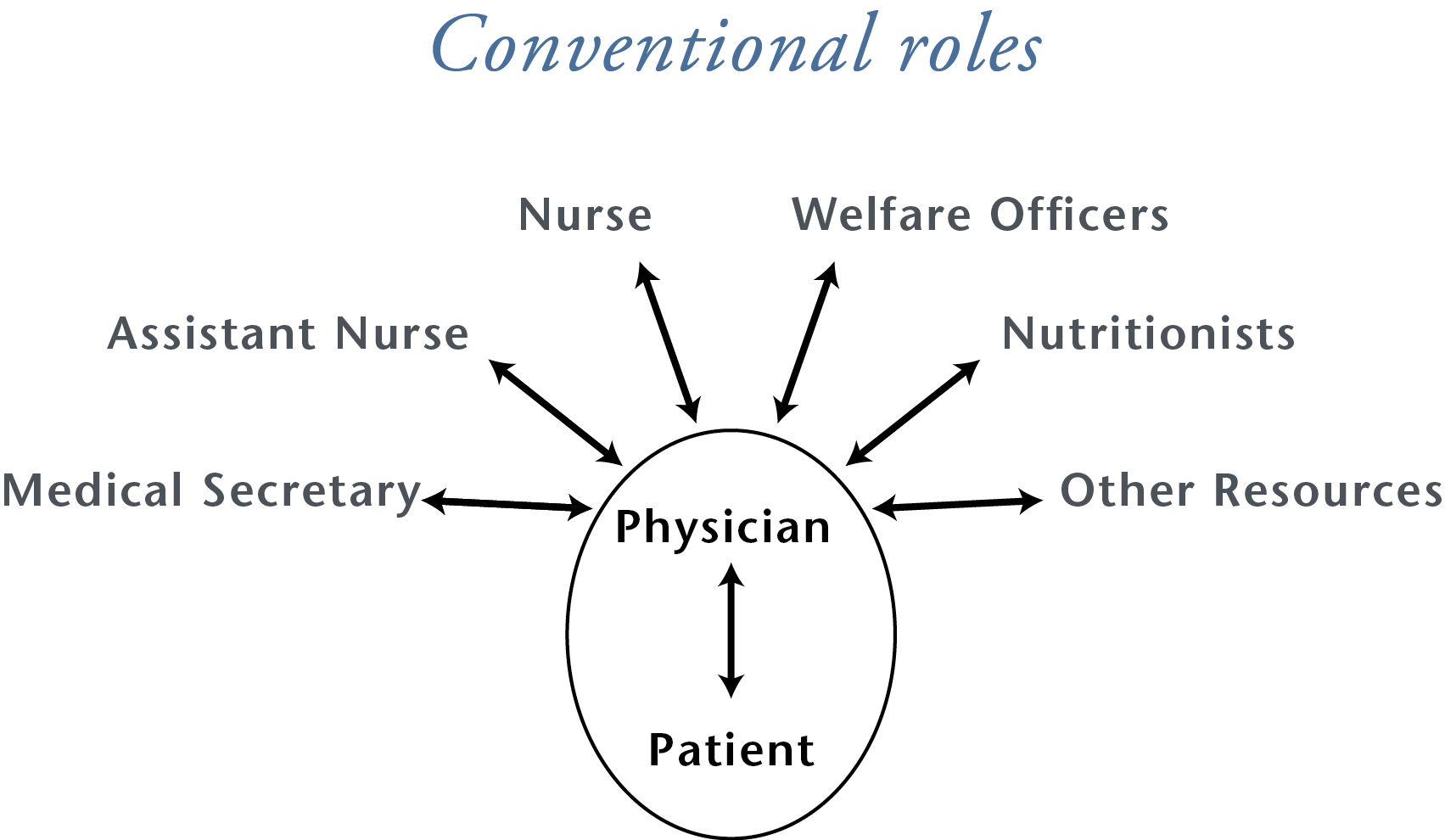
I’ve been working as a physician and gastroenterologist both in Denmark and Sweden for more than 30 years. Over time, I’ve become more and more puzzled about our healthcare system and how otherwise responsible human beings can tolerate the way that common behaviourial rules are suspended when you access healthcare.

In my role I am supposed to order people named ”patients” to behave the way that I or the ”science” believe is the right way to behave. At the same time, most medical practitioners know that their patients will not in fact behave the way recommended. Most studies on “compliance” with recommended treatment show that only 40-50% of patients actually follow therapy recommendations (WHO, 2003). This behaviour is most often a result of their conscious choice and does not arise from stupidity or ignorance. This mismatch is remarkable and the result is devastating to health as more than 50% of patients will be untreated for treatable or preventable diseases.

So, how did we get into this paradoxical situation?

To understand the modern healthcare system and its rules of behaviour, it is necessary to look back in time and try to understand how and why the system has developed. The healthcare system reflects society and is the result of the outlook and the values of citizens. From the beginning of the 16th century, the institutionalisation of health care started in monasteries. Naturally, the rules of behaviour (i.e. obedience and silence) were in accordance to monastic rules. The history of silence, and how we as humans can use the expectation of silence as a tool through which to rule over others, is fascinating. The monasteries aimed at helping people in need – but to get help you were expected to conform to the rules of the organisation.

In the early industrial period, and continuing into the post-world-war era, there was a widespread Western European political vision of the perfect society, in which blessed citizens would live happy and productive lives and where the state would look after all citizens. As a result of industrialization and urbanization, individuals who were not productive or who were a danger to public health (e.g. those suffering from tuberculosis or other infectious diseases or psychiatric conditions) were isolated in hospitals or sanatoria, which was a generally accepted approach. In Sweden this idealized state was named  ”Folkhemmet” (”the people’s home”) but the fundamental ideas and dreams were quite uniform throughout Western Europe.  Moreover, there was a belief that the State would help vulnerable groups by creating special enclaves designed to meet their specific needs.

The organisational models of the healthcare systems evolved by inspiration from the most advanced industrial model of the between-the-wars era, namely the car industry in Detroit. Therefore, healthcare was organized in departments and special units in order to focus upon production  outputs instead of supporting people. The idea that the employees of the healthcare system should and could dictate how “patients” should behave is probably a consequence of the roles and rules arising from history, reinforced by the influence of an industry handling production outputs and seeking very hard to standardize. The term “patient” is revealing, as a problematic and stigmatizing construction. It is not connected to “patience” (although often you do need to be patient to put up with the wait for healthcare). It actually comes from the Greek word ”pathos” – ”to suffer” – which marks the people concerned as different from “us”, making a repressive approach more possible.

This first post-war era ended when politicians such as the UK’s Prime Minister Margaret Thatcher recognized that this vision of an ”idealised” society went beyond the bounds of possibility and that, even if it could be achieved, this would only be at the price of an intolerable repressiveness towards individuals. What politicians like Thatcher realized (I believe) is that society actually is a conglomeration of individuals. This led inevitably to marketing the ideas of individualisation and personalisation.

However, this led to many health care workers getting stuck in an antiquated system with an extremely conservative structure. The reason why it has been so hard to change is difficult to understand. However, I think that one of the key reasons is that it is a very hierarchical system and that people at the top of the system are comfortable with it, so they do not have much motivation to change. Furthermore, it is becoming increasingly obvious that modern public management systems are focusing on processes instead of results, which preserves the current system.

How can we change healthcare towards a more human system?

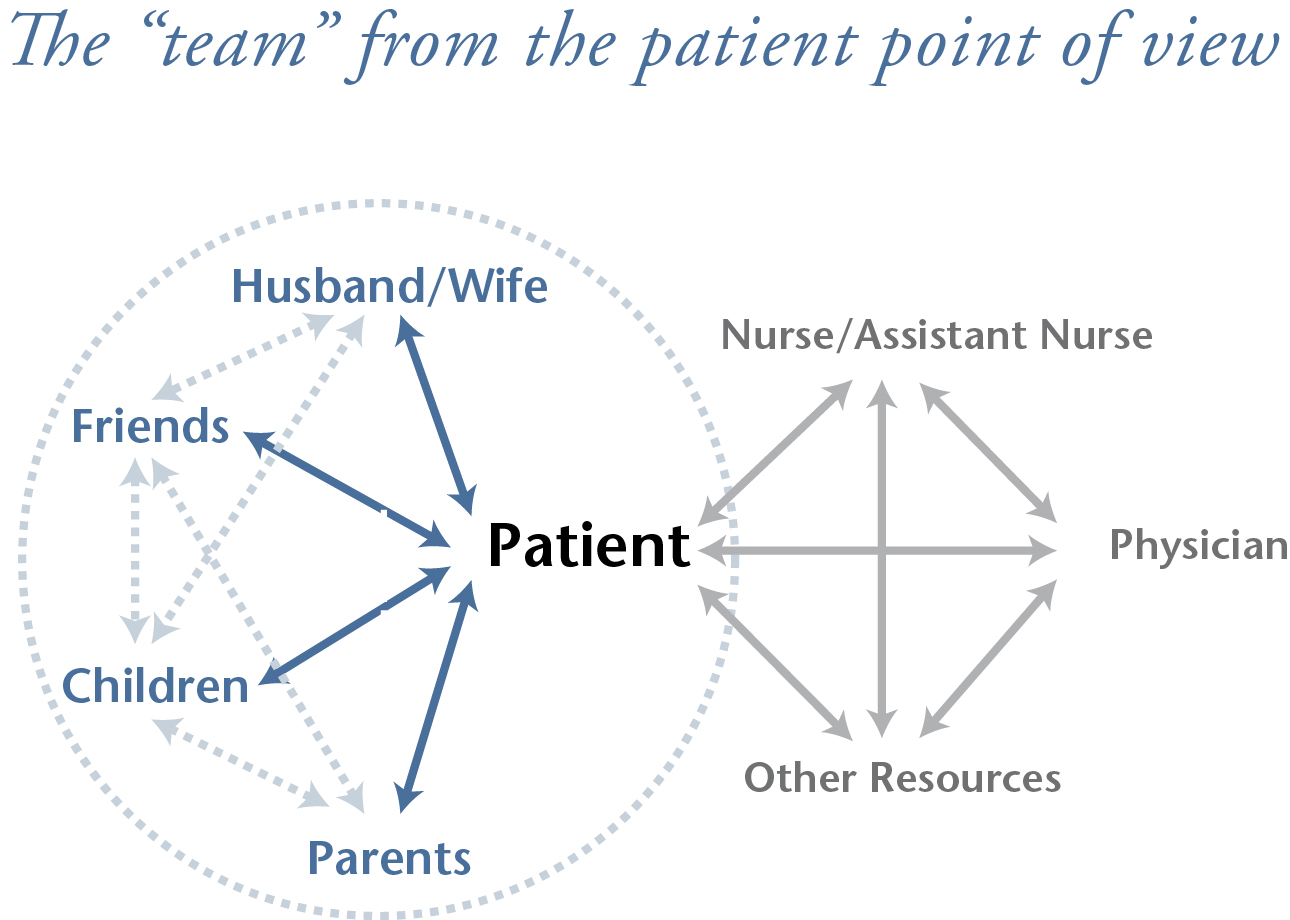
Co-production with patients_Sweden 1We have to accept that the behavioural rules underlying the traditional system are unacceptable and out of line with citizens’ expectations in the 20th century.  So we need to redesign the system. To do this we will have to change the way we think about healthcare. In particular, we need to develop an alternative approach, harnessing the skills and capabilities of human beings instead of continuing to use repressive approaches. We have to incorporate principles of co-design and co-production into how we think and interact – with staff, clients and their families, friends and networks.

This is how I started to transform my ward at in the Highland Hospital in Eksjö hospital in 2001 as described in the Governance International case study.

Co-production with patients_Sweden 2

One important driver of co-productive forms of behavior in healthcare may be greater transparency. Since we have moved to giving patients a much greater understanding of their own conditions, and how to interpret all of the information which we have on how their condition is progressing, we have had great improvements in our results. New ways of reinforcing this are now becoming available. For example, in the US and Sweden the rules are now changing so that patients have internet access to their own health record in order to help patients make proper choices. In the future, patients may even have the opportunity to add their own notes to health records which will open new possibilities.

Fundamentally this is a political issue, the basic question is how to let individuals take control of their own lives in a way that is in accordance with the 20th century.

Joergen Tholstrup

Jörgen Tholstrup is the Chief Medical Officer  at the Highland District County Hospital in Eksjö, Sweden. Until December 2013 he was the head of the gastroenterology unit in that hospital.


Under what conditions are decisions best made? Football managers and the public sector

Ian Briggs

I am not much of a football follower, but I am becoming increasingly bemused by the fascination for premiership clubs in becoming so closely associated with their managers. You can hardly fail to notice that the headlines stories on the back pages of newspapers concentrate a great deal on the relative merits of the approaches taken by the current crop of managers. Am I alone in thinking that they get more attention now than the players?

Their very personalities are so great that they now appear to be at least as important as the club itself. Success or failure on the pitch is often put down to the decisions of the manager and less on the relative performance of the players. Sir Alex Ferguson leaving Manchester United and Jose Mourinho becoming so much intertwined with Chelsea has got me thinking about our assumption that consensual decision-making is an absolute necessity within the public services – when compared to the unilateral decisions made by football club managers that are viewed as key factors in match results.

The committee system that we have lived within in local government for so many years, albeit often under a charismatic chairperson, is the very embodiment of consensual decision-making. A problem is placed within the political arena and through open discussion and challenge a decision is arrived at that is seen to be within some level of agreement and indeed consensus to be an appropriate means of doing business. For quite some time we have concentrated upon inter-agency partnership working where bringing together expertise from a range of organisations implies that the benefits of consensual decision-making are a necessity to cope with the complexity of delivering public services.

So, whilst on the one hand we have an acceptance of bringing together a group to concentrate on an issue of public interest either within management teams, committees or a partnership, on the other hand we are experimenting with non-consensual decision-making of certain prominent leaders in public life. Witness the debate over the relative merits of executive Mayors in local government (at best an unresolved argument) and the singular independent role of Police and Crime Commissioners as examples.

When things go wrong we may want to have a ‘head to roll’; if a football club is not winning then the supporters call for the sacking of the manager – even in some cases hiring aeroplanes to fly over the football ground with messages flapping from their tails to that effect. How different is this to occasional lurid tabloid newspaper headlines calling for the removal of a senior manager or politician if there is perceived poor performance in a public sector organisation. In some cases they could perhaps do the honourable thin and fall on their swords if the consequence of a bad decision (even if it is a decision they have merely endorsed rather than made themselves) has challenging or inappropriate and unintended consequences. All this leads to a gradual shift towards the public needing to have a strong, singular individual making decisions – eschewing consensus.

So under what conditions are decisions best made? In open, consensual arenas (even if committees often operate behind closed doors) or through a singular, individual focal point around a decision as in the case of football club managers?

Since Rittel and Webber formally described wicked problems in the early 1970s, we have debated what they mean for those who are in public management and leadership and are facing issues where there is little agreement over the exact nature of the problem. This has opened up much debate on the benefit of bringing together a wide range of stakeholders to focus their attention upon complex problems – and let’s face it, the list of these things seems to be growing! Is it because we see more and more ‘wicked’ issues and we have a relative lack of success in solving them that we are now becoming drawn towards a less consensual form of decision-making?

In his highly provocative book If Mayors Rules the World, Benjamin R. Barber offers the view that large nation-states with complex democratic consensual decision-making processes are poorly placed to deal with the complex and wicked issues faced today. If we were to place decision-making and leadership into the hands of one individual then the scope for clear direction setting and making brave and original decisions may increase and therefore be favourable to placing decisions in the hands of committees and stakeholder groups which often lead to stasis, mass avoidance and confusion. The subtext here is that we need to place a higher value on charismatic and visionary leadership; however, have not some of the most dangerous individuals in history conformed to this typology? As I am no student of football neither am I a student of history, but when Europe was a collection of small nation and city states this did seem to lead to war and violent competition!

To complicate matters a little further we might have degrees of consensuality in decision-making. Last week after the second reading of the hybrid bill for HS2, Parliament endorse the decision to press ahead with the project. Having all party agreement is important on a problem that has wicked characteristics such as this one. The next stage could be to ‘sell’ the decision to the public and the wider stakeholder community on the basis that it is a better decision because it has this degree of consensus. HS2 could be seen as valid in the public eye as it has this right level of political and stakeholder consensus, while it we had a football club style manager making the decision alone on HS2 there would be uproar.

So where does this leave us? Are we exploring the limits of consensual decision-making? The advent of new governance arrangements in health is perhaps a good current example of where through bringing together groups of stakeholders an assumption is made that the consensual approach to decision-making is most appropriate. However, the dynamics of bringing together multiple parties has disadvantages as well as assumed benefits. Successive studies suggest that when things get complicated (for this read ‘wicked’) and more and more perspectives and opinions are introduced into groups, then the more likely it is that an incidence of ‘multiple-uncertainty’ will occur. In short, there are too many holes in the process of deciding for any potential solution to fall into and be subsequently forgotten.

To avoid this inefficiency, decisions could be placed in the hands of one responsible and accountable person. The football team has not lost because the specialist coach who deals with the players in attacking roles has not done their job properly, nor is it because the players on the opposing side were better on the day. It is because the one individual at the top of the pecking order has failed to apply the correct strategy and not motivated the players well enough to win. In the post-match review, conducted usually in the full glare of the media spotlight, it is the manager who gets it in the neck because his (and remember it usually is a ‘his’) decisions were not deployed effectively during the game. On the specific issue of gender, it is worth noting that there are multiple studies which suggest that most women will be more effective than men in complex situation as they display a preference for consensual decision-making.

So, should we be concerned about whether decisions are best made in consensual or non-consensual arenas? Are we right to assume that the most effective way of leading through wicked decision is through strong individualised leadership that downplays where other stakeholders have differing ideas and preferences for solutions? In the end it may not matter and ultimately be down purely to contingency and circumstances – in some circumstances we must take others with us and in differing circumstances we need to have stand out leadership that prospers or fails on the basis that they deploy non-consensual decision-making and have the robustness and capacity to live with the public ridicule and criticism that this can bring. But we do seem to have conflicting approaches: local democracy was founded upon an add mixture of the checks and balances of consensual devision-making, yet we seem to be seeking new heroes and heroines. The committee was the place for shared and distributed responsibility, but remember that even a committee has a chairperson – their role might not be to just endorse the decision the majority comes to but also to create the conditions that are required to make a good decision.

I am a little shocked that as someone who has only a passing interest in football at best, I can now rattle off the names of managers and the clubs they lead. If top class football is a place where non-consensual decision-making is being played out with some success then we should step back and think about our approaches to open consensual decision-making in the world of public services. Would we be better served if we did have less of this and more of the singular, individualist decision-making here as well? My discomfort with this though of the potential benefits of the hero and heroine decision-makers who dismiss consensual mechanisms is equally by my bemusement at why I am interested in football after years of boredom with the game. But it seems that the football managers of today are at least asking questions of our understanding of the best approaches to decision-making in complex situation. Fancy a new job, Sir Alex?

briggs

Ian Briggs is a Senior Fellow at INLOGOV, and sits on a rural Parish Council in Warwickshire. He has research interests in the development and assessment of leadership, performance coaching, organisational development and change, and the establishment of shared service provision.

Public data: saleable asset or national resource?

Tom Barrance

Recent announcements by two government agencies, the HMRC and the Health and Social Care Information Centre (HSCIC), regarding the sale of information has thrown a spotlight upon government information and the attendant debates of privacy verses exploitation. What is the ownership of information collected by the state? Held in trust for the citizen, or seen as assets like 3/4G mobile phone licences to be sold by government to the highest bidder? Or should all government data be treated as open data that is made freely available to all?

Government information is gathered in a number of ways, by legal requirement and from its nodal position within networks. Data, then, may not be provided willingly. The willing provision of information is governed by the concepts of notice and consent. Consent is given by the citizen having the right to know why information is collected and for what purpose, and is supported by the right to withhold agreement.  Without this procedural fairness, the use, and sale, of data can fatally undermine trust in the data collector.

The sale of public data is not a new phenomenon brought about by the clamour for “Big Data” or the development of database services like Hadoop; indeed the trend for the sale of public data may be seen with the sale of the edited electoral register under the terms laid down by the Representation of the People Act 2000. The sale of personal address data, for those who have not opted out (and the sale of all data to Credit Reference Agencies), is now well established and has fuelled the direct marketing industry, allowing large numbers of companies to purchase and exploit information. Consent is assumed with a default opt-in, the citizen having to actively request that their information is not sold. The principle established then is that data accumulated by the state is an asset of the state, and may be disposed of as such.

Turning to the recent examples of the proposal to sell some HMRC tax data,  described by Conservative MP David Davies as “borderline insane” and the currently suspended care.data plan under which the HSCIC will make data available to a range of organisations, or customers in the language used by the HSCIC, meeting the wide ranging description of  “academics and universities, healthcare commissioners and providers, third sector organisations, information intermediaries and commercial organisations including life science companies”. These groups can purchase, and a detailed cost schedule is provided for, what is described as “De-identified data for limited disclosure or access – data that has been through a process of pseudonymisation, however there remains a risk of individuals being identified”.

The question turns to who owns personal data; that is the data likely to infringe privacy, and is this still considered to be a state asset? At first glance medical, social care and financial information would appear to be central to the definition of the private realm, especially when combined with name and address. However does this still hold when the information is pseudonymised? How secure is a pseudonym, could the data still make the individual identifiable; for example how many individuals with Crohn’s disease and one child live within a given postcode?  The exact nature of the information and the ability to cross-correlate data can lead to individual identification.

In all of these examples, it can be seen that government treats the information at its disposal as an asset which it owns outright and can sell within the bounds of data protection legislation, if it so chooses. In taking this step, the government assumes the best use of this data is to sell it to a small number of selected users, rather than releasing the information wholesale.

The voluntary sharing of what would otherwise be considered sensitive or personal data has been commonplace since the introduction of store “loyalty” cards. These cards act as a method of exchange for personal details, for example basic demographic information (including name and address) together with a detailed transaction history allowing the store to determine the spending habits of the individual and of a cohort of similar individuals; (Rust, et al., 2010).  People are happy to voluntarily part with some personal data as part of a transparent process, where there is an obvious reward and where they may consider themselves to be in control.

The Government approach is somewhat different; it appears to take the view that information its asset to be disposed of as it sees appropriate, in what is perceived as the national best interest. This is a case of acting without procedural fairness, which as can be seen from press coverage, results in a fatal loss of trust.

So, where does this leave the question of the sale of information? The issue that government must address is the conditions and terms for the release of data; and it must take the public with it on this journey. A keystone in this debate, government must determine whether it sees public information as a saleable asset or as a national resource. Transparency regarding the state’s attitude to information that it holds is crucial to popular support for either open data initiatives or the treatment of information as an asset. This transparency must include an understanding of the value of the information.

tom b

Tom Barrance is a part time Doctoral Researcher looking at Gov 2.0 in UK Local Government, and a full time Business Analyst/Project Manager at the London Borough of Hackney. He has worked in the public sector for the past 13 years, at a number of different local councils in a range of roles in Economic Development, business change and delivering ICT solutions.

Rebalancing Britain

Martin Stott

The Scottish referendum campaign is having an interesting knock-on impact on English political debate. The position and dominance of London – the place Scots most dislike about the United Kingdom in its present form – is being looked at more critically. There have been a couple of think tank reports recently, but the debate has moved quite a way beyond the narrow audiences that these reports usually attract. That in itself is a reflection of the way the ground is shifting.

First out of the blocks was the Centre for Cities’ ‘Cities Outlook 2014’ report. The document is mainly pretty dry, though jazzes up with unusual graphics and some different takes on the issues. Basically it is saying that London has become super dominant in the UK economy, so much so that four out of five private sector jobs are created in London and that every major city outside the South East is losing young people to London with one in three 22-30 year olds ending up there. Put another way, London accounted for ten times as many private sector jobs as any other city and also saw a growth in public sector jobs as well. By contrast Bradford, Sheffield, Bristol, Southampton, Blackpool and Glasgow all saw employment shrink in both the public and private sectors.

All this is very much backed up by word done for the Core Cities group (Birmingham, Bristol, Manchester, Leeds, Nottingham, Liverpool, Newcastle and Sheffield) who have initiated an Independent City Growth Commission chaired by Jim O’Neill, the Manchester born ex- Goldman Sachs Chief Executive. Their focus is on how to make Britain less focused on London in order to promote higher levels of national growth and create a less divided nation. Their plan is to issue a final report in the autumn in an attempt to set the agenda for the period leading up to the 2015 General Election. Essentially, the Core Cities interim report ‘metro growth: the UK’s economic opportunity’ argues that cities outside the South east need to be built into larger economic zones with better connections between them to create bigger markets and the kind of economies of scale for business that are to be found in London and the South East.

Meanwhile, the BBC’s Evan Davis has been busying himself on a very similar topic. His mini-series ‘Mind the gap: London vs the rest’ on BBC 2 looked at how London manages to earn more than one fifth of Britain’s income and continues to pull away in terms of growth and development while other regions still feel the sting of recession. Davis had some jolly japes in tall cranes and large diggers across London in search of the answers to his questions, but he knew that one very important answer was staring him in the face: public investment in intrastructure. Transport infrastructure investment is currently running at £5000 per person pa in London (think Cross Rail) and just £700 per person pa in the English regions.

Slightly perversely Davis took his viewers to visit the centre of his proposed new city-region-to-challenge-London: Hebden Bridge. But of course he had a point and it was that Hebden Bridge is in the centre of a huge potential city region stretching across England from Liverpool to Hull via Manchester and Leeds. Hebden Bridge is in the middle of this city region in the Pennines, rather winningly described by one of its residents as the city centre with an ‘inverted green belt’ – and places like Manchester and Leeds as its ‘suburbs’. This is far from outlandish. This part of the north of England really did challenge London for economic supremacy in the 19th century with its coal, steel and cotton as well as ports to export to the Empire.

But can it be revived as an economic counter-balance to London? That seems to depend on political will and a desire to invest in the area, especially its transport infrastructure. The Centre for Cities report makes a telling comparison. While acknowledging that the combined economies of Leeds and Manchester are just one fifth the size of London, it argues that they are unlikely to make the best of this combined scale because of ‘weak transport links’ citing ‘the distance between Leeds and Manchester is around 30% shorter than between Cambridge and London, yet the quickest train takes four minutes longer’. Jim O’Neill makes a similar point in an Observer interview about HS2, which he thinks will exacerbate the problem and simply make Birmingham a suburb of London, arguing that the money should be spent instead on creating a web of good links in the north: ‘In my judgement, for the national economy, that is way more important than improving the speed of the link from London to any of these places’.

Improving transport links in a new ‘super city’ is one dimension, but a couple of other factors are worthy of mention as well. London is the financial, political and cultural capital of the UK. This doesn’t give a lot of space for other cities to shine, unlike in say Germany with Frankfurt as its financial capital, Berlin as its political capital and Hamburg as its cultural capital. The same is true in Italy (Rome/Milan) and the USA, amongst others. Moving Whitehall and Westminster out of London would do them a power of good. If Scotland stays in the UK, the British Parliament could meet in London occasionally, but the four ‘nations’ would have Parliaments of their own in other cities.

More prosaically, the Centre for Cities report suggests that all the core cities should have access to the same policy powers as London has, i.e. strategic planning powers, powers over the budget for its transport system and police force, and a super-city wide elected assembly and directly elected mayor. A revival of regional identity and local government could yet come out of these debates, and not before time.

stott

Martin Stott joined INLOGOV as an Associate in 2012 after a 25 year career in local government.

Sustainable construction and local authorities: a failed experiment

Max Lempriere

Sustainable housing policy is a hot-topic at the minute. The autonomy that local authorities have had from central government since 2007 to require local energy efficiency and sustainable construction that supersede those in national building regulations is set to be revoked. The government has raised concerns that because so few local authorities are embracing this autonomy there is a hotchpotch of standards in different parts of the country, creating an un-even playing field and raising costs for developers. The decision to strip local authorities of this legislative independence represents a serious blow to the question of whether the sustainability of housing can be raised but, importantly, it also forces us to ask why the uneven playing field was created in the first place.

This experiment to involve the local level in the design and adoption of sustainable planning policy has failed not because of a lack of environmental concern amongst local authorities but because central policy makers and academics alike are unaware of the social, economic and political factors that affect the ability of local government to embrace any autonomy they are granted. They failed to see that conditions on the ground simply weren’t right for a significant number of local authorities to face up to developers and require more from them. Political, institutional, economic and sociotechnical barriers prevent a large number of local authorities from raising local standards, even when the will was there.

In my PhD research I attempt to increase our understanding in this regard by focusing on the barriers faced by local authorities. Up until now there hasn’t been much work that looks at what factors encourage or inhibit local government to legislate in pursuit of environmental goals, so my research doesn’t just help us understand this policy area but helps us refine our analytical models of the politics local government in processes of sustainable development.

It is becoming clear that for change to occur policy champions must push sustainable construction proposals through the local legislative process, there must be a culture of innovation and sustainability and a sense of ecological optimism in the council and proponents of change must be organised and resourced well enough to counter any challenges. It looks like these conditions simple weren’t there in the majority of local authorities to the extent required for reform of spatial planning policies.

Of course this provides only a snapshot of a bigger, far more complex picture. Spatial planning in particular and sustainable development in general cuts across many areas of policy, economics, society, technology, history and geography and the answer to why a local authority is more or less willing to legislate for either goal lies in a particular combination of factors drawn from all of these areas.

My work is therefore part of a bigger picture, one that policy makers and academics alike need to start painting. We need to recognize the important role that local government plays in the transition towards a more sustainable society and ask how we can understand the barriers they face in order to encourage more, and better, policy.

That brings me on to the main point I want to make here: If we are to prevent a repeat of this failed experiment then we need to increase our understanding of whether and why local authorities embrace the legislative autonomy granted to them in the context of environmental policy. Doing so will allow us to increase our certainty that future devolutions from the national to local level will be successfully endorsed. If, alternatively, we continue along our current trajectory of ignorance of the politics of local government’s role in legislating for sustainable development then we can expect any future experiments to fail.

Local authorities have an enormously important role to play in the provision of sustainable development and we cannot afford to ignore the mechanisms that permit or prevent them exercising that role.

lempriere

Max Lempriere is a second year PhD student in the Department of Political Science and International Studies at the University of Birmingham. His research interests include the politics of planning and construction, local government innovation and ecological modernisation.

Policing the journey along the low road

Alan Doig

Up to the 1980s, crime control in the UK was widely seen as virtually the sole domain and responsibility of law enforcement. Nearly all police forces had, for example, a fraud squad whose purpose was laid out in a 1970 Home Office circular (apparently 115/1970 since you ask) and who traditionally dealt with criminalised aspects of local government misconduct.

As I noted in my recent article and elsewhere that world has changed substantially. Successive governments have initiated policy-driven changes, from frontline policing to prioritised local policing plans, more recently reinforced by the election of local police commissioners with local objectives and local audiences to keep onside. The increasingly attuned political antennae of Chief Constables and the continuing downward grind of spending reviews have thus seen the abolition or downsizing of fraud squads in favour of these agendas.

Those which remain have an increasing focus on ‘economic crime’ – code for another government agenda which relates to financial offences involving organised crime, professional enablers (lawyers and others) and higher-end corporate scams. It is the same code that had the government announce the end of the National Fraud Authority as shifting the focus to ‘cutting economic crime’ through ‘concentrating effort into law enforcement bodies’.

Fraud squads – or economic crime sections or units as they are now invariably labelled – have long dealt with specialist crimes in this area, including misconduct in public office and, more recently, the steadily-growing number of election frauds. So they will no doubt be expected to take on the consequences of the government’s decision to swap some of the Standards Board’s and Audit Commission’s arrangements for a single conflict of interest/disclosure offence in Chapter 7, section 34, of the Localism Act.

Given what I know about their past enthusiasm for wading into local politics and council cultures, I am sure that the police are relishing having to untangle what on earth what is meant by councillors being ‘reckless’ about whether information on their disclosable interests is ‘true’ and ‘not misleading’ (and that’s after the police have already dealt with a whole raft of legislative linguistic ambiguities, including disclosable, pecuniary, taking steps, participating and – my favourite – reasonable excuse). Indeed, and given the economic crime agenda’s focus on serious and organised crime, one may wonder whether the police, and especially economic crime sections, are likely to have the interest and appetite for Section 34.

A wider issue concerns not just the police but also those other agencies and resources councils could draw upon as part of maintaining an effective control environment. In a landscape populated by agencies with various anti-fraud and anti-corruption roles and responsibilities, from the Land Registry to NHS Protect, a number have worked together with local authorities as task forces. Councils themselves shared information through the at-risk National Fraud Initiative. Councils have also been able to rely on DWP-funded Housing benefit investigators whose involvement in non-benefit-related frauds rose from 13% in 1994/95 to more than 40 per cent in 2010/11.

All these arrangements and resources, as well as the continuing fallout from the abolition of the Audit Commission, are, however, in a state of flux, leaving councils to ponder how they will sustain their control environments at a time when the localism agenda will require councils to become increasingly engaged in traditional red-flag areas, such as planning, new areas, such as public health, or spending through other partners, such as charities.

With two ministries debating over who pays the – very modest – bill to revive councils’ in-house investigative resources (with each council being lucky to get one FTE out of whatever deal is cobbled together), councils must wonder where the support exists in terms of any low road journey that involves criminal investigation, joint or joined-up working and information-sharing.

With only Greater Manchester Police bucking the trend and setting up a volume fraud, locally-focussed team to add to its economic crime section, accessing police expertise and capacity may be as unlikely as expecting any of the law enforcement or other bodies tasked to take on National Fraud Authority functions showing any willingness for leading, coordinating and working with councils. Even if the high road thus remains closed for the foreseeable future, the journey along the low road is not going to be without its challenges.

doig

Alan Doig is Hon. Senior Research Fellow at the International Development Department, University of Birmingham; Visiting Professor, Newcastle Business School, Northumbria University and Board member, Management Board, North-east Fraud Forum.