Preaching to the choir: reflections on key leadership skills for local authority chief executives – part 2: charm

Catherine Staite

If Brian Tracy and Ron Arden are right when they say the deepest craving of human nature is the need to feel valued and valuable. The secret of charm is therefore simple: make others feel important – then charm must be a crucial attribute for leaders.

staite 1

Charm is shorthand for a sophisticated set of skills which enable you to make new connections and solve old problems. Charm is about much more than being nice in a superficial way – otherwise known as ‘smarm’. If you don’t have real charm then just be gruff and honest. Everyone will understand. Smarm, on the other hand, will simply breed distrust.

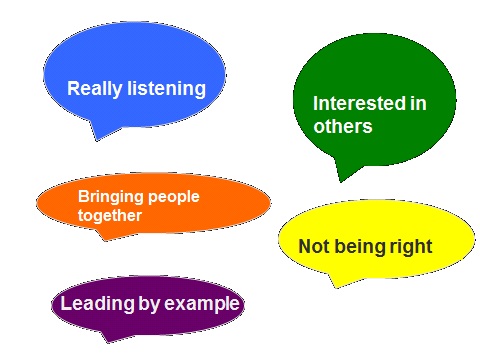
The truly charming have notable skills. They are interested in others. They pay them real attention and give them positive regard – as opposed to the barely controlled irritation demonstrated by some powerful people in their dealings with underlings. Even if they attempt to catch you with a bright idea when you are en route to the toilet, don’t snap – suggest they catch you on the way back, when you can give them your full attention. You need all the bright ideas you can get.

Charming leaders also know how to listen, not just to what the people you lead are saying but what they perhaps feel they can’t say to you. A leader who doesn’t listen won’t have access to all the facts, no-one will tell them the unvarnished truth and they won’t hear when people are trying to tell them they may just be wrong. The failure to listen renders leaders about as effective – and as potentially dangerous – as a blindfolded driver. You may have had experience of a leader who doesn’t listen. Remember how awful that was and don’t case that level of distress to your staff.

staite 1

Charming leaders seek to bring people together and that has never been more important for local government. Albert Camus observed that charm is a way of getting the answer ‘yes’ without ever having asked a clear question. You need a lot of people to say ‘yes’ to a lot of things they may not necessarily like if you are going to effect real change.

There is so much good work going on around collaboration for the benefit of the people we all serve but there are still so many terrible instances of people in senior positions who perpetuate old feuds and personalize organizational battles, to the point where there is no way out for anyone. A history of corrosive, destructive pettiness endlessly repeats itself.

I am sometimes obliged to listen to a range of grievances going to back to 1974 and it’s no fun. The petty disputes I observe range from being mere energy vampires to the evidence of utter moral failure. Those disputes are about the past and you have to get beyond them – and encourage your members to do the same. You are leading in the present to build a better future and you’ll need all your energy and charm to do that. That behavior will shape your organizational culture and ripple through external relationships to the point where no-one can articulate or even want to remember why this country doesn’t co-operate with that district or vice versa. That will have an impact across your area and beyond – so your charm is a force for real good.

It’s amazing how pervasive and powerful an influence the chief executive and top team have on the culture of their council. When the people I pass in your corridors are smiling – in spite of all the challenges – I know their leaders have charm and their councils will survive and thrive.

Catherine Staite

Catherine Staite is the Director of INLOGOV. She provides consultancy and facilitation to local authorities and their partners, on a wide range of issues including on improving outcomes, efficiency, partnership working, strategic planning and organisational development, including integration of services and functions.

Preaching to the choir: reflections on key leadership skills for local authority chief executives – part 1: creativity

Catherine Staite

I have called this blog series ‘preaching to the choir’ as it is dedicated to local authority chief executives and they already know a great deal about leadership. They wouldn’t survive and thrive in their posts if they didn’t.

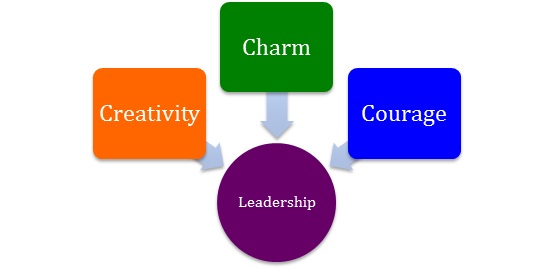
They already know that heroic leadership is only useful in the case of fire and flood and that leadership of organisations in giving way to leadership of whole systems – which is a whole lot harder. Instead, I’d like to focus on three aspects of leadership which are talked about less often but are absolutely crucial to effective and sustainable leadership, in complex systems and in difficult times. They are: creativity, charm and courage.

staite 1

So what is creativity and why do leaders need it so much?

We hear a great deal about the need for change and innovation – which implies creativity. However, so much which is described as innovation is nothing of the sort. Adam Smith introduced us to lean thinking in The Wealth of Nations in 1776. The Hanseatic League demonstrated the benefits of collaboration and shared services in the 17th century. We could and should learn from the past, but too often old ideas are re-labelled and sold on as new, not as a coherent element of a new way of solving problems but as a ‘one size fits all’, ‘but this and all will be well’, single focus solution.

So if creativity isn’t just about endlessly recycling the ideas of previous eras, what is it? Steve Jobs said creativity is just connecting things. How simple, and how true.

staite 2

We are subject to constant but superficial change. The ink hasn’t dried on one paradigm before it’s shifted. But we’re in a time of evolution not revolution, no matter how apocalyptic the environment feels at times. Not withstanding the 24/7 networked digital revolution we all still meet in rooms – not cyberspace. Joseph Chamberlain could come back from the dead and find his way round Birmingham City Council. Not only is the décor much as he left it, members and officers are focusing on the successor problems to those that were the focus of his attention. Both he and they are attempting to achieve the same outcomes – better lives for the people of Birmingham.

We really need creativity – not to create a new universe but to unstick the current one. In mental health services in the 1990s we were innovating to create an integrated care system, including diverting mentally disordered offenders from inappropriate custody. The evidence was clear. Early diversion from the criminal justice system and multi-disciplinary support wrapped around the person saved a lot of money for services and a lot of damage for people with severe mental health problems who committed minor offences. 25 years later not much has changed. Why is that? Perhaps it’s because, in spite of the enthusiasm and commitment of the champions of change, episodic creativity and short term collaboration does not penetrate the roots of organizational silos and professional conservatism. As Albert Einstein said, we can’t solve problems by using the same kind of thinking we used when we created them.

So what can leaders do to help convert short-term creativity into long-term benefits? According to Albert von Szent-Gyorgy, discovery consists of seeing what everyone has seen and thinking what nobody has thought. Leaders can make the space for creativity as well as bringing people together, allowing time, encouraging risk and forgiving failure. Creativity is often about seeing opportunities to bring together different ideas and new ways of thinking. Leaders can also help to embed new thinking by challenging some of the entrenched interests rather than colluding with those who say that change is ‘too difficult’. As Thomas Edison put it, with admirable brevity, there’s a better way to do it – find one.

Catherine Staite

Catherine Staite is the Director of INLOGOV. She provides consultancy and facilitation to local authorities and their partners, on a wide range of issues including on improving outcomes, efficiency, partnership working, strategic planning and organisational development, including integration of services and functions.

Local government: keepers of the moral compass?

Catherine Staite

Barry Quirk’s excellent article in the Local Government Chronicle highlighted the often overlooked role of local government as the guardian of public ethics.

Public ethics happen in the space where the state, in all its manifestations, civil society and the individual meet.  That space is highly contested and consequently difficult to navigate. We need a very good moral compass to find the right course through all the arguments, often fuelled by ignorance and blurred by misunderstanding, about who takes precedence – the majority or the minority? As we attempt to protect minorities are we inadvertently discriminating against them by failing to hold them to account?

There are no easy answers but examples like the child sexual exploitation in Rotherham highlight what happens when local government and its partners mislay their collective moral compass and lose their way.

What causes such failures? The fragmented nature of local government is both a blessing and a curse.  Councils are so different: their geographies, challenges, politics, culture and finances vary much more than the many over-simplified, generic journalistic, references to ‘town halls’ would suggest. The blessings stem from local knowledge, closeness to communities and relative agility – at least compared to national bodies. The curses lie in cultural isolation.

There is a lot of collaboration, integration and sharing of best practice and new ideas across the local government family but there is also quite a lot of  inward looking, ‘not invented here syndrome’ as well.  It is in that self-referential, parochial, isolation that the moral compass can be lost without anyone noticing. That isn’t a problem which is confined to local government – the ‘institutional racism’ of the Metropolitan Police and the unspeakable cruelty of Mid Staffordshire demonstrate how the lack of a moral compass can lead to the normalisation of moral and ethical failure.

So how do organizations maintain their moral compasses in good working order? It’s far too easy to place our faith in that mythical answer to all our problems: ‘leadership’.  All good leaders know that they are nothing without good followers. Old fashioned heroic leadership required unquestioning followers and that is a recipe for disaster. The most vulnerable leader is the one whom to whom nobody dare say ‘you are wrong’. Good followers are not sheep, they are engaged and challenging – not least because they know so much about what is good and bad in their organisation.  Good leaders and good organisations treasure and reward good followers.

Is external scrutiny the answer? The Audit Commission became a bit of a bête noir for local government before its demise but some of that reaction was generated by it doing its job well and challenging bad practice and groupthink.  It will certainly be re-invented at some form in the future because of a growing recognition of the need for positive and supportive external challenge. The Local Government Association makes a good fist of sharing good practice and its peer reviews offer some gentle challenge to those who invite it but it is a political organization and it’s not its job to be both advocate and enforcer.

One of the consequences of the Scottish Referendum is a reinvigorated debate about devolution in England.  As you’d expect, this has quickly resolved itself into discussions about structures and institutions but those discussion are missing the point. Successful devolution requires the explicit transfer of both powers and duties and one of those duties is responsibility for the moral compass.  The need for effective local guardians of public ethics has never been greater.

Catherine Staite

Catherine Staite is the Director of INLOGOV. She provides consultancy and facilitation to local authorities and their partners, on a wide range of issues including on improving outcomes, efficiency, partnership working, strategic planning and organisational development, including integration of services and functions.

Devo max – what it is and why it won’t happen

Chris Game

Devo Max – it sounds like a 99% efficient toilet cleaner, or a dodgy West Country car dealer, but either way I visualise its initials in upper case. And that’s its problem. It’s undoubtedly the ‘must use’ expression of the month. It’s not complicated, like ‘full fiscal autonomy’ or the Barnett formula, so anyone feels able to drop it authoritatively into even casual conversation. And everyone has their own idea of what it is.

For party leaders, desperate to save the Union in the final hours of the Scottish referendum campaign, it was perfect Looking-Glass, Humpty Dumpty-speak: it means just what we choose it to mean.  Sign up now, check it out on Friday the 19th.

For YesScotland campaigners it was a verbal Blob, impossible to pin down and attack – and especially frustrating, as they were the ones who had no need to check it out. They knew its precise meaning because they’d invented it, and knew that it wasn’t at all what most wavering voters imagined they were being offered.

It actually originated in a 2009 Scottish Government options paper, Fiscal Autonomy in Scotland. Five distinctive options were spelt out, ranging from the SNP Government’s preferred full fiscal autonomy (FFA) in an independent Scotland to a minimally changed current fiscal framework, which gave Scotland considerable discretion over spending but little over tax revenue raising, borrowing, or broader monetary policy.

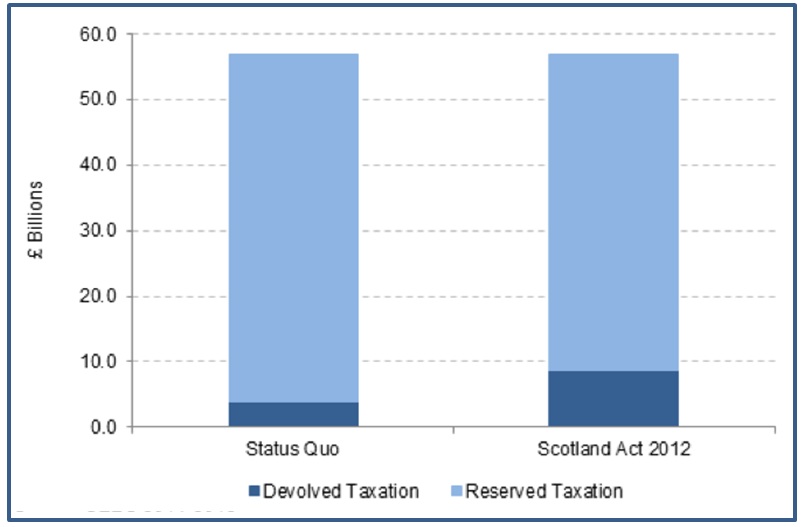
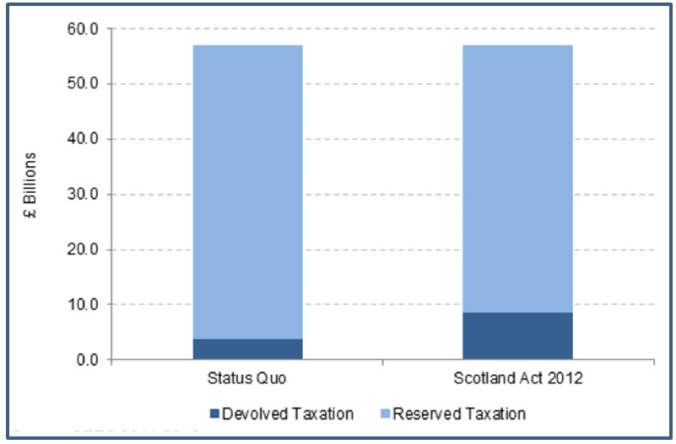
‘Devolution max’ was the SNP’s fall-back option, clearly defined as FFA within the UK. The Scottish Government would be responsible not only for most of the public spending in Scotland, but for raising, collecting and administering virtually all revenues – instead of the estimated 15% it would control even after the 2016 implementation of the 2012 Scotland Act, the famously “biggest transfer of fiscal powers in 300 years.”
game

The precision of its definition, as well as its content, makes Devo max entirely different from the third option of merely ‘enhanced devolution’, which really does sound vague, manipulable Humpty Dumpty-speak, and hardly surprisingly is unacceptable to the SNP.

Devo max, though, is not just definable. It can, its advocates would claim, be viewed and studied in practice, for it broadly resembles the system in the northern Spanish autonomous communities of Navarre and the Basque Country. Part of their autonomy is that the devolved governments are responsible for raising and collecting all direct taxes, including corporation tax, although, to conform with EU legislation and retain a harmonised social security system, indirect and payroll taxes remain centralised. The two regions have used their powers to lower certain taxes below the rates elsewhere in Spain, thereby creating a relatively more competitive tax regime, which is, of course, also an SNP aspiration.

The problem, as critically noted by the 2009 Calman Commission on Scottish Devolution (ch.3), is that Scotland – constitutionally, economically, as well as meteorologically – isn’t Spain.   A tax-based FFA might be operable in Spain, and at least conceivable in an independent Scotland.  However, attempted within the UK, it would clash with the Treasury’s expenditure-based economic model and its pooling and redistribution of taxes to fund common standards of public services and welfare benefits.

Tax experts will argue that the devolution of some additional taxes – personal income tax, land and sales taxes, alcohol and tobacco duties – is perfectly feasible and even desirable. In other cases, though, for combinations of practical, legal and political reasons, it is less feasible, and heading this list in the UK are usually the highly desirable corporation tax and the highly disputed oil and gas revenues.

In the UK, then, full fiscal autonomy short of independence is unattainable, and, even if attainable, would be effectively incompatible with the redistributive policies of our existing welfare state, and also with the controversial population-based Barnett allocation formula that all three major party leaders committed themselves to retain in their extraordinary orchestrated ‘Vow’ on the front page of the Daily Record.

So, whatever additional powers Scotland eventually gets, they won’t amount to Devo max. It might, therefore, be a good idea if we stopped trying to appropriate the label rather meaninglessly for English local government (with perhaps one exception), and looked instead to the persuasive and realistic cases already being made by those with first-hand experience of running local authorities.

By all means, use Scotland as a benchmark – as in the challenge issued by Graham Allen MP, Chair of the Commons Political and Constitutional Reform Committee: “I don’t see any reason why English councils are not capable of taking on the powers that go to Scotland.”  And London as another. The legislation is different, but the key recommendations of last year’s neatly titled report of Tony Travers’ London Finance Commission, Raising the Capital, are both applicable to other major authorities and possibly more straightforwardly implementable – particularly the proposed control over all property taxes: council tax, business rates, stamp duty land tax, capital gains property development tax, and the like.

It’s been good this past week to see the County Councils Network, with its pre-election Plan for Government, 2015-20 and the Key Cities Group of 23 mid-sized cities with its Charter for Devolution, both determined not to have their distinctive voices and proposals drowned out by the noise of the big cities.

There’s no doubt, though, that it’s in and around the big or the eight Core Cities where the main devolutionary action is, and particularly those who’ve been able create Combined Authorities. These are legal structures set by the Secretary of State following a request from two or more English authorities and a governance review. They may take on transport, economic development and potentially other functions, and they have a power of general competence.

They were a third-term New Labour idea, and the enabling legislation – the Local Democracy, Economic Development and Construction Act – was a full five years ago now. Greater Manchester CA, bringing together 10 authorities, was first in the field in 2011 and for some time out on its own, but since April we have had four more – West Yorkshire (5), Sheffield (4), Liverpool (6), and the North-East (7). There are reports too that councils in Derbyshire, Nottinghamshire and Buckinghamshire, as well as the Welsh Local Government Association, are all at least considering combined authorities as an alternative to a possible future of enforced mergers.

If anything, though, Greater Manchester is stretching its early lead, with its reluctant agreement to a directly elected mayor in exchange for the “complete place-based settlement” proposed on its behalf by the independent think tank, Res Publica – “an incremental process leading to the full and final devolution of the entire allocation of public spending”. Even this, for the reasons given above, wouldn’t technically amount to Devo max, but since they already seem to have appropriated it in the cause of alliteration – Devo Max – Devo Manc: Place-based public services, it’s the one exception I’m prepared to concede.

game

Chris Game is a Visiting Lecturer at INLOGOV interested in the politics of local government; local elections, electoral reform and other electoral behaviour; party politics; political leadership and management; member-officer relations; central-local relations; use of consumer and opinion research in local government; the modernisation agenda and the implementation of executive local government.

In case you missed it: the Local Government (Independence) Bill

Chris Game

It was partly the timing. In combination, the suddenly increased likelihood of both Scottish independence and a Coalition break-up were bound to eclipse last Friday’s scheduled Second Reading of the Local Government (Independence) Bill. It was unfortunate, though.  After all, local government independence would be a pretty big deal too, wouldn’t it?

You bet it would – though, if you’re at all serious about the betting bit, I’d suggest you check the bookies’ odds first. On a Scottish Yes vote you could get 2/1, and 66/1 on UKIP winning the General Election. On local government independence the giggling bookie would probably let you name your own odds.

That’s not to say that Friday’s events in Westminster weren’t important. They were, but they need setting in context.

The LG(I) Bill, not surprisingly when you hear its content, wasn’t a Government Bill, but a Private Members’ Bill, which limited its prospects for a start. Moreover, it wasn’t a Ballot Bill, introduced by one of the 20 lucky MPs whose names were drawn in the annual backbenchers’ ballot and whose chosen Bills stand most chance of eventually becoming law, partly through being prioritised on the limited number of Fridays set aside for private members’ legislation.

The LG(I) Bill was a Presentation Bill, microscopically few of which get anywhere near the Statute Book. True, there was a Protection of Birds (Amendment) Bill that apparently passed all its Commons stages in 67 seconds during one Friday sitting. That Friday, though, was in 1976, which explains why the LG(I) Bill’s sponsor, Graham Allen, Labour MP for Nottingham North, wouldn’t have been unduly optimistic, especially after seeing the Order of Business.

On an already curtailed parliamentary day, the LG(I) Bill was listed behind four Ballot Bills, headed by Liberal Democrat MP Andrew George’s Affordable Homes Bill – aka the Bedroom Tax (Embarrassing the Coalition Amendment) Bill – which made the improbability of Allen’s Bill being debated an effective certainty.

The Affordable Homes Bill would substantially undermine one of the Coalition’s most controversial welfare reforms, by allowing poor social housing tenants to retain their ‘spare room subsidy’ until they actually have somewhere smaller to live. The Lib Dems indicated they would join Labour in supporting George’s Bill, whereupon the Conservatives, unusually for a Friday, imposed a three-line whip on their MPs.

It guaranteed an extraordinary attendance, but not the defeat of the Bill, which received an acclaimed Second Reading by 306 votes to 231.  It was a momentous loss for the Government, in substance, scale and in its damage to inter-party relations within the Coalition. Its immediate effect, though, was that debate on the second Ballot Bill was adjourned at 2.30, and Allen’s Bill wasn’t reached.

It was obviously disappointing, but not much more: at worst, maybe, only the end of the beginning.  For in Graham Allen’s epic constitutional reform agenda, the most immediate objective was already achieved. The LG(I) Bill exists. It’s in the parliamentary machine, and Allen can proceed with his next stage of trying to convince all three main parties to pledge in their manifestos to support such a Bill in the next Parliament.

It’s ambitious, but perhaps not quite as quixotic as it sounds. For Allen is also the extremely active Chair of the Commons Political and Constitutional Reform Committee, whose major project throughout the present Parliament has been to explore the case for and against the UK having, like virtually every other country, a formally codified constitution.

With, I suppose, a forgivable and topical gesture, this project has been entitled ‘A New Magna Carta?’ and its first main product – a 400-page report, compiled in collaboration with King’s College, London – was published in July and put out to public consultation – http://www.parliament.uk/new-magna-carta-consultation. 

The committee takes no views on the desirability of codifying the current heap of common law, Acts of Parliament, European treaties and unwritten conventions into a clearer, more balanced and democratic set of constitutional arrangements. That’s for us to say through the consultation process.

Rather, the report presents three blueprints of how codification could be approached: a Constitutional Code, a Constitutional Consolidation Act, and, most interestingly and set out in full in the report, a completely new written constitution by which the UK, with or without Scotland, would be governed.

‘Principles of local government’ get just one of 53 chapters in this draft constitution, but it is these principles, embodied in a statutory Local Government Independence Code – drafted, incidentally, by former INLOGOV colleague, Professor Colin Copus – that largely comprise Graham Allen’s LG(I) Bill. 

The Bill’s purpose is to declare local and central government equal to and independent of each other, to separate their finances, to regulate the local-central relationship through a statutory code, and to set out procedures restricting any future parliamentary amendment or repeal of the code.

Many of the Bill’s provisions may sound fairly unexceptional. Local authorities’ accountability, the code would assert, is to their electorates, not to Whitehall. Local authorities are autonomous, democratically-elected bodies which independently decide upon, administer and regulate public affairs and deal with all matters of concern within their boundaries that are not the statutory responsibility of another body.  A local authority’s geographical boundary can be altered only by a proposal from the authority itself or from its electorate.

These things would indeed be unremarkable in most countries, with less centrally controlled systems of local government. In our system, unfortunately, concepts like local and territorial autonomy, operational independence, and ‘all matters of concern’ are enough to seize ministers and civil servants with a collective attack of the vapours.

And that’s before we get near to the real biggie: ‘local government financial integrity’.  Local authorities, the code would declare, shall be financially independent of central government, which may not place any restriction on decisions by local authorities about the exercise of their financial powers.

Each local authority shall receive from central government an agreed and guaranteed share of the annual yield of income tax. Local authorities may, with their electorates’ consent, raise additional sources of income in their areas in any way they wish – just like the Scots, if they behave themselves and vote No.  Central government shall not cap, or otherwise limit, local authorities’ taxation powers.

All that and more is in the first of nine Schedules. These substantive proposals, though, are possibly not constitutionally the most radical. That prize would probably go to the hurdles facing any future government seeking to amend or repeal the code: a minimum ‘super-affirmative’ requirement of unanimous approval by each parliamentary House, or by a two-thirds majority of the total membership of each House.

Which is why I suggested at the start of this blog that the LG(I) Bill’s lack of progress on Friday was only partly about its timing. Even without the Affordable Homes Bill, and setting aside much of the LG(I) Bill’s own content, the idea of abolishing two of Parliament’s most precious rights – to determine the country’s level of taxation, and to change or repeal any previous legislation – would be several bridges too far for many MPs.

For the present, therefore, local government independence must be considered to have been put on hold – though not, one can but hope, indefinitely.

game

Chris Game is a Visiting Lecturer at INLOGOV interested in the politics of local government; local elections, electoral reform and other electoral behaviour; party politics; political leadership and management; member-officer relations; central-local relations; use of consumer and opinion research in local government; the modernisation agenda and the implementation of executive local government.

Councils should have the power NOT to tax supermarkets

There’s no shortage of reasons to dislike supermarkets generally and Tesco in particular – their flimsy carrier bags, their irritating BOGOFs and BOGOHOs (Buy One, Get One Half Off), their unpoliced disabled parking bays, their Everyday Value instant coffee granules. Then there are all the economic, environmental and social reasons – the ones understandably more emphasised in Derby City Council’s recent proposal that local authorities be given the power to introduce a levy of 8.5% of rateable value on large retail outlets: a supermarket or Tesco tax, as it was instantly labelled by the media.

Supermarkets, the council claims, cost local jobs, increase waste- and traffic-generated environmental pollution, damage British agriculture, undermine local economies and community life, underpay their staff, and damage public health through being the largest suppliers of tobacco and alcohol – among other things.

The council’s cabinet actually approved the policy last December, with the acknowledgment – unfortunate for an education authority – that costs could include sponsoring a Bill through Parliament to ‘Royal Ascent’ (p.3).  But, after the public were consulted and support mustered, it was only formally announced in late July, at the start of the holiday season, with the result that reaction, including from local government, has been both less voluble and less co-ordinated than might have been expected.

After all, it sounds a popular, even populist, proposal. Tesco’s sales and share price may have fallen recently, and likewise its CE and finance director – with, almost needless to add, humongous payoffs. But its tax haven use is notorious and its Fair Tax Mark of just 3 out of 15, while marginally better than the 2s of Sainsbury and WH Smith, is set in its true context by Greggs’ perfect 15.

In short, supermarkets could afford their own tailored levy – amounting to maybe 0.1% of their total income – without passing it straight on to customers. Moreover, the legislation would require that the proceeds go directly to help local economic activity and services. Certainly, most early reaction supported Derby’s initiative, in addition to the more than 60 councils from across the party spectrum that the bid claimed had already indicated their backing.

The proposal was submitted under the 2007 Sustainable Communities Act, which gives councils the opportunity to ask central government to remove legislative barriers currently preventing them optimising the economic, social and environmental wellbeing of their area. Though the Act was introduced under a Labour government, the roughly 200 proposals initially submitted were inherited by the Coalition. The nearly two-thirds judged broadly consistent with Coalition policy were grouped into Action Areas and implemented wholly or in part, and the remainder rejected. This latter group, importantly for the eventual fate of Derby’s supermarket levy, included all tax-related proposals, from chewing gum to plastic bags, on the grounds that tax decisions are the Chancellor’s responsibility and therefore made as part of the overall annual budget process.

Most of the proposals from my own local authority, Birmingham, on the other hand, were deemed less threatening, and have contributed, for example, to the introduction of Accelerated Development Zones to fund new infrastructure investment, extended financial incentives to promote renewable energy generation, the revision of legislation to enable councils to provide more allotments and community gardens, and the discretionary power to regulate vehicles parking on and damaging grass verges.

Which all sounds, for maybe three seconds, very localist and encouraging – until you wonder why on earth one of the largest local authorities in Europe should be grovelling to ministers to allow it to spend my money on providing allotments and protecting grass verges.

And so, back to the Tesco tax, which, however much it’s described as a rateable value-based levy, is to ministers going to look, swim and quack like a tax – and a tax they’ll undoubtedly claim will threaten investment, push up food prices, and hit the ‘hard-working families’ on low incomes that they’re electorally anxious to be seen protecting.

Business opinion is overwhelmingly hostile, and makes the reasonable point that most recent supermarket expansion has been through convenience stores, not highstreet-destructive, out-of-town sheds. Even local government, though, isn’t unitedly enthusiastic, particularly some of the bigger cities. Manchester quickly announced that it didn’t fit in with its economic vision for the city: “We work very hard to bring in big supermarkets because they provide much-needed regeneration. We want to encourage them, not put them off.”. Last week Kirklees took a similar view.

Levy supporters invariably mention knowingly that similar schemes are already in operation in Northern Ireland and Scotland, but neither are precisely the same as that proposed by Derby, and evidence of their success is, at best, mixed. The money raised by Northern Ireland’s Large Retail Levy on all outlets with a rateable value of over £500,000 goes directly to the relief of rates paid by small businesses, and its impact is therefore more immediately visible than would be the case in England.

And the Scottish Health Levy on ‘big shops selling alcohol and tobacco’ (otherwise known as supermarkets), threatening as it does Scotland’s boast to have the UK’s most competitive business rates regime, has become so bitterly unpopular that its axing next year has already been announced.

Scotland, though, has something else, something much more fundamental, to contribute on this topic – namely, the final report of its Commission on Strengthening Local Democracy, set up to consider “how we do democracy here in Scotland”, whatever the outcome of the independence referendum.

It defined its task as turning around 50 years of centralisation, and its many radical recommendations include tripling Scotland’s current 32 councils to around 100 of a more genuinely local, Scandinavian-style, size, with the freedom to raise more than 50% (instead of just 18%) of their income locally. To do so, they would have full local control of the whole range of local taxes – council tax, business rates, land and property transaction tax, and, if there were one, a supermarket levy.

And that, I suggest, is what English local authorities should have: the choice to tax, or NOT to tax, their own local supermarkets, without first having to beg for ministerial permission.

game

Chris Game is a Visiting Lecturer at INLOGOV interested in the politics of local government; local elections, electoral reform and other electoral behaviour; party politics; political leadership and management; member-officer relations; central-local relations; use of consumer and opinion research in local government; the modernisation agenda and the implementation of executive local government.