Core Activities: notes from the Core Cities Summit, February 2015

On the 11th February over 300 people from across the public sector met for the Core Cities Summit in Glasgow. This post summarises the point reached so far and some of the conference’s live issues, and suggests three areas for further consideration: how to involve MPs and MSPs more fully, engaging communities in the debate and considering what kind of country the UK should become.

Core Cities at the forefront of innovation

The Core Cities buzz continued in Glasgow on 11th February at its well attended summit which launched the next stages in cities-based devolution discussions. The Core Cities’ approach to innovation through collaboration has challenged the government by setting the pace. It was a cross-border event which included a look at how the next round of devolution proposals will affect Glasgow, as an indication of the next stages of the development of the Core Cities campaign.

The event pages are online and the Twitter hashtag #devosummit is searchable for reactions. The summit launched both the Core Cities charter for devolution ‘A Modern Charter for Local Freedom’ and the Respublica report Restoring Britain’s City States.

A charter for devolution and recommendations for action

The Charter sets itself in the context of the 800th anniversary of Magna Carta and the waves of change emanating from the 2014 Scottish Referendum vote. It calls for action to consider what a ‘modern, mature state for the UK’ would look like, one which enables prosperity, equality and democracy. It sees itself as being applicable to the whole of the UK and not just to the Core Cities.

Devolution to local places is at the heart of its proposals with local freedom to make strategic decisions, to tax and invest, and to determine the shape of strategic planning and service delivery at the sub-regional level. To enable this, it calls on the Government to establish an independent body to facilitate devolution and oversee change, while ensuring that communities are strengthened, key investments are made, services are transformed and decision making devolved further to the appropriate level in communities, neighbourhoods and individuals.

Respublica’s report, Restoring City States, focuses on city devolution. It seeks to build on the recent city deals with Manchester and the Sheffield City Region in order to forge a ‘rebalancing of the relationship between central government and cities. Many of the issues set out in the Charter for Devolution are explored in more depth and underpin the report’s eight recommendations.

Core Cities’ case for change

Opening the Summit, Cllr Sir Richard Leese stressed that the summit was about a constitutional settlement, not just the devolution of powers. Ben Page highlighted the fact that whilst people are dubious about whether devolution is of relevance, they are concerned about inequality and there is potentially the space to try something new and to engage them in debate, as shown in the Scottish Referendum. In the Scottish context, Jim Murphy MP sought greater devolution by the Scottish Government to its cities. However Keith Brown MSP wondered whether local government could make more of its existing powers and was uncertain whether legislative change was really needed to achieve the Core Cities’ aims, a rehearsal of some of the debate nationally.

Considering reform to powers and fiscal matters, Danny Alexander MP wanted to see the government look at the devolution of stamp duty, amongst other measures, with a clear fiscal base to municipal re-empowerment. Philip Blond, Respublica, considered that the post 1945 model of the state was no longer fit for purpose and sought a new model to deal with a much more complex public service challenge. He considered that there might need to be some intervention in some ‘trailing’ cities to jump-start change, but considered cities to be the only agents nationally capable of bringing equality in an age of globalisation. Cllr Nick Forbes called for the next Comprehensive Spending Review to be based on place, rather than the individual spending limits of departments.

On the future form of devolution, Cllr Nick Forbes also stressed the need for cities not to be ‘walled cities’ but ones open to their surrounding partners, rooted in their local hinterland, pulling together to develop infrastructure, and linked into ideas about social justice. Pat Ritchie highlighted the need for devolution to be capable of adaptation to the different needs of different places. And Mayor Jules Pipe, speaking for London Councils, highlighted a need for devolution thinking to extend nationally, with further change needed in London, for example, to meet the extent of empowerment sought by the Core Cities.

Gaps and challenges

The focus of the day focused more on the growth agenda that it was on the social development of cities, although they are of course entwined, there were also some interesting gaps and unresolved issues.

The first gap relates to national politicians, the devolution debate has made much of devolving from government to city or place, but little has been said about the role of MPs (or MSPs). All of the cities involved in the discussion have numerous national representatives who are currently not part of the picture. There was talk on the day about the development of local Public Accounts Committees but as yet no sign of the development of a shadow version to see if it might work and help to hold a core city to account.

The second gap points out there has been little discussion of the quality of community in cities and aspirations for their development. Perhaps understandably much of the discussion has been aimed at central government, but the relationship of local people to each other and to the local state needs to be as much a part of the desired debate about the modern form of the state as a whole as any of the issues highlighted at the summit.

The third gap relates to the fundamental question of the kind of state the UK wants to be in the future (and here it is worth pointing out that this has been almost solely a local government led debate which of necessity does not yet include key local players in national services such as the NHS). This is a debate which perhaps should be at the core of the general election campaign, but is currently not on the agenda.

Next steps for everyone?

In its submission to the Political and Constitutional Reform Committee’s consultation on the constitution, INLOGOV said (amongst other things):

English devolution to a system based around London and the core cities would carry considerable risks if it becomes an exercise which bolts-on powers without thinking through the systemic change that is needed. We need to resolve the question of responsibilities, of citizens, communities, cities and regions, before the reallocation of powers.

… The UK’s greatest potential is contained in its networked nature, and the same can be said of the best cities and counties. What is needed is therefore constitution which does not just chunk up centralised power and devolve it.

… There should be a clear agreement about how power is shared (rather than devolved) between different legitimate and competent parts of the UK state, including local, regional and national governments.

So the current debate is a necessary one about devolution, but perhaps needs to develop into one about power sharing. To return to the Magna Carta theme, the Barons sought limitations to the exercise of central power and a clear basis for sharing it. They also did not rely solely on rational argument but potentially had the means to force King John to comply with their demands. It will be interesting to see how the Core Cities muster their forces and deploy them during the coming election and beyond.

As Sir Richard Leese recognised, the number of places that can be considered as core cities is necessarily limited. However it is clear that the approach that Core Cities have set out is one which has its application across England especially and the UK as a whole. All can benefit from the learning about ‘what works’ in creative, collective approaches to change and the development of confident, positive narratives about places and their people. And INLOGOV is uniquely placed to offer support by sharing learning and exploring approaches which challenge barriers of stagnation, short-sightedness, parochialism or old rivalries, all of which get in the way of what is important: long-term development based on outward-looking collaboration.

Know your local Councillor Photographs - St Albans - May 2008

Daniel Goodwin is an Associate Fellow of INLOGOV. He was previously Executive Director of Finance & Policy at the Local Government Association and Chief Executive of St Albans City & District Council.

The fairness (or otherwise) of the 2015-16 local government finance settlement

Chris Game

In choosing to announce the 2015-16 local government finance settlement just eight days before Christmas, ministers presumably hoped – as, indeed, I’d expected – that the argument about the presentation of funding and spending cut statistics for local authorities, both collectively and individually, would have died away by mid-January. However, it hasn’t, which is why I too am returning to the topic, which had its importance re-emphasised several times over the past week. First, Paul Woods, until recently Newcastle’s long-term and respected Treasurer, expressed in a Local Government Chronicle column (13 Jan.) his disappointment at the widespread:

“Acceptance being given to a low 1.8% spending power cut, as opposed to the more realistic analysis by the Chartered Institute of Public Finance & Accountancy (CIPFA) of a 6% cut. A truly independent and objective analysis of the settlement … would be unlikely to conclude that spending power has only been cut by 1.8% … [or that] as the government has claimed, the settlement is fair to north, south, urban and rural areas”.

That last ‘claim’ was a direct quote from the opening paragraph of an article that Local Government Minister, Kris Hopkins, had evidently felt it necessary to write for the same magazine (LGC 12 Jan.). Not surprisingly, it largely reiterated points from his settlement announcement – including that “councils facing the highest demand for services continue to receive substantially more funding … than authorities facing less pressure”, and that, for pooled budgets like the public health grant, “it would be perverse not to consider [all] the money as part of the funding available” to local authorities, including that actually spent by the NHS. Then, last Friday, we had the open letter from Rob Whiteman, CIPFA Chief Executive, to DCLG’s new Permanent Secretary, Melanie Dawes. After congratulating Dawes on her appointment, Whiteman attempted quite a barbed lecturette on “ethics in government”, including the need for “greater clarity” in the department’s public communications, as opposed:

“to the rhetoric and spin that has too often characterised the presentation of the numbers by DCLG and others over the past few years … [meaning that] … the public are being misinformed about official information and data. For example, describing transferred resources that still must be spent on the NHS as increasing councils’ ‘spending power’ in a way that under-reports their loss of DCLG grant is disingenuous.”

Given these developments, it seemed worthwhile using these columns – in which it is possible to include both links/references and a couple of rather striking graphs – to explain a bit more fully, if very definitely non-technically – what this dispute is about.

Grants and grant funding can seem both bewildering and paint-dryingly boring. But, at our combined average age of ten, my younger sister Jennifer and I didn’t know this, and we reckoned we’d cracked at least the essential principles – which was fortunate, as we and our mum were even more heavily grant-dependent than today’s metropolitan borough councils.

In our traditional patriarchal household, my father was the sole wage-earner, and he funded my mother through her weekly (Friday) ‘housekeeping’ grant, and us children through our weekly (Saturday) pocket-money grants. Opportunistically, through grandparental charity or the undertaking of ‘errands’ (mainly me) and ‘chores’ (J), we could increase our revenue spending power. But we could also suffer largely non-negotiable grant-loss, to pay for the upkeep of J’s pet rabbit, a cricket ball-broken window, or – seasonal touch here – Christmas gifts for the afore-mentioned grandparents.

The point is that, callow as we were, we understood perfectly the distinction between grant funding and spending power – unlike the sections of our media who either parroted or headlined not the finance settlement’s actual words – let alone its meaning – but DCLG ministers’ political message. ITV was typical: “the amount of funding councils will get in central government grants will be reduced by 1.8% in 2015-16”.

That’s what ministers hoped we’d hear, but for them the F-for-funding word has become as unmentionable in company as the Old English F-expletive. ‘Amount of funding’ is much too coarse, measurable and comprehensible. It’s far more refined – and cryptic – to talk of spending power (SP), particularly if you get to define it yourself. What minister Hopkins announced, therefore, was that “the average spending power reduction for councils in 2015-16 is just 1.8%”. Indeed, with “the additional transformation money the government is giving councils to improve services, this reduction falls to 1.6%” (emphases added). See, it’s getting even better. Moreover:

“Those facing the highest demand for services continue to receive substantially more funding. For example, Middlesbrough has a spending power per household of £2,441, which is £871 more than the £1,570 per household in Windsor and Maidenhead.”

This is the fifth year in which ministers have attempted this sleight of hand, and, to be fair, most of the media have caught on. Most did report that the 1.8% cut is not in councils’ grant-funding, but their spending power – though still only a minority explained the distinction and its significance.

It would have been like my father deciding in one of the 1950s’ sterling crises that we should all (kids included) be in it together, and imposing a three pence austerity cut in my pocket money of two shillings and sixpence (2/6 = 30 pre-decimal pence) – but overlooking that he’d already cut it by sixpence for cricketing misdemeanours, which I’d subsequently made up through errand work. As he might have explained, it was only a 10% reduction in my spending power, not the 12.5% grant cut I was claiming. Besides, he knew of better-off families in Westcliff (SE Essex’s nearly-as-posh equivalent of Windsor and Maidenhead) whose children didn’t even get weekly pocket money.

Following the Coalition’s ideological decision to reduce the budget deficit largely but selectively through public spending cuts, local government ministers in 2010-11 faced the problem of explaining to the public that they’d be cutting central government grant funding of council revenue spending by an unprecedented 28% in cash terms (40% in real terms, allowing for inflation) over four years, with 21% ‘front-loaded’ in the first two years.

The scale of ministers’ task can be seen in a simple but powerful chart in a recent House of Commons research paper, in which the dark green columns represent the savage annual average percentage cuts in councils’ grant funding, in contrast to the generally modest increases to which they’d been accustomed. Their solution: to replace the nasty dark green columns with much less alarming light green ones.
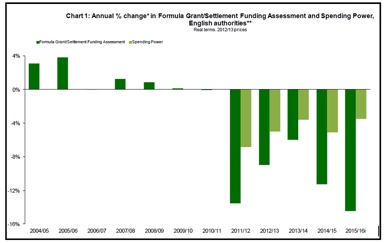
Game1 First, they – or their civil servants – restructured the whole grant system, to make before-after comparisons more difficult. They then created their Revenue Spending Power measure, which they claimed would – by including council tax receipts, certain specific grants, and NHS social care funding – give a fuller picture of a council’s overall financial position.

Fuller, yes, but not full. Contrary to what is stated in the Government’s Plain English Guide to the 2015-16 Grant Settlement (para. 3)  income from fees, charges and investments is NOT included in SP. These are income sources likely to decline in a recession and whose addition to SP would emphasise, rather than de-emphasise, councils’ grant dependency – so nothing like as politically helpful as the contrived SP measure, which could instantly reduce a 28% grant cut to a 14% cut in spending power.

Ministers, then, view SP in the same way as Humpty Dumpty in Alice Through the Looking Glass. It can mean just what they choose it to mean – or more, or less. If, say, they excluded council tax receipts from SP, any percentage grant cut would immediately become more (bad). If, on the other hand, they could include the whole of the new Better Care Fund (BCF) – a single pooled budget to incentivise the NHS and local councils to work more collaboratively – any cut would immediately become less (good).

Yes, of course it’s confusing; that’s its whole point. Present the public with two, three or more magnitudes of ‘spending power cuts’, and the chances are we’ll either turn off altogether or hear the one that’s shouted loudest: the Government’s. For 2015-16, as we’ve seen, the Government’s figure is 1.8% – or possibly 1.6%.

Neither the figures nor ministers’ form of presentation came, by this time, as a surprise, and the Local Government Association (LGA), attempting to get its retaliation in at least simultaneously, released its own figures to coincide with ministers’ announcements. These showed first that the Government’s total funding support to local authorities will be cut by 13.7% from the 2014-15 figure. It’s that F-for-funding word again, so ministers didn’t bother mentioning it, but it’s shown as a provisional figure in the Commons chart.

The LGA’s second calculation was that, if council tax income were excluded from SP – since it’s a completely different type of income from government grant – the average reduction would be not 1.8%, but 3.7%. Third, if you also exclude the NHS’s portion of the £3.5 billion Better Care Fund and include in SP only the estimated £2 billion spent on social care services by local authorities, the arguably rather truer average reduction in councils’ revenue spending power becomes 8.8%, or nearly five times the Government’s figure.  

CIPFA’s analysis, as we’ve already seen, was different again: a 6% drop in spending power – through including council tax income but excluding ring-fenced grants and the Better Care Fund. To adapt the old Punch cartoon caption: you takes your choice of definition, but you still loses your money.

And that spending power cut, to repeat, is the average for all English local authorities – and even under the Government’s SP figures, individual authorities could lose up to 6.4% of their spending power, though others would receive a nice little increase. But, especially with a General Election imminent, ministers like Kris Hopkins want to persuade us that their settlement “offers a fair deal to taxpayers all over the country; north and south, rural and urban. Councils facing the highest demand for services continue to receive substantially more funding and have about 40% higher spending power than authorities facing less pressure.”

That last sentence really is disingenuous. Any formula or block grant comprises both a redistributive element, to compensate for local authorities’ differing needs, and a negative ‘resources’ element, to reflect their differing ability to raise their own money through council tax. Even this government hasn’t contemplated abolishing the redistributive principle altogether. But let’s see how it judges that its way of doing things offers a ‘fair deal’ to taxpayers, regardless of where they live.

Again, I’ll start personally. I pay my council tax to Birmingham City Council, whose cut in spending power, according to the Government’s figures, is 6%, close to the maximum 6.4%. Cuts for other West Midlands metropolitan authorities run from Sandwell (5.1%) and Wolverhampton (5%), through Walsall (4%), Coventry (3.9%) and Dudley (2.8%) to Solihull – the sole Conservative-controlled council and, as it transpires, the only one whose SP will increase (+0.4%).

So Birmingham’s cut is proportionately the greatest, despite, as noted in Sir Bob Kerslake’s recent highly critical report on the council for the Government, having “more poor children than anywhere else in England” (p.6), and being overall one of the most multiply deprived authorities in the country.

According to the DCLG’s ranking of England’s 326 local authorities by multiple deprivation – Birmingham is 13th most deprived, Sandwell 9th, Wolverhampton 20th, Walsall 35th, Coventry 53rd, Dudley 113th, and Solihull 212th – almost precisely the same order as that for percentage SP cuts and, on the face of it, a non-obvious operationalisation of a ‘fair deal’.

Local Government Chronicle and the Association of North East Councils undertook a similar exercise on a larger scale, again using the Government’s SP measure. As shown in the chart, “the most deprived 10% of areas face a 5.2% cut while the most affluent tenth will see their funding rise by 1.5%”.
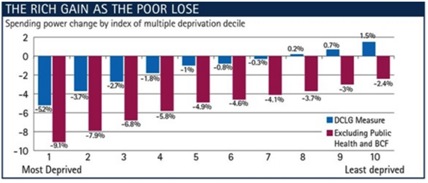
The Rich Gain As the Poor Lose With apologies for the length of this blog, that’s what this particular local-central argument is fundamentally about – a little more than just the niceties of statistical presentation.

An earlier Birmingham-focused version of this post appeared in The Chamberlain Files Chris Game - pic

Chris Game is a Visiting Lecturer at INLOGOV interested in the politics of local government; local elections, electoral reform and other electoral behaviour; party politics; political leadership and management; member-officer relations; central-local relations; use of consumer and opinion research in local government; the modernisation agenda and the implementation of executive local government.


Do Local Authorities Really Want Sustainable Construction Powers?

Max Lempriere

When it comes to setting sustainable construction standards new research reveals English local authorities favour national regulation over local powers. 

National planning policy and building regulations have undergone considerable reform in recent years. The latest incarnation is embodied in the Housing Standards Review, (HSR) published in 2014. The HSR sought to consolidate the plethora of standards into national building regulations whilst making it harder for local authorities to introduce standards that supplement these national regulations in response to local needs or priorities. One area where local powers have been significantly curtailed by the HSR is in the sustainability and energy efficiency of homes.

Since the publication of Building A Greener Future and the Supplement to the Planning Policy Statement: Planning and Climate Change in 2007, local authorities have been able to set local standards on building sustainability to reflect local needs and priorities. Although options are provided in the HSR for local standard setting in a number of areas to supplement the revamped building regulations, this isn’t one of those. The extent to which sustainable construction targets can be set locally has thus been significantly curtailed. The response was predictably fierce. The Association for the Conservation for Energy remarked on the ‘political naivety’ and ‘shortsightedness’ associated with the decision. A report by the Environmental Audit Committee from November 2013 suggests that ‘this decision bulldozes local choice in favour of a one-size-fits-all approach designed to benefit developers who want to build homes on the cheap’.

Yet what do local authorities themselves think? The evidence points towards local authorities being against the idea of local standard setting in the area of energy-efficiency in buildings.

When asked in the HSR consultation whether sustainable construction standards should be incorporated into National Building Regulations (thus restricting local choice) an overwhelming number of local authorities responded in favor (46 of 69 responses). When asked their views on whether local authorities should have the powers to set ‘Merton Rule’ type policies (which mandate the minimum renewable energy use in a building) ‘a number of local planning authorities are also in favour of a review [of the Merton Rule type policies], who do not see a role for planning in decisions about the energy performance of houses’.

What’s more, as part of my on-going research into this area I have surveyed all local English local authorities. Only 50% have embraced the standard setting powers that they have had up until the HSR, and even then there are serious concerns over whether those local standards are being enforced.

An obvious question that arises from this is why? Why do local authorities propose a national Building Regulations led approach to sustainable construction standards? In the course of my research two factors have been raised.

First, many local authorities feel that the national debate on sustainable construction is in such flux that to expend resources on incorporating local standards is risky. Take Harrogate Borough Council for example, who took a proactive lead on introducing sustainable construction targets in their 2009 Local Plan. Subsequent changes to the planning framework published by central government in 2012 reformed the technicalities of local standard setting and in effect forced Harrogate to tear up their plan and start the process again. This obviously comes at considerable costs. When resources are already being stretched to breaking point the threat of having the rug pulled from under their feet is enough to put a lot of local authorities off the idea.

Second, local authorities are subject to strong external pressures from developers that prioritise growth over sustainability. Many lack the necessary internal capacity (whether in terms of expertise, institutional norms, pro-environment policy networks or dominant discourse favouring ecologism) to overcome these pressures. On that basis many consider any local powers a waste, because they can’t be fully exploited.

We must not therefore be alarmist when we look at the HSR and its curtailment of local powers. It is by no means perfect; the extent to which the sustainability and environmental standards of homes can be raised in the future is largely down to how the Building Regulations are going to be reformed and there are doubts that it will go far enough in this regard. Nevertheless, the evidence points towards local authorities favouring a national approach. We should listen to and respect this view, and try to understand why they think like this at all. Only then can we hope to do anything about it.


lempriere

Max Lempriere is a third year PhD student in the Department of Political Science and International Studies at the University of Birmingham. His research interests include the politics of planning and construction, local government innovation and ecological modernisation.

The journey to the common: what is the role of the voluntary sector?

Anna Coleman and Julia Segar

A recent publication by the New Local Government Network (NLGN) looked at how local councils are preparing for the future and suggests depressingly that “there is simply no way that local government can reach 2018 let alone 2020 while still delivering the full range and quality of services currently on offer”(p6).

Simply put, we have an ageing population, with associated increasing demand for care services and draconian cuts in council budgets. The NLGN suggest we could be facing a future of “private affluence and public squalor”. However, it is not all doom and gloom. Perhaps austerity can be a strong stimulus for innovation? How would this work I hear you ask?

They suggest a new model being discussed around the country. The idea would be to mix technology, preventative investment, integration of council services with those of the NHS and others, alongside the creation of new partnerships between local government and local populations.

The NLGN report suggests three possible ‘landscapes’ for councils of the future. Firstly, a wasteland – a world of poorly prepared councils forced to cut services dramatically. Secondly, the wild meadow – councils provide core functions and rely on spontaneous public contributions to replace dwindling services. Finally, the common – the focus moves away from the council to places where it shares responsibility jointly with communities and businesses. This latter approach is seen as optimistic and would need to build on a strong social and voluntary economy.

This idea is timely for us as about a month ago Anna chaired, and Julia attended, a briefing event in the NW of England on Health and Wellbeing Boards (HWBs) and how (if at all) they were engaging with local voluntary organisations and local Healthwatch. Speakers at the event came from a local Healthwatch, a local overarching voluntary organisation and someone associated with Regional Voices. Speakers described their organisations and their relationships with their HWBs. They reflected on what could be done to improve these interactions to benefit all involved. So could we tap into some of these ideas for helping to build the idea of a common?

The official vision for HWBs from the Department of Health emphasised: joint local leadership between Clinical Commissioning Groups (CCGs) and local authorities; key roles for elected councillors, clinicians, and directors of public health, adults and children’s services; the enablement of greater local democratic legitimacy of commissioning decisions, and provision for opportunities for challenge, discussion, and the involvement of local representatives. However, HWBs have no formal powers, and their ability to influence others will depend upon their success in building relationships and interacting with other organisations locally. See our previous blog (Coleman 2014) for further detail on HWBs.

On paper, then, HWBs look like ideal forums for enabling the growth of both vision and action for building local commons. Speakers at the NW event, suggested that a shift in emphasis needs to take place before such a vision can begin to be realized. They argued that a tokenistic place on a HWB is of little value either to the HWB itself or to voluntary sector organisations. The voluntary sector together with Healthwatch, can provide valuable information about needs, concerns and available assets from a range of voices within a local community, with evidence varying between robust data to insightful patient stories (National Voices 2014). In Manchester alone, there are over 3000 voluntary organisations delivering a wide range of services to diverse groups. The estimated worth of the sector in 2012 was £477 million drawing on the work of over 94,000 volunteers (Dayson et al 2013). So HWBs should consider carefully who might sit on (or with) the HWB, and at what level (Board or sub-group) to represent the views of the voluntary sector and how these individuals should be chosen.

It was suggested that HWBs are missing a trick if they don’t engage effectively with local Healthwatch (who have a seat on HWBs) and voluntary organisations (who may be invited to sit on HWBs).These organisations have valuable knowledge, local intelligence and capacity at community level. The speakers indicated that very rigid structures and ways of working do not always work and that having a seat at the table does not guarantee that organisations are heeded. In order to develop new ideas and innovative solutions for complex local health and wellbeing needs, HWBs need to devote time and attention to voluntary organisations and to Healthwatch. In the current state of austerity sharing resources, skills and information is vital and good practice both locally and nationally.

This briefing event asserted the role of the voluntary sector in improving the health and wellbeing of local populations. The contributions that they could make in helping realise the landscape of the common is also clear. Step one on this path is to see, hear and listen to these organisations on HWBs.

Now read:

Anna and Julia’s article Joining it up? Health and Wellbeing Boards in English Local Governance: Evidence from Clinical Commissioning Groups and Shadow Health and Wellbeing Boards is published in Local Government Studies.

coleman

Anna Coleman is a Research Fellow in the HIPPO team (Health policy, politics and organisation groups), part of the Institute for Population Studies at the University of Manchester. HiPPO also constitutes, jointly with researchers from The London School of Hygiene and Tropical Medicine and the University of Kent, the Department of Health Policy Research Unit in Commissioning and the Healthcare System (PRUComm). PRUComm provides evidence to the Department of Health to inform the development of policy on all aspects of health-related commissioning.

Julia Segar

Julia Segar is a qualitative researcher in the Centre for Primary Care at the University of Manchester. Her previous projects were concerned with telehealthcare and with changes in the healthcare system. Julia part of the Health, Policy, Politics and Organisation (HiPPO) research group within the Centre.

Disclaimer: The research for referenced paper is funded by the Department of Health. The views expressed are those of the researchers and not necessarily those of the Department of Health.

The future is Intercommunality – yes, but with whom?

Chris Game

Rom com/date movies aren’t really my thing, so my excuse for watching the recent Words and Pictures was that I was a captive plane passenger – and that the ever-watchable Juliette Binoche was playing a rheumatoid arthritic abstract painter and prep school art teacher. The title refers to the silly challenge she charily accepts from alcoholic poet turned plagiarising English teacher, Clive Owen, to ‘prove’ whether Words or Pictures are more meaningful.

One of the Owen character’s numerous obnoxious ways of irritating colleagues is with his show-off polysyllable game: I’ll give you a five-syllable word, you give me one of six syllables, etc. Binoche, at least initially, won’t play, which, while entirely understandable, I personally found slightly disappointing, as I could SO have helped her.

For starters, I know that the seven-syllable word most frequently used conversationally was calculated (don’t ask!) to be, not homosexuality, which was one of the commoner guesses, but telecommunication – followed pleasingly by the one that describes INLOGOV: interdisciplinary. In the near future, though, it will surely be intercommunality – at least in local government conversations, most of which currently seem focused on Combined Authorities (CAs).

At present, we have just five: Greater Manchester, very much first off the blocks in 2010/11, followed earlier this year by West Yorkshire, Liverpool and Sheffield City Regions, and the North-East. But over the past fortnight alone, quite apart from the general ‘Please sir, can we have some of whatever Scotland’s getting’ pleas, we’ve had almost daily reports of CA discussions – among five Tees Valley councils, all 14 in Lancashire, some or many in Hampshire, six in West London, and four (or maybe five, six, or more) in the West Midlands, all seeking, through the formation of CAs, to grab some of the devolution goodies that Greater Manchester negotiated with George Osborne in exchange for a directly elected metro-mayor.

Of course, only in the UK could it possibly be deemed nationally newsworthy that a number of contiguous local authorities were thinking of working together in the interests of more efficient service delivery. I’m no specialist, but even I recall back in 2007 a whole book of country case studies of Inter-Municipal Co-operation in Europe (ed. by Hulst & van Montfort), demonstrating what a widespread phenomenon it had become in much, if not most, of Europe.

One reason I recall it is that it appeared around the same time as an article by Josie Kelly (Aston U) entitled ‘The Curious Absence of Inter-municipal Co-operation in England’ – a curiosity, I felt, that evaporated quite quickly, once you considered surely the single most basic explanation: namely, the structure and sheer scale of our local government.

With that in mind, let me start this brief backstory with a few figures on scale. England’s population is 54 million, and we have 326 unitary or lower-tier district authorities, with an average population of 165,000. The equivalents in France, population 66 million, are 36,700 lower-tier communes, average population 1,800.

Most communes date back to the 1789 Revolution, and the French are very attached to them – voting for their councillors and mayors in roughly twice the numbers we do. Successive Presidents tell them this ‘millefeuille’ structure of micro-communes is outdated, inefficient and must be reformed, but French citizens care more than us and they resist. No enforced mergers, humongous ‘local’ authorities, arbitrary boundary lines on maps, and meaningless council names for them.

So, French governments were forced to develop a compromise: intercommunal cooperation. By a mix of threats and incentives, communes were persuaded to group themselves into some 2,500 cooperative communities of varying shapes and sizes.

Biggest, most integrated, and with most powers and fiscal autonomy, are 16 urban communities (communautés urbaines) for the largest metropolitan areas. Smaller urban areas have communautés d’agglomération, and rural areas, without an urban core of 15,000 residents, have communautés de communes, which account for the great majority of the total.

With its ultra-local communal structure, France’s network of inter-municipal co-operation is one of Europe’s most extensive. But Spain has its mancomunidades (municipal associations), Italy its Unioni di Comuni (municipal unions), Germany Zweckverbände, and so on. As in so many things European, it is we who are the real exceptions. England’s enormous and largely self-sufficient local authorities, and their minimal responsibility for what in many countries are still public utilities, mean that our insularity has extended to a near absence of formal inter-municipal co-operation.

But the future, we’re told, will be different. The future is partnership working in general, and Combined Authority intercommunality in particular – which is fine, unless you happen to live, as I do, in Birmingham. First, you find you’ve missed out on the possibility of living in a regional Powerhouse, like a good chunk of ‘the North’ apparently will be. And second, it’s far from clear exactly who, when the music stops, we’ll be communing with.

Our problem, as ever, is Manchester. I had occasion last year to puncture its pretensions to be ‘Britain’s second city’ but now, it seems, it’s become English government’s José Mourinho, the special one. Worse, like Chelsea’s manager, it not only has a powerful and supportive backer, but is also pretty smart itself.

That smartness was seen in the city council’s being first to utilise Labour’s 2009 Local Democracy, Economic Development and Construction Act by orchestrating the creation of a Greater Manchester Combined Authority. The Act’s chief purpose was to set up local authority leaders’ boards to replace the abolished Regional Chambers, but it also provided for the creation of combined authorities covering multiple, contiguous local authority areas. In fact, the GMCA recreated the Thatcher-abolished 10-borough Metropolitan Council, by pooling newly devolved powers on public transport, skills, housing, regeneration, waste management, carbon neutrality and planning permission.

Though conceived under Labour, the GMCA’s establishment dates from 2011 and, perhaps surprisingly for an invariably Labour-dominated body, its principal backers have been Coalition ministers and most notably northern MP and Chancellor, George Osborne. Manchester especially has consistently opposed elected mayors, the Government’s proclaimed condition for further devolution. Nevertheless, it was the GMCA’s 2012 City Deal that included a ground-breaking ‘earn back’ tax provision, enabling it to recoup annually from government up to £30 million from increased business rates for reinvestment in a revolving infrastructure fund.

None of the other seven 2012 City Deals – even Liverpool’s, announced on the very day the city council took the decision itself to have an elected mayor – were as expansive, and the reason seemed inescapable. Though called City Deals, ministers had to negotiate any regional dimension they involved, not with a statutorily based, politically led, service-delivering CA, but with Local Enterprise Partnerships (LEPs) – voluntary, business-led, minimally resourced alliances of councils and businesses that help coordinate local economic development. More than talking shops, but not serious intercommunality.

You didn’t need a weatherman to know the wind direction. City-based LEPs, particularly where wholly or largely coterminous with a former metropolitan county, began negotiating for CAs, and, as noted above, there are now four more, leaving the West Midlands as the only ex-met county without one. Meanwhile, both major parties claim to see CAs, rather than ever larger merged councils, as the best vehicles to implement their vague, fluctuating, but still important devolution plans. For the present, though, the dealer’s chair is still occupied by George Osborne – yes, this is definitely Treasury, not DCLG, stuff – and first bidder for the next wave of devolution deals was once again Greater Manchester.

This time a price tag came with the Chancellor’s ‘Northern Powerhouse’ deal – a required and reluctantly agreed directly elected metropolitan mayor. The £1 billion of devolved funding and services s/he will share with the CA, while unremarkable in many EU countries, constitutes a big deal here, and everyone else desperately wants one too. The problem is that not everyone has Greater Manchester’s nicely polycentric coherence – seven of its nine surrounding boroughs sharing borders with the core city; or its unambiguous identity, its established record of intercommunal cooperation, and, above all, its undisputed name.

Demonstrably, the West Midlands doesn’t, which is why the recent stream of feverish announcements from local council leaders has seemed half-baked, unconvincing, and – who knows? – even potentially self-defeating. First, a West Midlands CA of Birmingham and the four Black Country boroughs (Dudley, Sandwell, Walsall, Wolverhampton – all Labour), with Coventry (Labour) an unsigned probable, but Solihull (Conservative, and Coventry’s only contiguous borough) an unsigned reluctant, which raises questions at the very least about an integrated transport policy.

Then, there are the Worcestershire and Staffordshire districts in the Birmingham/Solihull LEP and those in Coventry/Warwickshire LEP – apparently, they’re maybes or haven’t-yet-been-askeds. An elected mayor, twice rejected by Birmingham, is an unmentionable, and as for the name – the obvious but toxic Greater Birmingham? West Midlands? Birmingham City Region? Mercia?? Nobody is keener than I on the devolution of significant powers and fiscal discretions to our cities and city regions, but even I would take some convincing about somewhere that couldn’t make up its collective mind on its area, composition, name or form of governance.

gameChris Game is a Visiting Lecturer at INLOGOV interested in the politics of local government; local elections, electoral reform and other electoral behaviour; party politics; political leadership and management; member-officer relations; central-local relations; use of consumer and opinion research in local government; the modernisation agenda and the implementation of executive local government.
The PwC report on Tower Hamlets highlights fundamental tensions in local democracy, not always thought through clearly in new mayoral systems

Michael Keith

Competent bureaucrats commonly believe they protect the public interest by delivering transparent decision making in public institutions. This is commendable. Politicians normally believe that they are elected to carry out the wishes of their voters. This is forgivable. But these imperatives rub against each other when politicians try reshaping things in an image they prefer and the bureaucrat wants to preserve an order they recognize. This is difficult.

This tension is not new. Recent events in the east end of London exemplify an old problem. Max Weber’s thoughtful and commonly misunderstood discussion identifies this tension as one of the diagnostic features of bureaucracy. The bureau is in and of itself without politics. In a vocabulary anachronistic in its use and counterintuitive in its usage it might even be argued that Weber suggested bureaucracy was fundamentally anti-political.  The bureaucrat could serve the Chinese despot, the papal machine or the liberal democratic reforming state equally well. But at its best s/he personified a particular kind of stasis, a performative form of repetition without difference.

The bureau reproduces a specific social, moral and political order; dispassionately and without fear or favour or individual exception. This predictable repetition is at the heart of the bureau’s strengths.  At its best it makes visible transparent process. But our conception of the ‘political’ is at heart about change, the juxtaposition of one moral order against another. The politician – whether or not democratically elected – is for Weber a personification of the will to advance a preferred moral order and social settlement. A ‘conservative’ appeals to a particular set of pre-existing values threatened by social change, an alternative politics actively promotes a new moral order against an old one. In cities of flux, characterized by high levels of demographic ‘churn’, migrant urbanisms and processes of regeneration and gentrification the social order is constantly on the move, generating particular challenges for the bureau.

Translated into local government, the most conscientious political actors become engaged in representative democracy for a reason. Councillors normally want to change things in the ward and the local authority they represent. They identify needs, community organisations they believe are doing good things unnoticed, campaigns they want to champion. Such interests sometimes can be advanced through the bureaucracy. But such interests at other times have to be championed against the bureaucracy. Domestic violence only becomes an ‘object’ of local governmental gaze when community organisations campaign for it to be recognized. The consequences of an ageing population with multiple challenges are only recognized by welfare departments after a lot of knocking on doors at city hall. And in multicultural settings both entrenched forms of systemic racial disadvantage and a politics of recognition of cultural difference depend on changing the local state to recognize properly the different needs of cultural groups and evolving and at times banal demographics.

In my own experience the mums’ clubs based in certain locations and the provision for the elderly that once appealed effectively to a past East End tradition of gathering, music and alcohol based conviviality worked accidentally to exclude those who did not gather in pubs, did not socialize around a cup of tea and a cigarette after dropping the children at school. So the bureau only recognizes and changes with pressure. Multicultural realities challenge and change the bureau, belatedly some times, proactively when politcians advance in good faith an understanding of the complexities of new social formations through the architecture of city hall. But such change is never without friction.

Such tensions can be constructive. But in British mayoral systems we are unsure what the proper checks and balances should be. In Tower Hamlets when the will of a people so diverse, so rich and poor, so much a mix of different cultures is personified by one man, the challenges are particularly acute. Price Waterhouse Coopers last week reported to Secretary of State Eric Pickles a situation that led the Secretary of State to suggest that the report “paints a deeply concerning picture of obfuscation, denial, secrecy, the breakdown of democratic scrutiny and accountability, and a culture of cronyism risking the corrupt spending of public funds.”.

The report highlighted that in Tower Hamlets the three most senior bureaucrats are all on temporary contracts.  The boss (head of paid service), principal lawyer (monitoring officer) and head of finance (section 151 officer) are insecure. They depend on political whim for their pay cheque.  The checks and balances for a mayor in one of the most socially polarized parts of Britain are diminished. As PWC suggest and illustrate by one example after another the result in today’s east end is potentially catastrophic. This is why we need to think carefully how checks and balances for elected mayors should work, in the east end and elsewhere.

On the BBC Radio 4 Today programme on 13th November (and in other media) reports on recent events in Tower Hamlets have focused on whether or not there has been criminal behavior reported by PWC. Former Mayor of London Ken Livingstone and former MP for Bethnal Green and Bow George Galloway, both supporting Mayor Lutfur Rahman, curiously mirrored the framing of BBC journalist Zoe Conway in focusing on the issue of criminality and fraud. But this is a chimera. If the report is judged by whether criminality or fraud is eventually proven, if the mayoralty is judged by convictions in court, misses the point. The true message of the PWC report and the lesson for putative mayoral innovations, in Tower Hamlets, in Manchester and elsewhere is that if the proper checks and balances on deliberative democracy are not in place then the result is dysfunctional, opaque and – most importantly – to the detriment of democracy and the disadvantage of local people.

It is why most people will welcome the potential role of three commissioners in east London that might mitigate the questionable deployment of democratically elected but executively absolute power in today’s Tower Hamlets.

This post was originally published by Democratic Audit.

keithProfessor Michael Keith is the Director of COMPAS at the University of Oxford. He also has s a personal chair in the School of Anthropology at the University of Oxford. He is working on projects in the Labour Markets,Citizenship and Belonging, Urban Change and Settlement, and Welfare clusters. He was previously a politician in the East End of London, and has served as the Leader of Tower Hamlets Council.