Local authorities are under immense pressure to find savings whenever they can. After more than a decade of austerity, the collective deficit in the sector is expected to reach £9.3bn by next financial year. Local authority finances have also become increasingly speculative, as budgets are prepared on the basis of unpredictable grant allocations and single-year financial settlements, sometimes without audited accounts. Pressures to find new sources of income through commercial investments and private sector partnerships have also increased the complexity of council funding.
This creates a challenge: scrutiny of local government finance is more important than ever. Yet even with the best intentions, local authorities struggle to produce open and accessible financial information.
In a research collaboration between Research for Action and the University of Sussex, we set out to explore how financial information — such as council budgets and accounts — could be made more accessible to the public. Our research found that even experienced researchers, accountants and councillors struggle to find and understand local authority financial information.
We spoke to 26 people from the local government sector over three months this spring to examine barriers to making local authority financial information accessible to councillors and the wider public. Interviewees included councillors from a range of authorities, council officers, academics, accountants, journalists and key sector bodies like CIPFA.
Our key findings were a lack of standard reporting requirements, strained council capacity after years of austerity and a fragmented data landscape with no standard formats for publishing financial information. These barriers make it difficult to understand a single council’s finances and make comparisons across the sector, hindering effective scrutiny by councillors and journalists, and democratic participation by the public.
Some interviewees argued that accessibility was less of a priority in the face of a mounting crisis in local authority finances, but in our view, openness is not a luxury. It is key to effective local democracy.
How to improve open up council finances
Based on our findings, we set out a series of recommendations for greater transparency and openness.
The government should introduce new data standards for local government to improve accessibility, potentially via a Local Government Finance Act. This should include making financial information machine readable where possible and using accessible file formats. An easy win in this area would be to create a single repository for all local government financial information.
Local audit reforms are also an important piece of the puzzle. The new Local Audit Office (LAO) should be made responsible for local government financial data, including making it publicly available with tools to enable comparison and oversight. A more ambitious idea for the new LAO could be to create a traffic light warning system for the financial health of local authorities based on indicators that are timely and easy to understand, taking inspiration from Japan.
Council accounts were highlighted as a particularly technical and opaque part of local government finance. That’s why councils should be mandated to attach a narrative report to their annual accounts, as previously recommended by the Redmond Review.
We think that the Local Government Data Explorer, recently scrapped, should be replaced with a data visualisation that is genuinely accessible and interactive, perhaps taking inspiration from a dashboard created by academics in Ireland. There should also be funding for local open data platforms, because there have been isolated examples of successes, such as the Data Mill North.
The other part of the problem is that councillors often don’t have the knowledge and skills to properly scrutinise the complicated world of local government finance. That’s why we’re calling for greater support and training for councillors to enable better financial scrutiny, as well as public resources to improve literacy around local government.
While the sector faces great upheaval in the next few years through local government reorganisation and English Devolution, these reforms also present an opportunity to improve transparency – whether that’s at unitary or combined authority level.
We believe that greater openness will ultimately facilitate better public participation and healthier local democracies.
Matty Edwards is a freelance journalist based in Bristol who also works for Research For Action, a cooperative team of researchers that in recent years has investigated PFI, LOBO loans, the local audit crisis and scrutiny in local government.
The extent to which the Blair government’s delivery unit became the focus of tension between No 10 and the Treasury is a key theme in Michelle Clement’s fascinating history[1] of the unit. It was a product of Tony Blair’s ambition to reform public services and was seen by Gordon Brown as a threat to his dominance of domestic policies generally and his planning mechanism, public service agreements, specifically.
There are striking similarities between the Treasury’s “not invented here” attempted dismissal of the Prime Minister’s Delivery Unit (PMDU) and the treatment of the government’s missions in the recent spending review.
Prime Minister Kier Starmer announced in February 2023 that five missions would form the “backbone” of Labour’s election manifesto. In October 2024 the Cabinet Office announced the establishment of a “mission board” for each mission chaired by the relevant secretary of state. In December 2025 the government complicated things slightly when it published its Plan for Change: Milestones for Mission-led Government. It set out six targets which, “guided by our missions” would “set clear milestones[2]” to track the government’s progress.
The milestones were: raising living standards in every part of the UK; rebuilding Britain with 1.5m homes in England and fast-tracking planning decisions; ending hospital backlogs; putting police back on the beat; giving children the best start in life; and securing home-grown energy.
The missions were largely ignored in the spending review. Only one of the missions was referred to in Rachel Reeves’ speech and there were only 14 cursory references to missions in the core spending review document. This must mean that the missions were not central to the discussions about the government’s public expenditure priorities. This is so far removed from the way in which missions have been deployed elsewhere, such as by Camden Council. There missions were central to the council’s strategic planning and were used to engage partner organisations and the community in a concerted drive to address the challenges facing the borough.
It is clear from Clement’s book that the first head of the PMDU, Michael Barber, managed to keep the Treasury on board. His unpublished diaries are a key sources for the book, and Clement argues convincingly that, as one of the few senior figures who were respected by both Blair and Brown, he was instrumental in keeping the No 10-led show on the road.
In retrospect it is clear to me that local government suffered as a result of the differences of approach to delivery advanced by No 10 and Treasury. At the time the LGA, where I was director of strategy and communications, made a series of attempts to secure a more collaborative approach with government to the challenges then facing the country.
Local public service agreements (the name gives the game away) and their successors, local area agreements, became entangled in the Treasury’s target-laden bureaucracy and did not benefit from Barber’s more thoughtful “deliverology” which Clement refers to as an art rather than a science. Similarly the LGA’s “shared priorities, an earlier version of missions, got little traction beyond the Office of the Deputy Prime Minister and the then Audit Commission.
I do not recall any significant engagement with Barber, but I am not sure we would have made much progress. Clement refers to local delivery but not to local government and all the evidence suggests that Barber would have shared David Blunkett’s antipathy to the perceived lack of ambition of local education authorities (Barber worked with Blunkett in Blair’s first term).
It is not clear whether the absence of any significant reference to missions in the spending review was an oversight or a reflection of a bigger split between the Treasury and the Cabinet Office. If there is a serious divide we do not know where the Prime Minister stands. What we do know is that local government faces an urgent task in getting the Treasury to give more energy and political capital to the fundamental reform of local government finance. It is also fair to argue that, if taken seriously, the missions provide a good basis for a discussion why that should be a priority for central as well as local government.
One clear message from Clement’s book is that people matter. Local government needs to find its Barber.
[1] Clement, M. 2025 The Art of Delivery. Biteback Publishing
Phil Swann is studying for a PhD on central-local government relations at INLOGOV.
One of the most significant problems in public policy has been the persistent failure to draw on evidence of “what works”—and, perhaps more crucially, what doesn’t.
Despite a growing interest in evidence-based policy, we still have a long way to go in identifying and scaling up successful practice. Take, for example, the findings from Nesta’s 2013 report, which revealed that only three out of seventy programmes implemented by the Department of Education were well evaluated (1). Sadly, this gap in evidence was not confined to education and still applies today (2).
Public sector managers need to know what works, what doesn’t and where they should experiment intelligently. However, until the late 1990s, there was little emphasis on evidence as a basis for policy and we haven’t moved as fast as we should have since then. As a result, we have been slow to innovate, evaluate, and scale up new ideas that add value.
What have been the consequences?
That’s not to say there haven’t been some stellar examples of innovation. But these have usually been down to exceptional people or circumstances. In most public organisations, knowledge of best practice is either lacking or hard to access. Public sector managers, particularly outside of professional disciplines, often lack the skills to assess evidence or adapt successful policies to different contexts. In some cases, even when they are aware of evidence, politicians may override advice in favour of projects shaped by political pressure, ideology, or personal interest.
As a result, we keep reinventing policies rather than refining and improving them over the longer term. This makes it much harder to tackle persistent social problems. What’s worse, some policies have been introduced despite evidence that they probably wouldn’t work (3). And even when successful programs are found, we struggle to replicate or scale them up in different contexts.
The Challenges of Policy Transfer and Scaling
This is the core of the problem. A good example is the attempt by English police forces in the early 2000s to replicate a successful gang violence reduction program from the US. Unfortunately, they ignored the detail underpinning the most important components of the US model and the results were largely unsuccessful (4).
In contrast, Strathclyde Police in Scotland carefully adapted the model and successfully reduced gang-related violence. Between 2004 and 2017, the murder rate in Strathclyde halved, and the rate of knife crime dropped by 65%. This example underscores the importance of understanding not only what works, but why it works and how it can be adapted to local contexts (5).
Scaling up successful interventions presents additional difficulties. Long-term success depends on increased funding which is rarely guaranteed. Family Nurse Partnerships (FNPs), for example, have been shown to be effective but have only benefited a small fraction of eligible children in the U.K., despite their positive impact on school readiness and early education outcomes (6). There must be a better way.
Why Is This Still a Problem?
There are several reasons why doing ‘what works’ is a difficult nut to crack. not least of which is the political environment in which decisions are made. Politicians may also reject evidence-based proposals for understandable reasons: cost, public opposition or concern about how they will land with colleagues and the media. Sometimes the timing’s just not right.
Moreover, public sector organisations are often risk-averse. Innovation requires a supportive culture, special funding, expertise, and incentives—elements that are frequently absent. On the plus side, the requirement to produce a business case for new policies does encourage the search for evidence. The most common objection to evidence-based policy is that we often don’t have the evidence. I deal with this below.
Finally, until recently, there have been too few organisations charged with bringing evidence to decision-makers.
The What Works Centres
The good news is there has been some progress. Ten independent ‘what works’ centres have been set up in recent years to provide evidence-based guidance to policymakers. These centres, covering areas such as health, education, crime, homelessness, ageing and children’s social care, help to bridge the gap between research and practice (7). Their role is to provide unbiased, rigorous, and practical advice to help public services become more effective (8).
However, the work is far from complete. While the centres have made significant strides, there is no agreed, systematic way of incorporating ‘what works’ into the development of policy and delivery of services. Additionally, there has been no independent review of the centres’ overall impact on public policy in the 10 +years since they were founded.
What next for What Works?
The Centre for Public Impact (CPI) argues that a lot of evidence simply isn’t robust enough as the sole basis for social policy (9). It suggests we should use the term ‘evidence-informed’ alongside ‘evidence-based’ and proposes a combination of evidence, expertise, and experience as the best bet for designing policies that will work in most places. Evidence-informed practice – Centre for Public Impact
To progress the evidence-based policy agenda, five points need to be addressed:
Government Commitment: Government should invest more in research and development. While private companies like Volkswagen allocate a substantial portion of their budget to R&D, most government departments spend less than 1%. Senior civil servants must also be better equipped to understand and apply evidence-based policies (10).
Local Government Involvement: Much of the ‘what works’ conversation takes place at the national level. Local government and civil society must be more involved to ensure better policy and bigger impact. The Welsh Centre for Public Policy is thought effective because of its close working with the devolved government.
The Limits of Evidence: Often, evidence is incomplete or not easily applied to specific contexts. Furthermore, while the Centres are good at synthesising evidence, they don’t take account of the politics of policy making. Local policy makers often query the relevance of evidence when it doesn’t address their main policy questions (11). Evidence often needs to be combined with professional expertise and local experience to tailor policies to local needs.
Scaling Up Good Practice: Public sector organisations need better systems for integrating successful new approaches into their mainstream services. This reduces the need for special funding. Similarly, successful programmes should be repackaged in a form that makes them easier to replicate at scale (12).
Support for Local Managers and Practitioners: User-friendly, evidence-based information is crucial. For example, the Education Endowment Foundation assesses interventions based on evidence strength, cost and impact. This helps schools make good decisions. Other centres also provide ‘what works’ toolkits (13)
During 2024/25, there have been developments in the Network. For example, the Centre for Local Economic Growth has advised local authorities and emphasised tailored interventions that consider local contexts and needs. The Centre for Children’s Social Care has been recommending practices to improve outcomes for children in care. There has been greater collaboration among the Centres including a unified digital platform to disseminate findings. Looking ahead, new centres on climate resilience and digital inclusion are anticipated. The UK government has renewed its funding to the Network.
The ‘what works’ movement is a major step forward in improving public policy. To maximize its impact, its leadership needs to be refreshed, local government and civil society better engaged, and systems created to incorporate successful practice into mainstream services.
Jon Bright is a former civil servant who worked in the Cabinet Office and Department of Communities and Local Government between 1998 and 2014.
References
Cited in The What Works Network (2018) The What Works Movement Five Years On. P15.
Mulgan. G and Puddick. R, (2013) Making evidence useful- the case for new institutions, National Endowment for Science, Technology and the Arts (NESTA). See also Institute for Government event in October 2022 ‘What works’ in Government: 10 years of using evidence to make better policy. At this event, David Halpern commented that only 8% of sample of Government programmes had evaluation plans in place.
Wolchover. N, (2012) Was DARE effective? Live Science 27.3.2012; and College of Policing (2015) Scared Straight Programmes, Crime Prevention Toolkit.
4. Knight. G, (2009) How to really hug a hoodie. Prospect. November 2009. See also, Tita. G, Riley. J, Ridgeway. G, and Greenwood. P, (2005) Reducing Gun Violence Operation Ceasefire. National Institute of Justice (USA); and Braga. A. Kennedy. D, Waring. E, Morrison Piehl. A, (2001) Problem-oriented policing, deterrence, and youth violence: an evaluation of Boston’s Operation Ceasefire. National Institute of Justice.
5.Big Issue (2020) How Scotland’s’ Violence Reduction Unit breaks the cycle of crime, Big Issue 11.9.2020; Craston. M, et al, (2020) Process evaluation of the Violence Reduction Units Home Office Research Report 116, August 2020; O’Hare. P, (2019) How Scotland stemmed the tide of knife crime, BBC Scotland news website, 4 March 2019; and Batchelor. S, Armstrong. S, and MacLellan. D, (2019) Taking Stock of Violence in Scotland, Scottish Centre for Crime and Justice Research August 2019.
National Institute of Health Research (2021) Family Nurse Partnerships Building Blocks 5-6 study.
The What Works Network (2018) The What Works Movement Five Years On. See also Breckon. J, and Mulgan. G, (2018) Celebrating Five Years of the UK What Works Centres, NESTA.
Snow. T, and Brown. A, (2021) Why evidence should be the servant, not the master of good policy Centre for Public Impact.10.8.2021
Halpern, D presentation at an Institute for Government (2022) event op cit.
Private correspondence with Jason Lowther, Head of INLOGOV.
Little. M, (2010) Improving children’s outcomes depends on systemising evidence-based practice… Demos
Young carers provide unpaid, and often unacknowledged care, usually for parents or other family members. While caring may be viewed as a health and social care issue, most young carers who are under 18 will spend much of their time in full-time education. So it is critical that education professionals are ready and able to support young carers to achieve at school.
This study explored how a multi-agency approach could improve the educational experiences of young carers in Northern Ireland through a survey of teachers and interviews with professionals in education and health and social care. Young carers are often unseen by medical and educational professionals, who may be unaware they are providing care or unaware of what support may be needed.
Key findings
Young carers and their experiences are routinely overlooked and unseen in educational and health care settings.
The lack of legislative recognition for young carers has created a policy void, despite input which has explicitly identified the need to support and care for this group of young people.
Existing guidance which outlines ways to support young carers in school has not been routinely implemented in schools or shared with school staff
A combination of a strengths-based model, combined with existing protective factors for young people has the potential to provide appropriate care and support, promote positive self-worth and improve educational outcomes for young carers.
A systematic failure of planning contributes to patchy and inconsistent partnership approaches which are overly reliant on individual commitment to change, rather than systems change
Background
While my study focused on Northern Ireland, many of the issues faced by young carers are universal in nature. The literature review highlights the unseen nature of young carers as a key barrier identified by researchers and young peoples’ experience across cross-national researchers
Teachers’ understanding of impact and role of young carers is variable, and at times, dismissive. The age at which young carers may begin their caring role is often at primary school, which is unexpected by teaching and medical professionals. The study highlighted a willingness to help but also a reliance on parents or young carers disclosing their status.
Reaching out to young carers is essential
Teachers acknowledged the difficulties of identifying young carers; other research has established that young carers may be reluctant to self-identify or to ask for support if they feel they have not been listened to. Teachers felt that parents only disclosed when they felt forced, often during a crisis.
Transition points provide an excellent opportunity to encourage disclosure. Updating contact information each year, conversations about the transfer to post-secondary school and when young people enrol in a new school are ideal opportunities to ask if a child is undertaking caring responsibilities. This can help start the conversation about how to support them in school. Schools can include information on their websites, on posters, and use Assemblies to recognise the contribution young carers make.
The policy deficit contributes to suffering
Resources and initiatives have been identified, but never implemented, which is both disappointing, but also provides an opportunity for change. Guidance without legislative protection is unlikely to be prioritised. Young carers are less likely to take up further education and more likely to live in poverty, and more likely to experience poor mental health.
The sustained lack of policy attention is an issue which requires urgent redress. Existing guidance includes specific, practical examples of ways to support young carers emotionally and practically to achieve at school, and many of the suggestions require time and planning, not financial costs. A renewed effort to share and monitor this guidance, using a policy lever, could make a powerful impact on young carers.
Shifting the focus from harm reduction to promoting wellbeing
Professionals described a system which considers young carers primarily in terms of harm reduction. Despite the challenges, many young people are proud of their caring role and display outstanding qualities and strengths.
There is insufficient focus on working collaboratively to provide proactive support to young carers to achieve in school, take up opportunities to socialise, and enjoy breaks from caring, or to share information about this support to young carers.
Education Authority guidance, with input from young carers, highlights that what they often want most is practical support to help them get through the school day and for their teachers to show understanding of their reality.
Conclusion
This study highlighted that there are pockets of good practice and existing multi-agency working which have contributed to collaboration, but these are exceptional rather than routine.
The study concludes that there is a need for greater legislative recognition, including a statutory responsibility on key agencies in health and social care and education to provide support for young carers.
Agencies should be more proactive in seeking out young carers, by including information on school enrolment and admissions forms, asking during clinical admissions and review medical appointments, and signposting to young carers’ projects and other partners.
Young carers are being failed; they deserve better, and the answers are already there. What’s needed now is the impetus to follow through and deliver.
Elaine Campbell was awarded an MPA in 2023. Previously an Assistant Director at children’s charity Barnardo’s, Elaine is currently Head of Service Enablement and Improvement at Alzheimer’s Society. She is also a Chair of Board of Governors at a primary school. She can be contacted at [email protected]
Our world is experiencing multiple pressing crises; political elites’ inability or unwillingness to address them has contributed to diminishing trust in representative institutions. Democratic Innovations and participatory governance processes engaging citizens directly in politics and policymaking have been hailed as an antidote to elected representatives’ plummeting legitimacy. But they have also attracted much criticism, as they give much power to commissioning organisations, who design the process and choose who to invite, while there is limited follow-up on citizens’ recommendations.
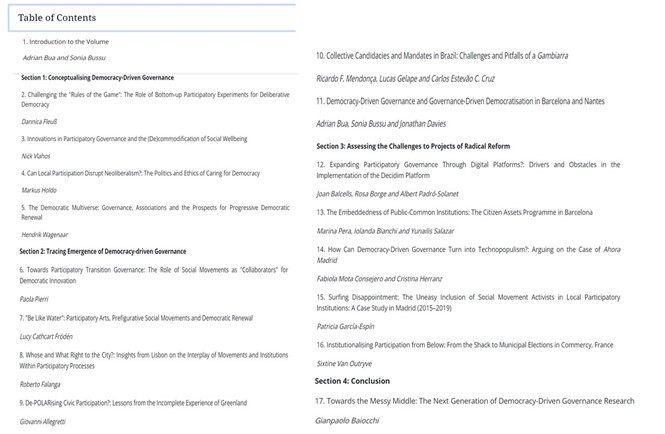
Reclaiming Participatory Governance, a volume I co-edited with Adrian Bua for Routledge’s Democratic Innovations series, provides an analysis of how social and grassroots movements are reclaiming and reinventing democratic innovations to strengthen the impact of citizen participation for social change. The book is articulated into three main sections to provide 1) theoretical and 2) empirical analyses of these processes, and to reflect on 3) challenges to the implementation of radical projects of social transformation. Through 17 chapters covering a range of cases, the volume captures the growing synergy between social movements’ mobilisations, the commons and participatory deliberative democracy, exploring how grassroots democratic action is mobilising to foster alternative forms of participatory politics and economics.
Throughout the book we apply democracy-driven governance as an analytical framework. We initially developed this concept to describe how social movements and grassroots groups who mobilised across Spain against austerity politics in the early 2010s used the deliberative and participatory toolbox, first to build movement parties’ platforms and later, after winning elections in many major cities, to transform local state institutions. Democracy-driven governance captures these social-movements-led forms of democratic innovations that aim to widen the scope of participatory governance from political institutions to the economy and wider society.
It is a counterpoint to Mark Warren’s governance-driven democratisation which refers to democratic innovations mostly initiated by public agencies, particularly at the local level. Governance-driven democratisation responds to specific policy issues and what Warren calls “pluralised ungovernability” (2014, 49). This refers to situations of high complexity that administrators are caught in as they navigate, on the one hand, dispersion of governing capacity, and on the other hand, high interdependence. The potential of Warren’s governance-driven democratisation resides in its pragmatic, problem-solving orientation, addressing problems of political leadership and public administration. However, by decoupling politics and economics and failing to attend to socio-economic factors, the practice of governance-driven democratisation has been quite tokenistic, falling short of making substantive positive change to the lives of citizens, in a context of widening inequalities.
Both governance-driven democratisation and democracy-driven governance exist in a dynamic relationship, which shouldn’t be understood as a mere bottom-up v. top-down heuristic. They both attempt to foster participatory governance or to include citizens in the work of public administration through “routinised participation”. They also interact with other participatory spaces, such as oppositional politics (protests) and the commons, where citizens create their everyday democracy by managing public goods through their own democratic decision-making rules and with limited interactions with state institutions.
The contributions to the volume look at how democracy-driven governance emerges across different socio-political and geographical contexts, and how it develops and navigates (or fails to) the constraints of day-to-day politics and public administration. Firstly, we wanted to test the analytical power of democracy-driven governance. By applying these concepts to a range of diverse cases, the chapters help flesh out the empirical characteristics of different forms of participatory governance. Secondly, we were interested in assessing how democracy-driven governance’s aspirations to social justice fare when applied to the real world. Can it strengthen the politics of the commons by making it visible and linking it to state institutions, as in the case of civic management and community-wealth building in Barcelona, or collective electoral mandates in Brazil? Can it facilitate processes of decommodification to help re-embed the economy in democracy and the wider society? Are these new approaches to politics and policymaking sustainable in the face of existing legal, business and public administration constraints?
The contributions trace practical challenges, from participation fatigue and activists’ disappointment with the slow pace of administrative work, to bureaucrats’ resistance or the challenges of reconciling democratic innovations, where citizens can participate as individuals, with assembly democracy, which strengthens organised civil society. One important aspect of democracy-driven governance concerns the digital commons, and the digital sphere will increasingly be the new battleground against the expansion of algorithmic capitalism.
The book provides many insights on the contested space to advance democracy, showing how social movements and citizen participation continue to play a crucial role in furthering the cause of critical theory: to challenge incumbency and demonstrate the possibility of other worlds.
The book launch is on 7th June 2023, at the University of Birmingham and on Zoom – register here.
Sonia Bussu is associate professor of Public Policy at INLOGOV. Her main research interests are participatory governance and participatory action research. Over the years, she has led research and published on participatory and deliberative processes, community engagement, coproduction of public services, and participatory research ethics.
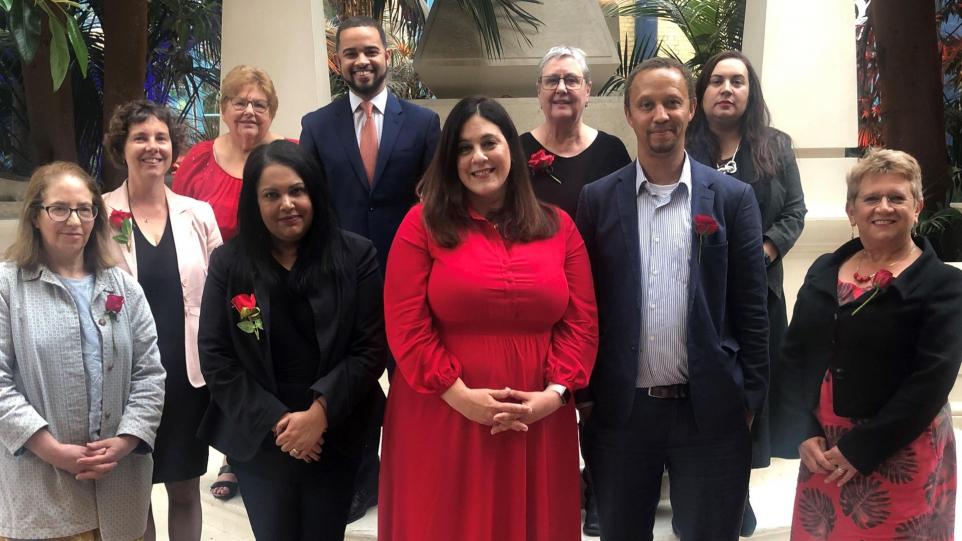
Local councils can and must do more to enable women to be councillors. Haringey’s new cabinet shows that this can be done, but fifty years after all government elected officials across the UK were finally elected under universal suffrage, new research shows barely a third of local councillors and MPs are women, whereas earlier research showed less than a quarter of Police and Crime Commissioner (PCC) candidates were women. This matters not only in terms of democratic fairness, but because politicians’ characteristics impact on public policy.
The research published last week by the Fawcett Society and Democracy Club reflects councillor representation in August 2022 across the UK. To collect the data, they had to scrape individual council websites since (incredibly) there is no official record of councillors’ gender (or other protected characteristics). This is because the relevant section of the Equality Act 2010 has still not yet been enacted and in any case as drafted would apply only to candidates in national elections. This is in contrast to council staff, where the Equality Act applies and has led most councils to capture and publish reasonably detailed assessments of workforce equality issues – as shown by the recent SOLACE / Shared Intelligence report, ‘Understanding and Improving Equality, Diversity and Inclusion in the Local Government Workforce’ which we discussed on the blog last autumn.
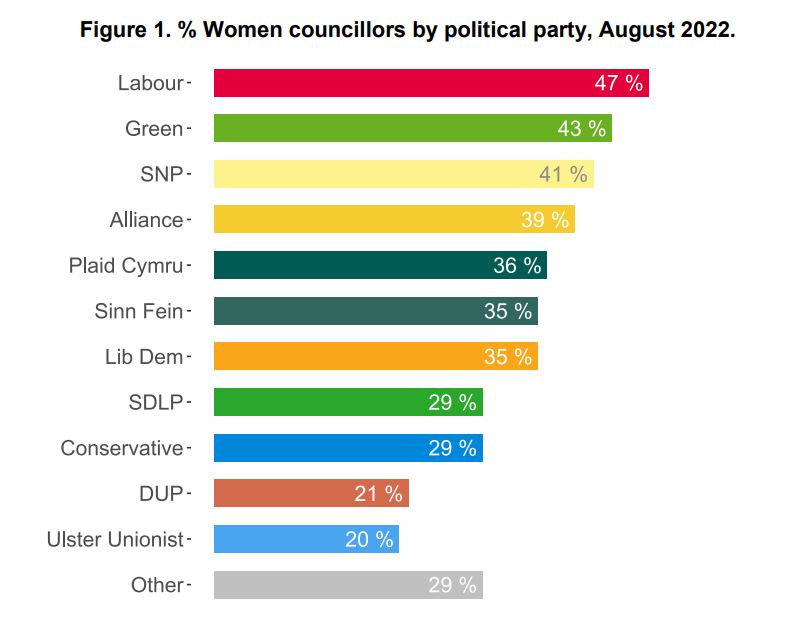
The Fawcett Society / Democracy Club results show no party yet has parity of representation between women and men, but some are doing much better than others. The highest proportion of women is found in the Labour Party (47%) and the lowest in the Conservative Party (29%), the SDLP, DUP, and Ulster Unionist Parties.
Source: Gender representation on local councils, Fawcett Society and Democracy Club (2022)
At individual council level, the highest proportions of women councillors were found in Haringey (65%), Rossendale (61%), Brighton and Hove (56%), Lewisham (56%), and Southwark (56%). In contrast, Perth and Kinross, Pendle, Comhairle nan Eileen Siar and West Berkshire each have 15% or less of the council made up of women councillors.
One effect of having fewer women decision makers may be that issues that disproportionately affect women are given insufficient attention. Policymakers play key roles in promoting status-based policies.
Recent research by Professor Francesca Gains (University of Manchester) and Professor Vivien Lowndes (Inlogov) published in the journal Politics & Gender in 2021 analysed the effect of Police and Crime Commissioner’s gender on policymaking around violence against women and girls (VAWG). An earlier quantitative phase of their research found that policy prioritisation was linked to Police and Crime Commissioners’ own gender, with female PCCs twice as likely to prioritize VAWG. Their later research analysed how this difference occurred, identifying ‘seven sets of rules that have shaped policy prioritization in favour of VAWG: the right to make key appointments; the requirement to set policy priorities; the obligation to utilize equalities duties; the power to commit resources; the expectation of partnership working with other agencies; the commitment to hold operational police officers to account; and the maintenance of diverse channels of contact with victims of crime and the wider public’ (Gains and Lowndes, 2022, p. 396).
To improve the situation, the Fawcett Society / Democracy Club report makes recommendations to government, political parties and local councils. For councils, the key actions are:
implement parental leave policies, to make being a councillor more accessible to those with caring responsibilities;
ensure that caring and dependency allowances reflect the real cost of childcare and are accounted for separately from ‘main’ members’ allowance;
pilot alternative ways of working including online and hybrid engagement mechanisms to enable councillors with caring responsibilities to carry out their duties more effectively; and
adopt codes of conduct, based on the model developed by the LGA in 2020
Local councils can only be truly effective when they represent the communities they serve. The Fawcett Society report is a timely reminder that we have a long way to go, but the first steps are clear and practical.
Jason Lowther is Director of the Institute for Local Government Studies (INLOGOV), University of Birmingham
Reference
Gains, F. and Lowndes, V. (2022) ‘Identifying the institutional micro-foundations of gender policy change: A case study of police governance and violence against women and girls’, Politics & Gender, 18(2), pp. 394-421.




 INLOGOV Blog