From Consultation to Co-Creation: How Birmingham Can Lead the Way in Participatory Governance

Susana Higueras and Sonia Bussu

In a time of growing inequality, political disillusionment, and institutional strain, Birmingham is at a crossroads. The city’s bold initiative, Shaping Birmingham’s Future Together (SBFT), offers a timely and transformative opportunity: to reimagine how local government works with its communities.

A new report by Susana Higueras and Sonia Bussu lays out a compelling roadmap for how Birmingham City Council (BCC) can become a participatory council. Drawing on UK and international examples, as well as interviews with local stakeholders, the report argues that participatory governance must be more than a buzzword. It must be embedded into the everyday workings of the council, grounded in inclusive practices, and driven by a genuine commitment to share power.

Why Participation, Why Now?

Birmingham is one of the UK’s most diverse and youngest cities. This diversity is a strength, but also a challenge when it comes to ensuring that all voices are heard in policymaking. At the same time, the city faces deep structural inequalities, including the highest child poverty rates in the UK. Traditional top-down governance models are no longer fit for purpose. What’s needed is a shift from consultation to co-creation.

The SBFT partnership, launched in 2024, aims to tackle these challenges by fostering collaboration across public, private, and community sectors. But as the report makes clear, this vision will only succeed if participation is embedded, not treated as an add-on or a one-off event.

What Does Embedded Participation Look Like?

Embedded participation means making citizen engagement a routine part of how decisions are made, from setting priorities to evaluating outcomes. It requires:

  • Facilitative leadership that enables collaboration and power-sharing;
  • Boundary spanners, or individuals who bridge the gap between institutions and communities;
  • Strong partnerships with civil society, grassroots, and voluntary organisations;
  • Intersectional inclusion that centres the voices of those facing multiple, overlapping barriers to participation.

The report highlights that successful participatory governance is not about flashy new tools or one-off events. It’s about culture change, within the council, across sectors, and in how communities are engaged.

Lessons from Elsewhere

The report draws on global examples to show what’s possible, and what pitfalls to avoid.

  • Porto Alegre, in Brazil, was a trailblazer in participatory budgeting, enabling residents to directly allocate public funds, at one point transferring over $300 per person annually to community control. However, as political leadership shifted, the commitment to the process waned, and budget allocations steadily declined, leading to a loss of momentum.
  • Barcelona, Spain, embedded citizen participation through digital platforms like Decidim and cultivated strong ties with social movements. At its peak, over 40,000 citizens engaged in budgetary decisions. Yet, the experience underscores the vulnerability of transformative initiatives when overly reliant on charismatic leadership, making them susceptible to political cycles.
  • Camden, London, institutionalised citizens’ assemblies, integrating them into formal decision-making structures. Notably, all 17 citizen recommendations on climate policy were adopted. Still, challenges persist around ensuring inclusivity and maintaining consistent follow-through.
  • Reykjavik, Iceland, leveraged digital platforms to crowdsource citizen ideas and implement participatory budgeting. Initially successful in mobilising thousands of residents, the initiative faltered as political support diminished and the platforms remained peripheral to formal governance, highlighting the limitations of digital participation without institutional anchoring.
  • Ostbelgien, Belgium, established the world’s first permanent deliberative system linked to a legislative body. Its legally enshrined Citizens’ Council and Assemblies offer a promising model of democratic stability and accountability. However, the top-down design and limited community ownership reveal the critical need for co-creation and inclusive recruitment to prevent the reinforcement of existing inequalities.

These examples show that embedding participation requires sustained commitment, institutional support, and mechanisms for accountability.

Opportunities in Birmingham

Despite the challenges, Birmingham has a strong foundation to build on:

But There Are Challenges Too

The report doesn’t shy away from the barriers:

  • Broken trust: Communities are tired of being consulted without seeing change.
  • Hierarchical leadership: A top-down culture limits innovation and responsiveness.
  • Structural silos: Departments often work in isolation, duplicating efforts and missing opportunities for collaboration and nurturing citizen participation.
  • Unfair funding mechanisms: Smaller community organisations feel sidelined and overburdened by bureaucracy.

These challenges are not unique to Birmingham, but they must be addressed head-on if SBFT is to succeed.

What Needs to Happen Next?

The report offers a clear set of policy recommendations.

Rebuild trust through transparent communication and visible follow-through.

Trust has been eroded by repeated consultations without tangible outcomes. BCC must commit to clear feedback loops, visibly acting on community input and explaining decisions transparently to rebuild credibility and legitimacy.

Embed participation in budgeting, service design, and scrutiny processes.

Participation should not be limited to one-off events; it must be embedded across governance functions. This can include participatory budgeting, citizen panels, and co-designed scrutiny mechanisms that give residents real influence over public decisions.

Foster facilitative leadership and cross-sector collaboration.

Leadership must shift from command-and-control to facilitation, enabling shared power and collaborative problem-solving. Cross-departmental working groups and partnerships with civil society can help break down silos and foster innovation.

Work better with communities, recognising them as co-creators, not just consultees.

Community organisations should be treated as equal partners, with fair funding, early involvement in policy development, and recognition of their expertise. This means moving from consultation to co-creation, where communities help shape solutions from the outset.

Design for intersectional inclusion, addressing overlapping barriers to participation.

Inclusive participation requires acknowledging and addressing systemic inequalities. Councils must create safe, accessible spaces and use diverse engagement methods, including arts-based approaches and multilingual formats, to ensure marginalised voices are centred and valued.

The SBFT partnership can be a catalyst of this change and become the space for shared governance and accountability.

A Call to Action

The SBFT initiative is more than a policy programme, it’s a democratic innovation. It’s a chance to reshape how power is shared in the city, how decisions are made, and how communities are valued. As one community leader put it: “We’re not asking to be asked. We’re asking to lead.”

If Birmingham can rise to this challenge, it won’t just be shaping its own future. It will be setting a national, and even global, example of what inclusive, embedded participatory governance can look like in the 21st century.


DOI: https://doi.org/10.48352/inlogov.bhamx.0001

Dr Sonia Bussu is an Associate Professor at the University of Birmingham Department of Public Administration and Policy where she studies and teaches public policy. Her main research interests are participatory governance and democratic innovations, and creative and arts-based methods for research and public engagement. 

Susana Higueras Carrillo is a Peruvian anthropologist. She is PhD candidate at Goldsmiths, University of London and holds a master’s degree in Environmental Governance from the University of Oxford. She has worked at the University of Birmingham in the INSPIRE (Intersectional Space of Participation: Inclusive, Resilient, Embedded) project researching how to strengthen intersectional inclusion through arts-based methods such as legislative theatre. Her research interests lie in environmental and social justice and communicating research in creative and impactful ways.

Renewing Democratic Leadership

Jason Lowther and Sonia Bussu

Legislative Theatre with West Midlands Combined Authority

As local government in England undergoes significant restructuring, with fewer councils serving larger and more diverse populations, the role of councillors is under pressure. At the same time, democratic innovations, such as citizens’ assemblies, or creative methods of participation, such as legislative theatre and digital engagement, are gaining traction. These innovations offer new ways to engage communities and strengthen democratic legitimacy.  But how do they fit with the role of elected councillors?

Recent research and practice suggest that councillors can play a crucial role in facilitating inclusive and impactful citizen participation.

Politicians’ Views on Participation

Across the UK and Europe, many elected representatives have expressed support for citizen participation in policymaking. They see it as a way to build trust, improve decision quality, acknowledge a wider range of perspectives and knowledge, engage citizens more deeply in political life, and potentially identify novel solutions to politically difficult issues. However, research by Kersting shows that this support is often conditional. Councillors tend to favour participatory instruments that reinforce their representative role, such as advisory boards or structured consultations. They are more sceptical of online platforms and randomly selected citizen assemblies (so-called minipublics), which they worry may not be genuinely representative of their electorate and may lack the capacity to understand complex issues.

Werner and Marien’s comparative experiments in Sweden and the Netherlands provide further insight. Their work shows that participatory processes consistently increase perceptions of fairness. This matters because fairness perceptions are closely linked to trust, policy compliance, and perceived legitimacy. Importantly, these effects are not limited to winners (who support the outcome of the exercise); even those who lose in participatory decisions tend to view the process more positively than in purely representative settings.

These findings highlight a tension. While democratic innovations can enhance legitimacy, councillors often feel uncertain about their role within them. Without open discussion, clear support, and integration, these processes risk bypassing councillors altogether.

Reimagining the Role of Councillors

Inlogov’s 21st Century Councillor research offers a compelling framework for renewing councillors’ roles. It describes councillors as hybrid connectors who build relationships both online and offline, multi-level diplomats who navigate partnerships across governance layers, and system stewards who shape democratic innovation and institutional change.

To fulfil these roles, councillors need support. This includes help to understand democratic innovations and any potential concerns.  They need understanding of key areas such as facilitation skills and digital engagement, confidence in narrative-building around democratic innovation, access to mentoring from peers with experience of these approaches, opportunity to explore difficult scenarios, and chance to reflect on their practice. Councils must also empower community members to scrutinise participatory outputs, and help councillors to navigate tensions between citizen input, officer advice, and party lines.

The Camden Model: Embedding Participation

Camden Council offers a practical example of how participatory processes can be embedded within representative governance. The council has institutionalised citizens’ assemblies as regular tools for major policy development, including planning, climate change, and health and social care. Assemblies are commissioned by council boards, which commit to formally responding to recommendations. In the case of the 2019 Climate Assembly, all 17 proposals were endorsed and integrated into Camden’s Climate Action Plan, with the citizen’s assembly referenced throughout the document.

This approach demonstrates how local government can lead participatory processes, ensuring they are not just consultative exercises but integral to policy development. However, several recommendations from the Camden climate assembly extended beyond the council’s jurisdiction, highlighting the structural limitations of local deliberative processes in addressing systemic issues like the climate. Councillors could have played a stronger bridging role, helping to clarify expectations and ensure that recommendations were grounded in the council’s remit. Stronger involvement from elected representatives might have thus enhanced democratic accountability.

Inclusive youth engagement in policymaking in the West Midlands

There is much more to learn and do to make democratic innovations more inclusive and effective, supporting participation from historically marginalised groups, which tend to ignore invitations to participate in citizen assemblies or formal consultation exercises.

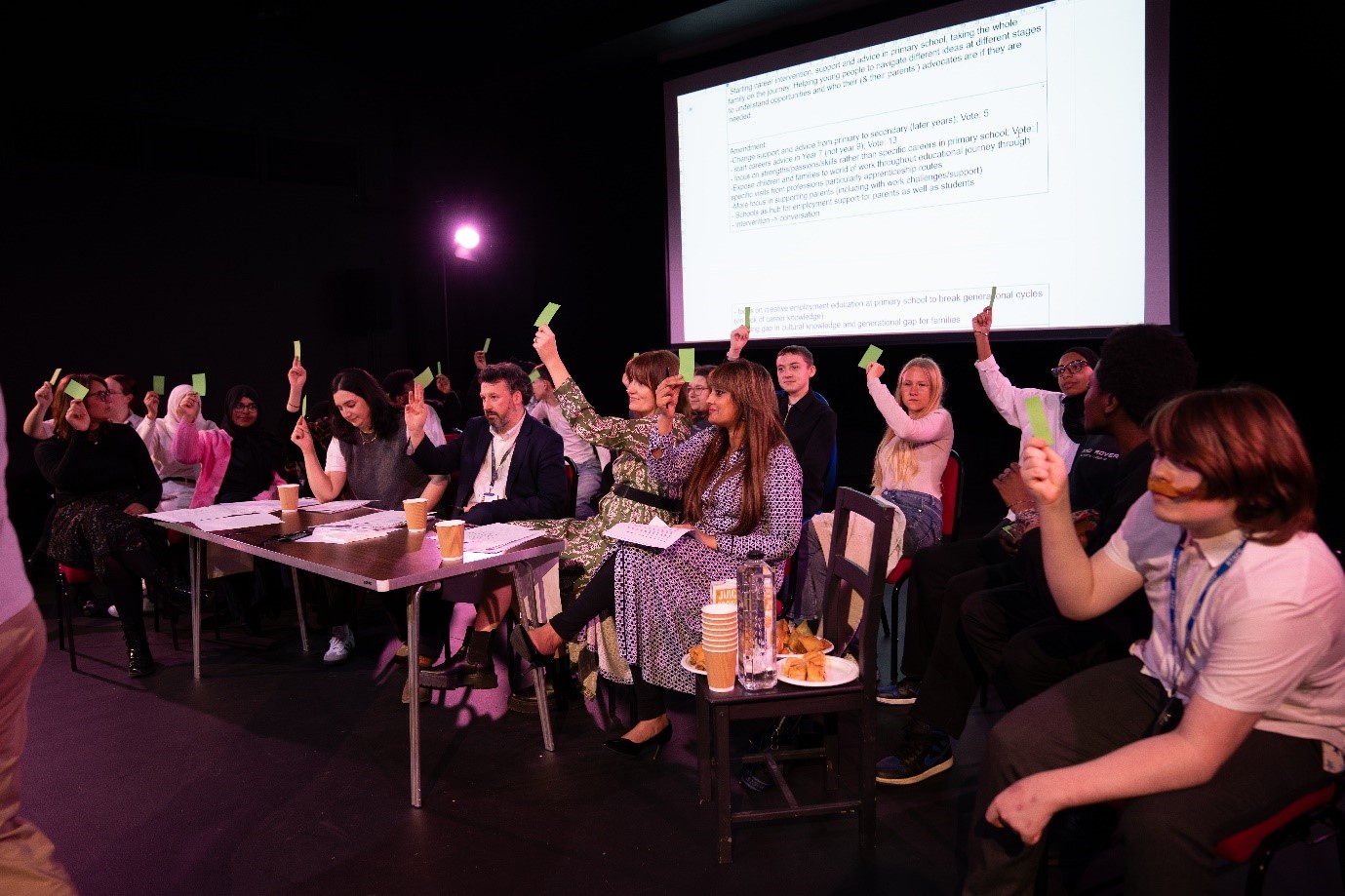
A recent example of inclusive approaches comes from the West Midlands, where the INSPIRE project, led by the University of Birmingham, used legislative theatre to engage young people in shaping youth employment policy. Legislative theatre is a method developed by Augusto Boal that uses performance to explore lived experience, test policy interventions, and co-create solutions. It involves watching a play co-created by the participants on real issues and based on their lived experience. During the event, an audience of community members and policymakers become spect-actors, acting out alternative scenarios, proposing policy changes, and voting on them in a public forum.

The University of Birmingham partnered with the Young Combined Authority and Youth Focus West Midlands to recruit a diverse group of 15 young people (14-17 years old) who, under the guidance of legislative theatre practitioners, developed a play about barriers to work experience and youth employment. Through performances and structured dialogue with policymakers, they co-created six policy proposals. These include reforms to careers advice, work experience, and employer accountability.

Crucially, policymakers were invited to participate not just as observers but as co-creators and champions. Their involvement can help bridge the gap between lived experience and institutional action, demonstrating how local government can play a central role in democratic innovation for social change.

Councillors as Democratic Innovators

Democratic innovations in Camden and the West Midlands are two examples of how local government can promote democratic renewal. Councillors can and should play more central roles in these processes, beyond party politics, to facilitate and nurture dialogue between citizens and institutions, ensuring follow-through on recommendations, and using committee structures to embed participatory outputs.

Rather than seeing participation as a threat, councillors can embrace it as a tool to strengthen their representative role and reconnect with communities. They are uniquely positioned to bridge the gap between citizen voice and institutional action. This requires a shift in mindset and practice.

Dr Jason Lowther is Director of Inlogov (the Institute of Local Government Studies) at the University of Birmingham, and was Assistant Director (Strategy) at Birmingham City Council from 2004 to 2018.  His research focuses on the use of evidence in public policy and central intervention in local government.

Dr Sonia Bussu is an Associate Professor at the University of Birmingham Department of Public Administration and Policy where she studies and teaches public policy. Her main research interests are participatory governance and democratic innovations, and creative and arts-based methods for research and public engagement. 

This article was first published in the Municipal Journal, 25th September 2025, available online here: https://www.themj.co.uk/renewing-democratic-leadership

Picture credit: Inspire Legislative Theatre, March 2025 – photo by Bucuria Maria Polodeanu – Insta: @reelmasterproduction

Equipping local governments to deliver national and local priorities

Jason Lowther

Today we launched our latest report, Equipping local government to deliver national and local priorities. Local government is critical to the delivery of the new government’s five key missions, and to improving life across the country. We argue that, once a series of critical reforms are in place, government should have confidence to equip local authorities with more power and (when public finances allow) prioritise additional resources there, enabling local and national priorities to be delivered. But critical reforms are needed in financial management, audit and performance management, and in community power and participation.

The new government inherited many challenges. Council budgets per person in England have been cut by 18% in real terms since 2010. Councils are hitting financial crises: twelve have issued section 114 notices in the last six years, compared with zero in the previous 17 years. Representative institutions at all levels of government are suffering from declining legitimacy and increasing polarisation. Local government plays a vital role in increasing democratic relationships and trust.

But councils’ wide remit, local knowledge, democratic accountability, public service ethos, and key roles in working with partners and shaping local places make them critical to the delivery of all five of the government’s key missions. Local governments are best placed to operationalise solutions to interconnected problems, for example, improving public transport and encouraging more cycling and walking helps meet net zero targets. It can also deliver health benefits, reducing the burden on the NHS, as well as increasing productivity by giving businesses access to a wider and healthier workforce.

Action is required to ensure that councils are fit for purpose to make the type of contribution that central government requires of them. Underlying this is a lack of confidence in local government on the part of ministers and civil servants.  We have identified three areas in which the government must be confident if it is to equip the local level with more power: financial sustainability, performance standards, and community power and participation. 

Policy recommendations

Financial arrangements

  1. Provide multi-year funding.
  2. End competitive bidding and deliver a “single funding pot” for each council/ local area that has been allocated fairly and sensitively to the needs and assets of the community.
  3. Abolish council tax capping.


Audit and performance management

  1. Strengthen the evaluation of councils’ performance management.
  2. Make OFLOG independent and extend its remit and approach.
  3. Reintroduce effective management and support of council external audit by independent bodies.


Community power and participation

  1. Strengthen the role of councillors as facilitators and catalysts of community-driven change.
  2. Embed participatory governance to ensure lived experience and marginalised voices drive policy and service delivery.
  3. Develop public-commons partnerships and community-wealth building to support community-driven sustainable economies.

As the Layfield Commission concluded 50 years ago, local government funding should promote responsible and accountable government. Beyond welcome recognition of acute financial challenges and commitment to multi-year funding settlements, there is a pressing need for additional immediate and longer-term action to improve Councils’ financial position and strengthen local accountability.

Local authorities have different needs for funding, depending for example on levels of population and its composition, deprivation, and spatial factors. Central and local government should develop updated funding formulae and funding models which are as simple as practicable whilst capturing the key elements of local need, and as transparent as practical in operation.  There are many reports researching available options for fairer funding, approaches to fiscal devolution, and local government funding options

Local audit, performance regimes and regulation each have a part to play. Both a parliamentary select committee and the Redmond Review into the Oversight of Local Government have sought to investigate the failings in local government audit.  The latter in 2020 critiqued market driven audits, stating that the new audit arrangements have undermined accountability and financial management. 

The adoption of the Redmond Review’s proposal for an Office for Local Audit Regulation would provide oversight on procurement, management, and regulation of external audits of local authorities. The government could extend the oversight of local government performance management processes while avoiding the creation of an overly powerful national regulator, by adopting key recommendations on the future arrangements of OFLOG (the Office for Local Government).

Proximity means that local government can play a crucial role in improving relationships between government and citizens. By creating conditions to mobilise the diverse expertise and resources of communities, local government can ensure that public policies and funding are informed by the assets, priorities and needs of local people and places.  There are already many examples where local government has made progress with innovations such as citizens’ panels and juries, the delegation of power to the hyper-local level and in building inclusive economies

We have over thirty years’ worth of research on deliberative democracy, social innovation, and co-production evidencing the value of collaboration with diverse communities and stakeholders. Participatory governance is less about finding perfect solutions and more about transforming organisations to engage with communities in processes of co-producing mutual understanding, shared solutions, and a sense of collective ownership.  

Our work on the 21st Century Councillor can help with enabling the role of councillors not just as democratic representatives but also as facilitators and boundary spanners between institutions, communities, civil society and local businesses.

Community-wealth building, pioneered in Preston and several London boroughs, can help strengthen the local economy with insourcing, linking public procurement to local cooperatives and social enterprises. These novel forms of governance can be formalised through Public-Commons Partnerships.

Equipping local government to deliver national and local priorities will leave a long-lasting legacy of a well-resourced, effective, accountable, and engaged local government.

The full report is available here

The report was edited by Jason Lowther and Philip Swann, with particular thanks to the following contributors (alphabetically by last name): Dr Koen Bartels, Dr Sonia Bussu, Prof Nicole Curato, Dr Timea Nochta and Dr Philip Whiteman. With thanks to other colleagues and associates in INLOGOV.

Democratising public administration through public-common partnerships: the case of the Citizen Assets Programme in Barcelona

Marina Pera and Sonia Bussu

In a recent article titled Towards Democratisation of Public Administration:Public-Commons Partnerships in Barcelona, part of a Special issue on The International Journal of the Commons (edited by Dr Hendrik Wagenaar and Dr Koen Bartels), we explored public-commons partnerships in Barcelona through a relational lens, examining how they might be contributing to deeper democratisation of public administration.

The commons refer to those cultural and material resources collectively managed by the community and represent an alternative to both the state and the market. Recent literature emphasises the capacity of the commons’ prefigurative politics to develop alternative institutions to neoliberal regimes and/or deliberative and collective forms of resource management. The grassroots movements managing the commons often take an oppositional stance to the state, but they might also depend on its resources. By the same token, the state has an interest in supporting assets and services managed as commons, which offer flexibility and efficiency, while encouraging citizen participation in local politics.  

Within political contexts sympathetic to progressive socio-economic projects, such as  new municipalism in Barcelona, formalised alliances between the local state and the commons started to emerge, facilitating the development of novel policy instruments that respond better to the demands of the commons and open opportunities for more participatory policymaking. So-called public-common partnerships are long-term agreements based on cooperation between state actors and the commons members. In our paper, we wanted to understand better the relational work behind these partnerships and the role of boundary spanners that build bridges between two worlds, such as the state and the commons, which are often quite distant in terms of visions of local democracy and the language to articulate such visions.  We take the case of the Citizen Asset Programme (CAP) in Barcelona to explore the relationships between public officials and commons members, highlighting how these collaborations shape governance practices and can help foster a collaborative culture within public administration.

CAP was approved in 2016 and aims to create the institutional framework to recognise and support commons-managed municipal assets in the city. Based on qualitative analysis of interviews with public officials and commons members involved in the partnership, as well as official documents, we drew out insights on the relational dynamics that facilitated the creation of two policy instruments under CAP: The Community Balance Metrics and the Social Return on Investment of Can Batlló. The first one is a set of indicators to evaluate the performance of community-managed assets considering their transformative potential and including dimensions of internal democracy, care, inclusion, and environmental sustainability. The second helps to measure the value of activities and volunteer work carried out in the community centre of Can Batlló.

Through a series of vignettes depicting the different state and commons actors involved, we examined how they forged alliances and employed creative thinking to manage conflicts, resistance, and scepticism from both the local administration and the grassroots movements. Public officials from the Active Democracy Department were able to build trust among commons representatives by recognising their needs and potential. They explained the workings of public administration in a clear language. They created spaces of open-ended dialogue between grassroots movements and different departments to facilitate the development of policy instruments, measures and indicators that valued the commons’ innovative work, while still coherent with existing legal requirements. For instance, a working commission was set up involving members of Can Batlló, the Legal and the Heritage Department, as well as representatives of the District administration. This public-commons partnership developed a comprehensive agreement to regulate asset transfers, which fully recognises the social and economic value of the commons.

By the same token, the commons members played a crucial role in communicating to grassroots movements the work of the Active Democracy officials and build mutual trust. On the one hand, they helped the commons understand feasibility issues of their demands; on the other they pressed the public administration for greater transparency and creative interpretation of existing regulatory framework to strengthen democratic values underpinning asset transfer agreements.

Two cooperatives supported these partnerships as consultants. They contributed knowledge of innovative public policies from across the world. They also facilitated knowledge sharing to encourage cooperation between commons members and state institutions, for instance by inviting grassroots groups from other parts of the world to share their experience of working with the state.

The work of these public-commons partnerships is gradually reshaping the administrative culture and fostering more transparent and democratic working practices within the public administration. An example is the joint work to develop the Community Balance Metrics, which helps evaluate the performance of the commons using indicators agreed upon by both local public administration and the commons. However, these processes face a number of challenges, as they clash with established working routines and performance evaluations of public administrators that hardly ever value participatory work. Existing literature suggests that despite the introduction and encouragement of new practices, there is a tendency to revert to traditional policymaking methods when faced with unexpected problems. When boundary spanners that had supported the partnership exit the process, they can leave a vacuum that is hard to fill and that can jeopardise the partnership. In Barcelona, ongoing discussion between Can Batlló members and the City Council on who is responsible for funding the refurbishment of one of Can Batlló’s building is causing friction within the partnership and some of the work has stalled.

Inevitably this collaborative work is hard to sustain, but in the face of multiple and overlapping crises facing local government, these public-commons partnerships are also beginning to open safe space to experiment and do things differently.

Picture credit: Victoria Sánchez.

Sonia is an Associate Professor in INLOGOV. Her main research interests are participatory governance and democratic innovations, and creative and arts-based methods for research and public engagement. She led on projects on youth participation to influence mental health policy and services, coproduction of research on health and social care integration, models of local governance, and leadership styles within collaborative governance.

Marina is a researcher at Autonomous University of Barcelona (UAB). She holds a PhD in Public Policy from UAB and a M.A. in Sociology from Columbia University (New York). She has been a visiting scholar at CUNY Graduate Center (New York) and at INLOGOV, University of Birmingham. Her research interests
include community assets transfer, democratisation of public administration, community development and public-common partnerships.

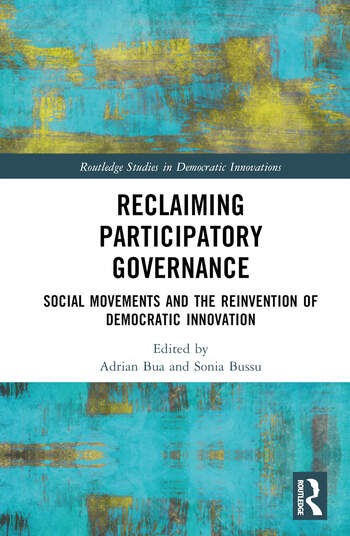
Reclaiming Participatory Governance: Social movements and the reinvention of democratic innovation

Sonia Bussu

Our world is experiencing multiple pressing crises; political elites’ inability or unwillingness to address them has contributed to diminishing trust in representative institutions. Democratic Innovations and participatory governance processes engaging citizens directly in politics and policymaking have been hailed as an antidote to elected representatives’ plummeting legitimacy. But they have also attracted much criticism, as they give much power to commissioning organisations, who design the process and choose who to invite, while there is limited follow-up on citizens’ recommendations.

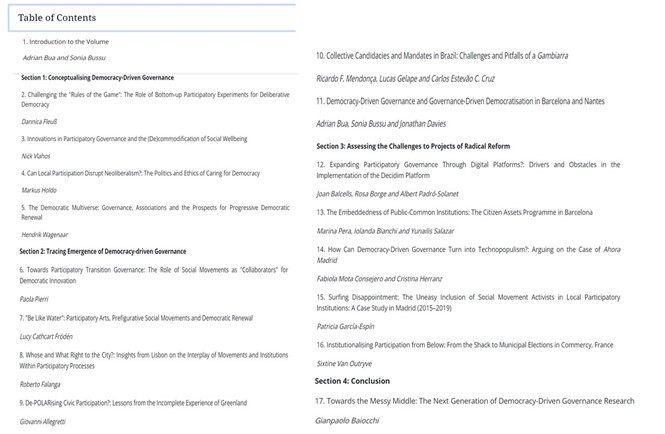
Reclaiming Participatory Governance, a volume I co-edited with Adrian Bua for Routledge’s Democratic Innovations series, provides an analysis of how social and grassroots movements are reclaiming and reinventing democratic innovations to strengthen the impact of citizen participation for social change. The book is articulated into three main sections to provide 1) theoretical and 2) empirical analyses of these processes, and to reflect on 3) challenges to the implementation of radical projects of social transformation. Through 17 chapters covering a range of cases, the volume captures the growing synergy between social movements’ mobilisations, the commons and participatory deliberative democracy, exploring how grassroots democratic action is mobilising to foster alternative forms of participatory politics and economics.

Throughout the book we apply democracy-driven governance as an analytical framework. We initially developed this concept to describe how social movements and grassroots groups who mobilised across Spain against austerity politics in the early 2010s used the deliberative and participatory toolbox, first to build movement parties’ platforms and later, after winning elections in many major cities, to transform local state institutions. Democracy-driven governance captures these social-movements-led forms of democratic innovations that aim to widen the scope of participatory governance from political institutions to the economy and wider society.

It is a counterpoint to Mark Warren’s governance-driven democratisation which refers to democratic innovations mostly initiated by public agencies, particularly at the local level. Governance-driven democratisation responds to specific policy issues and what Warren calls “pluralised ungovernability” (2014, 49). This refers to situations of high complexity that administrators are caught in as they navigate, on the one hand, dispersion of governing capacity, and on the other hand, high interdependence. The potential of Warren’s governance-driven democratisation resides in its pragmatic, problem-solving orientation, addressing problems of political leadership and public administration. However, by decoupling politics and economics and failing to attend to socio-economic factors, the practice of governance-driven democratisation has been quite tokenistic, falling short of making substantive positive change to the lives of citizens, in a context of widening inequalities.

Both governance-driven democratisation and democracy-driven governance exist in a dynamic relationship, which shouldn’t be understood as a mere bottom-up v. top-down heuristic. They both attempt to foster participatory governance or to include citizens in the work of public administration through “routinised participation”. They also interact with other participatory spaces, such as oppositional politics (protests) and the commons, where citizens create their everyday democracy by managing public goods through their own democratic decision-making rules and with limited interactions with state institutions.

The contributions to the volume look at how democracy-driven governance emerges across different socio-political and geographical contexts, and how it develops and navigates (or fails to) the constraints of day-to-day politics and public administration. Firstly, we wanted to test the analytical power of democracy-driven governance. By applying these concepts to a range of diverse cases, the chapters help flesh out the empirical characteristics of different forms of participatory governance. Secondly, we were interested in assessing how democracy-driven governance’s aspirations to social justice fare when applied to the real world. Can it strengthen the politics of the commons by making it visible and linking it to state institutions, as in the case of civic management and community-wealth building in Barcelona, or collective electoral mandates in Brazil? Can it facilitate processes of decommodification to help re-embed the economy in democracy and the wider society? Are these new approaches to politics and policymaking sustainable in the face of existing legal, business and public administration constraints?

The contributions trace practical challenges, from participation fatigue and activists’ disappointment with the slow pace of administrative work, to bureaucrats’ resistance or the challenges of reconciling democratic innovations, where citizens can participate as individuals, with assembly democracy, which strengthens organised civil society. One important aspect of democracy-driven governance concerns the digital commons, and the digital sphere will increasingly be the new battleground against the expansion of algorithmic capitalism.

The book provides many insights on the contested space to advance democracy, showing how social movements and citizen participation continue to play a crucial role in furthering the cause of critical theory: to challenge incumbency and demonstrate the possibility of other worlds.

The book launch is on 7th June 2023, at the University of Birmingham and on Zoom – register here.

Sonia Bussu is associate professor of Public Policy at INLOGOV. Her main research interests are participatory governance and participatory action research. Over the years, she has led research and published on participatory and deliberative processes, community engagement, coproduction of public services, and participatory research ethics.

Can democratic renewal help us ‘build back better’ from the COVID-19 crisis? Key recommendations from the Newham Democracy and Civic Participation Commission

Elke Loeffler and Nick Pearce

Newham has seen one of the highest rates of COVID 19 mortality in England and Wales. Being one of the 10% most deprived areas in the UK (according to 2019 deprivation indices) the crisis has exposed wider social and economic inequalities – in health, housing, access to services and income – particularly for the Black and Minority Ethnic population.

At the same time, Newham has also seen a flowering of community support and creativity in response to the crisis. The local council has pioneered new ways of working with the voluntary and community sector. A new COVID-19 Health Champions network has been launched to empower thousands of Newham residents to remain up to date on the latest advice about COVID-19, and a new digital initiative  ‘Newham Unlocked Community Broadcasts’ showcases the creativity of local artists.

Newham is also one of a relatively small number local councils in the UK which have a directly elected Mayor. In 2018 Rohksana Fiaz took over from Sir Robin Wales, after his 23 years in the post, as London’s first directly-elected female mayor. In her election manifesto Fiaz promised to hold a referendum on the direct elected mayoral system before the end of her third year as Mayor (i.e. 2021), although the impact of the COVID-19 pandemic will affect this timeline.

The Democracy and Civic Participation Commission

In this context the Mayor and the Council of Newham set up an independent Commission in autumn 2019 to examine both the Council’s current directly elected Mayor system of governance and the alternative approaches that exist in English local government, and to make recommendations on the best system of governance for Newham’s future, and to explore ways in which local residents can become more engaged and more fully involved in local decision-making and the Council’s work.

The Commission was led by Professor Nick Pearce. Extensive evidence gathering took place between November 2019 and February 2020.

A key concern of the six Commissioners was to make bold recommendations to reduce inequalities in public participation and bring citizen power into the Council to improve public services and the quality of life of local people. The COVID-19 crisis, which occurred during the latter stages of the Commission’s work, gave a dramatic glimpse of the huge potential resources in the community and the willingness of local people to make a contribution to improve the quality of life in their neighbourhood.

The “Newham Model” for more inclusive public participation

The resulting “Newham Model” aims to provide checks-and-balances to the way in which Newham is governed. It provides new participatory governance mechanisms. In particular, the Commission Report proposes the creation of a permanent Citizens’ Assembly, selected like a jury – the first of its kind in England. It suggests strengthening the accountability of the executive Mayor to local people and the main stakeholders of the Council, while also limiting the mandate of the executive Mayor to two terms, so that there is a frequent impulse for innovation and creative thinking at the centre of the Council.

Other key recommendations for strengthening public participation and co-production of public services and outcomes with local people are:

  • Extension of participatory budgeting – an increase in the resources allocated to areas or neighbourhoods for expenditure which is determined by local people from the current level of £25,000. The aim should be to spend a minimum of 20% of the Community Infrastructure Levy (CIL) resources through neighbourhood or area-based participation.
  • A new framework for area-based decision-making – allowing powers to be drawn down to the most local level – along with the piloting of an ‘urban parish council’ in one of Newham’s communities.
  • A new “Mayor’s Office for Data, Discovery and Democracy” to provide expertise and leadership on the democratic use of data, digital tools for resident engagement, and learning from digital champions such as the government of Taiwan.
  • Wider use of co-production with residents and people accessing services, including area regeneration, which means that the local council needs to become much better at mapping what local people are doing, and want to do in the future.
  • Enabling local councillors to play the increasingly important role of ‘community connectors’, mobilising local people and their enthusiasms.
  • Support for an independent, community-owned local media organisation.

The Report of the Commission was launched on 6 July 2020 in a virtual public meeting, with presentations from the Commissioners, followed by responses by the Mayor and Vice-Mayor on behalf of the Council. Newham Council’s cabinet members will formally consider the commission’s report and recommendations at a later meeting.

Clearly, councils need to adapt the ‘Newham Model’ to fit their local circumstances, while simultaneously learning from democratic innovators in the UK and internationally.  Moreover, research institutions such as INLOGOV have an important role in sharing learning on new local governance models to help local government to ‘build back better’ from the COVID-19 crisis.


Nick Pearce is Director of The Institute for Policy Research (IPR) and Professor of Public Policy at the University of Bath. He was formerly director of the Institute for Public Policy Research (IPPR), as well as Head of the No 10 Downing St. Policy Unit between 2008 and 2010.

Elke Loeffler is a Senior Lecturer at Strathclyde University, and INLOGOV Associate. She is author of ‘Co-Production of Public Services and Outcomes’ and co-editor of ‘Palgrave Handbook of Co-Production of Public Services and Outcomes’, both of which will be published in autumn 2020.