Why do philanthropic foundations engage with city governments?

Dr Ruth Puttick

The fact that governments face an array of challenges is a well-rehearsed argument. City governments across the globe are tackling a myriad of social, economic and environmental issues, from trying to reduce homelessness, improving health and wellbeing, or increasing educational attainment.  In parallel, philanthropic foundations’ accumulated wealth and knowledge means they are increasingly welcomed as a government partner in addressing social needs. So why do philanthropic foundations engage with city governments?

The UK Association of Charitable Foundations defines philanthropic foundations as “charities with private, independent, sustainable income that supports individuals and/or organisations” (Pharoah and Walker, 2019, p. 1). In 2015, there were over 10,000 charitable foundations based in the UK and some of these are engaging with city governments.

In the U.S. context, philanthropic foundations have a long history of interacting with the government (Zunz, 2012) They have traditionally funded physical structures like libraries and opera houses, and in recent years, foundations have increasingly working directly with governments to tackle issues as diverse as climate change (Madénian and Van Nest, 2023), gun control, and poverty reduction (Barber, 2014; Nijman, 2009; Moir et al., 2014). Yet, there has been little exploration of this phenomenon in the English context.

Based upon the case study analysis of three contrasting English cities, Bristol, Manchester, and Newcastle, I drew upon qualitative interviews and policy reports to understand the interconnections between foundations and city governments.

Why do city governments and foundations collaborate

Philanthropic foundations can be a capacity-building partner of city government, providing direct funding and non-financial resources to help city governments solve problems.  Philanthropic foundations provide city governments with direct funding and non-financial resources, including data, research, events, and other outputs, such as toolkits.

Foundations are motivated to improve public services, develop new approaches to problem-solving, advocate on policy issues, and fill funding gaps left by austerity. Foundations select city governments based on personal rapport and perceived ease of working.

City governments are motivated to engage with foundations to access resources, for foundations to help amplify the voice of city governments, and because foundations are perceived as less bureaucratic and more trustworthy funders.

Barriers to city government and foundation collaborations

Foundation engagement with city governments is inconsistent. This study found that certain city governments (in this case, Manchester and Bristol) had more partnerships with foundations. The reason is that foundations often will not work with city governments when the city government’s priorities are unclear, if they are hard to engage, or when there is a perceived slow pace of change in city hall.

On the part of city governments, a scarcity of resources can prevent them from seeking foundation resources. With the impacts of austerity still lingering, it may have been surmised that austerity could prompt cities to seek foundation support, instead, this study has found that a lack of internal capacity can prevent the city government from seeking foundation involvement.

Implications for policy and practice

City governments interacting with foundations in England is a relatively nascent and under-explored phenomenon. As well as few academic studies, there is often an opaqueness in the nature of these collaborations. A lack of transparency can hinder scrutiny, which is problematic if city governments and their partners are to be held to account. Going forward, a key facet of city government engagement with foundations should be a commitment to transparency in the nature of the collaboration and an openness to sharing evidence of the impacts of the interactions on the outcomes that the foundation and city governments are trying to achieve.

Areas for future research

As a relatively underexplored topic, more research could usefully explore foundation engagement with city governments across England on a larger scale, particularly to understand the implications for accountability. Futuremore, future research could usefully explore whether philanthropic foundations prioritise collaborating with city governments over different types of organisations, such as charities, and if so, whether this is because city governments enable potentially larger degrees of policy influence than more “marginal” political institutions, such as NGOs or community groups.

To find out more about the research, please contact Dr Ruth Puttick, [email protected]

The full article is available here.

Picture credit: https://www.jolietymca.org/blog/the-significance-and-joy-of-giving/


Dr Ruth Puttick runs a research consultancy and is a Senior Research Fellow at the Institute for Innovation and Public Purpose (IIPP) at University College London. She has over 15 years of practical research experience in the public and private sectors advising on public sector reform, innovation and impact. She served as a Senior Policy Advisor in the UK Government’s Open Innovation Team, and before that, she worked at Tony Blair Associates, a global management consultancy, helping establish the policy and research team in the government advisory practice. Prior to that, she spent six years at Nesta, the UK’s innovation agency. Ruth is on X.com @rputtick and can be contacted at www.ruthputtick.com


Thinking about the Earthquakes in Turkey: A Call for Local Democracy

Picture: FCDO/Russell Watkins

Professor Rabia Karakaya Polat

The earthquakes that took place in Maraş province of Turkey on February 6, together with the terrible destruction they caused, also led to the questioning of state institutions and capacity. An important dimension of the subject is the relationship between central and local governments in the country. These earthquakes and what happened afterwards have been instrumental in questioning the overcentralized structure of the state in Turkey[i]. Discussions centered on why the earthquakes were so devastating[ii] as well as the inadequacies in the post-earthquake response[iii].

In Turkey, the authority to issue city planning and zoning permits belongs to the central administration. The authority to carry out urban transformation processes in existing settlements also rests with the Ministry of Environment, Urbanization and Climate Change, which is the relevant ministry of the central government. Therefore, the possibilities of municipalities to make cities earthquake resistant are very limited. The authorities of municipalities, such as controlling and licensing the buildings against earthquakes, are not used effectively enough.

Turkish people have witnessed that the excessively centralized structure also hindered the post-earthquake rescue efforts. It was not possible for local actors to take the initiative and act. The lack of timely mobilization of local capacity increased the loss of life. It is very important that not only local governments, but also civil society mobilize in such crises. However, there was a process in which non-governmental organizations and volunteers carrying out aid campaigns were also targeted[iv]. In a televised speech to the nation, President Erdoğan complained about critical news and declared that he planned to hold critical voices to account. Later, access to Twitter was throttled while rescue operations were still underway. The government claimed that it did so to prevent “disinformation”. Some government actors and their supporters also raised concerns about the extent to which public support and fund-raising has been directed at civil society organizations like Ahbap, rather than the government’s own relief organization, AFAD.

In fact, we have witnessed such challenges to local actors in the face of complex and multiple crises by the central government before. For example, during the coronavirus pandemic, the efforts of the Istanbul Metropolitan Municipality to collect aid were stopped and the donations amounting to 6.2 million liras collected in the bank accounts were confiscated and transferred to the central government bodies[v]. The 3.5 million lira aid collected by the Ankara Metropolitan Municipality was blocked. The solidarity campaigns of municipalities were evaluated by President Erdogan as “the logic of being a state within a state”[vi]. Determining the policies and practices related to the pandemic from a single center instead of being shaped according to local conditions increased the negative effects of the pandemic on the society.

Municipalities were also left alone in the refugee issue, one of the deepest crises Turkey has experienced recently. Even municipalities with a refugee population of up to a quarter of their own population did not  receive a penny of additional support from the central budget[vii]. Moreover, municipalities do not know what to do about refugees, as there is no clear legislation and coherent policy in this area. While the discourse and policy towards refugees shifts from hospitality and religious solidarity to ‘voluntary’ return, municipalities are forced to cope with this uncertainty[viii]. Despite this, they develop and implement creative and entrepreneurial projects in cooperation with civil society to meet the needs of refugees and integrate them into society[ix].

The European Charter of Local Self-Government[x], signed by Turkey in 1992, obliges the parties to implement the basic rules that guarantee the political, administrative and financial independence of local governments. Despite this Charter, which provides for the recognition of the principle of local self-government in domestic legislation and, if possible, in the constitution, trustees appointed from the center serve instead of those elected[xi]. At the local elections on March 31, 2019, the HDP (Peoples Democratic Party) won 65 municipalities in the Kurdish-majority provinces. While six of the elected mayors were not given their certificates of election, trustees were appointed by the central government to 3 metropolitan, 5 provincial, 45 district and 12 town municipalities. While the municipalities are under such tutelage in regions where Kurdish voters are concentrated, a politically motivated judicial process hangs like the sword of Damocles over the head of Ekrem İmamoğlu, Istanbul Metropolitan Municipality’s elected mayor[xii].

Earthquake is one of the realities of Turkey. However, the strict centralist structure and the authoritarian regime, which further increases its negative impact, prevent local initiatives, resilience and solidarity not only in earthquakes but also in all kinds of crises that arise today. Complex crises such as pandemics, mass migration and climate change that we have faced in recent years and will face in the future are far from being problems that a single actor can deal with at a single level. It is not possible to deal with these crises without vertical cooperation between local, national and international levels of government and horizontal cooperation networks between state and non-state actors such as civil society organizations.

Although we can see the damages of over-centralized administration most clearly in times of crisis, the cost of not having resilient and participatory local government that meets local demands is much greater than we think. Local governments cannot be ‘local’ enough because they are financially dependent on the center and because of the arbitrary and partisan practices of the central government. If this earthquake is to be a start, taking big steps to strengthen local democracy should also be a part of it.

Rabia Karakaya Polat is a professor of political science at the Department of International Relations at Işık University (Istanbul). She recently completed a British Academy-funded joint research project, with Prof. Vivien Lowndes, analysing local refugee policies in Turkey. She published numerous articles in journals such as Security Dialogue, South European Society and Politics, Citizenship Studies, Parliamentary Affairs, Government Information Quarterly, Local Government Studies and Journal of Refugee Studies. Currently, she is working on refugee integration policies at the local level.


[i] Cemal Burak Tansel (2020) Reproducing Authoritarian Neoliberalism in Turkey: Urban Governance and State Restructuring in the Shadow of Executive Centralization, Authoritarian Neoliberalism, Routledge, 88-103

[ii] https://www.nytimes.com/2023/02/28/podcasts/the-daily/turkey-buildings-earthquake-construction.html

[iii] https://www.nytimes.com/2023/03/10/opinion/erdogan-turkey-earthquake.html

[iv] https://www.mei.edu/publications/turkeys-government-prioritizing-politics-over-policy-its-earthquake-response

[v] https://www.duvarenglish.com/turkish-govt-confiscated-millions-collected-for-covid-19-victims-by-istanbul-municipality-news-60396

[vi] https://www.al-monitor.com/originals/2020/04/turkey-erdogan-goodness-claims-may-backfire-amid-coronavirus.html

[vii] https://inlogov.com/2021/01/08/no-powers-no-funds-how-municipalities-are-working-creatively-to-address-the-needs-of-syrian-refugees-in-turkey/

[viii] Vivien Lowndes & Rabia Karakaya Polat (2020) How do local actors interpret, enact and contest policy? An analysis of local government responses to meeting the needs of Syrian refugees in Turkey, Local Government Studies, 48:3, 546-569

[ix] Rabia Karakaya Polat & Vivien Lowndes (2022). How does multi-level governance create capacity to address refugee needs, and with what limitations? an analysis of municipal responses to Syrian refugees in Istanbul. Journal of Refugee Studies, 35(1), 51-73

[x] https://rm.coe.int/european-charter-of-local-self-government-eng/1680a87cc3

[xi] https://bianet.org/english/world/259590-council-of-europe-finds-appointment-of-trustees-in-turkey-contrary-to-international-law

[xii] https://www.hrw.org/news/2022/12/14/turkey-court-convicts-istanbul-mayor-ekrem-imamoglu

Mission Possible? 

Jason Lowther

With under 700 days to the next UK general election, political parties are busy developing their manifesto documents.  In February, Labour leader Keir Starmer made a major speech laying out his “five missions for a better Britain”.   How do these five missions relate to local government?  And is the turn to “mission driven” government likely to work?

The five missions vary in their level of specificity and challenge.  Securing “the highest sustained growth in the G7, with good jobs and productivity growth in every part of the country…” is a little vague but likely to be difficult, especially given we are currently ranked 6 out of 7 in terms of output per worker.  Mission #2, “make Britain a clean energy superpower”, accelerating the move to zero-carbon electricity from 2035 to 2030, is specific but very challenging.  Mission #3, reform of health and social care and reducing health inequalities, will require a re-focus from secondary (hospital) care to social care and addressing the social determinants of health.  Mission #4 is about community safety, and likely to involve more community policing.  Finally, mission #5 is to “break down the barriers to opportunity at every stage” through reform to the childcare and education systems.

Local government potentially has important roles in each of the five missions.  Local education, skills and economic development functions will be critical to improving productivity.  On energy, Net Zero requires at least a doubling of electricity generation by 2050, from decarbonised sources.  Decarbonisation strategies need to be place-based, taking account of the geography, building types, energy infrastructure, energy demand, resources and urban growth plans.   We’ve recently argued here for the key roles of councils in this area. 

Turning to health and care services, local government clearly has leading roles – including ensuring place-based planning to address the social and behavioural causes of health inequalities.  Analysis by the Liverpool and Lancaster Universities Collaboration for Public Health Research in 2021 concluded: “investment across the whole of local government is needed to level up health including investment in housing, children’s, leisure, cultural, environmental, and planning services”.  Similarly community safety, child care and education are areas where local government could be enabled to have much greater positive impact.

Perhaps as important as the specific “missions” is the approach to governing which the party is proposing.   Labour’s document characterises this as a move from top-down, target-led, short-term, siloed approaches, to government which is more “agile, empowering and catalytic”, working across the public and private sectors, and civil society.  This, it argues, requires organising government around a shared vision, focusing on real world outcomes, concentrating on ends with flexibility and innovation concerning means, devolving decision making from Westminster, increasing accountability including central and local data transparency, and adopting long-term preventative approaches including greater financial certainty for local areas. 

In some ways the idea of mission-driven government echoes the 1990s thinking of Ted Gaebler and David Osborne’s book “reinventing government”, which argued for a more entrepreneurial approach to the delivery of government.  Their work pointed to entrepreneurial companies setting overall missions and goals, and then leaving managers to figure out how best to deliver these – for example, by providing an overall budget for a service rather than detailed line-by-line budgets which disappear if not spent by year end.  The focus on managers rather than considering the perspective of politicians is one of the problems identified in subsequent evaluations of the reinventing government model, together with difficulties in sustaining the approach.

Mission-driven policies addressing ‘grand challenges’ of society are increasingly common, for example in the UN Sustainable Development Goals and various EU policies.  Mazzucato et al recently argued that addressing such challenges requires strategic thinking about: the desired direction of travel, the structure and capacity of public sector organisations, the way in which policy is assessed, and the incentive structure for the private, public (and I would add community) sectors. Labour’s paper makes a start (albeit at a very high level) on thinking through these areas. The litmus test, though, will be in developing the detail and how far this engages with local areas.   

Over the next few months, we will be contributing to the debate on the upcoming party manifestos with some research-informed thoughts on a variety of local government related policy areas.  If you would like to be involved in developing these, please get in touch

Jason Lowther is the Director of INLOGOV. His research focuses on public service reform and the use of “evidence” by public agencies.  Previously he worked with West Midlands Combined Authority, led Birmingham City Council’s corporate strategy function, worked for the Audit Commission as national value for money lead, for HSBC in credit and risk management, and for the Metropolitan Police as an internal management consultant. He tweets as @jasonlowther

Picture credit: BBC

Integrated Care Boards – a new frontline in localism?

Jason Lowther

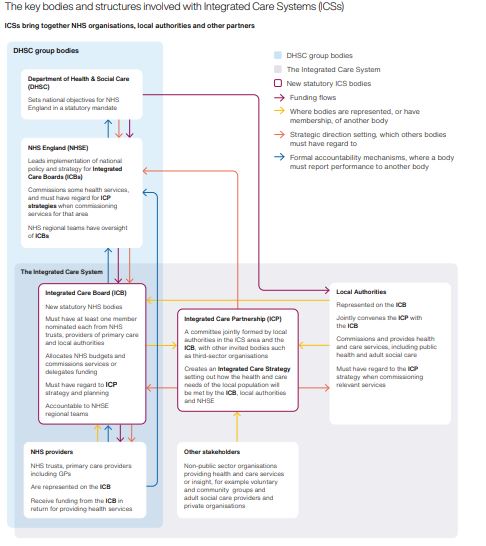
As the government once again kicks down the road decisions on vital reforms and funding for social care, local areas are establishing the Integrated Care Boards which will lead the new Integrated Care Systems (ICS), bringing together the NHS, local government and partners to plan and deliver integrated services to improve the health of the local population.  Building on the progress made since many public health responsibilities transferred back to local government in 2013, this is a great opportunity to address the determinants of health and issues around health inequality.  Might ICSs at last lead to an effective local voice in our over-centralised, top-down healthcare system?

Each ICS is supposed to plan at three levels: the neighbourhood (an area of around 40,000 people), the ‘place’ (often a LA area), and the (ICS) system (covering around 2 million people).  Working at the neighbourhood level is likely to be somewhat informal, often using a social prescribing approach and developing multi-disciplinary teams including third sector partners.  The approach to ‘place’ looks set to vary between areas, with some ICSs devolving significant responsibility (and funding) whilst others centralise these at ‘system’ level.  Meanwhile at ‘ICS system’ level, Integrated Care Partnerships (joint LA and health committees) will develop an Integrated Care Strategy to meet the assessed health and social care needs of their population identified in the Joint Strategic Needs Assessments and Wellbeing Strategies prepared by local Health and Wellbeing Boards.

Beyond the formal planning process, the success of local ICSs will partly depend on the quality of local collaborative (managerial and political) leadership – across statutory partners and with the third sector.  It will be a tough job to balance the priorities of the national health service and issues of local places, but many local authorities will be able to offer helpful experience , for example from moves to more networked governance approaches.

The National Audit Office recognises the potential but appears dubious on current prospects.  Last month it published a review, Introducing Integrated Care Systems: joining up local services to improve health outcomes, finding:

NHSE has a detailed regime to monitor performance against core NHS objectives but … it is less clear who will monitor the overall performance of local systems, and particularly how well partners are working together and what difference this new model makes…

The report notes that, whilst government is asking ICSs to set out local priorities and make progress against them, there is no protected funding and few mechanisms to ensure this happens.  This leads, as the NAO politely puts it, to “a risk that national priorities, and the rigorous oversight mechanisms in place to ensure they are delivered, crowd out attempts at progress on local issues”.  The report also identifies five “high risk” elements of effective integration: clarity of objectives, resourcing, governance and accountability (such as how ICSs will function alongside existing local government Health and Wellbeing Boards and how accountability differences between NHS and local authority bodies will be resolved), and the capacity to balance priorities other than national NHS targets. These urgently need to be addressed if ICSs are to begin to meet their potential.

At one of Inlogov’s “Brown Bag Lunch” discussions earlier this month we agreed on the importance of issues around how ICSs develop, particularly in terms of developing effective system leadership and planning, collaborating with community organisations, and links to wider devolution processes. I’d be interested to hear about experiences in local areas as these develop. 

Jason Lowther is the Director of INLOGOV. His research focuses on public service reform and the use of “evidence” by public agencies.  Previously he worked with West Midlands Combined Authority, led Birmingham City Council’s corporate strategy function, worked for the Audit Commission as national value for money lead, for HSBC in credit and risk management, and for the Metropolitan Police as an internal management consultant. He tweets as @jasonlowther

Picture credit: National Audit Office

Impact Measurement Practices of Human Rights Organisations

Sahar Khalil

In this post, a recent graduate of INLOGOV’s Master’s of Public Administration degree programme presents findings from their dissertation research. 

The world of impact measurement has expanded greatly over the past 10 years, with many leading NGOs putting in place rigorous impact measurement tools for their organisations. However, these NGOs have mainly been service provision NGOs, many of whom are funded by government grants. Government granting bodies have mandated impact measurement into their grant mechanism, and thus NGOs which receive this funding have to legally report back on the impact that the funding is having. The same cannot be said for human rights organisations, who do not receive any government funding (in order to preserve their independence in investigating all governmental human rights violations). As an operations manager at a leading human rights organisation in the UK, I have seen at first-hand how my organisation and many others in the field have been grappling with the quest of measuring the impact of their work. In this post, I present the findings from my master’s dissertation, conducted at INLOGOV, which looked in more detail at this issue.

Impact Measurement and Human Rights Research

Human rights work stems from the fundamental principle that all humans should have access to basic rights and focuses on protecting and promoting those rights. These principles, which are set out in the 1948 universal declaration of human rights, are backed by numerous international human rights conventions, declaration and resolutions. Human rights projects can create three types of intended positive changes: firstly, policy and legal reforms; secondly, social changes conducive to human rights norms; and lastly, strengthening civil society work. Impact measurement is about assessing the changes introduced by a intervention on policies, communities and the lives of individuals.

Difficulty measuring impact of human rights work

The difficulty with measuring impact of HROs work stems from the complexity of bringing about social or political change. Despite this complexity of change, most monitoring and evaluation toolkits currently used in the NGO sector follow the Linear Theory of Change. This model looks at change as a logical sequence of events, where inputs (funding and resources) lead to specific outputs and outcomes, which ultimately leads to change. This model follows that outcomes can be predicted on the basis of inputs. But change in human rights conditions rarely follow such logical paths. Project implementation teams face limitations in the influence they can exert over the social change process. They can have near total control over project inputs (staffing, funds raised, resources used, and so on) and activities and outputs, but virtually no control over outcomes and impact. No matter how clearly an organisation articulates a pathway to a desired long-term policy goal, it would be virtually impossible to name, predict or explain all the variables that might be at play within that change process. In addition to this, change could be slow and stagnant, while at other times it occurs in sudden leaps and in unpredictable ways.

For these reasons, along with other limitations HROs face, development of impact measurement tools in the sector has been lagging.

Findings from my research

Impact measurement of HROs is under researched, and what little research has been written on this topic is now outdated. I wanted to assess the current practices of human rights organisations in the UK. I spoke to 4 leading experts from major HROs in the UK of varying sizes and funding. The findings are summarised below:

  1. Not all organisations are systematically measuring impact. Some have a clearly developed strategy towards measuring impact; others don’t measure impact in a systematic way but have some limited practices in place. One organisation interviewed still relies on anecdotal evidence of the effectiveness of its work;
  2. Organisations who had systemic impact measurement practices in place stated that having a clear definition of impact that was understood by all employees was a vital and core component of their impact measurement strategy;
  3. Of the organisations that had a systemic impact measurement strategy in place, some are carrying out measurements using in-house staff, whereas others are outsourcing the work to independent private contractors;
  4. Some of these organisations found the Linear Theory of Change useful in helping them confine the scope of impact measurement work, which would otherwise be too broad to assess;
  5. Lastly, while the practices varied, all respondents agreed that there are several benefits to implementing impact measurement practices. Impact measurement has helped them improve the quality and effectiveness of their work, raise more funds, and has improved the transparency and accountability of the organisation in the eyes of the public and stakeholders.

Sahar Khalil is an operations manager at Human Rights Watch and graduate of INLOGOV’s  Masters of Public Administration distance learning degree programme.