Local Democracy in Crisis?

Peter Hetherington

Battered by fourteen years of austerity, is local government losing its once-proud standing and status? Probably. For a start, It’s no longer as ‘local’ as it should be. And it certainly isn’t ‘government’ as we once knew it.


These days, we sometimes tend to lump ‘democracy’ and ‘crisis’ together in a global context, forgetting that close to our doorsteps – in countless civic centres, town and county halls – there’s another crisis: restoring faith in local democracy, while sustaining councils literally facing insolvency.

At a hybrid event, organised by the Centre for Urban and Regional Studies at Newcastle University, we asked a simple question at the start: Do we need a new, positive direction for once-powerful towns and communities where meaningful democracy has disappeared as local government has withdrawn?

We attracted a great range of speakers putting, broadly, two cases: first for a new local government structure in England based on economic geography embracing combined authorities for big city areas alongside large county-wide single purpose unitary authorities, underpinned by a more equitable funding formula; and, secondly, for varying degrees of town and parish governance, sustained by participatory democracy, including citizens assemblies, with powers – parks, libraries, leisure facilities for instance – devolved from existing larger authorities. Often, such an asset transfer is born out of necessity because larger councils can’t afford to keep them anyway and parishes/towns can raise money through a council tax precept while sometimes creating stand-alone community interest companies.

The case for a genuine new ‘localism’ appeared strong. That’s because, currently, a continuing process of abolishing councils to create larger units with few, if any, local roots has created a sense of powerlessness, a collective loss of identity with little or no attachment to people and places. Fifty years’ ago England had almost 1200 councils, from the smallest urban/rural district to the largest city. “We were run by our own,” recalled the writer, broadcaster and ultimate polymath Melvyn Bragg, in his 2022 memoir ‘Back in the Day’. Born in Wigton, Cumbria, his small town had a rural district council (which I knew well): “We could challenge the elected councillors who made the decisions” Bragg continued. “They were not a separate cadre…they were just people you had been to school with…(approach) on the street…to whom you could write a personal letter knowing it would be read, considered, answered.”

No longer. His council disappeared in 1974. Today, after several rounds of ‘reorganisation’ under the dubious label of efficiency – although there’s little concrete evidence of cost saving – that number has been reduced to 317, with little if any public debate. A forthcoming devolution White Paper is expected to advocate more reorganisation and even fewer councils in a country where local authorities already cover much larger areas than in mainland Europe.

Against this background, it’s probably no surprise that Carnegie UK, in its recent ‘Life in the UK’ index, reports that a lack of trust in politics and government is undermining collective well being. Three-quarters of people, says Carnegie, feel they can’t influence decisions. Surely reconnecting them begins locally. But how local?

If the government’s approach so far is a broad definition of ‘taking back control’, could an over-arching contradiction be emerging? Will the apparent obsession with more all-purpose councils, the prospect of an all-unitary England – similar to the structure in Scotland and Wales – make people feel even more distant from power, disaffected? Carnegie insists that restoring faith in democracy should be the Government’s ‘mission of missions’.

If that’s one challenge, there’s another, interlinked: the crisis of financing local government, with 7 councils theoretically insolvent and many more heading that way; legally, they can’t go bust and have been forced to borrow the equivalent of pay-day loans on a mega-scale to stay afloat, adding to a debt mountain. Now Conservative-run Hampshire has said issuing a section 114 notice – prelude to technical insolvency – is “almost inevitable”, with a sting of others close behind. And as Prof Andy Pike, and Jack Shaw have outlined in their recent excellent, but chilling paper (‘The geography of local authority financial distress in England’) 96% of English councils won’t balance their books by 2026-27.

Of course, alongside that unparalleled financial crisis in local government, we’re also facing an alarming democratic challenge nationally with the lowest turnout ever recorded in the recent general election; almost half the electorate didn’t vote! Surely, the place to renew trust in the democratic process begins at the grass roots, perhaps reviving some of the 10,000 town and parish councils, some of which want to take over functions from larger authorities (some are obliging out of necessity). Could this – call it double devolution – provide one small way forward?

I’m aware there’s a danger that events, like the latest one at CURDS addressing the crisis in local democracy, can produce a combination of hand-wringing and hot air. But, hopefully, we concluded with a practical, positive outcome. As Professor Jane Willis, geographer and champion of community empowerment – now in Cornwall- noted: “It’s not all gloom and doom – there is good news.” In her county, communities are taking back control, again out of necessity – a really positive story and a lesson for elsewhere? Willis advocates a new social contract under a layered system of local government to “re-franchise” people.


In the meantime, the chair of the event urged those present to make their views known to MPs, and the government, as the forthcoming devolution White Paper foreshadows a pre-legislative consultation process. As Professor Andy Pike, of CURDS, noted in summing up, one leading question needed answering above all: “What is local government for, and how to fund it?”


All we know so far is that the White Paper, according to the Treasury, will include …“working with councils to move to simpler structures that make sense of their local area with efficiency savings from council reorganisation helping to meet the needs of local people…”. Contradictory or otherwise – will more larger councils “make sense” of local areas? – we must surely intensify a campaign for a genuine new ‘localism’, embracing places, communities, towns and some cities now without any form of local government. That doesn’t necessarily mean sidelining the case for a new – and/or revised – local government structure in England tied to a ‘needs’-based funding formula. The current one favours the richer parts of the country and penalises the poorest with the lowest tax bases.


But the time for national government to act is during the first year or so of a new administration. It assuredly won’t go down well with the ‘middle England’ target readership of – say – the Daily Mail. There’ll be howls of protest. But it must be a priority to bring a sense of fairness to a deeply unequal country and, equally importantly, deliver some hope to voters in the so-called ‘red wall’ seats who either returned to Labour at the last election or voted for an ascendant Reform. We live in a fragile democracy. Restoring faith in government, local and national, begins in community, neighbourhood parish and town. We need the Labour government to think big and act local. We haven’t much time.

Peter Hetherington is a British journalist. He writes regularly for The Guardian on land, communities, and regeneration.  He is also a vice-president, and past chair of the Town and Country Planning Association, former regional affairs and northern editor of The Guardian and the author of the 2015 book, Whose Land is Our Land? The use and abuse of Britain’s forgotten acres, and the 2021 book, Land Renewed: Reworking the Countryside.

Why do philanthropic foundations engage with city governments?

Dr Ruth Puttick

The fact that governments face an array of challenges is a well-rehearsed argument. City governments across the globe are tackling a myriad of social, economic and environmental issues, from trying to reduce homelessness, improving health and wellbeing, or increasing educational attainment.  In parallel, philanthropic foundations’ accumulated wealth and knowledge means they are increasingly welcomed as a government partner in addressing social needs. So why do philanthropic foundations engage with city governments?

The UK Association of Charitable Foundations defines philanthropic foundations as “charities with private, independent, sustainable income that supports individuals and/or organisations” (Pharoah and Walker, 2019, p. 1). In 2015, there were over 10,000 charitable foundations based in the UK and some of these are engaging with city governments.

In the U.S. context, philanthropic foundations have a long history of interacting with the government (Zunz, 2012) They have traditionally funded physical structures like libraries and opera houses, and in recent years, foundations have increasingly working directly with governments to tackle issues as diverse as climate change (Madénian and Van Nest, 2023), gun control, and poverty reduction (Barber, 2014; Nijman, 2009; Moir et al., 2014). Yet, there has been little exploration of this phenomenon in the English context.

Based upon the case study analysis of three contrasting English cities, Bristol, Manchester, and Newcastle, I drew upon qualitative interviews and policy reports to understand the interconnections between foundations and city governments.

Why do city governments and foundations collaborate

Philanthropic foundations can be a capacity-building partner of city government, providing direct funding and non-financial resources to help city governments solve problems.  Philanthropic foundations provide city governments with direct funding and non-financial resources, including data, research, events, and other outputs, such as toolkits.

Foundations are motivated to improve public services, develop new approaches to problem-solving, advocate on policy issues, and fill funding gaps left by austerity. Foundations select city governments based on personal rapport and perceived ease of working.

City governments are motivated to engage with foundations to access resources, for foundations to help amplify the voice of city governments, and because foundations are perceived as less bureaucratic and more trustworthy funders.

Barriers to city government and foundation collaborations

Foundation engagement with city governments is inconsistent. This study found that certain city governments (in this case, Manchester and Bristol) had more partnerships with foundations. The reason is that foundations often will not work with city governments when the city government’s priorities are unclear, if they are hard to engage, or when there is a perceived slow pace of change in city hall.

On the part of city governments, a scarcity of resources can prevent them from seeking foundation resources. With the impacts of austerity still lingering, it may have been surmised that austerity could prompt cities to seek foundation support, instead, this study has found that a lack of internal capacity can prevent the city government from seeking foundation involvement.

Implications for policy and practice

City governments interacting with foundations in England is a relatively nascent and under-explored phenomenon. As well as few academic studies, there is often an opaqueness in the nature of these collaborations. A lack of transparency can hinder scrutiny, which is problematic if city governments and their partners are to be held to account. Going forward, a key facet of city government engagement with foundations should be a commitment to transparency in the nature of the collaboration and an openness to sharing evidence of the impacts of the interactions on the outcomes that the foundation and city governments are trying to achieve.

Areas for future research

As a relatively underexplored topic, more research could usefully explore foundation engagement with city governments across England on a larger scale, particularly to understand the implications for accountability. Futuremore, future research could usefully explore whether philanthropic foundations prioritise collaborating with city governments over different types of organisations, such as charities, and if so, whether this is because city governments enable potentially larger degrees of policy influence than more “marginal” political institutions, such as NGOs or community groups.

To find out more about the research, please contact Dr Ruth Puttick, [email protected]

The full article is available here.

Picture credit: https://www.jolietymca.org/blog/the-significance-and-joy-of-giving/


Dr Ruth Puttick runs a research consultancy and is a Senior Research Fellow at the Institute for Innovation and Public Purpose (IIPP) at University College London. She has over 15 years of practical research experience in the public and private sectors advising on public sector reform, innovation and impact. She served as a Senior Policy Advisor in the UK Government’s Open Innovation Team, and before that, she worked at Tony Blair Associates, a global management consultancy, helping establish the policy and research team in the government advisory practice. Prior to that, she spent six years at Nesta, the UK’s innovation agency. Ruth is on X.com @rputtick and can be contacted at www.ruthputtick.com

Democratising public administration through public-common partnerships: the case of the Citizen Assets Programme in Barcelona

Marina Pera and Sonia Bussu

In a recent article titled Towards Democratisation of Public Administration:Public-Commons Partnerships in Barcelona, part of a Special issue on The International Journal of the Commons (edited by Dr Hendrik Wagenaar and Dr Koen Bartels), we explored public-commons partnerships in Barcelona through a relational lens, examining how they might be contributing to deeper democratisation of public administration.

The commons refer to those cultural and material resources collectively managed by the community and represent an alternative to both the state and the market. Recent literature emphasises the capacity of the commons’ prefigurative politics to develop alternative institutions to neoliberal regimes and/or deliberative and collective forms of resource management. The grassroots movements managing the commons often take an oppositional stance to the state, but they might also depend on its resources. By the same token, the state has an interest in supporting assets and services managed as commons, which offer flexibility and efficiency, while encouraging citizen participation in local politics.  

Within political contexts sympathetic to progressive socio-economic projects, such as  new municipalism in Barcelona, formalised alliances between the local state and the commons started to emerge, facilitating the development of novel policy instruments that respond better to the demands of the commons and open opportunities for more participatory policymaking. So-called public-common partnerships are long-term agreements based on cooperation between state actors and the commons members. In our paper, we wanted to understand better the relational work behind these partnerships and the role of boundary spanners that build bridges between two worlds, such as the state and the commons, which are often quite distant in terms of visions of local democracy and the language to articulate such visions.  We take the case of the Citizen Asset Programme (CAP) in Barcelona to explore the relationships between public officials and commons members, highlighting how these collaborations shape governance practices and can help foster a collaborative culture within public administration.

CAP was approved in 2016 and aims to create the institutional framework to recognise and support commons-managed municipal assets in the city. Based on qualitative analysis of interviews with public officials and commons members involved in the partnership, as well as official documents, we drew out insights on the relational dynamics that facilitated the creation of two policy instruments under CAP: The Community Balance Metrics and the Social Return on Investment of Can Batlló. The first one is a set of indicators to evaluate the performance of community-managed assets considering their transformative potential and including dimensions of internal democracy, care, inclusion, and environmental sustainability. The second helps to measure the value of activities and volunteer work carried out in the community centre of Can Batlló.

Through a series of vignettes depicting the different state and commons actors involved, we examined how they forged alliances and employed creative thinking to manage conflicts, resistance, and scepticism from both the local administration and the grassroots movements. Public officials from the Active Democracy Department were able to build trust among commons representatives by recognising their needs and potential. They explained the workings of public administration in a clear language. They created spaces of open-ended dialogue between grassroots movements and different departments to facilitate the development of policy instruments, measures and indicators that valued the commons’ innovative work, while still coherent with existing legal requirements. For instance, a working commission was set up involving members of Can Batlló, the Legal and the Heritage Department, as well as representatives of the District administration. This public-commons partnership developed a comprehensive agreement to regulate asset transfers, which fully recognises the social and economic value of the commons.

By the same token, the commons members played a crucial role in communicating to grassroots movements the work of the Active Democracy officials and build mutual trust. On the one hand, they helped the commons understand feasibility issues of their demands; on the other they pressed the public administration for greater transparency and creative interpretation of existing regulatory framework to strengthen democratic values underpinning asset transfer agreements.

Two cooperatives supported these partnerships as consultants. They contributed knowledge of innovative public policies from across the world. They also facilitated knowledge sharing to encourage cooperation between commons members and state institutions, for instance by inviting grassroots groups from other parts of the world to share their experience of working with the state.

The work of these public-commons partnerships is gradually reshaping the administrative culture and fostering more transparent and democratic working practices within the public administration. An example is the joint work to develop the Community Balance Metrics, which helps evaluate the performance of the commons using indicators agreed upon by both local public administration and the commons. However, these processes face a number of challenges, as they clash with established working routines and performance evaluations of public administrators that hardly ever value participatory work. Existing literature suggests that despite the introduction and encouragement of new practices, there is a tendency to revert to traditional policymaking methods when faced with unexpected problems. When boundary spanners that had supported the partnership exit the process, they can leave a vacuum that is hard to fill and that can jeopardise the partnership. In Barcelona, ongoing discussion between Can Batlló members and the City Council on who is responsible for funding the refurbishment of one of Can Batlló’s building is causing friction within the partnership and some of the work has stalled.

Inevitably this collaborative work is hard to sustain, but in the face of multiple and overlapping crises facing local government, these public-commons partnerships are also beginning to open safe space to experiment and do things differently.

Picture credit: Victoria Sánchez.

Sonia is an Associate Professor in INLOGOV. Her main research interests are participatory governance and democratic innovations, and creative and arts-based methods for research and public engagement. She led on projects on youth participation to influence mental health policy and services, coproduction of research on health and social care integration, models of local governance, and leadership styles within collaborative governance.

Marina is a researcher at Autonomous University of Barcelona (UAB). She holds a PhD in Public Policy from UAB and a M.A. in Sociology from Columbia University (New York). She has been a visiting scholar at CUNY Graduate Center (New York) and at INLOGOV, University of Birmingham. Her research interests
include community assets transfer, democratisation of public administration, community development and public-common partnerships.

Splitting up the Second City is a third-rate idea

Andrew Coulson            

Relations between first and second cities are often strained, especially when those who live in the Second City elect leaders from a political party that is not running the national government – as has been the case with Birmingham for much of its life.

After the Second World War, Birmingham was prosperous. It had avoided most of the bombing that destroyed the centre of Coventry, and its factories had produced aircraft, lorries, and other vehicles and equipment for the military and were now available to meet the post-war demand for cars and lorries. Wages for semi-skilled labour were some of the highest in the country.  There were shortages of labour, and to meet them employers welcomed bus drivers, conductors and nurses. These were followed in the 1970s and 1980s by workers mainly from Pakistan and Kashmir.

From the perspective of the London government, Birmingham did not need more employment, so companies who wished to invest in the motor industry were directed to Liverpool and elsewhere. But academic commentators, and the more thoughtful employers, could see that all was not well.  Britain was becoming increasingly dependent on service industries, which were far from strong in the Midlands.  In that context, in the mid-1970s, Birmingham Council proposed to build a National Exhibition Centre, on land near the airport. It would be owned by a company which was a partnership with Birmingham Chamber of Commerce.  The government wanted it in London; the council carried on regardless, and eventually the London government allowed it to do so.

Its structure was innovative – the company had just two shares, one owned by the city council, the other by the chamber. Each could nominate four directors. The chair would always be one of the chamber nominees – for a long time the leading industrialist Sir Adrian Cadbury.  But if voting on the board was tied, the chair did not have a casting vote, and what was proposed would not go ahead. The company, underwritten by the council, borrowed money and built the NEC.

A few years later, in 1987, the NEC company started building the International Convention Centre and Symphony Hall, on land off Broad Street. This was to make Birmingham a centre for conferences and business meetings. The decline in manufacturing and rising unemployment was by then so evident that Birmingham was granted Assisted Area Status by the European Union, so a fraction of the cost was met from Europe. The London government was not involved.

The ICC became a preferred location for large gatherings of professional bodies, such as the British Small Animal Veterinary Association, which grew till it hosted more than 8,000 delegates. It met in Birmingham every year for more than 25 years.  A boom in the construction of hotels met the demand for accommodation for this kind of event. Also of offices, many taken by national or international companies. No longer is Birmingham lagging in its provision of services. On the contrary it is a leader – almost entirely because of these initiatives.  Symphony Hall was built to meet the specification of Simon Rattle, then a very young but highly promising conductor of the City of Birmingham Symphony Orchestra. It was part of a city-council strategy to support the arts, of which another strand was the attraction of what became the Birmingham Royal Ballet to the Hippodrome theatre – with its charismatic directors, Peter Wright, David Bintley and now the Cuban star Carlos Acosta. Another initiative required investors in large buildings to put a small extra amount aside for public art.

The arrival of a national Conservative government in 2010 meant that the council started losing the extra grant it had long enjoyed to meet its high levels of deprivation, and put it under huge financial pressure. Whole levels of staffing in departments of the council were removed. Many senior officers did not stay long. Some posts were not filled. Others are filled by ‘interim’ staff, who are supplied by agencies, do not expect to stay in the city and are very unlikely to live in it.  

The refuse collection service was traditionally headed by an assistant director who had worked in the service for many years. For a period before the 2017 strike, this post was not filled, and the service was for a time run by the director of leisure. The strike was about reducing the number of operatives on each vehicle when wheelie bins were introduced. It was resolved by giving the workers improved pay.

It appears that it was only later that the implications of this for ‘single status’ were recognised, meaning that other categories of workers – in particular in social care – could claim equal pay for work assessed as equivalent. To meet the huge resulting costs, the city sold the NEC company for £300m. It was resold for £800 million three years later – a warning to the current commissioners not to sell this kind of asset on the cheap. Since then, the bin workers have managed to complete their shifts in less time than expected – partly assisted by some residents not putting their bins out every week – and been permitted to sign off early when their round was completed. Again, it has only recently been realised that this opens the city to another round of ‘single status’ claims.  Hence the near bankruptcy, Section 114 Notice, and appointment, by Michael Gove in London, of commissioners.

To resolve challenges such as this, when Birmingham is facing extreme pressures on all its services, will not be easy for the commissioners.

The worst thing they could do would be to split Birmingham into perhaps three smaller councils. This would increase the overhead costs – three directors of each service instead of one, three separate offices – and lose major economies of scale. It would also threaten the leadership and finance which is part of being the Second City – in the arts, in the representative institutions of local government, and in creating and implementing an economic strategy which responds to the local opportunities and needs which are most clear to people living in the city.

Andrew Coulson is a retired lecturer from INLOGOV and a former Birmingham City Councillor.  A longer version of this article was published in The Birmingham Post.  Andrew writes in a personal capacity.

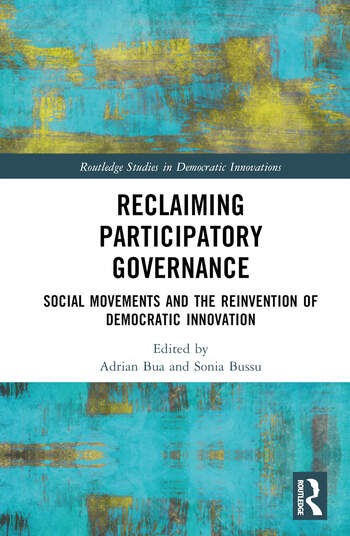
Reclaiming Participatory Governance: Social movements and the reinvention of democratic innovation

Sonia Bussu

Our world is experiencing multiple pressing crises; political elites’ inability or unwillingness to address them has contributed to diminishing trust in representative institutions. Democratic Innovations and participatory governance processes engaging citizens directly in politics and policymaking have been hailed as an antidote to elected representatives’ plummeting legitimacy. But they have also attracted much criticism, as they give much power to commissioning organisations, who design the process and choose who to invite, while there is limited follow-up on citizens’ recommendations.

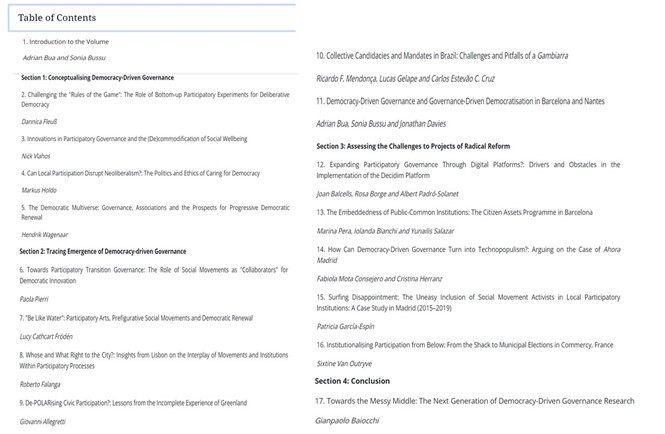
Reclaiming Participatory Governance, a volume I co-edited with Adrian Bua for Routledge’s Democratic Innovations series, provides an analysis of how social and grassroots movements are reclaiming and reinventing democratic innovations to strengthen the impact of citizen participation for social change. The book is articulated into three main sections to provide 1) theoretical and 2) empirical analyses of these processes, and to reflect on 3) challenges to the implementation of radical projects of social transformation. Through 17 chapters covering a range of cases, the volume captures the growing synergy between social movements’ mobilisations, the commons and participatory deliberative democracy, exploring how grassroots democratic action is mobilising to foster alternative forms of participatory politics and economics.

Throughout the book we apply democracy-driven governance as an analytical framework. We initially developed this concept to describe how social movements and grassroots groups who mobilised across Spain against austerity politics in the early 2010s used the deliberative and participatory toolbox, first to build movement parties’ platforms and later, after winning elections in many major cities, to transform local state institutions. Democracy-driven governance captures these social-movements-led forms of democratic innovations that aim to widen the scope of participatory governance from political institutions to the economy and wider society.

It is a counterpoint to Mark Warren’s governance-driven democratisation which refers to democratic innovations mostly initiated by public agencies, particularly at the local level. Governance-driven democratisation responds to specific policy issues and what Warren calls “pluralised ungovernability” (2014, 49). This refers to situations of high complexity that administrators are caught in as they navigate, on the one hand, dispersion of governing capacity, and on the other hand, high interdependence. The potential of Warren’s governance-driven democratisation resides in its pragmatic, problem-solving orientation, addressing problems of political leadership and public administration. However, by decoupling politics and economics and failing to attend to socio-economic factors, the practice of governance-driven democratisation has been quite tokenistic, falling short of making substantive positive change to the lives of citizens, in a context of widening inequalities.

Both governance-driven democratisation and democracy-driven governance exist in a dynamic relationship, which shouldn’t be understood as a mere bottom-up v. top-down heuristic. They both attempt to foster participatory governance or to include citizens in the work of public administration through “routinised participation”. They also interact with other participatory spaces, such as oppositional politics (protests) and the commons, where citizens create their everyday democracy by managing public goods through their own democratic decision-making rules and with limited interactions with state institutions.

The contributions to the volume look at how democracy-driven governance emerges across different socio-political and geographical contexts, and how it develops and navigates (or fails to) the constraints of day-to-day politics and public administration. Firstly, we wanted to test the analytical power of democracy-driven governance. By applying these concepts to a range of diverse cases, the chapters help flesh out the empirical characteristics of different forms of participatory governance. Secondly, we were interested in assessing how democracy-driven governance’s aspirations to social justice fare when applied to the real world. Can it strengthen the politics of the commons by making it visible and linking it to state institutions, as in the case of civic management and community-wealth building in Barcelona, or collective electoral mandates in Brazil? Can it facilitate processes of decommodification to help re-embed the economy in democracy and the wider society? Are these new approaches to politics and policymaking sustainable in the face of existing legal, business and public administration constraints?

The contributions trace practical challenges, from participation fatigue and activists’ disappointment with the slow pace of administrative work, to bureaucrats’ resistance or the challenges of reconciling democratic innovations, where citizens can participate as individuals, with assembly democracy, which strengthens organised civil society. One important aspect of democracy-driven governance concerns the digital commons, and the digital sphere will increasingly be the new battleground against the expansion of algorithmic capitalism.

The book provides many insights on the contested space to advance democracy, showing how social movements and citizen participation continue to play a crucial role in furthering the cause of critical theory: to challenge incumbency and demonstrate the possibility of other worlds.

The book launch is on 7th June 2023, at the University of Birmingham and on Zoom – register here.

Sonia Bussu is associate professor of Public Policy at INLOGOV. Her main research interests are participatory governance and participatory action research. Over the years, she has led research and published on participatory and deliberative processes, community engagement, coproduction of public services, and participatory research ethics.

Local government should welcome Gordon Brown’s private bills proposal

Phil Swann

Streamlined access to local legislation must be available to help struggling councils to improve rather than rewarding those that have already done so, writes a PhD candidate in central-local government relations at INLOGOV and former director of Shared Intelligence.

In 1926 Winston Churchill, then chancellor of the exchequer, successfully opposed a private bill promoted by Bristol Corporation to establish a municipal bank in order to stop “all kinds of incompetent town councils”, particularly “socialistic” ones, from running banks. He did so despite the fact that the bill was supported by his Conservative colleague and former mayor of Birmingham Neville Chamberlain, who argued that Birmingham’s municipal bank had encouraged thrift and home ownership.

It is interesting to reflect on this dispute (not the last between these two political Titans!) in the context of the move by Gordon Brown’s Commission on the Future of the UK to promote the use of private bills by local councils. Raising the prospect of “the great cities of England” exerting similar powers to the Scottish and Welsh governments, the commission recommends a new, streamlined process enabling councils to initiate local legislation in parliament. This, the commission argues, would give councils an ability to secure the powers they need and to have a direct relationship with Parliament.

Evading centralising tendencies

It is undoubtedly the case, as the commission argues, that private legislation provided a vehicle for innovation in Victorian local government in the face of the social, economic and physical impacts of the industrial revolution. 

The genesis of public health lies in local legislation as does the creation of public utilities to provide gas, electricity and public transport. It was the ability of local corporations to promote private legislation that fuelled Joseph Chamberlain’s ambition to turn Birmingham Corporation into “a real local parliament”. Private acts were also used by enterprising councils to evade the centralising tendencies of successive governments in the second half of the 19th century.

It is also the case, however, that by the inter-war period private legislation had become a feature of the tensions in central-local government relations rather than necessarily being a solution to them. The resources and ambition required to draft and promote private legislation reinforced a growing divide between “advanced” or “progressive” councils on the one hand and “backward” or “penny-pinching” councils on the other hand. This reinforced differences between the major cities and smaller towns and rural areas. The widespread use of private legislation also contributed to the ad hoc and complex structures and powers of Victorian local government.

Significantly these trends were reflected in the justification for increasing central government intervention in local politics. In the 19th century there was a shift in ministerial focus from corruption to efficiency and action to bring “backward” councils up to the standard of the “progressive”. The first half of the 20th century saw a financially driven move to rein in the most innovative councils and drive improvement in the poorly performing ones. The dispute between Churchill and Chamberlain over the Bristol bank bill is an example of this.

Clause acts and adoptive acts

Despite these warning notes from history, the ambition of the Brown commission to enable local leaders to have access to a streamlined process to initiate local legislation should be welcomed. Many of the problems that emerged when private legislation was a common feature of local government could be overcome if it was explicitly seen as a way of testing new legislative powers prior to wider adoption – genuine pioneering.

Two other legislative devices deployed in the Victorian period could help to secure this approach if they were refreshed alongside a revival of local legislation. The first device is a clauses act, the prime example being the Town Improvement Clauses Act 1847. It brought together the provisions most commonly inserted in and effectively deployed through local legislation. Clauses acts, each of which would relate to a particular service area or initiative, would both streamline the legislative process and avoid unhelpful adhockery.

The second device, which takes this a step further, is the adoptive act. This is a piece of legislation which has been through the parliamentary process but which comes into effect only when it is adopted by individual local authorities. Acts of this type could make powers that have been successfully adopted by one authority available to be adopted by others without requiring local drafting or taking up parliamentary time.

Earned autonomy?

One other issue which requires attention is whether there should be a link between an ability to initiate local legislation and a council’s perceived performance. A sustained thread running through central-local government relations since the 1830s is the view that that councils should not benefit from new powers or responsibilities until they have met certain conditions or achieved a certain standard.

Joseph Chamberlain, who made extensive use of private legislation in Birmingham, took a different view. In 1877 he argued that “whatever the defects” of a council “I defy you to make a better one for the place except by gradually increasing its functions and responsibilities and so raising its tone.” No earned autonomy for Chamberlain!

If the increased use of local legislation is to help achieve the ambition set out by Brown and his commissioners, it is essential that streamlined access to local legislation is available to help struggling councils to improve rather than as a reward for having done so.

This article first appeared in the Local Government Chronicle on 13th December 2022.

Phil Swann is researching a PhD on central-local government relations at INLOGOV