The LGA are Right – In the Team Benchmarking Stakes, Residents’ Panels Don’t Even Medal

Credit where it’s due – in this case to the Local Government Association’s recent decision that data gathered from local residents’ panels about their views of and satisfaction with their councils cannot be used for benchmarking purposes. The ruling could have come sooner and will be criticised by some of the LGA’s own member authorities, but it is surely right. The reverse decision would have damaged the interests of local government in general, and ultimately would have done no favours either for those critics’ own authorities. 

The decision and the story behind it are largely technical – about the different methodologies used to measure residents’ perceptions of their councils’ performance – which is perhaps why it has received less attention than it deserves as one of the more important current developments in our local government world. It stems from the Coalition’s move away from central targets and assessments – generally welcomed but also coinciding with local authorities having to operate on ever tighter budgets.

The biennial Best Value User Satisfaction/Place surveys undertaken separately but coordinatedly by all English authorities between 2000 and 2008, coupled with the accompanying Ipsos MORI analyses, provided better information on the user’s perspective of council services than was available in Comprehensive Performance Assessments, and also allowed robust comparisons of perception-based performance indicators (PIs) across authorities.

Then in 2010 all this infrastructure was swept away. Now, supplanting CPA’s successor, Comprehensive Area Assessment, we have sector-led improvement and peer challenge, and, seeking to fill the gap left by the scrapping of the Place Survey, there is Local Government Inform (LG Inform) – a new online LGA service intended to give local authorities and eventually the public easy access to resident satisfaction data about councils and their areas, and to enable comparisons with other councils.

The comparison part is crucial. A resuscitated BV-style centrally driven survey is out, on both political and financial grounds. But some standardisation of methodologies and questions, as formerly ensured by the DCLG, is clearly necessary. The LGA and London Councils therefore commissioned Ipsos MORI to undertake a review and develop a set of questions – on residents’ satisfaction and their views of crime and community cohesion – which, as with the BVPI questions, councils could slot into their own local surveys, thereby producing a sufficiently consistent and methodologically robust subset of data for comparative and benchmarking purposes.

The review was a useful document, explaining and illustrating the key issues of data collection methods, sampling and question design with welcome clarity. Its core was naturally the presentation of the set of 12 recommended questions and advice on their usage and analysis, but the preceding technical review also contained plenty of useful dos and don’ts.

The questions were divided into three tiers: a core benchmarking set, which should be a priority for all councils, worded identically, and ideally opening the survey; a second tier, also recommended for benchmarking, and a likely priority for most councils; and a third tier of more detailed questions, of interest to probably only some councils. The three core and three second-tier questions are:

  • Overall, how satisfied or dissatisfied are you with your local area as a place to live
  • Overall, how satisfied or dissatisfied are you with the way [name of council] runs things?
  • To what extent do you agree or disagree that [name of council] provides value for money?
  • Overall, how well informed do you think [name of council] keeps residents about the  services and benefits it provides?
  • How strongly do you feel you belong to your local area?
  • How safe or unsafe do you feel when outside in your local area after dark? / How safe or unsafe do you feel when outside in your local area during the day?

As every survey researcher will tell you, though, who and how you ask are at least as important as what. Different modes of data collection will produce different responses, even to identically worded questions. For example, satisfaction ratings tend to be higher in face-to-face interviews than in self-completed postal questionnaires, and higher still in volunteer telephone interviews. Asking about satisfaction with the council before a question about value for money will produce higher ratings than the reverse order. Which means that, for benchmarking purposes, comparisons should be limited to results generated by the same methods, or at least methods in which the respondent’s experience is essentially the same.

Statistically, the gold-standard survey design is that used by the early Best Value surveys: face-to-face interviews with random samples of preferably at least 1,000 respondents, drawn from a robust sampling frame – nowadays the Royal Mail’s Postcode Address File – in which every household or person in the target population has an equal, random, and known probability of selection, and results can be generalised to the total population with calculable degrees of confidence.

But, as with Olympic medals, silver and bronze standards are also very acceptable, and, under specified conditions, smaller sample sizes, rigorously drawn quota samples (with face-to-face or telephone interviews), and self-completed postal or online questionnaires (with random samples) may all pass muster for benchmarking purposes.

The fundamental condition, stripped of its details, has already been noted: for inter-authority comparisons and benchmarking, compare only ‘like-for-like’ data, collected by the same method – which means that LG Inform will require detailed reporting of sampling and data gathering methods when authorities come to upload their data.

Which brings us to residents’ and users’ panels – on which Ipsos MORI’s professional advice is unambiguous and emphatic: NO!  In themselves, they’re absolutely tickety-boo. They’re an easy and efficient consultative tool for, say, testing prospective policy initiatives, or tracking attitude changes over time. But, even if panel members are recruited to represent proportionately the council’s population, they will be volunteers, rather than a statistically selected sample, and their responses should not therefore be compared with data systematically collected from another council’s genuinely random survey.

It’s the same point that the Scottish Government was attempting to make last week over same sex marriage. Responses to a consultation exercise, no matter how numerous or passionate, are not the same as the results of statistically representative sample surveys: not worse, or better, simply different.

Understanding residents’ or users’ views and how they compare with those in similar or neighbouring council areas is a vital part of local authority performance management. But cutting corners in order to make such comparisons at precisely the time when the sector is endeavouring to demonstrate its ability to manage and improve itself would be a seriously false economy – maybe not as daft as drug-cheating in the quest of a medal, but still a really, really bad idea.

Chris is a Visiting Lecturer at INLOGOV interested in the politics of local government; local elections, electoral reform and other electoral behaviour; party politics; political  leadership and management; member-officer relations; central-local relations; use of consumer and opinion research in local government; the modernisation agenda and the implementation of executive local government.


Tax Collection Rates: Central and Local

Chris Game

Council tax collection rates have become an annual Commons ritual, pleasingly coinciding with the first week of Wimbledon.  Party whips select a tame Government backbencher – the parliamentary equivalent of a first-round loser – to lob up a couple of juicy written questions for the high-seeded Communities and Local Government Minister to smash away, adding for good measure some unsubtle party spin. This year, though, there were a couple of interesting variations.

First, the questions were tabled not by a neophyte Tory backbencher, but by Helen Jones, four-term Labour MP for Warrington North and Shadow Local Government Minister. Second, she wanted to know about council tax arrears as well as collection rates, for each billing authority, in cash and percentage terms.

To most people, the two things are clearly distinguishable. Uncollected taxes relate to the most recent financial year and, fairly or not, can be seen as an indicator of administrative inefficiency.  Arrears are uncollected taxes over several years that are still being chased as, in principle, collectable. Presentationally, they should be more problematical, for even fruitless chasing sounds more diligent than just giving up and writing them off.

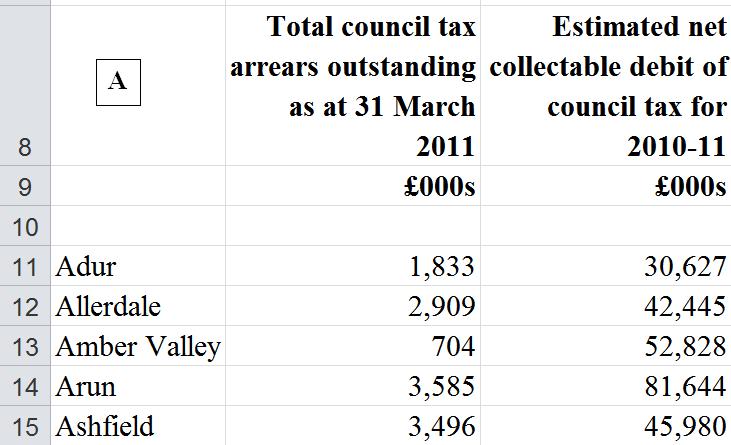
But to ministers this is a distinction without a difference: they can attach their political message equally easily to either set of statistics. Combining Jones’ two questions, Local Government Minister, Bob Neill, placed in the Commons Library a two-column table (Figure A), showing for each alphabetically listed billing authority their accumulated council tax arrears at 31 March 2011, and the total tax they were attempting to collect in 2010-11.


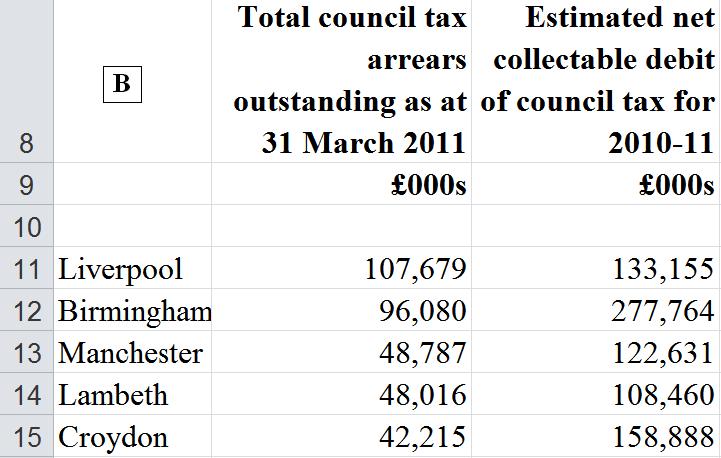
More helpful would have been the 2011-12 figures, which were in fact available to us all a couple of days later. Still, not to worry; other assistance was on the way. Ministers were naturally concerned that the full partisan significance of these figures might be lost, if MPs, let alone journalists, were forced to sift through all 326 of these authorities. So a Spad (ministerial special adviser) circulated the media with a list re-ranking them in order of their total tax arrears at the end of 2010-11 (Figure B).

Guessing the sections of the media likely to run their story, the Spad also added some useful quotes. The revised list was “a league table of the worst offenders”, in which “9 out of 10 of the worst authorities are Labour run”. There were some interpretative comments too from his ministerial master, Eric Pickles:

“This roll call of shame is familiar reading, with Labour councils year in, year out, topping the table of local authorities who squander millions by failing to collect our council tax. If these Labour authorities stopped complaining about the legacy of cuts left by their own party and actually chased up these tax dodgers, they could use the money to protect hundreds of frontline jobs.”

Yes, the DCLG ministerial world is apparently that simple.  All uncollected council tax is attributable to tax dodging and the compliance of lazy, inefficient and moaning Labour councils.  Oh dear – just where do you start?

First, perhaps, with the most obvious.  Yes, Labour Liverpool did top the 2010-11 arrears table, but two of the top five places were occupied by Birmingham, run until May by a Conservative-Lib Dem coalition, and Conservative Croydon. Even the Daily Mail worked out that 9 of the top 10 couldn’t therefore be Labour – albeit in a story whose snappy title left little doubt as to its content: “£2 billion of council tax left uncollected by town halls who then moan about cuts by Whitehall”.

If this arrears listing were indeed a ‘roll call of shame’, Croydon’s prominence would be embarrassing over and above its political control.  As would be expected – by anyone sensing that uncollected tax may not be entirely due to ‘Won’t Pay’, rather than ‘Can’t Pay’ – there is a consistent overall correlation between councils’ annual tax collection rates and their position on the DCLG’s own Indices of Deprivation.

Manchester and Liverpool, for example, are ranked 3rd and 4th on the national Index of Multiple Deprivation, behind Hackney and Tower Hamlets. Birmingham and Lambeth are 13th and 14th. Croydon, by contrast, is no higher than the 20th most deprived borough in London.

As we’ve seen, though, the listing provided to Helen Jones and the Commons Library ranks councils by their accumulated council tax arrears – and in cash terms, moreover, not as a percentage or efficiency measure of anything at all. Big cities, London and metropolitan boroughs are almost bound to head such rankings. If any of the “worst offenders”, Croydon included, wanted to drop down the list and, presumably, earn ministerial brownie points, they could simply change their corporate write-off policy, stop chasing these really hard-to-recover debts, and write them off. Would that genuine efficiency gains were that easy!

To make their party propaganda properly, ministers should have had their Spads rank order not councils’ arrears, but their tax collection rates – their actual tax receipts for the financial year as a proportion of the total due. We now have these figures for 2011-12, and they make interesting reading (Table 7 of hyperlink).

English local authorities collected £22.1 billion in council tax and £20.8 billion in non-domestic rates (NDR), or 97.3% and 97.8% respectively of the totals due to them. Shire districts’ council tax percentages were slightly above the overall average (98.2%) and those of London and metropolitan boroughs (96.3 and 96.1%) and unitaries (97.2%) slightly under.

Highest collection rates in Inner London were in Conservative Wandsworth (98%) and Labour Camden (96.7%), the lowest in Labour Hackney (93.7%) and Lewisham (93.9%). In Outer London, the spread was rather greater, largely due to Newham’s 89.6% – which was 4.5% lower than any other OL borough and, most oddly, 10% lower than its 99.6% NDR collection rate, the highest in London. Supposedly inefficient Croydon was precisely on the Outer London average (96.6%).

Among metropolitan districts, the only three to top a 98% collection rate were an assorted West Midlands trio – Conservative Solihull and Dudley, and Labour Sandwell – followed by Conservative Trafford and Labour Rotherham.  Lowest were Salford (91.3%) and Manchester (92.3%).

Even from this small selection of extremes, it is clear that politically the picture is more complicated than Eric Pickles would have us believe. It is also clear – and, surely, hardly surprising – that Conservative councils overall do have at least slightly higher collection rates than Labour. There may be good explanations for the variations, from year to year and across apparently similar types of authority, but the questions do need asking, which is why these statistics, properly understood and deployed, are so important. After all, if Newham raised its collection rate to that of the hardly more affluent Tower Hamlets, it would bring in an additional £4 million; if Birmingham matched Sandwell, it would collect an extra £10 million.

Of course, other questions too suggest themselves: how, for example, does local government’s £600 million council tax collection gap look when compared with those for HMRC-administered taxes? To which the answer is: not too shabby.

HMRC helpfully produces an annual report on this very subject – Measuring Tax Gaps – and the latest estimates, for 2009-10, include: direct taxes (income tax, NI contributions, capital gains tax) – £14.5 billion or 5.8%; VAT – £11.4 billion or 13.8%; corporation tax – £4.8 billion or 11.7%; beer, spirits, cigarette, tobacco duty – £2.4 billion or roughly 10%. And the total gap: just the cool £35 billion or 7.9% (Table 1.1 of hyperlink). It kind of puts local government’s 2.7% into a slightly different perspective, doesn’t it, Minister?

Chris is a Visiting Lecturer at INLOGOV interested in the politics of local government; local elections, electoral reform and other electoral behaviour; party politics; political  leadership and management; member-officer relations; central-local relations; use of consumer and opinion research in local government; the modernisation agenda and the implementation of executive local government.
The New Virtual Town Hall

Ian Briggs

They wear tweeds, ride fold up bicycles and have a strange obsession with bandstands, they are often viewed as being at the fringes of society – a minority interest group with a small but powerfully loyal following – they are those who hold dear to their hearts that our 19th century heritage should never be lost. They value the majesty of the Town Hall as a Victorian edifice that spoke of the power of the elected (or in most cases the appointed) in society – have they lost sight of the importance of downsizing public organisations, ensuring that we have a quasi retail approach to services and that we should administer them from anodyne, faceless replicants of a local branch of an insurance company?

Certainly for many within cities and towns the structures that spoke so loudly of the power of the local community served not just to reinforce the civic dignity of the individuals who were called upon to govern but also were – and perhaps still are important icons of civic place and power. True, they are a huge burden to the local purse but at a time of dwindling concern for the council (mindful of a story told a few days ago of a recent election in a ward where only 16 people bothered to vote) we perhaps need a kind of iconography to remind us all that choice and voice at a local level is so profoundly different from the way we have our political views represented at a national level that we need to have some physical representation of the distinctiveness of local democratic place.

All this came out in a conversation with a senior member at this week’s LGA conference here in Birmingham. How he was so troubled by the ‘Moulton fold up bike brigade’ (MFBB) who were repeatedly making his life such a misery with their expertise in the preservation of the civic heritage and their near obsessive persistence that large amounts of expenditure must be made to keep the Town Hall in the condition that our forefathers wished it to be in irrespective of the impact upon other services that he was genuinely afraid for his seat!  However, if we cannot afford the physical iconography can it be replaced with a virtual one? This became an interesting question – opportunities offered by social networking when exploited with care and sensitivity could perhaps replace or compound the iconography of the traditional approach to ‘civicness’? As we are developing our understanding of the community leadership role of councillors should we be thinking more about the overall impact of placing the locally elected in a virtual space as well as a physical space? These are skills that councillors are now just beginning to develop – they understand that their role extends beyond the importance of effective problem centred decision making to being the custodian of the local narrative. In the past the narrative has for many places been the Town Hall representing the power of civic dignity and profound distinctiveness of place. The contemporary narrative is one of connectedness, blending historical tradition with the requirement to maintain and better local conditions so the ‘MFBB’ of the future will look upon our ipads, tweets and blogs as worthy of preservation as much as the Victorian edifices are valued by some today. Watch out – it will happen.

Ian Briggs is a Senior Fellow at the Institute of Local Government Studies.  He has research interests in the development and assessment of leadership, performance coaching, organisational development and change, and the establishment of shared service provision.

The 21st Century Chief Executive

Councillor Graham Chapman

It’s not only clothes and pop music which are subject to the vacillations of fashion. They affect the more mundane world of local government too. Elected mayors for example are a fashion of the ‘naughties’, when larger-than-life bankers, entrepreneurs, football managers, celebrities of all types were supposed to provide solutions to a whole range of problems by dint of pure charisma and personality.  Even the staid role of the chief executive is subject to fashion.

The traditional function of the chief executive with a legal background overseeing due process and formal decision making, gave way in the 80s to the more managerial approach, and perhaps was the heyday for the role. In the 90s and early 2000s it took another turn. Under the cover of the CPA and star ratings, where the chief executive was given a far more important role by the inspectors than the leader, and encouraged by SOLACE and the Blair Government, the ‘personality’ Chief Executive emerged. It was thankfully not totally pervasive but frequent enough to create conflict with the role of the elected members, and to increase chief executive remuneration in some cases to a point of embarrassment.  We are now going through a counter-revolution, partly because a minority of chief executives overplayed their hands, partly because of the recent antagonism whipped up against the public sector and because chief executives, as some of the most highly paid public servants, are an easy target. The counter-revolution now questions the need for the role at all and a number of authorities have abolished it, or are in the process of doing so.

My view is that chief executives are essential. A good chief executive provides continuity and integrity to the local government system, and a healthy counterpoint to political decision making. The system is part of a British tradition of local government which, being British, we do not appreciate sufficiently.  But if the role is to be accepted, de facto it does need to rid itself of some of the fashions it has been subject to and it needs to establish a set of core principles. The best, perhaps the only, set available has been devised by Roger Taylor, former chief executive of Manchester and Birmingham.  The principles should be of particular interest to the more buccaneering breed of chief executives who see themselves as more important than their members.

So here they are in précis in Roger Taylor’s own words.

1. However powerful a chief executive may seem, his/her success is always dependent upon gaining and maintaining high levels of political confidence and approval.

2. Chief executives need to develop a clear sense of the corporate  which is informed by, and contributes to, the politics of place

3. However difficult it may be for the political leadership at the time, it is vital that chief executives can demonstrate a clear moral and ethical compass and foundation to their work.

4. Chief executives are at the nexus between the democratically elected council and it’s paid servants. While they will be the leaders to the paid service, they can never allow themselves to become partisan.

5. Chief Executives must always avoid being “the story”. Some of the best chief executives are those who eschew the limelight and concentrate on the affairs of the council.

6. How well chief executives are likely to ‘gel’ with officer colleagues will always be less important than their intellectual capacity and ability to explain complex things clearly.

7. Chief executives need to have, and to demonstrate, the political skills to manage effectively in the spaces between leadership and opposition councillors.

8. Competent chief executives never need fear the working communications between their colleagues and the political leadership.

9. Chief executives need to have some empathy with the complexities and the arduous nature of leadership in the Council.

10. Chief executives who work with a political faction and against the leadership should never be trusted, especially by the political faction they work with.

11. Chief executives need always to bear in mind that neither the conferences nor the special roles pay the salary.  Chief executives constantly need to bear in mind what their day job is.

12. The heart of any relationship between leader and chief executive has to be trust, truth and tolerance.  It should never be an intimate friendship but it should always have with it an informality and an appreciation of each other’s company.

13. Leaders should have a clear idea about what they want chief executives to achieve and they should be able to rely on objective and independent support for the negotiation of these objectives and subsequent review of the chief executive’s performance.

To summarise: I have little doubt that the move to abolish the role of chief executive will turn out to be the most ephemeral of the fads and that those authorities trying to survive without one will return to the fold. However, it does not mean that the role does not need shoring up and insulating from the sum of the political and, often self-induced, managerial opportunism to which is has been subject. Roger Taylor’s list of dos and don’ts is a good start.

Graham Chapman is the Deputy Leader of Nottingham City Council, and the Portfolio Holder for Economic Development, Resources and Regeneration.  He is a Councillor for Aspley Ward.

How Mayoral Recall Could, and Wouldn’t, Have Worked

Chris Game

We’ll never know, of course, whether a well publicised mayoral recall provision could have swung some of those lost referendums. My own view is that, with a half-decently organised Government-led Yes campaign – detailing the ‘city deals’ that mayoral cities could expect, and confirming that mayors elected by voters would be recallable by voters – several additional referendums, including Birmingham’s, were comfortably winnable. 

What is surely undeniable is that Ministers’ refusal even to address the issue of recall – to which the Government had been publicly, if reticently, committed since its January 2011 mayoral impact assessment – understandably increased people’s doubts about elected mayors and ultimately cost votes.

I’ve been wondering this past week – over the final stages of arguably the second most important US election this year – whether, if those mayoral referendums had been held just a month later, the topic might have forced itself on to our electoral agenda, and, if so, with what effect?

The election in question was only the third time in US history that a state Governor faced the prospect of being voted out of office in a recall election – and the first time ever that the defending Governor had won. That’s the statistical measure of what happened on Tuesday in the state of Wisconsin; its historical importance will be seen between now and the Presidential election on November 6th.

Scott Walker – the conservative Republican politician, not the “Make It Easy on Yourself” one – was elected Governor of Wisconsin in November 2010 on a platform of tax cuts for businesses and the well-off and wage cuts for public employees.  Inheriting a projected $3.6 billion budget deficit, he almost immediately unleashed the most politically inflammatory Budget Repair Bill imaginable.

Public employees’ wage increases were capped at the rate of inflation, their pension and health insurance contributions increased and the programmes cut. Above all, though, this was an attack on the Democratic Party through the public sector unions, who saw their incomes slashed and – going beyond any campaign pledges – their collective bargaining rights virtually abolished.

There were furious protests and demonstrations, occupations and sit-ins, negotiations and some amendments, major procedural delay, judicial review, and finally reference to the state Supreme Court. Eventually, however, the Bill was passed, and opponents turned their attentions to recall. 

Recall – enabling a citizens’ vote to remove and replace a public official before the end of their term of office – is almost as long established in the US as the other way of getting rid of them, through the more judicial route of impeachment. With 150 recall elections and 75 recalls across the country in 2011 – including, incidentally, two mayors – its deployment, particularly at local level, is widespread, but it is not universal, and removal of senior state officials through recall is exceptional.

Wisconsin is one of 19 states to permit recall elections for governors and other state officials, but in the hundred years pre-Walker the impact had been limited to a couple of state senators being recalled and a couple surviving recall elections. As for state governors, there had been just two gubernatorial recall elections in all US history – both lost by the incumbent, but neither, contrary to what might be imagined, having anything to do with corruption or personal misconduct.

North Dakota’s Governor Lynn Davis was held personally responsible for the savage agricultural depression of the early 1920s. More famously and somewhat similarly, Gray Davis in 2003 was blamed for California’s electricity shortage – created partly by market manipulation by energy companies like Enron – and the budget crisis that followed the burst of the dot-com bubble, and was replaced by Republican Arnold Schwarzenegger. 

Recall procedures vary from state to state, although all involve gathering large numbers of signatures on a citizens’ petition. Wisconsin required signatures equalling 25% of the total votes cast for the office of governor at the last election – roughly 540,000 – to be collected within 60 days, which, when I first heard it, struck me as mountainous.

But what do I know? Wisconsinites, certainly when riled, and led by powerful public sector unions, can be a formidable force, and within just 30 days they were almost there, with over half a million names.  They eventually got to 900,000 – 23% of the state’s eligible voters and 46% of voters in the 2010 gubernatorial election. On the face of it, then, things looked tricky for Governor Walker – until you put the petitioners’ undoubtedly impressive organisation up against the sheer weight of the incumbent’s cash. 

Particularly since the Supreme Court’s historic ‘Citizens United’ decision in 2008, holding that the First Amendment prohibited the government from restricting independent political expenditures by corporations and unions, effective controls over campaign fund-raising in non-federal elections have been almost non-existent.

The two sides in the Wisconsin recall election are estimated to have raised $63 million, with Walker outspending his Democratic opponent, Milwaukee Mayor, Tom Barrett, by 7 to 1. In these quantities, money talks loud. As election day approached, the gap between the candidates grew and the final result saw Walker create history with an increased vote share of 53% to 46%.

But, if it was unfortunate for Barrett, also the defeated candidate in 2010, it’s potentially dire for President Obama, his economic policy, and re-election prospects. The public sector unions are vital both financially and organisationally to the Democrats in general and Obama in particular. In a state that voted Democrat in the last six presidential elections, Scott Walker took the unions and their members on, scythed them down, and survived. There are 28 other Republican governors out there, many just waiting for this sign.

As for the influence, if any, these extraordinary events might have had on UK public opinion and the mayoral referendums, I really have no idea. They’d have made it harder for Ministers to maintain their almost Trappist silence on the recall issue, but at the same time would presumably have encouraged the idea that elected mayors would Americanise our politics, which is neither accurate nor, judging from this instance, an altogether edifying prospect. The one certainty is that this is definitely not the last we’ll hear on the subject. Whether in relation to MPs, mayors or police commissioners, recall ain’t going to go away.

Chris is a Visiting Lecturer at INLOGOV interested in the politics of local government; local elections, electoral reform and other electoral behaviour; party politics; political  leadership and management; member-officer relations; central-local relations; use of consumer and opinion research in local government; the modernisation agenda and the implementation of executive local government.
Managed Difference, Local Solutions, Market Forces – Anything but Postcode Lotteries!

Chris Game

It was over six years ago that Sir Michael Lyons launched his campaign to abolish ‘postcode lotteries’ from the local government lexicon.  As he wrote in his 2007 report, “I would hope to see debate about postcode lotteries being replaced, over time, by discussion of ‘managed difference’ – recognising the right and ability of local communities to make their own choices, confident in their own competence, and in the knowledge of their own preferences.”

Others, doubting perhaps the rallying appeal of ‘managed difference’, proposed alternatives – local difference, local solutions, postcode preferences – but to nil avail. The campaign made no more headway than most of the Lyons Report’s substantive recommendations, as was painfully apparent last week – during which the populist media brought us what seemed like a new PL each day, each of course with its accompanying outrage and public alarm. 

First was the Diabetes Treatment Postcode Lottery. A National Audit Office (NAO) report showed “significant variation in quality of care received by people with diabetes across the NHS”. Quality of care was defined here solely in terms of the 9-process care regime advised – yes, only advised – by the Department of Health (DH) and National Institute for Health and Clinical Excellence (NICE), and the most recent data were from 2009-10.

Still, I mean, the results were, like, just incredible. The 151 English PCTS and 34,000 GPs clearly weren’t all following fully and identically the DH’s recommended care package.

Next came the seasonal Holiday Cash Postcode Lottery. Which? magazine sent mystery shoppers to a range of different currency exchange providers across the UK on the same day and – surprise! – found they weren’t all offered exactly the same number of euros for their £500s. In fact, there were regional variations, with London and Glasgow shoppers getting more euros than those in Birmingham, Sheffield and, yes, Haverfordwest – except that there weren’t really, since over a two-month period the Post Office and Thomas Cook offered the best deals, irrespective of region. 

Then lgcplus ended the week with the Child Care Postcode Lottery, choosing to lead its news round-up on 25th May with a Times story: “‘Postcode lottery’ in child care proceedings”.  A Cafcass (Children and Family Court Support and Advisory Service) report found that, in the three years since the Baby Peter Connelly case, there has been an increase of over 60% in local authority care applications – but, again amazingly, not spread absolutely equally across all 152 relevant local authorities.

Let’s start with the child care case. First, I’m fairly certain the Cafcass report itself contains no mention whatever of a ‘postcode lottery’. The cheap and misleading headline was chosen by The Times – presumably to rubbish local government in general and certain councils in particular – and then, regrettably, recycled by LGC.

Second, the report’s main findings constituted a generally highly positive local government news story – though you’d never know it from The Times’ version, since the very term ‘lottery’ has deliberately negative connotations.  

To quote directly from the report: “as a result of intensive work on behalf of children, court applications to protect vulnerable children are being made in a more timely way than in 2008 and at an earlier stage of local authority involvement with a family. In particular, neglect cases are being acted on more quickly … and local authorities are more fully prepared coming into court”.

Third, the whole point of a lottery is that there are unmistakeable winners and losers, good and bad outcomes. For the media, the good guys here are, no question, those councils heading the league table of public law applications per 10,000 children. That’s not, however, the Cafcass view.

Cafcass CE, Anthony Douglas, stressed that it’s impossible from the statistics alone to know whether high appliers are being diligently active or defensively over-reactive, and whether low appliers are being slow or perhaps have much better family support services.

The authors warn that their study “does not provide evidence about what the ‘proper’ level of care applications should be”, and admit they were hesitant about publishing statistics in this form, given the likelihood of their prompting comparison of authorities’ levels of intervention. Perhaps they should have hesitated longer.

The diabetes treatment case is not dissimilar. Again ‘postcode lottery’ comes not from the NAO report, but is a media tag to justify the pillorying of, in this instance, Primary Care Trusts. Again too the lottery headline obscured an at least partly positive story: that the proportion of diabetes patients receiving the full recommended care package had increased significantly since the previous audit.

This time, however, the report’s authors were quite certain who the lottery losers were: diabetes patients in PCTs in which only relatively small numbers – say, under 40% – received all nine DH-recommended care processes in 2009-10, regardless of any other treatment they may have received.

Almost as striking, though, is that in not one of the 151 PCTs were more than 69% of diagnosed diabetics receiving all nine processes. Which, to an outsider, suggests either that there are no even moderately high performing PCTs in this field – which seems unlikely – or that many, including the best, are employing other tests and other forms of care, in which the NAO were not apparently interested.

They, it seemed, were more into the blame game – the problem being to decide whether it was the recalcitrant PCTs themselves at fault or the DH’s sloppy monitoring.

By contrast, my problem – indeed, my profound irritation – is that none of these three cases is at all accurately or usefully labelled a ‘postcode lottery’. The cheap point here, of course, is that postcodes were designed for the purposes of delivering mail – the clue’s in the name – and therefore have little to do with council, PCT, or any other political or administrative boundaries.

I’ll tell you what a postcode lottery is. It’s if you happen to live in the Galashiels postcode area in TD9, 12 or 15, and may be either in Scotland or England; or in the Newport postcode area in NP7, 16 or 25, and not know which side of Offa’s Dyke you are.

No, the postcode bit is just silly. It’s the lottery bit that’s serious. Variations in policy and practice across local authorities or PCTs aren’t products of chance. They result from people exercising their right to make decisions in what they judge to be the best interests of those to whom they are answerable – for example, to follow official guidance or try an alternative that is or might be better or more locally appropriate, or from which they and others might learn.

In both the diabetes and child care cases, the ‘postcode lottery’ presentation of the story was not only misleading, and possibly unnecessarily alarming, but militated against our understanding of what the reported variations actually do represent. As for the exchange rate differences, they result from straightforward high street competition, that Which? magazine must surely have come across before.

Chris Game is a Visiting Lecturer at INLOGOV interested in the politics of local government; local elections, electoral reform and other electoral behaviour; party politics; political  leadership and management; member-officer relations; central-local relations; use of consumer and opinion research in local government; the modernisation agenda and the implementation of executive local government.