Birmingham – second city’s acceptable, but second most unequal?

Chris Game

Google “Birmingham – Britain’s second city” and you get 110,000 results; for “Birmingham – Britain’s third city” just three – all ignorant, obviously prejudiced, or both. By contrast, “Manchester – Britain’s second city” gets 895 results, only just outscoring “Manchester – Britain’s third city” with 866. QED – unofficial as the title is, if there’s going to be a second city, it’s Birmingham. Simples!

Except it’s not – not if you live and work in Birmingham, anyway. In vox pops and even proper opinion polls, Manchester more often than not edges it – and, as you may sense from the opening paragraph, we can get ever so slightly defensive about it. Which is why, if we’re offered ‘second city’ status, we generally welcome it – if only to stick it to Manchester.

Second most unequal city, however, is altogether different; and second most unequal city in the second most unequal country in Europe sounds, to me anyway, awful. Yet statistically that’s what Birmingham is.

Latest evidence comes in Cities Outlook 2013, the annual report on the economic performance of UK cities by the urban policy think tank, Centre for Cities. Now in its sixth edition, Cities Outlook is wide-ranging and influential, having played a major part in promoting the key role of cities, and particularly city-regions, as drivers of economic growth and recovery.

For policy purposes, this city-region emphasis is understandable, but it does make the title, Cities Outlook, a bit misleading. For it’s not in fact a comparative survey of 64 UK cities and their respective local authorities, but of 64 things called PUAs – Primary Urban Areas, or the built-up areas of cities, which may cover a whole bunch of authorities.

It’s fine for studying trends over time, but less so for comparing, say, Coventry and Birmingham, because Coventry PUA is the city, with its population of 319,000, while Birmingham PUA includes Dudley, Sandwell, Solihull, Walsall and Wolverhampton – and a population of 2.4 million. So you have to keep remembering: ‘Birmingham’ is actually Birmingham-plus.

Though entitled Cities Outlook 2013, the report’s data were collected back when we fondly imagined we were emerging from a mere double-dip recession, rather than slithering into a triple-dip one. The report assesses how its 64 city/PUA economies weathered the two dips, which in Birmingham’s case could be described as OK-ish. Not great; we’re in the half of cities more, rather than less, severely affected in both recession periods; but there are plenty of places that economically have had it much worse.

The trouble with OK-ish is that, while it may be mildly reassuring, hovering just below mid-table in any league doesn’t get you many headlines. So I tried looking for measures where Birmingham was near the top or bottom of a table.

In itself, of course, it’s easy. In any table measuring sheer quantity, Birmingham-plus is so large that it’s got to be right up there. Not surprisingly, we have the second highest population, second highest public and private sector employment, second largest housing stock, and second grossest CO2 emissions.

Not helpful. We need things measured in percentages or ratios – like inequality.  Cities Outlook uses a proxy indicator for inequality, dividing its cities into neighbourhoods with average populations of 1,500 and counting the percentages of Jobseeker’s Allowance (JSA) claimants in each neighbourhood. A city’s inequality is the gap between the neighbourhood with the highest JSA claimant percentage – assumed to be the poorest or most deprived – and that with the lowest.

In November 2012, the highest Birmingham-plus neighbourhood claimant rate was 24.1% and the lowest 0.4%, giving a gap of 23.7%, second only to Glasgow’s 25.4%. Obviously, there are other possible measures – household income, for example, or even personal wealth, as in last week’s other circumstantial inequality evidence, the Birmingham Post Rich List (see below). But JSA disparities are easier and less contentious. If you accept, as most statisticians do, their broad validity, Birmingham is currently the most economically unequal city in England, and second most unequal in the UK.

Though inequality isn’t directly related to size, large cities are almost bound to be more unequal than medium-sized and smaller ones, and six of the 10 largest cities are indeed among the 10 most unequal. London, though, was only 7th, Newcastle 9th, Manchester 13th and Liverpool 23rd, all with inequality gaps of less than 20 per cent. The truth is that, just as several of the smallest cities – Hastings, Gloucester, Ipswich – are by no means the most equal, the largest don’t have to be as unequal as some of them are.

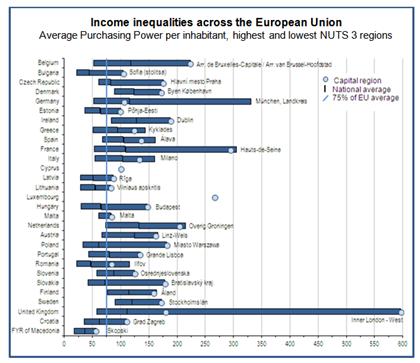
And essentially the same is true of nations. There are numerous measures of national income inequalities, and, if you’re into visual aids, one of the most vivid depictions of Britain’s extreme economic inequality is that based on the regions into which, for statistical purposes, EU nations are divided: NUTS (Nomenclature of Units for Territorial Statistics). The NUTS 3 level comprises ‘small regions’, the UK’s 139 consisting mainly of upper-tier and unitary authorities.  For each NUTS 3 region the average individual Purchasing Power is calculated and standardised (PPS), and a country’s income inequality is the difference between its highest PPS region and the lowest.

game table

Source: Office for National Statistics

The UK national average PPS is 110.6, that in the highest region (Inner London – West) 596, and in the lowest regions (Wirral and West Wales) 57 – a tenfold inequality that is almost twice that in Germany and France, three times that in Italy and Spain, and five times that in Denmark, Finland and Sweden.

Dramatic as these ratios are, it should be emphasised that they are derived from workplace, rather than residential, data: individuals’ incomes are related to where they work, not where they live. The much more widely used measures of national income inequality are those based on the Gini coefficient or ratio, developed by the Italian sociologist, Corrado Gini. He was Mussolini’s favourite statistician, with some dubious ideas about nations having life cycles, and ‘young’ nations fulfilling their destiny by expanding at older nations’ expense, through a combination of wars and cross-breeding with younger races.

Happily, his stats were less flaky, and the Gini coefficient of national income distribution is widely used around the world, generally based in more developed countries on disposable, post-tax income. Data are collected through household surveys, and the coefficient runs from a hypothetical zero or perfect equality, where everyone has exactly the same income, to a similarly hypothetical 1, where one person has the lot.

In the latest statistics published by the 34-nation OECD (Organisation for Economic Co-operation and Development), the overall coefficient is 0.31, and the range extends from Slovenia (0.24) and Denmark (0.25), through the US (0.38) and Turkey (0.41) to Mexico (0.48) and Chile (0.49). Taking the EU-27 alone, highest is Portugal’s 0.35, closely followed by the UK on 0.34.

So Birmingham is the second most unequal city in the second most unequal country in the EU – which doesn’t altogether surprise me, but certainly isn’t something I’d want to celebrate. Nor the OECD, who are pretty clear what their figures represent: “High income inequalities typically imply a waste of human resources, in the form of a large share of the population out of work or trapped in low-paid and low-skilled jobs.”

Yes, I can see that, but then I’m not one of the 50 on the Birmingham Post’s West Midlands Rich List, published by pleasing coincidence in the same week as Cities Outlook. The net worth of the lucky 50 rose last year by just the 13.8% or £3.46 billion. That’s right, the single-year increase of these 50 mainly-male Midlanders alone equalled Birmingham City Council’s total budget, or roughly half of the real-terms funding loss of all English councils put together over the 2011-15 spending cycle.

Which, say our business leaders, is “very good news … [for] with wealth creation goes job creation and this is to be applauded.”  You can almost hear Thatcher, can’t you: “Our job is to glory in inequality”.  Remember the trickle-down theory? The rich perform a public service by getting richer still, because their prosperity would automatically trickle down to the poor. There are many still waiting for that trickle to reach them, and who must be relieved that the City Council’s ‘living wage’ policies at least sound as if they make sense.

game

Chris is a Visiting Lecturer at INLOGOV interested in the politics of local government; local elections, electoral reform and other electoral behaviour; party politics; political  leadership and management; member-officer relations; central-local relations; use of consumer and opinion research in local government; the modernisation agenda and the implementation of executive local government.

How can communities mobilise to shape public policy and service delivery in new and creative ways?

Catherine Durose, Jonathan Justice and Chris Skelcher

Community organising and co-production can shape public policy making and service delivery in new and creative ways, providing an alternative to privatisation and the outsourcing of public services. This is the claim made in our new pamphlet, ‘Beyond the state: mobilising and co-producing with communities’. The pamphlet is written with community activists and policy researchers, and provides case studies and analysis of UK and US experience in community organising to solve problems and improve public services. The pamphlet features contributors from CitizensUK, Locality and Scope and a Chicago-based organisation, Pilsen Alliance.

Community organising has a long tradition internationally. It offers a way for communities to recognise their common interests and mobilise to achieve change.  Often their target is government, and their desire is to redress disadvantage by actively campaigning for changes in policy and practice.  Sometimes this is to overcome the effects of existing policy, but it is also about shaping emerging policy to ensure that affected communities become beneficiaries rather than bearing the costs. Co-production is becoming an important way of thinking about the active design and delivery of services through collaboration between users and providers.  While its origins are in social care and health services, it has much wider applications.  But to be effective, it requires ways of redressing the power imbalance between users and producers.  Here, community organising can be an important mechanism. Together, the contributions show how community organising and co-production are powerful instruments to open up the policy process, potentially deepening democratic engagement and administrative responsiveness.  As such, they offer a challenge to the way in which governing beyond the state sometimes obscures accountability, privileges private interests, or facilitates governments’ off-loading of responsibilities to civil society.

This pamphlet’s contributions show the value of moving beyond a perspective that recognises the state as the only legitimate centre of authority. At the same time, however, the contributors challenge an assumption in our title. For ‘beyond the state’ implies that non-state models of collective choice and action are somehow secondary or less fundamental than those of government. The evidence from the contributors is that community organising and co-production are not somehow second best models, when compared to government provision.  They show that there is a vital energy that can be mobilised, but that it cannot be shaped to government’s agendas.  Community organising and co-production are political processes that create new possibilities that are not solely oppositional but also collaborative.

This can be a struggle for those in government, used to traditional models of policy making and service delivery, and trying to reconcile the political legitimacy of politicians with the demands and campaigns of users and communities. The state has become and is likely to remain a focal institution for defining and accomplishing shared purposes. But its monopoly on the legitimate use of coercion need not imply a monopoly on the legitimate use of collective decision and action. So we should continue to look past the language to observe the actual processes and results of power, and to look beyond the state alone for solutions.

durose

Catherine Durose is Director of Research at INLOGOV. Catherine is interested in the restructuring of relationships between citizens, communities and the state. Catherine is currently advising the Office of Civil Society’s evaluation of the Community Organisers  initiatives and leading a policy review for the AHRC’s Connected Communities programme on re-thinking local public services.


Jonathan Justice

Jonathan Justice is Associate Professor in the School of Public Policy and Administration at the University of Delaware. Jonathan previously worked for the City of New York and for non-profit organisations in the New York metropolitan area. His areas of specialisation include public budgeting and finance, accountability and decision making and local economic development.


skelcher-chris

Chris Skelcher is Professor of Public Governance in the University of Birmingham’s School of Government and Society. His research and teaching focus on the transformation of UK governance in an international context. Chris is currently leading a three year ESRC study of the reform of public bodies and their changing relationships with sponsor departments.

In favour of the mundane: citizenship testing and participation

Katherine Tonkiss

This weekend saw the announcement that the Government has completed its revisions to the ‘Life in the UK’ citizenship test, refocusing the questions on British culture, history and sport.  According to the Government, there will be no more ‘mundane’ questions about water meters, job interviews, the internet and public transport.  Rather, as immigration minister Nick Harper described, ‘the new book rightly focuses on the values and principles at the heart of being British.  Instead of telling people how to claim benefits, it encourages participation in British life’.

This is just the latest in a series of announcements which have reinforced some notion of a British way of life as a criterion of both immigration and integration, as I have described elsewhere.  Nick Harper’s words draw us again into the vastly questionable argument that migrants are ‘benefits scroungers’, and so rather than telling them how to access those benefits we should instead be expecting them to assimilate to the British way of life.  It is this, we are being told, that holds the key to participation in community life.

The use of the word ‘participation’ is itself more than a little problematic.  Is participation really what is at stake in this debate?  Harper is also quoted as saying that the new citizenship test is ‘just part of our work to help ensure migrants are ready and able to integrate into British society’.  Integrate into.  This claim seems to denote the idea that integration is something that migrants ‘do’ when they come into a country in order to take on the national culture and history, rather than something that a society experiences collectively in order to build social inclusion and cohesion.

None of this sounds much like participation to me.  Casting an eye over the ten sample questions from the new test is similarly illuminating.  Does my knowing which admiral died in 1805 and has a monument in Trafalgar Square help to participate in my local community?  Does my knowing the name of the prehistoric landmark still standing in Wiltshire really help me to play an active role in society?

Actually, what it might do is to further define me as an outsider, whether or not I know the answers.  Much in the same way that Communities and Local Government Secretary Eric Pickles has suggested that Councils only publish documents in English because ‘translation undermines community cohesion’, the new citizenship test underpins the idea that it is up to migrants to integrate into ‘our’ culture, and that if migrants are unable to do that then they have no right to live in our country, to make use of our services or to participate in the lives of our communities.  It presents an ideal of Britishness which is unattainable beyond a simplistic test, when migrants bring with them their own rich cultural heritages – heritages which have, previously, been celebrated as central to the life of our communities.

And the very notion of ‘our culture’ is itself deeply problematic.  This suggests a one-size-fits-all notion of Britishness that will evade people who were themselves born in Britain.  Arguing that Britishness involves ‘the national love of gardening, the novels of Jane Austen and the musicals of Andrew Lloyd Webber’ is ignorant not just of diverse ethnicities and cultural heritages, but also of the diversity of genders, class backgrounds and life experiences present within Britain today.

I want to make an argument in favour of the mundane. If we have to have a citizenship test, then surely in a liberal society our citizenship test should be about helping people to access public services and to actually participate in their community through contact with their elected representatives and other important organisations in their area.  We live in a liberal democratic society – citizenship testing should not be about reinforcing a sense of Britishness that is alien even to the most ‘British’ amongst us.  Rather, it should be about making sure that everyone has equal access to services and the equal chance to participate, and that everyone is deserving of equal respect.

me

Katherine Tonkiss is a Research Fellow in INLOGOV.  She is currently working on a three year, ESRC funded project titled Shrinking the State, and is converting her PhD thesis, on the subject of migration and identity, into a book to be published later this year with Palgrave Macmillan.  Her research interests are focused on the changing nature of citizenship and democracy in a globalising world, and the local experience of global transformations.  Follow her Twitter feed here.

The forgotten last chapters of localism

Ian Briggs

“Beware of false knowledge; it is more dangerous than ignorance”, George Bernard Shaw once wrote – it seems to sum up some extraordinary lessons that the recent winter weather is offering us. What really gets people off their backsides and make representations to local councils are things that affect them immediately. Go for a peaceful evening walk and stand in some dog mess and suddenly you are aware of the all inconsiderate dog owners in your neighbourhood – it snows and you become aware that the grit bin at the end of your road is empty – hit a pot hole in your car and you are immediately aware of poor road surfaces.  You are so wound up you e mail and write letters of complaint, but it is not enough, you actually go and berate your local Town or Parish Council at the next meeting because it is closest to you.

This immediacy of awareness can be the cause of backlashes and sweeping generalisations of public service performance.  Whether the gap between public expectation and the reality of delivery can ever be reconciled is a matter of useless speculation, but when faced with the anger of a citizen for what they see as public service failure an incremental level of dissatisfaction can be the result. This seems to be the case in a number of what may appear to be small incidents but taken in the round add up to what is a serious problem. This is often most evident in the thousands of Town and Parish Councils that make up so much of the English democratic infrastructure.

This problem can be illustrated by a story told to me as part of a Masters programme some years ago, it centred around the new CEO of an airline who sought to better understand the customer experience by booking himself on a number of the airlines services in a kind of mystery shopper experience. On one flight he fell into conversation with a regular passenger (in economy) who was concerned that aircraft maintenance was being undertaken in a shoddy and potentially dangerous manner. Somewhat surprised, he enquired as to whether the passenger had professional experience in this matter only to find out he was a furniture salesperson. He had made his striking and knowledgeable conclusion from the fact that this was the third time he had recently flown on an aircraft where there were sticky messy rings left from leaky coffee cups on previous flights. If the airline could not do something as simple as clean up a coffee cup ring on a fold down table then how on earth could they effectively maintain a complex system like a jet aircraft properly?

This came to mind the other night when out doing my bit as a Parish Councillor –  I had a reflective vest on (bought by myself) used a spade (my own) and was spreading some grit over a road junction that is regularly the scene of multiple minor bumps and scrapes when there is snow and ice around. A motorist – not young – hurtled up the lane at a speed that suggests he was not taking account of the conditions and braked suddenly close to where I was doing my bit. The driver’s window opened and a veritable torrent of abuse was directed towards me – assuming that I was a council employee I was accused of wrecking the national economy, luxuriating in a huge public funded pension, ruining his children’s education and future prospects and robbing him blind of his wages through his council tax.

It is not about the factual correctness here – it is about the underpinning belief systems that pervade society. It is the drama around false knowledge – seeing me looking like a council employee, doing what he assumes a council employee does was enough to trigger connections that confirm and  reinforce the underlying belief system.  It is also about the dangerous level of ignorance we have allowed to accumulate in civil society. Most reasonable and rational people can see what goes wrong locally, and on top of this they often know stuff about putting it right but the disconnect between the two remains. If localism is about reversing the top down, parent always knows better in public service delivery do we not have to offer some seed corn to enable the person in the street to engage better with our attempts and actions to make living here better?

The sting in the tail here is that anger at perceived failure is only one aspect of the danger of false knowledge – the phenomenon of the dangers of success is out there too. Although anecdotal, we are capturing the awkward issue of what some are calling ‘need acceleration’ – this occurred to one councillor who recently was pleased to find that after some door knocking and street level engagement a number of residents were saddened by the state that some Victorian iron railings were in around an amenity area. They were rusting and in poor repair. This became the target for spending his small discretionary ward grant – within days the railings were restored to their former glory – rust removed, gleaming black paint and looking very much as they did in the days of the childhood of local residents. However, as much as a few were clearly delighted with the result more residents came forward pressurising the councillor that if they could do something as simple as put right the railings around the small park then why on earth could they not do something about the ghastly, unsightly ‘bomb site’ at the end of the street? A fine example of need acceleration and perhaps a good example of false knowledge.

High expectation coupled with innocent ignorance of the reality of how we link civil society and the state is perhaps a problem that localism will never satisfactorily resolve – the last chapter will perhaps be written on Parish and Town Council letter headed notepaper! Increasingly it seems that is where the buck stops.

briggs

Ian Briggs is a Senior Fellow at the Institute of Local Government Studies.  He has research interests in the development and assessment of leadership, performance coaching, organisational development and change, and the establishment of shared service provision.

Councillors: Engage more and engage differently, but not at the expense of the basics

Karin Bottom, Catherine Mangan and Thom Oliver

This month saw the ‘Communities and Local Government Committee’ release its report on the role of the modern councillor. Focusing on  the impact of the Localism Act (and associated  developments in recent years),  Clive Betts MP,  Chair of the Committee,  suggested that local representatives are now spending less time in council and more in the community. As a result, they now shoulder the majority of responsibility for ensuring that  that their local communities have the tools to make the most of the localities in which they live. While the Report’s findings held few surprises, it did suggest that those we elect to be the local democratic voice of our communities must embrace this challenge and meet it head on. This position resonates with early findings from an INLOGOV project concerned with local engagement and the role of the local representative.

Firmly grounded in the belief that councillors’ responsibilities and remits vary, the current climate suggests they require a more nuanced and responsive skill set than ever.  In this sense, elected representatives must be outward looking, open to new ideas and welcoming of new approaches, but they must take care not to throw out the baby with the bath water.  Instead, our research suggests that what councillors need to do is integrate new learning into their existing repertoire of behaviours, while at the same time being more dynamic and responsive in their increasingly frontline role.[i]

For respondents, one of the main challenges they felt they faced was engagement. Whereas it is natural for all councillors to ‘do engagement’, a variety of approaches were evident in our research and for those who had moved into executive positions, the role shift was accompanied by community activities having to be curtailed. Respondents were very clear that the Localism Act was beginning to have an impact, for example in the mediating role that  has now been allocated to councillors: this meant developing skills as a community organiser and ultimately being on top of a great volume of information while managing a number of resources and contacts. This form of community engagement, though hard, was thought to have clear  rewards: a number saw the benefits of having shared aims and  a deeper understanding of the people they represented,  which in turn provided greater insight into the experience of being on the receiving end of council services; in contrast others thought wider community engagement created opportunities to lead opinion and ultimately change behaviour, for example one councillor worked with environmental groups to shape the ward’s attitude towards refuse collections and recycling.

Our interviews also surfaced information suggesting that that the majority of traditional communication methods continue alongside a slow evolution to greater online engagement and use of social media. While one councillor referred to sending regular email shots and creating a web page to articulate local information, activities and updates,  another described  how Facebook had enabled him to engage with people – often young people – who  generally chose not to participate in politics and local policy conversations. Finally, a number of councillors explained that twitter enabled them to aggregate opinions en mass, engage in debates and learn information they would otherwise be unaware of,  while some with cabinet responsibilities stated that this particular medium was unique in that it enabled them to keep on top of their portfolio while also providing opportunities to build and consolidate relationships they would otherwise not have had time to address..

One factor that was evident in almost every interview was that councillors always needed to be aware of the bigger picture: different methods worked in different situations and knowing a ward’s story or the history behind a particular community group could make the difference between successful and unsuccessful engagement. Just because a particular approach might work in one instance, there is no assurance it will work in another, despite apparent similarities. So, while councillors may see their responsibilities increasing and their community role broadening, it is vital that they maintain depth in their representative activities: if they don’t, potentially successful initiatives run the risk of failing.  

The authors are grateful to the School of Government and Society, University of Birmingham, for providing funds to assist in this research. With thanks also to NLGN for their contribution to this work.  For further information about the research project, contact Karin A. Bottom: [email protected]

bottom-karin

Karin Bottom is Lecturer in British Politics and Research Methods at INLOGOV, University of Birmingham.  Her core research areas comprise parties (particularly small and the BNP), party systems and party theory.  She is particularly interested in concepts of relevance and how national level theories can be utilised at the sub-national level.

Portrait of OPM staff member

Catherine Mangan is a Senior Fellow at INLOGOV.  Her interests include public sector re-design, outcomes based commissioning and behaviour change.  Prior to joining INLOGOV she managed the organisational development and change work for a not-for-profit consultancy, specialising in supporting local government; and has also worked for the Local Government Association, and as Deputy Director of the County Councils Network.  She specialises in adult social care, children’s services and partnerships.

thom

Thom Oliver is a Postdoctoral Research Fellow at Oxford Brookes Business School.  He completed his PhD, exploring the representative role of councillors on appointed bodies, at INLOGOV in 2011. He currently lives in Bristol and has recently rejoined INLOGOV as an Associate.  Follow his Twitter account here, and read his own blog here.


[i] Research to date provides initial findings from interviews in three councils (one London Borough and two Metropolitan).  Interviews comprised a broad mix of age, seniority, roles and experience. Approximately equivalent numbers of men and women were interviewed.

The bonfire of the quangos has thus far only smouldered

Katherine Tonkiss and Katharine Dommett

Quangos, non-departmental public bodies, or arm’s length bodies (ALBs), as they are variably termed, are a category of public organisations that operate with a degree of independence from ministers. These bodies have become an established feature of government, created to deliver policy, offer expertise and regulation (among other functions). Yet despite their proliferation they have been widely condemned by the political class and are subject to frequent reviews and culls. In reality few attempts to address the number and significance of bodies have, thus far, yielded much success. Indeed, hitherto the bonfires of quangos have smouldered rather than raged.

In this light David Cameron’s call in 2009 for the existence of ‘each and every quango’ to be justified in accordance with three tests appeared little more than a restatement of established political rhetoric. However, building on the Conservative manifesto commitment, the Coalition Government moved quickly to ‘reduce the number and cost of quangos’, conducting a review in the summer of 2010. After just five months in government 902 quangos had been surveyed and 200 bodies scheduled for abolition, 120 for merger and 176 for substantial reform. This early pace signalled a clear determination on the part of the Government to shrink the size of the state, informed by their desire to reduce ‘the cost of bureaucracy and the number of public bodies’, ‘to increase accountability’ and to achieve ‘efficiency, effectiveness and economy in the exercise of public functions’.

Two years on, the recently published Public Bodies 2012 report provides an overview of this reformed quango landscape. But what level of success has been attained? Each of the Government’s objectives is assessed in turn below, evaluating progress thus far and identifying future challenges to the reform agenda.

Are There Fewer Quangos?

The implementation of the reform programme was rapid, despite occurring in a period of relative instability (given budget and staffing reductions, as well as widespread civil service reform). Public Bodies 2012 states that since 2010 the number of NDPBs has been reduced by 220. While this denotes substantial progress on this objective, most bodies abolished thus far have been smaller advisory bodies and many functions have survived, being transferred into departments, executive agencies or merged into the remit of other bodies. Accordingly, while the numbers of arm’s length bodies is reducing, the scope of government is not necessarily shrinking.

In addition, a number of new bodies have been created by the coalition. Public Bodies 2012 notes that nine new bodies have been created since 2010 – six independent monitoring boards, the National Employment Savings Trust, the Office for Budgetary Responsibility and the Independent Commission for Aid Impact. However, the scope of Public Bodies 2012 is limited to NDPBs only, and this prevents a wider appreciation of changes in arm’s length bodies more generally. For example, some new executive agencies – such as the four created in the Department for Education, the Legal Aid Agency, the proposed National Crime Agency – and also other organisational forms such as the Office of Tax Simplification (an ‘independent office of the Treasury’) are NDPBs in a new form. The overt focus on numbers of NDPBs therefore misses the wider question of where functions of government are located – and many are remaining at arm’s length.

Have They Saved Money?

The belief that inefficiency and poor governance was rife within public bodies provided a key motivation to not only abolish but also reform ALB governance. In embarking on the reform programme, the Cabinet Office publicised anticipated savings of £2.6 billion by 2015 and ongoing savings of between £800 and £900 million a year after the Spending Review. A third of the initial saving (£0.9billion) was predicted to come from the abolition of two bodies, the Regional Development Agencies and Becta, yet the rest was based on imprecise and often incomparable data from departments. For example, some estimated reductions were based on spending review requirements, whilst others focused exclusively on savings from ALB reform.

This lack of consistency led an NAO report to argue that the Cabinet Office did ‘not yet have the means to confirm the removal of £2.6 billion from administrative budgets’ or to check that this money was the result of savings rather than cuts. In its response, the Government highlighted that this figure incorporates wider efficiency savings from bodies that will continue to exist, but acknowledged that the cost of reform was still unclear. Indeed, the projected savings stemming from reform have recently been reviewed, and Public Bodies 2012 puts administrative savings at £401 million in the year 2011/12.

Furthermore, in calculating the money saved, little attention has been directed to the costs of transition, failing to consider the difficulties of, for example, disposing of assets and addressing redundancy costs. While the NAO has estimated transition to potentially cost £830 million, Public Bodies 2012 estimates the cost of reform to be between £650 million and £800 million. This wide variation in estimates again highlights the challenges faced by the Cabinet Office in demonstrating that efficiencies are a direct result of the public bodies reform agenda.

Are They More Accountable?

Government has sought to increase the accountability of ALBs by bringing them closer to departments and Ministers. In addition to the newly created executive agencies, the functions of 9 bodies have been transferred to executive agencies (which are said to enjoy far less autonomy from Government compared to other forms of ALB); and 16 have been transferred into departments. For the bodies that remain, a process of triennial review is being implemented whereby each body is subject to independent review every three years – serving to provide departments and Ministers with more awareness of their ALBs and thus improve the accountability (and efficiency) of these bodies.

However, the idea that moving bodies closer to the centre will increase accountability is not as clear cut as it seems. There is a risk that functions in, for example, executive agencies, will not be scrutinised to the same extent as those in NDPBs where triennial reviews occur. In reducing the length of the arm at which key functions are exercised, there is therefore a risk that formal structures of accountability, enhanced as a part of the reform programme, are bypassed.

Conclusion

The public bodies reform programme has represented a radical attempt to streamline arm’s length governance in the UK. The speed at which reform has been implemented and the numerous bodies abolished or otherwise reformed denotes considerable success over these first two years of reform. However, it remains unclear as to whether the reform programme will deliver on the government’s objectives to improve the efficiency and accountability of the arm’s length governance landscape.

The Government has committed to implementing a ‘benefits realisation framework’ which will enable departments to ‘better define, measure and optimise all forms of value created in consistent and credible way’, with a greater emphasis on improving the efficiency and accountability of the bodies that survived the cull. With these new developments, there is a possibility that the initial momentum of reform will be maintained, allowing the government to deliver greater efficiency and accountability across the public bodies landscape.

There remains, however, a broader challenge in terms of how public bodies reform is reconciled with wider civil service reforms. Public bodies reform was, in part, a centripetal process involving the transfer of functions back into departments. In contrast, the Civil Service Reform Plan clearly has a centrifugal logic that is based around pushing functions away from Whitehall and traditional bureaucratic structures, through emerging models of service delivery such as outsourcing and mutualisation. The next phase of public bodies reform will need to reconcile these contrasting logics in a way that delivers efficiency while still serving the accountability goal of public bodies reform.

This post was originally featured on the LSE British Policy and Politics Blog on 17th January.

kateDommett

me

Katherine Tonkiss (INLOGOV) and Katharine Dommett (University of Sheffield) are Research Fellows on Shrinking the State, a research project exploring public bodies reform in the UK, and drawing on historical and international comparisons. The project is led by Professor Chris Skelcher (Birmingham) and Professor Matthew Flinders (Sheffield). The authors acknowledge the financial support of the ESRC (Grant Ref. ES/J010553/1). The views expressed are those of the authors.