The forgotten local elections – Conservatives defied predictions here too

Chris Game

You’d not have known it from the national media, either before Election Day or since, but the 650 parliamentary contests weren’t the only ones taking place in the UK last Thursday. It was the year in local government’s four-year election cycle that almost all English district and unitary councils – 279 of 293 – had elections, and there were votes too for six mayors, for many parish and town councils, plus the odd local referendum.

There were no council elections in London, Scotland or Wales, but English voters – many doubtless to their surprise – were confronted by up to five ballot papers. Those in Bedford, for example, had votes for an MP, a mayor, two borough councillors, up to 11 parish councillors, and a referendum on their Police and Crime Commissioner’s proposal to increase Council Tax – the first ever of its kind. The proposal – specifically for a 15.8% increase in the Police and Crime Commissioner’s portion of council tax – was rejected by nearly 70% to 30%: Yes 91,086; No 207,551.

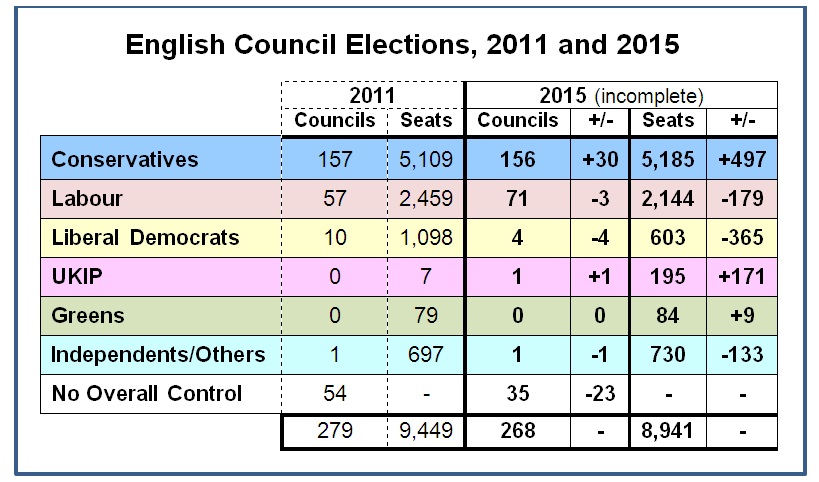
These multiple ballots offered electors the obvious opportunity for split-voting: one for their MP or national government, and another more personal, local or protest vote. Minor parties and independents in the council elections could be expected to be chief beneficiaries, but, as shown in the nearly complete results table, that was another ‘expert’ prediction largely confounded.

Blog 11th May

9,500 local elections are even trickier to predict than 650 parliamentary ones, and few are daft or brave enough to try. Those who do will start from the baseline of four years ago – 2011 here – when these actual seats were last fought, compare that year’s results with current national opinion polls, and hope.

2011 was surprisingly good for the Conservatives, a year into their far from popular Coalition with the Liberal Democrats. They gained votes from disaffected Lib Dems, and the coinciding electoral reform referendum galvanised their own supporters. This time, though, the national election effect was expected to boost the turnout of Labour and Lib Dem voters.

The poll standings of both main parties had dropped significantly since 2011. But, with the Conservatives the more damaged by UKIP’s dramatic rise, and defending twice as many seats as Labour, the latter was predicted to make most net gains, with the Lib Dems not suffering “too badly” in losing perhaps “around 50 seats”.

If these predictions echoed those for the General Election, then so did the outcome. The Conservatives were unambiguous winners of these local elections, Labour not just net, but absolute, losers, and the Lib Dems suffered as painfully as they did nationally.  UKIP made progress, but less than it hoped, and the Greens flatlined.

For the Conservatives, their more than 30 gains – mostly, it should be noted, councils previously under arithmetically No Overall Control – will take the local headlines. Two particularly satisfying results, though, will be the retained control in their only two metropolitan boroughs – Solihull and Trafford – both with additional seats. Solihull Greens lost a seat, but, with the Lib Dems losing two, they are still the official opposition.

Conservative unitary council gains include Basingstoke & Deane, Poole, and Bath & North East Somerset, where there are now two Greens, but 14 fewer Lib Dems and a first-time Conservative majority. Districts won include traditionally Independent Babergh, Suffolk, also for the first time in its 41-year history; Amber Valley, Gravesham and North Warwickshire straight from Labour; Hinckley & Bosworth from the Lib Dems; Gloucester, St Albans, Scarborough, Winchester, and Worcester.

Further Labour losses to No Overall Control included Walsall metropolitan borough and the unitaries, Plymouth and Stoke-on-Trent. There was a little compensation perhaps in hanging on to a knife-edge majority in Bradford, thanks to Independents, UKIP and Respect all losing seats, and gaining majorities in unitary Stockton-on-Tees, and, after a suspended recount and overnight rest, Cheshire West & Chester.

Labour is also now largest party on Brighton & Hove council, since 2011 the UK’s first to be run by the Greens. As in the General Election, the Greens’ recent membership surge didn’t really translate into hard results, though they will be encouraged by seven gains in Labour-dominated Bristol, bringing them within touching distance of official opposition.

This time UKIP was the history maker. UKIP leader Nigel Farage had failed to become Thanet South’s MP, but his party reduced Thanet district’s Labour councillors from 24 to 4 and, with 33 of its own, won overall control of its first principal council.

Good Lib Dem news was at a premium all weekend, but enough of Bedford’s conscientious voters gave their mayoral ballot paper X to Lib Dem Dave Hodgson to re-elect him comfortably for a third term as the borough’s mayor.

In other mayoral votes, Peter Soulsby was re-elected for Labour in Leicester, Gordon Oliver for the Conservatives in Torbay, and Mansfield’s three-term Independent Tony Egginton was succeeded by his Mansfield Independent Forum colleague, Kate Allsop.

Another Independent, Mike Starkie, was elected as the first mayor of Copeland in Cumbria, while in Middlesbrough three-term Independent Ray Mallon has retired and is replaced by Labour’s Dave Budd – though only after a second preference count and the rejection of large numbers of spoilt ballots, presumably from the many Labour members who, despite the result, want the mayoral system abolished.

In these mayoral elections at least, then, there’s something for almost everyone: Labour, Conservative, Lib Dem, and Independent.

Chris Game - pic

Chris Game is a Visiting Lecturer at INLOGOV interested in the politics of local government; local elections, electoral reform and other electoral behaviour; party politics; political leadership and management; member-officer relations; central-local relations; use of consumer and opinion research in local government; the modernisation agenda and the implementation of executive local government.
The other 1215 Charter: 800 years of elected mayors

Chris Game

The LGA’s Magna Carta web pages have recently featured a delightful homophone – sounds the same as another word, but different spelling and meaning.  Among this summer’s many MC commemorative events will reportedly be “a programme of inciteful lectures and talks” (my emphasis).

Excellent, I thought. Insight’s for wimps. Rousing incitement is what’s needed if, like the LGA, we’re to model today’s struggle for devolution on that of the 13th Century rebel barons with their tyrannical but cash-strapped King, and what better rouser than the Association’s aptly named Chair, David Sparks.

Given the countless products already being promoted by June’s 800th anniversary – from Jay Z’s free-to-smartphone album, Magna Carta Holy Grail, to the British Library’s ginger fudge – cynics might accuse the LGA of bandwagon jumping. But they’d be unfair.

There is much more local government stuff in Magna Carta than I for one first appreciated. I knew the main local government clause (13), about the City of London and “all other cities, boroughs, vills [towns] and ports” being assured all their “ancient liberties and free customs, by both land and water”. But I’d no clear idea what the liberties and customs were, and also assumed that was about all there was.

In fact, most of clauses 23 to 31, ostensibly about such things as county farms and commandeering of timber, actually referred to malpractices of the King’s local agents – sheriffs, bailiffs, and so on – with clause 25, perhaps most relevantly to modern-day concerns, limiting the financial burdens placed by the King on the counties.

Then there’s clause 48, empowering 12 knights elected in each county to investigate and abolish those malpractices, which can be seen as part of a wider local self-government campaign around the turn of the 13th Century.

Even so, there’s a still better instance of early local self-government in a contemporaneous charter which, though less known, was important in itself and also played a key part in shaping the Runnymede agenda: the King’s Charter for London of May 9th 1215.

The London here, of course, is the famous Square Mile – today’s City of London Corporation – some of whose ‘ancient liberties’ predated the Norman Conquest. From 1067, in exchange for London’s supporting the King with cash or troops, these liberties were extended in successive royal charters, and included exemptions from certain taxes and tolls, right of trial by the City’s own courts, and the right to appoint civic officials.

Richard I (1189-99) was particularly indebted to Londoners, as funders of his crusades overseas and defenders against his baronial opponents at home, and it earned them in the early years of his reign both a recognized body of self-government, in the form of a Norman-style ‘commune’ – precursor of the City Corporation – and their own mayor, in place of the King’s Portreeve or sheriff.

Historians dispute precise dates, but the City claims 1189 as the year Henry Fitz-Ailwin de Londonestone was appointed its first Mayor – the addition of ‘Lord’ took another 200 years – and proceeded to serve a never remotely repeated 24 terms.

This circumstantial evidence alone suggests Fitzy was not only entirely acceptable to the King, but probably a financial backer and appointed by him.  And explicit reinforcement comes in the May 2015 Charter, King John’s last desperate (and unsuccessful) attempt to detach London from the baronial insurgency that would culminate in the following month’s Magna Carta.

Charter for London

In a key concession and, it seems, the first documented reference in this country to a popularly elected mayor, the Charter grants “to our barons of the City of London, that they may choose to themselves every year a mayor …”.

The full translation, from the second line of the illustrated extract, runs:

“Know ye that we have granted … to our barons of our city of London, that they may choose to themselves every year a mayor, who to us may be faithful, discreet and fit for government of the city, so as, when he shall be chosen, to be presented unto us, or our Justice if we shall not be present… and he shall swear to be faithful to us; and that it shall be lawful to them, to amove him and substitute another, if they will, or the same to retain …”

The King’s climb down could not be clearer. The tables are turned: You now choose your own Mayor, and I get to approve his faithfulness, rather than the reverse.  It wasn’t his biggest surrender of that 1215 summer, but it was significant then and, whatever you happen to think of even the idea of directly elected mayors, it obviously still has its relevance today.

The story, and this blog, could obviously end here, but that would have involved omitting quite an interesting postscript, which links these events directly to the one Lord Mayor of London that even most non-Londoners can name: Richard Whittington.

We need to set aside much of the pantomime tale: the Gloucestershire lad, Dick, and his fictional cat who, returning home up Highgate Hill after failing to find his fortune in London, heard the distant Bow Bells preternaturally telling him to fulfil his destiny and “Turn again, Whittington, thrice Lord Mayor of London”.

Never mind what he was doing returning to Gloucestershire via Highgate Hill, or whether he could conceivably have heard the Bow Bells chiming five miles away. The interesting bit is the ‘thrice’ – because, by the time this bit of nonsense was written, centuries later, Whittington had in fact served four mayoral terms: 1397-98, 1406 and 1419. So why the confusion?

No Lord Mayor since Whittington has served as many terms, so there can be no doubting his renown and popularity during his own lifetime. His money helped.  A successful import-export merchant, he’d have easily made the Sunday Times Rich List, and he spread it around judiciously. Plenty was ‘borrowed’ by the King of the day, but plenty also went to good causes and public works – including an unmarried mothers’ ward at St Thomas’ Hospital, rebuilding the Guildhall, and a 128-seat public toilet.

The one big irony in all this is that the early public affection for Whittington’s mayoralty owed much to his initially NOT having been popularly elected – despite it having become the established practice by then for London citizens ‘at large’ to choose their mayor, with the King formally ratifying their choice.

However, when the incumbent mayor died in June 1397, Richard II, in one of his absolutist moods, decided he’d do the electing and simply imposed Whittington, one of his long-term creditors, on the City. The new mayor responded by negotiating a costly but popular deal, buying back for London its own usurped privileges for £10,000 (around £6 million today), and in October was triumphantly elected by a grateful citizenry – the two separate assumptions of office in the same year apparently accounting for the doggerel-writer’s ‘thrice’, unless of course it was the difficulty of scanning ‘quadruple’.

Chris Game - pic

Chris Game is a Visiting Lecturer at INLOGOV interested in the politics of local government; local elections, electoral reform and other electoral behaviour; party politics; political leadership and management; member-officer relations; central-local relations; use of consumer and opinion research in local government; the modernisation agenda and the implementation of executive local government.
A marriage made in heaven?

Catherine Staite, Director of INLOGOV

The ESRC, LGA and SOLACE have created a new role – that of Research Facilitator for local government – with the aim of supporting strong and productive relationships between researchers, policy makers and practitioners. I’m very pleased to take on that role, with the active support of the INLOGOV team of academics and expert practitioners. Over the next year we’ll be establishing a dating agency for those seeking partners to answer some essential questions and running a series of events to support creative and sustainable relationships. A GSOH will be essential.

Public services need researchers. That is because evidence is the lifeblood of efficacy. When money is so tight, the last thing we should be wasting it on is the wrong service, at the wrong time, in the wrong place.  Policy decisions and service design need timely and accessible evidence and there’s plenty out there. So why aren’t researchers, policy makers, commissioners and providers using the available evidence to do better with less? Why aren’t we getting it together?

We work in very different spatial and temporal environments (note the unnecessary use of obscure language) which means that opportunities to meet suitable partners are limited and academic time-scales militate against speedy responses. Academic language is often impenetrable: designed to impress other academics rather than to inform those who can actually use the evidence on offer.  Contestation is a vital element of academic discourse. That means – academics also like to argue among themselves and even with themselves.  After a few pages of ‘on the one hand this and on the other hand that’  … policy makers and practitioners can be forgiven for giving up and going off to make it up.

However, the fault is not all on one side. Too often research is commissioned, not to gather objective evidence or stimulate creative thinking but to justify an existing policy or priority.  The findings of research can be a major challenge to political ideologies. Those who are seeking to bolster their prejudice with an academic fig leaf are doomed to disappointment.  If you ask for independent research – that’s just what you’ll get. Don’t ask if you don’t want to know the real answers. It will lead only to mutual disappointment.

So how can we make this relationship work? Let’s spend more quality time together, getting to know each other and exploring our shared passions.  Let’s make each other some promises.  If we promise not to argue about how many angels can dance on the point of a pin, would you promise not give us six weeks to enumerate and classify the angels and calculate the likely savings from combining seraphim and cherubim? Agreed? Great – now let’s do some good work together.

Catherine Staite

Catherine Staite is the Director of INLOGOV. She provides consultancy and facilitation to local authorities and their partners, on a wide range of issues including on improving outcomes, efficiency, partnership working, strategic planning and organisational development, including integration of services and functions.

Preparing future leaders: The Total Leadership Programme

Daniel Goodwin – Senior Associate Fellow

The leadership and management challenges faced by local government have never been greater. Budget constraint, population change, and the need to respond to heightened expectations present future leaders with lots to grapple with. People thinking about taking up the top roles in public service will need a solid foundation of thinking and a great support network to turn challenge into opportunity.

The Total Leadership Programme is an exciting new venture which is designed to help senior local government managers prepare themselves for a chief executive role. It’s a partnership between INLOGOV and SOLACE (The Society of Local Government Chief Executives and Senior Managers), which fills a serious gap in provision nationally. It is open not only to directors in councils but also to people at a similar level within private sector firms who work in the public sector and who might be considering such a move too.

The programme will be delivered by a combination of INLOGOV Faculty members and Associates with significant management education development expertise, practicing chief executives and senior politicians, and experts in particular leadership fields.

Participants will develop a deeper understanding of the local government leadership space which will inform their future thinking in the remainder of the programme. They’ll consider how they will personally develop relationships of trust across the whole system locally and also how they might start to develop a national profile as an ambassador for place. The programme will help them feel at ease with ideas of complexity, collaboration, agency and leverage, and be able to use them to develop further learning.

Through an examination of local government in a non-UK context, participants will come away with reflections on the way local leadership happens in a different but comparable system. They will have thought about what we can learn about the way in which challenges are perceived and addressed. They will also have considered whether there are identifiably different strategies and approaches which might have an impact on their future work. In a module on entrepreneurial leadership, participants will gain a deeper appreciation of the perspectives of those they commission and explore what entrepreneurialism means in the local public sector context.

Finally, participants will consider how to create a positive public leadership narrative which helps them to engage with how people to see them as a leader. They will explore how to offer their leadership to people through a narrative that they can relate to. This will include exploring how engagement with digital media changes and shapes that approach.

All of the modules will be informed by the latest thinking on key cross-cutting issues, including community development and participative social media led democracy, demand management, ‘digital by design’ and new organisational forms.

Participants will have an input into the development of the modules through a design day in June and through ongoing discussions and reflection. They’ll also have access to INLOGOV’s distance learning materials and will be encouraged to engage in learning and networking between the modules. And of course they will also be able to learn hugely from each other, the groups will be kept at an optimal size of around 12-15 people to help develop a strong peer learning network.

The deadline for applications to the first cohort is 31st May and the modules start in September. Demand is high and the programme is already two thirds full. Confirmed participants include directors from a wide range of authority types from across the UK.

To find out more follow this link: www.solace.org.uk/tl

Know your local Councillor Photographs - St Albans - May 2008

Daniel Goodwin’s career has mainly been in local government, starting in libraries and cultural services and progressing through policy and corporate services. He is particularly interested in policy into practice issues, largely relating to local leadership and the politics of communities and place, and is a regular contributor to journals, conferences and seminars.

Make elections work for you: check the polls, but follow the money

Chris Game

Spoiler alert: this is a blog about elections, but not local elections – mainly because it’s about election betting, and, with one conspicuous exception, which will be mentioned, our modern-day local election contests and candidates are rarely of sufficiently general interest to attract much serious fixed odds betting.

My prompt was the Conservatives’ recourse to their apparently hastily conceived Campaign Plan C – following the failures of A: negative, personal and increasingly counter-productive attacks on Ed Miliband; and B: daily, unexplained and increasingly implausible financial treats for everyone from NHS patients and rail users to volunteers and better-off housing association tenants.

Plan C involves drawing on – or alarmingly, in the latter case, ‘weaponising’ – the proven, if contrasting, electioneering skills of famous grey man, soapbox campaigner and former PM, John Major, and safe seat candidate and London Mayor, Boris Johnson.

Let’s start with Johnson, the opening paragraph’s ‘conspicuous exception’. You can currently get odds of 33/1 both on his being the next London mayor and next Deputy Prime Minister, and a very short 1/50 on his becoming MP for Uxbridge and South Ruislip – which in itself gives a small hint of the huge growth in recent years of so-called novelty betting in general and political betting in particular.

We wagered over £1 million on Prince George’s arrival in 2013 and could well top that this time. Current shortest odds are on a blonde female, eventually named Alice, born on April 25, with 50/1 on triplets and 1000/1 on the hapless infant being named Boris. But royal births are peanuts compared to political betting. Bookies reckon we laid out £30 million on the 2010 election, £50 million on the Scottish independence referendum, and predict this election will be the first UK non-sports betting event to break £100 million.

With William Hill’s taking bets online of £200,000 and over the counter of £50,000 on a hung parliament – at 2/9 and 1/8 respectively – it suggests some clearly see it as an easy earner, and they could be right. The odds on these big bets may be short – £50,000 at 1/8 would win just £1 for every £8 staked, or £6,250 plus the returned stake. But that doesn’t necessarily make them unattractive compared, say, to the 8/1 (£8 for £1 staked) you could get on an improbable coalition involving the Scottish Nationalists.

The attractiveness of particularly these short odds bets obviously depends on whether you think the bookies can predict the results of election races as skilfully as they can horse races and football matches. Put another way, and the main topic of this blog: who are generally more reliable – pollsters or punters?

Step up, John Major, the country’s most electorally successful living Conservative, thanks to his historic triumph in the 1992 General Election. Averaged out, the then four main final polls put Labour ahead on 39%, the Conservatives on 38%, and projected a comprehensively hung parliament. Next day, Labour managed just 35%, while the Conservatives won nearly 43% and a Commons majority of 21 seats. Major became the only UK party leader ever to win 14 million votes – nearly a third more than Cameron in 2010 – a hung parliament was postponed for another 18 years, and ‘shy Tories’ had arrived as a pollster’s nightmare. For a young and still mistrusted polling industry it was a humiliating setback.

It has, as the current campaign daily demonstrates, recovered, grown, and evolved methodologically almost beyond recognition. At the same time, particularly with the proliferation of smaller parties, both polling and seat prediction have become considerably more hazardous. All political pollsters, however, are parts of large commercial companies. Screw up, and their other clients immediately know, so generally they’re highly rigorous and pretty good – provided you judge them reasonably.

They’re not predictors or forecasters. They take time-specific opinion snapshots, with different interrogatory cameras – some using online panels, some random digit phone dialling – of what they hope are politically as well as demographically representative samples of the whole electorate. But because they’re samples, mostly of between 1,000 and 2,000, not much more than 19 times in 20 will any single response be within 3 per cent (plus or minus) of what it would be, had the whole population been surveyed.

This means two things: first, roughly every 20th finding or poll will be outside that +/- 3 per cent margin of error; second, that ‘rogue poll’ will invariably attract more media attention than the rest put together.

That’s almost certainly what happened in the last fortnight of the Scottish referendum campaign. Of nearly 40 polls published between June and the September 18 polling day, only two put the Yes vote ahead. The coverage given to particularly the first of these polls was enough, though, to prompt all three major party leaders to panic in concert, rush up to Scotland, and make desperate vows and commitments they’re still regretting.

It doesn’t, though, explain why the averaged five final polls put the No vote on 49.2%, with a lead of just 4.2% – when the actual result was 55.3% to 44.7%, and a No lead of 10.6%. Poor methodology, very late change, shy No voters, whatever – the pollsters got it wrong.

And they got it as badly wrong – or, in fairness, their Israeli counterparts did – in this year’s perhaps most publicised elections: those in March to the Israeli Knesset, called early by Prime Minister and Likud Party leader, Benjamin Netanyahu.  The averaged seat projections of the final seven polls published before Israel’s five-day pre-election poll ban gave Likud 22 seats and its main opposition, Isaac Herzog’s two-party Zionist Union 26 – prompting newspaper headlines like the Daily Telegraph’s ‘Bye-bye for Bibi?’.

The three exit polls suggested that the four-point gap had been closed in the final few days’ campaigning, but none came anywhere near the actual result of a six-seat lead (30-24) to Likud/Netanyahu. In what is a 120-seat legislature, with 10 parties having at least five seats, forming a government is tricky, but, in these matters anyway, Israelis are more patient than we are, and the permitted 42 days have been extended to allow Netanyahu until May 6 to name his.

Those ‘Bye Bye, Bibi’ headlines, however, weren’t the only ones. Gambling sites and the more refined ‘prediction markets’ were giving Netanyahu “an 81% chance of being re-elected”, and offering the equivalent of fractional odds of 1/6 on his winning and 4/1on losing.

It could have been a replay of the Scottish referendum. Over that final ten days, while English politicians and pollsters were over-reacting, the betting odds, overwhelmingly predicting No throughout the campaign, hardly wobbled: around 7/2 against Yes, and 1/4 for No. Indeed, one firm paid out a six-figure sum on a No bet three days before polling day.

These cases of the betting industry having a better sense (no apologies; pun deliberate!) of what’s actually happening aren’t the exceptions that prove the rule; they are the rule – a rule, moreover, that’s logically to be expected. Pollsters ask about our voting intentions and opinions, whereas bookies and bettors focus only on results and outcomes. Above all, though, they back their judgement with their money. So watch the polls carefully, as the bookies do, but if in doubt, then, as Americans might say, follow the frogskins (greenbacks for the alliteratively inclined).

At the time of writing – Wednesday 22nd – there have been 11 new polls since last Thursday’s BBC1Opposition Leaders’ debate. Five put the Conservatives ahead in percentage votes, five Labour, and one had them tied on 34 per cent.  There have also been seven poll-based seat forecasts: five showing the Conservatives ahead, two Labour.

No division among the bookies, though. The best seat-number odds being offered on Labour by any of Oddschecker’s 24 bookmakers were 21/10, while the best on the Conservatives were 1/2. Next PM, though, is very different: Miliband was 3/4 and shortening; Cameron 11/8 and drifting – rather like his party’s campaign.

Chris Game - pic

Chris Game is a Visiting Lecturer at INLOGOV interested in the politics of local government; local elections, electoral reform and other electoral behaviour; party politics; political leadership and management; member-officer relations; central-local relations; use of consumer and opinion research in local government; the modernisation agenda and the implementation of executive local government.
An invitation to the 7th annual postgraduate colloquium

The School of Government and Society plays host to the 7th Annual Postgraduate Colloquium, being held in room 429 of Muirhead Tower on Wednesday 29th April between 9am-4pm. This event provides postgraduate researchers from across several departments the opportunity to showcase their research and present their latest findings.

Readers of this blog are invited to attend, especially those currently undertaking post-graduate research or who are thinking of doing so in the future, whether at Birmingham or elsewhere.

We have a full day of panels lined up with papers from PhD researchers from across the School, more details of which can be found on the website:

http://www.birmingham.ac.uk/schools/government-society/events/2015/04-29-annual-postgraduate-colloquium.aspx

A free lunch will be provided on the day and a drinks reception will follow for all colloquium delegates and presenters from 5.30 onward.

Please confirm your attendance on our Facebook event page: https://www.facebook.com/events/350231068509806/

We look forward to seeing you all there and if you have any questions in the mean time please get in contact with Max Lempriere at [email protected]