Is a 120-member council really too big?

Chris Game

This blog’s main purpose is to place somewhere in the public domain some basic electoral data on council size. Basic, but not normally presented in a form that I’ve sometimes wanted for illustrative purposes. I’m hoping, therefore, there may be others who’ll find the data of at least passing interest, so here goes.

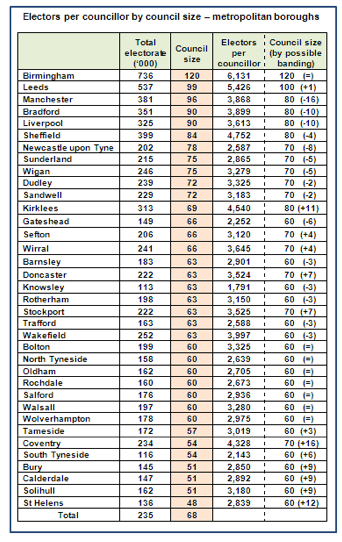
Cllrs table

Hmmm. I can sense you’re containing your excitement, so I’d better explain why I’m bothering you with this stuff when you’ve already got the Greek debt, bombing Syria, Osborne’s budget, child poverty and Wimbledon to worry about. It’s the very top line, showing how Birmingham’s 120 councillors represent by far the largest electorates of any single-tier English authority – and arguably three times that 6,131 number in practice, as all metropolitan boroughs currently comprise entirely three-member wards.

And that’s it? No, but it’s interesting, surely, to have statistical confirmation of the demands we make on councillors by the exceptional scale of our so-called local government. In Birmingham this means having to get yourself known by, and every four years seek the votes of, up to 20,000 voters, who wonder (or ask you aggressively) why they see their ‘local’ councillor only at election times.

It’s interesting too, I think, to have again confirmation of how the Local Government Boundary Commission for England (LGBCE) – whose figures these are concerns itself exclusively with ward/division variance within, as opposed to across, authorities. Just one ward or division exceeding 30% variance from an authority’s electors-per-councillor average qualifies that authority for electoral review. Yet, for instance, the 93% variance between the overall average for Birmingham (incidentally, the 9th most deprived English district) and that for neighbouring Solihull (179th) is brushed aside as, in the words of the Polish expression, “not our circus, not our monkeys”.

But even that’s not it – or not entirely. The timing of the blog is prompted by the possibility/probability that the Commission is preparing to act in a way that would increase that Birmingham-Solihull variance from 93% to around 130%. More specifically, it is understood to have rejected a cross-party submission by Birmingham’s political leaders to retain the 120-member city council at its present size, on the grounds that it “runs counter to recommendations in the Kerslake Review which suggested 100 councillors as a maximum number”.

At which point, I should first mention that ‘council size’ will mainly be used henceforth in the relatively rare but Boundary Commission sense of “the number of councillors elected to serve a council”. Secondly, and more importantly, I should explain this blog’s secondary purpose: to update you on one stream of the action that’s followed last year’s Pickles-initiated review into the governance of Birmingham City Council, led by Sir Bob Kerslake in the months before his retirement as DCLG Permanent Secretary.

Collectively, the Kerslake review’s findings and conclusions were dire. Birmingham was judged a dysfunctional council, with a damaging corporate culture, a micro-managing leadership, poor member-officer relations, an arrogant attitude towards partnerships, with multiple plans and strategies not followed through, and no clearly articulated vision for the city.

The Review produced 10 main recommendations, several with multiple parts. The first and probably most important was the imposition of an independent Improvement Panel to “provide support and challenge” to the Council and oversee the implementation of an improvement plan.

The fourth recommendation, and inevitably one of the most contentious, was that the LGBCE should conduct an Electoral Review to enable the Council to move to what Kerslake felt would be a more effective model for representative governance – namely, replacing (by 2017/18) the current system of election by thirds from three-member wards to all-out elections every four years from single-member wards.

For what it’s worth, it’s a recommendation with which I completely agree. But here’s the thing – size and numbers, views and recommendations. Most of the Kerslake review’s many references to the size of Birmingham City Council seem – though it’s always clear – to be to the Council as an organisation, to its staff, or even to its residential population.

There’s no doubt that the reviewers also weren’t keen on the size of the council in the Boundary Commission sense (p.10). They felt it made the council (apparently in the organisational sense) difficult to run and had encouraged “individual councillors to micro-manage services”. But their major concerns were the size of the three-member wards – which meant “some councillors are struggling to connect their communities with the council – and the pattern of election by thirds, which “has not helped the council’s ability to take strategic decisions.” These were the changes called for in the Electoral Review recommendation, which contained no mention of councillor numbers per se.

Council size was treated differently in the Kerslake review from election by thirds. It easily could have been a whole or part-recommendation, but it remained merely a “view” of the report’s authors that “there needs to be a significant reduction in the current number of councillors” (p.26). I don’t feel this is academic nit-picking. Words have meanings, and, were council members to argue that a view shouldn’t carry the same weight with the Commission as a recommendation, they would seem to have a point.

The 100-councillor figure, moreover, wasn’t even a view, or, for that matter, a maximum; more a conveniently round-numbered illustration (p.26): “For example, by creating 100 mainly single-member wards, the average population of a ward could be reduced to just 10,730 from 13,413. This would result in a direct saving of around £1.6 million over five years.” Note that casual “just 10,730”, which would be nearly half as many again as the highest average ward population of any other single-tier authority, EVEN IF that authority too (Leeds) were forced to switch to single-member wards.

As already emphasized, however, the LGBCE, regards such comparisons as irrelevancies. So, if Birmingham is going to be deemed not to merit a council of more than 100 members, what case will the Commission make to justify driving it even further out of line with other major metropolitan councils?

The Commission’s own 50-page Technical Guidance suggests it sees itself as independent of government, consultative where necessary, and open-minded, with no predetermined views of council size or councillor numbers. It believes each local authority should be considered individually, and dislikes comparisons of council populations and electorates, any mathematical criteria or formulae, and also arguments based either on population projections or future cost-savings. It is evidence-driven, provided the evidence is substantiated and relates specifically to the characteristics and needs of the review authority and its residents – the governance arrangements of the council, its scrutiny functions, and the representational role of its councillors in the local community.

All of which sounds fine. If 120 councillors with already statistically the heaviest workloads in the country with by far the highest population:councillor ratios in Europe can’t effectively justify their own continued existence, then perhaps they don’t deserve one. But then, if the Commission really did start with no predetermined views, why the rumours of it following the apparently cost-driven notions of the ministerially appointed Kerslake review not merely to the letter, but beyond? Odd.

As in so much of our local government practice, other countries have other ways of doing these things. Most democratic countries pay at least lip service to every vote being of equal weight, and therefore start off with a table rather like mine, listing numbers of either registered electors or all residents in each municipality, precisely so that comparisons CAN be made across councils of the same type.

Sweden is, well, Swedish, and details the whole council size procedure in Chapter 5 of its Local Government Act – and then translates the whole thing into English!. For a start – and a very good one, for any voting assembly – all total councillor numbers must be odd.

Second, an electorate-based formula sets MINIMUM numbers, which municipalities themselves may, and regularly do, increase: up to 12,000 electors – 31 councillors; 12,001 to 24,000 – 41; 24,001 to 36,000 – 51, and so on. Stockholm’s 660,000 electors, should any mathematicians be wondering, get just the 101 councillors, not 561.

Of course, not all countries are as Scandinavian in their determination of council sizes – though Purdam et al’s 2008 CCPR Working Paper is still one of the few academic examinations of these matters. But few, unaware of our now constitutional requirement that Manchester be advantageously treated in all things, would see the disparity between that city’s 96 councillors representing an average of 3,868 electors, Leeds’ 99 representing 5,426, and Birmingham’s current 120 representing 6,131 as some bizarre kind of democratic virtue. As for Kerslake’s suggested 10,730, they’d surely dismiss it as some sub-category of ‘ze Ingleesh sense of humeur’.

The table’s final column shows potential council sizes under a rough-and-ready Swedish-type formula, adjusted for the greater size of our metropolitan authorities: up to 200,000 electors – 60 councillors; 200,001 to 300,000 – 70; 300,001 to 400,000 – 80, and so on. Different bandings would obviously produce different results, but this one has Coventry, St Helens and Kirklees as the biggest gainers, Manchester, Bradford and Liverpool as the biggest losers, and Birmingham – well, there’s a coincidence – retaining its current 120 members.

In principle, one possible partial explanation of Manchester’s more generous councillor allocation could be that on current figures it’s the 4th most multiply deprived of England’s 326 district authorities – were it not that, as was noted above, and also in the Kerslake Supporting Analysis noted (p.13), Birmingham is only just behind it at 9th.

Kerslake doesn’t link deprivation to any consideration of council size, but the Scottish Boundary Commission does. In fact, it uses BOTH population size and level of deprivation as two of its three principal criteria for determining council numbers.

North of the border, therefore, Birmingham’s current population size, its dramatic projected growth – an additional 150,000 by 2031 – and its multiple deprivation would all militate against any cut in its councillor numbers. If the English Commission sees things markedly differently, it will be interesting to hear why.

Recall – right for councillors, right for mayors

Chris Game

The topical, and certainly most agreeable, purpose of this blog is to applaud the appointment of illustrator, cartoonist and writer, Chris Riddell, as the ninth Children’s Laureate. The enviably talented Riddell has been The Observer’s political cartoonist for 20 years and is also a writer and multi-award-winning illustrator of children’s books. But before any of that fame and fortune, he generously provided easily the most eye-catching half-page in an INLOGOV undergraduate degree recruitment brochure. His still spiky cartoon captures those history-changing few days in March 1991 when the Major Government dumped Mrs Thatcher’s community charge/poll tax, slashed existing bills by raising VAT from 15 to 17½%, announced what would become the replacement council tax, and saved the 1992 General Election.

Game pic

For younger, or possibly overseas, readers, the distraught pilot of the community charge flying machine with its flying pig emblem (and looking just a little like the late Michael Foot) is Michael (now Lord) Heseltine, then in his second stretch as Environment Secretary, and the VAT balloon man is the Chancellor of the Exchequer, Norman (now Lord) Lamont.

The accompanying sketch has no connection whatever, except that it’s the only art work – as opposed to artwork – I ever actually commissioned for a recruitment brochure, by Rose (Rosetta) Checkley, a then member of our secretarial staff. It shows the Joseph Chamberlain Clock Tower (‘Old Joe’), the unrefurbished Muirhead Tower, where INLOGOV is today, and in the foreground the JG Smith Building, where we were then.

It would be really good now to segue into a blog on, say, the kinds of things Chris Riddell will be promoting or fighting, like school libraries and public library cuts. But I can’t, so instead it’s a Python-style Now-for-Something- Completely-Different moment.

Leaders of England’s 150 largest councils should be receiving about now a letter from Kevin Davis, Conservative leader of the Royal Borough of Kingston upon Thames council, urging them to follow Kingston’s lead in introducing a system of councillor recall.

It’s hardly a new idea. We hear it almost whenever a councillor is revealed to have ‘forgotten’ to declare a significant pecuniary interest, confided their tasteless personal opinions to Twitter and the world, or simply failed persistently to attend council meetings.

It has slowly come to the boil in Kingston, though, after a Liberal Democrat councillor was dismissed from his party group over allegations of falsely claiming more than £3,600 in council tax benefit. He was eventually convicted, but in the long meantime he continued sitting as a councillor and claiming his £7,500 annual allowance.

Moreover, if re-elected, he could have continued doing so even after his conviction, since the offences carried a maximum tariff of less than a three-month prison sentence. Understandably, many constituents were angry that, under existing rules, there was nothing they could do. In future, though, there may be.

Kingston council will vote next month on innovative proposals to give voters the power to sack their local Councillor.  Several suggested scenarios could trigger a petition calling for a by-election. They include a Councillor’s attendance at meetings over a municipal year falling below 20%, conviction of a crime resulting in any prison sentence, and moving their main residence outside the Royal Borough.

If any of these criteria are met, the council’s monitoring officer would decide whether a petition should be launched on the council website calling for the Councillor’s resignation. Ward electors would have three months to sign the petition, and, if more than a third do so, the Councillor would be expected to resign, triggering a by-election.

The ‘expected to resign’ formula obviously reflects the voluntary nature of the procedure at this stage, even if adopted. But Councillor Davis hopes it will be taken up across local government – hence the letter to council leaders – and eventually embodied in legislation.

My guess, though, is that Ministers, however fondly they may currently feel towards the electorate, are likely to be pretty suspicious. For this ‘let’s trust the voters’ business is just the kind of contagious democratic populism they felt had to be stamped on in the last parliament in relation to MPs’ recall.

Some Members – like, as it happens, Kingston’s two MPs, Zac Goldsmith and James Berry – argued for a genuinely voter-initiated recall process. Instead, we had the Coalition’s half-hearted and unconvincing concession that voters will only get even a chance to remove their MP if s/he is actually jailed or fellow MPs give their permission first.

It was a promising opportunity cynically wasted, so it’s encouraging that the recall principle is being kept in the public eye by this Kingston initiative. However, if we’re looking at local government, while being able to instigate the recall of councillors is undoubtedly important, it’s surely even more vital to have a robust procedure in place to remove, if necessary, those with serious executive power.

At present, that means particularly the metro-mayors that the Cities & Local Government Devolution Bill sets as the accountability price for a combined city regional authority to be trusted with Chancellor George Osborne’s “full suite of devolved powers” over transport, policing, economic development, health and social care.

Obviously, elected executive mayors don’t constitute the only, or even necessarily the best, model of city or county regional leadership and accountability.  It reeks, particularly ironically for a devolution policy, of one-size-fits-all, and it’s almost nationally embarrassing that this and previous governments haven’t cared enough to compare and consider models deployed effectively in other European cities: leaders’ boards, elected and unelected assemblies, standing conferences of key stakeholders.

But sadly, that’s not how UK governments work, of any political colour. They use parliamentary majorities backed by a quarter of the registered electorate to enact dogma-driven rather than evidence-based policy, and this government’s devolution dogma is metro mayors, at least for city regions.

In a governmental system as centralised as Britain’s, therefore, if elected mayors are the government’s condition for ‘far-reaching devolution’, and it was in the party’s election manifesto – as metro-mayors were – you work with and try to make the best of it, which in this case should mean including in the legislation an electoral recall procedure.

That’s what Germany did in the early 1990s. After decades of different local government systems in each of the four Allied occupational zones, and following the country’s reunification, there was throughout the Länder what one commentator described as a “bushfire-like spread of the direct election of mayors”, driven by concerns about performance and democratic deficits.

Bushfires tend not to consult much before they spread, and neither did the Länder governments. They legislated and imposed.  BUT, as a quid pro quo, all the newly mayoral Länder also legislated procedures whereby a sitting mayor could be removed from office through a local referendum – a direct democratic instrument to hold the mayor politically accountable. It was obviously inspired by the recall mechanism used widely in the US, though, with all mayoral municipalities having elected councils, in some Länder the actual referendum is triggered by, say, a two-thirds majority vote of councillors, rather than by a citizen petition.

In the week when Tower Hamlets voters elected a mayor to replace one they themselves played no direct part in removing, it is worth emphasising the importance of both the existence and accessibility of these recall mechanisms in easing German citizens’ early acceptance of what for most was an alien institution.

They had their teething problems – in Brandenburg, for instance, whose voters were so taken by their new democratic power that mayoral recall became for a time a new popular sport: ‘Burgermeisterkegeln’ or playing bowling with the mayors. Generally, though, the prominence given to recall proved both good politics and good government – as surely it would be here.

Chris Game - pic

Chris Game is a Visiting Lecturer at INLOGOV interested in the politics of local government; local elections, electoral reform and other electoral behaviour; party politics; political leadership and management; member-officer relations; central-local relations; use of consumer and opinion research in local government; the modernisation agenda and the implementation of executive local government.

Metro mayors: this time at least feels different from 2012

Chris Game

Despite what service users doubtless feel on occasions, things can move quite fast in local government. Four weeks ago (from when I’m typing this) many of us were anticipating a Labour-led government. Three weeks ago in these columns Daniel Goodwin reported George Osborne’s Manchester announcement that the Conservative Government’s Queen’s Speech would include a Cities Devolution Bill. In the actual Queen’s Speech, eight days ago, it was renamed – to general approval – the Cities and Local Government Devolution Bill (CLGDB).  Six days ago the Bill was published, together with Explanatory Notes, and received its First Reading in the Lords. Next Monday it will be generally debated and receive its Second Reading.

It seemed a little remiss that since Daniel’s blog we’ve not posted even a comment on something that could bring the most significant power-shift in English government in generations, so I thought I’d give an airing to my thoughts on metro mayors. Which is fine, if you know where they fit into the CLGDB. But just in case, I’ll start with an albeit cumbersome one-sentence précis of what it thinks it’s about.

The Bill aims to boost growth and increase local government efficiency, by legislating to deliver the Greater Manchester Devolution Agreement and other future combined authority deals – in large cities which choose to have elected mayors, but in other places too [hence the Bill’s name change] – as part of a devolution strategy of moving powers out of Whitehall and building a Northern Powerhouse.

The rest of this blog is a slightly nerdy look at why most of these large cities don’t have elected mayors already. And my chance starting point is that the weekend before the Queen’s Speech I happened to read More Human: Designing a World Where People Come First, the manifesto-style book written by Steve Hilton and two Stanford University colleagues, and extensively plugged, reviewed, commended, and pompously rubbished over recent weeks.

Hilton is best known here as, from 2010 to 2012, David Cameron’s ‘blue-sky thinker’ and strategy adviser. His book is not about local government per se, but, as its title intimates, it contains much of interest, once you sift the perspicacities from the platitudes, to anyone sensing that our own local government scale and structures too often hinder rather than assist our instincts to behave more humanly/humanely.

As it happens, I enjoyed it, but its mention is mainly to enable me to quibble with its author. Specifically, I question Hilton’s accusation, in an interview with The Sunday Times’ Camilla Cavendish (May 17), that the Coalition’s failure in 2012 to introduce elected mayors to most of England’s biggest cities was due to the policy’s ‘sabotage’ by the Lib Dems in general and Nick Clegg in particular – rather than to, say, general ministerial neglect and incompetence.

Nowadays it’s Conservative policy to blame the Lib Dems for everything – including not winning enough seats to prevent the Government having to implement the nastier parts of its manifesto. But to hold their ex-leader responsible for voters in nine of 10 cities rejecting elected mayors amounts to rewriting history – highly relevant history too, for, as already noted, metro mayors are back in a big way.

Chancellor George Osborne has been commendably transparent and consistent about his enthusiasm for them. If a combined metropolitan authority, like the West Midlands, aspires to a “full suite of devolved powers” – city-wide responsibilities for transport, policing, economic development, health and social care, plus worthwhile fiscal discretion – the accountability price includes an elected metro-wide mayor who “takes the decisions and carries the can”.

Exactly which decisions will be in the mayor’s can and which in the combined authority can is still unspecified, though we may learn more in Monday’s debate. It is clear, though, and worth emphasising, that the very fact of devolved functions being divided between mayor and authority means that, to quote the House of Commons Library blog, “this is emphatically not the ‘London model’ of a strong elected mayor controlling city-wide public services” that enthusiasts would favour and detractors fear.

But mayors there will be, without any further referendums, because, ministers insist, it was all covered in a sentence on page 13 (lucky for some) of the Conservative manifesto: “We will devolve far-reaching powers … to large cities which choose to have elected mayors”.

Cities which choose – or, rather, cities whose leaders choose. Certainly for new combined authorities, there will be no imposition of mayors, which antagonised so many last time. Osborne’s challenge to existing city council leaders is simple: elected mayor = far-reaching powers; no elected mayor = no far-reaching powers. Your call.

This time, therefore, things really are different from 2012.  There’s a very senior minister – in fact, with Communities Secretary Greg Clark, two senior ministers – genuinely committed to devolution; the devolvable powers are more explicit, more realisable, and more substantial; and we’re talking not cities but city regions.

The fact remains, though, that this case would be far easier to make, certainly to the public, had not nearly a million city voters participated just three years ago in referendums that decisively rejected mayoral models of government.

So back to Steve Hilton, who, as strategy adviser, foresaw the difficulty. If there’s an iron law of referendum drafting, it’s to have your preference as the status quo – staying in the EU, retaining an up-and-running mayoral system – and as the positive Yes option.

“That’s why Michael Heseltine and I felt it important that people experience the difference a strong mayor could make before they were invited to take a view” (my emphasis). Fine – but now Hilton’s memory begins to fade.

“Both the 2010 Conservative manifesto and the Coalition Agreement”, he claims, “pledged to introduce a mayor to the biggest cities and to let people vote later in a ‘confirmatory referendum’ (my emphasis). “The Lib Dems reneged on that deal.  When a question was asked in parliament, Clegg made clear there would be no mayors without referendums”.

Here, Hilton is WRONG, in almost every particular. There was no deal or publicly shared understanding, because the key phrase in both manifesto (p.76) and Coalition Agreement (p.12) was, presumably deliberately, left ambiguous: “We will create directly elected mayors … subject to confirmatory referendums …” (my emphasis).   Mayors first, or referendums – Hilton, and everyone else, could claim whichever they preferred.

Prior to the Localism Bill’s publication in December 2010, different (Conservative) ministers gave completely conflicting statements. Communities Secretary Eric Pickles reassured MPs: “Of course we will not [impose mayors]. That is completely out of the question” (col. 1117) – following which his Bill proposed doing precisely that.

As minister, Pickles would have powers under Section 9N of the Bill to order a council to create a ‘shadow mayor’ in 2011, and to operate a mayor/cabinet form of governance until it be confirmed or rejected in a 2012 referendum – in short, the Hilton/Heseltine formula.

The Lib Dems have never, as a party, liked mayors, but opposition to their apparent imposition on unconsulted local authorities was near-universal – through most of the local government world, all major parties in the Lords, and particularly the city councils directly affected. Shadow mayors were finally dropped from the Bill on the very first day’s debate of its Lords committee stage in June 2011, the announcement made not by Clegg, but Conservative local government minister Lady Hanham (col. 1062).

The following May, nine of the 10 ‘big city’ referendums rejected elected mayors by majorities ranging from Manchester’s 53%, through Birmingham’s 58%, to Sheffield’s 65%. The exception was Bristol, swiftly rewarded by being invited with London to jointly host this October’s inaugural Global Parliament of Mayors.

Despite there being over 30,000 directly elected municipal mayors in EU countries alone, the global dimension in the 2012 referendum ‘debate’ barely stretched beyond The Simpsons’ Diamond Joe Quimby and New York’s 9/11 hero Rudy Giuliani. Generally, the Yes campaigns were half-baked and the No campaigns puerile – Birmingham’s intellectually challenging contribution being ‘Vote No to a Power Freak’. Serious information and ministerial leadership were as minimal as they were six months later in the Police and Crime Commissioner elections.

Yet most, if not all, of these referendums were almost certainly winnable. Early campaign opinion polls showed clear majorities of respondents in favour of their city having a directly elected mayor – 53% to 37% in Birmingham, 54 to 23 per cent across the five South and West Yorkshire cities. That the referendums were lost, and that public opinion today is far more negative than it was then, is attributable not to Clegg and the Lib Dems, but to Conservative ministerial indifference and leadership failure.

One thing the Government both could and should have done, and advocated at the time in these columns, was to introduce a power of recall, to deal with the frequently raised concern of voters being unable – unlike in some other mayoral systems – to remove an elected mayor in whom a large proportion subsequently loses confidence.

It should have been done, because ministers said they would in the Localism Bill’s 2011 impact assessment (p.9): if mayors were going to exercise additional powers, the accountability regime should include a recall mechanism.

Like Osborne’s famous balanced books, the “later date” at which it was supposed to happen never arrived. So, if we’re to accept his dogmatic insistence that elected mayors and only elected mayors will meet his accountability requirements, now would be a good time to resuscitate recall and hurry it along.

Chris Game - pic

Chris Game is a Visiting Lecturer at INLOGOV interested in the politics of local government; local elections, electoral reform and other electoral behaviour; party politics; political leadership and management; member-officer relations; central-local relations; use of consumer and opinion research in local government; the modernisation agenda and the implementation of executive local government.

400 heads are better than one: Tales from a public management conference

Sue Olney

With more conferences and events happening each year, deciding on where to share your practice and research findings and where to seek professional development is challenging. It can help to know more about key conferences and how they may inform your work or be a vehicle to share your insights. In this post, Sue Olney (@olney_sue) gives us an overview of the International Research Society of Public Management Conference hosted by INLOGOV, and provides some highlights as well as links to interesting sessions. 

The annual conference of the International Research Society for Public Management (IRSPM) attracts delegates from around the world interested in new developments in public management and the implementation of public policy. The theme of the 19th annual conference, held at the University of Birmingham from 30 March 2015 to 1 April 2015, was hosted by INLOGOV and titled Shaping the Future – Reinvention or Revolution? In a packed program around four hundred academics, new researchers and policy practitioners shared their insights and research into the potential for public organisations and their partners in delivering public services to respond, reflect, reinvent, and revolutionise in the face of fiscal, political, environmental and cultural upheaval. Australia was well represented by policy luminaries including Gemma Carey, Helen Dickinson and Helen Sullivan, Jenny Lewis and Damon Alexander,Siobhan O’Sullivan, Brian Head, John Alford, Jo Barraket, John Halligan,Owen Hughes, Warren Staples, Deborah Blackman and Janine O’Flynn.

As a first-time attendee moving from implementing social policy into research I was encouraged by the strong links between scholarship and practice evident at the conference. The opening plenary, involving ex MP, ex civil servant and international policy activist Clare Short, community activist Jess Steele, Councillor and Birmingham City Council Cabinet Member for Children and Family Services Brigid Jones and Local Government Ombudsman Jane Martin and chaired by the University of Birmingham’s Chris Skelcher, promised a ‘citizen’s-eye view of public services’ and unflinchingly explored the challenges of developing and implementing policy in the context of competing priorities, diverse and sometimes incompatible demands, scarce resources, outsourced and fragmented government services and shrinking government bureaucracy. The panellists argued that citizens should be encouraged and empowered to play a greater role in identifying and addressing local issues but acknowledged that public sector reform over the last two decades – marketisation, outsourcing, commissioning, internal cost-cutting and the individualisation of social services – has muddied the waters for collective action. They also argued that these changes have sapped the bureaucracy’s ‘motivation to serve’ and called on governments to find new ways of working with citizens to ensure innovation is not stifled by accountability in tough economic times. The plenary segued into fifty three panel sessions over three days tackling complex questions about the role of government, public value, austerity, inequality and the relationship between evidence and policy, under themes ranging from what citizens and governments expect of public servants; local governance; democracy, third sector and citizen engagement; sectoral challenges in public management; research and knowledge utilisation in public management; resources, accountability and technology; public-private partnerships; public management in developing and transitional states; and networks, complexity and innovation.

The conference closed with the University of Melbourne’s Helen Dickinson, the CEO of Skillshare International Cliff Allum and experienced health and social care executive Cynthia Bowerreimagining the 21st century public servant as a commissioner, storyteller, resource weaver, system architect, networker, municipal entrepreneur and broker, in a hopeful and thought-provoking plenary chaired by the University of Birmingham’s Deborah Youdell. In between, we attended a civic reception with the Mayor at Birmingham’s Council House and a gala dinner at the International Convention Centre next to the spectacular Birmingham library.

I gravitated toward sessions about the third sector and spent the conference torn between keen interest in the research into policy struggles on this front and despair at the pervasiveness of market approaches to delivering public services. There were numerous examples of policy development affecting the most vulnerable members of society running counter to evidence, with governments appearing to favour short term fiscal and political gains over long term social change. Two very different papers likely to interest readers of this blog are Exploring the public-third sector boundary – designing and managing a dynamic partnership for innovative services with young people , which found that while the third sector is an important player in the coproduction of services for hard-to-reach young people its diversity produces mixed results – a challenge for governments wanting to replicate programs – and The New Intersections of Philanthropy, the Third Sector and Public Policy: Revealed, Reinvented, Revolutionised?, which explores the changing nature of philanthropy where ‘giving’ is being replaced by ‘social investment’.

All the conference papers are available online here and there is unfiltered commentary on the conference as it rolled out on Twitter under #IRSPM2015. The real value of gatherings like these is the opportunity for researchers to test their ideas, to defend or strengthen their theories in response to expert feedback or what they learn from listening to other people, and to forge international alliances to build new knowledge. If two heads are better than one, a conference-load is bound to be pushing research into public management in the right direction.

Sue Olney

Sue Olney has worked in the public sector, the private sector and the not for profit sector and participated in numerous cross-government and cross-sector initiatives to promote access and equity in education, training and employment in Australia. She is doing a PhD at the University of Melbourne on employment services for the long term unemployed and recently presented some of her findings at the IRSPM conference in Birmingham.

This blog post was also posted here on the 8th May, 2015

A new typology of local government systems

Pawel Swianiewicz Typologies of the European systems of local government are important and frequent point of reference for many scholars. But the trouble for scholars from my part of Europe is that the most popular classifications concentrate on Western part of the continent, totally disregarding the post-communist Central and Eastern Europe. After 25 years from the political turn-over and from the fall of the Berlin Wall, the numerous attempts to include the whole of Europe usually end up with putting the whole of Eastern Europe into one basket of democratizing and decentralizing societies. Such an approach could be justified in the 1990s, i.e. in the early stages of political and economic transformation, when the new local government systems were in flux, and it was difficult to find any stable patterns. But after more than 20 years, and after over decade since a group of those countries have joined the European Union, such an approach seems to be much anachronistic. Nevertheless, even relatively recent works on Heinelt and Hlepas (2006) or Loughlin et al. (2010) sustain the scheme of treating the whole group of East European countries as one, a relatively homogeneous cluster, which is considered separate from the rest of European local governments. They argue that “they are considered as a distinct group because of their historical background and in particular recent radical decentralization in these countries” (Heinelt and Hlepas) or that the group “Shares a common experience of communist dictatorship… they also share a common experience of the transition to democracy and preparation for, and accession into, the European Union [their analysis ignored countries of Eastern Europe other than those who became new member states of the EU in the 2004-2007 period – P.S.] … The legacy of that period was political systems marked by high levels of centralization and uniformity” (Loughlin et. al. 2010). My recent article “Empirical Typologies of Local Government Systems in Eastern Europe” demonstrates the weaknesses of such approach. It shows the diversified universe of the eastern part of the continent in regards to their territorial arrangements and decentralization strategies. The variation is probably not smaller than among West European countries, covered by classic typologies of Page and Goldsmith (1987) or Hesse and Sharpe (1991). The article develops a new typology of local government systems in Eastern Europe. Obviously, it is just a first step towards the integration of our knowledge on local governments across the whole Europe. The next step would be to bridge a gap between typologies covering both parts of continent, and to paint a single, coherent landscape of decentralized Europe. One may expect that this next step will be made relatively soon, and the article is one such contribution efforts of re-unification of academic research on local government studies across the whole of Europe. Pawel Swianiewicz Pawel Swianiewicz is a professor of economics at University of Warsaw, Head of the Department of Local Development and Policy at the Faculty of Geography and Regional Studies. His research and teaching concentrates on local government finance, local politics as well as territorial and decentralization reforms in Central and Eastern Europe. Adviser on local government issues to the President of Poland since 2010. Between 2005 and 2010 – President of the European Urban Research Association.

Professor Swianiewicz’s prize winning article related to this post is published in Local Government Studies 

A day for devolution

Daniel Goodwin

Thursday 14th May 2015 might not see celebrations in 800 years’ time in quite the same way as Monday 15th June 1215, which saw the sealing of Magna Carta. However it did see two events which are quietly momentous in local government terms. In the morning the Core Cities launched their Devolution Declaration in London, setting out five actions that they sought from government. And in the afternoon, in Manchester, George Osborne appeared to meet the first of these by announcing that the Queen’s Speech would include a Cities Devolution Bill, granting powers over housing, transport, planning and policing.

The Core Cities were caught by surprise and, whilst apparently delighted, had to make hasty arrangements to be present at the announcement. It remains to be seen whether the other actions set out in their package of measures will be implemented quite as speedily, time will tell. However they include a devolution commission, a place-based Comprehensive Spending Review, much broader fiscal retention and devolution and a Constitutional Convention to address UK-wide issues.

There has already been much comment in the local government press and on social media about the two events, so I will not try to summarise them here. However I am struck not only by the pace of change, but also the tenor of the debate. I have compared these with the points made by INLOGOV in its response to the Political and Constitutional Reform Committee’s work on codifying the UK constitution.

We considered that any form of devolution will need to be addressed in the round. It should not just bolt on new service or tax based powers. Our response considered that there needs simultaneously to be a review of the responsibilities of individuals, communities, cities, regions and countries within the UK. In doing so it should also consider the questions of the extent of devolution of local government within all four countries and not just restrict itself to England. We considered that there should be some key guarantees on local determination, perhaps in line with the European Charter for Local Self Government, to which the UK is a signatory.

The 2015 General Election has left the UK with a highly diverse political picture in the four nations and at the more local level within them. The Government’s challenge is to find strengths in that diversity and prevent it turning into division. The key question is whether the changes will provide sufficient means of self-determination and self-government and embed these effectively in the as yet unwritten constitution. This will depend on the extent to which they are founded on community leadership and capability rather simply expediency in facing service cuts. Will the discussion be one about the principles of power sharing rather than long-winded discussions about structure? Can we have a debate on the future of the UK as a modern nation rather than one focused on service structures in England?

The Core Cities are to be commended for setting out their Declaration. It is an ambitious document which sees the challenge as ‘working together nationally and locally in a different way [to] transform the lives of millions and ensure our country can compete in an increasingly globalised and complex world’. The Cities Devolution Bill, with careful attention to principle as well as expediency and in the context of wider constitutional renewal, could just be the way to start to make that happen and help to address the wider devolution challenges which the UK faces following the General Election.

Know your local Councillor Photographs - St Albans - May 2008

Daniel Goodwin’s career has mainly been in local government, starting in libraries and cultural services and progressing through policy and corporate services. He is particularly interested in policy into practice issues, the links between strategy and finance, local leadership and the politics of communities and place. He is a regular contributor to journals, conferences and seminars.