The Cameron-Hudspeth letters: the gift that keeps on giving

Chris Game

‘The gift that keeps on giving’ – originally a US 1920s marketing slogan for a new phonograph/gramophone, it’s since been applied to anything from magazine subscriptions to sexually transmitted diseases. And now, for the distraction and delectation of a local government world waiting anxiously for the Chancellor’s Autumn Statement, we have the almost-too-good-to-be-true exchange of letters between David Cameron and Ian Hudspeth, Conservative leader of Oxfordshire County Council.

It’s just conceivable – though hard seriously to imagine how – that the correspondence might have remained private. Even leaked out in mid-September, when the exchange took place, it might have been lost in the mass coverage of Corbyn and the party conferences. But, thanks largely to the media’s hesitancy to touch anything even vaguely technical to do with local government finance, it’s oozed out almost day by day. Well into its second week as I write (November 15th), it’s still exuding, but is surely already established as the classic case of a PM going out of his way, and possibly beyond his remit, to demonstrate how little he comprehends about the consequences of his own government’s policies – until, of course, the next case comes along.

The sequence of events has been as follows:

September 14th – Cameron [MP for Witney, Oxfordshire] writes on Commons notepaper to Ian Hudspeth at his home address, detailing his disappointment “at the long list of suggestions floated in the [County Council’s 2016-17 Budget] briefing note to make significant cuts in frontline services – from elderly day centres, to libraries, to museums.” He also offers “to initiate a further dialogue with advisers in the No10 Policy Unit and yourself – please contact Sheridan Westlake [PM’s Special Adviser – No10 email address given], if you wish to take this up.”

September 22nd – Hudspeth replies with detailed 6-page refutation, and accepts the Sheridan invitation.

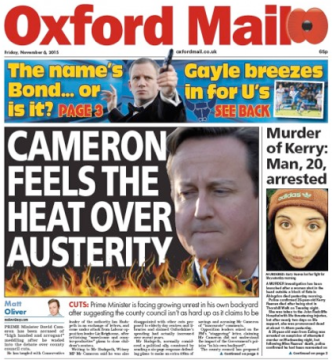
November 6th Oxford Mail’s Matt Oliver writes front-page story based on the gaping divergence of views and statistics revealed in the evidently leaked letters. BBC 1’s Breakfast programme leads on the story, but without crediting the Mail, for which it later apologises.
Game

Oxfordshire County Council (OCC) publishes, as part of its budget consultation, some “more background information to help people understand our budget position” – including a funding graph, showing how (contrary to Cameron’s assertion) the council’s “overall funding is going down, and the balance between local and government funding [of local government] fundamentally changing”.

November 7th – 9th – Despite the BBC coverage, the story is largely ignored by the national media over the weekend, though picked up on the Monday by the Mirror and on subsequent days by the broadsheets.

November 11thThe Guardian’s George Monbiot writes the first really detailed and documented story – “The PM hasn’t the faintest idea how deep his cuts go. This letter proves it”.

November 12th – Labour finally realises this could be not just a ‘PM clueless’ or ‘PM’s hypocrisy’ story, but a ‘PM flouts Constitution’ one. Shadow Cabinet Office Minister, Jonathan Ashworth, writes to Cabinet Secretary asking for a ruling whether Cameron, in apparently conflating his roles as minister and constituency MP, has broken the ministerial code. The code says: “Ministers are provided with facilities at government expense to enable them to carry out their official duties. These facilities should not generally be used for party or constituency activities.”

As I said, it’s one of those gifts that keeps on giving. Stand by for a Clintonesque Lewinsky defence: “It depends what the meaning of ‘generally’ is”. This, though, is a local government blog, interested primarily in the two letters’ core contents. It’s not easy to summarise Hudseth’s long, detailed missive – explaining, as Monbiot put it, each issue gently, as if to a slow learner – but I’ll try, using the leader’s own assertion-refutation format, to convey something of both its explicit substance and (in italics) its implicit spirit. It’s also worth adding, that, according to the DCLG English Indices of Multiple Deprivation 2015, Oxfordshire is ranked 9th least deprived of 152 upper-tier local authorities (File 11).

Assertion: “Oxfordshire’s spending has actually increased in recent years …”

Refutation: Only if you believe your government’s own ‘spending power’-driven propaganda, ignore the council’s additional responsibilities – particularly public health and the new burdens related to adult social care – and forget that additional Better Care Funding for adult social care is not new money, but has been at the expense of funding for NHS services (see also https://inlogov.com/2015/01/21/the-fairness-or-otherwise-of-the-2015-16-local-government-finance-settlement/).

OCC’s employment (excluding schools) has fallen by 37.4% since April 2010; and, according to the DCLG’s own figures, grants from central government (excluding housing benefit and other service-specific grants) have been cut by 36.3% overall in real terms, and local authorities’ total revenues have fallen by 19.9%.

Assertion: OCC is not following the best practice of other Conservative councils.

Refutation: You seem to have no better understanding of the circumstances of the area you represent and of your electors than you do of local government finance. OCC’s reducing budget starts out from a low base – under £300 per capita from the UK taxpayer (excluding fire services), compared to an upper-tier/unitary average of around £500, and £900+ for authorities such as Westminster. If the Council Tax referendum threshold had permitted us to make the planned modest increase of 3 – 3.75% over the decade, we would be facing £50 million less of required savings.

As a thriving economy, growing more quickly than London since the recession, our overall population is projected to rise over 13% between 2009 and 2020. The elderly population, who generate the largest social care demand, will grow from under 15,000 to over 20,000 in the present decade and more rapidly still thereafter, generating cost pressures of £30 million in the annual budget. The other big area of cost growth has been children’s social care. We currently have 574 children in care at an average cost of £49,000 p.a., and relevant budgets have increased by 60%, from £40 million in 2009-10 to £64 million.

Assertion: The £204 million your briefing note said had been taken out of the budget since 2010 is a cumulative figure that includes efficiency savings from cutting waste.

Refutation: (No italics required) “I cannot emphasise enough that £204 million is NOT a cumulative figure. Rather, it is the amount we have saved annually by 2014/15. The cumulative savings since 2010/11 are in fact £626 million.”

Assertion: I would have hoped that Oxfordshire would be following the best practice of Conservative councils across the country in making back-office savings and protecting the frontline.

Refutation: You really don’t get it, do you! Our significant savings over recent years have included taking as much from the back-office as possible through our in-house shared service arrangements. From this July, ongoing savings in this area will be secured via our new partnership with Hampshire County Council. In addition, we have undertaken a major review of our management structures across the council since 2010, making significant cost savings through cutting 40% of our two top tiers of management and 50% of our third-tier managers.

I trust you’ll have got the gist; if not, there’s another five pages or so in much the same vein. My guess is that, while he may just keep his place on the Camerons’ Christmas card list, Mr Hudspeth probably won’t be joining them for New Year’s Eve karaoke and ‘dad-dancing’.
 

Chris Game - pic

Chris Game is a Visiting Lecturer at INLOGOV interested in the politics of local government; local elections, electoral reform and other electoral behaviour; party politics; political leadership and management; member-officer relations; central-local relations; use of consumer and opinion research in local government; the modernisation agenda and the implementation of executive local government.


Pro-Christian, Anti-Muslim or Anti-Refugee? What is behind European politicians’ statements favouring Christian refugees?

Vivien Lowndes and Roda Maziva

In the midst of what has come to be known as the worst refugee crisis of our generation, the wrench­ing images of a toddler lying dead on a Turk­ish beach emerged as evidence of a reality that cannot just be captured in words. This has seen many calling for the need to shift the debate away from borders and security and towards asylum, solidarity and responsibility. Yet, in the midst of this humanitarian talk, a new rhetoric is emerging which suggests that the lives of some refugees have more value than others. In particular, the anti-Muslim rhetoric by some politicians in Australia and other European countries such as France, Slovakia, Poland, the UK and many others have widely been judged as discriminatory and a perversion of liberal values especially hospitality, compassion and inclusion.

The Polish Prime Minister, Ewa Kopacz was cited as saying “Christians who are being persecuted in a barbaric fashion in Syria deserve Christian countries like Poland to act fast to help them”. The former Australian Prime Minister, Tony Abbott had reportedly been under pressure from the Coalition Members of parliament who pressed for the need to prioritize Christian refugees from the Middle East as they were perceived to be the “most persecuted in the world” and therefore “the most needy”. In France, a Member of Parliament and Mayor, Yves Nicolin, was heavily criticized for vowing to only accept refugees in his town on the condition that they were Christians and not ‘disguised terrorists’. While such sentiments may imply a welcome for Christian refugees, there seems to be a gap between rhetoric and practice in the absence of a well-defined protection plan or selection process, not least because distinguishing between Muslim and Christian refugees is not actually a clear-cut process.

Our research with Pakistani Christians suggests that processes to determine refugee status do not map onto any clear distinction between welcome Christians and unwelcome Muslims.  Indeed, Christian refugees from Muslim-majority countries face special difficulties in putting forward their asylum case, and in negotiating community relationships.  Like thousands of Christians fleeing war and Islamic State in Syria, Pakistani Christians come to the UK under fear and trauma. They are seeking to escape discrimination, persecution and harsh blasphemy penalties in the context of the Pakistani government’s limited action to prevent religiously-motivated violence. For those who have fled and managed to reach the UK for safety and protection, arrival in the UK is not the end to their traumatic experiences, as our interviews, focus groups and case reviews demonstrate.

Ironically, Pakistani Christians’ experience of seeking asylum in the UK is characterised by a putative Islamophobia.  Like Pakistani Muslims, they are frequently received with suspicion as an unwelcome population of a particular ethnic and national origin, with an ascribed Islamic religious identity. In the context of Islamaphobia,  perceptions of Muslim extremism are associated with particular bodies and nationalities. Thus, the conflation of nationality and religion has seen Pakistani Christian asylum seekers being invariably treated as suspects first and ‘welcome-Christians’ second (if at all).  The assumption seems to be that all migrants from Muslim majority countries, by virtue of their place of origin, are potentially dangerous and therefore unwanted.  The refugees we worked with were traumatised by the experience of double-discrimination, often backed up by actual or threatened violence – in Pakistan as Christians and then in the UK as presumed-Muslims.

In seeking asylum on religious grounds, our respondents reported that their testimonies often fell foul of understandings of Christianity that were ill-suited to the Pakistani context from which they had come.  In addition, our respondents alleged that Home Office translators of similar national heritage, but from the Muslim majority, were ignorant of appropriate language to describe Christian experiences, and even undermined or manipulated accounts in a discriminatory fashion.

Our research raises serious questions of whether the current Christian/Muslim binary discourse could simply be a political cover for both Islamophobia and refugee-phobia.  Such rhetoric needs to be seen in the context of a highly controversial political debate over the policy measures that Europe should adopt in order to protect the humanity of thousands of uninvited, yet desperate migrants arriving daily on its shores.  Not all refugees arriving from the Middle East are Muslims. Christian refugees arrive daily from Syria, Eritrea, Afghanistan and Iran.  Among Syrian refugees, there are also other religious minorities including Druze and Yazidis.

The unfolding refugee crisis has been characterized by the European Union’s struggle to get its member states on board to address what is, in reality, a shared problem.  The UK has refused to engage with the transnational project of coordinating access and settlement, yet against the backdrop of an overwhelmingly expression of sympathy for the refugees from its publics. The Home Secretary, Theresa May’s infamous speech to the Conservative conference in October 2015 stated that a ‘chosen few’ Syrian refugees would be identified in refugee camps through the UN High Commission for Refugees.  They would then be processed under conditions which spell out the point that those who benefit are the lucky recipients of a gracious favour rather than a right under international humanitarian law.

The British government, to its credit, has not proposed any religious selection criteria in its (highly restrictive) refugee policy.  But its intention to take refugees directly from camps in Syria could have serious side effects.  Due to religious discrimination in Syria, this policy may be particularly disadvantageous to refugees from non-Muslim backgrounds.  One of our research participants, with extensive experience of working with Christian asylum seekers from Muslim majority countries, explained that:

‘The way the UK government plans to get refugees from Syria is very likely to be detrimental to Christians. Because they plan to get people from the refugee camps, as Christians don’t feel safe in a refugee camp, so they tend to hide, seek for routes to escape where possible or just stay where they are no matter how hard the situation is for them. So they’re among the most vulnerable of the vulnerable, but they would actually be missed by the government’s approach’

In addition, the Director of the Migrants Rights Network has pointed out that the system that the UK has put in place represents a sub-standard version of refugee protection as temporary status. The future of all Syrian refugees largely depends on ‘safe return reviews’. This in turn leaves government authorities with the power to repatriate Syrian refugees whenever it is deemed safe to do so.

Our research suggests that the term ‘Muslim’ is increasingly being used as synonym for ‘Refugees’ or ‘Migrants’ or ‘Unwanted persons’, especially in the case of the Western member states that are either unwilling to admit refugees of whatever faith or seek to minimise the numbers of refugees they can settle into their territories. We have also found that expressing a preference for Christian refugees may simply be a way of deflecting responsibility for refugees in general, rather than reflecting any serious engagement with the complex experience of Christians fleeing the Middle East. These types of policy pronouncements are actually a disservice to refugees of all religious backgrounds.  Religion should play no part in the selection of refugees (directly or indirectly), but asylum claims based upon religious persecution need to be taken seriously.

The authors Vivien Lowndes (INLOGOV, University of Birmingham) and Roda Madziva (University of Nottingham) and  are researching the experience of asylum seekers as part of a Leverhulme funded programme Making Science Public: Opportunities and Challenges’, led by the University of Nottingham.

Vivien Lowndes photo

Professor Vivien Lowndes is involved in research, teaching and knowledge transfer on local governance and public services. She is particular interested in partnerships, citizen participation, and gender issues. Currently Vivien is working on the development of Combined Authorities in the context of devolution, local government responses to austerity, Police and Crime Commissioners’ gender policies, and the use of evidence in migration policy. With colleagues at INLOGOV, she is also engaged in comparative research analysing innovative governance institutions in the UK and Brazil.

roda

Roda Madziva is a Research Fellow working on the use of evidence in public policy as part of a Leverhulme funded programme, ‘Making Science Public: Opportunities and Challenges’, led by the University of Nottingham.


Skills? What Skills!

Maximilian Lempriere

At a workshop hosted in early November by City-REDI, INLOGOV,The Public Services Academy at the University of Birmingham practitioners and academics from the world of local government came together to share experiences on the current Combined Authorities and city-region devolution agenda. In the second of a series of posts Max Lempriere, a doctoral researcher studying the formation of combined authorities, reflects on the days major talking points.  This blog is also posted on  www.lgnk.org.

One recurring theme that stood out in our discussions on potential problems with establishing effective systems of leadership and governance for Combined Authorities and mayors was the integral role that the mayor needs to play to develop and maintain collective and collaborative models of leadership. Previously in this series of posts we saw that the mayor needs to tread carefully to neuter clashes of identity, but their skill-set needs to extend far wider.

First, they need diplomatic skills. They will need to tread a careful path between council Leaders and Chief Executives. Leaders in particular are used to having the last say over key policy and political decisions affecting their areas. It isn’t overly cynical therefore to expect that the arrival of a new (directly elected) kid on the block is bound to cause additional tensions. Many of the mayors will be ‘independents’ free of the constraints and pressures resulting from the need to balance conflicting views within the group and the council. Even if mayor and combined authority leaders represent the same political party this isn’t enough to guarantee congruence of visions and policies. If the mayor has a different vision to the existing Leaders members it is unclear how this tension will be reconciled.  Importantly, he or she will need to rely on the support of constituent council Leaders for approval of the budget, meaning that unless internal unity can be achieved the mayor may prove to be somewhat of a lame duck.

Second, they need a thick skin. Osborne’s idea is that mayors act as a single point of accountability for both local citizens and central government officials. The logic behind this is commendable, but it may leave the mayor between a rock and a hard place. Central government (and in particular the Treasury) has made it clear in the various devo-agreements that central oversight is built into the governance arrangements, so there may well be pressures for arms-length control of combined authorities through the mayor. Yet their allegiances lie with the combined authority; can they please both at once? Unlikely. Will this leave them open to criticism from either side? Probably.

Third, they need to be electable. Ultimately it is down to voters to decide whether or not to keep the mayor in a job, so they need to work hard to keep the public on board. Will this be possible? One danger is an expectations gap amongst voters, who misunderstand what falls inside and outside the mayor’s legislative remit. What’s more, the mayor as an institution doesn’t yet garner widespread public support, meaning that any attempted power-grabs are likely to be fiercely resisted. Similarly, it is likely that whenever the combined authority is seen to falter the mayor will be in the firing line, regardless of whether it was central government, Combined Authority members or the mayor themselves that are strictly to blame. The mayor is designed to be the accountable figurehead of the authority, but they should be careful not to oversell themselves or raise voter expectations. Without public support they lack legitimacy, without legitimacy the mayor cannot lead the combined authority and without effective leadership the combined authority is weakened.

The list goes on, but the point is simple: the mayor will have to foster internal political coherence, legitimize both themselves and the authority and be accountable both downwards and upwards. Quite how difficult these tasks will be to achieve depends on the particular power arrangements in place across different Combined Authorities and how much power has been given to elected-mayors. Nevertheless, if done right they can act as a strong figurehead for the new authorities, bringing together constituent members and powers to create something bigger than the sum of its parts and that is both resilient and durable over time. If done badly we could have a combined authority lacking in legitimacy, a vilified public figure that further disengages people away from politics and a prolonged exercise in blame shifting.

Because of the novelty of the metro-mayor and combined authority arrangements no one really knows what to expect. This could be perceived as a risk. Indeed in some areas, notably Yorkshire, disagreements at the outset over power sharing between the Combined Authority and Mayor have derailed plans.

However, it should also be seen as an opportunity. We should hope for the best but prepare for the worst.

This series of workshops is being supported by the Economic and Social Research Council, Local Government Association and the Society of Local Authority Chief Executives (SOLACE) and is led by Catherine Staite, Director of INLOGOV and SOLACE’s Research Facilitator for Local Government.


lempriere

Max Lempriere is a final year PhD researcher at the University of Birmingham. His research interests include flexible institutional design, local government policy making, the politics of sustainable planning and construction and ecological modernisation.

Is commercialism the answer? If so, what is the question?

Catherine Staite, Director of INLOGOV

 I often hear local government compared unfavourably with business, often by members who have had careers in business or industry. However, when I ask where they worked – they almost invariably name companies that are now defunct.  That makes me wonder if local government deserves this unfavourable comparison. That’s before I ponder the notable probity of the banks, the honesty of VW and the reliability of Cross Country Trains.

Commercialism is a loose term, covering everything from trading activities to the skills to commission, procure, manage markets and deliver services through complex contracts.  There also seem to be a number of implicit underlying meanings, including ‘entrepreneurial’ as in ‘risk taking’ and ‘tough’ as in ‘winner takes all’.  Those perceived meanings strike me as both very masculine and very old-fashioned.

Commercialism, however it is understood, is not a guarantee of success.  In fact, the wholesale importation of now discredited low cost/low effectiveness models of service from the private sector have actually generated failure demand.

So why do so many commenters think that increased commercialisation of local government’s functions or the acquisition of stronger hard and soft commercial skills is so necessary?  There are usually two key reasons; the need for agility in a time of rapid change and to maximize resources in a time of austerity.

Every book on local government that I have ever read, regardless of when it was published, starts with a statement about the turbulence and unprecedented change being experienced by local government at that time. That does demonstrate that everything is relative.   Was there ever a time  when local authorities were like stately galleons, built for stability not speed, breasting the waves, largely unmoved by external pressures or internal dissent, with the cry of ‘steady as she goes’ echoing through the corridors?

If that was ever the case it certainly isn’t true now.  Now many local authorities seem more like racing yachts – ploughing through stormy seas, with small crews and all hands on deck.  Many are agile, resilient and efficient with some truly excellent skippers who are tacking in response to current pressures while maintaining a clear view of where they are headed. INLOGOV’s study for Grant Thornton in 2014  highlighted the significant differences between local authorities in terms of their likely financial futures, even after taking account of the inequities of local government finance. The difference between the most and least agile isn’t a reflection of varying degrees of commercialism. It’s much more fundamental than that. The best are distinguished by mature relationships between political and managerial leadership, with shared understanding of risks and opportunities that enable difficult choices to be made without blowing the authority off course.

The importance of trust and a new set of skills and attributes, in order to maximize resources, is becoming ever clearer, as demonstrated by INLOGOV’s study ‘The 21st Century Public Servant’ which highlighted the importance of ‘municipal entrepreneurs’. Their role is about a lot more than commercialism. It is more about creativity working with agility while never losing sight of fundamental purpose of public services and retaining all the ethical underpinnings of stewardship.  Our study for DCN on ‘New Ways of Working’ demonstrates that toughness and the short-term pursuit of financial gain don’t bring success, selflessness does.

Mature relationships and 21st century skills are now forming the foundations of Combined Authorities and underpinning ‘devo deals’.  The potential gains are likely to be of an entirely different order of magnitude than those achievable through mere commercialism.

Catherine Staite

Catherine Staite is the Director of INLOGOV. She provides consultancy and facilitation to local authorities and their partners, on a wide range of issues including on improving outcomes, efficiency, partnership working, strategic planning and organisational development, including integration of services and functions.

Do Danes co-produce? Yes, we do! And we do it in other ways than the British, as far as I can see.

Anne Tortzen

Here is a Danish success story about co-production. It involves cycling, of course, as we are discussing Denmark!

I am a Dane, currently based at INLOGOV as a visiting PhD student. I am working on a thesis on co-production in Danish municipalities, and I am getting increasingly challenged by this seemingly ambiguous, slippery and magic concept that is co-production. Is co-production a panacea to democratize and improve public services or is it just a concept invented to ‘sugar coat’ savage cuts in public spending by shifting responsibilities on to citizens? Or is it, for that matter, something in between?

At its core co-production is about active citizens, communities and governments working together to create better outcomes of public services. And I believe that to go on believing in the possibility of this, we must tell the stories of the successes.

So here is a success story about how Danes co-produce. It is about a project called ‘Cycling for all ages’, the core idea of which is that everybody – regardless of age and health – should be entitled to get ‘around and about’ on a bicycle and feel the ‘wind in their hair’. In more conventional terms it is about improving the quality of life of older and disabled people – and improving relationships and fostering friendship across people of different age groups.

So, the essence of the co-production initiative is this: Volunteer ‘pilots’ offer free rides on bicycle rickshaws (funded by the local council) to older and disabled people, who have difficulties getting around – or who would just like some new company and inspiration. The initiative started in Copenhagen four years ago and is now running in more than 60 Danish municipalities with a total of 2500 volunteer ‘pilots’.

The initiative was started in Copenhagen by an ‘ordinary’, but quite entrepreneurial citizen, Ole. At the time he was living close to care home in a residential part of Copenhagen and was observing the inhabitants in wheelchairs being pushed around the block. So the idea struck him: Why not give these inhabitants the opportunity of seeing more of the city? Ole, himself, is a keen cyclist. So he hired a bicycle rickshaw and knocked on the door of the care home, asked to speak to the manager and offered his bicycle services. And this is exactly the defining moment of the co-production process: How does a public servant respond to a citizen initiative such as this? As a bureaucrat thinking about the risks and hassle of the whole endeavor – or with trust and appreciation of an active citizen wanting to contribute? Fortunately, Ole got the latter reaction – and that, I think, tells us that the most important ingredient in successful co-production is trust!

So in which sense is this co-production? I would argue, that we are talking about ‘co-produced design and production of welfare services that enhance the quality of life’ made possible through contributions from care workers and councillors, active citizens and the older ‘service users’ themselves in the following way: The local councillors allocate means for buying one or more bicycle rickshaws and maintaining them. The care workers contribute by promoting the bicycle activity to the older people and assisting Tom in getting ready for his trip. Sometimes the care workers also volunteer to drive the bicycle. Volunteers of all ages (the youngest is only 12) and origins contribute as ‘pilots’ riding the bicycles and taking care of the planning and coordination of trips and of recruiting more volunteers – all via Facebook (check out 12-year-old Christian’s short clip by clicking here). And finally, Tom co-produces his own welfare service by deciding where he wants to go on the trip and what stories about his life he would like to share on the way. And he gets an immense boost in life quality out of it – as is obvious from this film about Torkild, aged 92, on a nostalgic trip through Copenhagen with Ole as his ‘pilot’.

It may or may not be, that this ‘additive’ co-produced service to the elderly saves public expenditure in the long run – but it surely does bring about quality of life and social capital. And that, I think, is the best we can hope for from co-production.

PS: The success story is no longer solely Danish. The concept of Cycling without age has gone international – just like the Danish TV series Borgen and The Killing – and is now taking off in more countries all over the world.

foto-at2-farve

Anne Tortzen is based at the University of Roskilde, Denmark. Alongside the PhD she works as a consultant on citizen engagement and co-production. Anne is the founder and director of Centre for Citizen Dialogue, which specializes in consulting with Danish and Nordic municipalities, ministries and institutions to develop citizen engagement in public policy and services.

‘If the rules aren’t written, you can write your own’ – Flexibility, Elected Mayors and Combined Authorities

Max Lempriere

At the first of a series of workshops hosted in early November by the College of Social Sciences at the University of Birmingham, with input from INLOGOV, The Public Services Academy and City-REDI, practitioners and academics from the world of local government came together to share experiences on the current combined authorities and city-region devolution agenda. In the first of a series of posts Max Lempriere, a doctoral researcher studying the formation of combined authorities, reflects on the day’s major talking points. 

Combined authorities are emerging as the arrangement of choice for local authorities across England keen to harness greater powers and funding from central government. Five have so far been established with another six in the pipeline. More will follow in the coming months and years.

One of the clearest challenges coming out of our discussion is that there is no ‘blueprint’ to follow in their design. It is up to each prospective combined authority to ‘bid’ for a package of powers and funding that reflects local needs and priorities in negotiation with central government. But what does this mean for those on the ground involved in those deliberations?

Underlying much of the discussion was an optimism that this kind of flexibility presents. One participant remarked ‘if the rules aren’t written, you can write your own’. But, accompanying this was also a frustration at the ambiguity and uncertainty that accompanies this kind of design flexibility. The need to ensure public value, a resilient institutional arrangement and a design that can achieve specific foundational objectives certainly raises the stakes.

Take the issue of elected-mayors. Agreeing to adopt an elected mayor is a necessary condition to achieving the full range of powers and funding available, but again there is flexibility in terms of what powers and competencies the mayor will have. If nothing else the mayor will become the figurehead of the combined authority, so a lot rests on ensuring their success.

There is a danger that if not carefully thought through the ‘mayor issue’ could undermine the success or resilience of the combined authority. A functional economic geography may be an appropriate basis from which local authorities can come together but the congruence of economic and political geographies is not a given. Participants agreed that the powers and ‘design’ of the mayoralty must be carefully negotiated to reflect local identities, political priorities and political geographies. Take the West Midlands, for example. Here the development of a combined authority has to navigate the deep historical tensions between Birmingham, the Black Country, and Solihull/Coventry. Would a mayor be able to negotiate these differences? Would any attempts to do so be met with hostility and, if so, what would that mean for the legitimacy of the mayor? Several participants at our workshop were concerned that if the mayor was to be seen as ineffective there is a danger that the whole combined authority could be at stake.

So what does this mean for combined authority designers?  The most obvious conclusion is that local authorities need to be leading the discussions, not central government. In the words of one participant, local authorities need to be ‘feisty’ in their negotiations and unafraid to ‘flex their muscles’. There isn’t a comprehensive deal without an elected mayor and there isn’t a combined authority without an effective mayor. How the mayor is presented, engaged with and positioned within the combined authority is more fluid and contingent than a set of formal powers suggests. Combined authorities should not rest on their laurels and assume that just because their mayor ‘works’ today it will do so tomorrow.

So should we write off their potential? Far from it! There are real, tangible opportunities to seize back control from central government. Everyone involved must be sensitive to both the enormous opportunities this presents but also the potential pitfalls of flexible, negotiable institutional design.

This series of workshops is being supported by the Economic and Social Research Council, Local Government Association and the Society of Local Authority Chief Executives (SOLACE) and is led by Catherine Staite, Director of INLOGOV and SOLACE’s Research Facilitator for Local Government.

lempriere

Max Lempriere is a final year PhD researcher at the University of Birmingham. His research interests include flexible institutional design, local government policy making, the politics of sustainable planning and construction and ecological modernisation.