Measuring Mandates – Let’s at least use the facts

Chris Game

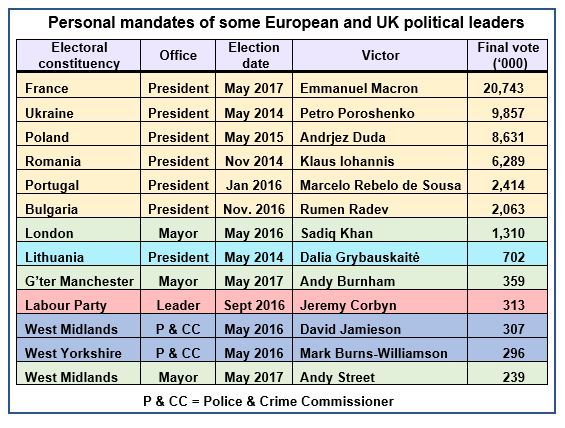
Maybe it was a Monday morning thing.  But when last Monday’s Times – once, to foreigners at least, the ‘newspaper of record’ – recycled for the umpteenth time the claptrap about London Mayor, Sadiq Khan, having “the third biggest personal mandate of any directly elected politician in Europe”, my 16 months’ silent tolerance ran out.

The probably familiar story was that Mayor Khan, not being an ‘ordinary’ Labour Party member, had been barred from addressing ‘the people’s conference’. But then, presumably because he’s one of the relatively few Labour people who do actually run something – like Greater London – and decide stuff – like the fate of Uber – he was unbarred.

Unlike Mayor Andy Burnham, who also runs something – Greater Manchester – but who actually challenged Jeremy Corbyn for the party leadership, and has a willy – sorry, personal mandate – smaller than Corbyn’s, barely a quarter the size of Khan’s, and was easily side-lined to fringe meetings.

Because that’s what most of these things are fundamentally about in the male-dominated world of politics: if you’re a union leader, the size of your membership; if an MP, the size of your majority; if a council leader, the size of your electorate; and if a directly elected leader, the size of your mandate – all willy substitutes. Which is why it’s important to get the measurements right – unlike The Times, which, like at least some of our students, apparently uses Wikipedia as its bible of factual information.

The pity is that Sadiq Khan’s genuine statistical achievements are impressive enough not to need exaggerating. Largest personal mandate of any politician in UK history. First elected Muslim mayor of any major western capital.

To me, it was the precision of the Wiki/Times factoid that made it immediately suspicious – ‘third biggest’ personal mandate, of any directly elected European politician? It never even sounded right. After all, Europe’s a biggish place. Nearly 50 countries, even excluding the Vatican. At least 30 with populations over 3 million, where a personal vote bigger than Khan’s 1.3 million is at least conceivable.

It seemed a bit like assuming Andy Street, because he’s elected mayor of the largest mayoral Combined Authority, has the biggest personal mandate of any political figure outside London – instead of, as shown in my table, only the second biggest in the West Midlands.
Politicians%27%20personal%20mandates%202.JPG

Anyway, back to the Khan claim, and a couple of early concessions. Let’s accept President Erdoğan’s Turkey, with the great majority of its population in Asia, and despite most holiday insurance classifications allowing it as European, counts as either Asia or Middle East. And Russia, though over three-quarters of its population live in Europe, as technically Eurasian. Otherwise, President Putin’s nearly 47 million votes in 2012 would present quite a hurdle.

But Ukraine, as every pub quizzer knows, is the largest country entirely in Europe.  Maybe not your established, Scandinavian-model democracy, but it is a kind of French-style semi-presidential republic, with a multi-party system. And its 2014 post-revolution presidential election – though excluding the annexed Crimea and certain other areas – was accepted by scrutineers both for its (broadly) democratic conduct and outcome: President Poroshenko’s decisive first-round victory.

France itself is one of Wiki’s top two, Emmanuel Macron comfortably topping 20 million personal votes in the second round of this May’s presidential elections. The other Wiki nominee, though, is Portugal’s President Rebelo de Sousa, which would be fine, were he not the only other nominee.

Like France, Portugal is one of the semi-presidential systems that constitute almost the governmental norm in modern-day Europe. They’re all different, particularly in their division of powers between the head of government and head of state. The key questions: is the president/head of state directly or indirectly elected, and, if directly, is s/he politically significant or essentially a ceremonial figurehead?

Portugal’s President was elected in a party political election and has real powers, from dismissing governments to vetoing laws and granting pardons. Wiki is quite right, therefore, to include it – but quite wrong to suggest that President Rebelo de Sousa is, apart from Macron, the only European politician with a bigger personal mandate than the London Mayor’s.

Wrong, partly because it appears not to understand the huge breadth of practice found in different ‘semi-presidential’ systems, and partly because its ‘Europe’ appears to stop at the Oder-Neisse Line, the former border between the German Democratic Republic and Poland. Even then, though, Poland, Romania and Bulgaria, like Ukraine, were European countries – their EU membership is a bit of a giveaway – and today, like France and Portugal, are semi-presidential republics whose Presidents are very far from symbolic.

If you’ve any doubt, just think back to the Polish bit of William and Kate’s embarrassing summer ‘Brexit tour’. Monday, they were shaking hands with President Duda at the Pres’s palace. Tuesday, he was assuring TV viewers that his Law & Justice Party’s plans to give government the power to appoint and dismiss judges were purely to increase judicial efficiency, and really nothing alarming. Wednesday, legislation was rushed through parliament allowing the government to dismiss at will any of the 83 Supreme Court judges.

Not exactly the kind of stuff a genuinely ceremonial Head of State like William’s grandma gets up to, so let’s hope the handshake was worth it when it comes to Poland’s vote on any Brexit deal – if indeed the EU Commission hasn’t by then suspended the country’s voting rights.

Apologies for the digression, but my point is simply that Presidents Duda, Iohannis, Radev and Poroshenko are no less “directly elected European politicians” than President Macron, which I reckon puts Mayor Sadiq Khan’s mandate down from 3rd to 7th in the list. Still ahead of that of any directly elected woman politician in Europe – Lithuania’s President Dalia Grybauskaitė – but then she hasn’t got one to feel the need to wave.

gameChris Game is a Visiting Lecturer at INLOGOV interested in the politics of local government; local elections, electoral reform and other electoral behaviour; party politics; political leadership and management; member-officer relations; central-local relations; use of consumer and opinion research in local government; the modernisation agenda and the implementation of executive local government.

WMCA shouldn’t have to mean (almost) Wholly Male Combined Authority

Chris Game

Combined Authorities, elected mayors, women’s representation, Greater Manchester CA, Liverpool City Region CA, West Midlands CA, Andy Burnham, Steve Rotheram, Andy Street, Fawcett Society, Liverpool Women’s Leadership Group

Combined Authorities have had a women problem – or rather, a lack-of-women problem – pretty well from their inception, and the much recycled picture of 11 very male and pale, if not stale, Greater Manchester council leaders signing an even paler George Osborne’s first devolution deal (see below). It was re-emphasised with the 32/7 m/f imbalance of mayoral candidates and 6/0 imbalance of the victors. In the West Midlands, though, we have a mega-problem – to which this blog, about CAs’ governance arrangements, will suggest there are two dimensions: why it exists, and what isn’t being done about it.

It exists first because the WMCA is both bigger and more complex than the other mayoral CAs. In addition to Mayor Andy Street, it comprises seven constituent members – the metropolitan boroughs, whose leaders are the Mayor’s ‘Portfolio holders’ or cabinet – plus 13 non-constituent members: three Local Enterprise Partnerships and 10 of the councils they cover.

All are represented on the CA Board, constituent councils by two elected members each (rather than other CAs’ one), non-constituent bodies by one each. Adding several accredited Observers and a Co-optee makes 33 – three or more times the size of other mayoral CAs. Finally, and with potential representational significance, all members have a nominated Substitute Member to attend and act, if required.

Of the WMCA’s 33 members, all but one are men, the single, albeit distinguished, exception being Councillor Izzy Seccombe, Leader of Warwickshire County Council, a non-constituent member. The other CAs are smaller, but their gender disproportionality similar. None have more than one woman board member, the overall split being 71-3 or 4% women – a situation, moreover, that was both predictable and predicted.

In March, the Fawcett Society published an ‘Evidence Document’ on Women in Greater Manchester in conjunction with the local women’s campaign group, DivaManc. It concluded by asking all candidates to respond to five fairly demanding “Mayoral Pledges and Calls to Action”, headed by “Gender-balanced leadership and representation across Greater Manchester”.

All candidates duly signed, including odds-on favourite, Labour’s Andy Burnham. The Fawcett document then outlined the hurdles involved in the “gender-balanced representation” pledge, and the likelihood that, whatever the election result, “only one of 11 GMCA members will be a woman”. For the ten constituent councils had already chosen their leader/elected mayor as their single permitted GMCA member, and only one at the time was a woman – Jean Stretton, Labour leader of Oldham Council, whose own cabinet, probably not by chance, is gender-balanced.

Signing the Fawcett pledge, therefore, would commit the new Mayor to:


  • Call for the Government to amend this policy, requiring each constituent council’s CA representation to comprise a man and a woman.
  • If that failed, request that 50% of the councils nominate a senior woman councillor to attend in place of the leader/mayor; or ensure that all substitute members are women, that they attend on an equal rota, and have substantial roles and responsibilities.
  • If a man, appointing a woman as Deputy Mayor.


The day following his election, new Mayor Andy Burnham demonstrated his commitment to the pledge by appointing two deputies, one being Baroness Beverley Hughes – former Leader of Trafford Council, Labour MP and Minister – as Deputy Mayor for Policing and Crime, making 11 cabinet portfolio holders, including two women. Hughes is the only salaried deputy, her appointment enabled by the previous portfolio holder (as GM Police & Crime Commissioner) being interim mayor Tony Lloyd – whose own multi-ethnic selection of six men and 14 women deputies had, even if temporarily, presented a strikingly un-stale-pale-male picture.


GreaterManchesterCA

Unable to replicate that picture, Mayor Burnham has nevertheless demonstrated that constitutions are there to be reconstituted. An amended GMCA constitution now requires appointed portfolio holders to nominate assistant leads of a different gender to ensure balanced representation in meetings and decision-making. Committees, panels and boards that advise the Mayor will also be gender-balanced wherever possible.

Down the M62, though, Liverpool City Region CA Mayor, Steve Rotheram, was finding life tougher, his seven-member, all-male cabinet, plus three male co-optees, prompting considerable local protest.  He had “attempted to bring two women into his cabinet, but was blocked by other members”.  One – Merseyside Police & Crime Commissioner Jane Kennedy – has since become a non-voting co-optee, and six of his seven specialist Mayoral Advisors are women. Liverpool City Council Mayor Joe Anderson has also nominated Councillor and former Merseyside Police Commissioner Ann O’Byrne to represent him on the LCR cabinet, making her the only woman with voting rights.

Liverpool Women’s Leadership Group, though, are unappeased.  In a recent open letter referring to Greater Manchester’s example, they are “appalled that the LCR cabinet is made up entirely of men”, and call on all cabinet members with voting rights “to redress the enduring gender imbalance by nominating a woman from your cabinet to take your place”.

And so back to the West Midlands, where new Mayor Andy Street appears to acknowledge the WMCA’s socio-economic unrepresentativeness – an issue that was “referenced many times on the campaign trail [and] would need addressing in the weeks and months ahead”. It wasn’t, however, mentioned in his 48-page, nearly 250-pledge manifesto, and the emphasis now was clearly on months, not weeks. Rather than follow the Fawcett/Burnham route, his single Deputy is fellow Conservative, Solihull Council leader, and former CA Chairman Bob Sleigh.

Over the now months, there have been several impressive appointments of women as WMCA Chief Executive and senior officers. Also an announced WM Leadership Commission, chaired by Anita Bhalla, OBE, “to improve opportunities for communities and groups currently under-represented in the leadership of the West Midlands.” No specific reference to women, though, or their Board representation, let alone to doing anything or amending the WMCA Constitution.

In conclusion: I fully recognise that some, women undoubtedly included, will argue that women’s inclusion and representation by themselves say little about either the significance of any posts to which they’re appointed, or women’s status in the political system – and of course they’re right. My simpler point is that exclusion and non-representation DO say something – something rather important.


Chris Game - picChris Game is a Visiting Lecturer at INLOGOV interested in the politics of local government; local elections, electoral reform and other electoral behaviour; party politics; political leadership and management; member-officer relations; central-local relations; use of consumer and opinion research in local government; the modernisation agenda and the implementation of executive local government.

Seeds of Change: English Devolution and Central-Local Relations

Sarah Ayres, Matthew Flinders and Mark Sandford 

‘England’s devolution deals do not constitute a move away from traditional patterns of central-local relationships, though they may contain the seeds of change’.

That is the conclusion from our article, titled ‘Territory, Power, Statecraft: Understanding English Devolution’, recently published in Regional Studies. Much recent debate and commentary has been generated by the priorities of the newly-elected metro-mayors and their implications for the sub-national governance of England. But there is a broader question: will they lead to longer-term change in relationships between central and local government in the UK?

The recent devolution initiatives within England provide an opportunity to reassess the relevance of Jim Bulpitt’s 1983 book, Territory and Power in the United Kingdom. This provided a then-novel portrait of UK territorial political relations. For Bulpitt, the UK central state had long favoured what he called the ‘central autonomy model’ of territorial relations. He saw central government’s priority as keeping its distance from local and parochial matters; and in turn, expecting that local governments will not usurp their authority and attempt to challenge the centre’s role. He coined the term ‘dual polity’ to describe the parallel roles adopted by centre and localities.

Since Bulpitt wrote, central attitudes to local government in England have become more readily interventionist. In that context, the initiatives towards devolution of power in the mid-2010s are of interest. A good deal of commentary has focused on whether this devolution is ‘real’. Does it constitute a challenge to the ‘central autonomy’ model of relations? Drawing on data from three academic research projects, we assessed whether there was evidence of such a shift to date. Does the way in which English devolution has been negotiated and delivered show that central-local relations are changing?

The findings indicated that the ‘territorial management code’ in England remains largely the same as the historical norm. In Bulpitt’s terms, the central autonomy model continues to dominate. Deals have been negotiated in private between civil servants and small groups of local elites. Central government has remained tight-lipped about its policy priorities, dampening the ability of localities to take the initiative. Localities are required to develop business cases for the handling of devolved powers, and to evaluate them against the terms of the ‘devolution deal’. Through the terms and conditions of devolution, central autonomy is retained in place. Even when some devolution deals collapsed following stakeholder and public disquiet, the Government did not deviate from this approach: and this insistence on control is visible in the current impasse over arrangements in Yorkshire.

Bulpitt also noted the prevalence of ‘court politics’, focused on a small number of decision-making individuals. The slowing of devolution policy following the departure from government of its chief architect, George Osborne, bears out the continued importance of this dimension of territorial management.

But there are also hints that the central autonomy model is not as dominant as it once was. The Government has not used its political resources as assiduously as it might have done. Local participants in negotiations reported genuine interest from civil servants in devolving power and encouraging local initiative: one stated that the Government was ‘desperate’ to conclude deals. This is quite different from what a central autonomy model would imply. Central autonomy also assumes a ‘bureaucratic machine’, via which the centre dominates the ‘periphery’. This is visible in the deals’ requirements for central oversight, but there is a constrained capacity for this to happen.

Central government’s governing strategy – to reaffirm its control over territorial relations – is largely hands-on. But again there are signs of change. The democratic mandate of elected mayors is a source of unpredictability: it could import political conflict into a system of governance much of which is designed around broad stakeholder consensus. In the longer term this could presage the evolution of English territorial relationships towards Bulpitt’s ‘capital city bargaining model’, involving local actors’ “interference in the centre’s affairs but often in a cooperative fashion”. This depends on whether metro-mayors can take the opportunity to establish themselves as significant political players, both in the institutional and cultural dimensions of English governance.

In summary, Bulpitt’s framework allows us to look at the attitudes and priorities made evident during the devolution deal negotiations; and to use these to suggest how metro-mayors might be able to extend and entrench their positions in the political landscape. It holds out the possibility that they could drive longer-term change in central-local relations: though this is very much contingent on the tacit permission of central government.

Acknowledgements

The article ‘Territory, Power, Statecraft: Understanding English Devolution’ is based on the following research projects: The Political Studies Association’s Research Commission, chaired by Sarah Ayres (University of Bristol) to examine the role of ‘informal governance’ on devolution to England’s cities. The second, an ESRC project that focused on English regional governance in order to test the utility of different models of citizens assemblies vis-à-vis constitutional policy-making led by Matthew Flinders (University of Sheffield). The third consists of a literature review and analysis conducted by Mark Sandford for the House of Commons Library.


image003Sarah Ayres is a Reader in Public Policy & Governance at Bristol University, and Co-editor Policy & Politics. Her research interest focus on the governance of place, space and territory.


MFlinders-new-smallMatthew Flinders is Professor of Politics and Founding Director of the Sir Bernard Crick Centre for the Public Understanding of Politics. He is also President of the Political Studies Association of the United Kingdom and a board member of the Academy of Social Sciences.


image002Mark Sandford is a Senior Research Analyst at the House of Commons Library specialising in local and regional government.


The stardom of tsardom – but are policy tsars actually useful?

Chris Game

I’d have bet money on at least one turning up in time for my recent round-up of the six Combined Authority mayors’ first 100 days.  We’re talking policy tsars, and I’d thought surely one CA mayor would see unveiling, say, a Homelessness or Youth Unemployment Tsar as an irresistible ‘First 100 Days’ publicity opportunity. I was wrong – but only just.

Here in the West Midlands, Mayor Andy Street had other, more inclusive, ideas. Like London, we’ll have a Mayor’s Task Force to tackle homelessness and the alarming rise in adult rough sleeping, chaired by Jean Templeton, CE of St Basils young people’s housing charity. And addressing youth unemployment will be a thousand-plus Mayor’s Mentors.

But, so far, no tsar – unlike Liverpool City Region, still without a Chief Executive, but who can now boast a Fairness Tsar. Moreover, with Mayor Steve Rotheram’s cabinet being even more overwhelmingly male than most, a ‘Fairness Tsar’ could hardly NOT be female, and indeed is: TUC Regional Secretary Lynn Collins. A good start, then, ticking the Mayor’s manifesto pledge “to put fairness and social justice centre stage”, though detailed objectives for Collins’ part-time role – as ‘critical friend’ and Chair of the Mayor’s Fairness and Social Justice Advisory Board – have still to be revealed.

Mayor Street also made a key appointment last week – a permanent, full-time, top-tier one. The WMCA’s Director of Strategy will be Julia Goldsworthy, whose varied career is in itself a useful introduction to the somewhat shadowy world of policy advice. A Liberal Democrat MP from 2005, she (narrowly) lost her Cornish seat in 2010. Whereupon she became a SPAD (Special Political Advisor) to Danny Alexander, Lib Dem Chief Secretary to the Treasury in the Coalition Government, following which she has been “devolution driver” at the professional services firm PwC.

Goldsworthy has thus moved from politician to being now a permanent regional/local civil servant, providing expert and politically impartial advice to policy makers – the Mayor and CA – as opposed to the politically partial advice expected of her as a temporary civil servant or SPAD.

Policy tsars offer a third channel of advice, different again, and ideally complementary. While a novelty at CA level, there have been far more nationally than certainly I imagined. Not that long ago, some academic colleagues, excited by a clearly exploitable new research topic, asked several of us how many we reckoned there’d been since New Labour – as you might guess, tsars’ chief progenitors – took office in 1997. Not one of us got to within a hundred of the actual figure, which at the time was approaching 300, including 46 appointed by Gordon Brown alone, as Chancellor and Prime Minister.

Our ignorance was obviously due largely to most of these tsars not being commonly known as such, even to their nearest and dearest. Indeed, the genuinely famous or those with serious clout have often preferred alternative titles: Joan Bakewell – insistent that she was not Older People’s Tsar, but the Voice of Older People; Keith Hellawell – Anti-drugs Co-ordinator; Maggie Atkinson and successors – Children’s Commissioner; Sir Michael Parkinson – Dignity (in Care) Ambassador; Sir Steve Redgrave – 2012 Sports Legacy Champion; Lord Digby Jones – Skills Envoy.

True, some do appear to relish the stardom of tsardom, like Dame Louise Casey, ‘Tsar for All Seasons’, who, as, inter alia, Homelessness Tsar, ASBO Tsar, Respect Tsar, Victims Commissioner, and Integration Tsar, has seemingly made a career of what for most are one-off, short-term, part-time appointments.

Personally, though, while accepting that the T-word’s four letters usefully fit media headlines, I find it meaningless and objectionable. To me, Tsars – whether the Slavic autocrats or the Caesars from whom the name derives – summon up images of seriously unpleasant macho males, who exercised their absolute powers pretty ruthlessly, and weren’t terribly concerned about issues like the needs of children and the elderly in an elective and supposedly accountable democracy.

But, however they introduce themselves, in media shorthand they’re all Tsars. More importantly, while their qualifications vary – some being specialists, some generalists, others advocates – in the public administration lexicon too they’re all the same. Not permanent, or temporary, civil servants; not SPADs; but individuals from outside government, publicly appointed by (until now) government ministers, to advise on policy development or delivery on the basis of their personal expertise.

So what’s not to like? In our exceptionally closed political system – where ministers, drawn only from Parliament, are heavily dependent on advice from a permanent and also narrowly recruited civil service – surely a bit more openness is good? Tsars are publicly appointed, and their popularity amongst ministers is seen in their increasing numbers – roughly a tripling by each government since 1997.

On the other hand, how much is the system opened up when, by 2012, 85% of all appointees had been males, 83% over 50, 98% ethnically white, 38% Lords, Baronesses, Knights or Dames, and 18% themselves politicians? In short, where’s the transparency and public accountability concerning all those publicly funded tsars that don’t fascinate the media: the openness and scrutiny of the ‘public’ appointments procedure, the evaluation of their work, its impact (if any), and their Value for Money?

Generally – albeit sometimes because it’s required to – local government tends to do pretty well all these things better than central government, so let’s hope CA tsars are no exception.


Chris Game - picChris Game is a Visiting Lecturer at INLOGOV interested in the politics of local government; local elections, electoral reform and other electoral behaviour; party politics; political leadership and management; member-officer relations; central-local relations; use of consumer and opinion research in local government; the modernisation agenda and the implementation of executive local government.

Spending beyond Your Means during a Recession? Not So Much for Local Governments Constrained by Fiscal Rules

Lang (Kate) Yang
The Great Recession, which started nearly a decade ago, may feel like a distant memory for some, as the United States economy is expanding for a ninth consecutive year. However, local governments in the nation still experience turmoil in their finances. National League of Cities’ 2016 City Fiscal Conditions report shows that city revenue has recovered to about 96 percent of precession (2006) levels. While many cities have improved service provision efficiency or cut back services and workforce during the recession, another option to weather the shock is to run a deficit and spend beyond the means. While structural or persistent fiscal imbalances are undesirable for local officials and can even lead to credit rating downgrades, deficit financing during recessionary periods may be justified for maintaining the necessary level of public service provision when regular tax and other revenue collection does not suffice.

Local governments achieve deficit spending through either borrowing or dipping into their reserves, if they have built one going in to a recession. Neither option is free. Borrowing from banks or investors on the municipal bond market requires interest payments, while leaving that reserve alone usually means investment returns. To what extent local governments are willing to take on a deficit during the recession depends on factors including local governing structure, managerial preference and expertise, level of savings, access to the debt market, and the capacity of paying back debt or replenishing reserves after the recession ends.

It is the last factor and its relationship with tax and expenditure limits that I explore in the recent paper published in Local Government Studies. Tax and expenditure limits are fiscal rules imposed on local governments by state governments (through legislations) and statewide voters (through referendums) to limit how much revenue localities can raise in any given year. For example, the famous Proposition 13 in California limits annual real estate tax on a parcel of property to one percent of its assessed value and the assessed value can only increase by a maximum of two percent per year. For cities constrained by a tax and expenditure limit, their capacity of paying back debt or replenishing reserves is predictably limited. The paper explores whether these cities were less likely to deficit spend during and after the Great Recession than unconstrained cities.

Data collected from the largest 50 cities’ comprehensive annual financial report show that cities subject to a tax and expenditure limit indeed were less likely to spend beyond their means. Their expenditure levels grew at a slower pace. As a result, their net assets, which are assets net of any payback liabilities, decreased at a slower pace as well. The difference between cities subject to tax and expenditure limits and unconstrained cities was especially pronounced immediately after the crisis (years 2011 and 2012), possibly because cities first pursued other means of weathering the shock than cutbacks and because the hit on city finance is delayed compared to the hit on the general economy.

Many cities saw their streetlights shut off, community centers shuttered, and bus services cancelled during the recession. While some may rather prefer the cuts than spending, others may see the value of maintaining a stable level of service provision despite decreased revenue collection. Although the paper refrains from evaluating whether deficit spending in general is beneficial to city governments and residents, it is ultimately a decision up to the localities. The paper finds that fiscal rules imposed by a higher-level government have an impact on city financial decisions. This finding indicates that deficit financing following a recession is no longer a “pure” local decision. Financial management conservatism caused by tax and expenditure limits might have contributed to more painful cuts in some cities than others.


Picture1

Lang (Kate) Yang is an assistant professor at George Washington University. Her research interest includes state and local government taxation, budgeting, and financial management. Her recent publications in Public Budgeting & Finance and National Tax Journal examine how local governments respond to fiscal rules imposed by higher-level governments.

All in A Day’s Work: Mental Health Provision, Wellbeing and Scrutiny in Brent Council

Cllr. Ketan Sheth

As Chair of the Community and Wellbeing Scrutiny Committee at Brent Council, Cllr. Sheth has a behind the scenes look at the workings of local government. Here he shares his experience in trying to improve Brent’s mental health provision and his views on what good local authority overview and scrutiny looks like. 

One in four people will experience mental ill health at some point in their lives – so it is likely all of us will directly or indirectly need support from the valuable services that support people to recover and to remain resilient.

Mental health – a once under-reported and some would say under-valued aspect of our health and wellbeing – has been making headlines recently and is a stated national priority. Earlier this year the Prime Minister announced plans to transform mental health services with a particular focus on children and young people. This was subsequently followed by an announcement last month by the Health Secretary of a plan to create 21,000 new posts, investing £1.3bn by 2020. Again, the commitment to mental health services for children and young people was affirmed.

This brings a welcome focus given children and young people’s mental health and wellbeing can ultimately shape their life chances and outcomes. So now we must think about how we – as a local authority overview and scrutiny committee – understand what is going on behind the headlines and – as elected councillors – continue to shine the spotlight locally.

Scrutiny work that adds a real value and makes a positive difference to local residents’ lives must remember a number of important factors: are elected councillors supported to carry out a meaningful review? Do they understand how to capture the service model? Do they understand how to draw out the challenges to effective delivery of that model? Do they have the tools and information they need to be responsive local decision makers?

In Brent, my Community and Wellbeing Scrutiny Committee recently went behind those headlines to better understand mental health provision for children and young people across Brent and to see how we might add value to the current service model. A Task and Finish Group on Child and Adolescent Mental Health Services (CAMHS) was set up to review this complex area, and their report makes for very interesting read.

The task group was put in place to gather evidence – qualitative evidence from face-to-face interviews and research, and quantitative data and this was done alongside NHS Brent CCG, local health providers, schools and further education representatives and community representatives. I want to highlight two things my committee learnt in undertaking this work.

Firstly, the involvement of young people in this research was vital. Let’s face it, elected councillors in a local authority tend to be far older than the demographic we were seeking to reach, so it was incredibly helpful to have the input and perspectives of young people. We appointed a former member of Brent Youth Parliament (now a student at King’s College London) and they brought an excellent viewpoint to the task group’s work and deliberations.

Secondly, it was essential we recognised and embraced the complexity of this area. CAMHS is a complex and challenging subject for overview and scrutiny members because it cuts across local government and health responsibilities. Whilst this is excellent news for integrated care, it means you must be able to grasp and work across a range of people and organisations. You must also recognise the child or young person and their family and carers are a vital part of this system and network of care, and understand their perspective as well.

Effective scrutiny can be a powerful vehicle for change if committee members can stand back and really understand what is happening across local government and health services. If we are honest, overview and scrutiny committees nationally have varying relationships with public sector colleagues; however, in Brent, my committee’s relationship with NHS Brent CCG and wider health services is a good one. We try to be constructive and fair in forming our recommendations, especially in areas where we think things could be done differently and outcomes could be improved.

We have now made our recommendations to the Brent Council Cabinet and NHS colleagues and will monitor progress as a result. In Brent we will ensure mental health for adults and children and young people remains on the agenda, irrespective of the headlines.

To read the CAMHS task group report, visit http://www.brent.gov.uk/scrutiny.


Picture1.png

Cllr. Ketan Sheth is a Councillor for Tokyngton, Wembley in the London Borough of Brent. Ketan has been a councillor since 2010 and was appointed as Brent Council’s Chair of the Community and Wellbeing Scrutiny Committee in May 2016. Before his current appointment in 2016, he was the Chair of Planning, of Standards, and of the Licensing Committees. Ketan is a lawyer by profession and sits on a number of public bodies, including as the Lead Governor of Central and North West London NHS Foundation Trust.