The Good Law Project – proud to be judged by its enemies

Chris Game

“I ask you to judge me by the enemies I have made”. No, not Ukraine’s remarkable President Zelenskyy, fitting though it would seem. It’s generally attributed to the rather longer-serving US President Franklin D Roosevelt, an at least equally appropriate author for this column’s political theme.

But who in the last fortnight’s UK politics might have prompted FDR’s “judge me by my enemies” thought?  Well, it wasn’t exactly a ‘who’.  Rather, a smallish, youngish, not-for-profit campaigning organisation doing its best to challenge abuses of power, inequality and injustice, mostly by Government departments and Ministers, in cases bigger, better-funded organisations hesitate to take on.

And they do have an appealing name – the Good Law Project (GLP).  Which is fortunate, since appealing is how they’re largely funded – through donations and periodic crowd-funded contributions to cover specific cases, as in this instance.

In a few short years, dominated by our EU exit and Covid, they’ve also racked up a pretty appealing court record, unless of course you view it as, say, a recent or current Government minister.

You’ll recall that Boris Johnson, within weeks of becoming PM in July 2019, ‘advised’ the Queen to prorogue/shut down Parliament for an unprecedented five weeks, thereby avoiding further parliamentary scrutiny of the already thrice-defeated Brexit withdrawal agreement, and enabling the UK potentially to leave the EU on October 31st without a deal.

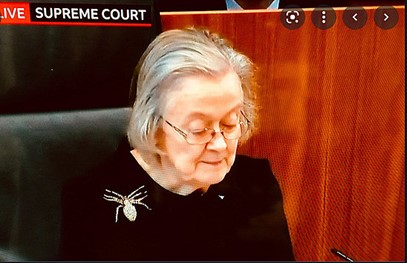
The Queen had little constitutional option but to accede. Others, though, did. The GLP crowd-funded an appeal, sufficient to allow lawyers to petition first the Scottish Appeal Court, then the UK Supreme Court. You can maybe even re-picture the historic, televised, unanimous 11-judge ruling, delivered by the UoB Vice-Chancellor’s most recent Distinguished Lecturer, the Supreme Court’s spider-brooched President, Lady Hale.

Picture1

Johnson’s prorogation advice to the Queen “was outside the powers of the PM”, Parliament’s suspension unlawful and unconstitutional, and it should be immediately reconvened. Score: UK Government 0, GLP several.

Then came Covid, bringing with it what was quickly tagged ‘institutionalised cronyism’, with Health Secretary Matt Hancock and Cabinet Office Minister Michael Gove the biggest serial offenders.

The GLP could have chosen numerous cases, but selected three PPE (Personal Protective Equipment) contracts as illustrations: £252m to a finance company for face masks, £108m to a confectionery products agency, and £345m to a company trading as Pestfix – which, as we’ll see, is what the grudge-bearing Hancock would still dearly love to do to the GLP.

The otherwise defenceless Health Secretary – the man who broke his own social distancing guidelines in his own office – resorted to disputing GLP’s legal standing. The high court judge ruled, however, that he had acted unlawfully in respect of “vast quantities” of taxpayers’ money in failing to publish multibillion pound contracts within the legally required 30 days.

Cabinet Office Minister Michael Gove also had cronies. Ministers in those early Covid days needed to influence public opinion, and get focus group feedback on the effectiveness of their messaging.  Unfortunately, neither Gove nor anyone in the entire civil service could think of an experienced polling company.

Luckily, though, the PM’s Chief Adviser, Dominic Cummings, knew a ‘communications agency’, Public First, run by chance by some friends. Time, regrettably, was far too short for advertising or competitive tendering, so Public First got the eventual £840,000 ‘no-tender’ contract. Job done.

What was fast becoming almost standard ministerial practice was a gift for the GLP, and they set about proving Gove too had broken the law.

In June 2021 the High Court finally agreed. It rejected Gove’s bluster that no one else could possibly do the job, ruling that any “reasonable observer” – the legal test – would reckon it was Public First’s relationships with Cummings and Gove that secured the contract. The minister had indeed broken the law … and the GLP had acquired another ministerial enemy.  And no, Gove didn’t resign either.

Time for a statement of the obvious. The GLP don’t always win, as we’ll see. They deliberately select tough cases that big, established law firms decline. They raise funding case-by-case. Considering which, their record is impressive: in 2021, “four judgements, four wins”.

Then came Tuesday Feb.15th.  Notwithstanding Ukraine and the Duke of York, most media found room for reports variously headlined: “Ex-Health Secretary Matt Hancock broke/ignored/did not comply with equality laws/rules/duty over Covid appointments”.

Picture2

In a case brought jointly by the UK’s leading independent equality thinktank, the Runnymede Trust, and the GLP, two High Court judges ruled that “the UK government failed to comply with equality law” when appointing Baroness Dido Harding as Chair of the National Institute for Health Protection and Mr Mike Coupe as Director of Testing at Test and Trace.

Specifically, the “then Health Secretary Matt Hancock did not uphold a public sector duty to promote equality when hiring officials.”

It sounds clear and crushing enough, and it was.  However, that part of the judges’ verdict was in effect directed only at the Runnymede Trust, who had what is known as the standing and entitlement to bring the case. The judges deemed the GLF not to have such ‘standing’ – now or, by implication, were likely to have any time soon.

Still, does that verdict sound to you like an ex-Minister’s judicial triumph?  It apparently did to him!  Read to the end of the Guardian report, and you’ll see he went on instant attack, in a way that readers must have found, if not confusing, then surely bemusing, or simply desperate.

“We’re delighted the department has won yet another court case against the discredited Good Law Project. Claims of ‘apparent bias’ and ‘indirect discrimination’ have been quashed and thrown out by the high court.”  Which, of course, they weren’t.

“What the judgment does make clear is that ‘the claim brought by Good Law Project fails in its entirety’, therefore highlighting the fact this group continues to waste the court’s time.”

Back, then, to President Roosevelt. Last week was undoubtedly a setback for the GLP.  But the instant glee and hauteur with which the court’s ruling was received by Hancock and some of its other critics suggest that, given its record and support, it is unlikely to prove the “existential blow” they apparently crave.

And on the FDR scale – “Judge us by the enemies we’ve made” – they’re still doing pretty well.

Photo

Chris Game is an INLOGOV Associate, and Visiting Professor at Kwansei Gakuin University, Osaka, Japan.  He is joint-author (with Professor David Wilson) of the successive editions of Local Government in the United Kingdom, and a regular columnist for The Birmingham Post.

This blog was originally published in the Birmingham Post, March 3-9, entitled ‘Campaign group proud to be judged by its enemies’

Making friends with a highlighter pen

Anon

In this final blog of our series, one of our former apprentices reflects on how they grew in confidence through the process and offers some advice for anyone considering studying for a senior leader apprenticeship.

Picture: Photosteve101 https://www.flickr.com/photos/42931449@N07/

In 2019, my manager informed me our organisation had partnered with INLOGOV at the University of Birmingham, meaning an opportunity to enrol on their Senior Leader Apprenticeship programme. It seemed almost too good to be true to think that this opportunity would be fully funded. Never one to shy away from a challenge I decided to apply. Brave.  I was further surprised to be accepted onto the course and began my journey somewhat naively without quite appreciating what lay ahead.

It is fair to say that I had underestimated the time I would need to complete the learning, reading, assignments and portfolio preparation. It was a steep learning curve but I soon developed strategies to manage my time. I preferred to read in the evening.  Many an evening was spent sitting in the car reading journal articles while my daughters were at various clubs. The time I was investing was becoming more and more worthwhile as I learned to apply new skills and ways of thinking to my work, as well as receive pleasing grades for my assignment.  I started to think perhaps I could do this after all.

The onset of Covid-19 meant that additional challenges of remote learning and home-schooling my daughters had to be managed alongside other pressures, but I carried on, and with amazing support from my family, work colleagues (and some very understanding tutors) I managed to continue working through the assignments and the intense phase of my project.

I won’t pretend this was easy, but the more I became engrossed in my project the more determined I became that I would complete the course.  Completion meant both personal pride and a final project which would be beneficial to my work and team.  Compiling my portfolio gave me a great opportunity to reflect on some of my work achievements, and to identify areas where I needed to improve and demonstrate my skills. This culminated in a project showcase and professional discussion that allowed me to show how my learning had improved working practices.

If you are interested in a course like this my top five tips/reflections are:

  • It sounds corny, but if you want to achieve something, and have the right support to do so, then you can achieve it.
  • Commit to the process.
  • It will probably be more work than you imagine, but the personal and professional rewards are worth it.
  • Buddy up with someone else on the course so you can support one another – this was invaluable to me.
  • Onenote and highlighters will become your best friends!

Rediscovering the intellectual muscle memory…

Simon George

As part of National Apprenticeship Week we are posting daily blogs profiling INLOGOV’s Senior Leader Apprenticeship.  Today we here from a recent graduate, Simon George, and his experience of returning to study and balancing his studies with a global pandemic.

Picture: Eldriva https://www.flickr.com/photos/eldriva/

January 18th was an important day for me this year as not only was it my 50th birthday, but also the day I received my apprenticeship grade after a mixture of two years of academic study and practical learning/application at work.

Over the two years as a senior leader at a large county council it often felt strange referring to myself as being on an apprenticeship scheme, but by the end of the period it has felt much more normal.  With other senior colleagues at my council undertaking a similar journey, as well as chums in other organisations, perhaps the language and understanding around “Apprenticeships” has shifted over the past 24 months?

It was a good number of years since I had either studied for a degree or for professional qualifications and during the first couple of terms there was definitely some intellectual “muscle memory” that needed to be recovered. I soon realised that in my day job I review and (maybe) add a little to reports/documents, then forward them on; researching topics, crafting an essay from scratch and getting to grips with academic referencing certainly took some getting used to as it was completely different to my usual way of working. However, the support from INLOGOV was great in this regard; online resources abound, but more importantly a quick email to either one’s personal tutor or the module lecturer always received a swift/insightful response removing whatever log-jam was in the way.

As part of the apprenticeship one’s employer is required to carve-out 20% of the working week as time to spend on the apprenticeship – so in my case a day-a-week. In truth that worked out about the right amount of time for me: as I say to my 9 year-old “Steady-Eddy wins the race”, regularly bagging that day week, meant the reading was done and the assignments submitted without too-much late night caffeine fuelled drama (largely because that is a young person’s game!)

COVID obviously had an impact on both the academic and on-the-job aspect of the apprenticeship.  Sadly, it meant only two of the six modules “face-to-face” learning was done on Campus, meaning some of the contacts/connections one would hope to make are not as deep or as enduring, however I have a few.  But the online learning worked just fine and I would say excepting the time lost chatting over coffee or in the bar, I don’t feel the experience has been materially denuded.

For anyone considering an apprenticeship at the higher level, I would really recommend it. It is good to challenge your ways of thinking and actively assimilate different perspectives that can be applied back at the workplace. It is a commitment, but I as I mentioned earlier as long as you keep the interaction with the apprenticeship regular and don’t try and cram it all into a week once a term it is all doable.

So did I get a nice birthday present on the 18th January? Modesty prevents me from saying, but I was pretty chuffed!

Simon George is Executive Director of Finance and Commercial Services for Norfolk County Council.  He was an INLOGOV Senior Leader Apprentice 2019-2021.

Back to Uni with a new Pukka Pad.

Richard Baldwin

As part of National Apprenticeship Week, we are posting daily blogs profiling INLOGOV’s Senior Leader Apprenticeship.  You can find the first two posts here and here.  Today we hear from a recent graduate Richard Baldwin and his experience of campus life as a public servant.

Photo: Garret Keogh https://www.flickr.com/photos/cheesesnaps/

I was lucky enough to be offered a place on INLOGOV’s Senior Leader Apprenticeship back in September 2019. I have 20 years local authority experience under my belt, and although I had undertaken a little continued professional development, it had been some time since any formal academic learning. Apprehensive but armed with a new pukka pad I attended the first lectures at the University of Birmingham with colleagues from across the country and from across all walks of local authority life.

The on-campus learning days in Birmingham were both enlightening and relevant with useful case studies and guest speakers. Although the academic learning was, at times, hard going, there was always a check back with how the theory translates to real life practice. One particular benefit of the on-campus days, as well as the opportunity to feel like a student again, was Joe’s Bar in the Guild of Students!

When Covid hit in March 2022 all learning switched to on-line, which took some adapting to, but I must say the University were great in their flexibility, with lectures recorded so that you could engage with the learning when it suited you. Although the day job ramped up considerably as I was pulled into various Covid response functions, conversely my social life dipped due to lockdown, meaning that there was little else to do than University reading and finishing off assignments.

I would whole-heartedly recommend the apprenticeship. The partnership of INLOGOV, the University of Birmingham and the Chartered Management Institute works well, with a wealth of material delivered by highly knowledgeable lecturers. Learning content was well paced, with both your academic and personal tutors steering you through the ups and downs.  Being able to share ideas, challenges and best practice with others from across the country and different areas of local government services has also been a great element of the course. The way in which you build a portfolio of evidence is structured so that you can use examples from work and once you get into the routine of recording the evidence it’s not overly onerous. One particular tip would be to make sure that you reference as you go, saving hours of rereading to find out where you got a quote that you want to use.

All that said, I would warn any new recruits that it’s hard work, you must have a supportive employer and line manager, you must be organised and disciplined from the outset and must have the support of your family. It is however, well worth the effort!!

Richard Baldwin is Assistant Manager for Leisure, Sport and Wellbeing at Babergh and Mid Suffolk councils.  He was an INLOGOV Senior Leaders Apprentice 2019-2021.

INLOGOV’s Senior Leader Apprenticeship 101

Stephen Jeffares

All this week we are celebrating INLOGOV’s Senior Leader Apprenticeship. In this short blog we are offering an overview of the programme, it builds on yesterday’s post about why we launched an apprenticeship for public service leaders.

In a nutshell – public servants enrol on a two-year programme where they study online and on campus, and develop the knowledge, skills and behaviours expected of a senior leader. That’s it really.

The ideal student is someone who has around 5 or more years’ experience as a manager and ambition to become a senior leader in public service.

The programme is made up of six modules. For each of the two years there’s one module in the Autumn, one in Spring and one in early summer.  Modules are blended, which means 6 weeks of online learning and then coming together for two days on campus.

The online learning is structured so you can choose when in the week you want to work on it. There’re usually 2 or 3 papers to read, a set of pages with course content to work through and a discussion board. This board is where you connect with others on the programme – responding to a question, posting to the board and commenting on the posts of others. This is where you find out what happens in other organisations, something our apprentices really value.

The modules are designed and led by research active academics and lecturers with first-hand public service experience: public management and governance, leadership, digital era public policy, evidence and policy, performance strategy and challenge, and commercialisation. The modules are assessed with two written assignments. These are submitted online and feedback is received after 15 days.

In the weeks between modules there is time to spend undertaking activities to develop and evidence competency as a senior leader. This activity is documented in a portfolio.  Once a term you meet with your practice tutor who helps review progress and identify priorities, opportunities, and next steps.

Once the taught modules are complete you undertake a special workplace project to develop a Strategic Business Proposal. This is a 12-week project and designed to demonstrate your acquired knowledge, skills and behaviours expected of a senior leader in public service.

The final piece of the puzzle is to undertake a 2-hour oral assessment, one to one with an independent assessor. For the first half you will present and respondent questions about your business proposal. The second half is a professional discussion led by the contents of your portfolio.

All being well the process is completed in two years and two months. The qualification is a Senior Leader Apprenticeship, but in addition the CMI grant chartered manager status and the University awards you with a Postgraduate Diploma in Public Management and Leadership. After completion you are invited to upgrade your PG diploma to a full MSc by completing a dissertation without further costs.  This invitation is offered to all apprentices who successfully complete the programme.

If you want to hear more, on Thursday 3rd March we’ll be hosting lunchtime webinar where you can hear more about the programme and pose questions to me – the Academic Programme Director.  You can sign up for the webinar or access to the recording here.  Alternatively, if you’d like to speak one to one please email me and we can set up a call [email protected]

Dr Stephen Jeffares is Associate Professor in Public Policy and Digital Government at the Institute for Local government studies. He is also Director of INLOGOV’s Public Management and Leadership apprenticeship programme and author of three books: Hybrid Governance, Hashtag Politics and the Virtual Public Servant.

What have apprenticeships ever done for us?

Dr Stephen Jeffares

It is national apprenticeship week! This year’s theme is “build the future”. We thought it an opportunity to celebrate the public servants on INLOGOV’s somewhat unique apprenticeship programme that seeks to build the future generation public service leaders.

Picture credit: Mark Cohen, https://www.flickr.com/photos/143106192@N03/

I can’t blame you if you tend to glaze over when you read about apprenticeships.  The world of modern apprenticeships is mired in jargon which can be daunting if not off-putting to those new to it. It was certainly a steep learning curve for colleagues when we first set about designing the programme back in 2016. But please read on.

There are now many universities and other education providers delivering the Senior Leader apprenticeship. But from the beginning we wanted to explore how we could take what a somewhat generic set of management competencies and translate into a vision for the future of public service.

There were moments in 2016 and 2017 where we were starting to regret embarking on that journey but it all fell into place on the morning we welcomed our first cohort to the campus. The energy in the room is always life affirming and reminds you that managers in public service are not the faceless bureaucrats as often portrayed, they are clever, creative, curious and dedicated to their local communities. On top of that, working with groups of public servants is what we do, what we have always done since our formation in the mid 1960s.

Leading and managing public services is a tough job, there is no typical week and work is rarely confined to 9-5. When the financial crash bit in 2009-2010 and the austerity budgets took hold making cuts to the development of public sector leaders was perhaps the easiest and most popular cut to make. Since then, our public servants have had to continually adapt and innovate and adjust to new ways of working, with reduced budgets and higher expectations.  As we emerge from the latest chapter of the global pandemic our local authorities are looking to new ways to support local communities. To succeed we need to develop our leaders.

You could say the apprenticeship levy and programmes like the Senior Leader apprenticeship has thrown management development a lifeline – it offers a means for local authorities to foster the next generation of public service leaders by giving them time away from their day-to-day work, an opportunity to develop new knowledge and skills, build networks with colleagues from across the country and learn from world leading academics in some of the finest research intensive universities.

Last month the second cohort of our programme completed their End Point Assessments, assessed by the Chartered Management Institute. Confirmation that everyone has passed, several with distinction is one of the emails that brightens your day. For this group it is job done as they resume normal duties.

There are three unique features of an apprenticeship programme that distinguish it from your regular part time postgrad qualification. The first is time. Learners are given 20% of their regular working hours a year to dedicate to their studies and development. This puts the student at a huge advantage as all too often part time qualifications have to be completed in evenings, weekends and holidays. This can be jarring to line managers however – they can often be somewhat surprised, horrified even, to consider letting their brightest and best be away for a 5th of a time. But they soon realise it does not mean losing somebody a day a week, that learning can be flexible and fit around major projects, furthermore that off-the job means undertaking special projects and much needed energy and capacity.

The second feature is commitment – The funding is structured to ensure that all parties -learner, line manager and programme leader are committed to each and every apprenticeship. It is this focus that means we can be sure people are on the right programme at the right time and that they are going to be supported through. All too often postgraduate study is undermined by a lack of commitment. It can seem pedantic to have tripartite commitment statements, but it matters and it works.

Third is support – we have always supported our postgraduate learners with academic tutors / dissertation tutors, welfare tutors etc, but apprentices get a dedicated practice tutor who meets with apprentice and line manager regularly to identify priorities, and discuss progress.

This programme is arguably the most demanding programme we have ever delivered.  Not only do our students have to complete 6 taught modules but they have to complete a portfolio evidencing their competencies as a senior leader, a strategic business proposal, a project presentation and a professional discussion with an external assessor. But with the time, commitment and support in place we are seeing first hand it is possible to succeed.

All this week we’ll be taking over the INLOGOV blog. Tomorrow we’ll offer an overview of the programme – its structure and expectations.

Later in the week you can read some accounts of some recent apprentices – what motivated them to do an apprenticeship at this stage in their career, their experiences and their tips for anyone considering applying to the Senior Leader programme.

We’ll be hosting lunchtime webinar on Thursday 3rd March at noon, where you can hear more about the programme and pose questions to me – the Academic Programme Director. You can sign up for the webinar or access to the recording here:

https://bham-ac-uk.zoom.us/webinar/register/2316440021075/WN_SJvks70eRzig6ucW2jrmPQ

Alternatively, if you’d like to speak one to one please email me and we can set up a call [email protected]

Dr Stephen Jeffares is Associate Professor in Public Policy and Digital Government at the Institute for Local government studies. He is also Director of INLOGOV’s Public Management and Leadership apprenticeship programme and author of three books: Hybrid Governance, Hashtag Politics and the Virtual Public Servant.