Voter ID – in theory, practice and mirrors

Picture credit: https://www.electoral-reform.org.uk/why-the-governments-mandatory-voter-id-plans-are-a-terrible-idea/

Chris Game

“ID cards for polls are nothing more than suppression of voters” – D Butler. I’d forgotten precisely when and where I first read this pronouncement – May 2021 in The Times, as it turned out – shortly after the Government’s Elections Bill, now Act, was published. But I certainly remembered it.

Partly the phrasing, as personally I’d have gone for “nothing less than”, if I was hoping to galvanise readers into outraged protest. The seriously striking bit, though, was obviously the author.

Since first becoming fascinated by elections and electoral studies – thanks initially to Prof Richard Rose at the Univ of Manchester, then the late Prof Tony King at Essex – there has only ever been one D Butler in that file of my academic consciousness. Populariser of the Greekish word ‘psephology’ for the study of elections, and original authority figure in the BBC’s General Elections coverage: Nuffield College, Oxford’s Sir David Butler, who died earlier this month, aged 98.    

I knew him – distantly, but sufficiently to know he’d never have uttered anything resembling that strongly opinionated opening sentence – and, of course, ’twas not he. Rather, as I almost immediately realised, it was Dawn Butler: recent candidate for Deputy Labour Party Leader and, it so happens, MP for the London Brent constituency in which I first voted – shortly before she was born.

All of which might have excused a quickish blog return to the contentious Voter ID issue – within weeks of its last coverage – even if it hadn’t once more been prominently in the news this past fortnight, with Parliament finally getting its first full sight of the Government’s Voter Identification Regulations and the Electoral Reform Society leading the call for a parliamentary inquiry into its implementation.

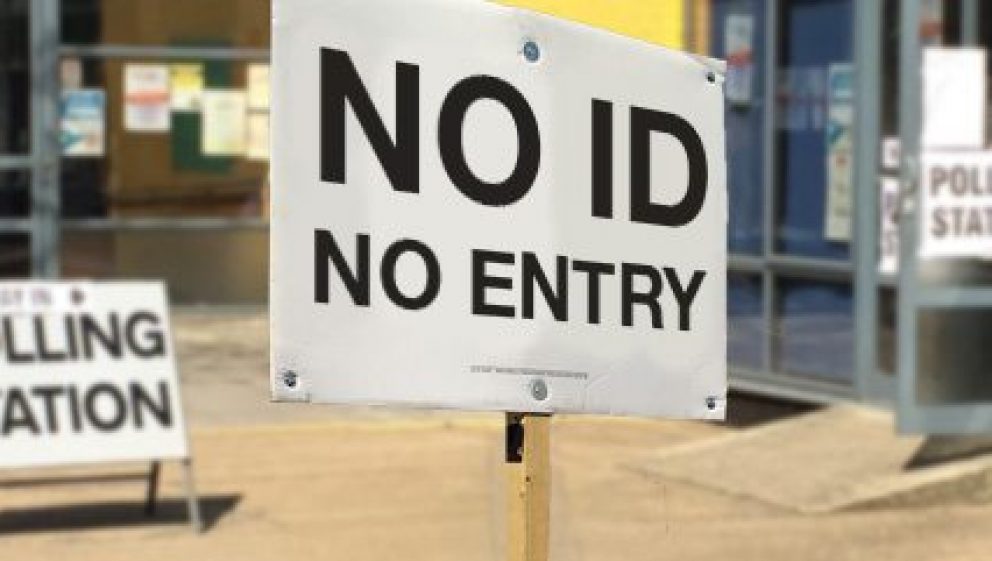
The Elections Act requires voters, from next May, to produce photo ID at UK Parliamentary and most English local elections. And now, a mere six months or so later, we – and the local election officials required to implement them – finally have the Government’s list of acceptable forms of ID and proposed guidelines governing initially next May’s council elections: Coronation permitting, in most English councils – though not Birmingham, to save you checking.

The guidelines run to just the 344 pages, taking effect probably in January. Leaving already pressured election officials with minimal time (and as yet undetailed costs, beyond a ‘ballpark’ £180 million per decade) to process and issue electoral identity documents for those who gradually discover they don’t have acceptable forms of photo ID. Plus the near certainty that at least some would-be, and quite likely upset, voters will be turned away at their polling stations – which could add to the fun for the small army of volunteer poll workers.

At which point I should indicate my personal viewpoint. Instinctively – and certainly predating Birmingham’s own 2004 embarrassment of six Labour councillors getting elected through what was judicially described as a “massive, systematic and organised” postal voting fraud campaign – I’ve long broadly supported, in principle, stronger election integrity rules in general and photo voter ID specifically.

And I have recounted in these columns the reactions of some of my overseas students to the frankly casual ID confirmation procedures they’ve observed when accompanying me to the polling station. Their surprise at the staff’s indifference to whether I’ve brought my poll card identification; and almost shock as I ‘helpfully’ point on the register to what I claim is my name and address.

So why my support in principle for photographic ID – as well as nowadays that of a substantial majority of voters themselves and the conditional backing of the independent Electoral Commission?  Simples!  Elections are the engines of our democratic system. They should be seen by all as important, and that perceived importance is diminished by not having visibly more robust voter identification procedures – like virtually all other ‘democratic’ nations.

On the Crime Prevention Research Center’s database of Europe’s nearly 50 such countries, “only the United Kingdom” does not require government-issued photo voter ID to vote in national elections.

Correction!  Not the UK, just GB. Northern Ireland introduced voter ID nearly 20 years ago, and now has numerous forms of acceptable photographic ID – including, as well as passports and driving licences, a free Electoral Identity Card, plus senior, disabled and blind persons’ ‘SmartPasses’.

Since when, the Electoral Commission has found that, far from prompting polling day protest riots, voters’ confidence that elections are well-run has steadily increased to at least match the levels in other UK regions[1]. The demonstrable message has been not that we elsewhere in the UK are uniquely virtuous and trustworthy – though even Ministers concede that fraud levels are minimal, if not invariably seen as such. Rather, it’s that for us – and successive Governments – voting has been seen as less big a deal than, say, collecting a parcel at a post office.

Until now, that is, following a decade of quite dramatic change in the voting behaviour of particularly our 18 to 24-year-olds. Their turnouts are invariably lower than the average, but still high enough to hurt. In the 2010 General Election these mostly fledgling voters split equally across the Conservatives, Labour and Lib Dems, roughly 30% for each. By 2019, almost overlooked in the Conservatives’ overwhelming win, it was Labour 52%, Conservatives 28%, Lib Dems 11%.

That’s what evidently prompted the rush – not ‘personation’ or fraud, which for polling station voting are acknowledged as negligible. Rather, a possible early General Election campaign in which the Conservatives don’t start way ahead of the field. It also explains why the apparently generous range of 21 acceptable forms of ID is clearly weighted towards the better paid and over-60s. Older Person’s Bus Pass, Oyster 60+ card, Freedom Pass (66+), Scottish National Entitlement Card (60+), etc. – all welcome. Those particularly applicable to younger people, like Student ID cards or Railcards, remain “unacceptable”, as in the original legislation.

Yes, as in Northern Ireland, free ‘Voter Authority Certificates’ will be available – including online – and a public awareness campaign will remind you and your selfie to apply in time.  And no, none of this remotely approaches the legalised voter suppression we saw in some of this November’s American state elections. But – to coin a dreadful cliché – it’s from the same partisan playbook.

As are the £1.3 million-worth of 40,000 mirrors and privacy screens – one of each per polling station – that desperately cash-strapped councils must provide to check on would-be voters with religious face coverings. But they may well prove worth a blog of their own sometime before next May.

_______________________

A slightly publisher-edited version of this blog appeared in The Birmingham Post, 17th November – https://www.pressreader.com/uk/birmingham-post/20221117/textview


[1] Examples from the Electoral Commission’s ‘Winter Tracker’, Jan/Feb 2022:

   “Elections are affected by fraud/corruption?”  Total agree: 37%; W Midlands 37%; NI 30%.

Those “not confident that elections are well run: Some people have difficulties registering to vote”:                                          
Total agree: 20%; W Midlands 18%; NI 10%.

Chris Game is an INLOGOV Associate, and Visiting Professor at Kwansei Gakuin University, Osaka, Japan.  He is joint-author (with Professor David Wilson) of the successive editions of Local Government in the United Kingdom, and a regular columnist for The Birmingham Post.

Integrated Care Boards – a new frontline in localism?

Jason Lowther

As the government once again kicks down the road decisions on vital reforms and funding for social care, local areas are establishing the Integrated Care Boards which will lead the new Integrated Care Systems (ICS), bringing together the NHS, local government and partners to plan and deliver integrated services to improve the health of the local population.  Building on the progress made since many public health responsibilities transferred back to local government in 2013, this is a great opportunity to address the determinants of health and issues around health inequality.  Might ICSs at last lead to an effective local voice in our over-centralised, top-down healthcare system?

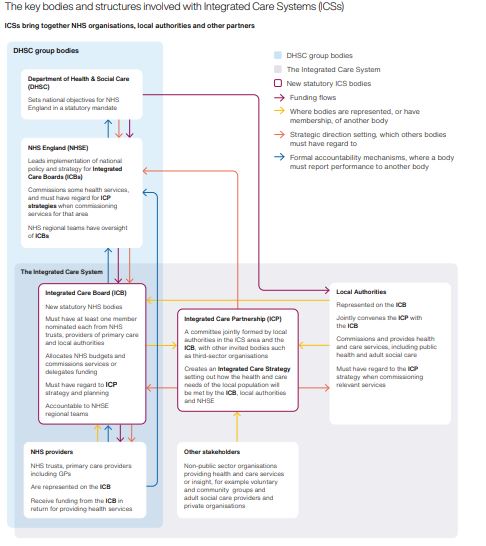
Each ICS is supposed to plan at three levels: the neighbourhood (an area of around 40,000 people), the ‘place’ (often a LA area), and the (ICS) system (covering around 2 million people).  Working at the neighbourhood level is likely to be somewhat informal, often using a social prescribing approach and developing multi-disciplinary teams including third sector partners.  The approach to ‘place’ looks set to vary between areas, with some ICSs devolving significant responsibility (and funding) whilst others centralise these at ‘system’ level.  Meanwhile at ‘ICS system’ level, Integrated Care Partnerships (joint LA and health committees) will develop an Integrated Care Strategy to meet the assessed health and social care needs of their population identified in the Joint Strategic Needs Assessments and Wellbeing Strategies prepared by local Health and Wellbeing Boards.

Beyond the formal planning process, the success of local ICSs will partly depend on the quality of local collaborative (managerial and political) leadership – across statutory partners and with the third sector.  It will be a tough job to balance the priorities of the national health service and issues of local places, but many local authorities will be able to offer helpful experience , for example from moves to more networked governance approaches.

The National Audit Office recognises the potential but appears dubious on current prospects.  Last month it published a review, Introducing Integrated Care Systems: joining up local services to improve health outcomes, finding:

NHSE has a detailed regime to monitor performance against core NHS objectives but … it is less clear who will monitor the overall performance of local systems, and particularly how well partners are working together and what difference this new model makes…

The report notes that, whilst government is asking ICSs to set out local priorities and make progress against them, there is no protected funding and few mechanisms to ensure this happens.  This leads, as the NAO politely puts it, to “a risk that national priorities, and the rigorous oversight mechanisms in place to ensure they are delivered, crowd out attempts at progress on local issues”.  The report also identifies five “high risk” elements of effective integration: clarity of objectives, resourcing, governance and accountability (such as how ICSs will function alongside existing local government Health and Wellbeing Boards and how accountability differences between NHS and local authority bodies will be resolved), and the capacity to balance priorities other than national NHS targets. These urgently need to be addressed if ICSs are to begin to meet their potential.

At one of Inlogov’s “Brown Bag Lunch” discussions earlier this month we agreed on the importance of issues around how ICSs develop, particularly in terms of developing effective system leadership and planning, collaborating with community organisations, and links to wider devolution processes. I’d be interested to hear about experiences in local areas as these develop. 

Jason Lowther is the Director of INLOGOV. His research focuses on public service reform and the use of “evidence” by public agencies.  Previously he worked with West Midlands Combined Authority, led Birmingham City Council’s corporate strategy function, worked for the Audit Commission as national value for money lead, for HSBC in credit and risk management, and for the Metropolitan Police as an internal management consultant. He tweets as @jasonlowther

Picture credit: National Audit Office

Are councillors safe? #DebateNotHate

Jason Lowther

Earlier this summer the Press Association reported an attack on an Edinburgh Councillor who was said to be very shaken up after he was confronted by a man he reported as ‘hurling verbal abuse’ at him as he was delivering leaflets in his ward at about 11.10am on Sunday, continuing ‘he then put his hand up to my throat and he then pushed the leaflet down the top of my shirt’ (PA Newswire: Scotland, 7 August 2022).  This isn’t an isolated incident, although media and government attention has often been focused on threats to British MPs, such as the tragic murder of Jo Cox, and violent conflicts in the USA.

The LGA submitted evidence to the 2019 House of Commons review of intimidation in public life, giving several examples of the intimidation of councillors including:

  • A Sandwell councillor’s car was forced off the road, and the authority used a court injunction to stop an abuser approaching two councillors.
  • A young female Conservative councillor decided not to stand for election again, citing the abuse she faced.
  • A disabled former council leader stayed away from a council meeting because he feared for his safety.
  • Abusive messages were sent to an Isle of Wight councillor’s daughter in the run up to a controversial decision.

The 2017 review of Intimidation in Public Life by the Committee on Standards in Public Life made recommendations to government, social media companies, political parties, the police, and others about the measures needed to deal with intimidation, which the Committee described as ‘a threat to the very nature of representative democracy in the UK’.  Three years on, the Dec 2020 progress report welcomed greater protections by social media companies, whilst noting the companies had still not enabled users to escalate potential illegal content online to the police.  All of the Westminster political parties have established Codes of Conduct that explicitly prohibit bullying, harassment and unlawful discrimination and some (the Labour Party, the SNP, the Liberal Democrats, Plaid Cymru and the Green Party) have signed the joint statement of conduct against intimidation.

Just over a year ago, LGA Labour Group leader Cllr Nick Forbes called for a ‘zero-tolerance approach’ to the harassment of councillors and a ‘change in the law to protect us’ (Municipal Journal, 21 October 2021).  He recalled abuse over social media and dog mess being put through his door.  At the same meeting of the LGA’s executive advisory board, LGA deputy chair, Cllr Tudor Evans, who has been subject to a death threat, said: “we can’t tolerate this anymore”.  The meeting received a report which recommended a campaign focused on detoxifying public political discourse and improving the response to unacceptable behaviour, as well as developing a code of conduct for councillors.

Some guidance and support is available.  The LGA has published advice for councillors on handling intimidation, which it defines as “words and/or behaviour intended or likely to block or deter participation in public debate, which could lead to an individual wanting to withdraw from public life”.  The guidance includes the organisation of ward surgeries, such as avoiding holding solo surgeries in otherwise empty buildings, advice on home security, managing social media contact, and how to handle visitors to the councillor’s home address.  There’s also useful advice for councils on how they can support councillor safety. 

But more needs to be done. It is never acceptable for councillors to have to choose between feeling safe and serving their community. It’s wrong that social media companies don’t facilitate reporting to the police. All political parties should be signed up to conduct against intimidation. All councils should be reviewing the LGA advice to ensure their elected members are as safe as possible, and government should provide funding for the necessary security measures. As the Committee on Standards in Public Life concluded in a blog on progress since their report: “Intimidation and abuse have no place in a healthy democracy”.

Jason Lowther is the Director of INLOGOV. His research focuses on public service reform and the use of “evidence” by public agencies.  Previously he worked with West Midlands Combined Authority, led Birmingham City Council’s corporate strategy function, worked for the Audit Commission as national value for money lead, for HSBC in credit and risk management, and for the Metropolitan Police as an internal management consultant. He tweets as @jasonlowther

Picture credit: guystuffcounseling.com/

What are the career backgrounds of city managers in the United States?

Wesley Meares, Beth M. Rauhaus and William Hatcher

In our recent Local Government Studies article, we report the career paths of city managers from a nationwide survey of 345 chief administrative officers leading cities throughout the United States (U.S.). We sought to understand who the chief administrative officers are, how they arrived in their current position, and the significant challenges they face. Exploring these topics helps us describe the composition of local government managers, and knowing the career paths of these public administrators helps our field in preparing future managers for their service. While these topics have been researched in the past, for example, by Watson and Hassett (2004) and Folz and French (2005), an updated view of chief administrative officers of U.S. cities was needed. To explore these questions, a survey was sent to chief administrative officers of small, medium, and large cities throughout the U.S. From our survey, we learned three key takeaways.

Who: The Make-Up

Local government management in the U.S. needs to diversify. Most survey respondents reported being white males, with nearly half being 55 or older and only slightly over 18% reporting as female. Public administrators must reflect and mirror the communities they serve, and local government management in the U.S. does not represent the nation’s diverse population. Thus, diversity needs to be a focus of the field in the future. There will soon be an opportunity with the impending retirements of many in local government management – what the ICMA has labeled a “silver tsunami.” This oncoming wave shows up in our survey’s findings. Over 50% of those surveyed indicated they intended to retire in the next ten years, and 30% said they would retire within five years. The need to hire the next generation of local government managers is an excellent opportunity to increase gender and racial diversity in local government.

How: Career Pathways

Local government management is more stable than in the past. Of those surveyed, the average tenure in their current positions was a little over seven years. One career pathway to local government management is having prior work experience in the area. Most of those surveyed were hired into their current positions as external candidates, often making lateral moves in their careers. Another career pathway to local government is having experience in budgeting and planning. City managers identified developing negotiation skills, having a mentor, and earning an MPA as other critical pathways to local government management.  

What: Major Challenges

Local government management is more concerned with technical aspects of the job (time management, leading teams, human resource actions, etc.) than political conflict and relations with the public. This is a surprising finding. On the one hand, it is positive that city managers are concerned with the nuts and bolts of their jobs. However, on the other hand, many of the challenges they face will surround issues of politics. For our field of public administration to advance democratic governance, we need public administrators to be concerned about politics and community outreach.

With the fast-approaching retirement of many within local government, there is an opportunity for U.S. cities to diversify their workforce, particularly those leading cities. Our study’s data on career pathways provide a roadmap to help public administration scholars and instructors help achieve effective, efficient, and equity in local government management.

Wesley L. Meares is an Associate Professor of Public Administration in the Department of Social Sciences at Augusta University, where he serves as the graduate program director for the Master of Public Administration program. His research focuses on housing policy, community development, sustainability, and local government administration.

Beth M. Rauhaus is an Associate Professor of Public Administration and the MPA Program Coordinator in the Department of Social Sciences at Texas A&M University, Corpus Christi. Her research explores issues of gender and diversity in the public sector.

William Hatcher, Ph.D. is a professor of public administration and chair of the Department of Social Sciences at Augusta University. His research explores the intersections of public administration and healthy policy, public administration education, and public budgeting.

References:

Folz, D. H., & French, P. E. (2005). Managing America’s small communities: People, politics, and performance. Rowman & Littlefield.

Watson, D. J., & Hassett, W. L. (2004). Career Paths of City Managers in America’s Largest Council‐Manager Cities. Public Administration Review, 64(2), 192-199.

Picture credit:Luis Marina

Is Government Giving Value For Money?

Jason Lowther

When money is short, how we spend it becomes even more important. As central government reheats its arguments for austerity following the chaos of the last few weeks, I’ve been reflecting on the contents of the 2021 budget (just a year ago).  The 2021 budget set out not just spending plans, but also a souped up approach to measuring outcomes and cost-effectiveness of government spending. How are these playing out, and will they survive the No 10 merry-go-round?

Rishi Sunak, then eight months into the job as Chancellor, noted that government borrowing was relatively high after the pandemic, warned of the public finances’ exposure to rises in interest rates, and outlined how spending was being linked to the delivery of outcomes alongside across the board ‘efficiency savings’:

The fiscal impact of a one percentage point rise in interest rates in the next year would be six times greater than it was just before the financial crisis, and almost twice what it was before the pandemic…

Decisions have been based on how spending will contribute to the delivery of each department’s priority outcomes, underpinned by high-quality evidence. The government has also taken further action to drive out inefficiency; SR21 confirms savings of 5% against day-to-day central departmental budgets in 2024-25. (page 2)

The “priority outcomes” are the latest in a long line of attempts to prod government spending into delivering effectively on political priorities, rather than blindly increasing/decreasing by x % compared to last year.  A 2019 report from the Institute for Government helpfully outlines many of these earlier initiatives (summary from the House of Commons Library) including:

  • “Scrutiny programmes” and the Financial Management Initiative (FMI), introduced under Thatcher.
  • The Cabinet Office and Treasury set up the Financial Management Unit (FMU) in 1982 to help with creating plans under the FMI.
  • The “Next Steps” report, published in 1988, which recommended the establishment of executive agencies to carry out the executive functions of government.
  • Tony Blair’s administration developed a greater focus on performance targets and Public Service Agreements (PSAs) which put these targets on a formal basis.
  • In 2001, Blair’s government also set up the Prime Minister’s Delivery Unit (PMDU), which was intended to coordinate PSAs and bring them under more central control.
  • Under the coalition government in 2010-15, PSAs were abolished and replaced with Departmental Business Plans (DBPs). These shifted the focus from targets to actions – in other words, they listed what each department would do and by when, rather than what they sought to achieve.
  • Under the Conservative government in 2016, DBPs were renamed to Single Departmental Plans (SDPs), which were themselves renamed to Outcome Delivery Plans (ODPs) in 2021. According to the NAO, SDPs (and by extension, ODPs) are supposed to be “comprehensive, costed business plans”.

As well as having to write down what outcomes they want to achieve, and how they will know whether that is happening, under the SDP system departments were also required “to assess progress in delivering their priority outcomes [and] … share regular performance reports with HM Treasury and the Cabinet Office”. 

In the 2021 spending review, the departmental outcomes were spruced up to reflect the (now last-but-one) PM’s five priorities of levelling up; net zero; education, jobs and skills; recovering the NHS; and reducing the volume and harm of crime.  

This blog’s audience may be interested in “Where does local government fit in this compendium of key priorities?”  The answer is a little depressing: on the last line of the last page (page 30 of 33), just before the devolved government departments. The relevant outcome is inspiring enough: “A sustainable and resilient local government sector that delivers priority services and helps build more empowered and integrated communities”, albeit with the reassuringly non-SMART measure that “the department will provide narrative reporting on progress for this outcome”.  Of course I exaggerate, because local government has critical inputs to very many of the earlier outcomes too, but it’s hard not to conclude that local services and communities were not yet at the top of the ministerial attention list.

Will the “priority outcomes” survive the whirlwind of ministerial movements and unforced economic missteps?  After the last seven weeks, I’m not going to make predictions – but we should know in the next month, and alongside the financial figures they could be our best hint yet on where a Sunak government is heading.

Picture credit: https://www.youtube.com/watch?v=Du_6mRV8Hm8

Jason Lowther is the Director of INLOGOV. His research focuses on public service reform and the use of “evidence” by public agencies.  Previously he worked with West Midlands Combined Authority, led Birmingham City Council’s corporate strategy function, worked for the Audit Commission as national value for money lead, for HSBC in credit and risk management, and for the Metropolitan Police as an internal management consultant. He tweets as @jasonlowther

Are councils representing their communities?


Jason Lowther

Fresh from this year’s successful Solace Summit, the organisation this week launched a new report on “Understanding and Improving Equality, Diversity and Inclusion in the Local Government Workforce”.  It’s a challenging but inspiring read raising fundamental issues for the sector where a recent survey found that more than 80% of children’s services directors in English upper-tier local authorities were white British and only 2% identified as black African or Caribbean while Asians were not represented at all. 
[Full disclosure – Inlogov and the LGA supported the research, which was commissioned by Solace, undertaken by Shared Intelligence, and funded by Zurich Municipal].

Many councils are publishing only limited information on the diversity of their workforce.  The Solace research analysed workforce profile reports of the 152 “top tier” local authorities in England.  The research found that just over half (55%) of these councils publish detailed statistics of their workforce in terms of ethnicity and provide the necessary level of information to compare with the local workforce by sub-category of ethnicity. A further 38% only disclosed an overall percentage of BAME employees, and EDI Workforce reports were not found for a dozen councils.  Almost a fifth of the reports were seriously out of date (19% from before 2020).  The best performing area was the West Midlands, with 12 of their 14 councils publishing complete data.  Only about half of the councils nationally provided pay and grade information by ethnicity.  The report recognises that workforce data is often unreliable or out of date.

Some councils are achieving a workforce that reflects their community’s ethnic mix.  Out of 140 councils with complete and partial information, in 49 councils the percentage of BAME employees is greater than the BAME working population. However, outside London and the East Midlands, in each region the council workforce has a lower BAME percentage than the local working population.  The representation of minority ethnic groups appears to drop significantly at senior or leadership positions, and among the top earners. 

The report makes three big recommendations to improve the value of council workforce data.  First, being transparent about the quality and completeness of the information for example by including the response or completion rate for ethnicity data in the council’s HR system.  Secondly, adopting  a consistent categorisation of ethnic groups at sub-category level (in line with the Census 2021).  Thirdly, standardising the data presentation, for example using a standard approach of recording ethnicity at 10,000 pound pay bands and median pay gaps.

Solace has committed to champion diversity.  The Solace launch webinar for the report saw Non-Executive Director Leads on Diversity & Inclusion, Nazeya Hussain and Chris Naylor, discuss Nazeya’s powerful lived experiences and the organisation’s “statement of intent” championing equality, diversity & inclusion across local government.  

In a country where over 20 per cent of the population reports being from a minority ethnic group and yet Black and minority ethnic people are 2.5 times more likely to be in relative poverty than their white counterparts and Bangladeshi men are still 3 times more likely to die from Covid, more councils need to look like their local community.  This report shines an important light on how to get there, and how we can better check whether progress is being made.

Jason Lowther is Director of the Institute for Local Government Studies (INLOGOV), University of Birmingham

Picture credit: EpicTop10.com https://www.flickr.com/photos/182229932@N07/