Thursday’s local elections: Catzilla and the county councils

Chris Game

I really wish sometimes – OK, occasionally – that I still did my British Government undergraduate lectures. This would be revision season, with lectures atypically well attended, by previously unseen students hoping for hints about exam questions. And there’d be the local elections, and the opportunity to point out once more that, as students, many of them could not only register twice, at home and at their term-time address, but also in these elections vote twice – and try to persuade them to do both at least once.

It’s not easy. Post-election opinion polls tell us that in the 2010 General Election, for example, 56% of 18-24 year olds didn’t vote, compared to 35% of all electors and only 24% of over-65s. They don’t usually tell us, though, that most of those 56% couldn’t vote, because they weren’t even registered. The Electoral Commission can, though, and their statistics on the inaccuracy of electoral registers are alarming. Using known population growth rates, the Commission reckoned the April 2011 registers, showing an electorate of around 45 million, were 15% inaccurate, that at least 6 million people in GB were unregistered, and among 17-24 year olds the non-registration rate was 44%.

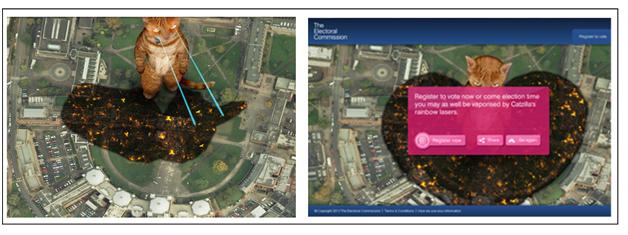
The Commission runs regular campaigns to promote registration, this year’s being clearly aimed at these elusive young people. I’m not sure about its effectiveness, but I’d certainly use it, and I can recall few visual aids of whose student appeal I would be more confident. ItsYourVote is a website whose home page comprises a satellite image of the UK, and a warning that “Without a vote, you have no say in what happens in your local area”. To learn what fearful fate that might be, you enter your postcode, whereupon the satellite homes in and you discover that, should you fail to register, “come election time, you may as well be vaporised by Catzilla’s rainbow laser eyes”, or possibly seized by a massive disco fairground grabber, or swept up by a giant ice cream scoop.
catzilla
Source: ItsYourVote

The Daily Mail thinks the website “absurd” and an appalling waste of public money. But I fear it misses the subtlety. While obviously the ice cream scoop is a bit silly, you can see that Catzilla, though provoked by the under-registration of Birmingham University students, has been impressively selective in his vaporisation of our Edgbaston campus – wiping out the Law faculty and the entire University administration, but leaving untouched, for instance, the Muirhead Tower and my civic-savvy, fully registered INLOGOV colleagues.

As it happens, the Commission’s efforts would be wasted on most of our students this year, for, as noted in my elections preview blog, this is the one year in four when the metropolitan boroughs like Birmingham, along with most unitary authorities and shire districts, don’t elect any of their councillors. This leaves just 37 councils in England plus one in Wales holding any kind of local elections this week, and, with that first blog having at least briefly covered those in the 8 unitaries and the mayoral elections in Doncaster and North Tyneside, the remainder of this one will focus on the 27 county councils.

They were previously elected in 2009, when Labour’s standing in the opinion polls was desperate – 16% behind the Conservatives, at 23% to 39%, with the Liberal Democrats on 19%. Reflecting those figures, the Conservatives, the dominant party anyway in this tier of local government, won nearly nine times as many seats as Labour – 1,261 to 145, with the Lib Dems taking 346 – and took majority control of every one of the 27 councils except Cumbria, where they became the leading party in a Conservative/Labour/Independent coalition.

2009 is therefore the baseline against which to assess the prospects and eventual performance of the various political parties, whose standings in the polls today are, of course, dramatically different. In this week’s Sunday Times YouGov poll, Labour have a 9% lead (40% to 31%) over the Conservatives, with the Lib Dems and UK Independence Party (UKIP) level on 11%, and the Greens on 3%. These figures indicate a Conservative –> Labour swing of nearly 13% since 2009, and no swing at all between the Conservatives and Lib Dems. It’s a blunt measure, but about the best we have for assessing the electoral chances of the major parties.

In the same poll, incidentally, UKIP leader, Nigel Farage, gets a higher rating as a party leader – 44% saying he’s doing a good job – than Cameron (36%), Ed Miliband (29%), or Nick Clegg (21%). Partly because of headlineable findings like these, and partly because they are a real, but unpredictable, threat to all parties in these elections, UKIP have, as Karin Bottom noted last week, been attracting the bulk of media attention. In terms of seats, though not councils, gained, they will undoubtedly be among Friday’s winners – indeed, it’s about the one knowable thing about them – but mainly because they’ve virtually nothing to lose.

UKIP like boasting of their “army of councillors sitting on borough, town, county and parish councils across the UK”. This army, though, would make Gideon’s little band of soldiers that took on the Midianites seem like a legion. In fact, its massed ranks contain just over 100 town and parish councillors (out of 75,000) and about 30 on principal authorities – including 11 (out of 1,800+) on county councils. And there’s a similar economy with the truth in its manifesto claim that “where UKIP is in charge of local government, we use that power to cut costs … we believe that council taxes should go down, not up”. Back on Earth, the only local government of which UKIP has ever had charge is Ramsey Town Council in Huntingdonshire, Cambs., and since taking ‘power’ in 2011 they have ‘slashed’ the council tax precept by +28%, from £42.56 on Band D to £54.61 in 2012-13.

Council tax rates are, quite properly, a big issue in these elections, but hardly a straightforward one. First, Coalition Government ministers have from the outset done their utmost to set – that is, freeze – all councils’ tax and spending totals themselves, by bribing them with limited and potentially disadvantageous freeze grants. Second, it is the districts, not the county councils being elected this week, who are the billing authorities who will have sent out the bills and be trying to collect the taxes, even though it’s the counties who do about 90% of the actual spending.

Third, this year, although almost all counties obediently accepted their one-off grant deals and froze their tax precepts, well over a third of the districts refused them and raised their tax bills – more than half of whom were Conservative-controlled. So, does a voter in one of these ‘naughty’ districts, urged by David Cameron to vote Conservative for lower council taxes, punish the council that raised its tax or reward the county that didn’t?

It’s nothing like as simple as, for instance, street-lighting. It’s not, perhaps surprisingly, a statutory obligation for any council, but, if your street lights are being dimmed or switched off in the interests of economy, it’s almost certainly the county who control the photo-electric timers. So, either way, if you approve of the cost and carbon savings, or disapprove of jeopardising safety and security, you know how to vote.

So how many of the 27 counties, all Conservative today, will be differently controlled come Friday? In Cumbria, the one that half got away in 2009, Labour in recent years has usually had a plurality, if rarely a majority, and will be looking to regain that position of largest single party. However, a Conservative Police and Crime Commissioner (PCC) was elected in November, and, as elsewhere, Ed Miliband’s claim to be “fighting for every vote” is undermined by the party fielding 14 fewer candidates than in 2009, while Greens are up from 15 to 31, UKIP from 4 to 52, and, in another sign of the times, the British National Party (BNP) down from 41 to 9.

While becoming largest party may be fine in Cumbria, in the four councils Labour held virtually uninterruptedly from 1981 until 2005, anything short of winning back majority control will surely count as failure. Derbyshire was numerically the Conservatives’ narrowest capture, with 33 of the council’s 64 seats, and they have already lost that overall majority, with one councillor having to resign for unsavoury personal reasons and another switching allegiance to UKIP. Even a modest swing should do. Nottinghamshire is much trickier, for in 2009 Labour lost seats variously to the Conservatives, the Lib Dems, UKIP (in Ashfield), and assorted Independents, especially in Mansfield. A straight swing of even 10% from the Conservatives might not be enough, but a repeat of those with which they won by-elections in Worksop and Rufford certainly would. In Lancashire too Labour need almost to reverse the trouncing they suffered at the hands of all parties, including the Greens and BNP. A 5% swing from the Lib Dems in Burnley, where they have already won back one seat in a by-election, and a 10% swing from the Conservatives elsewhere should do it – even without ousting the notoriously independent Idle Toad, Tom Sharratt, from his South Ribble fastness.

If Lancashire was a trouncing, Staffordshire was a bloodbath, from which Labour crawled out with just 3 of its former 32 seats. With nearly two-thirds of divisional boundaries having been changed, it is difficult even to assess the scale of the task of regaining majority control from such a tiny base, the most promising guide being perhaps the results in the three districts that held elections last year. In both Cannock Chase and Newcastle-under-Lyme Labour took majority control of the council by gaining a total of 15 seats from the Conservatives, Lib Dems, and in Newcastle also from UKIP. In Tamworth too they won seats from the Conservatives, and across the three councils there was an average Conservative –> Labour swing since 2009 of 14%, which, repeated on Thursday, would indeed have been sufficient, without boundary changes, for Labour to reverse the horrors of 2009. In November, on the other hand, the electorate – or a very small portion of them – preferred a Conservative PCC.

Had the Lib Dems gone into opposition in 2010, rather than national coalition, they too would be aiming to regain the councils they lost in 2009: Somerset, Devon and, although it became a single-county unitary at the same time, Cornwall. But two years of depressing opinion polls and local election results are taking their toll, and Devon, for example, seems to be one of several counties in which UKIP candidates will outnumber Lib Dems. Indeed, Ilfracombe, in Lib Dem hands for years, appears to be being surrendered without even a defence.

Somerset, where almost all contests are between the Conservatives and Lib Dems, and the latter were in majority control for most of the period between 1993 and 2009, is a much stronger prospect. Again, extensive boundary changes make projections difficult, but even a 5% Conservative –> Lib Dem swing on existing boundaries would be enough for the Lib Dems to regain control. But, as noted above, there’s been no perceptible swing at all, and the easy victory of an Independent in the Avon & Somerset PCC election may suggest that this is particularly promising territory for independents and smaller parties.

As for the rest, it might seem that in these uncertain times, if a case can be made for Staffordshire being recoverable by Labour from a councillor base of three, almost anything is possible. Well, yes – but realistically, even a really good result for Labour would probably be limited to depriving the Conservatives of their overall control in a few more councils. One could be Warwickshire, which, as a minority administration Labour have run for longer in recent years than have the Conservatives, and another Northamptonshire, one of apparently a small handful who are all claiming to have “the lowest council tax set by any of the 27 shire counties in England”.

Clearly they can’t all be right, and, this being an academic blog, I feel it’s appropriately pedantic to close by citing the relevant House of Commons note reporting that Northamptonshire’s Band D equivalent precept of £1,028.11 is in fact only third lowest, behind Staffordshire (£1,027.25) and Somerset (£1,027.30).

game

Chris is a Visiting Lecturer at INLOGOV interested in the politics of local government; local elections, electoral reform and other electoral behaviour; party politics; political leadership and management; member-officer relations; central-local relations; use of consumer and opinion research in local government; the modernisation agenda and the implementation of executive local government.

The balance between electability and visibility

Ian Briggs

Much has been made of the challenge of actually getting people to vote. The November 2012 Police and Crime Commissioners elections had a pretty dire turnout and there may be some particular issues with regard to that election; but the May 1013 local elections are somewhat different. The three major parties are turning their attention to the next general election and on the back of the Eastleigh By-election the UKIP vote is attracting some attention.

But beneath all of this we need to look more closely at some of the basics of campaigning. Political parties are not swimming with cash at the moment – resources are limited and if the truth be told nearly all parties are short of volunteers to support local campaigns.

Some recent research suggests that over 85% of the UK population have some form of internet connectivity – this of course does mean to say that all are effective users of web based communications. Can the political parties rely more on web based media, social media and electronic campaigning?

In conversations in social settings and when travelling to and from work, it is not that people are wholly disinterested, but rather it is that they say they have few opportunities to actually see the whites of the eyes of the candidates. In more concentrated urban areas it might be possible to do more door to door work but the cost and the time involved to go door knocking in dispersed population areas is a big issue for many candidates – especially as this week’s election is for mainly upper tier councils that cover significant geographical localities. This assumes that all candidates are sound of wind and limb.

A recent conversation with one candidate – a 76 year old widow – revealed that she has little financial support from her party and finds getting about a challenge. Should this in any way detract from her worthiness to stand, her ability to engage in local political and community activity? The answer has to be no, if we believe in local democracy, yet her visibility to those who she is wishing to represent is in marked contrast to the early 40s male candidate who has employer support to stand and whose political career may even enhance his professional career. He also has extensive skills to use web based and social media and can easily find the time to go from door to door in dispersed rural communities to actually talk to local people. He accepts that for many – but not all – it is the policies that he is promoting that are attractive to the electorate and not his shiny German car and sharp cut suit.

If the many who do not have strong political allegiance walk into the polls willing to vote (assuming they have the time and motivation to do so), are they more likely to offer their vote to the individual who has actually taken the time to talk to them on their doorstep? If your telephone has rung and you have been asked if you are going to vote and if so for whom, might it be the one who stood on your doorstep and engaged you in conversation? Do we think enough in the lead up to elections about who are selected to be local candidates and whether there are any inherent inequalities in the way that candidates are selected?

It might just be that sometimes the best candidates, irrespective of their party, might be the better ones to have irrespective of their politics.

briggs

Ian Briggs is a Senior Fellow at the Institute of Local Government Studies. He has research interests in the development and assessment of leadership, performance coaching, organisational development and change, and the establishment of shared service provision.

Do we want fewer councillors, or should we make better use of those we have?

Andrew Coulson

“What are councillors for?” was the question asked at a recent INLOGOV event.

“To take the rap for cuts” was one of the responses.

“We should have fewer councillors, in large single-member wards” was another response. To which the reply came back, sharply, that this would lead to lower quality of councillors, as those who were entrenched in safe seats refused to move on. Young people, women, and people from minorities would find it even harder to get selected. If what we need is a high quality of councillors then the only reliable way of achieving this is to have a large pool of councillors, from which the best can be chosen for office.

The county council elections also provide food for thought on these matters. In six of the counties where there have been boundary changes these will result in fewer councillors (in most of these cases the Boundary Commission was responding to proposals from the councils concerned): Bucks -8, Glos -10, Northants -16, Oxon -11, Somerset -3. This is is a situation where we already have by far the highest ratio of residents to councillors anywhere in Europe – and the more residents a councillor is supposed to represent, and the more distinct communities, the harder it becomes to properly represent local feelings and interests.

So what are councillors for? OK, they are a channel for local residents with grievances in their wards, opposing planning applications (on rare occasions supporting them), and, when opportunities arise, working with local activists in their communities, or taking a lead themselves, to create new initiatives, new responses to situations and needs, or to openings created by new legislation. But, if they are to go beyond this and engage directly with senior officers and act strategically, then a certain level of knowledge is needed and plenty of confidence as well. And the way local government works at present does little to encourage this – hence, perhaps, the complaints that most councillors are redundant and that we should have fewer of them.

The Local Government Act 2000 gave almost all the strategic decision making to small cabinets or individual mayors or cabinet members, or, increasingly, to paid officials (“officers” – does not the military language say it all?) It removed most of the powers of the Full Council, and with that most of the opportunities for councillors who are not members of the cabinet to contribute to strategic decision-making. With decisions taken elsewhere, full council meetings degenerated, often into slanging matches between the main political parties structured (if that is the word) around resolutions which reflect national priorities or party campaigns.

Yet a council should be a Parliament for its area. It is the demonstration of the benefits which can come from the right, expressed in the European Charter of Local Self-Government, for a town or village to elect its own representatives to run its own affairs, to the greatest extent that this is possible, and with sufficient resources to make real choices. That means debates on local issues, discretion over budgets, and votes when appropriate, giving councillors the power to give their local leaderships a bloody nose when they deserve it.

Scrutiny should be a facility to assist the full council in its role of holding the executive to account (and other agencies active in the local area also). This corresponds to the role of select committees in the Westminster or Cardiff parliaments. These are best known for their set-piece occasions when they hold bankers, the chief executives of multinational companies, senior civil servants, or ministers, to account. It is often forgotten that their bread and butter work is the collection of evidence on matters of policy or public administration, which is enshrined in detailed reports – more consultancy or research than ritual humiliation for the TV cameras or a court of law. It is that kind of detailed investigation that scrutiny committees in local government do best, working across party allegiances to discover the truth and offer recommendations on the best way forward.

The Local Government Act 2000 put scrutiny in hoc to cabinets, with no mention of the full council. This weak position is further entrenched when scrutiny officers double as policy officers supporting the Cabinet (it is no secret that scrutiny, like the select committees, depends profoundly on able and independent-minded officers or clerks who can turn the often rambling questionings of politicians into sharp, focussed and often critical reports and recommendations).

That is why a small but increasing number of councils are returning to decision-making by all-party committees. Not because decisions are made more quickly that way (though councils can make quick decision when they have the will to). Not because it makes a single person responsible for a decision (though the chairs of strong committees are often at least as powerful as cabinet members). Not because it allows decisions to be made in public (any more than do cabinets, where the real decisions are made in private before the public meetings, making the public meetings almost redundant). But because it involves all the elected councillors in decision-making, enables those newly elected to participate from Day 1, keeps officers and committee members on their toes, and properly respects the expertise of Opposition councillors and their rights to ask questions and to probe the logic of officers.

Where you have government by committees, no-one any longer questions what councillors are for.

andrew coulson blog

Dr. Andrew Coulson is Lead Consultant on Overview and Scrutiny at INLOGOV, University of Birmingham, with wide experience of Overview and Scrutiny. He has recently launched one of the first assessed qualifications on the subject. His further research interests include partnerships and governance, economic and environmental strategies, and local government in Central and Eastern Europe.

On 27 June INLOGOV will be holding its third day-workshop on Governance by Committees. Many of the councils who changed their governance arrangements in April 2012 will be present, along with other councils who will by then have changed. This is a unique opportunity to consider the merits of the change. For further information see the advert and booking form.

The parties: UKIP’s support should not be ignored, whatever the outcome

Karin Bottom

To date, the majority of pre-local-election attention has focused on UKIP and its potential to diminish or fracture the mainstream vote; particularly that of the Conservatives. In an environment which has – by any standard – undergone substantial change in recent years, the thought that a comparatively small party has the potential to alter the new status quo is important, especially in the run up to a General Election.

So why is UKIP attracting the support it does? While a number of explanations spring to mind, three stand out.

First, the party’s policies resonate with a sizable portion of the electorate, namely disaffected conservatives and those who feel that the mainstream has failed to address their concerns. Indeed, the majority of polls report the party attracting at least 10 per cent of the vote.

Second, UKIP is the leading small party contender in this contest. The largely decimated BNP provides no opposition and neither do the English Democrats. The Greens – though sizable by small party standards in this country – are beleaguered by voter perceptions which seem unable to associate them with bread and butter politics, and despite the party’s efforts to articulate strong opposition to austerity-related policies, their gains are likely to be minimal.

This leads to the third reason for UKIP’s support: it may well have more to do with the other parties than itself. The electorate is largely unsatisfied with the three main alternatives. Despite the dismal economic situation and unpopularity of the Conservative-led government , Labour’s polls are abysmal for this point in the electoral cycle while the Liberal Democrats are just trying to survive. Most importantly none of the mainstream party leaders seem able to fill the electorate with confidence, and despite the gloomy economic situation – though Cameron and Osborne must be grateful for small mercies, given the narrow avoidance of a triple dip recession – Labour remains unable to secure the electorate’s confidence in its economic policies. All things considered, it is little surprise that UKIP’s policies and Farrage’s charismatic maverick qualities have attracted an audience.

Of course, for every positive, there is at least one negative. Vote intentions do not necessarily predict election day results and even if they did, UKIP would suffer because of its widely distributed support base. As a result, the electoral system will probably produce a very poor votes/seats ratio for the party. Furthermore, turnout is likely to be low as these elections will run alone. This is bad news for UKIP which will not be able to bag a vote for the local council on the back one for the European Parliament, as it did in 2009.

Yet, whatever the results, UKIP’s support to date is important and should not be ignored, even if it sheds more light on the political environment than UKIP itself.

bottom-karin

Karin Bottom is Lecturer in British Politics and Research Methods at INLOGOV, University of Birmingham. Her core research areas comprise parties (particularly small and the BNP), party systems and party theory. She is particularly interested in concepts of relevance and how national level theories can be utilised at the sub-national level.

Having the ear of George Ferguson: Bristol, elections and the mayoral model

Thom Oliver

Its election time in Bristol and there is a strange feeling in the air, something has changed and it’s not the colour of the mayor’s trousers. George Ferguson is now the sole power and the culture of politics is perhaps changing in the City.

oliver pic

In a recent news article BBC Bristol Reporter Robin Markwell stopped short of asking the question ‘whats the point of councillors’ in favour of ‘why bother voting‘? As the ‘no’ campaigners warned in their literature about the dangers of placing all the power of the hands of one person, the election of an Independent mayor in Bristol has got some councillors re-evaluating their role and redoubling their focus. With a third of the council up for election and the Lib Dems with potentially the most to lose the mayoral model is also changing the focus and content of campaigns.

As the second largest group on the council, and not a member of the multi-party cabinet, Labour’s campaigning at first glance seems quite generic. It stresses a national stance against the bedroom tax and champions the NHS, which in the light of national events may strike a chord with many. Their local pledges focus around making Bristol a Living Wage City (something Ferguson has spoken against in the past), a piggy-backing onto the campaign of local non-political activist Daniel Farr against the Fares of FirstBus, along with a desire for more affordable homes and childcare places. The movement to pushing these broader campaigns is unsurprising in the light of the movement to a mayoral model.

Across the city the Liberal Democrats have perhaps grasped the nettle of change more strongly, a campaign leaflet reads:

‘This election won’t decide who runs Bristol, or the country. It’s about the best person to stand up for our local area and fight our corner on the council’.

This focus is not so much a change, but perhaps a re-assertion of the community politics and community champion focus which served the party so well before any conception of the party as one of national government. Yet for a party which until the election of Ferguson was running the council, it’s certainly a re-evaluation.

Elsewhere across the City the Conservatives are hugging the mayor tight in their campaigns and the Green party (contesting all seats) are concentrating their efforts on two wards including the one where they already have one councillor. Independents for Bristol remain a bit of an enigma, and it is difficult to even estimate their electoral chances. Their campaigning led with a leaflet about the Independents for Bristol umbrella group, followed by a ‘Magnificent seven’ leaflet (although they are in fact standing 8 candidates) which again made little of localised campaigns or individuals as candidates, with the final leaflet due to hit letterboxes soon it’s a short time for candidates to assert their independence and individuality, this work is presumably being done on the doorstep.

With party politics a dirty word, Independents for Bristol have focused on the Nolan principles for politicians and appointees as an ideological basis, on the evidence thus far in terms of group organisation, the messaging on campaign literature and the existence of selection panels some are beginning to ask the question: if it walks like a duck, and quacks like a duck… The challenge for IfB is and will remain in giving independent candidates a competitive platform against better resourced local parties without impinging on the independence of individual candidates. This was highlighted by Helen Mott (IfB Candidate) in her recent blogpost.

As the campaign plays out questions on the composition of Ferguson’s all-party cabinet remain of interest to locals and politicos. Recently the mayor moved with great relief to fill the void left by Labour councillors as both the local party and National NEC vetoed any Labour involvement in George’s new politics. He appointed two Lib Dems and a Conservative to join his skeletal and stretched cabinet of one a Conservative, a Liberal Democrat and a Green. As George and the group leaders look over their coffee cups the morning after the count the spectre of this debate will re-emerge asking questions about George’s new politics and how councillors, independents, parties can promote campaigns, champion their local areas and ultimately get the man in the red trousers to listen.

thom

Dr Thom Oliver is a Postdoctoral Research Fellow at Oxford Brookes Business School. He completed his PhD, exploring the representative role of councillors on appointed bodies, at INLOGOV in 2011. He currently lives in Bristol and has recently rejoined INLOGOV as an Associate. Follow his Twitter account here, and read his own blog here.