What works in homelessness and rough sleeping

Jason Lowther

We’ve just started a new series of Inlogov blogs summarising the growing body of evaluation evidence in local government, and what it tells us about how councils are learning what works. Nowhere is that learning more urgent or more complex than in homelessness and rough sleeping. A series of recent national evaluations provide a rich, if sometimes uncomfortable, picture of how programmes are operating on the ground, what difference they are making, and where the system continues to struggle. 

Systems‑wide evaluation of homelessness and rough sleeping

The systems‑wide evaluation represents a deliberate attempt to step back from individual programmes and understand homelessness as a complex, interconnected system rather than a set of discrete services. Led by the Centre for Homelessness Impact with research partners, the early reports combine systems‑mapping, policy analysis and qualitative fieldwork in five local authority areas.

The core finding is stark: the system is not working as intended. Public spending and organisational effort are disproportionately focused on crisis response rather than prevention, even though this approach places increasing pressure on local authorities and delivers poorer outcomes. Fragmented funding streams, short‑term grants and inconsistent incentives across departments actively undermine joined‑up working. The evaluation does find examples of strong local partnership practice,but these are often working around the system rather than being supported by it.

The central conclusion is that meaningful progress requires sustained, cross‑government commitment to prevention, better alignment between housing, health, justice and welfare systems, and a clearer understanding of how national policy choices shape local outcomes.

Rough sleeping and complex needs process evaluation

The rough sleeping and complex needs evaluation zooms in on services supporting people facing the most entrenched disadvantage. This process evaluation examined interventions funded through the Rough Sleeping Grant and Rough Sleeping Social Impact Bonds, focusing on people with co‑occurring mental health and substance misuse needs.

Using case studies across 12 areas, interviews with service users and staff, and cost analysis, the evaluation explored how different models worked in practice. It found that progress, including improved housing stability and engagement with services, was most likely where support was flexible, persistent and relationship‑based. Small caseloads, psychologically informed approaches and multi‑disciplinary working were all important.

However, delivery was often hampered by structural barriers beyond local control: gaps in mental health provision, restrictive criteria in mainstream services, workforce instability and the limitations of short‑term funding.

Rough Sleeping Initiative process evaluation

The Rough Sleeping Initiative (RSI) process evaluation complements earlier impact analysis by explaining how and why the initiative achieved results. While the impact evaluation estimated a significant reduction in rough sleeping in RSI areas, the process evaluation explored local delivery through surveys of all funded authorities and in‑depth qualitative case studies.

Local authorities consistently reported that RSI funding enabled them to expand outreach, create specialist roles, and strengthen partnerships with health and voluntary sector providers. Rapid mobilisation, local flexibility and visible political commitment were key strengths. Many areas highlighted the value of multi‑disciplinary teams and assertive outreach in engaging people who had been sleeping rough for long periods.

At the same time, the evaluation identified familiar challenges: recruitment difficulties, reliance on short funding cycles, and the risk of losing skilled staff when funding ends.

Next Steps Accommodation Programme evaluation (briefing paper)

The Next Steps Accommodation Programme (NSAP) evaluation focuses on what happened after the incredible emergency response of “Everyone In” during the Covid pandemic lockdowns. It draws on two waves of interviews with service users in 34 local authorities, around 12 and 18 months after they were placed in longer‑term accommodation.

The findings are cautiously positive. Many people reported improved stability, safety and wellbeing, and a reduced use of emergency services. Sustained accommodation outcomes were more likely where individuals received ongoing, tailored support alongside housing. However, the evaluation is clear about its limits: the absence of baseline data, attrition over time, and the likelihood that those still in contact with services are the “success cases”.

Crucially, it highlights risks to sustainability, particularly affordability pressures, isolation, and unmet support needs.

Capital Letters process evaluation

The Capital Letters process evaluation adds an important organisational and commercial dimension to the evidence base. Capital Letters was established in 2019 as a borough‑owned, non‑profit company to reduce homelessness and temporary accommodation use in London by collectively procuring private rented sector homes, reducing competition between boroughs and driving better value for money.

The evaluation, based on interviews with boroughs, board members, landlords and MHCLG officials, alongside document and performance data review, focuses on how the initiative was set up, governed and sustained. It finds that Capital Letters had early success in demonstrating the potential of scale, shared negotiation and coordinated landlord engagement. Boroughs valued the ambition to change market dynamics rather than simply manage them.

However, the evaluation also highlights significant challenges. Achieving financial self‑sufficiency while meeting social objectives proved extremely difficult, particularly in a highly pressured London housing market. Tensions emerged between commercial risk, borough expectations and the constraints of homelessness legislation. Governance and accountability arrangements were complex, and uneven borough engagement limited the company’s ability to operate at the scale originally envisaged. Ultimately, despite grant support, Capital Letters was unable to become financially sustainable and subsequently wound down operations in 2025.

What does this mean for local authorities?

Read together, these evaluations paint a coherent but challenging picture of what local government can do in homelessness and rough sleeping.

First, prevention and system change demand stability. The biggest barriers to progress lie beyond individual projects. Short funding cycles, fragmented policy levers and misaligned national incentives consistently undermine local efforts, even where practice is strong. Councils can innovate, but without longer‑term certainty the system pulls them back towards crisis response.

Second, relationships and capability are critical. Outreach teams, assertive support for people with complex needs, and sustained tenancy support all rely on skilled staff, trust and persistence. These are precisely the elements most at risk from time‑limited programmes and competitive commissioning.

Third, housing supply and affordability are constraints. The Rough Sleeping Initiative and Next Steps evaluations both underline that service innovation only works when there are viable move‑on options. Capital Letters reinforces this at a system level: even ambitious collective approaches struggle when the underlying market is stacked against local authorities.

Fourth, collaboration is necessary but tricky. Whether through multi‑disciplinary teams or borough‑owned companies, partnership working requires time, governance capacity and shared risk. The evidence suggests collaboration works best when it is supported by clear national frameworks, realistic financial models and space to mature, rather than when it is required to develop and achieve results rapidly.

Finally, these evaluations show the growing value of learning‑focused evaluation in local government. They do not offer simple answers or “magic bullet” models. Instead, they help councils articulate what they are already experiencing on the ground and provide credible evidence to challenge policies and funding arrangements that make homelessness harder, not easier, to resolve.

The learning is no longer about whether local authorities know what works. It is about whether the wider system will allow them to do it.

Placemaking: how do we design better homes and neighbourhoods?

Jon Bright and Vincent Goodstadt

The Government wants to build 1.5m new homes. Here, we discuss one aspect of this ambition: how to ensure that they are designed well. Many in the past have not been.

Good design results in attractive homes, streetscapes and neighbourhoods. It contributes to placemaking, creating popular places, with community facilities, green spaces and essential services.

Well-designed neighbourhoods are sustainable: they don’t rely on high levels of car ownership and energy consumption. As a result, homes are more affordable with low energy bills and access to public transport.

There’s lots of guidance on design, for example, the ‘National Model Design Code’, Oxfordshire County Council’s ‘Street Design Guide’, and the Building Beautiful Commission’s report ‘Living with Beauty’. The problem is not primarily with the guidance.

The problem is that developers and housebuilders don’t use the guidance that exists and planning authorities don’t enforce it.

What’s the evidence?
A 2020 report, ‘A housing design audit for England ‘, concluded that the design of new housing developments in England is overwhelmingly ‘mediocre’ or ‘poor’.

The audit reveals that 75% of new housing developments studied should not have gone ahead due to ‘mediocre’ or ‘poor’ design. It inspected 142 housing developments and found that one in five should have been refused planning permission outright as their poor design was contrary to the National Planning Policy Framework (NPPF). A further 54% should not have been granted permission without improvements to their design.

The importance of design has been reaffirmed in the new NPPF (December 2024).

In addition:
• Housing for less affluent communities is much more likely to be poorly designed.
• Low-scoring developments scored badly in terms of character and sense of place.
• The worst places were dominated by access roads, storage, bins and car parking.
• More positively, schemes scored highly for security and included homes of varying sizes.

The author, Professor Matthew Carmona said: “Planning authorities are under pressure to deliver new homes and are prioritising numbers over the long-term impacts of bad design. At the same time, house builders have little incentive to improve when their designs continue to pass through the planning system. Some highways departments do not even recognise their role in creating a sense of place.

“House builders, planning authorities and highways departments need to significantly raise their game. This can’t come soon enough”.

A second study – ‘Delivering Design Value’ – assessed the problem of design quality by looking at what happens on the ground when large housing schemes are built. It confirmed that although planners want to create attractive places, design is frequently overlooked because of the pressure to meet housing targets. This is because we don’t have enough planners, especially with design skills.

Of course, developers are also responsible for design quality. But it’s widely known that volume house builders use tried and tested site layouts and house types that lack design value. Too often, local authorities approve them when they shouldn’t.

The study recommends that design should be at the heart of development and design value standards prepared that are simple, concise and translatable into clear guidance.
Without change, the housebuilding industry will continue to receive a ‘free pass’ on design and local authorities’ powers to shape places will be eroded further.

What is to be done?
Central government has revised the NPPF and the chapter on design is strong. But much will depend on how its implemented. Drawing on the two studies, we recommend that:

National design standards should place design at the heart of planning and housebuilding. Local design codes should be prepared for each major site and highways design should be a part of the planning process.

Applications for new housing should reflect national design standards and local policies covering placemaking, sustainability, streetscape, landscaping and access for pedestrians, cyclists and motor vehicles.

Local Design Panels should include specialists and review the design of major housing schemes. This should not cause delays if guidance has been followed. Design guidance should be a part of the Local Development Plan.

Local Authorities need more planners with design expertise. The main players – house builders, planners, design experts and community leaders – should collaborate on the design and master planning of large housing developments.

Conclusion
Too many housing developments are poorly designed. This must change. Local Authorities should give more attention to design, review large developments and set and enforce planning conditions.

As the new NPPF notes, ‘Development that is not well designed should be refused, especially where it fails to reflect local design policies and government guidance on design.’ (Para 139).

Developers and housebuilders need to raise their game by drawing on their best achievements and stop relying on a small number of site layouts and building types.

(Our full paper which amplifies the views in this blog can be accessed through the link here.

Jon Bright is a former Director at the Department of Communities and Local Government. He was involved in designing and implementing the Government’s national strategy for neighbourhood renewal (1998-2007) and is currently a Trustee of a charity that advises communities on Neighbourhood Planning. His book ‘Modern Management and Leadership: People, Places and Organisations’ was published in 2023.

Vincent Goodstadt is a member of the Design Council’s Network of Experts and advises organisations in the public, private, and voluntary sectors. Previously, he held senior planning posts in local government. He is a Past President of the Royal Town Planning Institute (RTPI), holds an Honorary Professor at the University of Manchester, and is a Vice-President of the Town & Country Planning Association.

80% of councils directly involved (again) in delivering housing

Chris Game

If you’re an academic – either a genuine intellectual, theorising one, or a more lecturing, popularising one like what I was – there’s a good chance that the week before Easter is Conference Week.

It’s easy to mock, and knock, academic conferences. Too many delegates reading, rather than ‘presenting’, their papers; no time for proper interrogation, discussion and debate; mediocre university campus food. And for overseas conferences, add in climate threatening CO₂ emissions.

However, I like them – conferences, that is.  Indeed, this recent Easter week I racked up a full half-century of attending, at least intermittently, PSA (Political Studies Association) conferences.

Like most such events nowadays, this one was ‘hybrid’ – with panels attended partly in person, partly digitally via Zoom. Which makes genuine discussion additionally problematic, and emphasises the importance of the written papers addressing subjects that ideally are appealing, topical and even newsworthy.

Happily, in the Local Politics Specialist Group this is almost the norm. And this year one paper especially – in addition, obviously, to that of the INLOGOV’s Director, Jason Lowther (from ‘Birminham’, according to p.25 of the evidently un-proof-checked programme!) – struck me as both sufficiently important and timely to bring it to the attention of a couple of slightly wider audiences⃰.

Timely because we’re fast approaching the May 5th local council elections, and, if these councils’ controlling parties choose to draw voters’ attention to it, many could boast something they might well not have been able to even four years ago when these same seats were last collectively contested.

Specifically, over four in every five should be able to claim that they are genuinely and actively involved in the business of delivering social housing.  And if that doesn’t grab you, or you’re thinking: “well, isn’t that one of the main things councils are supposed to do?” – or maybe, as a Birmingham resident, you’ve heard of the 4,000+ homes built by the Birmingham Municipal Housing Trust, the City Council’s housebuilding arm, and assume that it’s fairly typical, rather than really exceptional – then I politely suggest you’ve rather lost the plot in recent years.

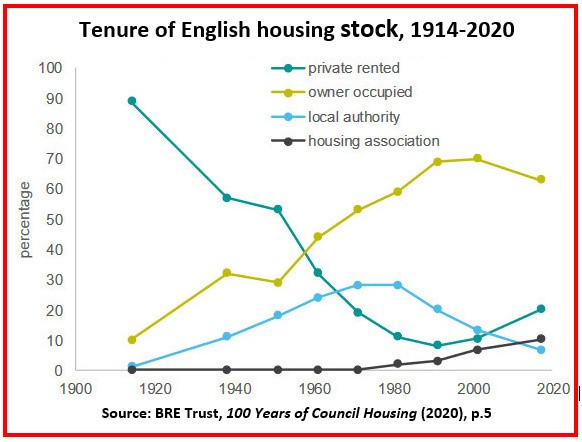
When I used to lecture to particularly overseas students about housing in England or the UK, I would use a couple of very basic graphs, similar to those illustrated here. The first showed the changing relative importance of our main housing tenures since 1919 – private rented, owner occupied, local authority, and housing association.

Tenure1

At the end of the First World War, the ‘big picture’ was straightforward: roughly 90% of housing stock was privately rented, 10% owner occupied. Councils were empowered to build ‘corporation housing’, but few did.  But the War changed everything. PM Lloyd George promised not just houses, but “Homes Fit for Heroes’, and the 1919 Addison (Housing, Town Planning, &c.) Act facilitated it. Council housing committees sprung up, generous subsidies were provided, and council estates mushroomed.

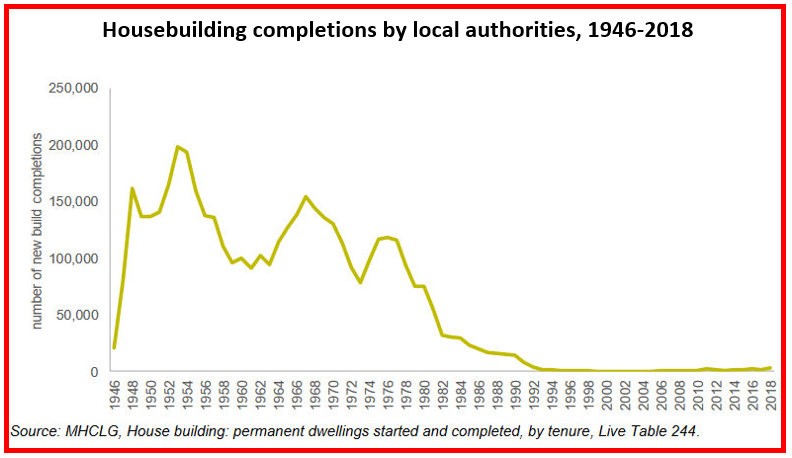
By 1939 over 10% of the population lived in council homes, and the numbers increased steadily post-war, with the Labour Government’s Town and Country Planning and New Towns Acts. At their 1950s peak, under Conservative Governments, councils were building nearly 200,000 houses a year – one completion every three minutes, if you were wondering.

By the 1970s over a third of England’s housing stock was ‘council’. Private renting had plummeted to below 20%, with owner occupation over 50% and rising, and housing associations just beginning to take off.

The 1980s Thatcher Governments’ priorities, though, were very different: a “property-owning democracy”, with successive ‘Right to Buy’ policies – requiring, rather than allowing, councils to sell off their housing stock, if tenants, particularly of larger, better-quality properties, wished to purchase.

Coupled with Treasury restrictions on councils borrowing money for capital expenditure, there began the long-term shift from council housing to housing associations or ALMOs (Arm’s-Length Management Organisations): from 7% of all social housing in 1980 to over 60% today, including virtually all new social housing.

On my second graph, of ‘Housebuilding Completions’ – albeit scaled for dramatic effect – the local authority line by the mid-1990s was barely distinguishable from the horizontal x-axis. Council house building on any significant scale virtually stopped, new homes countable in the hundreds, rather than hundreds of thousands – until, if you peer extremely closely, you can just see the space between line and axis opening up in 2018.

Housebuilding

Sales meanwhile averaged well over 100,000 a year, re-boosted by increased discounts from the Coalition Government following the 2007/8 financial crisis. That same Coalition – or its Treasury – also imposed tightly restrictive ‘caps’ on councils’ ability to borrow against their own Housing Revenue Accounts in order to build affordable homes.

True, the 2011 Localism Act and other changes gradually empowered councils to work both like and with private sector companies. But it was really only when, several years later, Theresa May announced to her October 2018 Party Conference that she would ‘ditch the cap’ that councils’ widespread re-engagement with housing provision seriously took off.

There were and still are significant hurdles: tenants’ right to buy, planning constraints, the need for more grant funding. But the climate has indisputably changed, and at least some of the circulating local election manifestos will surely contain the evidence.

The reason I’m confident of this is that one of the York conference sessions I attended was presented by Bartlett School of Planning’s Professor Janice Morphet, who, with her colleague Dr Ben Clifford, recently completed the third of their series of biennial surveys of councils’ engagement in the provision of affordable housing.

I was aware of this work, but frankly had no real idea of its scope, depth, rigour or even of the sheer quantity of data the surveys produced and made available, in both the respective main reports and the separate desk survey reports. Seriously impressive – and obviously impossible to do any kind of justice to here.

Hence the focus on what has been one of the surveys’ particularly key and consistent findings, summarised here in a couple of quotes: first from Morphet herself, then from the recent third survey’s Executive Summary:

“The third wave of research shows how local authorities are directly engaging in housing provision [and] that this has moved from a marginal to a mainstream issue.”

“From the desk survey, we found that in comparison with 2017 and 2019, the number of councils with [housing and/or property] companies … has increased from 58% in 2017, 78% in 2019 to 83% in 2021 … From the direct survey, we have found that 80% of local authorities now self-report that they are directly engaged in the provision of housing, a notable increase from the 69% … in our 2019 survey … and the 65% from the 2017 survey.”

Who said academic conferences are an indulgent waste of time?

________________________

⃰ A slightly abbreviated version of this blog – “Candidates will be homing in on a growing council priority” – appeared in the Birmingham Post on April 28th –  https://www.pressreader.com/uk/birmingham-post/20220428/281951726382871

Photo

Chris Game is an INLOGOV Associate, and Visiting Professor at Kwansei Gakuin University, Osaka, Japan.  He is joint-author (with Professor David Wilson) of the successive editions of Local Government in the United Kingdom, and a regular columnist for The Birmingham Post.

Do shared services improve resilience?  Mixed evidence from district councils during the Covid-19 pandemic

Dr Thomas Elston and Dr Germà Bel

Inter-municipal collaboration, often referred to as ‘shared services,’ has gained a significant foothold in English local government over the last 10-15 years, bringing England into line with much of mainland Europe and the USA. 

This model of jointly providing public services across two or more local jurisdictions, whether through a ‘joint committee’ or ‘lead authority’ model, or by joint commissioning of a private contractor, was primarily intended as an efficiency measure through which cash-strapped councils might attain new economies of scale during the ‘age of austerity.’  Limited evidence to date unfortunately suggests that councils’ large cost-saving aspirations have not tended to be been matched by achievements, though more research is needed.

Nonetheless, when councils and management consultants were preparing their ambitious shared service business cases, typically in the early 2010s, improved service quality and better resilience in the face of unexpected adversity were also named as advantages of the shared services approach, alongside efficiency.  Since efficiency and resilience are often regarded as mutually incompatible (e.g., slack resources are inefficient but protective against shocks), and given that there are few if any empirical tests of the relationship between shared services and business continuity in existing literature, we set out to investigate.

Taking the first Covid-19 lockdown during the spring of 2020 as the sudden and severe ‘adversity’ against which local government resilience was tested, we compared levels of service disruption in collaborating and autonomous councils compared against pre-covid performance, controlling statistically for potential alternative explanations.  Our analysis focuses on revenues and benefits departments in district councils, since a significant proportion of these (ca 30% at the onset of Covid-19) are operated collaboratively.  And we focus on the administration of Housing Benefit specifically, for which robust, high-frequency (monthly and quarterly), and multi-dimensional (speed, quality and cost) performance data is available.

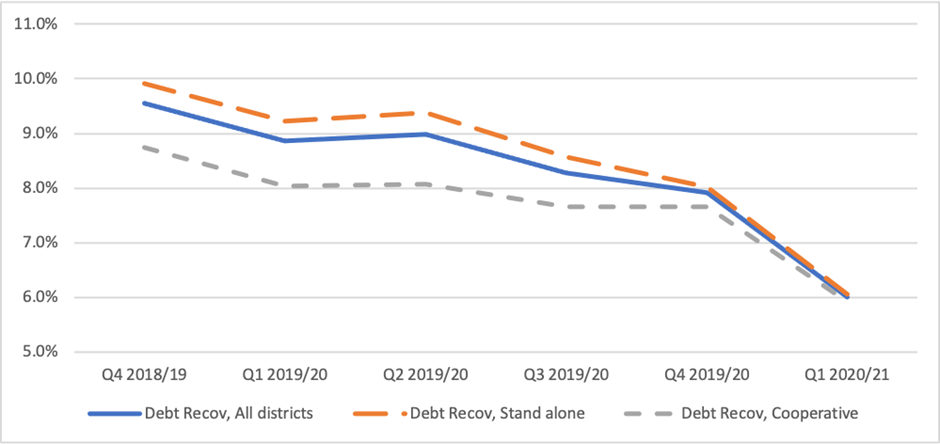
Our study found that disruption of Housing Benefit application processing speeds during lockdown was unrelated to mode of service provision.  For both shared and autonomous arrangements, performance worsened slightly during lockdown, before resuming its pre-pandemic trajectory over the summer of 2020.  However, collaborating councils did show less of a decline in service accuracy objectives during lockdown, measured as both the identification of new debt owing to benefit overpayments (not shown) and, particularly, the recovery of such debt from claimants (shown in the graph below).  These mixed results – no effect on speed, partial protection for accuracy – proved robust to various different econometric specifications.

Average value of debt recovered from Housing Benefits claimants as percentage of total debt outstanding, comparing ‘stand alone’ and collaborative provision, Q4 2018–19 to Q1 2020–21

There are a variety of possible explanations for this pattern. 

First is that the apparent resilience in debt identification and recovery is simply an artifact of the performance differential between shared and autonomous revenues and benefits departments pre-pandemic.  As the graph above indicates, and contrary to business-case predictions, shared services (grey dashed line) appear to be consistently associated with less debt recovery prior to COVID, meaning that autonomous councils simply had ‘further to fall’ during the emergency, producing their appearance of reduced resilience. 

Second, and more substantively, is that high-performing organizations can fall into ‘success traps’ or ‘competency traps.’  According to existing literature on organizational resilience, the low level of challenge facing high-performing organizations during ‘normal’ times can leave them complacent and ill-equipped to deal with unexpected adversity; whereas less-successful organizations are more familiar with confronting and managing adversity in their everyday operations, and thus better rehearsed for managing crises.

Third is that there genuinely is something about the shared services model – be it the increase in operating scale, the balancing of peaks and troughs in demand and resourcing across different partners, the greater experience of remote working prior to COVID, or the lock-in effects that arise when service operations are specified in contracts or service-level agreements – that enables collaborative arrangements to better withstand the challenges of service delivery during lockdown.

Finally, it is interesting to consider why the partial resilience revealed in our data is concentrated on debt identification and recovery, rather than speed – recognizing that bureaucracies often face a trade-off between speed and accuracy of decisions.

Studies of goal conflict suggest that organizations can cope with such split objectives by prioritizing those that are most valued by their largest or loudest constituency.  Benefit claimants and their landlords favour speedy service, whereas central government (which funds Housing Benefit) advocates accuracy.  But perhaps Whitehall overseers pursued this agenda less forcefully during the pandemic, when many distractions arose and when preservation of life and livelihoods was clearly better served by providing speedy financial support to vulnerable populations than by auditing prior applications.

Alternatively, goal conflict can also be address by sequencing – addressing one goal first, and then another. Whereas poor timeliness of benefit processing cannot be subsequently rectified (once a payment is late, it is late), poor accuracy can be corrected subsequently through greater attention to and resourcing of debt collection later in the year or in future years. The debt will still be owed, albeit the risk of debt write-off will be higher. Future research will be able to test this ‘catch-up’ hypothesis once data on debt identification and recovery during subsequent quarters of the pandemic is released.

Overall, then, in contrast to the questionable financial benefits of shared service adoption in the English context, this study has indicated that possible advantages may be gained in terms of service resilience.  We have just secured a research grant to replicate and expand this research agenda into additional service areas and over a longer time frame.

This blog is based on research recently published in Public Management Review.

Dr Thomas Elston is Association Professor of Public Administration at the Blavatnik School of Government, University of Oxford.  His research focuses on the organisation of public services, and particularly on questions of performance, resilience, reform and democratic control.  His work on shared services has been published in JPART, Public Administration, Public Management Review, and Public Money & Management.

Dr Germà Bel is Professor of Economics and Public Policy at the University of Barcelona.  His research deals with the reform of the public sector, with a special focus on privatization, regulation, and competition. His research pays particular attention to local public services, transportation, and infrastructure. His work on shared services has been published in JPART, Public Administration, Public Management Review, Local Government Studies and Urban Affairs Review.

The Leaseholder Cladding Scandal and When Ministers Direct

Chris Game

You probably caught at least something of the Commons ‘cladding’ debate last Monday (1st Feb), and almost certainly some of this week’s fallout.  Called by Labour on one of its designated ‘Opposition Days’, the debate sought “urgent” Government action to end the scandal of lease-holding flat owners, living in unsafe, unsaleable, uninsurable properties, being forced to pay unaffordable sums of money for the removal of flammable cladding.

And, if 43+ months after the Grenfell Tower tragedy qualifies as “urgent”, we finally got it this Wednesday, in the form of a statement from Robert Jenrick, Secretary of State for the whole thing – Housing, Communities and Local Government.

Important as that statement obviously is, neither its content nor even its questionable squareability with the PM’s most recent pledge that “no leaseholder should have to pay for the unaffordable costs of fixing safety defects that are no fault of their own” are the central concerns of this blog, which by comparison – Reader Alert! – are arcane verging on nerdy. For the record, however, Jenrick’s three key proposals are for:

  • a further £3.5bn of government grant to pay for the removal and replacement of dangerous cladding systems on buildings over 18 metres tall;
  • for buildings below 18 metres, a long-term “financing solution” of a government loan to the owner, repaid by leaseholders, with a payment cap of £50 per month;
  • a new levy for developers, to become applicable when planning permissions are submitted for high-rise developments.

Back, though, to last Monday. Labour’s motion, introduced by Shadow Housing Secretary, Thangam Debbonaire, called for the Government to establish a new, somewhat Starmer-sounding, cladding taskforce that would make buildings with dangerous materials safe and protect leaseholders from the costs. Initial respondent for the Government was, remarkably, the Minister of State for Europe and the Americas, Chris Pincher, not due formally to assume office as Minister of State for Housing for another 12 days. The so-called – and here so appropriately – wind-up was done by Eddie Hughes, Junior Minister for Rough Sleeping and Housing.   

As for the not generally publicity-shy Jenrick, he apparently “stayed away entirely”. Which inevitably reinforced the impression, conveyed by his being openly accused of “incompetence” in this matter by his own backbench ‘colleague’, that neither he nor the Government as a whole were any more bothered than they had appeared previously about even being seen to regard this scandal as a major priority.

For the record, Monday’s motion was passed by 263 votes to nil. The Ministers seemed unable to convince anyone that the Government was addressing the issues with anything like the requisite urgency. But Conservative backbenchers, increasing numbers of whom had already been seeking, without noticeable Labour support, to amend the Fire Safety Bill to avoid remediation costs being passed on to leaseholders, chose to abstain, rather than give HM Official Opposition unearned credit.  

At which point I must temporarily side-line cladding, while explaining how, almost by chance, I happened upon one of the latest updates in the Institute for Government (IfG)’s occasional series of ‘Explainers’ – on Ministerial Directions (MDs) – a topic about which previously, I confess, I’d bothered myself relatively little.  

Poor show perhaps, for someone actually endeavouring to teach students about British politics. My rationalisation would have been that, while broadly aware of what MDs were/are and their obvious importance, I sensed that their usage wasn’t that frequent, and that anyway, until “the rules” were changed and GOV.UK was launched in 2011/12, most such directions would indefinitely have remained state secrets.

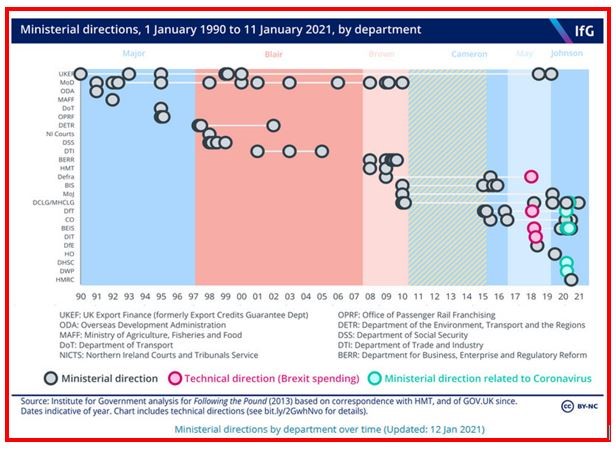
Unwittingly, I was actually right about the numbers – as shown in one of the IfG’s several excellent graphics: an average of under two a year while I was teaching, compared to 31 in the past three years and 19 in 2020 alone. The explosion, and indeed MDs generally, seemed worth further inquiries.

min-explainers

First, then, what exactly are ‘Ministerial Directions’?  In this case, just what it says on the tin: formal directions from Ministers instructing their department to proceed with a spending proposal – and in so doing overriding the principled objection of the most senior civil servant: the Permanent Secretary (PS), who is also the ‘Accounting Officer’, accountable to Parliament for how the department spends its money.

And it’s not just a clash of wills, or opinions. There are specified criteria any spending proposal must meet: that it’s within both the department’s legal powers and agreed spending budget, meets “high standards of conduct”, constitutes value for money, and stands a feasible prospect of being implemented as specified within the intended timetable. If a PS has doubts about a proposal meeting any of these criteria, they must seek explicit direction from the Minister, who thereupon writes a ‘directing’ letter and takes accountability for the decision.  Interestingly, that’s often how it seems to work: less a Minister’s wanting to spend overriding the horrified protests of a cautious civil servant than the civil servant seeing or at least agreeing the need to spend but constitutionally requiring the Minister’s say-so.

British politics being conducted in the ‘civilised’/secretive way it generally is, even the traditionally rare occasions on which such clashes come to a head are rarely much publicised, but there are exceptions. Remember Joanna Lumley’s ‘Garden Bridge’ over the Thames – proposed as a largely privately-funded project, but taken up with characteristic enthusiasm by the then Mayor of London and given significant pre-construction funding by the Department for Transport?  At which point the Transport Secretary, Patrick McLoughlin, came back wanting more – arguing to the ‘Accounting Officer’ (the PS)  and in his Ministerial Statement that there were more than mere transport benefits to be considered and that the Department’s pre-construction commitment should be increased by up to £15 million.  It duly was, and of course the Garden Bridge is today the “iconic tourist attraction right in the heart of our capital city” that the Mayor and Minister predicted. Sorry, is it not?

A more specifically local governmenty Ministerial Direction was that the MHCLG should not recover from councils £36 million that, through an error in civil servants’ methodology, they had been overpaid for participating in 100% business rate retention pilots (2017/18). Nice one, Sajid Javid!

What had particularly caught my interest, though, was that noticeable rise in MDs over the past 2-3 years and the positive explosion under the Johnson Premiership, certainly since the arrival of Covid.  In fact, the IfG’s graph reminded me almost immediately of the well-known view of one of the ugliest buildings in London – the Vauxhall Tower overlooking St George Wharf – and, as it happens, just two bridges down-river from the IfG.

tower

There have already been 14 Covid-related Ministerial Directions – worth possibly a blog in their own right – but I’d gone in looking for cladding business, and there it was, in May 2019 – two months pre-Johnson. James Brokenshire, Jenrick’s predecessor as Housing and Communities Secretary, had made clear both his and PM Theresa May’s view that leaseholders should not have to pay – even assisted by the kind of loan scheme announced this week.

It’s worth reading the full exchange of letters between Secretary of State Brokenshire and the Permanent Secretary, but the following extract from Brokenshire’s will convey at least the flavour:

“I  understand  that,  in  making  these  choices,  the  taxpayer  will  pick  up  the  vast  majority  of remedial costs.  However, I have considered that against the safety implications for residents and the need for pace.  I consider those two factors to be more important.”

The only thing, however, seemingly throughout this whole wretched business, to have happened at any pace was Brokenshire’s own departure, like that of Theresa May herself, to the backbenches. A pity – somehow I don’t feel he would have taken last Monday afternoon off, or that nearly 20 months later there would still have been no Government policy.

Photo

Chris Game is an INLOGOV Associate, and Visiting Professor at Kwansei Gakuin University, Osaka, Japan.  He is joint-author (with Professor David Wilson) of the successive editions of Local Government in the United Kingdom, and a regular columnist for The Birmingham Post.

The disparities in housing and public health within the BAME community and the pandemic crisis

Cllr. Ketan Sheth

Public Health is important: it prolongs life. A fundamental quality of Public Health is its preventative nature; prevention is far more effective and far less expensive than cure. Public Health is important because we are constantly striving to close the inequality gap between people and encourage equal opportunities for children, all ethnicities and genders. Health is a human right and we should be ensuring no one is disadvantaged, regardless of their background, their ethnicity or where they live. Becoming the voice for people who have no voice is our collective duty. Simply put, our influence on the improvement of someone’s health is a fundamental act of kindness.

Poor housing and living environments cause or contribute to many preventable diseases, such as respiratory, nervous system and cardiovascular diseases and cancer. An unsatisfactory home environment, with air and noise pollution, lack of green spaces, lack of personal space, poor ventilation and mobility options, all pose health risks, and in part have contributed to the spread of Covid-19. The disparities in housing and public health within the BAME community have persisted for decades cannot be doubted, and is underscored by a raft of research over the past six decades as well as highlighted by the recent analysis of the impact of Covid -19. The death rate among British black Africans and British Pakistanis from coronavirus in English hospitals is more than 2.5 times that of the white population.

What are the possible reasons? A third of all working-age Black Africans are employed in key worker roles, much more than the share of the White British population. Additionally Pakistani, Indian and Black African men are respectively 90%, 150% and 310% more likely to work in healthcare than white British men. While cultural practices and genetics have been mooted as possible explanations for the disparities, higher levels of social deprivation, particularly poor housing may be part of the cause, and that some ethnic groups look more likely than others to suffer economically from the lockdown.

Homelessness has grown in BAME communities, from 18% to 36% over the last two decades – double the presence of ethnic minorities in the population. BAME households are also far more likely to live in overcrowded, inadequate or fuel poor housing. What’s more, around a quarter of BAME households live in the oldest pre-1919 built homes. And their homes less often include safety features such as fire alarms, which is striking given the recent Grenfell Tower tragedy. Over-concentration of BAME households in the

neighbourhoods in London, linked to poor housing conditions and lower economic status all ensure negative impacts on health, all of which means lower life expectancy. The roll-out of Universal Credit is having greater effects on the living standards of BAME people since a larger percentage experience poverty, receive benefits and tax credits, and live in large families.
Larger household size also means that ethnic minorities are far more vulnerable to housing displacement because of the Bedroom Tax or subject to financial penalties if they do not move to a smaller home.
These stark facts, sharply bring to our attention the health, social and economic inequalities among our minority ethnic community, all of which are critical to understanding why some ethnic minority groups are bearing the brunt of Covid-19. In this time of reflection, it is not enough to observe; we must think about what more we can do, right now, to reduce the health, housing and economic vulnerabilities that our BAME communities are much more exposed to in these fragile times. Let’s act and prolong life together, as a flourishing community.

Cllr. Ketan Sheth is a Councillor for Tokyngton, Wembley in the London Borough of Brent. Ketan has been a councillor since 2010 and was appointed as Brent Council’s Chair of the Community and Wellbeing Scrutiny Committee in May 2016. Before his current appointment in 2016, he was the Chair of Planning, of Standards, and of the Licensing Committees. Ketan is a lawyer by profession and sits on a number of public bodies, including as the Lead Governor of Central and North West London NHS Foundation Trust.