From Ghana to Birmingham: How a Global Learning Network reinvigorated Public Managers

Shailen Popat

What happens when city managers from Ghana and governance experts from the UK sit around the same table? Ideas spark, assumptions are challenged, and new ways of working begin to take shape. That’s the story behind the Ghana City Managers Community of Practice (CoP) – a bold experiment in international collaboration that’s changing how we think about public management. The full article published in the Education in Practice journal can be found here.

Why This Matters

Public managers everywhere face “wicked problems” – issues like urbanisation, climate resilience, and service delivery that defy simple solutions. Traditional training often falls short because it’s one-off and disconnected from real-world complexity. Enter Communities of Practice: long-term learning networks where practitioners and academics share experiences, co-create solutions, and build trust. They’re not just about knowledge – they’re about relationships and sustained engagement. CoPs are powerful because they bridge the gap between theory and practice. They allow managers to learn from each other, adapt ideas to local contexts, and build confidence in tackling complex challenges. For countries like Ghana, where decentralisation and urban growth create both opportunities and pressures, this approach offers a way to strengthen governance without imposing external models.

The Big Idea

In March 2025, the University of Birmingham hosted 14 senior Ghanaian officials for a week of immersive learning. Backed by the UK’s International Science Partnerships Fund, the visit wasn’t a typical study tour. It was a strategic intervention to launch a transnational CoP – one that blends academic insight with practical experience and positions both Ghana and the UK as partners in governance innovation.

The goals were clear:

  • Forge lasting institutional partnerships
  • Co-design training materials rooted in Ghanaian realities
  • Build capacity through comparative insights
  • Shape future research on urban resilience and inclusive governance

This initiative reflects a broader shift in development practice – moving away from top-down technical assistance towards partnership-based models that prioritise mutual benefit and knowledge reciprocity.

Inside the Week: What We Did

The programme kicked off with a high-energy plenary featuring voices from both sides of the partnership: Prof. Samuel Bonsu (GIMPA), Dr Nana Ato Arthur (former Head of Ghana’s Local Government Service), and Mo Baines (CEO, APSE). Their message was clear – governance challenges may differ, but the principles of collaboration and accountability are universal.

Photograph of the CPD participants and some trainers at the Edgbaston Campus

Workshops tackled decentralisation, participatory planning, and sustainable cities. These weren’t lectures – they were conversations, with Ghanaian managers sharing frontline realities and UK experts offering comparative perspectives. Institutional visits added texture: at the West Midlands Combined Authority, delegates explored regional governance and economic development strategies; at Birmingham’s Lord Mayor’s office, they saw the symbolic power of civic leadership in action. The week ended with a roadmap: virtual meet-ups, annual exchanges, and joint research projects. Participants left not just with ideas, but with commitments to keep the momentum going.

What Changed?

The impact was immediate and tangible:

  • Partnerships Deepened: UoB, GIMPA, and Ghana’s Local Government Service agreed on joint research and staff exchanges
  • Capacity Built: Delegates gained practical insights into governance models they could adapt at home
  • Training Co-Created: New modules blend academic theory with Ghanaian case studies – tools designed by practitioners, for practitioners
  • Policy Influence: Senior officials pledged to embed lessons into local reforms
  • Research Horizons Expanded: Themes like digital governance and urban resilience emerged as priorities for future collaboration
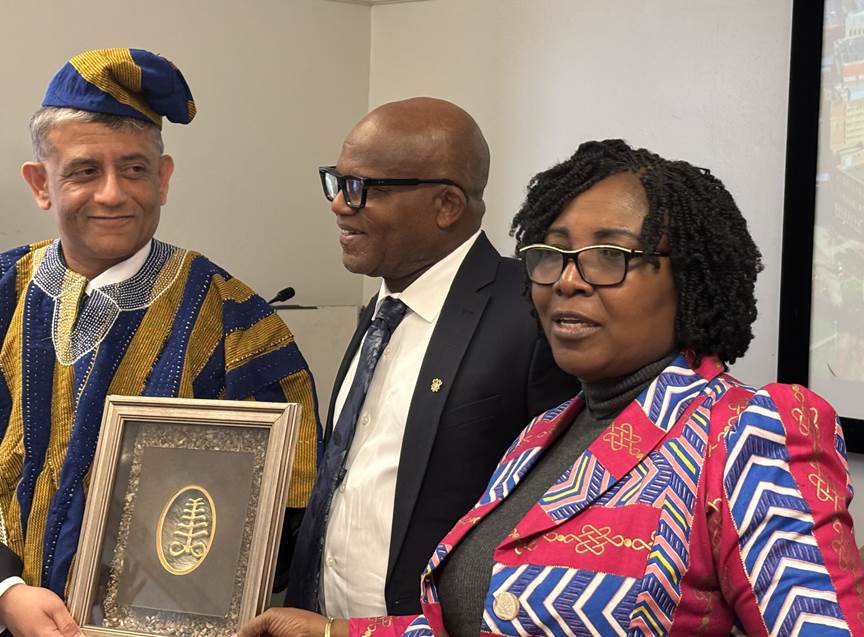
The Head of the Ghanian Local Government Service, Dr Stephen Nana Ato Arthur and the Chief Director of the Office of the Head of the Local Government Service, Madame Felicia Dapaah Agyeman-Boakye, honouring Shailen at the end of the CPD in Edgbaston.

Why It’s Different

This isn’t about exporting UK models or ticking boxes for donor reports. It’s about mutual learning and knowledge democracy – valuing local expertise as much as global frameworks. It’s also about universities stepping up as conveners of global networks, using their resources and credibility to drive real-world change. The co-designed training materials exemplify this ethos. They combine global frameworks with Ghanaian case studies, creating tools that are contextually grounded and practically useful. This approach aligns with calls to decolonise development practice – moving away from prescriptive solutions towards collaborative innovation.

What’s Next?

The Ghana CoP is just the beginning. Plans are underway to bring in managers from other African and UK cities, creating a richer, more diverse learning ecosystem. Future funding bids will build on the success of this pilot, ensuring the network grows and thrives. For INLOGOV, this story is a call to action: let’s champion collaborative governance, not as a buzzword, but as a practice that transforms institutions and communities. The challenges facing public managers are too complex for isolated solutions. By investing in relationships, shared learning, and co-production, we can create governance systems that are adaptive, inclusive, and resilient.

Dr. Shailen Popat works as an Assistant Professor in Public Policy and is the Director of the MSc in Public Management at the University’s Institute of Local Government Studies. He completed his PhD at the University of Oxford and his thesis explored the sensemaking processes of School Principals when enacting a significant new policy. He specialises in supporting public managers to enact policies in a manner that can be effective in their context and is a founding partner of a partnership between the University, GIMPA, and Ghana Local Government. Known for his student-centred approach and ability to explain complex concepts in a comprehensible manner, Shailen is considered to be an outstanding lecturer and tutor and was awarded the accolade of ‘Teacher of the Year’ at the 2022 University of Birmingham Teaching Awards, and in 2023 he was awarded a Senior Fellowship of the UK Higher Education Academy for his Educational Leadership.
Why Short CPD Training and Long – Term Mentoring Communities of Practice Should Work Together

Shailen Popat

In today’s rapidly changing public sector, professional development is no longer a luxury — it’s a necessity. But what’s the best way to equip public managers with the skills and mindsets they need to lead effectively? Is it through short, intensive training sessions, or through long – term mentoring and peer learning? My recent article, Reflections on Short CPD Training and Long – Term Mentoring Communities of Practice for Public Managers, explores this question through two linked initiatives in Ghana and the UK. You can read the full piece here, but here’s a summary of the key insights.

Two Initiatives, One Goal: Building Public Sector Capacity

In March 2024, I co – led a three – day Continuing Professional Development (CPD) workshop at the Ghana Institute of Management and Public Administration (GIMPA). Over forty senior local government officers came together to explore cultural intelligence, organisational culture, and change management. The workshop was highly participatory, encouraging reflection on power dynamics and leadership behaviours. It wasn’t just about technical skills — it was about shifting mindsets. A year later, in March 2025, we launched a transnational Community of Practice (CoP) in Birmingham. Fourteen Ghanaian city managers and academics joined UK counterparts for a week of collaborative learning, site visits, and strategic dialogue. Unlike the CPD workshop, this wasn’t a one – off event. It was the start of an ongoing network designed to foster mutual learning, co – produce training materials, and build institutional partnerships.

What CPD Brings to the Table

CPD is familiar to most professionals: structured, time – bound, and focused on specific competencies. It’s efficient and accessible, making it ideal for introducing new frameworks or addressing urgent skills gaps. Our GIMPA workshop, for example, gave participants analytical tools to examine organisational culture and power dynamics — critical for reforming local governance. But CPD has limitations. Without follow – up, its impact often fades. Participants in Accra voiced this concern: how could they sustain the momentum after the workshop ended? This reflects a broader critique in the literature — CPD can feel like a “tick – box” exercise if not embedded in a longer learning journey.

The Power of Communities of Practice

Communities of Practice, a concept popularised by Etienne Wenger, take a different approach. They’re about relational, situated learning — professionals learning with and from each other over time. Our Ghana – UK CoP exemplified this. Participants didn’t just absorb knowledge; they co – created it. They shared case studies, identified research priorities, and even laid the groundwork for joint projects and staff exchanges. This collaborative model builds trust, fosters innovation, and creates a sense of ownership. It also delivers tangible outcomes: institutional partnerships, co – produced training materials, and a platform for policy experimentation. In short, CoPs turn learning into a living, evolving process.

Why We Need a Hybrid Model

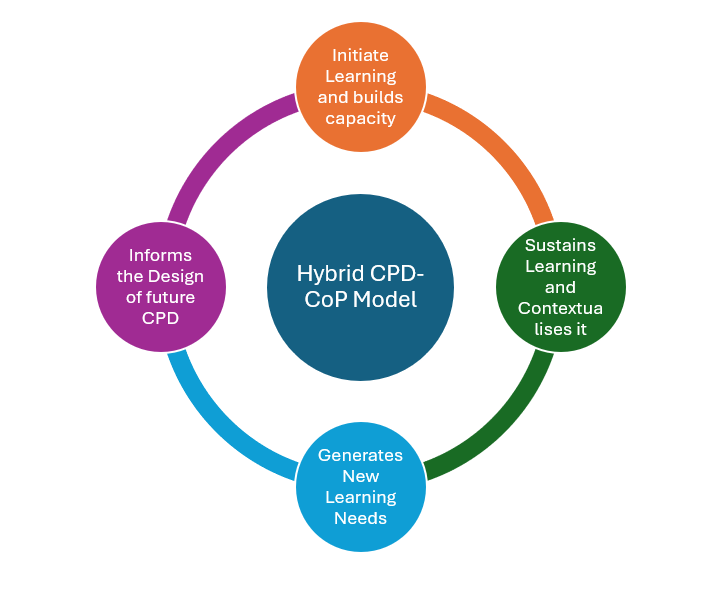
So, which is better — CPD or CoPs? The answer is both. CPD offers structure and accessibility; CoPs provide depth and sustainability. When combined, they create a dynamic learning ecosystem:

  • CPD as the entry point: Introduce core concepts and skills in a structured, time – efficient way.
  • CoPs as the follow – through: Sustain learning, contextualise it, and generate new insights for future CPD.

This cyclical relationship ensures that professional development is continuous and adaptive. It aligns with the idea of a “learning organisation” and supports the kind of hybrid professionalism today’s public managers need — technical expertise plus collaborative, contextual competencies.

The Role of Universities

Universities are uniquely positioned to make this happen. They have the research capacity, convening power, and infrastructure to sustain long – term engagement. But this requires a shift: from delivering knowledge at a distance to embedding themselves in professional ecosystems. That means co – designing curricula with practitioners, facilitating peer learning across borders, and evaluating impact not just in terms of knowledge acquisition but institutional transformation. Our Ghana initiatives show what’s possible when universities embrace this role. The CPD workshop sparked mindset shifts; the CoP built enduring partnerships and practical tools for governance reform. Together, they created a professional learning ecosystem grounded in local realities and enriched by global perspectives.

Why This Matters Now Public managers face unprecedented challenges — climate change, urbanisation, digital transformation. These are “wicked problems” that demand adaptive, collaborative leadership. Short – term training alone won’t cut it. Neither will informal networks without structure. We need integrated models that combine the best of both worlds. If you’re a public sector leader, educator, or policymaker, I invite you to read the full article here. Let’s reimagine professional development as a shared, iterative, and relational endeavour. The future of public service depends on it.

Dr. Shailen Popat works as an Assistant Professor in Public Policy and is the Director of the MSc in Public Management at the University’s Institute of Local Government Studies. He completed his PhD at the University of Oxford and his thesis explored the sensemaking processes of School Principals when enacting a significant new policy. He specialises in supporting public managers to enact policies in a manner that can be effective in their context and is a founding partner of a partnership between the University, GIMPA, and Ghana Local Government. Known for his student-centred approach and ability to explain complex concepts in a comprehensible manner, Shailen is considered to be an outstanding lecturer and tutor and was awarded the accolade of ‘Teacher of the Year’ at the 2022 University of Birmingham Teaching Awards, and in 2023 he was awarded a Senior Fellowship of the UK Higher Education Academy for his Educational Leadership.

Some thoughts on how universities can benefit the people and communities that they serve

Shailen Poppat

On Wednesday 12th and Thursday 13th June 2024, I will be speaking on a panel with Dr. Rhiannon Jones of the University of Derby and Martin Ferguson of Socitm who invited us as part of their annual President’s Conference on the approaches that can be provided by universities for the benefit of the people and communities that they serve. As time is short on the day, I thought that I would put a few points in writing.

Hub for Collaborations

A University can provide a hub for collaboration between organisations in multiple sectors. Universities inhabit an in-between space – they are part of the country where they are situated and also very international both in terms of the composition of students and staff, and in the reach of their networks and research collaborations. Universities also exist in the cloud, with many courses being entirely online or hybrid, and many library resources now being electronic. Universities are measured on impact and therefore they also lie in that in-between space between academic knowledge and real-world practice within increasing emphasis to show how research and teaching is impacting communities outside of the institutions. Universities are also large employers and magnets for resource in their geographical location. Many suppliers have contracts with universities and many local businesses rely on student expenditure during university term times. This gives a university the influence and gravitas to be able to bring people together in a way that very few institutions can do, and I would advocate that it is something that we need to do much more of in a more organised manner. It does happen but it tends to be driven by individual academics or certain research projects rather than as part of a wider strategic plan either by a college or school.

Spaces to Reflect

Public service workplaces are busy places and over these last 15 years everyone has had to adopt the mantra of achieving more with less resource! This means that public service workers have been doing more than one person’s job which consequently means less time for them to reflect, learn, and develop themselves. Conversations with colleagues provide valuable support within stressful and complicated situations, however, they can often be action and task focused – we are talking shop when we talk to each other in a workplace. And this is where the learning development partnership with universities can be so helpful. I would say that a university course can provide a public service practitioner space to think about bigger philosophical themes that do not get focus in the workplace although implicitly public service practitioners know what these are. At the Institute of Local Government Studies, we deliver three master’s programmes, two of which are part-time programmes and one which is full-time programme. All of these programmes take a student through a learning journey to reflect upon six key questions:

Unless we are thinking about these things we just carry on moving on the treadmill without pausing and considering whether there are alternative approaches to the way things are currently.

Connecting Academic Knowledge with Practice Knowledge

When I am training practitioners or attending knowledge-exchange events, I always keep in-mind that I have to convince people that academic knowledge can be of relevance to their work. Both types of knowledge (academic and practice) can inform each other as much research is really the observation of practice and then taking those observations and formulating theories that can help us to better understand exactly what’s going on. For example, one of my roles in the School of Government is to represent us in a partnership with a civil service college in Ghana. I conducted a training there in March on the topic of understanding organisational cultures which was quite a novel topic for them. One of the models that I used from the academic literature in a workshop format was this one by Johnson et al. (2008).

Participants were mayors, assembly members, city managers, and other public managers, and they were asked to use the model to reflect upon their own work situation for approximately 15 minutes. They then split into smaller groups and shared experiences with each other and this seemed to provide them with a rich understanding of the dynamics that they were experiencing day-to-day but they would not necessarily have analysed what was going on without this exercise, and the academic framework provided a structure in which they could contain their thoughts. The feedback that I received was very positive for example,

‘After the CPD training, I have been able to gradually change the attitude of some staff towards work in terms of lateness, absenteeism, efficient use of material resources, client focus, participation, etc.’

‘By understanding the organization’s mission, vision and goals, as well as foster collaboration, innovation, learning and team effort in achieving the organizational overall objectives. Organizational culture also helps me build shared values and unified efforts among my colleagues, hence it helps to contribute to achieving the organization goals and objectives.’

So, you can see that universities can provide practice with spectacles with which to see what is going on so the practitioners gain better clarity on how to create change.

Shailen Popat works as an Assistant Professor in the Institute of Local Government Studies at the University of Birmingham where he is Director of the MSc in Public Management. In 2022, he was awarded the accolade of University Outstanding Teacher, and in 2023, he was awarded a Senior Fellowship of the Higher Education Academy.

Could do better – supporting young carers at school

Elaine Campbell

Young carers provide unpaid, and often unacknowledged care, usually for parents or other family members. While caring may be viewed as a health and social care issue, most young carers who are under 18 will spend much of their time in full-time education. So it is critical that education professionals are ready and able to support young carers to achieve at school.

This study explored how a multi-agency approach could improve the educational experiences of young carers in Northern Ireland through a survey of teachers and interviews with professionals in education and health and social care.  Young carers are often unseen by medical and educational professionals, who may be unaware they are providing care or unaware of what support may be needed.

Key findings

  • Young carers and their experiences are routinely overlooked and unseen in educational and health care settings. 
  • The lack of legislative recognition for young carers has created a policy void, despite input which has explicitly identified the need to support and care for this group of young people. 
  • Existing guidance which outlines ways to support young carers in school has not been routinely implemented in schools or shared with school staff
  • A combination of a strengths-based model, combined with existing protective factors for young people has the potential to provide appropriate care and support, promote positive self-worth and improve educational outcomes for young carers.
  • A systematic failure of planning contributes to patchy and inconsistent partnership approaches which are overly reliant on individual commitment to change, rather than systems change

Background 

While my study focused on Northern Ireland, many of the issues faced by young carers are universal in nature. The literature review highlights the unseen nature of young carers as a key barrier identified by researchers and young peoples’ experience across cross-national researchers

Teachers’ understanding of impact and role of young carers is variable, and at times, dismissive. The age at which young carers may begin their caring role is often at primary school, which is unexpected by teaching and medical professionals. The study highlighted a willingness to help but also a reliance on parents or young carers disclosing their status. 

Reaching out to young carers is essential

Teachers acknowledged the difficulties of identifying young carers; other research has established that young carers may be reluctant to self-identify or to ask for support if they feel they have not been listened to. Teachers felt that parents only disclosed when they felt forced, often during a crisis. 

Transition points provide an excellent opportunity to encourage disclosure. Updating contact information each year, conversations about the transfer to post-secondary school and when young people enrol in a new school are ideal opportunities to ask if a child is undertaking caring responsibilities. This can help start the conversation about how to support them in school. Schools can include information on their websites, on posters, and use Assemblies to recognise the contribution young carers make.

The policy deficit contributes to suffering 

Resources and initiatives have been identified, but never implemented, which is both disappointing, but also provides an opportunity for change. Guidance without legislative protection is unlikely to be prioritised. Young carers are less likely to take up further education and more likely to live in poverty, and more likely to experience poor mental health.  

The sustained lack of policy attention is an issue which requires urgent redress. Existing guidance includes specific, practical examples of ways to support young carers emotionally and practically to achieve at school, and many of the suggestions require time and planning, not financial costs. A renewed effort to share and monitor this guidance, using a policy lever, could make a powerful impact on young carers. 

Shifting the focus from harm reduction to promoting wellbeing 

Professionals described a system which considers young carers primarily in terms of harm reduction. Despite the challenges, many young people are proud of their caring role and display outstanding qualities and strengths.

There is insufficient focus on working collaboratively to provide proactive support to young carers to achieve in school, take up opportunities to socialise, and enjoy breaks from caring, or to share information about this support to young carers.

Education Authority guidance, with input from young carers, highlights that what they often want most is practical support to help them get through the school day and for their teachers to show understanding of their reality.

Conclusion 

This study highlighted that there are pockets of good practice and existing multi-agency working which have contributed to collaboration, but these are exceptional rather than routine. 

The study concludes that there is a need for greater legislative recognition, including a statutory responsibility on key agencies in health and social care and education to provide support for young carers.

Agencies should be more proactive in seeking out young carers, by including information on school enrolment and admissions forms, asking during clinical admissions and review medical appointments, and signposting to young carers’ projects and other partners.

Young carers are being failed; they deserve better, and the answers are already there. What’s needed now is the impetus to follow through and deliver.

Elaine Campbell was awarded an MPA in 2023. Previously an Assistant Director at children’s charity Barnardo’s, Elaine is currently Head of Service Enablement and Improvement at Alzheimer’s Society. She is also a Chair of Board of Governors at a primary school. She can be contacted at [email protected]

Mission Possible? 

Jason Lowther

With under 700 days to the next UK general election, political parties are busy developing their manifesto documents.  In February, Labour leader Keir Starmer made a major speech laying out his “five missions for a better Britain”.   How do these five missions relate to local government?  And is the turn to “mission driven” government likely to work?

The five missions vary in their level of specificity and challenge.  Securing “the highest sustained growth in the G7, with good jobs and productivity growth in every part of the country…” is a little vague but likely to be difficult, especially given we are currently ranked 6 out of 7 in terms of output per worker.  Mission #2, “make Britain a clean energy superpower”, accelerating the move to zero-carbon electricity from 2035 to 2030, is specific but very challenging.  Mission #3, reform of health and social care and reducing health inequalities, will require a re-focus from secondary (hospital) care to social care and addressing the social determinants of health.  Mission #4 is about community safety, and likely to involve more community policing.  Finally, mission #5 is to “break down the barriers to opportunity at every stage” through reform to the childcare and education systems.

Local government potentially has important roles in each of the five missions.  Local education, skills and economic development functions will be critical to improving productivity.  On energy, Net Zero requires at least a doubling of electricity generation by 2050, from decarbonised sources.  Decarbonisation strategies need to be place-based, taking account of the geography, building types, energy infrastructure, energy demand, resources and urban growth plans.   We’ve recently argued here for the key roles of councils in this area. 

Turning to health and care services, local government clearly has leading roles – including ensuring place-based planning to address the social and behavioural causes of health inequalities.  Analysis by the Liverpool and Lancaster Universities Collaboration for Public Health Research in 2021 concluded: “investment across the whole of local government is needed to level up health including investment in housing, children’s, leisure, cultural, environmental, and planning services”.  Similarly community safety, child care and education are areas where local government could be enabled to have much greater positive impact.

Perhaps as important as the specific “missions” is the approach to governing which the party is proposing.   Labour’s document characterises this as a move from top-down, target-led, short-term, siloed approaches, to government which is more “agile, empowering and catalytic”, working across the public and private sectors, and civil society.  This, it argues, requires organising government around a shared vision, focusing on real world outcomes, concentrating on ends with flexibility and innovation concerning means, devolving decision making from Westminster, increasing accountability including central and local data transparency, and adopting long-term preventative approaches including greater financial certainty for local areas. 

In some ways the idea of mission-driven government echoes the 1990s thinking of Ted Gaebler and David Osborne’s book “reinventing government”, which argued for a more entrepreneurial approach to the delivery of government.  Their work pointed to entrepreneurial companies setting overall missions and goals, and then leaving managers to figure out how best to deliver these – for example, by providing an overall budget for a service rather than detailed line-by-line budgets which disappear if not spent by year end.  The focus on managers rather than considering the perspective of politicians is one of the problems identified in subsequent evaluations of the reinventing government model, together with difficulties in sustaining the approach.

Mission-driven policies addressing ‘grand challenges’ of society are increasingly common, for example in the UN Sustainable Development Goals and various EU policies.  Mazzucato et al recently argued that addressing such challenges requires strategic thinking about: the desired direction of travel, the structure and capacity of public sector organisations, the way in which policy is assessed, and the incentive structure for the private, public (and I would add community) sectors. Labour’s paper makes a start (albeit at a very high level) on thinking through these areas. The litmus test, though, will be in developing the detail and how far this engages with local areas.   

Over the next few months, we will be contributing to the debate on the upcoming party manifestos with some research-informed thoughts on a variety of local government related policy areas.  If you would like to be involved in developing these, please get in touch

Jason Lowther is the Director of INLOGOV. His research focuses on public service reform and the use of “evidence” by public agencies.  Previously he worked with West Midlands Combined Authority, led Birmingham City Council’s corporate strategy function, worked for the Audit Commission as national value for money lead, for HSBC in credit and risk management, and for the Metropolitan Police as an internal management consultant. He tweets as @jasonlowther

Picture credit: BBC

Making friends with a highlighter pen

Anon

In this final blog of our series, one of our former apprentices reflects on how they grew in confidence through the process and offers some advice for anyone considering studying for a senior leader apprenticeship.

Picture: Photosteve101 https://www.flickr.com/photos/42931449@N07/

In 2019, my manager informed me our organisation had partnered with INLOGOV at the University of Birmingham, meaning an opportunity to enrol on their Senior Leader Apprenticeship programme. It seemed almost too good to be true to think that this opportunity would be fully funded. Never one to shy away from a challenge I decided to apply. Brave.  I was further surprised to be accepted onto the course and began my journey somewhat naively without quite appreciating what lay ahead.

It is fair to say that I had underestimated the time I would need to complete the learning, reading, assignments and portfolio preparation. It was a steep learning curve but I soon developed strategies to manage my time. I preferred to read in the evening.  Many an evening was spent sitting in the car reading journal articles while my daughters were at various clubs. The time I was investing was becoming more and more worthwhile as I learned to apply new skills and ways of thinking to my work, as well as receive pleasing grades for my assignment.  I started to think perhaps I could do this after all.

The onset of Covid-19 meant that additional challenges of remote learning and home-schooling my daughters had to be managed alongside other pressures, but I carried on, and with amazing support from my family, work colleagues (and some very understanding tutors) I managed to continue working through the assignments and the intense phase of my project.

I won’t pretend this was easy, but the more I became engrossed in my project the more determined I became that I would complete the course.  Completion meant both personal pride and a final project which would be beneficial to my work and team.  Compiling my portfolio gave me a great opportunity to reflect on some of my work achievements, and to identify areas where I needed to improve and demonstrate my skills. This culminated in a project showcase and professional discussion that allowed me to show how my learning had improved working practices.

If you are interested in a course like this my top five tips/reflections are:

  • It sounds corny, but if you want to achieve something, and have the right support to do so, then you can achieve it.
  • Commit to the process.
  • It will probably be more work than you imagine, but the personal and professional rewards are worth it.
  • Buddy up with someone else on the course so you can support one another – this was invaluable to me.
  • Onenote and highlighters will become your best friends!