The Good Law Project – proud to be judged by its enemies

Chris Game

“I ask you to judge me by the enemies I have made”. No, not Ukraine’s remarkable President Zelenskyy, fitting though it would seem. It’s generally attributed to the rather longer-serving US President Franklin D Roosevelt, an at least equally appropriate author for this column’s political theme.

But who in the last fortnight’s UK politics might have prompted FDR’s “judge me by my enemies” thought?  Well, it wasn’t exactly a ‘who’.  Rather, a smallish, youngish, not-for-profit campaigning organisation doing its best to challenge abuses of power, inequality and injustice, mostly by Government departments and Ministers, in cases bigger, better-funded organisations hesitate to take on.

And they do have an appealing name – the Good Law Project (GLP).  Which is fortunate, since appealing is how they’re largely funded – through donations and periodic crowd-funded contributions to cover specific cases, as in this instance.

In a few short years, dominated by our EU exit and Covid, they’ve also racked up a pretty appealing court record, unless of course you view it as, say, a recent or current Government minister.

You’ll recall that Boris Johnson, within weeks of becoming PM in July 2019, ‘advised’ the Queen to prorogue/shut down Parliament for an unprecedented five weeks, thereby avoiding further parliamentary scrutiny of the already thrice-defeated Brexit withdrawal agreement, and enabling the UK potentially to leave the EU on October 31st without a deal.

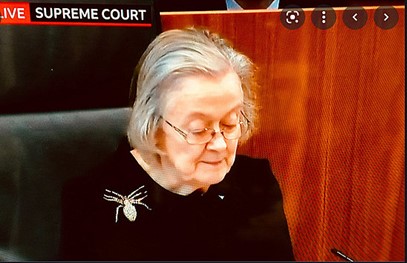
The Queen had little constitutional option but to accede. Others, though, did. The GLP crowd-funded an appeal, sufficient to allow lawyers to petition first the Scottish Appeal Court, then the UK Supreme Court. You can maybe even re-picture the historic, televised, unanimous 11-judge ruling, delivered by the UoB Vice-Chancellor’s most recent Distinguished Lecturer, the Supreme Court’s spider-brooched President, Lady Hale.
Picture1

Johnson’s prorogation advice to the Queen “was outside the powers of the PM”, Parliament’s suspension unlawful and unconstitutional, and it should be immediately reconvened. Score: UK Government 0, GLP several.

Then came Covid, bringing with it what was quickly tagged ‘institutionalised cronyism’, with Health Secretary Matt Hancock and Cabinet Office Minister Michael Gove the biggest serial offenders.

The GLP could have chosen numerous cases, but selected three PPE (Personal Protective Equipment) contracts as illustrations: £252m to a finance company for face masks, £108m to a confectionery products agency, and £345m to a company trading as Pestfix – which, as we’ll see, is what the grudge-bearing Hancock would still dearly love to do to the GLP.

The otherwise defenceless Health Secretary – the man who broke his own social distancing guidelines in his own office – resorted to disputing GLP’s legal standing. The high court judge ruled, however, that he had acted unlawfully in respect of “vast quantities” of taxpayers’ money in failing to publish multibillion pound contracts within the legally required 30 days.

Cabinet Office Minister Michael Gove also had cronies. Ministers in those early Covid days needed to influence public opinion, and get focus group feedback on the effectiveness of their messaging.  Unfortunately, neither Gove nor anyone in the entire civil service could think of an experienced polling company.

Luckily, though, the PM’s Chief Adviser, Dominic Cummings, knew a ‘communications agency’, Public First, run by chance by some friends. Time, regrettably, was far too short for advertising or competitive tendering, so Public First got the eventual £840,000 ‘no-tender’ contract. Job done.

What was fast becoming almost standard ministerial practice was a gift for the GLP, and they set about proving Gove too had broken the law.

In June 2021 the High Court finally agreed. It rejected Gove’s bluster that no one else could possibly do the job, ruling that any “reasonable observer” – the legal test – would reckon it was Public First’s relationships with Cummings and Gove that secured the contract. The minister had indeed broken the law … and the GLP had acquired another ministerial enemy.  And no, Gove didn’t resign either.

Time for a statement of the obvious. The GLP don’t always win, as we’ll see. They deliberately select tough cases that big, established law firms decline. They raise funding case-by-case. Considering which, their record is impressive: in 2021, “four judgements, four wins”.

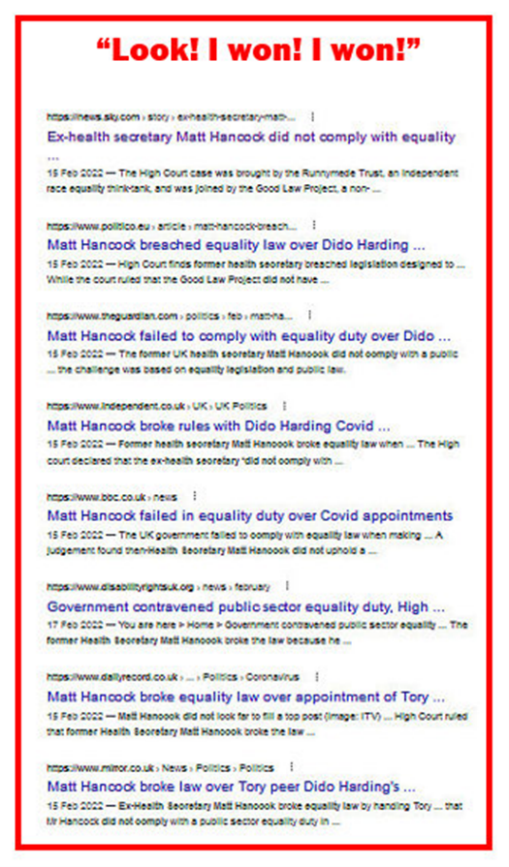
Then came Tuesday Feb.15th.  Notwithstanding Ukraine and the Duke of York, most media found room for reports variously headlined: “Ex-Health Secretary Matt Hancock broke/ignored/did not comply with equality laws/rules/duty over Covid appointments”.
Picture2

In a case brought jointly by the UK’s leading independent equality thinktank, the Runnymede Trust, and the GLP, two High Court judges ruled that “the UK government failed to comply with equality law” when appointing Baroness Dido Harding as Chair of the National Institute for Health Protection and Mr Mike Coupe as Director of Testing at Test and Trace.

Specifically, the “then Health Secretary Matt Hancock did not uphold a public sector duty to promote equality when hiring officials.”

It sounds clear and crushing enough, and it was.  However, that part of the judges’ verdict was in effect directed only at the Runnymede Trust, who had what is known as the standing and entitlement to bring the case. The judges deemed the GLF not to have such ‘standing’ – now or, by implication, were likely to have any time soon.

Still, does that verdict sound to you like an ex-Minister’s judicial triumph?  It apparently did to him!  Read to the end of the Guardian report, and you’ll see he went on instant attack, in a way that readers must have found, if not confusing, then surely bemusing, or simply desperate.

“We’re delighted the department has won yet another court case against the discredited Good Law Project. Claims of ‘apparent bias’ and ‘indirect discrimination’ have been quashed and thrown out by the high court.”  Which, of course, they weren’t.

“What the judgment does make clear is that ‘the claim brought by Good Law Project fails in its entirety’, therefore highlighting the fact this group continues to waste the court’s time.”

Back, then, to President Roosevelt. Last week was undoubtedly a setback for the GLP.  But the instant glee and hauteur with which the court’s ruling was received by Hancock and some of its other critics suggest that, given its record and support, it is unlikely to prove the “existential blow” they apparently crave.

And on the FDR scale – “Judge us by the enemies we’ve made” – they’re still doing pretty well.

Photo

Chris Game is an INLOGOV Associate, and Visiting Professor at Kwansei Gakuin University, Osaka, Japan.  He is joint-author (with Professor David Wilson) of the successive editions of Local Government in the United Kingdom, and a regular columnist for The Birmingham Post.

This blog was originally published in the Birmingham Post, March 3-9, entitled ‘Campaign group proud to be judged by its enemies’
Defining ‘Levelling Up’ – best effort yet?

Chris Game

PoliticsHome, the online Parliamentary news source, recently commissioned a Redfield & Wilton Strategies poll into the public’s awareness and understanding of the Government’s ‘flagship’ slogan – sorry, policy – of ‘Levelling Up’.

It wasn’t great – the awareness and understanding bit, I mean, not the poll. “Somewhat” and “moderately aware” responses formed the clear majority, with a further third of respondents shamelessly admitting “no understanding at all”.   

Which left 14% reckoning they were “well aware” – confident perhaps that they’d not be pressed for details. That’s one in seven potential voters claiming familiarity with the Government’s two-year-old core domestic policy.  Hardly impressive, but I’m sorry – I didn’t believe this particular sub-sample of the Great British Public, even when I first read it.

That is, before the week in which we learned that none of the HS2 eastern leg, the planned Northern Powerhouse Rail, and the Government’s cap on social care costs were, as widely supposed, integral to Levelling Up

Not the least of my reasons for doubting that 14% “well aware” figure was that I’d question whether that many Conservative MPs (50+) would seriously have claimed such familiarity. Even returning from October’s annual party conference, they were openly pleading for fewer “buzzwords” and some “meat on the bones” to offer their increasingly disaffected constituents.

Hardly surprisingly, considering all they’d got from the proverbial horse’s mouth – Levelling Up Minister Neil O’Brien at a Policy Exchange fringe event – was that it’s a “four-fold concept”, involving empowering local leaders and communities, growing the private sector in areas with lower living standards, improving public services, and heightening civic pride. Just what PoliticsHome’s 14% had in mind, no doubt!

But then O’Brien got carried away, almost parroting Douglas Adams’ Hitchhiker’s Guide to the Galaxy: “It’s big – You just won’t believe how vastly, hugely, mind-bogglingly big it is. You may think it’s a long way down the road to the chemist’s, but that’s just peanuts to …” 

Adams, of course, was describing space. Compare O’Brien on Levelling Up: It’s “a huge expensive thing … and will help all people who’ve long felt neglected”.  And there’ll be even more “in the Levelling Up white paper we’ll be publishing … (pause for drumroll) … shortly”.

Or not so shortly, as we learned this past weekend from the DLUHC’s otherwise largely silent ‘big hitter’, Michael Gove – but quite possibly featuring “swathes of rural England [electing] powerful American-style governors”. Odd that O’Brien didn’t mention them!

Either way, it’s frustrating for all concerned, particularly with Ministers having been handing out – and some of their constituencies receiving – tranches of supposedly Levelling Up-type funding for over two years now. So many tranches, indeed, that it’s genuinely hard to keep up.

And that’s not the purpose of this blog, but even a highlights list would include:

* £3.6 billion Towns Fundlaunched as effectively the new PM’s first policy initiative in July 2019, this one would “unleash the full economic potential of [eventually 101] English towns … as part of the Government’s plan to level up our regions”. 

An initial 1,082 towns were narrowed down to the “most needy” 50%, then grouped regionally by “officials” into high, medium and low priority.  All 40 ‘highs’ were selected for funding of up to £25m, with ministers choosing the remainder “based on the information provided and their own judgement”.

Which enabled Communities Secretary, Robert Jenrick, to judge his junior ministerial colleague Jake Berry’s 270th most deprived constituency as still pretty ‘needy’, in apparent exchange for Berry making a similar evaluation of Jenrick’s Newark.

* UK £220 million Community Renewal Fund awards to help 100 particularly needy places/communities across the UK prepare for next year’s launch of the (very much bigger – est. £1.5 billion) UK Shared Prosperity Fund that will replace EU structural and investment funding.                          

Bids were ranked on five ‘metrics’ – productivity, skills, unemployment rate, population density, and household income – with final funding decisions made by the Secretary of State for the (now) Levelling Up, Housing and Communities Department, “after considering any comments from ministerial colleagues”. No actual mention back then of Levelling Up, and disgruntled moans this time from MPs and councils across the spectrum – but, with over £15m to Moseley Road Baths, it wasn’t all bad.

* £4.8 billion Levelling Up Fund – this one is definitely about Levelling Up, bringing together that department, the Treasury, and Transport to invest in “high-value local infrastructure”. Focus is on “places where it can make the biggest difference to everyday life, including ex-industrial areas, deprived towns and coastal communities”. 

Come the results, though, we were back in Towns Fund territory – Sajid Javid’s Bromsgrove constituency and Culture Secretary Nadine Dorries’ Central Bedfordshire being levelled up still further from their positions among the least deprived fifth of authorities nationwide.

As with most of these exercises, the assessment process and criteria are explicit, but without providing the key information successful or, even more, unsuccessful bidders really want.  There are “pass/fail gateway criteria”, assessment criteria – here covering “strategic fit, deliverability, value for money, and characteristics of place” – giving GB bids a potential score of 100.  Following which, Ministers are increasingly involved, together with and guided by officials (of course), but in an essentially indeterminable way.

MPs, naturally, react at least in the first instance to whether ‘their’ patch has ‘won’ or ‘lost’ in these funding contests.  Not so the Commons Public Accounts Committee – Labour-chaired, but Conservative-dominated – who, pretty well from the outset with the Towns Fund, have criticised severely the blatant Ministerial involvement in the “not impartial” selection process.

Civil servants had ranked towns into three categories by local need and growth potential, then chosen all 40 ‘High Priority’ ones. Whereupon Ministers then selected a further 60, heavily represented by Conservative MPs, from the Medium and Low priority categories. Twelve Low Priority areas won out over Medium Priority towns, including Greater Manchester’s Cheadle, ranked 535th out of 541, but with a vulnerable 2,336 Conservative majority.

“Vague and based on sweeping assumptions” was the Committee’s verdict on Ministers’ selections, which risked jeopardising the civil service’s reputation for integrity and impartiality.

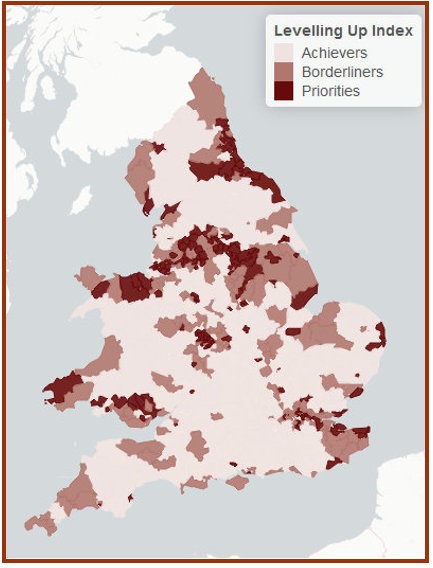
With something at least as sophisticated and certainly more objective evidently required, up stepped WPI (Westminster Policy Institute) with its Levelling Up Index. It attempts almost exactly what the Government claims it wants: a comprehensive socio-economic statistically based identification of those areas (though by parliamentary constituency, rather than local authority) most in need of levelling up.

WPI’s Index assigns all English and Welsh constituencies ‘Levelling Up’ rankings – from the most needy, Blackpool South (1), to the least, South Cambridgeshire (573) – then divides them into three categories: Priorities, Borderliners, Achievers.

Achievers, mainly in the South and upwardly mobile suburbs of major urban centres, perform better than Borderliners, who constitute the national average and are judged to require support in certain areas. Levelling Up Priorities, though, should be places, disproportionately in the North, Midlands, and Wales, that have historically suffered through industrial decline, and often additionally through Government spending policies.

Six indicators combine to determine a Levelling Up score: spending power; financial dependency, based on Job Seekers’ Allowance and Universal Credit claims; crime rates; deprivation scores; health measures; and empty commercial properties.

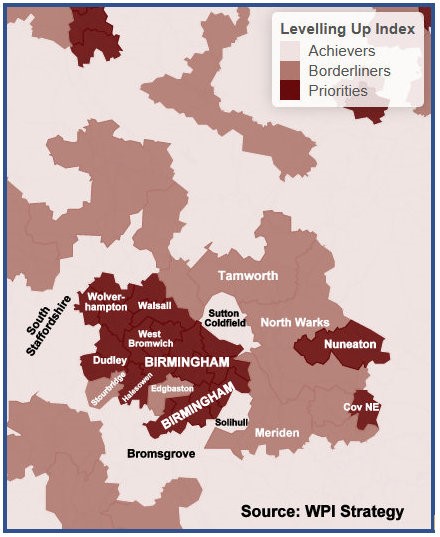
Better still, there’s an excellent interactive WPI Index Map, the enlarged West Midlands section of which shows clearly the prioritisation the six indicators suggest our region’s constituencies should be accorded in any objectively conducted Levelling Up exercise.

The map’s core message barely needs commentary, but some individual Levelling Up scores are useful. The whole metropolitan West Midlands is a Priority, with the exceptions of Borderliners Edgbaston (sounds familiar – 208) and Stourbridge (210), and Achievers Sutton Coldfield (452) and Solihull (524).

Other Birmingham scores range from Erdington, Ladywood, and Hodge Hill (9, 10 15), through Perry Barr, Hall Green, Yardley, and Northfield (43, 55, 60, 62), to Selly Oak (156).

Viewed pictorially, we look pretty determined to get our deserved recognition. To me, anyway, we resemble a rather ferocious, albeit three-legged, tail-docked Cockapoo – about to attack those South Staffs Achievers, before making mincemeat of Boris’s Peppa Pig.


Photo

Chris Game is an INLOGOV Associate, and Visiting Professor at Kwansei Gakuin University, Osaka, Japan.  He is joint-author (with Professor David Wilson) of the successive editions of Local Government in the United Kingdom, and a regular columnist for The Birmingham Post.

Inter-municipal Cooperation is the key to better environments in our cities.

Victor Osei Kwadwo

The 2021 United Nations Climate Change Conference (COP26) aims at “Uniting the World to Tackle Climate Change”. While the technical aspects to addressing climate change is more evident in the goals of COP 26, it is time attention is equally paid to the governance of climate change at the metropolitan scale made up of our major cities.

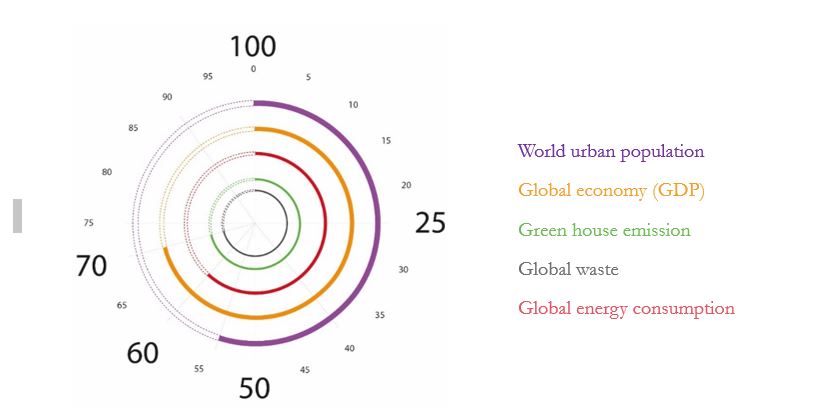
Due to rapid urbanization, the world is increasingly becoming metropolitan. Cities have expanded outwards and have become more interdependent with their immediate peripheries. Cities occupy only approximately 2% of the world’s total land yet host 54.5% of the world’s population. Cities are responsible for 70% of the world’s GDP, over 60% of global energy consumption, 70% of global greenhouse gas emissions, and 70% of global waste.

As cities agglomerate, the footprint and interdependence within and between cities blur existing administrative boundaries to the extent that development issues in one local government jurisdiction have spillover effects on neighbouring jurisdictions. These spillover effects have led to a call for cooperation on functional grounds, making metropolitan areas a salient scale for public policy interventions. Metropolitan areas such as Cape Town, London, Mexico City, São Paulo and Tokyo are mainly characterised by densely inhabited functional urban areas and their surrounding interconnected lower-density areas.

In the management of metropolitan areas, for instance, many cities in the USA, Greater London, Brussels, Dar es Salaam and Greater Accra, the joint provision of metropolitan-wide services or jointly addressing a cross-boundary problem is an explicit choice of local governments that make up the metropolitan area. This voluntary nature of cooperation poses a collective action dilemma when local governments have to address problems jointly.

The dilemma arises from the externalities of environmental outcomes that drive low incentives for cooperation and a high risk of free-riding. To find joint solutions to cross-boundary problems in metropolitan areas, inter-municipal cooperation (IMC) is identified as critical for better economic and environmental outcomes in service delivery. There is empirical evidence that inter-municipal cooperation saves costs but does it also improve environmental outcomes?

Governments tend to be reluctant to cooperate when environmental outcomes are at stake, and this is partly due to the limited evidence on the impact of cooperation on environmental outcomes. It is therefore important to provide an evidential basis on which local governments can justify and initiate cooperation arrangements to address environmental concerns jointly.

In a study I co-authored with Tatiana Skripka, we provide this evidence using data covering 229 metropolitan areas in 16 OECD countries. The study tests the impact of cooperation in transportation on CO2 transport emissions. We did this by estimating a three-level mixed-effects model that takes into account both national and metropolitan-specific characteristics.

The results demonstrate that if local governments cooperate, better environmental outcomes can be achieved. Metropolitan areas that worked together on transportation issues were able to reduce CO2 transport emissions.

The findings give an indication of what needs to be done to effectively fight the environmental challenge. More significantly, beyond normative predictions, the findings provide a basis for local governments to justify and pursue local to local partnerships to address environmental issues.

What we measured

We used “working together on transportation” as a measure of cooperation and “CO2 transport emissions” for environmental outcomes to estimate the impact of cooperation on CO2 transport emissions reported in 2000, 2005 and 2008 for 229 metropolitan areas in 16 OECD countries.

We accounted for factors such as the year of observation, economic status, socio-cultural, geographical, technological and governance measures such as mitigation policies, enforcement, and metropolitan structure. The factors covered both the national and metropolitan area-specific characteristics: socio-cultural conditions, level of technology, geography, and metropolitan governance structure. We used data from the OECD metropolitan governance database, the OECD Metropolitan Governance Survey, the World Bank, among others.

Key findings

We found that metropolitan governance structures, whether fragmented or consolidated, are equally inefficient in delivering reduction in CO2 transport emissions. The finding contrasts with an increasing trend of scholars advocating for fragmented metropolitan structures that favour voluntary cooperation, compared to consolidated structures that address collective action problem through coercion.

We also found that countries with a higher GDP were more efficient in reducing CO2 transport emissions. In contrast, metropolitan areas with higher GDP recorded increases in CO2 transport emissions. While national funding can dictate climate-related interventions and standards, metropolitan wealth is more flexible in taking on such obligations. As metropolitan areas are mainly production centres, investments in environmentally-friendly interventions may be more easily sacrificed at the metropolitan level for economic gains.

We further found that CO2 transport emissions increase despite the mere presence of environmental mitigation policies. This is consistent with empirical observations. For example, while the Paris Agreement has 196 Parties adopting to limit global warming to less than 2 degrees Celsius, emissions have continued to rise globally by 1.4 per cent per year on average since 2010. Environmental policy effectiveness lies in the ability of the cooperating parties to ensure widespread policy implementation and enforcement.

The crucial factor explaining the reduction of CO2 transport emissions in metropolitan areas is inter-municipal cooperation that facilitates coherence and widespread enforcement of mitigation policies. The impact of cooperation on CO2 transport emissions is magnified in metropolitan areas within countries that have stringent environmental mitigation policies.

Next steps

Inter-municipal cooperation (IMC) is critical in the governance of metropolitan areas if better environmental outcomes are to be achieved in our cities. Cooperation ensure policy uniformity, facilitates the possibility of widespread enforcement and reduces incentives for free-riding irrespective of governance structure. It is recommended that scholars and policymakers emphasise how to incentivise effective cooperation regardless of the metropolitan governance structure. Also, efforts must be geared toward uniform mitigation policies and their subsequent enforcement across local jurisdictions in metropolitan areas.

Read the full paper here

https://www.tandfonline.com/doi/full/10.1080/03003930.2021.1958785

Victor Osei Kwadwo is a PhD fellow in Economics and Governance at UNU-MERIT and Maastricht University. He has broad expertise in political science, economics, and public policy with a special emphasis on urban governance and development. For his PhD, he explores how and why independent local governments cooperation arrangements emerge to address transboundary issues in metropolitan areas.

The Lambeth tragedy and electoral reform

Chris Game

The recent Independent Inquiry report, chaired by Professor Alexis Jay, into the serial sexual abuse of children in the residential care (or neglect) of Lambeth Council from the 1960s to 1990s makes dire, sickening reading. It is lessened not one jot by being semi-historic, particularly for someone like myself who had at least intermittent dealings with the councillors and officers of Lambeth and other London councils during the 1980s, the most politically malevolent of those decades.

Pause for some indulgent, but explanatory, personal history – only three paras, promise!  I remember that key mid-80s period vividly. My early INLOGOV years, in the early 80s, felt like a kind of extended apprenticeship. I’d been appointed to launch the Department’s undergraduate PMA (Public Policymaking & Administration) degree, of which several senior colleagues were undisguisedly suspicious. I had no personal local government background, and was barely allowed near INLOGOV’s ‘shop window’: its prestigious, 6-week Wast Hills residential AMDP (Advanced Management Development Programme) for senior lg officers – because, well, what could I possibly tell them that they didn’t already know and weren’t already doing?

But then came ‘Widdy’ – the Committee of Inquiry into the Conduct of Local Authority Business, chaired by David Widdicombe QC – the Thatcher Government’s thinly disguised vehicle that would reveal the scurrilous goings-on (and, yes, ‘abuses’ – though even she didn’t mean sexual ones) in particularly left-wing Labour councils, enabling legislation that would restrain and generally weaken them. For several reasons it didn’t work out like that. Future Professor Steve Leach and myself from INLOGOV and two other colleagues spent the summer of 1985 visiting over 100 GB councils, interrogating senior members and officers, and eventually producing a 340-page report – far longer and more detailed, nuanced and qualified than the ‘hatchet job’ it was widely assumed the PM and Environment Secretary Nicholas Ridley had been hoping for.

For me, though it cost me a cricket season, it was fantastic.  At last I knew stuff about the inner political workings of local government that both councillors and officers were actually asking to hear about.  I could jointly run seminars and training programmes for officers and members – including week-long residential programmes for officers from groups of London boroughs – AND even get invited to address AMDP, without senior colleagues sitting in at the back checking me out.

We would discuss the internal, organisational politics of our local government system: the workings of and relations between party groups; one-party committees and sub-committees; the differences between Independent-dominated and ‘politicised’ councils; and, of course, member-officer relations and respective spheres of responsibility, including to electors and service users.

However … it was also during the 1980s that the Jay Inquiry found a root cause of the “widespread” sexual and other abuse of children in ‘care’ to have been the “politicised behaviour and turmoil” (p.vii) that dominated and warped Lambeth’s Labour-controlled council, for which “a succession of elected members and senior professionals ought to have been held accountable” (p.v), and weren’t.

Children were functionally weaponised in a “toxic power game” (p.vii) between Labour councillors and the Thatcher Conservative Government – a project that took precedence over providing quality, or simply adequate and undamaging, services and in 1985/6 over even setting a council tax rate (for which, for the record, 26 Labour councillors were surcharged and disqualified from office).

It’s rather late now to return my training programme fees, and I can’t meaningfully comment on the fundamental changes and redress measures since implemented.  I raise the Lambeth case solely because it loosely links to recent election-related news items I do know something about.

The first is that on 6th May, while I was previewing the various ‘First-Past-The-Post’ or ‘winner-takes-all’ council elections across the West Midlands, voters elsewhere in GB were voting in their sixth sets of Proportional Representation (PR) elections for their respective devolved institutions: the Scottish and Welsh Parliaments and London Assembly. There at least, what was once considered radical and even ‘Un-British’ is now the widely supported norm, with versions of PR also used in Scottish local elections and soon, if councils choose, in Wales too.

They are preferred to ‘Winner-takes-all’ because of results like those, for example, in this May’s Warwickshire and Worcestershire County Council elections. The respective Conservative parties took 74% and 79% of their councils’ seats – and four years of statistically comfortable overall policy control – on well under half the respective votes cast.

Just as that 1983 Thatcher Conservative Government won its 144-seat Commons majority with 42% of votes. These unearned bonuses are not just decisive, but gross, distorting, and potentially dangerous. Under even a loosely PR system, that 42% would have given the Conservatives under 300 seats instead of 397, Labour perhaps 180, and the Social Democratic-Liberal Alliance’s 25% vote share a potentially Government-determining 160-plus, instead of just 23.  And that whole fractious decade would have been very different.

Fantasy, of course. But – and finally, the key prompt for this blog – I do distinctly recall discussing, with Lambeth’s 40 Labour and 23 non-Labour councillors, how, had their 1982 local elections been run under any PR system, the chances were that, just as Thatcher probably wouldn’t have been in Downing Street, Labour almost certainly wouldn’t have won control of their 64-seat council.

For the Conservatives had won comfortably most votes, their 39% giving them perhaps 25 seats. Labour’s 33% could have meant not 40, but 22, leaving – as nationally – the Social Democratic-Liberal Alliance councillors holding the balance of power with maybe 17.  And the tragic events recorded in the Jay report would never have happened. The message is obvious: yes, election results shape history, but those results and outcomes are shaped by electoral systems.

There are many variants of PR electoral systems, but all aim to produce parliamentary or council memberships proportionately reflecting actual votes cast. And, conveniently, all three bodies mentioned – the Scottish and Welsh Parliaments and London Assembly – use versions of the Additional Member System (AMS).

Voters have two ballot papers. One lists candidates standing for single-member constituencies, the candidate with most Xs winning the seat. The second, usually regional, ballot paper lists the contesting parties and their respective candidates, and the voter’s X goes to their preferred party list. Now the key bit: these list seats are allocated specifically to ensure the overall seat shares in the Parliament/Assembly/Council match as closely as possible the shares of party votes received.

And back in May?  Space here, I’m afraid, only for Scotland, where the nowadays dominant Scottish National Party (SNP) won 62 of the Parliament’s 73 constituency seats – but with under 48% of the constituency vote. The nearly 22% vote shares of the Conservatives and Labour won them just 5 and 2 constituency seats respectively.

These disparities, however, were ironed out in the second, regional votes. The SNP’s 40% vote gained it only two additional seats, giving a total of 64 – just short of an overall majority in the 129-member Parliament, and reflecting its failure to win majorities in either vote.

By contrast, the Conservatives’ 24% regional vote earned them 26 additional seats to total 31.  Labour’s 18% brought them up to 22, and the Greens, without any constituency seats, won 8% of the regional vote, gaining them 8 seats. Which is why, once they understand it, voters tend on balance to like it – because it includes, rather than excludes.

Which, sadly, is the precisely opposite aim of Home Secretary Priti Patel’s planned electoral reforms – from compulsory photo ID to abolishing preferential electoral systems for Mayors, Police Commissioners and the London Assembly. But then inclusivity really isn’t her bag, is it – and, though a Londoner herself, she’s too young to remember 1980s Lambeth.

_____________________

A shorter version of this blog – minus the personal INLOGOV bits – was published in the Birmingham Post on 19th August under the title ‘Electoral reform could have prevented tragedy’ (https://www.pressreader.com/uk/birmingham-post/20210819/281956020861052)

Photo

Chris Game is an INLOGOV Associate, and Visiting Professor at Kwansei Gakuin University, Osaka, Japan.  He is joint-author (with Professor David Wilson) of the successive editions of Local Government in the United Kingdom, and a regular columnist for The Birmingham Post.

Our elections should be about voter inclusion, not exclusion

Chris Game

When I used to teach undergraduate Politics courses, I would try to invite along at least one overseas student when I went to vote – partly for their cultural education, partly to share their impressions.

Their customary first question was: will there be queueing?  It would be asked in relation to almost any unfamiliar British activity, but particularly after I happened to have recounted the time a Romanian Presidential Election clashed with Birmingham’s Frankfurt Christmas Craft Market, and police were required to shepherd literally hundreds of remarkably patient Balkan voters round the fringes of the market to the Town Hall, doubling for the occasion as a regional Romanian polling station.

My queueing answer, even for a General Election, was a confident ‘No’. Likewise, to usually the next question: taking photos.

The students would already know about voting in the UK not being compulsory. So the polling station trip’s key ‘learning point’ was identity verification, as they were fully aware that, unlike many of their countries, we don’t have national ID or citizen cards, with or without a photo.

Whereupon I would produce my so-called poll card from the City Council Returning Officer, detailing the election date, my polling station and register number, voting hours, plus “You do not have to take this card with you in order to vote”. They would be underwhelmed by the flimsy, featureless B&W card that almost begs to be junked immediately upon, if not before, being read. So I would tease them by telling them initially that it’s another ‘British tradition’.

Poll cards were first produced for the 1950 General Election, and tradition requires them still to look as if printed by a pre-Xerox mimeograph machine. Compared to our queueing obsession, separate hot and cold water taps, and constant apologising, it usually struck students as among our lesser cultural eccentricities.

But how would I prove my identity?  Whereupon I would explain that, although Northern Ireland voters have since 2002 had to produce one of seven possible forms of photographic ID – including, if necessary, a free Electoral Identity Card – as a GB voter, I wouldn’t have to. Indeed, even if I proffered my poll card, the Poll Clerk would still ask my name and address – which I could easily read upside down on the electoral register as it was being marked off.

Meaning, if I wanted to cheat small-time – commit ‘personation’ by having someone illegally cast an extra vote for my preferred candidate – I could easily memorise the names of neighbours who had not yet voted, and select one least likely to in, say, the next hour or so, who could thus be safely impersonated.

Almost invariably, that voting practice summary proved among the most impactful information I imparted to my students. “How British!” was their first reaction, though generally followed by mild but real shock: at our treating so apparently casually this core act of political participation that many of them and their parents’ generation had literally fought – and then queued – for.

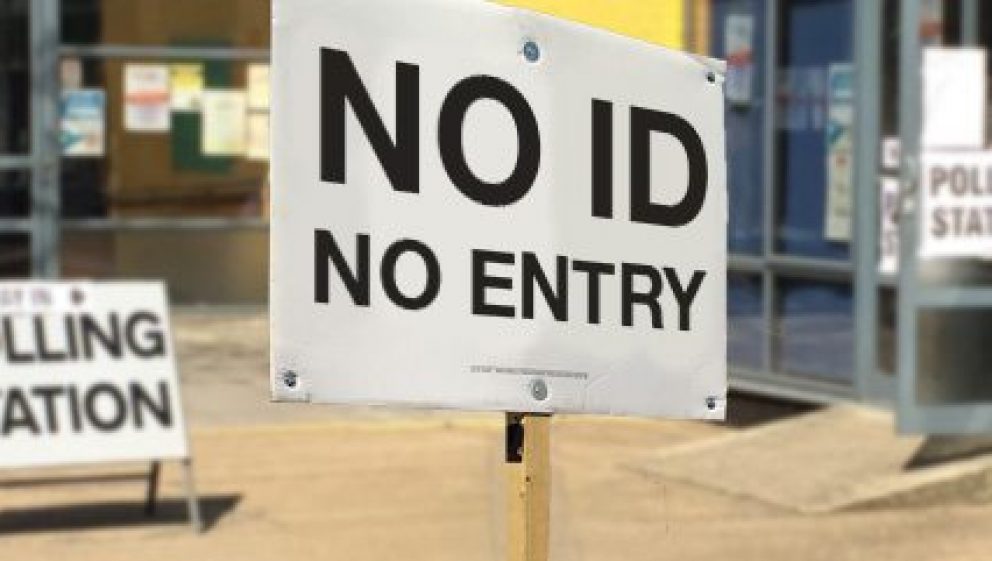
All of which is an anecdotal way of introducing my own ambivalence towards the Government’s commitment to extend from 2023 the Northern Ireland practice and require all UK citizens to show photo ID in all the categories of Parliamentary and local elections taking place on May 6th.

So what’s my problem? The Electoral Commission has supported it for years.  The policy has been in two winning Conservative manifestos. It will be an Electoral Integrity Bill, which sounds worthy enough. It has been pilot tested – kind of. It worked in Northern Ireland, where ‘personation’ has been largely eliminated.

Besides, since we nowadays show ID for ever more everyday services, it’s irrational not requiring it for something as important as voting. I can almost hear my students agreeing – as indeed do I. My problems are with the Government’s priorities – and the false Northern Ireland analogy.

20 years ago NI had a big, pumpkin-sized electoral problem – public perception of widespread electoral malpractice, including vote-stealing, impersonation, voter intimidation, multiple register entries. GB, thankfully, doesn’t.

The Electoral Commission’s own analysis shows that of 58 million votes cast across the whole UK in 2019, 595 alleged electoral fraud cases were police-investigated – most concerning local elections and campaigning offences. Just four led to convictions, one being for impersonation.

Partly, and sadly, because of widespread political apathy and alienation, GB’s voting malpractice problem is, pinching the Electoral Reform Society’s metaphor, nut-sized – yet to which the Government proposes bringing a clumsy, costly, partisan legislative sledgehammer.

Second, the effectiveness of the NI photo ID reform is almost always judged first by pre-reform turnout rates not having significantly fallen. What significantly rose, though, to today’s seriously disturbing levels, is the incompleteness of the electoral registers on which those turnout percentages are based.

According to the Electoral Commission, just 51% of NI 18-34 year olds were correctly registered in 2019, compared to 94% of over-65s; 88% of ‘outright’ homeowners, but 38% of private renters. Obviously, if you’re not registered, you’re not part of the turnout base. In short, NI today is not an exemplary electoral model for the rest of the UK.

GB’s genuinely big electoral problem, again based on those most recent Electoral Commission data, is that over 9 million, or 17%, of eligible GB voters were either not or incorrectly registered at their current address – particularly, if unsurprisingly, the young, persons of colour, renters, low-income, disabled, and simply those with no fixed address.  Many/most of whom – how to put this – would on balance probably not be natural Conservative supporters.

There is an obvious solution: Automatic Voter Registration (AVR) – the direct enrolment of citizens on to the electoral register by public officials; no citizen initiative required. But that’s for another blog.

Meanwhile, if anything should be made compulsory, let’s make it not photo ID, but poll cards: “You SHOULD take this card with you when you go to vote”.


Chris Game is an INLOGOV Associate, and Visiting Professor at Kwansei Gakuin University, Osaka, Japan.  He is joint-author (with Professor David Wilson) of the successive editions of Local Government in the United Kingdom, and a regular columnist for The Birmingham Post.

Source: Electoral Reform Society

Research to Help Rebuild After Covid-19

Jason Lowther

Last month Sir Patrick Vallance, Chief Scientific Adviser to the UK Government, met (virtually) with over 100 researchers and policy officers to discuss the output of a six-month programme looking at some of the fundamental challenges to our society, economy and ways of living.  Commissioned by the Government Office for Science, the Rebuilding a Resilient Britain programme aims to help government with medium- and long-term challenges relating to the challenges of Covid-19, captured under nine themes including “vulnerable communities”, “supporting services”, and “local and national growth”.


The overall programme was led by Annette Boaz and Kathryn Oliver, two experienced social scientists whose work focusses on the use of evidence.  In their recent LSE article, they explain the background to the programme and how plans were upturned in March with the introduction of Lockdown in the UK.  

I was particularly involved in the “supporting services” theme, convening the work around local government.  It is an exciting initiative to be involved with, not just because of its scope and pace, but also because of the range of people engaged: researchers and academics, government policy and analysis officers, and funders.  What I found particularly interesting was how different Government departments and different academic disciplines were often looking at very similar issues but framing them from distinct perspectives and using diverse language to describe them.  This highlights the need to develop shared definitions of issues and ways to address these – considering “problem-based issues” in the round.

As well as summarising the existing research evidence around each of the identified themes, the work identified several “gaps” in the extant evidence base and opportunities for new research, policy/research dialogue, and knowledge exchange.

Within the Local Government theme, we recognised that LG’s role proved critical in the first stage of the pandemic, for example in supporting vulnerable and shielded people, enabling voluntary community groups, freeing up 30,000 hospital beds, housing over 5,000 homeless people, and sustaining essential services such as public health, waste collection, safeguarding and crematoria.  This role is likely to increase in future stages of the pandemic, with more responsibility for local surveillance testing and tracing, implementing local lockdowns, economic development, contributing to a sustainable social care system, and supporting further community mutual aid.

There is already a good evidence base showing how local government is playing vital roles in responding to and recovering from the pandemic.  We identified four main themes: empowering local communities, delivering and supporting services, devolution and localisation, and funding.
For each issue we considered the key policy and practice implications of existing evidence, the evidence gaps and the ways in which gaps might be filled.  

Around empowering local communities, for example, evidence showed that LAs responded quickly to the pandemic, and well-functioning local systems emerged to tackle the immediate crises in many parts of the UK.  Areas adopted a range of strategies in partnership with local communities. But informal community responses can lack coordination, resources, reach and accountability; and some groups face barriers to involvement.  Further evidence is required on what works in strengthening community support networks, empowering different types of communities, and co-producing public services.  Councils also need to understand better how staff, councillors and the institutions themselves can change to empower communities.

There has already been some important learning from this work, such as recognising the treasure trove of useful knowledge contained in existing evidence and expertise.   We need to get much better at using evidence from, for example, the evaluation of past policy initiatives.  The programme is helping to strengthen relationships across government, including some new and more diverse voices, and will be useful as government departments revisit their Areas of Research Interest post-Covid.  The thematic reports are due to be published in coming weeks.

I will be exploring the findings for other areas of interest to Local Government in future articles.

[This article also appeared in the Local Area Research and Intelligence Association December newsletter]

Jason Lowther is Director of the Institute for Local Government Studies at the University of Birmingham.