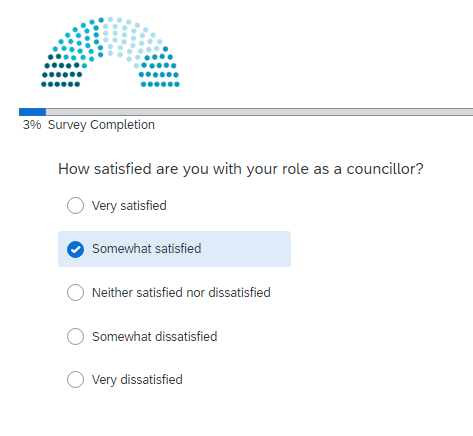
In the intricate tapestry of European local governance, local councillors stand as pivotal figures, linking citizens to decision-making processes that shape their daily lives. Their interactions within communities, councils, and broader public administration are the bedrock of modern democracy. Last week, alongside colleagues from the University of Bristol, Cardiff University, and Ghent University, we embarked on an ambitious endeavour: an email survey reaching over 19,100 councillors across England, Scotland, Wales, and Northern Ireland.
The survey is part of a broader European effort, with a single shared survey being rolled out with spans twenty-eight European countries driven by a broad collaboration of academics emerges from extensive international research network dedicated to conducting surveys with local political actors to understand local and national political dynamics. Over two decades their comparative work has shed light on the councillor, council leader and mayor roles of local government, administrative intricacies, civic cultures, and political practices across Europe, enriching both academic and practical understanding.
Our latest research now refocuses on local councillors, probing fundamental questions about democracy, their perceptions of their roles, views on local government, challenges within the institutional environment, and policy priorities. The survey also aims to understand councillors’ experiences with aggression and abuse and the influence of such encounters on their council activities and public engagement.
But this survey is more than just academic curiosity; it’s about amplifying the voices of local representatives. Councillors are the conduits between citizens and power, entrusted with articulating community aspirations and championing collective interests. They face mounting external pressures—from austerity to centralisation—and grapple with balancing economic growth, development, and environmental concerns, alongside the existential threat of rising social care costs as more and more councils face financial distress.
Unlike previous paper-based iterations, this survey employs electronic questionnaires sent to individual councillors across England, Wales, Scotland, and Northern Ireland, with the survey lasting around 15 minutes, we are keen that councillors both start and finish the survey, so have enabled them to complete it over multiple sittings if required via simply clicking on the email invitation.
As the survey unfolds across 28 countries, we urge councillors to join the dialogue and lend their voices to the study. Personalised emails have been sent directly to councillors’ inboxes, and follow-ups will continue over the coming month. Any councillors unable to access the survey can reach out to the project team using the contact details provided below.
We are calling on all councillors to check their inbox for our survey! Your voices are crucial to use better understanding the challenges and priorities in your role. This is the first time we have delivered the survey across England, Scotland, Wales, and Northern Ireland so we are really keen to ensure that all voices are represented across political parties, different tiers of local government, and geographies. Let’s ensure all your voices are heard loud and clear.
Dr Thom Oliver is a Senior Lecturer in Politics at the University of the West of England, Bristol. Thom completed his PhD at INLOGOV in 2011. Along with Dr David Sweeting (Bristol), Prof Colin Copus (Gent), and Dr Bettina Petersohn (Cardiff), he is leading the Return of the Councillors study in England, Wales, Scotland, and Northern Ireland. Thom leads the Qualitative Election Study of Britain, and is a co-investigator on the Bristol Civic Leadership Project.
Previouscolumns have urged a cautious approach to the introduction of photographic voter ID in England. The May 2023 elections provided the first nationwide test of the system, and early analyses are highlighting some significant issues.
Elections took place in 230 areas in England and around 27 million people were eligible to vote. This week, the Association of Electoral Administrators (the people in councils who actually deliver elections) issued their post-match analysis, highlighting ‘the fragility of the system’ and recommending a fundamental review of the country’s electoral arrangements.
With less than four months between the enactment of the new legislation and polling day, which included new statutory duties on accessibility as well as voter ID, councils faced a huge and risky task to administer the new system effectively. They also faced significantly more paperwork, with new forms to track electors unable to vote and new data capture requirements. The AEA report significant impact on polling officials: ‘many of our members reported POs feeling overwhelmed by paperwork and the time it takes to complete throughout polling day and at the close of poll’.
The AEA report reveals that the government’s website to provide free photo ID to those needing Voter Authority Certificates (VACs) failed to work properly from its launch in January and many functions were still not available by the deadline to apply for a VAC for 4 May poll. Updates were still being issued two weeks before polling day. Almost 90,000 people applied for VACs by the deadline, well short of the Electoral Commission’s earlier estimate of 250,000 – 350,000 applications based on the proportion of local election voters who did not have suitable ID. Many didn’t know they would need one – just over half (57%) of the overall population and those who said they did not already have photo ID were aware of VACs in May, according to the Electoral Commission.
The types of photo ID acceptable under the legislation proved rather esoteric. Passports are accepted, but what about a passport from Zimbabwe or a British format immigration document? London Oyster 60+ cards are accepted, but not the Merseytravel Over 60s pass which has similar application checks. Photo IDs issued by councils themselves, such as taxi licences and gun licences, were presented but could not be accepted. Similarly police warrant cards, NHS and other emergency services photo ID were presented but unable to be accepted.
The Electoral Commission’s interim report on the election was issued on 23rd June. They found that immediately before polling day, 87% of people in England (excluding London, where there were no elections) were aware that they needed to show photo ID to vote at a polling station – implying that around 3.5 m potential voters were not aware as the poll approached. Awareness was lowest amongst young people, BME communities, those who haven’t previously voted in local elections, and people who didn’t have the necessary forms of photo ID.
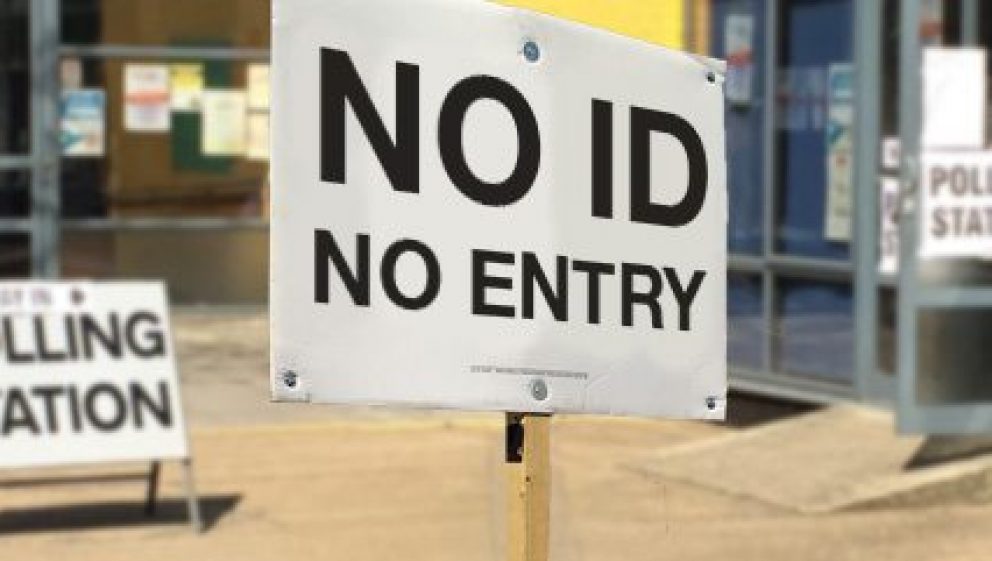
To avoid voters queuing for a ballot paper and being turned away, in some areas ‘greeters’ were appointed to meet electors as they arrived and check whether they had an accepted form of photo ID with them. Others provided posters and banners to explain the requirements outside polling stations. Polling stations with greeters recorded a smaller proportion of people ‘turned away’ inside the polling station compared to those without greeters. As a result of voters receiving advice outside the polling stations, and because of some other data issues, we should treat statistics on numbers of electors unable to vote with caution. Data collected inside polling stations shows that at least at least 0.7% of people (39,000 voters) who tried to vote at a polling station were initially turned away but around two-thirds of those people (63%) returned later in the day and were able to vote. In some councils more than 1 in 100 electors were turned away.
More worryingly, the Electoral Commission found that 4% of people who said they did not vote in these elections gave an unprompted reason related to the ID rules, and the proportion of non-voters giving an ID-related reason rose from 4% to 7% when survey respondents were selecting from a list of reasons.
It was not possible to capture reliable demographic data on people who were not able to vote because of the ID requirement because electoral law did not allow polling station staff to collect demographic information about individuals who were turned away. In the EC survey, disabled people and those who are unemployed were more likely than other groups to give a reason related to ID for not voting.
Voter confidence doesn’t seem to have been massively improved. In fact, the EC found 68% of people were confident that the May elections were well run, compared to 73% in 2022. For those who said they were not confident, the most common reason selected (by 46%) was that “some people were unable to vote due to the ID requirement”.
We await the Electoral Commission’s full report in the autumn.
Meanwhile, I close with an interesting comment made at the National Conservatism conference on the 15th May 2023 by former Secretary of State for Business, Energy and Industrial Strategy, Sir Jacob William Rees-Mogg:
Parties that try and gerrymander end up finding their clever scheme comes back to bite them – as dare I say we found by insisting on voter ID for elections. We found the people who didn’t have ID were elderly and they by and large voted Conservative, so we made it hard for our own voters and we upset a system that worked perfectly well.
Jason Lowther is the Director of INLOGOV. His research focuses on public service reform and the use of “evidence” by public agencies. Previously he worked with West Midlands Combined Authority, led Birmingham City Council’s corporate strategy function, worked for the Audit Commission as national value for money lead, for HSBC in credit and risk management, and for the Metropolitan Police as an internal management consultant. He tweets as @jasonlowther
Without a question, decolonisation is a slippery concept already! Decolonising democratic innovations (DI) is even more slippery because of its inherently normative foundation. Here, Temidayo Eseounu’s argument in her blog, which forms part of the Political Studies Association’s Participatory and Deliberative Democracy Specialist Group’s blog series on Decolonising Democratic Innovations, could not be more to the point: ‘Eurocentric normative values such as inclusion, equity, representation and equality are intrinsic to the theories of participatory and deliberative democracies, which underpin democratic innovations’. Indeed, the fact that a citizen jury or mini public, where groups of citizens meet to reflect on problems and assess policy proposals, is firmly rooted in a set of Eurocentric norms makes it a productive democratic innovation in a Western context, where people value above all individual rights and personal expression and are used to openly criticizing their leaders. Such an approach to public participation is in harmony with the social contracts found in Western civilizations, which typically construct mankind as free and equal by nature, and base political authority on the individual self-interests of members of society. Typically, under a Western vantage point, a well facilitated citizen jury or mini public would be praised for offering a ‘platform for exchange’, ‘giving a voice to marginalised members of the community’, ‘deepening democracy’ and ‘improving governance’.
‘Equality’ or ‘inclusion’ are not universal concepts
Such normative framing, which indeed constitutes the very foundation of the concept of democratic innovation, disregards the vastly different realities of most non-Western societies, their underpinning Weltanschauung, core values, beliefs, ethics, and their historical social contracts that help to structure the relationship between the people and their government. In many societies, the universalism of normative values and motivations, such as inclusion, equity, representation and equality, is fallacious – they are inherently Eurocentric! Irrespective of how expertly designed a citizen panel or mini public might be, it would not work well in many collectivist societies in non-Western contexts, where people do not prioritise values such as equality, individualism and personal freedom. For example, participatory activities in non-Western governance settings, such as the United Arab Emirates or Singapore, are not aiming to tackle a democratic deficit, accomplish egalitarian objectives or wholly enhance governmental accountability. In those contexts, while the purpose of a mini public might very well be public service improvements for all, however they are not intended to provide a platform for collectively debating political questions behind services and policies, nor to strengthen inclusion, equality or equity beyond particular segments of the population – as it might be in the West.
Different strokes for different folks
Being clear about the normative foundation of participatory and deliberative events in non-Western settings requires a holistic understanding of the respective local context, or life world, which is a state of affairs in which the everyday world is experienced by the people, who simultaneously create social reality while being constrained by it. For instance, the Balinese life world is based on viewing the cosmos as a grand hierarchy, wherein animals and demons are at the bottom, gods and god-kings are at the top, and ordinary mortals are distributed throughout an elaborate assortment of fixed status ranks in between. The often cantankerous nature of Western-type citizen panels that assume every human being is equal and has a right to pursue his or her self-interest could be viewed as an incomprehensible and disrespectful exercise that causes more damage than good to the community and established hierarchies. Similarly, the press in Arabic Bedouin societies often portrays Western-style democratic innovations with their explicit advocacy and public naming and shaming as ‘uncivilized’. The Bedouin culture of ‘saving face’, loyalty to the leader and respect for his ‘God-given’ mandate, safeguarding family honour and tribal traditions is not compatible with the reform-seeking debates and critical tirades that can typify Western-style citizen juries. Under the vantage point of bedoucrats (those who believe in Bedoucracy, which proffers a model of Arab public management that originates in the Bedouin tribal culture and joins traditional bureaucratic design with tribal power culture), many Western-type democratic innovations amount to little more than a ‘narcissist circus’. However, the Bedouin culture of mediating by means of patience and forgiveness and seeking compromise, which signifies some synergy with Western-style citizen juries, has ensured that there are a number of age-old traditional institutions in Arab Bedouin societies that can be built upon for the purpose of engaging members of the public in participatory and deliberative exercises.
This was done in a Taiwan Buddhist village. Aware of the foreign (Eurocentric) norms that underpin the theory and design of democratic innovations, a team of facilitators who were tasked with conceiving and facilitating a citizen assembly to explore public service challenges and policy solutions in a Taiwanese Buddhist village, had no other choice but to construct and formulate from scratch not a democratic but a culturally appropriate innovation by building on traditional institutions. Given that the citizens’ life world was particularly characterised by a collective emphasis on ‘belonging to one large family’ and ‘respecting social hierarchy’, the facilitators knew that those agreeing to participate in the citizen assembly would not be willing to raise problems for fear of being seen as disrespecting the family and its established hierarchy. Hence, the facilitators framed the act of problem exploration as a co-operative endeavour along Buddhist concepts, such as the ‘eightfold noble path’ and ‘cause-condition-effect’ and developed a buddhicratic approach to delivering and facilitating a citizen assembly with a normative foundation that was in harmony with local worldviews, values, ethics and social contracts.
What now?
Having unmasked the Eurocentricity of DI’s normative foundation, how do we then begin the process of radical renewal with a view to construct a new, broader, postcolonial normative foundation that allows for an increasingly pluralistic approach? Is it even possible to reconsider the legitimacy and comprehensiveness of the established knowledge on democratic innovations by applying the hermeneutic resources and referencing the precepts of the very theories we criticise? As with all wicked and intractable issues, we may have to accept that there is no one panacea. Instead, theorists and practitioners will need to undergo a paradigm shift and prepare themselves to accept and engage with a rich variety of truths, and their underpinning values, social contracts and hierarchies of power. Given the current dearth of non-Western theories and practical templates on public participation and deliberation, we will need to work on a case-by-case basis in constructing locally sensitive and culturally appropriate innovations that are not necessarily and inevitably aspiring to be democratic, but depending on the case perhaps buddhicratic, bedoucratic or othercratic. Importantly, by capturing the empirical observations from each case and theorising the insights gained on platforms such as this blog, or in special issues such as the one on ‘Decolonising the Public Administration Curriculum’ (link to Call for Abstracts here), or in journals that explicitly focus on promoting knowledge exchange across vastly different contexts and episteme such as Public Administration & Development, in time, we might be able to consolidate empirical regularities and develop new, postcolonial theoretical models.
Abena Dadze-Arthur is Assistant Professor at the School of Government (INLOGOV), University of Birmingham, and Associate Editor of the Wiley journal Public Administration & Development. Combining the experience of an international policy practitioner with the robust theoretical approach of an academic, Abena’s research and teaching focus on decolonizing and transforming approaches to public management and governance, and contributing to the development of indigenous solutions and sustainable change.
Residents of marginalised neighbourhoods have long been governed as a vulnerable group in need of help. Today, they are increasingly expected to be active citizens and (co-)creators in improving their neighbourhood. In the Netherlands, like in other European countries, local and participatory approaches are now central in urban policy for marginalised neighbourhoods. But what does this shift in governance approach look like in the work practice of urban professionals who give shape to citizen participation?
Urban professionals are known to play a key role in realising citizen participation: municipal and non-municipal professionals, ranging from civil servants to professionals working for welfare organisations and other social partners linked to the neighbourhood. What their role exactly entails is, however, not really clear. Especially in terms of the (dis)empowerment of urban residents and in marginalised neighbourhoods.
On the one hand, urban professionals are seen to empower citizens. They can navigate between different roles and mediate between ‘the state’ and ‘the people’ due to their unique position in between. On the other hand, they can undermine residents’ power. This can happen when, despite emancipatory aims, decision-making authority remains in the hands of public officials or is shared only with a small group of already privileged residents.
I explored how urban professionals gave shape to citizen participation in my ethnographic study of a participatory governance approach in a Dutch marginalised neighbourhood. Here, I found that the work of these urban professionals cannot be classified simply as either empowerment or disempowerment.
While the participatory approach was discursively positioned as embodying active citizenship, in the work practice of urban professionals the idea of vulnerable places and people in need of help was not so easily replaced. Residents were viewed as having problems and simultaneously as having talents and capabilities; they were assumed to be in need of help from the government and from professionals, while also being able to come up with and execute initiatives to improve the neighbourhood.
As urban professionals translated the broader shift in the governance of urban marginality to their work practice, they navigated between narratives of ‘vulnerability’ and ‘active citizenship’ and employed, what I call ‘selective empowerment’. This is a differentiated approach towards citizen participation in which professionals ascribe a significant role to themselves as a continuous support system for citizens. In the words of one urban professional: “Participation needs to be supported. . . . We [professionals] need to create a canvas on which participation can go nuts. But you can’t expect a painting to arise without bringing the brushes.” Moreover, they facilitate participation within a normative framework of ‘appropriate’ or more traditional expressions of active citizenship. For instance, youths who violently protested in response to the COVID-19 evening-curfew were redirected to a youth council.
By employing selective empowerment, urban professionals reproduced existing categories of vulnerability while reworking the meaning of ‘active citizenship’ or ‘citizen participation’ with marginalised groups. Acknowledging vulnerability is then not (only) a reproduction of existing inequalities. It is also an embedded approach employed by urban professionals to facilitate context-specific citizen participation against the background of urban marginalisation. A discursive shift in governance approach is not automatically synchronised with the work practice of urban professionals. Based on my research, I propose a more nuanced understanding of the work of urban professionals beyond mere empowerment or disempowerment. These insights may provide a starting point for urban professionals’, and, more generally, local governments’, reflexivity: to challenge not only their perceptions of residents as ‘vulnerable’, but also the storyline of residents as ‘active citizens’. Such reflexivity could imply a move beyond discursive ideals of ‘active citizenship’ towards context-specific practices of participation in local neighbourhood policy.
Simone van de Wetering is a PhD candidate at the Department of Public Law and Governance of Tilburg University. Her research focuses on identity and inequality in the city. In her PhD project, she studies citizen participation in marginalised urban neighborhoods in the Netherlands and France. Taking an ethnographic approach, she zooms in on the strategies of citizens and the state to make urban change.
I assume it was the 2021 mayoral election results that finally clinched it. With the Conservatives winning just two of that year’s 13 mayoralties to Labour’s 11, it was time to enact the party’s 2019 manifesto pledge – “to continue to support the First-Past-The-Post (FPTP) system of voting, as it allows voters to kick out politicians who don’t deliver, both locally and nationally”. Specifically, the Supplementary Vote (SV) system – despite also, like electoral systems generally, featuring the kicking-out of politicians – had to be replaced for mayoral and Police and Crime Commissioner (PCC) elections asap.
True, the counting of electors’ supplementary – second preference – votes had just enabled West Midlands Conservative Mayor, Andy Street, to be re-elected with the useful perk of a narrow overall majority of votes cast, along with the party’s rising star, Tees Valley’s Ben Houchen, who’d swept in with nearly 73% of first preference votes.
No supplementary second round necessary there, but nor should there have been, reformers reckoned, in Cambridgeshire & Peterborough, where the established Conservative Mayor, James Palmer, had been a victim of the dastardly SV ‘system’. He’d comfortably led Labour’s Nik Johnson after the count of first preference votes – by nearly 18,000 votes or 8%. Yet, by some foul trickery, or possibly because he simply wasn’t as broadly appealing his opponent, after the counting of relevant second preference votes, he’d fallen behind: 48.7% to new Mayor Johnson’s 51.3%. Despite Government Ministers repeatedly claiming that “the candidate with the most votes” lost, he hadn’t. He’d won – he just wasn’t Conservative.
Anyway, Palmer threw what looked like a wobbly, promptly retired from politics, and SV elections for Mayors and PCCs would be retired with him, though not in time for last May’s Mayorals, which very nearly produced a Croydon re-run of that Cambs & Peterborough result. First count: Jason Perry (Con) 34.8%, Val Shawcross (Lab) 32.7%. Second count: Perry 50.4%, Shawcross 49.6% – the candidate with the leadership-resonant first name just edged it.
By then, though, the FPTP legislation was well under way. The next Mayoral elections – this May – would use FPTP, as will next May’s PCC elections. It seemed a good time for a review of the whole SV lifespan, facilitated by the invaluable statistical records of my polling specialist friend, David Cowling.
Quickish review: the Supplementary Vote is obviously not a proportional system, which would be tricky when electing single Mayors, Police & Crime Commissioners, etc. Rather, it’s a simplified majoritarian system, enabling voters to rank their two most favoured candidates on the ballot paper in order of preference.
If no candidate gets over 50% of first preference votes on the first count, just the top two candidates continue to a run-off, thereby encouraging candidates from the outset to seek support beyond their core supporter base. The winner may still get less than half the total vote, but will need significantly wider support than under FPTP, and especially under FPTP with a lowish turnout.
Both, however – ultra-topical insert – are more democratic than this past weekend’s Spanish ‘mayoral’ elections, in which Barcelona Mayor Ada Colau, almost certainly the nation’s best-known mayor both at home and abroad, is seeking a third term of office … but as Leader of a two-party socialist coalition – for Spanish mayors aren’t even elected by ‘the people’, but indirectly by fellow councillors.
The name – Supplementary Vote – may have been new when it was ‘invented’ by an early 1990s Labour Working Party, but essentially similar ‘preferential’ systems had been quite widely used internationally for ages. France’s Presidential ‘double-ballot run-off’ was one example, but most obviously there was the Alternative Vote – the actual subject of Winston Churchill’s senseless but oft-recycled quote, about it rewarding “the most worthless votes given for the most worthless candidates” – although today’s Conservative critics have no difficulty unearthing and redirecting it to SV.
I’m old enough to recall lecturing about the SV’s UK ‘invention’ by a Labour Party working party in the early 1990s and the even then revered ‘psephologist’, the late Sir David Butler, getting uncharacteristically incensed about it – calling it “silly”! But his sphere of matchless expertise was parliamentary elections, with turnouts at the time of consistently over 70%. Even they, though, have slipped a bit since, and well over a third of today’s MPs won less than 50% of their constituency vote, and that’s an awful lot of voters left feeling unrepresented.
Local (including mayoral) election turnouts, however, are proverbially in another ballpark – and this is probably the blog’s key point. Except when they coincide with parliamentary elections, they average around 40%, and that’s on good days. PCC turnouts, unsurprisingly, are significantly lower still – not one of the 39 areas in England and Wales managing even 51% in May 2021, and Durham and Wiltshire not quite achieving 17%. All of which, under FPTP, will mean large percentages of the votes of the most civically conscientious and politically committed citizens being ‘wasted’ and, arguably even more importantly, the mandates of the elected mayors and PCCs correspondingly diminished.
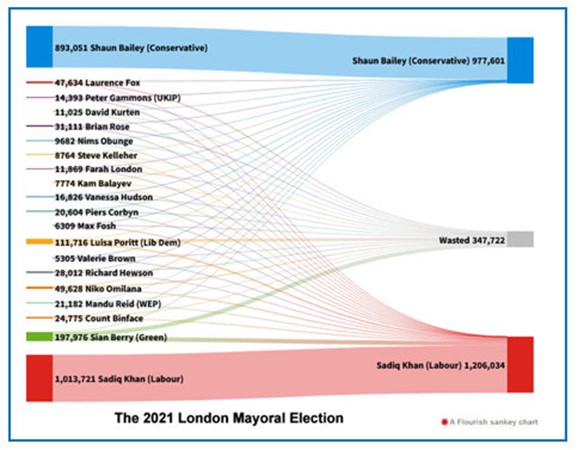
And then there’s the loss of the visual aids – for SV also produces what I only recently discovered are called ‘Sankey charts’, illustrating how the second-round count both produces a winner able to claim a statistical majority of positive votes and a dramatic reduction in the proportion of ‘wasted votes’ – on the part of voters choosing not to make use of their possible second choice. Good, isn’t it!
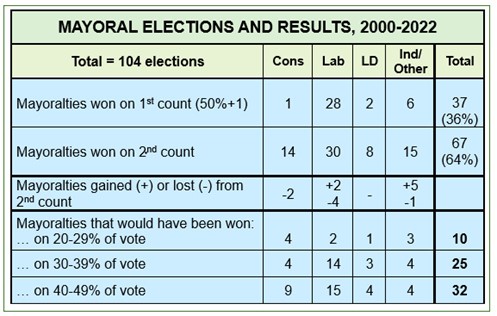
The Supplementary Vote, then, still favours the two main parties, but, returning to recent history and as shown in the following table, one in three of the 67 SV Mayoral elections going to second counts were won by Lib Dems, Independents and other parties. Labour won by far the most mayoral contests, but they also lost most in second counts. All of which contributes to SV hovering around mid-table in global democratic rankings of electoral systems – nothing to shout home about, except when compared with FPTP’s ranking as ‘least democratic’, apart from maybe Djibouti’s ‘Party Block Voting’.
SV’s statistical merits apply in principle to any elections, but particularly to a set in which two-thirds of turnouts were under 50% and nearly a third under 40% (see table). First, it hugely reduces the number and proportion of so-called ‘wasted votes’ – those cast for neither of the leading two candidates – and secondly it ensures that the winning candidate can claim the majority backing not necessarily of all voters, but at least of those the system counted.
My presumptuous guess would be that West Midlands PCC Simon Foster likes knowing, and possibly even mentioning now and then, that he was elected with 53.7% of the vote, rather than 45.5%. And, while I don’t know any of these people, that Surrey PCC Lisa Townsend (one of 12 women PCCs, if you were wondering) definitely prefers her 58% to 33.5%.
Time to start closing, by checking out the arguments Ministers sought to make to justify their replacement of SV with FPTP – or, rather, plundering the critique the Constitution Unit’s Alan Renwick and Alejandro Castillo-Powell made at the time.
That SV increases the number of spoilt ballots – possibly, very fractionally; but, if so, why not work on improving ballot paper design?
It allows ‘loser candidates’ to win – stupid argument (see above); they won the election they were required to contest.
It reduces the accountability voters have in expressing a clear choice – but increases it by saving them from calculating how best to cast their single vote ‘tactically’ to elect or defeat a particular candidate.
“FPTP is the world’s most widely used electoral system.” Tricky – needs its own separate blog; also a bit silly. Depends a bit on whether you mean number of countries or number of voters. India, Pakistan, Bangladesh and the US give FPTP a head start. More to the point, a 650-Member legislature isn’t the same as a single elected mayor or PCC.
SV is an “anomaly … out of step’ with other elections in England.” True, it was decisively rejected in the 2011 referendum for the election of MPs, but these are the country’s only public elections to executive offices. In short, they’re completely different.
None of which, of course, stands the remotest chance of influencing, never mind changing, anything … but it was quite enjoyable to ‘research’ and write!
Chris Game is an INLOGOV Associate, and Visiting Professor at Kwansei Gakuin University, Osaka, Japan. He is joint-author (with Professor David Wilson) of the successive editions of Local Government in the United Kingdom, and a regular columnist for The Birmingham Post.
Our world is experiencing multiple pressing crises; political elites’ inability or unwillingness to address them has contributed to diminishing trust in representative institutions. Democratic Innovations and participatory governance processes engaging citizens directly in politics and policymaking have been hailed as an antidote to elected representatives’ plummeting legitimacy. But they have also attracted much criticism, as they give much power to commissioning organisations, who design the process and choose who to invite, while there is limited follow-up on citizens’ recommendations.
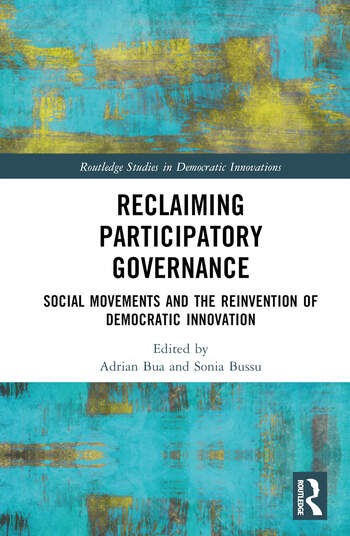
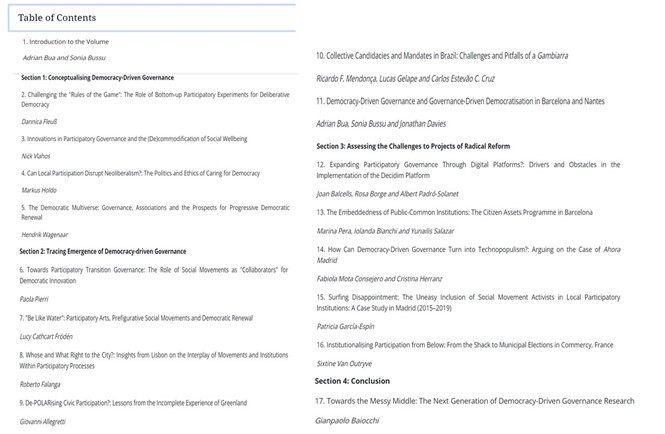
Reclaiming Participatory Governance, a volume I co-edited with Adrian Bua for Routledge’s Democratic Innovations series, provides an analysis of how social and grassroots movements are reclaiming and reinventing democratic innovations to strengthen the impact of citizen participation for social change. The book is articulated into three main sections to provide 1) theoretical and 2) empirical analyses of these processes, and to reflect on 3) challenges to the implementation of radical projects of social transformation. Through 17 chapters covering a range of cases, the volume captures the growing synergy between social movements’ mobilisations, the commons and participatory deliberative democracy, exploring how grassroots democratic action is mobilising to foster alternative forms of participatory politics and economics.
Throughout the book we apply democracy-driven governance as an analytical framework. We initially developed this concept to describe how social movements and grassroots groups who mobilised across Spain against austerity politics in the early 2010s used the deliberative and participatory toolbox, first to build movement parties’ platforms and later, after winning elections in many major cities, to transform local state institutions. Democracy-driven governance captures these social-movements-led forms of democratic innovations that aim to widen the scope of participatory governance from political institutions to the economy and wider society.
It is a counterpoint to Mark Warren’s governance-driven democratisation which refers to democratic innovations mostly initiated by public agencies, particularly at the local level. Governance-driven democratisation responds to specific policy issues and what Warren calls “pluralised ungovernability” (2014, 49). This refers to situations of high complexity that administrators are caught in as they navigate, on the one hand, dispersion of governing capacity, and on the other hand, high interdependence. The potential of Warren’s governance-driven democratisation resides in its pragmatic, problem-solving orientation, addressing problems of political leadership and public administration. However, by decoupling politics and economics and failing to attend to socio-economic factors, the practice of governance-driven democratisation has been quite tokenistic, falling short of making substantive positive change to the lives of citizens, in a context of widening inequalities.
Both governance-driven democratisation and democracy-driven governance exist in a dynamic relationship, which shouldn’t be understood as a mere bottom-up v. top-down heuristic. They both attempt to foster participatory governance or to include citizens in the work of public administration through “routinised participation”. They also interact with other participatory spaces, such as oppositional politics (protests) and the commons, where citizens create their everyday democracy by managing public goods through their own democratic decision-making rules and with limited interactions with state institutions.
The contributions to the volume look at how democracy-driven governance emerges across different socio-political and geographical contexts, and how it develops and navigates (or fails to) the constraints of day-to-day politics and public administration. Firstly, we wanted to test the analytical power of democracy-driven governance. By applying these concepts to a range of diverse cases, the chapters help flesh out the empirical characteristics of different forms of participatory governance. Secondly, we were interested in assessing how democracy-driven governance’s aspirations to social justice fare when applied to the real world. Can it strengthen the politics of the commons by making it visible and linking it to state institutions, as in the case of civic management and community-wealth building in Barcelona, or collective electoral mandates in Brazil? Can it facilitate processes of decommodification to help re-embed the economy in democracy and the wider society? Are these new approaches to politics and policymaking sustainable in the face of existing legal, business and public administration constraints?
The contributions trace practical challenges, from participation fatigue and activists’ disappointment with the slow pace of administrative work, to bureaucrats’ resistance or the challenges of reconciling democratic innovations, where citizens can participate as individuals, with assembly democracy, which strengthens organised civil society. One important aspect of democracy-driven governance concerns the digital commons, and the digital sphere will increasingly be the new battleground against the expansion of algorithmic capitalism.
The book provides many insights on the contested space to advance democracy, showing how social movements and citizen participation continue to play a crucial role in furthering the cause of critical theory: to challenge incumbency and demonstrate the possibility of other worlds.
The book launch is on 7th June 2023, at the University of Birmingham and on Zoom – register here.
Sonia Bussu is associate professor of Public Policy at INLOGOV. Her main research interests are participatory governance and participatory action research. Over the years, she has led research and published on participatory and deliberative processes, community engagement, coproduction of public services, and participatory research ethics.



 INLOGOV Blog